
September 28, 2024
The House of Commons is back in full swing and media policy issues are coming thick and fast.
For at least the next few months, it might be a good idea to rename this blog MediaPolitics.ca.
I say that because the politicization of media policy issues —- the linking of minor events to allegations of catastrophic policy failure — is spinning around the turntable at 78 rpm.
***
I just attended a conference organized by Taylor Owen of the Max Bell School of Public Policy focussing on policy issues embedded into the Liberal government’s Bill C-63, the Online Harms Act.
The Bill earned publicity when it was tabled in the House last February by folding in tougher criminal sanctions against hate communications and reinstating the right of individuals to file human rights complaints as a consequence of online hate.
But the core of the bill is legislating a generic “duty to act responsibly” for social media platforms such as Instagram, Snapchat, and TikTok.
Platforms will be required to reduce online harms through safety plans that re-engineer data-driven algorithms responsible for driving harmful content and Internet predators to unsuspecting users. User tools and settings are other ways for platforms to make their services safer. Take-down orders are limited to revenge porn and sexual exploitation of children.
Justice Minister Arif Virani is the bill’s sponsor in the House but, he informed the crowd, he has no intention of giving ground to suggestions that he split off the hate crime provisions of the Bill to enable the safety plan core of the legislation to pass the House with less resistance from Pierre Poilievre’s Conservatives.
Online hate, said Virani, is what silences Canadians belonging to vulnerable, maligned communities and discourages their participation in online speech.
Online racist hate, he continued, radicalized the murderers who targeted those same Canadians. The rest of us of should find more empathy for those Canadians, he suggested, choosing his words more diplomatically than I have paraphrased.
Those who advocate for splitting the hate provisions off into another Bill (I’m one such advocate) see only another Conservative filibuster in House committee proceedings, previously the fate of the Netflix Bill C-11 (twice in the House and arguably a third time in the Senate).
On the other hand, Virani may be looking the Leger and Nanos opinion polls that demonstrated a high level of support for getting tough on hate crimes and haters. If the Conservatives try to block the government bill, they are going to wear it at election time.
The Conservatives may have figured out that their habitual opposition to regulating the Internet won’t cut it when it comes to online harassment, bullying, and sexual exploitation of minors.
That’s why they just tabled a private member’s bill, C-412, An Act to enact the Protection of Minors in the Digital Age.
Here’s the Leader of the Opposition’s branding:
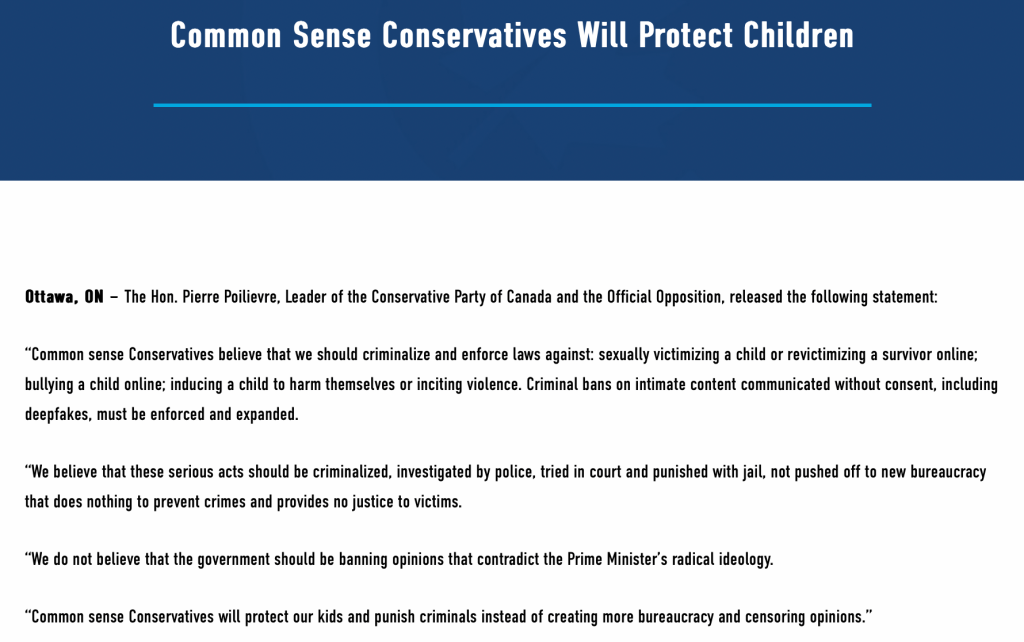
Beyond the bombast, the CPC bill is a serious piece of legislation, but of a different (and smaller) footprint than the government’s C-63.
The Conservative bill requires social media and gaming platforms to design their tools, settings and recommendations of content and contacts to protect children, and only children, from harm.
Unlike the government bill, there are no safety plans in the CPC bill for adults, not even for revenge porn or hate (although both are currently subject to criminal sanctions: the Conservative Bill would increase prisons sentences for revenge porn).
Leaving little work for a future regulator, the CPC bill gives explicit instructions to Internet platforms on what they must or must not do to protect children through safety settings that children and their parents can control or disable:
5 (1) Every operator must provide any parent of a user whom the operator knows or should reasonably know is a child, as well as that user, with clear and readily accessible safety settings on its platform, including settings to
(a) control the ability of other individuals to communicate with the child;
(b) prevent other individuals from consulting personal data of the child that is collected by, used or disclosed on the platform, in particular by restricting public access to personal data;
(c) reduce features that increase, encourage or extend the use of the platform by the child, including automatic displaying of content, rewards for time spent on the platform, notifications and other features that could result in addictive use of the platform by the child;
(d) control personalized recommendation systems, including the right to
(i) opt out of such systems, while still allowing content to be displayed in chronological order, with the latest published content displayed first, or
(ii) limit types or categories of recommendations from such systems; and
(e) restrict the sharing of the child’s geolocation and notify the child and their parent when their geolocation is being tracked.
Default settings
(2) The operator must ensure that the default setting for the safeguards described in subsection (1) is the option that provides the highest level of protection.
It’s shrewd retail politics and allows the Conservatives to say “limiting screen time,” “protect children,” and “parents’ rights” all in the same sound bite.
What seems to have slipped under the radar is that their bill authorizes interference with algorithmic recommendations, previously the centrepiece of the Conservatives’ opposition to the Online Streaming Act.
What’s next for these bills is subject to the whirlpool of Parliamentary politics. It’s not clear when (or if) the Conservative bill might be cleared for mandatory debate by MPs sitting in the House Justice Committee. The same committee has yet to schedule the government’s bill.
***
The battle over the Netflix Bill C-11 continues to flare. With an election in the air, the foreign streamers are engaged.
This week Netflix announced it was pulling training and development funding — vaguely described as $25 million spent over the last few years— from Canadian creator projects such as the Pacific Screenwriting Project and the imagineNATIVE film festival. Netflix gave the Globe and Mail a statement blaming its cancellations on the CRTC’s cash levy on foreign streamers to support financing subsidies to Canadian news and entertainment programming.
Netflix is already appealing the CRTC’s $52 million annual cash levy to the Federal Court (my estimate based on 3.5% of $1.5 billion in annual Canadian revenue).
Netflix had previously told the CRTC it would support a 2% charge, but strenuously objected to any of its cash going to the Independent Local News Fund.
Netflix had also pitched to the CRTC that its training and development deals with various Canadian creative organizations ought to be deducted from the cash levy (training funds are also not deductible from the 5% levy paid by Canadian cable companies).
The CRTC has enveloped Netflix’s 3.5% levy like this:
- 0.5 % ($7.5M) to the Canada Media Fund for CanCon television series
- 0.5% to the Indigenous Screen Office to support television productions
- 0.5% shared by the Black Screen Office, the screen fund for BPOC creators and the Broadcasting Accessibility Fund
- 0.5% shared by funds supporting producers in official language minority communities in Québec and English Canada, as well as diverse communities; and
- 1.5% ($22.5M) to support newscasts at independent local stations.
[The list above has been revised and corrected from the original blog post]
Netflix’s grievance is that it ought to be given special regulatory treatment to deduct training and development funding of Canadian recipients of its choosing. (There is no public information available on whether there are strings attached to their funding).
The door is not closed on Netflix making its argument to the CRTC, however. When the Commission completes its regulatory assessment on Netflix and the other video streamers by setting expectations of direct spending on Canadian shows for their services, the streamers can make the same pitch to deduct training and development commitments.
In the same fighting spirit, the US-based music streaming lobby group Digital Media Association is launching a Canadian online petition campaign (see photo above), accompanied by messaging on its services guiding Canadians to the petition. The “Scrap the Streaming Tax” site threatens consumer price increases expressed in a vocabulary similar to the Conservative Party’s “scrap the Carbon Tax.”
Google did a similar campaign two years ago to mobilize opposition to Bill C-11. Canadian cable companies also launched a “Stop the TV tax” campaign in 2009.
***
Here are two new information releases that you can nerd out on.
The CRTC released its “what we heard” report that summarizes public comments on whether and how to revise Canadian content rules for video entertainment. This is a first step towards a public proceeding on possible revisions to CRTC rules that accredit video programming for regulatory compliance.
The Commission also posted for comment an application from APEM, the French-language song publishers’ organization, asking the CRTC “to collect data from the main online music streaming services and to make them public in order to provide the entire sector with a status report on the listening, showcase and recommendation of musical selections in Canada.”
***
If you would like regular notifications of future posts from MediaPolicy.ca you can follow this site by signing up under the Follow button in the bottom right corner of the home page;
or e-mail howard.law@bell.net to be added to the weekly update;
or follow @howardalaw on X or Howard Law on LinkedIn.

 MediaPolicy.ca
Dear Howard,
I think you were too optimistic in your breakdown of Netflix’s funding of .5% to OLMC production. CRTC 2024-121-1 clarifies that
Commission’s decision 38. In regard to the allocation split between OLMC producers and producers from diverse communities, paragraph 138 of the Policy specifies that 50% of the new CIPF funding envelope would be allocated to OLMC producers while paragraph 140 specifies that “a minimum of” 50% would be allocated to those producers. The Commission’s intent was for the new envelope to be allocated equally between each group of producers, to ensure a balanced approach to funding allocations and to recognize the strong support throughout the proceeding for more OLMC funding, as well as the need to support producers from diverse communities.
The OLMC .25% is divided between EN and FR OLMCs and .25% goes to diverse production which apparently excludes OLMCs. You mentioned diverse in your list as .5%, but that is the Black Screen Office fund, so not diverse.
I think the OLMCs and CMF were the big losers in that decision. I think Netflix and other US streamers were the big winners because they can keep a lot of this 3.5% for their own “Canadian content” production. Exactly what constitutes Canadian content will be decided in a future hearing. More American lobbying can be expected to turn Cancon into service.
Best, Kirwan
>
LikeLike
Thanks, Kirwan, i need to go back and correct that.
LikeLike