Catching up on MediaPolicy – CBC’s missing $200M – The Six Billion Dollar news subsidy – The Hub says Yes to news subsidies – the nihilism of activist journalism – are paid news subscriptions enough for civic dialogue?

“Six billion dollars”

May 10, 2026

There’s no other way to say it. It was a goofy week for Canadian media policy.

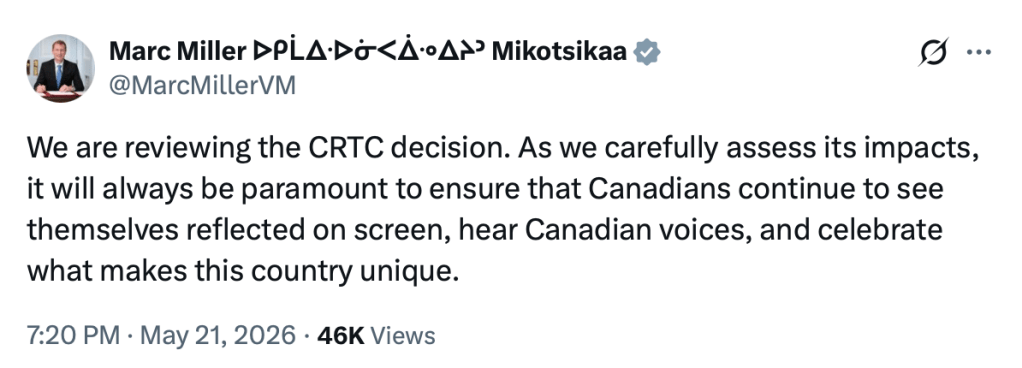
On Tuesday, cabinet minister Marc Miller popped up at the Commons Heritage Committee. MPs wanted to hear from him before voting on the government’s main budget estimates for 2026-2027.

At last someone put him on the spot about the Liberals cutting nearly $200 million from the CBC just a few months after delivering on Prime Minister Carney’s signature election promise of adding $150 million to the $1.4 billion parliamentary grant. 

In response to Conservative MP Bernard Généroux’s sardonic admiration of the government’s sleight of hand, Miller replied (in this Google translation):

With all due respect, Mr. Généreux, I think one needs to better understand how budget estimates are made. We see an immediate picture of CBC/Radio-Canada’s funding profile, but that doesn’t factor into the subsequent bailout estimates. It’s a flawed equation to say we’re giving 150 to take away 200. This is part of the budget cycle.

Silly Opposition MPs. Don’t they know about the double-tap of Supplementary budget estimates that often follow the Main Estimates? 

By the way, the French word Miller used was “renflouement,” translated as “bailout” or “refloating.” Or perhaps it means “later, when we can make a favourably timed announcement of more money for the CBC in a Supplementary Estimate .” 

The committee’s attention then turned to the government’s recent announcement in the Spring Economic Update that it will hold public consultations on extending the federal QCJO journalism labour tax credit to broadcasting companies. Making the government’s intentions known, the minister said, “it’s how, not if.”

One salacious policy hint he dropped: the government expects a discussion of a subsidy ceiling on the largest broadcasters in favour of smaller ones. 

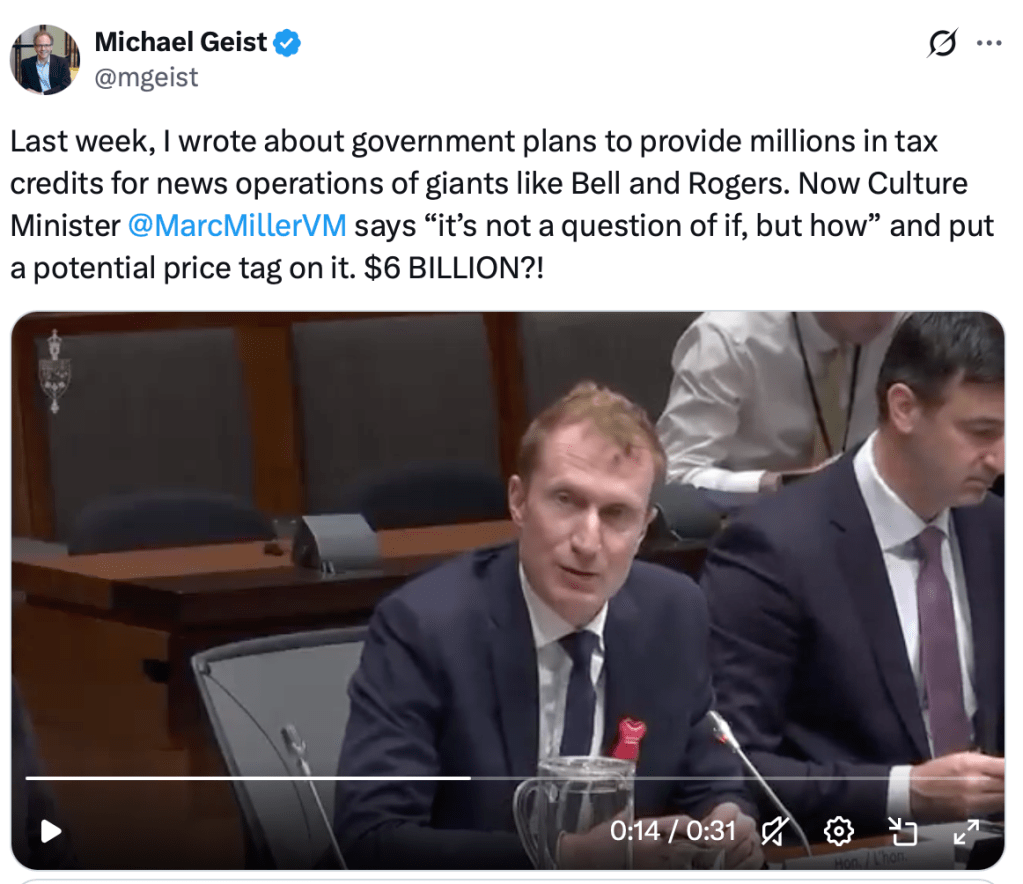
Then Miller said an odd thing (twice, so not by accident): the additional cost of the expanded program would be $6 billion dollarsThat’s 100 times the cost of the existing QCJO program for print media.

By the time his interlocutor, Bloc MP Martin Champoux, followed up on that eye-popping number, Miller had left the committee room.

As you might expect, the Twittersphere went off like a Roman candle. Six. Billion. Dollars. Try to imagine Mike Myers’ Dr. Evil delivering that line.

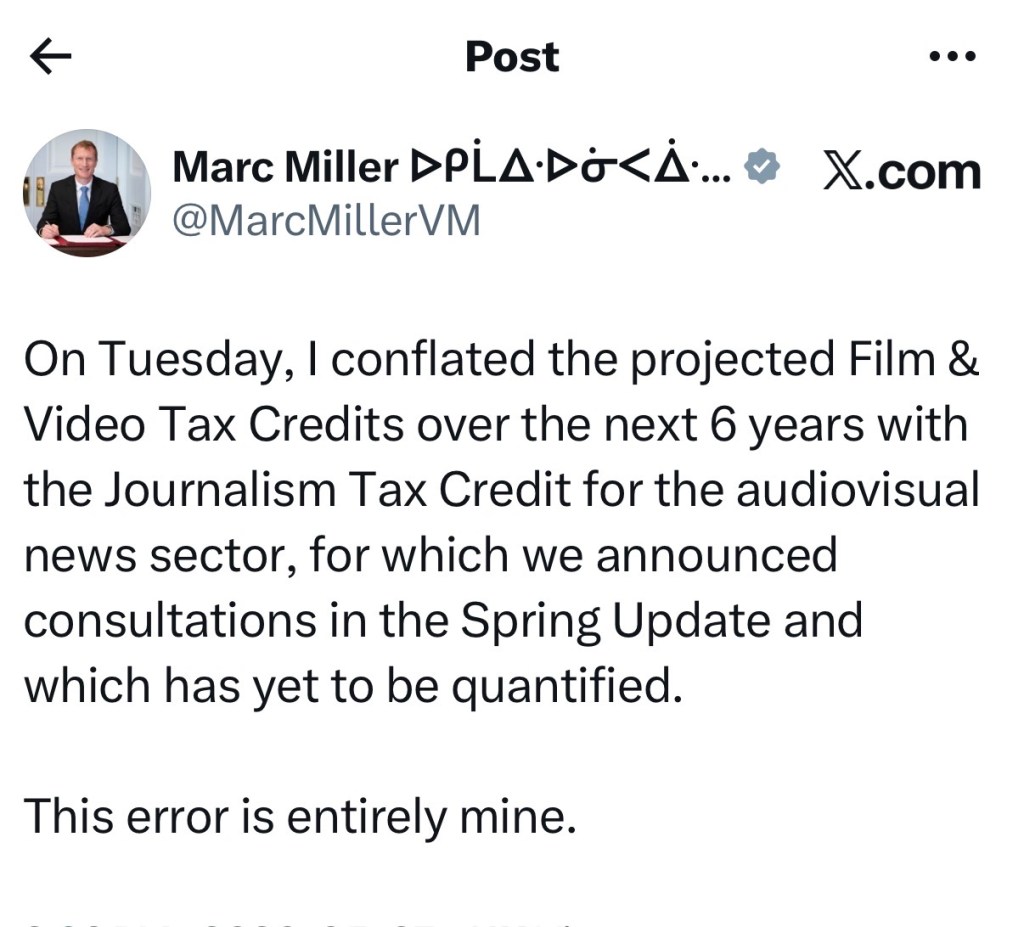
Two days later, Miller ‘fessed up in an X post saying he misspoke. He had mixed up the $75M per year journalism labour tax credit for print media with the $1 billion per year budget for federal film and television productions tax credits (over the next six years, ergo the $6 billion figure). 

Okay. Happens all the time.

So what might be the cost of a program for supporting broadcast news? Grabbing the nearest napkin and pen, I came up with a number somewhere between $82 million and $115 million. Let me show you my math:

To begin, the program cost of the federal labour tax credit is driven by journalist headcount based on 35% of journalist wages on the first $85,000 of salary. 

Going to the best available source for headcounts, the news producer head count for the Google funds distributed under the Online News Act by the Canadian Journalism Collective, expressed as full-time equivalents working a 40-hour week, is 3,549 for broadcasting companies and 4,179 for publishers. Bottom line: the broadcasting headcount is 85% of print journalists, a figure I need for this arithmetic.

As for a hypothetical broadcasting program cost fixed as an 85% percentage of the known costs of federal print media subsidies, you need to first establish the combined cost of labour tax credit for print journalists at daily newspapers ($75M), Aid to Publishers for community weeklies and magazines ($71M), another program for free distribution weeklies ($13M) and the Local Journalism Initiative (LJI) for 700 additional reporters in local media ($20M, although not all in print media). It adds up to $179M for print media journalists. 

But there’s a caveat to that $179M figure: the payout in the Aid to Publishers and LJI subsidies are much higher than the 35% wage subsidy in the labour tax credit, although how much higher is difficult to pin down. 

Rough guess of a final print media subsidy? Calculating the total print journalism program costs at an across-the-board 35% wage subsidy spits out a final number of $135M for print media journalists. 

Next step: the broadcasting headcount is 85% of that $135M, leading to an estimated  program cost of $115M for TV and radio news outlets. 

But there’s one final adjustment to the numbers: the existing labour tax credit  is scheduled to fall back from 35% to its original 25% next year, a 29% reduction. If that goes through, the $115 million for broadcasting support drops to as low as $82M. And if a ceiling is put on subsidies to large broadcasters, even further. 

So, not $6 billion, no. 

***

The next goofy thing is ironic, not funny.

I subscribe to The Hub, a commentary and news reporting website that is cerebral in its writing and conservative in its point of view. I listen religiously to its biweekly Full Press podcast.

On Thursday, publisher Rudyard Griffiths informed subscribers that he was abandoning The Hub’s years long refusal to accept QCJO labour tax credits or distributions of Google money under the Online News Act. I estimate the value of the two income streams to his publication at $60,000 annually. Griffiths cited softening advertising revenues and promised to park the cash in a reserve fund.

As he put it, “We are using that latitude to park any payroll subsidies in a segregated “rainy day” fund—available if we ever truly need it, but walled off from day-to-day operations so our journalism doesn’t become dependent on government money. If we ever draw on these subsidy dollars, we will tell you.”

There’s no need for “I told you so’s” here, although Griffiths has been vocal for years in his opposition to journalism wage subsidies, as well as passing judgement on those news organizations that accept them (“the soft, silent takeover of the nation’s press.”)

The Hub’s walk-back dittos the Western Standard which did it in September 2025, also stating it was doing so reluctantly. 

As far as I know, this leaves just two news organizations who could qualify for the labour tax credits (which require ongoing publication of original news content) but make a point of refusing subsidies. 

One is the hyper partisan Juno News. The other is the watchdog news outlet Blacklock’s Reporter which specializes in access-to-documents news reporting on the federal government and, it’s fair to say, offers no quarter to government and expects none. 

***

Moving on, I was distressed reading journalist Shauna Rae’s winning essay for the Dalton Camp Award, juried by Friends of Canadian Media. I’m a long time member of Friends and a volunteer on its policy committee, but I don’t have any connection to the annual writing award that honours Camp, the veteran political strategist who died in 2002. 

You can read Rae’s short piece and evaluate the message in her own words. To summarize, she is of the view that journalists should feel free to report the news as their truth, rather than the truth.

This is hardly a newly minted journalist creed even though I believe it is very much in the minority. 

It’s a call for “openly activist and participatory” (Rae’s words) journalism in the fight against privilege and power, in a binary world of oppressor and oppressed. It feeds directly into identity politics of racial and gender inequality and the dispossession and gross mistreatment of Indigenous peoples; identity politics in the sense that individuals are ascribed membership status as either oppressor or oppressed. Taken to the global stage, it underpins an anti-Israel news narrative. 

Rae’s justification for activist journalists throwing off the shackles of objectivity is that no such thing as objectivity exists. 

Objectivity may be the world’s biggest straw man. Outside of university seminars dwelling upon political theory I don’t think I’ve ever met anyone, let alone a journalist, who posits the existence of objective truth. The overwhelming majority of journalists (that I’ve ever met) adhere to the journalist creed of “pursuing the truth” while practicing professional norms of fairness and accuracy in fact gathering.

But, fill your boots with openly activist and participatory journalism if you wish. It’s a free and independent press that allows Rae and any other journalists to wear the activist mantle if they choose. Their work will be judged on its merits.

What disturbs me so deeply—and I know this will sound harsh— is the intellectual nihilism behind the activist creed. It’s the idea that in the absence of indisputable objectivity that anything goes. It’s the idea that you can defend any news reporting narrative as fair and deserving of credibility no matter how closely it operationalizes the writer’s agenda for making change in the world. 

Mostly it disappoints me because that’s not how change happens. And do we ever need change.

***

At the risk of making this weekly update too long, there is another item that I didn’t want to go stale.

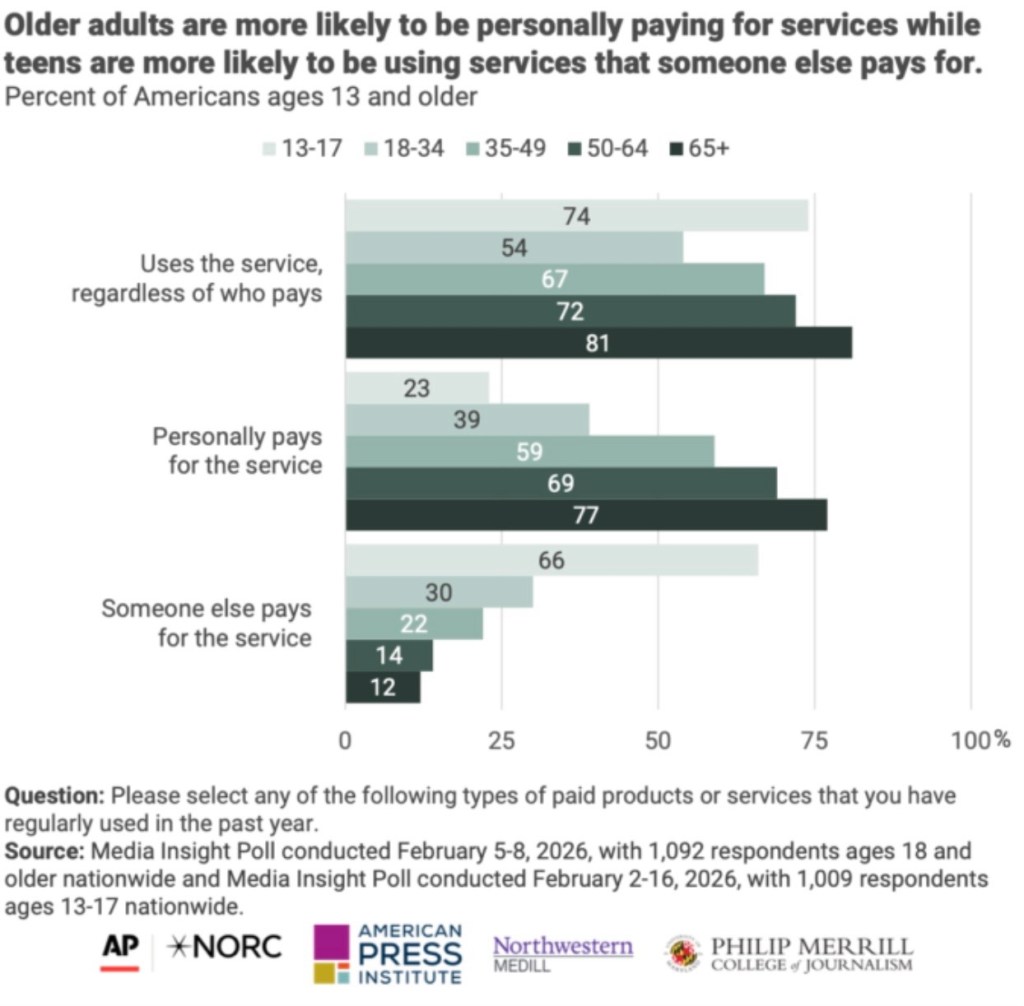
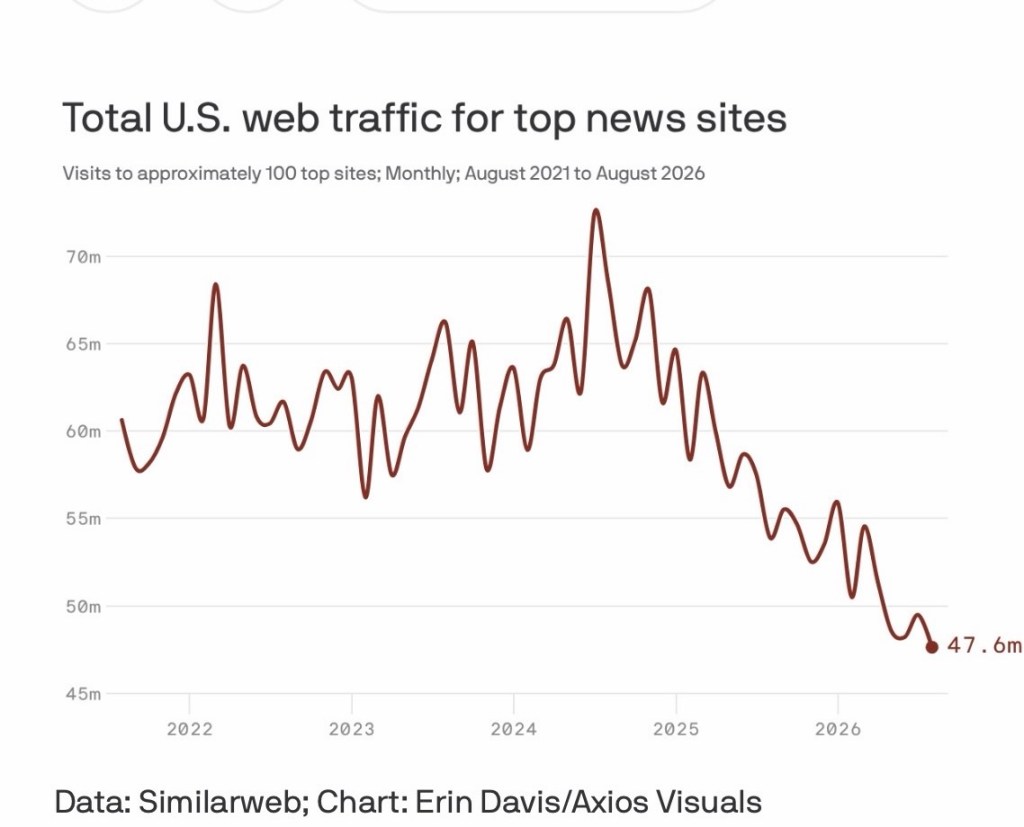
It’s a survey conducted by the Media Insights Project on where Americans get their news and whether they pay for it. That has implications for how much emphasis we Canadians might put on public policy subsidizing paid news subscriptions as a reliable delivery vehicle for reporting on current events to a broad based democratic polity. It’s an issue that Senator Andrew Cardozo and I raised in our recent report, “Making News Media Sustainable.”

A key conclusion in the survey was “the majority of Americans — 7 in 10 — access a paid media service of some kind, even if they don’t pay for it themselves.”

We already knew that Americans pay for digital news subscriptions at a slightly higher rate than Canadians, which tends to fluctuate between 15% and 20%.

The public policy consequence is that such a low uptake on paid news subscriptions makes it hard to rely on the subscription business model as a comprehensive way of delivering news when so many Canadians are stuck on getting free news (there is data suggesting lower prices of digital news subscriptions don’t tempt people much).

The low uptake on digital news is mitigated by the fact that half of Canadians live in a household with access to a cable TV package that includes news channels (alas, news is a serious money loser for television networks).

The Media Insights survey’s conclusion that “7 in 10” Americans have access to “a paid media service” even if they don’t pay for it suggests that young people are watching cable TV or else making liberal use of a streaming password shared by someone else who paid for it. Thanks Mom and Dad.

The asterisk to that “7 in 10” statistic, and the limitation of the survey question’s relevance to news policy, is that it was about paid media services, not paid news media services. There’s this thing called Netflix, you know.

Still, it’s an encouraging set of public policy data on news consumption. Which reminds me to refer you again to the Cardozo-Law study where we recommend the federal government experiment with a generous news voucher program for news subscriptions.

***

If you would like regular notifications of future posts from MediaPolicy.ca you can follow this site by signing up under the Follow button in the bottom right corner of the home page; 

or sign up for a free subscription to MediaPolicy.ca on Substack;

or follow 
@howardalaw on X or Howard Law on LinkedIn.

COMMENTS ARE WELCOME. But be advised they are public once I hit the “approve” button, so mark them private if you don’t want them approved. 

I can be reached by e-mail at howard.law@bell.net.

This blog post is copyrighted by Howard Law, all rights reserved. 2026.
Catching up on MediaPolicy – journalism subsidies for news broadcasters ? – Australia lowers price on Big Tech news levy – Age verification bill tabled in House of Commons

AI Image

May 2, 2026

On Wednesday I posted about the new report written by Senator Andrew Cardozo and myself on the future of subsidies for news journalism

One of the not so surprising options we propose is to extend the federal QCJO  journalism labour tax credits to news websites operated by broadcasting companies. The Québec provincial government did it in March with their labour tax credit that parallels the federal QCJO.

Entirely by an accident of timing (promise!), on Tuesday the Carney government announced a public consultation proposing to extend QCJO labour tax credits to “audio and audio visual news production,” which is not quite the same thing as digital news websites operated by broadcasting companies, but close enough. 

Law professor Michael Geist was out of the gate fast opposing public journalism subsidies being paid to major broadcasters, in particular the three owned by telco pantomime villains Bell, Rogers and Québecor. It’s fair to say, Geist won’t be alone on this. 

I have a long winded rebuttal which I will save for later. 

***

AI Image

The Australian government has taken the next step in responding to Meta’s refusal in March 2024 to reboot news licensing agreements under the News Media Bargaining Code (NMBC). The 2021 NMBC legislation was the prototype for Canada’s Online News Act.

To counter Meta’s exit from news licensing agreements, the Australian government announced in December 2024 that it would replace the NMBC with a News Bargaining Incentive (NBI). The key provision in the proposed NBI is a default cash levy on Meta, even if it tries to elude payments by banning local news. The NBI news levy would be reduced by any licensing deals struck between tech platforms and news outlets. It also would extend the levy net to catch TikTok, in addition to Meta and Google.

The calendar months have flipped by and it was not until this week that the Australian government at last announced the next step for the NBI, a public consultation.

The most newsworthy item in the announcement was the proposed price point for the cash levy: 2.25% of a company’s Australian revenues.

At first glance, that number suggests a climb down from an old levy rate of 4% of revenues that in 2021 generated $190 million in annual licensing payments by Google and Meta. The de facto 4% figure was identified by reverse calculation back in September 2023 by Canadian officials commenting on the monetary value of the 2021 Australian deals with Google and Meta.

Canadian officials said at the time that applying the Australian 4% target under our Online News Act would mean Canadian outcomes of $172 million from Google and $62 million from Meta. When Ottawa finally settled in December 2023 with Google for $100 million instead of $172 million, that converted the Canadian 4% into 2.32%.

Which is awfully close to the 2.25% proposed now by the Australian government.

But the lower Australian levy rate is still intended to produce the same $190 million contribution outcomes from 2021 because the legislation adds TikTok revenues and reflects the growth of Google and Meta revenues in the last five years.

Back in Canada, it’s unclear what Ottawa is going to do about the Meta ban on mainstream news (going forward I am calling it “Meta’s mainstream media ban” as it’s now clear that Meta permits certain Canadian news outlets to post on Facebook and Instagram provided these outlets sign off that they are not, or would not be eligible for federal QCJO labour tax credits or a share of the $100 million in Google money under the Online News Act. Effectively, this means the Meta news ban on Facebook and Instagram targets mainstream Canadian news organizations who produce original news).

This selective news ban gives the peripheral news organizations —whether they behave as honest news outlets or political activists — a leg up on mainstream media in the quest for audience. 

The policy boomerang that smacks mainstream media in the mug, whether you blame Meta or the legislators of the Online News Act for the ban, results in the loss of audience exposure and click-through referrals to news websites.

But there are self-help strategies.

On this, Torstar President Angus Frame appeared before the parliamentary Heritage committee on April 23rd and offered some interesting information. 

In the course of testimony about Big Tech in Canada, Frame said that since Meta imposed the news ban in August 2023 the Torstar chain of dailies and community weeklies has neutralized the loss of referral traffic.

I asked how and his answer, about leaning into web traffic generated by Google Discover and e-mail distribution strategies, is succinct enough to quote in its entirety:

There are always a bunch of variables in the mix, but the simple story looks like this:

In July 2023 (the month before Meta pulled out of news in Canada) our community sites generated 1.6M page views from Facebook referrals. This was typical for the first half of 2023 though the number had been declining since about 2018.

In July 2023 we generated 550K page views from newsletter click-throughs (people visiting from our own newsletters). We had 5.2M page views from Google.

Last month we had 1.55M page views from our newsletters, which almost completely replaces the views lost to Facebook. Google referrals were at 5.1M.

So the way that all came together is this:

-With the Meta ban, we shifted focus to optimizing for Google and in particular Google Discover. This gave us a good recovery heading into 2024 but it has since declined a bit with some reductions in Google traffic.

-Once Google was in better shape, we started to emphasize newsletter growth and newsletter effectiveness. This involved a number of tactics to get more people to sign up for our newsletters, to make sure our newsletters were landing in people’s inboxes properly and to optimize the newsletters (both design and story selection) for the best possible click-through rate. And that gets us to where we are today with newsletter traffic almost completely replacing the lost Facebook traffic. 

And the newsletter traffic is better for us — we have a direct relationship with that audience, they come back to us more frequently and we can continue to grow that audience channel without worrying about algorithm changes or other things that can disrupt the strategy.

***

The Senate Bill S-209 that would introduce age verification to block underage access to porn sites and porn on social media apps has now made its way into the House of Commons.

The Opposition Conservatives always supported S-209 and Saskatchewan MP Rosemarie Falk tabled it in the House for first reading on Thursday.

Now that the Liberals have a majority in the House, don’t expect the bill to get far, even if they find themselves on the wrong side of public opinion on this one.

The door isn’t completely shut. Heritage minister Marc Miller was quoted in the Globe and Mail as saying S-209 “has merit,” the opposite of what the Trudeau PMO used to say.

But Miller appeared to pour cold water on the bill anyway, simultaneously saying that age verification would not be in a Liberal online harms bill while referring the issue, along with the idea of a blanket age ban on social media, to his expert advisory committee.

As part of the debate over child safety and social media, expect the troubling privacy and compliance issues to keep bubbling up to the surface.

There are anecdotal reports of Australian teenagers circumventing the new social media ban in that country.

As well, the technical issues of privacy breaches keep arising, as they just did in Europe. The hacking of adult viewers’ age verification data is a problem that gets bigger depending on where the digital gatekeeping of age verification happens, from the narrow access to online porn sites to universally accessed social media or device operating system sign-ins.

***

Here’s a few things to read that follow up on issues followed in MediaPolicy:

The Paramount sneeze and the Canadian cold: The possibility that a soon-to-be- sanctioned merger between Paramount and Warner Brothers Discovery will sideswipe Bell Media, by cancelling HBO’s exclusive Canadian distribution through Crave, is further off in the future than previously thought. The Globe & Mail‘s Barry Hertz got Bell to talk.

Canadian book publishing: Hugh Stephens has reviewed Richard Stursberg’s Lament for a Literature. Stephens offers his skepticism of Stursberg’s “draconian” proposal for state intervention into the Canadian book publishing market. Knowing Stursberg, he wouldn’t flinch at “draconian” but would argue that drastic measures are required after 40 years of federal neglect.

CanCon: Cartt.ca is publishing Brad Danks’ seven-part series on the future of Canadian content in a small domestic market and a global streaming audience. So far there are two instalments and if you find the first one a little abstract, the second (“why Canadian media keeps missing the upside”) makes his arguments with brevity and persuasion. I won’t give away more than that. 

Journalism standards: Are you a Canadian journalist? Colette Brin of Laval University is shaking your tree to get involved a survey supporting a study on whether there are consensus standards for news coverage that we should be articulating for the industry. If you don’t help, consider your dissenting privileges revoked!

***

Lastly, a magnetic documentary to watch.

CBC is streaming Canadian filmmaker Ric Esther Bienstock’s two-part “Speechless,” profiling the pitched ideological battles staged on American university campuses and inside faculty lounges.

The film got a meh from Globe reviewer Kelly Nestruck, but I found it both riveting and kind of terrifying (after having tuned it all out for years for just that reason).

***

If you would like regular notifications of future posts from MediaPolicy.ca you can follow this site by signing up under the Follow button in the bottom right corner of the home page; 

or sign up for a free subscription to MediaPolicy.ca on Substack;

or follow @howardalaw on X or Howard Law on LinkedIn.

COMMENTS ARE WELCOME. But be advised they are public once I hit the “approve” button, so mark them private if you don’t want them approved. 

I can be reached by e-mail at howard.law@bell.net.

This blog post is copyrighted by Howard Law, all rights reserved. 2026.
A sustainable Canadian news media: what is to be done? A new report.

April 29, 2026

Today, Senator Andrew Cardozo released his new report “Making News Media Sustainable,” co-authored with yours truly, on future policy options for supporting Canadian news journalism. It’s about subsidies. 

Our project is to put forward new ideas. For discussion. The working assumption is that public support of private journalism is here to stay in one form or another, so what can we offer in terms of continuous improvement? The Senator already put forward his ideas about public support for the CBC in a 2024 report here, so this new report focusses on public support to privately owned news journalism.

Some of our ideas will roil the waters. Just to choose one, we suggest that federal news subsidies should be reduced or eliminated to heavily indebted news organizations (i.e. Postmedia) that are using public money, in whole or in part, to pay off their controlling owners and creditors.

There are other ideas that you might call technocratic, invoking the subtle art of policy design, such as offering news organizations an opportunity to go paywalled, or to stay paywalled, and forego journalist salary subsidies in favour or more enticing subscription tax credits offered to citizens. To work properly, the federal government would have to launch a seriously generous news voucher program for citizens, whether or not they pay taxes. 

Another idea, that we lean on pretty hard, is that the federal government end its arbitrary exclusion of broadcasting companies from accessing subsidies for their news websites that are indistinguishable from the digital operations of print publishers. By coincidence, yesterday the Carney government announced in its Economic Update that the Finance Department will launch a public consultation “to seek the views of Canadians and stakeholders on extending the Canadian Journalism Labour Tax Credit to audio and audiovisual news production.”

We give a lot of attention in the report to the under appreciated history of innovation success in Canadian news journalism, both with respect to digital technology and content strategies. There have been many successes to admire or replicate, both from start-ups and legacy news organizations. One policy idea that emerges from that experience is public funding of innovation-related expenses, such as IT staff salaries. 

We also applaud the gaining traction of non-profit news journalism. It is no silver-bullet to cure all that ails the beleaguered industry. But it clearly can be tapped for greater potential.

One of the challenges to change-management in our sprawling news industry is that we lack a cohesive public policy for supporting news journalism. Policy initiatives have been ad hoc, reactive, and initiated under overlapping jurisdictions of federal government, provincial governments, and the federal regulator, the CRTC. Unsurprisingly, there is no central institute equipped to collect and analyze a broad and deep well of industry data that might guide the best decisions for supporting journalism.

And our closing advice in the 100-page report: the policy solutions for news journalism may not be one-size fits all. We have an array of Canadian news markets where consumers seek or passively consume the news of the day: national, regional, local, by language, by content silo, by platform preference, etc. 

The biggest conundrum, the one that reveals our deepest policy conviction in writing the report, is the enormous gap between the number of Canadians who will pay for news (about 20%) and those who won’t. That 20% number is stubborn: even hypothetically lower paywall prices don’t seem to budge it very far. 

All Canadians vote (well, 68% of those eligible in the last federal election), whether they consume news or not. As the loss of advertising revenue to Big Tech platforms has destabilized news organizations that distribute trustworthy news for free and without a subscription, the threat of a news consumption deficit becoming a democratic deficit is something that only the naive would avoid looking straight in the eye.

Finally, we have a lot to say about the connection between public trust and public subsidies to news journalism.

We don’t subscribe to the idea that a penny of subsidies means a pound of distrust: the healthy and unhealthy skepticism expressed around the world about news media is powerfully influenced by many things other than subsidies and, for example, is far more profound in the United States where there is precious little subsidy of news journalism. Regardless, care must be taken regardless by making greater efforts to make the gatekeeping of Canadian news subsidies arm’s length from the government. 

The report begins with a brief executive summary. It’s followed by a landscape review of subsidy programs, a comparison to policy initiatives in non-Canadian jurisdictions, and then an extended series of policy issues inviting you to engage in the debate over what is to be done.

***

If you would like regular notifications of future posts from MediaPolicy.ca you can follow this site by signing up under the Follow button in the bottom right corner of the home page; 

or sign up for a free subscription to MediaPolicy.ca on Substack;

or follow @howardalaw on X or Howard Law on LinkedIn.

COMMENTS ARE WELCOME. But be advised they are public once I hit the “approve” button, so mark them private if you don’t want them approved. 

I can be reached by e-mail at howard.law@bell.net.

This blog post is copyrighted by Howard Law, all rights reserved. 2026.

Catching Up on MediaPolicy – Streamers spending less in Canada – CPAC gets a raise – Independent TV stations want interim funding – Bloc MP rips Rebel News

Slide from Profile 2025

April 21, 2026

This week the Canadian Media Producers Association released its annual Profile snapshot of how much money is being spent in Canadian video production, both for Canadian content and American shows shot on Canadian soil.

It’s best to draw conclusions from these Profile reports over an arc of multiple years. But there’s no mistaking what is going on.

The numbers are anemic this year and suggest that the lucrative FLS (“foreign location shooting”) business in shooting US shows is a little better than last year but not going to recover to its 2022 peak. 

We are past peak spending by global streamers and the viral FLS growth that Canada enjoyed from in 2015-17 has now, in real terms, appeared to have levelled off. In inflation adjusted dollars, Canada is back at 2018.

Aside from FLS, Canadian content spending is also down, even without taking inflation into account. 

That’s because the CRTC’s required investment and spending requirements for Canadian broadcasters continue to tail off with the decline in earnings. But CanCon investments by US streamers also continue to drop although you wouldn’t know it from parsing the statement that Hollywood’s Motion Picture Association gave to Cartt.ca in response to the CMPA report:

Global studios and streamers, including MPA-Canada member studios, are leading investment in the Canadian film, television, and streaming industry. In addition to driving the majority of production spending and employment in Canada, global studios and streamers have proudly become one of the largest sources of private financing for Canadian productions, providing more financing than the Canada Media Fund (CMF) and Telefilm combined. The report clearly makes the case MPA-Canada’s members have been making for years: global investors are already a vibrant and indispensable capital partner of the Canadian screen sector.

The MPA is making a couple of points here, the first being that Hollywood continues to shoot a lot of US production here in Canada, thanks to our world class facilities and production crews, a low Canadian dollar, and Canadian taxpayer support through subsidies. As I mentioned, FLS has receded to 2018 levels now.

MPA’s other claim is that US studios have proudly become “one of” the largest sources of private financing for Canadian content. That’s certainly a true statement of fact (the other “one of” being Canadian private investment). More to the point, it’s policy hieroglyphics for saying the streamers’ investment largesse ought to win them a mulligan from cash contributions to Canadian media funds, something they are opposing in court.

Revealed in the report’s fine print, streamer investments have declined in the last four years, from $480 million to $408 million in English language production, a 22% drop in real dollars. In French language productions, streamer investment has declined from $13 million to $7 million although the story there is not the decline but the size of the investment.

***

The creaking of the floorboards beneath the feet of publicly funded Canadian television news is getting louder.

In a decision that split the CRTC panel hearing the case, the non-profit parliamentary news channel CPAC finally obtained the increase to its regulator-fixed cable subscriber rate that it has been asking for since July 2024. The rate of 13 cents per monthly subscriber ordered by the Commission in 2018 will go up to 16 cents this fall. All cable companies must absorb the cost within the CRTC-capped price of a basic cable subscription. In an odd twist to the story, CPAC is owned by five cable companies Rogers, Eastlink, Cogeco, Québecor’s Vidéotron, and Access Communications.

Based on its 2024 regulatory filing, CPAC is a $14 million operation and lost $1.38 million in 2024. According to CPAC CEO Christa Dickenson, it’s now a $13 million operation and the three cent bump will bring in $2.8 million.

The Commission reversed itself from a ruling in November 2025 that it was deferring making a decision on the applications from CPAC, TV5 and Vue et Voix for higher subscriber fees because other CRTC panels are seized with the two high level reviews of television and streaming services that were publicly heard in the spring and fall of 2025 and which are due to be published “in the coming months.” Many months later, there remains a graveyard silence on those files.

During that stretch of time, CPAC very publicly warned that it was about to hit a financial wall and its programming was at risk. CPAC broadcasts Parliamentary proceedings as well as occasional coverage of court proceedings, political conventions, conferences and general elections.

What also happened in the intervening time was that nothing was announced for CPAC in the Carney government’s main budget estimates in February. In 2024, the Trudeau administration cut a $5 million cheque to upgrade its equipment. But historically CPAC has only been funded by cable subscriber fees, having been cut adrift from the CBC in the 1990s. It is not licensed to sell advertising. 

Update: Within minutes of publishing this MediaPolicy post, CPAC CEO Christa Dickinson posted on LinkedIn that despite the additional revenue expected from the increase in the subscriber rate, CPAC was cancelling its French and English language evening political shows and laying off 12 staff, including the host Michael Serapio.

***

Another loud floorboard creak just emanated from independently owned local television stations in Québec.

Executives from RNC Media and Télé Inter-Rives are making pleas for the CRTC or the federal government to do something quick about the shortfall in the Independent Local News Fund that supports as much as 70% of newsroom expenses to 17 independent stations across Canada. 

The stations relying on the ILNF media fund have been waiting since CRTC’s 2022 approval of the Rogers-Shaw merger to sort out the consequences of admitting 15 additional Global News stations to the $17 million ILNF pool sponsored by Canadian cable companies. The doubling of stations effectively cuts the news subsidies in half.

The Commission thought it had squared this circle in 2024 by ordering Netflix and the US streamers to inject a further $42 million into the ILNF. But the extra money is in escrow while the streamers fight the levy in court.  

Bloc MP Martin Champoux is advocating for the federal government to step into the breach. He is recommending the federal government extend federal QCJO labour tax credits from the current program supporting only online journalism provided by print publishers to include news websites operated by broadcast companies. The CAQ government in Québec did just that in March with its provincial news subsidies that parallel the federal QCJO program. 

***

It is always entertaining for the discomfitters to be discomfitted. Rebel News editor-in-chief Shiela Gunn Reid was ripped by Bloc MP Champoux at the parliamentary Heritage committee hearings for allowing her boss, Ezra Levant, to spin nonsense about the committee proceedings being “cancelled” to prevent Gunn Reid from speaking.

Karyn Pugliese has the story here.

***

If you would like regular notifications of future posts from MediaPolicy.ca you can follow this site by signing up under the Follow button in the bottom right corner of the home page; 

or sign up for a free subscription to MediaPolicy.ca on Substack;

or follow 
@howardalaw on X or Howard Law on LinkedIn.

COMMENTS ARE WELCOME. But be advised they are public once I hit the “approve” button, so mark them private if you don’t want them approved. 

I can be reached by e-mail at howard.law@bell.net.

This blog post is copyrighted by Howard Law, all rights reserved. 2026.

Catching Up on MediaPolicy – Being Galen Weston – California budget cuts – Liberal culture cuts, revisited

April 4, 2026

In case you missed it, last week I posted something I have been needing to get out of my system for a while, a counter-rant against the false labelling of mainstream media (whatever that is) and Canadian journalists as “left-wing.

***

There’s more mainstream media on the way, left wing or not.

The Weston family’s foray into non-profit news journalism, Be Giant, launched April 1st.

The Editor in Chief is veteran journalist Alison Uncles, commanding an initial newsroom complement of ten and a new magnet for freelance pitches.

Uncles describes the editorial mission as solutions-based and innovation-focussed news coverage: the branding is Canada’s potential to “Be Giant.”

The long-form journalism feels best suited to weekend readers and magazine lovers.

You can sign up for their weekend e-mail distribution: the business model is ad-free and subscription-free. In short, it’s 100% billionaire backed.

At first glance, Be Giant’s news genres put it in competition with the Globe & Mail and The Logic, but the solutions based mission means that smaller outlets like The Tyee, The Discourse and The Narwhal are going to face more competition for the best in Canadian freelance journalism. 

With more than 20% (i.e. 100%) of its philanthropic funding coming from the Loblaw-owning Westons, the non-profit Be Giant will not be able to issue tax receipts should it start accepting donations from readers or foundations.

One thing seems likely: Be Giant will not lack for investment capital. 

***

Public financing of news journalism, public or private, does not exist at the federal level in the United States.

At the state level however, five Blue states representing almost a quarter of the national population have significant subsidies for local news. The biggest state (with the least significant subsidies) is California.

Perhaps not for long. Governor Gavin Newsom’s final budget proposal for 2026-27 (he terms out in December) eliminates the state’s $10M support to local news. The state contribution is the condition of Google’s matching $10M support.

Not discouraged, state assembly Democrats have tabled a bigger subsidy for inclusion in the budget.

***

On the other hand, Newsom isn’t backing off the state’s recent doubling of the state’s 35% subsidies for film and television production, expanded from an annual $330M USD to $750M.

According to the Hollywood Reporter, the grinding down of the Californian film and television industry continues as Hollywood sheds jobs, labour hours and its share of  both US and global production.

With the next, and pre-midterm, federal budget cycle approaching, Hollywood is agitating for a federal production subsidy to match its own state subsidy. Unlike Canada, the US does not offer federal subsidies. (Canada’s combined federal-Ontario labour subsidy is about 35% for US productions, higher for Canadian content).

Over the last decade, the US has lost market share of video production and the main winners have been Canada and the United Kingdom that offer competitive subsidies and a supply chain of world-class production clusters that Hollywood producers have integrated into their business models.

graphic from the Hollywood Reporter

Months ago, President Trump touted slapping tariffs on movies shot abroad for the US market, paid for by Hollywood studios. This is not what Hollywood studios want: they want federal subsidies. The analogy to continental auto manufacturing seems apt.

The story in the Hollywood Reporter notes that David Ellison’s Paramount, the winner of the Warner Brothers merger sweepstakes, has committed to producing at least 30 movies annually to fend off anti-trust objections. That opens up a scenario in which the Trump FCC ties the location of shooting to the merger approval, a move that would impact the UK more than Canada. 

***

Two weeks ago MediaPolicy pointed out some big Liberal cuts to cultural funding in the Parliamentary budget process, the “Main Estimates” for 2026-27.

Impacting News:

  • CBC: elimination of $192M from the $1.454 billion parliamentary grant;
  • Canadian Periodical Fund: cut $13M from the $86M budget with a further $14M cut in 2028/29;
  • TV5: cut $2M from the $13M budget.

Impacting Culture:

(The latter two media funds are co-funded by government, broadcasters and streamers). 

My sources suggested that the cuts to the CBC and the Canada Media Fund might not end up being so dire. Possibly, some of the funding might be resurrected in a later, Supplementary Estimate, at a time of the government’s choosing.

Well, I wanted to know more before I cast my ballot at the advance poll this weekend in Toronto’s University-Rosedale by-election.

I e-mailed Canadian Heritage and asked what the story was. I found the answer less than 100% clear, but here is the information I got:

The Heritage spokesperson described the absence in the Main Estimates of the Liberals’ much touted $150M increase to the CBC in the last budget as a consequence of the new money being part of last year’s Supplementary Estimate (which just got Senate approval two weeks ago) and therefore not rolled into the 26-27 Main Estimate. 

Moreover, the spokesperson said categorically the missing $150M is not part of the budget cutting under the government’s three-year Comprehensive Budget Review.

Bottom line: without promising the $150M is coming back, it seems likely it will.

But that leaves the fate of the remaining $42M cut to the CBC grant unclear. That $42M figure reflects the extra funding that the Trudeau government pumped into the CBC in 2024 as a response to falling revenues and mass layoffs announced by the CBC. Nothing in Heritage’s answer to my email clarified whether that money is coming back.

Heritage didn’t respond to my question about cuts to the other media funds, including whether the budget reductions were impacting civil servants or program subsidies.

The Canada Media Fund, which pumps extra subsidy cash into Canadian TV dramas, documentaries, and children’s programming, has been limping along on the same $135M base funding from the federal government since 2011.

In 2017, Heritage minister Melanie Joly committed to an annual supplement of $42M to neutralize the falling contributions to the Fund from the declining cable TV companies. Last year, the government publicly committed to extending that supplement for three more years. 

The $42M supplement has never been part of the CMF’s base funding that shows up in the Main Estimates. So probably it’s coming back and/or the government is going to claw it back once the streamer contributions to the Fund begin. 

On the other hand, about $20M in time-limited DEI funding for CMF-supported programming just expired and by the end of this budget year the remaining $5M will stop. 

Final CMF budget cut: unknown.

The rest of the Heritage cuts are part of the comprehensive expenditure review and they are real. According to Heritage: “Reflected in the 2026-27 Main Estimates are planned spending reductions. Incremental reductions in 2027-28 and in 2028-29 will be reflected in future Main Estimates for those respective years.”

***

If you would like regular notifications of future posts from MediaPolicy.ca you can follow this site by signing up under the Follow button in the bottom right corner of the home page; 

or sign up for a free subscription to MediaPolicy.ca on Substack;

or follow 
@howardalaw on X or Howard Law on LinkedIn.

COMMENTS ARE WELCOME. But be advised they are public once I hit the “approve” button, so mark them private if you don’t want them approved. 

I can be reached by e-mail at howard.law@bell.net.

This blog post is copyrighted by Howard Law, all rights reserved. 2026.
Catching up on MediaPolicy – CRTC will adjudicate Meta’s ban on Canadian news outlets – US juries find Meta and YouTube liable for online harms to children

Narcity news post

March 30, 2026

Today is the CRTC’s deadline for the public to weigh in on the application by several independent television stations to officially designate Facebook and Instagram as digital news intermediaries under the Online News Act and force Meta to bargain news licensing fees with the broadcasters.

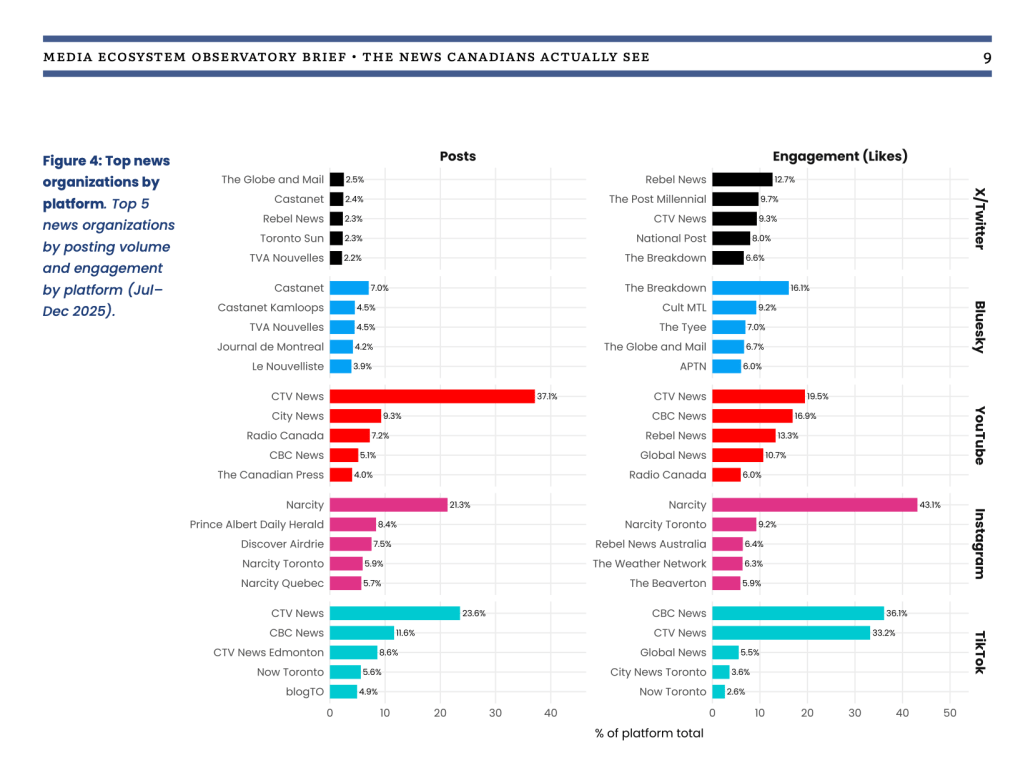
Despite Meta’s ongoing “ban” on Canadian news, there’s still plenty of Canadian news to consume on Facebook and Instagram.

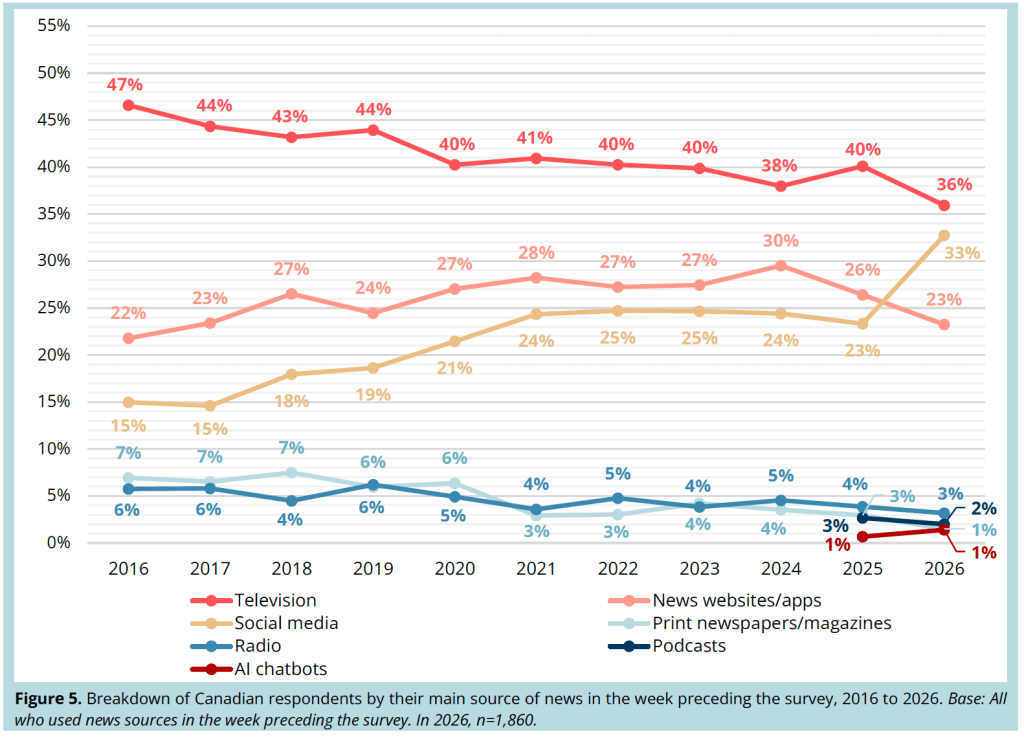
Forty-four per cent of Canadians surveyed by Reuters in its 2025 Digital News Report said they still got news from social media.

But if news is banned from the two biggest social media platforms, Facebook and Instagram, how come so many Canadians find news on social media?

As you suspected, it’s because the Meta ban is selective.

For example, I follow the news site Narcity Canada on Facebook. I keep up with the biggest stories in the news cycle by reading its artfully presented posts linking to Canadian Press stories. Narcity also writes and posts travel and lifestyle news stories written by its own journalists, but not as much as it posts Canadian Press stories.

As the steady flow of Narcity posts suggest to the casual observer, Facebook appears to be a digital news intermediary that “makes news content produced by news outlets available to persons in Canada,” ban or no ban.

But the key is the phrase “produced by news outlets”: news publishers that would have a claim against Meta for licensing revenue if their news content wasn’t banned. If a news publisher has no claim, it isn’t banned.

This is Meta CEO Mark Zuckerberg’s legal strategy and, so far, it seems to be working: if Meta forbids Canadian “news outlets” to post news stories, or refuses to suffer others posting their stories, then he figures Meta doesn’t trigger its legal obligation to negotiate the mandatory licensing payments that the Online News Act contemplates.

That’s his plan, in theory anyway. The practice is different. Meta’s swiss cheesey news “ban” has holes:

  • According to CRTC filings, Meta only half heartedly deletes user posts of news stories published by Canadian news outlets. Some posts remain for months or years as pointed out by the broadcasters who found their own news content posted by others on Facebook and Instagram.
  • My own observation is that Meta doesn’t appear to be deleting news items posted by persons employed by banned news outlets (I’m not outing anyone!)
  • As pointed out as a flagrant example by the litigating news companies, Facebook allows Rogers to post news videos from its Breakfast Television current affairs show, my guess is someone has decided wrongly that’s not news.

But most significantly to Meta avoiding cash liability, it seems to be quietly making its own calls on who is a news outlet, and who isn’t.

Despite the stream of Narcity top news stories of the day, the CRTC does not seem perturbed by this kind of thing in its December 2025 staff letter that wound up its staff investigation into the Meta ban.

Back in 2024, Narcity publisher Chuck Lapointe publicly celebrated Meta green lighting his publication’s return to Facebook. His post indicated this was a mindful decision by Meta and linked it to a ruling by the Independent QCJO Panel that Narcity doesn’t publish enough of its own news reporting to become eligible as a “news organization” to collect federal journalism subsidies under the Income Tax Act.

Replatformed by Meta, Narcity’s posts are a firehose of Canadian Press’s current events reporting, with less frequent posts of its own lifestyle and travel news.

Presumably Meta had Narcity sign-off on any compensation based on this policy:

In the meantime, social media influencers like Mario Zelaya can post their own news content on Facebook, as can Canada Proud or freelance journalists like Rachel Gilmore. Meta doesn’t owe Gilmore or Zelaya any compensation for their content because a “news outlet” must employ at least two journalists under the Online News Act.

The bottom line is that Meta is not banning all news or news reporting, it’s only banning news published by news organizations that might make a legal claim for compensation as a “news outlet.” The rest, it doesn’t ban.

That draws the eye to section 51 of the legislation. It’s the undue preference provision which prohibits Meta from giving “undue or unreasonable preference to any individual or entity” while unjustly discriminating against or disadvantaging a news outlet.

***

The first two in a string of consumer lawsuits against Meta and YouTube has resulted in jury findings of liability and multi-million dollar damages against the social media platforms in Los Angeles and New Mexico.

The civil convictions were based on Meta’s and YouTube’s addictive design features, causing mental health damage to children.

The New Mexico case, where the jury awarded $375 USD million in damages, was also based on Meta and YouTube concealing the risks of sexual exploitation of children.

The juries made their decisions against YouTube and Meta regardless of the fact that US juries are prohibited by federal law from considering the harmful nature of the posted content —-shielded under a 1996 law that gives immunity to online common carriers of content posted by third parties— so plaintiffs must convince juries that the platforms’ addictive design features and the lack of default safety mechanisms are to blame for human harm.

***

If you would like regular notifications of future posts from MediaPolicy.ca you can follow this site by signing up under the Follow button in the bottom right corner of the home page; 

or sign up for a free subscription to MediaPolicy.ca on Substack;

or follow @howardalaw on X or Howard Law on LinkedIn.

COMMENTS ARE WELCOME. But be advised they are public once I hit the “approve” button, so mark them private if you don’t want them approved. 

I can be reached by e-mail at howard.law@bell.net.

This blog post is copyrighted by Howard Law, all rights reserved. 2026.

Defending our cultural sovereignty, down to the last budget cut

March 21, 2026

There was a brief political buzz this week when US Congressman Lloyd Smucker (R-PA) introduced a bill in the House Ways and Means Committee to ask the Trump administration to pronounce Canada’s Online Streaming Act Bill C-11 an unfair trade practice.

The technical term for the congressional request is a “section 301” investigation under the US federal Trade Act that can lead to retaliatory tariffs against other nations, Canada in this case, or it can fizzle out.

On the eve of CUSMA trade negotiations, Smucker’s congressional action is the expected statement of American intent. He and other Congressional representatives have sporadically demanded White House intervention since Parliament passed Bill C-11 in April 2023. In Canada, Smucker’s move was met with a smattering of told-you-sos from the foes of the Online Streaming Act, as was the case when Joe Biden’s White House expressed the same opposition to C-11.

The allegation of “unfair trade practice,” taken seriously, requires the Trump administration to recant its endorsement of CUSMA in 2018, a treaty that Smucker enthusiastically supported.

That’s because the Online Streaming Act, and the CRTC’s implementation of it that includes a 5% cash levy on US streamers to replenish Canadian media funds, almost certainly does not violate CUSMA, which may be why neither the Biden administration nor the Trump White House ever filed a complaint against C-11 that would have gone to a trade arbitrator for final resolution.

It’s not a violation of the CUSMA trade deal to impose financial or regulatory obligations on foreign companies that hurt their bottom line so long as Canadian companies are subject to broadly equivalent regulatory requirements that hurt their’s. That’s clearly the case in the Online Streaming Act and the CRTC levy.

None of that matters a whit, of course.

After plenty of lobbying, the US streamers believe they have the tariff-mad Donald Trump in their corner and they may well be right. With Paramount Plus having swallowed Warner Brothers Discovery under the new ownership of friend-of-Trump Larry Ellison, the streamers are even tighter with the White House than before. So who cares that Canadians obeyed the trade deal that Trump signed?

Netflix is all in for trade action too. This is mostly a case of smash and grab: they will take what they can get from the White House. In Europe, Netflix plays ball with regulators because they have no better option. In Israel, Netflix succeeded in getting streaming regulations scrapped at Trump’s request. As for Canada, Netflix told the CRTC two years ago it could live with a 2% cash levy (Disney seemed to be okay with something closer to 3%) —so quaintly pre-Trump, yes?—but if the new White House administration is willing to go to the mats for Hollywood, why not go for broke?

Meanwhile, the Carney government is sending some mixed messages to the US on how highly we value our culture.

Of course there was last summer’s Carney-cave on the digital services tax, but strictly speaking that was a corporate tax dispute rather than cultural legislation.

Most recently, our federal government’s projection of its own budgetary spending in the next three years suggests that Canadians love culture so much that the Prime Minister is prepared to make the deepest cuts to the CBC, the Canadian Media Fund (CanCon), the Canadian Periodical Fund (news journalism), the Canada Book Fund (Canadian books), and the Canada Music Fund (CanCon) since Stephen Harper took a cleaver to them.

The Main Estimates tabled in the House of Commons by Carney’s treasury board look something like this for 2026-2027:

  • CBC: eliminate $192M from the $1.5B parliamentary grant (13% cut);
  • Canada Media Fund: eliminate $68M from the $203M budget (33%);
  • Canadian Periodical Fund: eliminate $13M from the $86M budget (15%) with a further $14M cut in 2028/29;
  • Canada Book Fund: eliminate $3.4M from the $40M budget (8%);
  • Canada Music Fund: eliminate $16M from the $40M budget (40%);
  • TV5: eliminate $2M from the $13M budget (15%).

Funding for the Canada Council for the Arts, the Indigenous Screen Office, and the Local Journalism Initiative is frozen.

All of this violates the Liberal government’s election platform that left no wiggle room in promising to increase CBC funding by “an initial $150M” —implemented in 2025-26 budget —before moving on to future increases. At least the government hasn’t resorted to blaming Donald Trump’s tariff squeeze, well known to all when these election promises were made.

These cuts require a budget to make them final. But they aren’t a trial balloon. The Main Estimates were approved by cabinet’s treasury board and tabled in the House of Commons on February 26th, citing them as the government’s promised “comprehensive expenditure review.” Two weeks earlier, Heritage minister Marc Miller appeared before the Commons Heritage committee to praise the government’s increased cultural spending in the 2025-26 budget.

If there’s been any public outcry about Carney’s deep cuts to cultural spending, it’s been lost in the din. Somewhere, Stephen Harper is turning purple with indignation at the double standard.

As trade talks loom, it appears that Canada will defend its culture down to the last budget cut.

***

If you would like regular notifications of future posts from MediaPolicy.ca you can follow this site by signing up under the Follow button in the bottom right corner of the home page; 

or sign up for a free subscription to MediaPolicy.ca on Substack;

or follow 
@howardalaw on X or Howard Law on LinkedIn.

COMMENTS ARE WELCOME. But be advised they are public once I hit the “approve” button, so mark them private if you don’t want them approved. 

I can be reached by e-mail at howard.law@bell.net.

This blog post is copyrighted by Howard Law, all rights reserved. 2026.

Catching Up on MediaPolicy – Meta’s “Faustian bargain” – Paramount, so much winning – Millennial beer buddies have at it on ‘Elbows Up’

February 28, 2026

Meta’s ban on Canadian news and the rumour mill about the federal government being interested in fixing it has dragged on for several months. 

It seems that Meta and Ottawa are talking about something that touches upon licensing of news content for Meta’s AI tools, age verification for social media accounts, the Online News Act, and Meta’s news ban on Facebook and Instagram.

Earlier this month, Meta spokesperson Rachel Curran was invited to a ten-minute spot on David Cochrane’s CBC news hour to discuss Meta’s pitch to have the federal government impose age verification responsibilities on app stores (Google and Apple) rather than apps (Meta).

At the eight minute mark they pivot to the news ban and Meta’s recent chats with the Liberal government.

“We would love to have news back,” said Curran, which doesn’t exactly square with her adamant position that as an advertising-driven business they get no commercial value from news content.

Her read-out of Meta’s talks with the Liberals was that the government agreed with Meta’s view.

That’s an astonishing claim —not denied by the government as yet— given that the Online News Act was built on precisely the opposite foundation, the government’s policy conclusion that Facebook monetizes news content and exploits its commanding market position in social media to shortchange news publishers in what would otherwise be a fair market in licensing payments for news snippets and hyperlinks. 

A more nuanced answer from Curran might have been that Meta is willing to pay for news content from some news publishers, but not from most others, and therefore a mandatory licensing regime doesn’t make sense. 

The idea that some news content generates ad revenue for Meta, but some content does not, is a value proposition that could be true but it has never been proven one way or another and Meta has no intention of putting it to the test.

The Online News Act gave Meta a chance to prove such a claim by negotiating different price points for different news outlets. But prevented by the Online News Act from cherry picking news outlets, Meta instead chose the nuclear option of a news ban.

Now we’re back to “Go” on the Monopoly board and Meta wants to cherry pick deals with chosen news outlets for the ingestion of news content into the training of its AI tools.

Curran tried to obscure the cherry picking by making the shamelessly false statement that the Online News Act is preventing Meta and news outlets from engaging in negotiations over AI content (the Online News Act only regulates “making news available” to the public and would require amendments to apply to content licensing for the training of AI tools). 

Alternatively, Meta wants news content in order to offer AI products that mimic search engines and embed news links in its chat replies. Yes, that might well be covered by the Online News Act and so Curran would be right, the Online News Act is an obstacle to implementing Meta’s evolving global model of monetizing third party content without licensing it.

But the important take-away here is that Meta is pitching a deal to Ottawa: repeal the Online News Act, let Meta cherry pick a few Canadian news outlets for licensing deals, and in return Meta will allow news publishers and their content back onto Facebook and Instagram.

The President of the Canadian Association of Journalists Brent Jolly dubbed this “a Faustian bargain,” but a more descriptive characterization would be “total capitulation by Ottawa.”

Removing the news ban would certainly help some news publishers, especially start-ups, who are still willing to put their business faith in Meta-controlled distribution. But the political value of the Liberals of taking such a lop sided deal seems minimal.

***

The battle to buy Warner Brothers Discovery is over.

This week the WBD board accepted Paramount’s improved $31 per share offer as “superior” to its tentative deal with Netflix, which declined to bid higher. It’s an $111 billion USD deal in the end.

You could spend the rest of your weekend reading analyses of the dramatic bidding war. For something short and punchy, here is Aakash Gupta’s X post. 

The deal is supposed to catapult Paramount into a far better competitive position with the streaming thoroughbreds Netflix, Disney, YouTube and Amazon, improving upon its current also-ran position. With a mountain of debt financing sitting on Paramount’s post-merger balance sheet, major layoffs and studio production cost controls are a good bet. 

Prior to the improved share bid, Paramount tried to satisfy the WBD board and its major shareholders with a key promise to buy its laggard cable assets (including CNN) and other guarantees around break-up fees and the reliability of its debt financing. In the end, it had to pay more.

Netflix didn’t want to pay more and may have been listening to the chorus of critics who thought they were overpaying, even with a lower per share price and Netflix stock swaps for WBD shareholders.

One interesting view was that Netflix might get more bang for its buck buying Spotify instead of a bigger share of the video streaming market through WBD’s prestige HBO content, WBD’s other IP brands and its massive movie archive.

Paramount is ultimately owned by Larry Ellison, third richest man on the planet and tight-with-Trump. The New York Times has a useful overview of Ellison’s budding media empire in technology, movies, cable news, and TikTok USA. 

There will be at least two story lines for MediaPolicy readers to follow once the deal is closed. 

The first is what happens to CNN News. In less than a year, Ellison has acquired control of CBS News and now CNN. 

CBS News is already being repositioned towards a more conservative audience. 

CNN —disparaged for years by Republicans as the “Clinton News Network”—  seems a good candidate for being starved for cash, stripped for parts or transformed into Fox News 3 unless Ellison is shrewd enough to hang on to a centre-left audience for advertisers. Certainly his friend in the White House expects a conservative CNN.

On the latter point, Ellison may have jotted down notes on Jeff Bezos’ business misjudgment in humbling the Washington Post to appease Trump.

The other story is Canadian: will Ellison renew or let the HBO  licensing deal with Bell Media expire and offer HBO as a stand-alone streaming service in Canada (in a bundle with Paramount Plus, or separately). (Update 2/3/26 – Paramount has announced that HBO and Paramount Plus will be merged into one streaming service.) 

If Bell loses the profitable HBO content stream, its entire broadcast enterprise becomes very weak, possibly an intolerable drag on its bottom line. 

This merger drama started by WBD CEO David Zaslav isn’t quite over of course. There are anti-trust hurdles for Paramount, even with a friendly government in Washington DC. 

The Attorney-General of California Rob Bonta is talking out loud about challenging the deal. But anti-trust is notoriously a long shot both in timeline and chances of success.

Regardless, the deal may not close for a year, an election year,  and the Congressional Democrats are not going to let this merger go gently into the night.

***

In December I wrote about the book Elbows Up, an anthology of centre-left English Canadian and Indigenous voices responding to Donald Trump’s annexation threats.

I wasn’t deeply impressed by the book and said so. But I recommend an entertaining follow up: The Hub’s Harrison Lowman video interview of the book’s editor, CBC Radio host Elamin Abdelmahmoud.

Lowman had the same problem with the book that I did: no conservative voices and more than a generous dose of settler-state vocabulary that seems at odds with forging the ecumenical political bonds and links required for resisting US hegemony.

His guest had no good answer for the parochial exclusion of conservative perspectives on a common Canadian challenge, the threat of annexation: he weakly implied a lack of interest from conservatives to meet his time sensitive call-out for contributions. 

But Abdelmahmoud is quick-witted to say the least, and he did a good job of explaining the importance of Canada and Canadians integrating the Indigenous perspective of dispossession, domination and death into our national consciousness of who we are, what we want to be, and, as pointed out in the book, why Trump’s threats provide a perfect opportunity to advance our reconciliation project.

Lowman and Abdelmahmoud, conservative and progressive bookends, are good friends in their private lives and listening to the interview is like sitting back and appreciating a robust argument over beers. That makes it an almost perfect metaphor for the national conversation we might have. 

***

If you would like regular notifications of future posts from MediaPolicy.ca you can follow this site by signing up under the Follow button in the bottom right corner of the home page; 

or sign up for a free subscription to MediaPolicy.ca on Substack;

or follow 
@howardalaw on X or Howard Law on LinkedIn.

COMMENTS ARE WELCOME. But be advised they are public once I hit the “approve” button, so mark them private if you don’t want them approved. 

I can be reached by e-mail at howard.law@bell.net.

This blog post is copyrighted by Howard Law, all rights reserved. 2026.
Catching up on MediaPolicy – YouTube’s fake AI Journalists – Go west, CBC – DM@X 2026

AI image by Perplexity

January 19, 2026

You like to think you’ll never fall for a digital fishing scam. You like to think you’ll never fall for a deep fake news video.

Ahem, I fell for a deep fake news video.

YouTube, in its algorithmic omniscience, pushed to me as its top daily recommendation a video of the famous Washington Post political corro George Will.  As the NeverTrump Reaganite we know him to be, Will delivered a withering critique of US tariffs by pointing to Toyota’s investment of $40 billion in Canada.  Later, after I searched for a news announcement and found none, I wised up. (My friend in the auto industry kindly reminded me that $40 billion equals eight new car plants).

But for a good ten minutes, I was all in. The AI-video had George Will on the screen, live and in the flesh, saying exactly what George Will would say and how he would say it, but strangely looking twenty years younger than his 85 years. Then checking the meta-data, the video creators claimed to be a George Will fan site. I very much doubt they were licensed to impersonate George. A week later, YouTube had taken it down. 

A few days later YouTube pushed me a similar fake, this time tech journalist Kara Swisher. Fool me once, etc.

Digital deception is now a daily event, according to a Canadian poll. Fifty-two per cent of us are “very concerned” about it; a full 88% are concerned.

Canadians generally want action against digital deception and hold a mix of views on who ought to do the acting:

Meanwhile, news publishers are soaking their heads in an icy bucket of water.

The Oxford Reuters Institute posted a new year’s survey of 280 CEOs, executives and editors in 51 countries expressing, guess what, their deepening pessimism about the future prospects for journalism. 

The collective wisdom was that news journalism is getting squeezed for audience attention (and ultimately revenue) on either side by AI and social media influencers. Thanks to AI-generated videos and Chat summaries, the latter published with or without links to digital news sites, publishers are expecting referral traffic to keep declining and more or less crash and burn. 

If there’s a silver lining, twenty per cent of publishers believe they will make deals for significant licensing revenues, another 49% see a minor stream of revenue, and another 20% expect none. The latter group are concentrated in local media, public broadcasting and smaller countries. 

A cause for optimism is that a lot of publishers are innovating by hiring digital creators to work with their journalists to compete in the influencer /video/ social media world.

Watch that space: I am waiting for someone to come up with a licensed AI-generated celebrity journalist/influencer who gets content up on the ‘net tout de suite in the news cycle. Someone like George Will.

***

As I’ve been griping about for some time now, the CBC has been slow out of the blocks to put its five year plan into action and earn that $150M raise in the Parliamentary grant.

We may be getting somewhere.

Editor in chief Brodie Fenlon just announced that CBC “will add 33 local journalists and create 11 new bureaus, increasing [our] Canadian footprint from 66 to 77 locations. This “boots-on-the-ground” investment is in addition to last year’s local service expansion of 30 journalists hired in 22 communities across Canada. Many of the new positions are based in Central and Western Canada.”

Now for context, CBC has about 3600 news journalists in television, radio and online. It’s long been underweighted in western Canada, likely because of where the television and radio stations were located decades ago when our demography was a lot more central Canadian. In British Columbia, for example, the private television broadcasters collectively outspend CBC television 7:1. 

The CBC has also hired a new head of English language services to replace the retiring Barb Williams. The new EVP is Doug Smith. He’s arriving from Paramount Canada and his CV stretches back to ViacomCBS, Rogers, and Alliance Atlantis. 

A streaming guy. Let’s give him a couple of years and see what he can conjure up at CBC Gem.

Maybe we’ll see a shift to buzzy blockbusters that emulate the recent success of Crave’s Heated Rivalry in Canada and abroad.

Making hit Canadiana television that is validated by successful export is not new: Canadian broadcasters have done it repeatedly with Transplant, Flashpoint, DaVinci’s Inquest, Degrassi, etc.

At home, Bell Media can take credit for a hitting streak of popular and authentic Canadian shows, smacking doubles like Shorsey, LetterKenny and Late Bloomer, and now Heated Rivalry, a centre-field blast worthy of Bo Bichette (sorry, too soon?).

There’s no reason CBC can’t do the same. It can and has (Sort Of was genius). But as a paid subscriber to Gem (how many of us is a secret), my personal request is to pour money into the functionality of the high friction, algorithmically anemic streaming site. 

(Correction: An earlier version of this post identified the number of CBC newsroom employees at 3400.)

***

This year’s annual coven of Media Policy conspirators is scheduled in Toronto in the first weekend of February.

Digital Media at the Crossroads will be held at the Faculty of Music building, University of Toronto, on Friday 6th- Saturday 7th. Here’s the program. See you there.

***

If you would like regular notifications of future posts from MediaPolicy.ca you can follow this site by signing up under the Follow button in the bottom right corner of the home page; 

or sign up for a free subscription to MediaPolicy.ca on Substack;

or follow 
@howardalaw on X or Howard Law on LinkedIn.

COMMENTS ARE WELCOME. But be advised they are public once I hit the “approve” button, so mark them private if you don’t want them approved. 

I can be reached by e-mail at howard.law@bell.net.

This blog post is copyrighted by Howard Law, all rights reserved. 2026.

Catching up on MediaPolicy – Online harms bill is coming back – Canadians are alienated – Manitoba action on local media

(AI image)

December 23, 2025

The Online Harms bill is coming back to the House of Commons.

The Liberal Bill C-63 that died on the order table when the April 2025 federal election was called was initially a three-in-one omnibus. 

It was an anti-hate bill that increased prison terms for existing Criminal Code hate speech offences and hate-motivated crimes as well as codifying the judge-made law on defining hate.

It also reinstated the abolished right of individuals to bring human rights complaints against hate speech. 

And it charged social media companies with the responsibility of developing and enforcing safety practices to mitigate online harms, particularly to kids. This was the long expected policy piece that was born of lengthy public consultations, taking aim at Facebook and Instagram.

Michael Geist was right (he is, occasionally) in condemning C-63 as three controversial bills wedged into one. Others agreed and the Justice Minister Arif Virani split the legislation into two bills. But the election call killed them anyway and when the government reformed the new Justice Minister Sean Fraser messaged he wasn’t committed to C-63 as it stood.

Since then, Fraser has tabled bills that are policy-cousins to C-63. Bill C-9 takes up the supercharging of prison terms for hate-motivated offences, permits the police to charge hate offences without waiting for the green light from the Attorney-General, and picks up the judge-made law on defining hate (detestation or vilification is hate, but disdain or dislike is not.)

As part of a broader criminal justice reform, Fraser also introduced Bill C-16 to make it easier to prosecute blackmail threats of online sexual humiliation and deem the posting of deep fake sex videos a criminal act.

Senator Julie Miville-Dechêne’s Bill S-209, a proposal to use age verification technology to keep kids away from online porn, is paused in Senate committee but will probably re-emerge in February.

Now the Hill Times is reporting that Fraser will return some time in the new year with an online harms bill that may offer an organized government policy on online hate, harms and safety.

***

There are the standard ways that we like to take the temperature of public opinion on media.

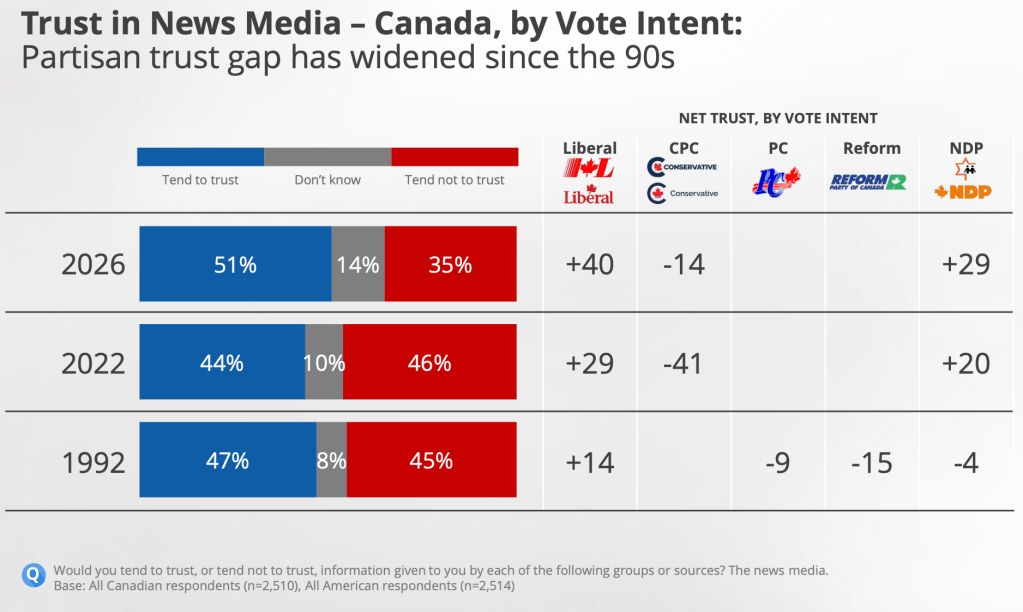
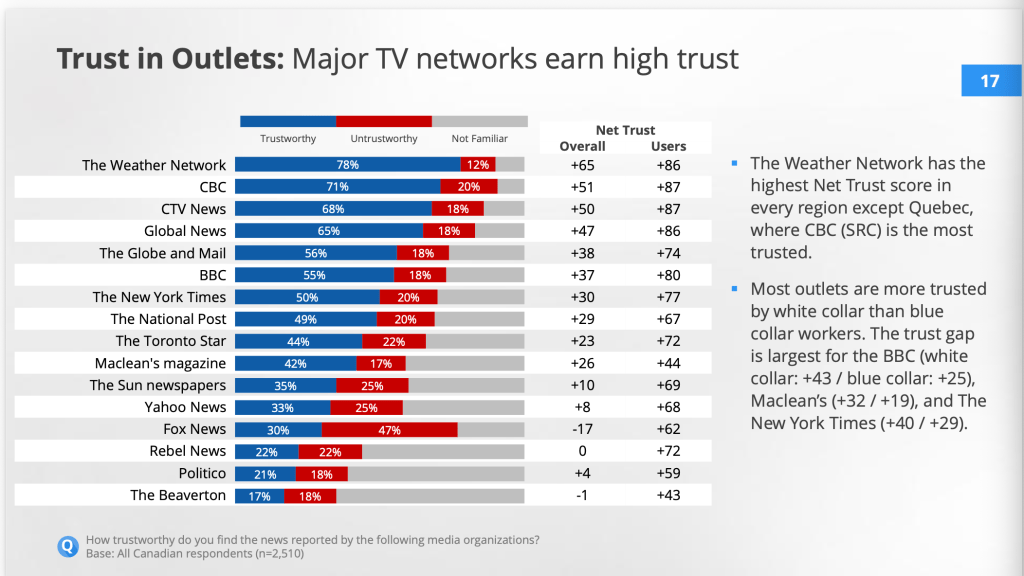
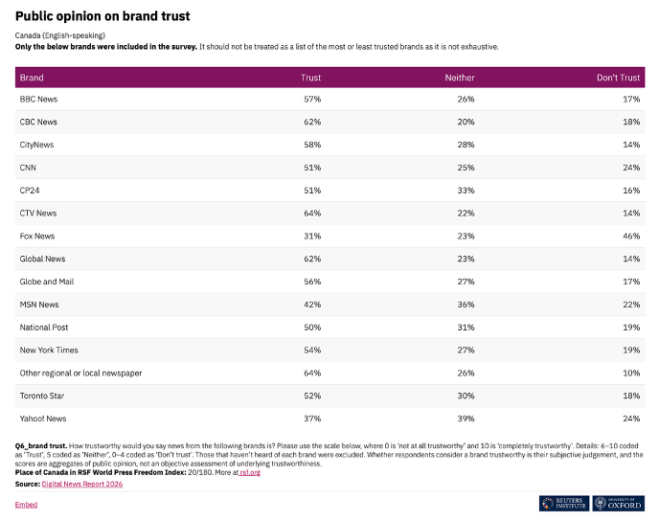
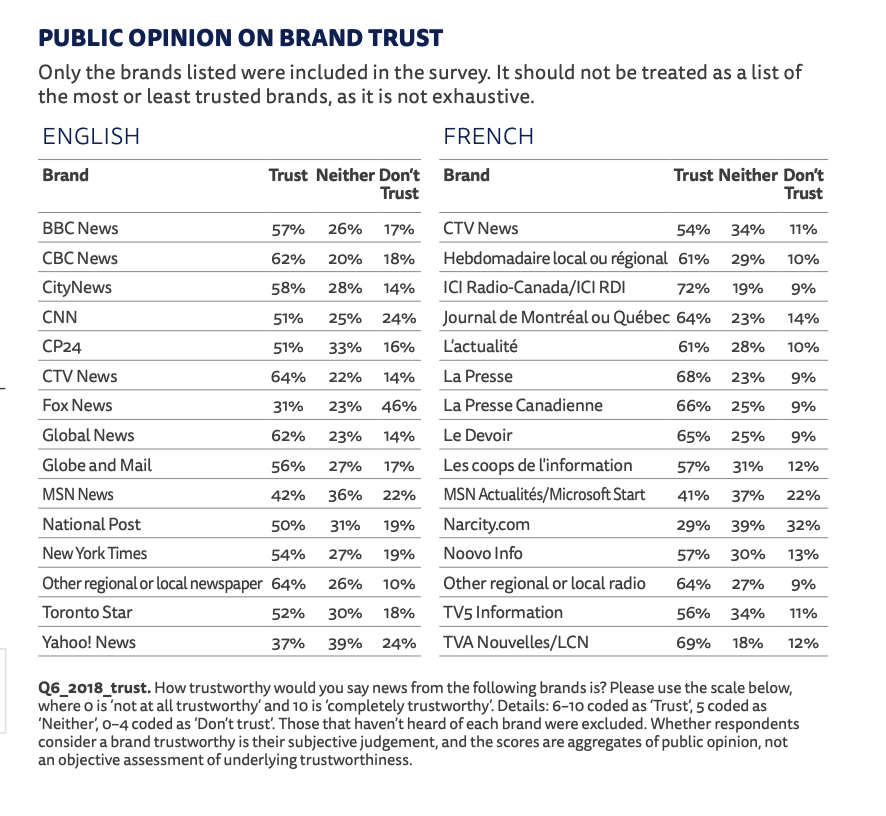
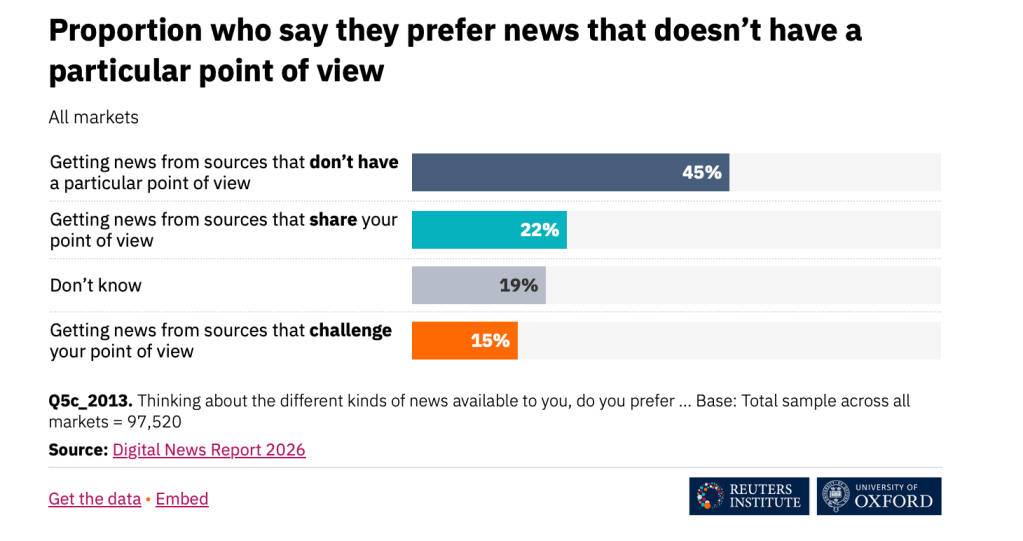
The go to is whether one “trusts” media. Asked that simply, the polling outcomes reflect likes and dislikes of news outlets as much as reliability or manipulation.

I like this news outlet; I trust it. I hate this news outlet; I don’t trust it. 

Occasionally pollsters try to dig a little deeper. The latest poll from Innovative Research doesn’t probe trust-in-media per se but rather the thing that drives trust and mistrust of public institutions: “cultural alienation,” a state of disengagement from the other, where the other is believed to be harmfully powerful.  

The Innovative poll reports shocking levels of popular alienation from Canadian “elites” (another piece of terminology, like “trust,” that can barely shoulder the weight it is asked to bear).

As for the pollster, it describes “culturally alienated” thus: “A full-spectrum pessimistic bloc that believes Canada’s institutions are broken, elites are disconnected, our shared identity is lost, and the country is headed toward crisis. Their worldview is consistently bleak.”

According to the poll, there is a large pool of culturally alienated Canadians, about 28%. 

The culturally alienated are joined in their disaffection by “anti-elite populists” who are “Canadians who feel strongly that the system is rigged and elites don’t care about ordinary people. They are less concerned with institutions or national identity collapsing.” That’s another 29%. I know a lot of people matching the description and I am guessing so do you.

Added together, the numbers look dire.

Now if that puts you into too dark a mood, keep in mind the poll was taken from a standing opinion panel of opted-in respondents, not a random sample of Canadians, so it is disproportionately asking questions of opinionated Canadians.

Also, the results might be skewed pessimistic by the questions. Many of the mood-testing questions are necessarily binary, asking respondents to answer yes or no to questions like “Canadian institutions are broken” and “Canadian elites don’t care about ordinary Canadians.”

Ask an emotional question, get an emotional answer. 

I keep telling myself, it isn’t as bad as it looks. That makes me a moderate pessimist, apparently.

***

An all-party committee of the Manitoban legislature is recommending Premier Wab Kinew’s NDP government follow the lead of provincial governments in Ontario and Québec to financially support local media.

If the NDP acts on the recommendation, it will copy the Ontario procurement practice of reserving 25% of $200 million in government ad spends for placement with local media.

Also, the MLAs propose that Manitoba offer a journalist salary subsidy similar to Québec which provides a 35% salary subsidy (up to $26,250 annually) that stacks on top of the federal 35% salary subsidy (up to $29,000). 

***

If you would like regular notifications of future posts from MediaPolicy.ca you can follow this site by signing up under the Follow button in the bottom right corner of the home page; 

or sign up for a free subscription to MediaPolicy.ca on Substack;

or follow 
@howardalaw on X or Howard Law on LinkedIn.

COMMENTS ARE WELCOME. But be advised they are public once I hit the “approve” button, so mark them private if you don’t want them approved. 

I can be reached by e-mail at howard.law@bell.net.

This blog post is copyrighted by Howard Law, all rights reserved. 2025.