
December 21, 2024
On today the shortest day of the year it seems that nature is in pathos with the times: what a dark time and chaotic mess we are in.
I refer to the obvious, obviously. Our national politics are in turmoil. An economic terrorist to the south mocks our elected Prime Minister, our country and half-seriously threatens to annex us at economic gunpoint.
But this too shall pass, just as the days will get longer. Besides, it’s the weekend.
The more troubling thing that is not going to pass is the tectonic change in news media, particularly the frayed success of serious news outlets reaching the mass audience.
What I have in mind is how the November election in the United States illustrated a tipping point in the movement of the audience from doting on mainstream news outlets that mostly reside on traditional media to the massive but fragmented universe of YouTubers, Rumble channels, podcasters, Substackers, influencers and video shock jocks who can monetize outrage in echo-chamber audiences with relative ease.
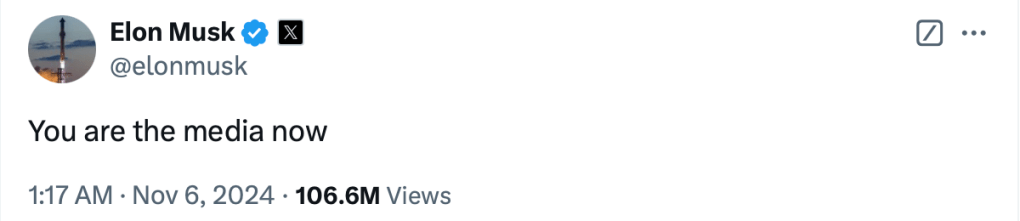
Those media actors are —-prematurely—— crowing victory over mainstream media, captured by Elon Musk’s chortle “You are the Media now.“
Whether this perception of chaos in news journalism is just some kind of passing zeitgeist, well let’s check in again this time next year.
On that note, I was pleased to see that CBC is pleased to see that its YouTube pivot is bringing in the numbers hoped for.
CBC’s audience development guy Paul McGrath posted on LinkedIn that the CBC YouTube channel hit a billion views in 2024 (it’s unclear if he means all CBC digital or just English-language news):
I’m proud of this one. Together, we got 1 billion views on our YouTube channels this year. It’s the first time we’ve ever surpassed a billion views in a single calendar year. A new all-time record.
It actually happened on Nov. 11, but no one noticed because we don’t usually track views. We tend to focus on watch time and other metrics. Our goal is reaching and engaging new audiences and growing our channels. We’re getting better at that, and along the way we picked up a billion views.
What’s driving this?
YouTube Shorts is a big part of it, obviously. But it’s also because we made a big strategic bet on YouTube, we all got behind it and it’s paying off. YouTube is the biggest video viewing platform on the planet, and we’re prioritizing reaching and engaging new audiences there.
So far this year we’ve published over 30,000 videos, including over 500 full episodes of full season shows (we’ve taken a similar approach to the ITV deal that was announced this week).
So yeah, we focused on growing our channels and reaching and engaging new audiences. We got tactical about the nuts and bolts. And along the way we picked up a billion views.
McGrath goes on to thank his staff but also US media commentator Evan Shapiro (not to be confused with Doug Shapiro) who is bullish on the opportunities for public service media on YouTube.
Fishing where the fish are, or at least the younger fish that don’t watch CBC television, it’s a matter of survival for the CBC to attract the younger audience before the older audience ages out (McGrath has another post on this).
And YouTube is a good place to do it. By contrast, TikTok’s short-video format and slavish devotion to engagement metrics is more suitable for breaking news and partisan rants, not reflective commentary or explainers.
Here’s some insight into the opportunities for news journalism succeeding on YouTube. This chart from Press Gazette (unfortunately the data is a year old, before CBC made its big push) tells me two things: CBC ain’t doing bad when you look at the US and UK news organizations ahead of it and the Canadian news outlets behind it. And secondly, look at who is hitting it out of the park:

The chart-topping Vox does not do breaking news. Arguably, this is what should be a lower priority for CBC in a world in which there are plenty of Canadian and global media companies happy to compete for that audience.
Instead, Vox excels at explainers and reflective journalism on issues that don’t break so much as they emerge and cook.
Sounds like public broadcasting to me.
***
I hope that you caught the MediaPolicy post last week of an interview with Peter Menzies on the state of the CBC.
As I describe in the introduction to the interview, Menzies is neither defunder nor defender of the CBC and his criticism is blunt. It’s something both defunders and defenders need to hear, agree or not.
His comments elicited a Letter to the Editor response from Chris Waddell, who also contributed to this MediaPolicy series of posts on the CBC.
I’m working on one more interview to complete the series.
***
Last week the Labor government in Australia announced it would pass legislation taxing Big Tech platforms to pay for news, even if they block news on their platforms.
The voluntary licensing agreements reached in 2021 between Meta and Google and Australian news outlets were reputedly worth about $190M annually. The value of the new tax, which will cover all large tech platforms, has not been set.
This week the government followed up with an announcement of direct government funding for news outlets worth $33M annually. That number is proportional (based on national population) to Canada’s QCJO subsidy to journalist salaries.
Detailed reporting on the Australian program has been sparse, so stay tuned.
A national election in Australia is expected in May 2025.
***

Let me shift gears and look at entertainment television programming.
Doug Shapiro’s chained-tweet narrative that I have been reposting on X might be summed up as this: the long term growth in video entertainment is being captured by YouTubers, TikTokers and the rest of the “creator economy.”
Faced with this trend, Hollywood’s gold-plated business of long-form premium video is in a torpor that it hasn’t shaken off, and we’ll all be watching closely to see if it does (hint: the go-to salvation for big media companies is typically mergers and corporate consolidation).
That raises the question of the impact of industry trends on the Canadian ecosystem of independent television producers who make Canadian content and, as a profitable side-gig, make shows for Hollywood.
The Canadian Media Producers Association just released its annual Profile report for 2023/24 that includes all sorts of metrics of industry health. The data runs up to March 31, 2024 and therefore captures the expected downturn after an atypical spike in the 22/23 report.
The way I look at the new 23/24 numbers, unfortunately the long-term flat-lining in Canadian content production has been restored (once inflation is taken into account).
This is relevant to the debate over the Online Streaming Act C-11 where opponents such as Michael Geist have suggested that things have never been better for Canadian producers and the production of Canadian content and therefore it is unnecessary to compel Netflix and the foreign streamers to contribute to Canadian content.
The other way of looking at it (available in my gift-friendly book about C-11, Canada v California) is that the post-2017 downturn in Canadian broadcasting revenues has shrunk the media funds and licensing fees available to finance Canadian programs, hence the stagnation.
***
I wish you a Merry Christmas and a Happy Hanukah. It’s so cool they fall on the same day this year. We’ll be honouring tradition by going out for Chinese food on Christmas Eve.
And thinking about the hostages.
Chag Urim Sameach.
***
If you would like regular notifications of future posts from MediaPolicy.ca you can follow this site by signing up under the Follow button in the bottom right corner of the home page;
or e-mail howard.law@bell.net to be added to the weekly update;
or follow @howardalaw on X or Howard Law on LinkedIn.

 MediaPolicy.ca