
Graphic courtesy of Sarah Blostein
February 23, 2025
The big media news of the week was Heritage Minister Pascale St.-Onge presenting a 10,000-foot “proposal” to better fund and govern the CBC. MediaPolicy offered an overview here.
The Minister’s recommendations have yet to be endorsed by the Liberal cabinet or contenders to replace Justin Trudeau as Prime Minister. As for St.-Onge, she’s quitting politics.
Her proposal stole headlines with its bold plan to double Parliamentary funding from $33 to $62 per Canadian, a number she walked back immediately to $50, phased in over five years.
Pierre Poilievre was grateful for the opportunity, messaging that the Liberals were promising “another one billion dollars of your money” for the CBC. He then squandered the point with populist blarney to the effect that the money was “an extra incentive [for the CBC] to campaign day and night to re-elect the Liberal government to a fourth term. A reminder to believe nothing you see or hear on CBC.”

On the other hand, the leading candidates for the Liberal leadership have some thinking to do on how to respond to their colleague’s big idea.
The McGill poll from October pegged 78% majority support for maintaining the CBC in the face of Poilievre’s threat to defund. Importantly, that 78% was tied to “changes” at the CBC (at some point we ought to poll what Canadians mean by changes).
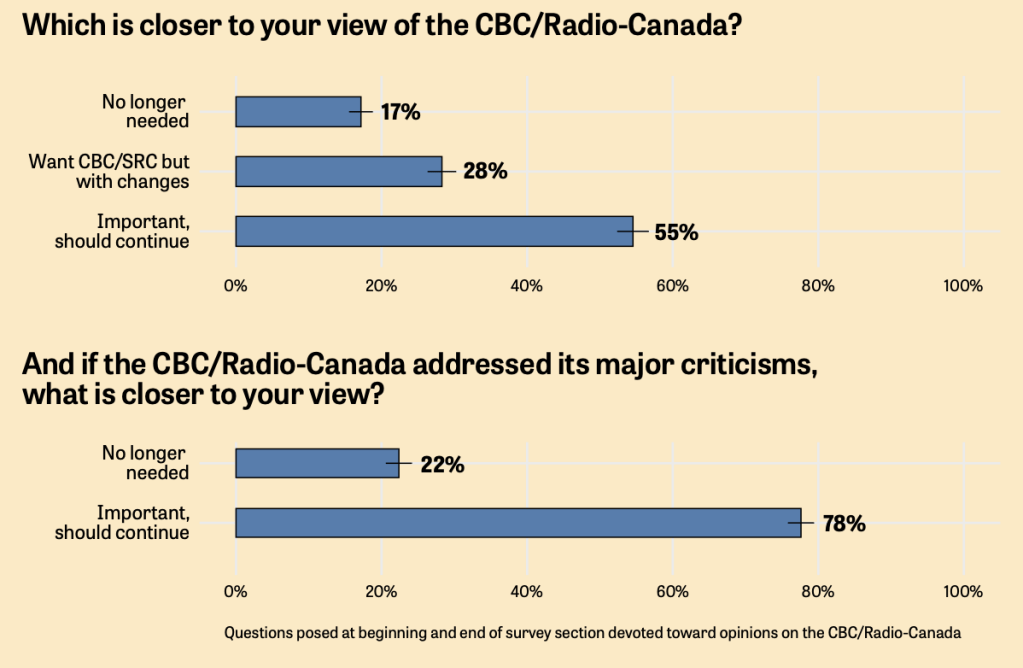
But other results from the McGill poll are sometimes overlooked. Thirty-four per cent of the same pool of respondents said CBC needs more reliable funding, unchanged from previous polling in 2021. Perhaps surprisingly, the 34% is not skewed by regional differences but support for the CBC and better funding is higher among non-Conservative voters.

The political challenge for the Minister’s plan is that it’s front loaded with money, with the changes to come later. That’s why the pressure is on CBC/Radio-Canada CEO Marie-Philippe Bouchard to describe the changes.
The political challenge for defunder Poilievre is that Donald Trump has put the CBC top of mind for many Canadians. We’ll wait for some polling on that.
***
Two weeks ago I posted an update on the CRTC’s regulation of foreign music streamers and, as promised, the Commission has announced a June hearing on audio services, radio and online.
Parliament handed the Commission a laundry list of tasks in implementing the Online Streaming Act, the most pressing of which is what’s expected of Spotify and the American music streamers and whether the declining Canadian radio industry can catch a regulatory break.
The Commission’s Notice of Consultation sports the usual hints of what it’s already thinking before the hearings begin. Its code words are “our preliminary view,” “we consider,” and “we propose.”
Here’s a rundown:
- As the Commission ruled in June, the streamers are going to pay five per cent of Canadian revenues into funds for Canadian musicians and radio news. Perhaps to shore up its legal flank in the face of the streamers’ upcoming court challenge this June, the Commission plans to impose more significant cash contributions on Canadian radio networks that take in at least $25 million in annual revenue (the same earnings threshold as the Commission is applying to the foreign streamers).
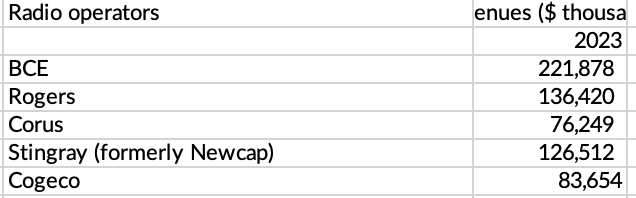
CRTC Figures identify five radio broadcast groups exceeding $25 million in annual Canadian revenues
- As for smaller radio broadcasters, the Commission seems ready to eliminate their half-per cent of revenue (0.05%) cash contributions to musician development funds. The current radio airplay quotas of 35% to 65%, however, are slated to remain.
- The national pastime of debating the “MAPL” formula for a Canadian song that qualifies to fill airplay quotas will be revived but the Commission seems committed to the modest changes it proposed in 2022. Rules on Canadian co-writing of music and lyrics will be loosened. The Commission doesn’t seem convinced as yet that Canadian studio producers ought to join artists and songwriters in the talent club that satisfies the airplay quota.
- The Commission is interested in strengthening on-air exposure for emerging Canadian artists and is open to a 5% airplay quota for artists in the first four years of their recording careers.
- Similarly, the Commission is interested, in fact very determined, to introduce a 5% airplay quota for Indigenous music.
- In a typically opaque discussion of news programming, the Commission declares that “news is a priority” (indeed the Online Streaming Act says so) but unlike other policy items it offers no blueprint for how to make the priority into a reality on air.
But the most difficult policy question is how to close the gap between radio broadcasters and online streamers with respect to the prominence and consumption of Canadian songs.
As noted by the Commission, CanCon consumption is a mere 10% on streaming platforms operating in Canada, a far cry from the 35% to 65% radio airplay quotas. The consumption of streamed French language music is 8.5% in Québec.
What’s unmissable in the Commission’s public notice is how little it makes of these consumption outcomes, so dismal that they are directly proportional to the Canadian share of the continental market.
It’s safe to say that if the Commission was planning anything bold to address the outcome gap, it would have said so. Instead it says “more information is required to fully understand how online services can facilitate [CanCon] discoverability.”
***
The Liberal-tormenting True North has rebranded itself as Juno News and its boss Candice Malcolm had Pierre Poilievre on her show for a 37-minute video interview last week.
The Malcolm interview is in the vein of the Conservative leader’s famous chat with Canadian expat Jordan Peterson: it falls short of being a softball news interview, it’s more of a tag team narrative (for example, Malcolm responding to Poilievre’s comments as “excellent”).
So naturally Malcolm introduced the topic of independent journalism.
What was interesting was that Poilievre passed on the opportunity to reiterate his plans for a scorched earth repeal of federal aid to journalism and said Canadians should wait to see his election platform.
Having said that, he expressed concern that some news organizations had been denied eligibility for federal aid for politically motivated reasons.
All of this is difficult to read, but there seems to be some kind of policy cogitation going on behind the scenes and we will, as the Opposition Leader suggests, have to wait to see his election platform.
***
If you would like regular notifications of future posts from MediaPolicy.ca you can follow this site by signing up under the Follow button in the bottom right corner of the home page;
or sign up for a free subscription to MediaPolicy.ca on Substack;
or follow @howardalaw on X or Howard Law on LinkedIn.
I can be reached by e-mail at howard.law@bell.net.

 MediaPolicy.ca
2 thoughts on “Catching Up on MediaPolicy – The CBC times two – CRTC launches its audio policy hearing – Juno News and press independence”