May 6, 2025
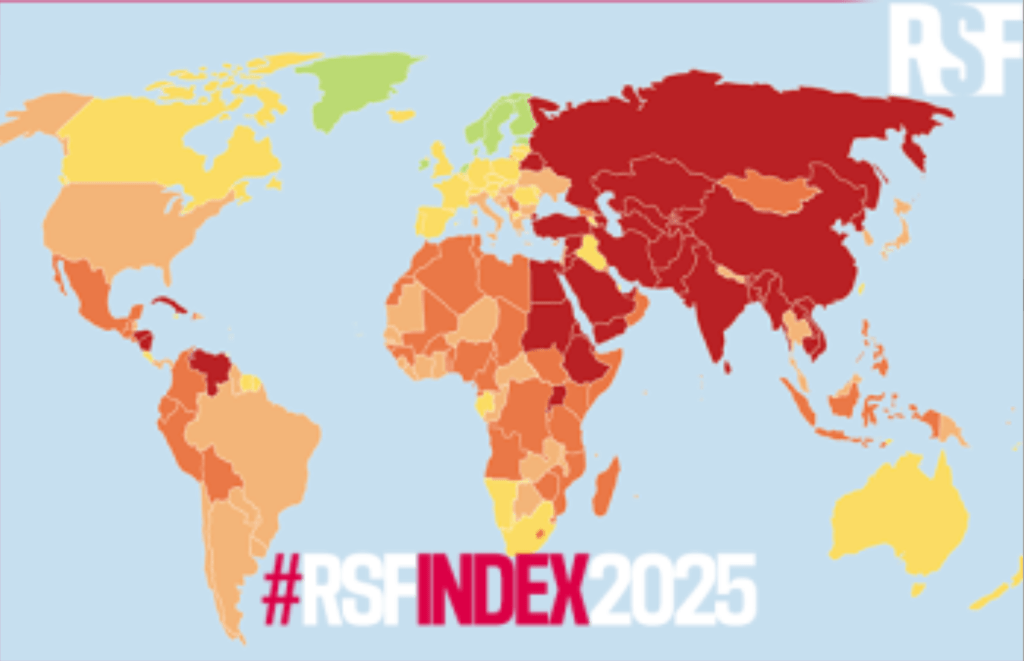
The annual World Press Freedom index is not something all national governments dread.
If you’re Norway (1st of 180 surveyed nations) or China (178th) you aren’t going to sweat what Reporters Without Borders, a Paris-based NGO best known for public campaigns against the murder or imprisonment of journalists, has to say.
But in between, maybe liberal democracies that think highly of themselves are in for a humbling moment.
This year, Canada’s global ranking is 21st, down from 14th because its index score, spread across five categories of political, legal, economic, social and safety considerations, fell from 81.7 to 78.75 out of 100 points. The US is 57th, France is 25th and the United Kingdom is 20th.
In who’s opinion, you might ask: in each of 180 nations, Reporters Without Borders asks local news journalism experts and practitioners to respond to a series of standardized “press freedom” questions that plumb the depths of journalists’ ability to report on the news without interference.
According to the RWB website:
Press freedom is defined as the ability of journalists as individuals and collectives to select, produce, and disseminate news in the public interest independent of political, economic, legal, and social interference and in the absence of threats to their physical and mental safety.
The Canadian report does not moot the debate over Canadian media subsidies and regulation, to the contrary across 180 nations strong public service broadcasting tends to drive higher scores.
The Index is as much a monitor of a healthy Press as freedom from state power. Broader social, political and economic factors that support or attack a free press play an important role in the scoring.
The editorial notes that accompany Canada’s score suggest that the police arrests of Canadian journalists covering volatile news sites —blockades, demonstrations and encampment clearings— drove down our ranking.
That concern also appears in Reporters Without Borders election-related statement that called for better training of Canadian police in their treatment of journalists as the top public policy priority.
RWB’s other recommendations included protecting the CBC from defunding, a ban on police spyware aimed at journalists, and a rebuilding of Canada’s “broken” access to government information mechanisms (the new Prime Minister having shown some interest in the latter).
RWB also noted the existence of “a patchwork of [media subsidies] policies” that beg for “a comprehensive and consistent strategy that helps enable the media to innovate and find news models of sustainability.”
The latter point was included in my own list of things for the next Culture & Identity Minister to do, posted last week: Miles to Go: the Media Policy work of the 45th Parliament.
In next year’s report, we’ll likely see an impact on ratings from CTV’s firing of Rachel Gilmore as a guest election fact checker because of trolling by right-wing actors.

***
This is my last post for a month thanks to our first real vacation since pre-pandemic times. It’s a bit of a science experiment: can four adults manage a two-year old while travelling? Should be possible.
I couldn’t leave without commenting on Donald Trump’s latest announcement of a 100% tariff on Hollywood’s movie production outside the U.S.
It will be a popular move in the US. Hollywood is making less audio visual content globally and in the United States owing to a number of factors, most noticeably budget cutbacks in response to the saturation of the subscription streaming business.
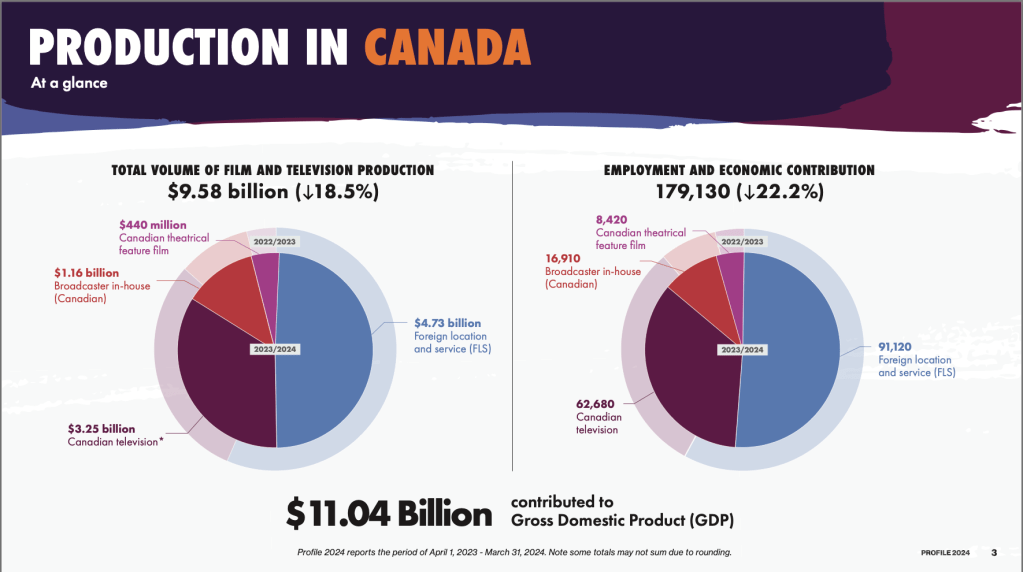
Canada is Hollywood’s biggest non-American supplier of movies and television shows: half of Canada’s $9.58 billion in annual production is for American shows and much of our Canadian content is widely exported to the American market for second runs. The employment hit could be substantial, as this screen capture from the CMPA’s Profile report reveals:
The obvious Canadian counter-tariff is a 100% surcharge on American-made shows exported to Canada. Those would hit Canadian broadcasters filling their schedules with American programming (Corus, TVA, CTV, Bell Crave, etc) but also Netflix and the other American streamers who sell to Canadian subscribers.
It’s not likely that Hollywood asked for the Trump tariff: the studios rely upon the high-quality, competitively priced production centres across Canada, but mostly Toronto and Vancouver.
The tariff disrupts their supply chains and their budgeting, not unlike the Trump tariffs hitting the auto industry.
A White House spokesperson walked back the President’s announcements within hours —-“no final decisions“— suggesting a WTF phone call from the Motion Picture Association.
Shortly afterwards, Trump’s “Hollywood ambassador” Jon Voight made a public statement suggesting that his recommendations to the President had been to boost tax incentives and subsidies for domestic production, negotiate international co-production treaties, and apply tariffs in some situations.
At the CRTC, the Motion Picture Association and the US streamers have put almost all of their strategic capital on securing a minimal commitment to offering Canadian content because the studios spend so much money making American movies in Canada.
That strategy is now in shreds.
A recommended article on the tariff is by Barry Hertz in the Globe & Mail.
***
If you would like regular notifications of future posts from MediaPolicy.ca you can follow this site by signing up under the Follow button in the bottom right corner of the home page;
or sign up for a free subscription to MediaPolicy.ca on Substack;
or follow @howardalaw on X or Howard Law on LinkedIn.
I can be reached by e-mail at howard.law@bell.net.
This blog post is copyrighted by Howard Law, all rights reserved. 2025.

 MediaPolicy.ca
Howard, a good blog for a final shot before a vacation ! See you this aft. Tim
>
LikeLike