
(Some classic Canadian humour to start your weekend)
October 25, 2025
MediaPolicy previously made the observation that while Culture and Identity Minister Steven Guilbeault rejects any further trade concessions to Donald Trump on cultural legislation, we haven’t heard from Mark Carney. And probably won’t. The PM is shying away from those kind of red lines as he transitions rhetorically from “elbows up” to bended knee.
Those of you who recall your history might remember that, according to reports, Canada’s theatrical film legislation was the very last thing on the negotiating table when Brian Mulroney and Ronald Reagan agreed to Free Trade deal number one in 1987. It didn’t go our way.
It’s good to educate ourselves in anticipation of similar cliffhangers. Last weekend the Globe and Mail’s arts staff writers went all out with a collection of stories about the challenges for Canadian artists and media producers as Canada’s trade relationship with the United States wobbles.
Kelly Nestruck wrote about how television production, stage shows and museum exhibitions are going to manage when access to their main export market, the United States, could be up for grabs.
Brad Wheeler invited Rheostatics’ Dave Bidini to riff on his new album, as well as elbows-up nationalism (“Bumper sticker nationalism is not interesting to me,” says Bidini).
Josh O’Kane looked at the desperate state of Canadian-owned book publishing.
Kate Taylor offered a solid overview of trade deals and US retaliation (and trade law wonks can check out the latest from Hugh Stephens).
Eric Andrew-Gee explained the warm hearth of Québec’s cultural nationalism to anglophones (“The price of having a culture to protect is constant fretting about the state of that culture”).
And last of all Barry Hertz broached the sensitive topic of whether collectively we are up to supporting Canadian culture at all.
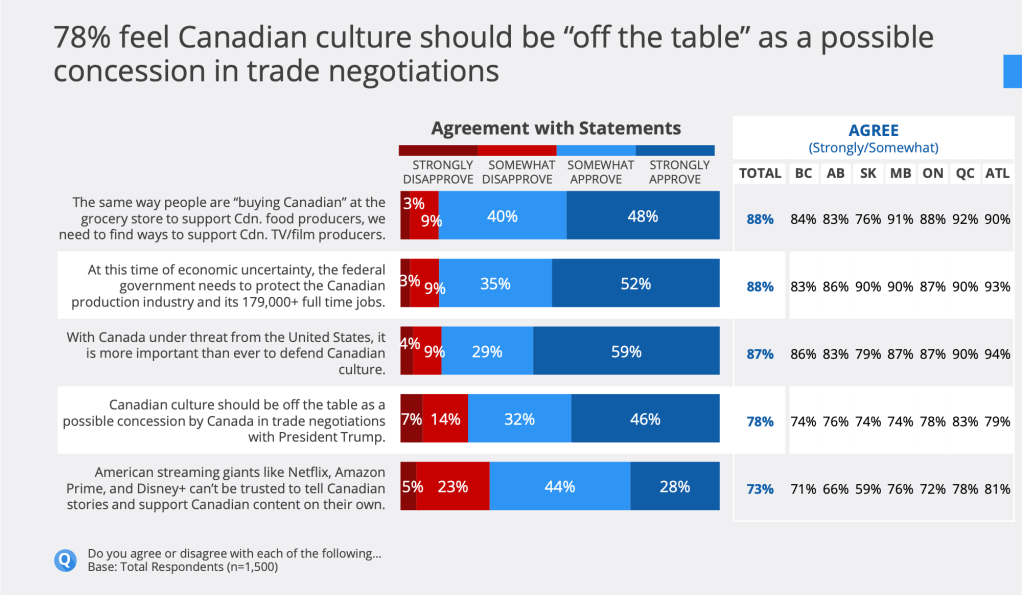
Hertz’s column references a new opinion poll just released by Pollara, sponsored by Canada’s independent television and film producers, that shows Canadians want Mark Carney to defend Canadian culture against American trade aggression.
The poll says that 87% of Canadians now support the Liberals’ Online Streaming Act Bill C-11 (up from 67% in May 2022). As for having a fight over Canadian culture with Trump, 68% of Canadians say yes, only 13% say throw it under the bus (the rest don’t know).
It’s true that half of Pollara’s respondents had no clue about C-11 in the first place, but the pollster’s “statement” polling below suggests Canadians’ values are nevertheless strongly aligned with defending cultural legislation.
***
In last weekend’s post, MediaPolicy summarized CBC President Marie-Philippe Bouchard’s plan for reinvigorating the public broadcaster. Her two biggest points were “more local” and “more diversity.”
Bouchard did the Parliamentary rounds last week, appearing before the Commons Heritage Committee and the Senate communications committee.
Bouchard’s line on ‘more local’ —-she keeps using the word “proximity” to capture both geography and audience affinity with content —- is that digital technology means the CBC can pivot back to local without having to build new stations.
Sitting next to Bouchard, CBC’s Regional Services GM Jean Francois Rioux also emphasized affinity. Canadians want to see people “like me” or “like us” on CBC. They also want other Canadians to see and hear their concerns on the national stage that CBC provides.
There are others who have a different take on affinity, and they mean ideological affinity, code for “more conservatism” on CBC.
Bouchard treads delicately on this one, although in her Commons appearance she thoughtfully suggested that the CBC’s retreat to major cities as a response to budget cuts in the 1990s probably meant that coverage skewed to metropolitan values, which can feel “more centre and left” to anyone living in the “more centre or right” hinterland of Canada.
Bouchard was also interviewed by CBC reporter Jayme Poisson on her October 16th Frontburner podcast. Poisson poked reasonably hard on a number of sore points. On ideological diversity, Poisson pointed out that although CBC’s “trust” rating tops the charts, CTV and Global score better with conservative listeners. Maybe more opinion coverage is what’s needed?
Bouchard didn’t immediately bite on the suggestion —- avoiding a debate over whether big-c Conservatives are treated fairly in CBC coverage— but said what was needed was consistent inclusiveness in CBC content:
Well, I mean, there’s all sorts of ways to make people feel reflected and included. It starts by being in the communities where they are. It also means including a more diverse set of points of view. If that’s possible. And it’s also about being constant about it. Not just during an election period or during a specific period of time. It’s just to have that reliable approach to a diversity of points of view.
That sounds like a shift in content curation as a conscious effort. The execution will be the hard part.
***
A public broadcaster that offers affinity as broadly as possible (my new description of being “highly trusted”) is something we need to keep our democracy glued together. It’s important that everyone is motivated to check in with at least one media source that tells them about all tribes, not just their own.
Wikipedia does something similar. The popular website is quietly just there in our Google Search results. If you read it critically, you’ll get both the uncontroversial facts and the contentious points, the latter helpfully linked to content that you can read and then draw your own conclusions.
That’s unless Wikipedia is a woke, left-wing mind control machine, which is how it gets disparaged these days by the MAGA movement. To that point, Elon Musk says he’s about to release his politically recalibrated competitor to Wikipedia.
Here’s an interesting read from the Washington Post about the political campaign against Wikipedia lead by co-founder Larry Sanders.
***
If you would like regular notifications of future posts from MediaPolicy.ca you can follow this site by signing up under the Follow button in the bottom right corner of the home page;
or sign up for a free subscription to MediaPolicy.ca on Substack;
or follow @howardalaw on X or Howard Law on LinkedIn.
I can be reached by e-mail at howard.law@bell.net.
This blog post is copyrighted by Howard Law, all rights reserved. 2025.

 MediaPolicy.ca
Terrific “issue”! I
LikeLike