
January 27, 2026
Hola from the centre of the universe, Toronto, where the biggest snowfall since 1999 (50 cm) has everyone on the watch for the army to be deployed, shovels in hand.
Here are a few things happening in Canadian media policy:
Canadian culture and the 2026 CUSMA trade talks
I’m going to be giving a ten-minute explainer on this topic at the Digital Media at the Crossroads annual conference on February 6-7 in snow-bound Toronto. The program and registration link is here.
No foolish predictions from me other than taking note that the US trade agenda goes far, far beyond Canadian cultural legislation such as the Online Streaming Act, the Online News Act or a potential online harms bill.
US chief negotiator Jamison Greer is floating the idea of a North American customs union which sounds a lot like double-digit Trump tariffs in exchange for Washington blocking Canadian trade diversification.
Regarding the Canadian streaming legislation that Netflix wants Greer to kill, last week MediaPolicy published a guest column from Peter Grant on how the CRTC might extend an olive branch to Netflix by allowing foreign streamers (and Canadian broadcasters) a CanCon credit for licensing and distributing Canadian shows abroad.
MediaPolicy also posted a book review of Richard Stursberg’s Lament for a Literature, a call to revive the nearly dead Canadian-owned book publishing industry. The Globe’s John Ibbitson also reviewed it. Stursberg’s “what is to be done” menu of policy action requires CUSMA’s “cultural exemption” of CanCon to survive the trade talks.
Another cultural trade issue that might pop up during CUSMA talks is Trump’s previous threats to tariff movies made in Canada for the US market.
The context of this is the retrenchment of streamer spending on new productions since 2022. The Hollywood Reporter has fresh data about where US shows are being made and the only thing that is indisputable is that California is hurting and in an incremental way non-US foreign location shooting is taking a bigger share of a reduced production market . Canada’s volume is steady over time; UK and Irish shooting has gone up.
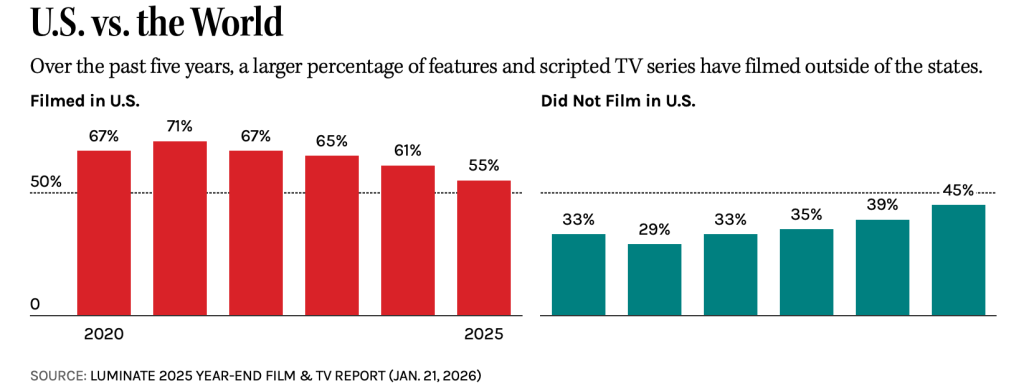
Within the United States, a game of musical chairs has resulted in New Jersey and New York gaining business, while Georgia and California have lost work.
Social Media Ban for Youth
Australia’s ban on social media accounts for youth under 16 has its detractors.
But it has its admirers too. The Globe & Mail reported that the Carney government is thinking about it for under 14s.
The French government just passed an under 15 ban.
Canadian TikTok “ban” repealed
Ottawa has repealed the TikTok “ban.”
The Trudeau government’s 2024 ban on the TikTok’s business activity in Canada (but not the app itself) followed a bipartisan Congressional ban in the United States on the grounds of national security.
Now that the Trump administration has completed the transition of the Chinese-owned TikTok into a separate US company, controlled by American interests with a minority Chinese ownership stake, the national security concern has evaporated in both the US and Canada.
Our federal government has agreed to a judicial consent order that reinstates TikTok’s right to carry on business in Canada (and presumably jump starts its investments in Canadian creators).
The odd thing: it’s the Chinese TikTok company, not the American-Chinese joint venture, that will operate in Canada. But the national security concern, which was never revealed by the federal government, has disappeared.
***
If you would like regular notifications of future posts from MediaPolicy.ca you can follow this site by signing up under the Follow button in the bottom right corner of the home page;
or sign up for a free subscription to MediaPolicy.ca on Substack;
or follow @howardalaw on X or Howard Law on LinkedIn.
COMMENTS ARE WELCOME. But be advised they are public once I hit the “approve” button, so mark them private if you don’t want them approved.
I can be reached by e-mail at howard.law@bell.net.
This blog post is copyrighted by Howard Law, all rights reserved. 2026.

 MediaPolicy.ca