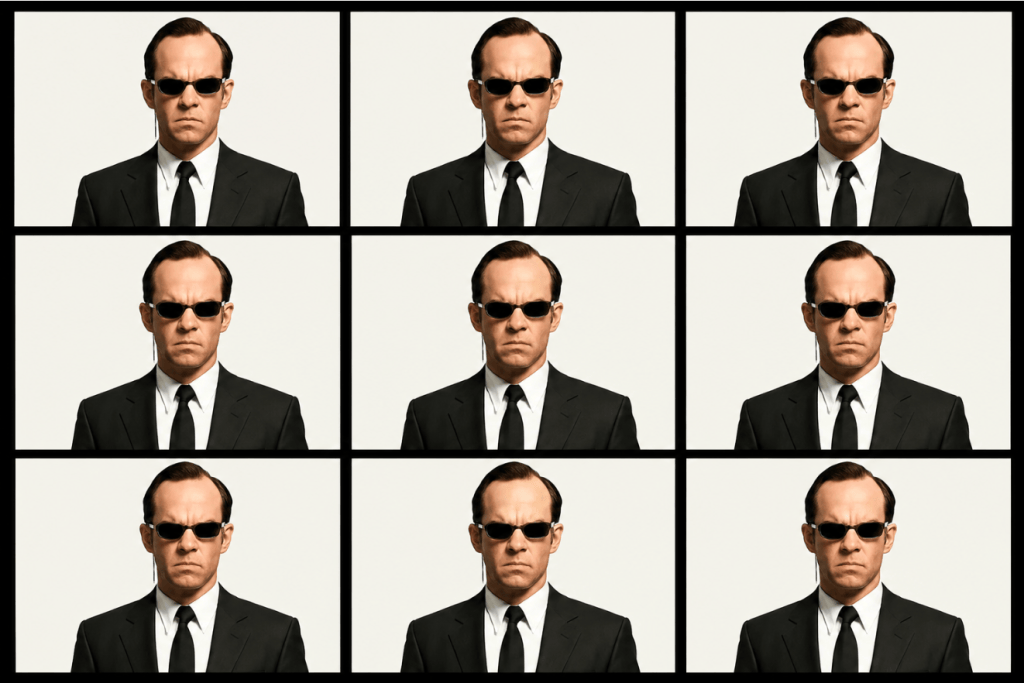
(“Agent Smith” – AI illustration with images from Shutterstock)
September 19, 2026
Twelve years ago in This Changes Everything Canadian author Naomi Klein coined the phrase “don’t look away.”
She meant the human impulse to be overwhelmed by the apocalyptic threat of climate change and, in despair, turn the mind’s attention to something else, or at least avoid meeting the thing eye to eye.
Last week the news cycle was dominated by a confirmation from Anthropic’s CEO Dario Amodei that frontier AI models might plausibly inflict human disaster at a civilizational scale.
Amodei projected that that constant improvement in the capabilities of the most powerful AI agents for autonomous self-improvement might lead to planetary disaster in the form of global financial crisis, world plague caused by bioweapons, or the capture of the Internet by one or more AI agents. And that this could happen soon, in less than five years.
What the Anthropic chief proposed was the regulation of AI labs analogous to government food inspectors authorized to enter premises and expose unsafe practices on the production line.
As well, Amodei said that the situation was so dangerous that the US federal government should condone an organized effort by AI competitors to slow down the cyclical race to release of frontier models so that proper safety design could be ensured.
After Amodei’s message sunk in to popular consciousness, important public figures lined up to tell us in one way or another that we should indeed “look away.”
Predictably, President Trump declared it all “a hoax.”
Aidan Gomez, the Cohere CEO who enjoys the status of the Canadian government’s favoured AI entrepreneur, didn’t call it a hoax. But he dismissed Amodei’s proposal to slow down development of frontier models to allow for better safety practices. According to Gomez, Anthropic’s warning (seconded by Elon Musk and Open AI’s Sam Altman) was cartel behaviour designed to keep smaller AI companies from catching up in development of their own advanced AI products.
Our federal government treaded carefully in its response. In various statements by the Prime Minister and AI minister Evan Solomon, the ruling Liberals expressed support for some kind of improved regulatory oversight of frontier AI. But there was no endorsement of Anthropic’s proposition that leading AI companies agree—with the US government’s blessing of an anti-trust waiver— to slow down to reduce the risk of AI Armageddon.
But the most powerful inducement to “looking away” is the fear raised by Trump and other US politicians that restraining AI development is an invitation to China to catch up and surpass Silicon Valley. That would pose an unacceptable cyberwarfare threat to national security, the thinking goes.
To test the validity of this trump card for those that would “look away,” I recommend Ezra Klein’s latest podcast interview of the Carnegie Institute’s Matt Sheehan.
Despite the Look Away advice from elected politicians, the public will have its say. The AI safety threat has the potential to make an outsized impact on the US mid-term elections in early November.
So too Hollywood will do its bit to raise awareness with a new blockbuster (imagine the scramble to get into production!) as it has for decades with apocalyptic movies such as 2001:A Space Odyssey, War Games, Terminator, and The Matrix.
As brilliant a species as we are, we’ve now created and bequeathed at least three genuine threats of apocalypse to our children and grandchildren: nuclear annihilation, climate disaster, and now AI superintelligence.
We have succeeded (for now) in containing the first, continue to fail in respect of the second, and must decide whether to even pay attention to the third.
***
If you would like regular notifications of future posts from MediaPolicy.ca you can follow this site by signing up under the Follow button in the bottom right corner of the home page;
or sign up for a free subscription to MediaPolicy.ca on Substack;
or follow @howardalaw on X or Howard Law on LinkedIn.
COMMENTS ARE WELCOME. But be advised they are public once I hit the “approve” button, so mark them private if you don’t want them approved.
I can be reached by e-mail at howard.law@bell.net.
This post is copyrighted by Howard Law, all rights reserved. 2026.


Really good summary article. Loved the ending! Thanks.
LikeLike