September 24, 2026
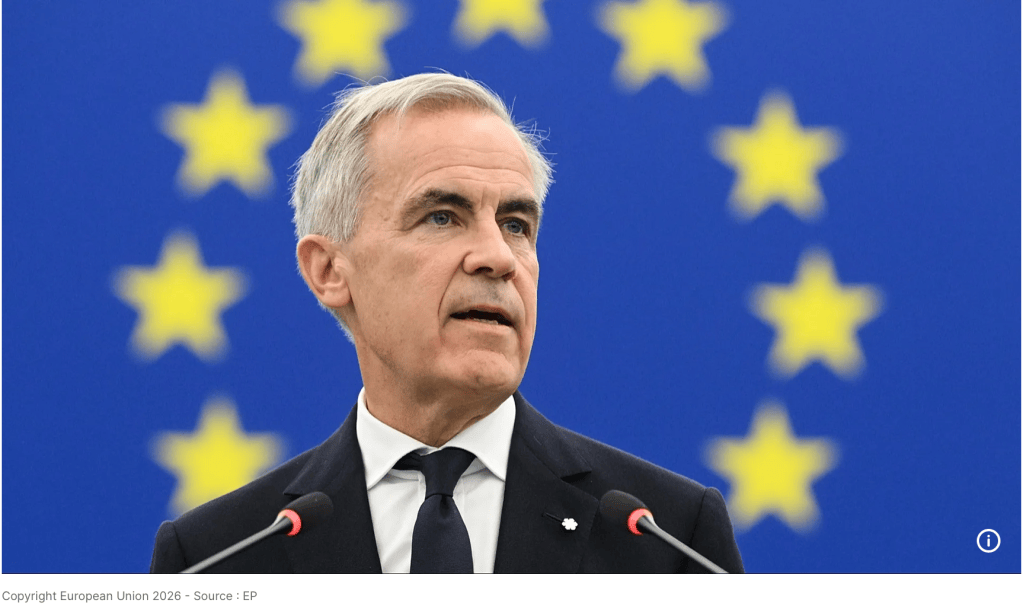
In this historical moment, Prime Minister Mark Carney has become our greatest cultural export. He is considered in his pronouncements, good natured and unflappable. He is the global anti-Trump.
Occasionally, the imperious CEO gets loose. In a rare appearance in the House of Commons for Question Period, Carney was obliged to grind out the parry and return of Opposition barbs.
Having gamely returned service to Pierre Poilievre’s first serves on issues of affordability, Carney swivelled to meet the incoming from Bloc Québécois Leader Yves-François Blanchet on the PM’s repeal of the Digital Services Tax and Netflix cash contributions to Canadian media funds.
“Mr. Speaker,” said Blanchet, “the Prime Minister personally cancelled contributions of any kind by tech giants to the economy or the arts in Quebec and Canada, including through taxes or content creation, simply to appease the American President. The effort fell flat. Although I remain unconvinced, the Prime Minister claims to have walked away from the negotiation table for language and culture-related reasons. Since the effort failed, should the Prime Minister consider reinstating the digital services tax and allowing cultural contributions by the web giants?“
After a reply offered in banal Parliamentary vocabulary, the Prime Minister steadied for Blanchet’s follow up volley.
Blanchet suggested that Carney’s strategy to build closer ties to the European Union meant that Canadian alignment with the EU’s bolder approach to digital taxes and streamer contributions would make sense after breaking off trade talks.
The Prime Minister stood up and delivered a curt, “No, Mr. Speaker.” And sat down. Pointe finale.
Now it helps to watch this on video so you can appreciate the dismissive tone and body language. The clip also captures the bemusement rippling through the Bloc MPs seated behind Blanchet.
As the Prime Minister probably appreciated afterwards, that kind of answer won’t cut it in Québec, a province that loves legislation regulating streamers so much it has two.
***
With the House of Commons sitting again, Parliamentary committees picked up from where they left off in the spring.
In the modern age of an all powerful Prime Minister’s Office, these independent committees frequently resemble teenager house parties when the parents go out of town. Don’t destroy the place and you can do much pretty much anything you want.
The Finance committee is chaired by Karina Gould, the Toronto–area MP and former cabinet minister who made an impressive run for the Liberal leadership in 2025. This week Gould delivered the Liberal committee majority’s report on public submissions for the upcoming 2026 budget.
It’s not all that newsworthy when the Finance Committee reports on its “pre-budget” consultation. Its MPs make loads of budget recommendations in policy areas already covered by fellow MPs sitting on other Parliamentary committees like Canadian Heritage. And in a Budget that remains in the tight fisted grip of the Finance Minister and the PM, the Finance MPs’ recommendations are far from being a first draft of the final Budget.
On culture, the Finance MPs made eleven recommendations.
Some are guaranteed never to see the light of day.
A recommendation that Internet Service Providers (i.e. Bell, Rogers, Québecor) begin paying the same five per cent culture levy that their cable divisions pay is a non-starter.
Recall how in June 2017 Prime Minister Justin Trudeau humiliated Canadian Heritage committee chair and fellow Liberal MP Hedy Fry by holding a pre-emptive news conference to dismiss out of hand her committee’s recommendation favouring an ISP tax.
Other recommendations may be under more serious consideration by the PMO. For example, this omnibus recommendation on public spending on news journalism captures several of them:
Support the sustainability and growth of newsroom jobs by maintaining the Canadian Journalism Labour Tax Credit at the current 35% rate and expanding eligibility criteria to include owner-operators, employees in broadcasting, and partners in news businesses. Budget 2026 should also direct at least 25% of federal advertising spending toward private-sector Canadian news outlets, address disparities in tax treatment for advertising, and extend the Local Journalism Initiative indefinitely to support the creation of original civic journalism in underserved communities.
The other recommendation that caught my eye was the strengthening of the intellectual property rights of news organizations in response to the ingestion of their content by AI large language models such as ChatGPT, Gemini, and Claude:
The committee further recommends that the Government of Canada protect Canadian news publishers’ intellectual property in the context of artificial intelligence by requiring government AI suppliers to commit to the principles of transparency, consent, and attribution when using copyright-protected content, requesting that the Competition Bureau examine competition issues in search and AI markets, including crawler practices.
And here is a companion recommendation that applies to any kind of Canadian media:
Ensure that artificial intelligence (AI) developers obtain permission and provide compensation for the use of copyright-protected works in training data, reject any new or expanded copyright exceptions for text and data mining, and require transparent disclosure and record-keeping of training sources to support a functioning licensing market.
There are many public policy issues packed into those two paragraphs.
But to news publishers, the issue is simple. They want to be compensated (or even asked permission) by the AI giants for ingesting their content, first for the “training data” that birthed the LLMs’ vocabulary and gave them the context to understand news content, and also for the “output” summaries that LLMs provide to inquisitive users like you and me.
The news publishers’ claim is that AI ingestion is not only without permission and compensation, it’s grabbing intellectual property that news publishers might use to make their own LLMs in open-sourced applications. As well, the LLMs are using ingested news content to create de facto news outlets that directly compete with the news publishers.
Faced with litigation from news publishers, the AI global giants have signed off some pick-and-choose deals with top news outlets.
It’s reminiscent of what happened ten years ago in news hyperlinking by Google and Facebook, ultimately leading to the Online News Act C-18. The web giants made a few deals on the cheap with big news organizations and stonewalled the smaller news publishers.
To those unlucky news outlets, the web giants offered instead free distribution of their hyperlinks in order to draw traffic to their websites. Even if that quid pro quo was ever adequately remunerative to publishers big and small for hyperlinks, it’s not on offer from AI companies for ingestion, including again Google and Meta.
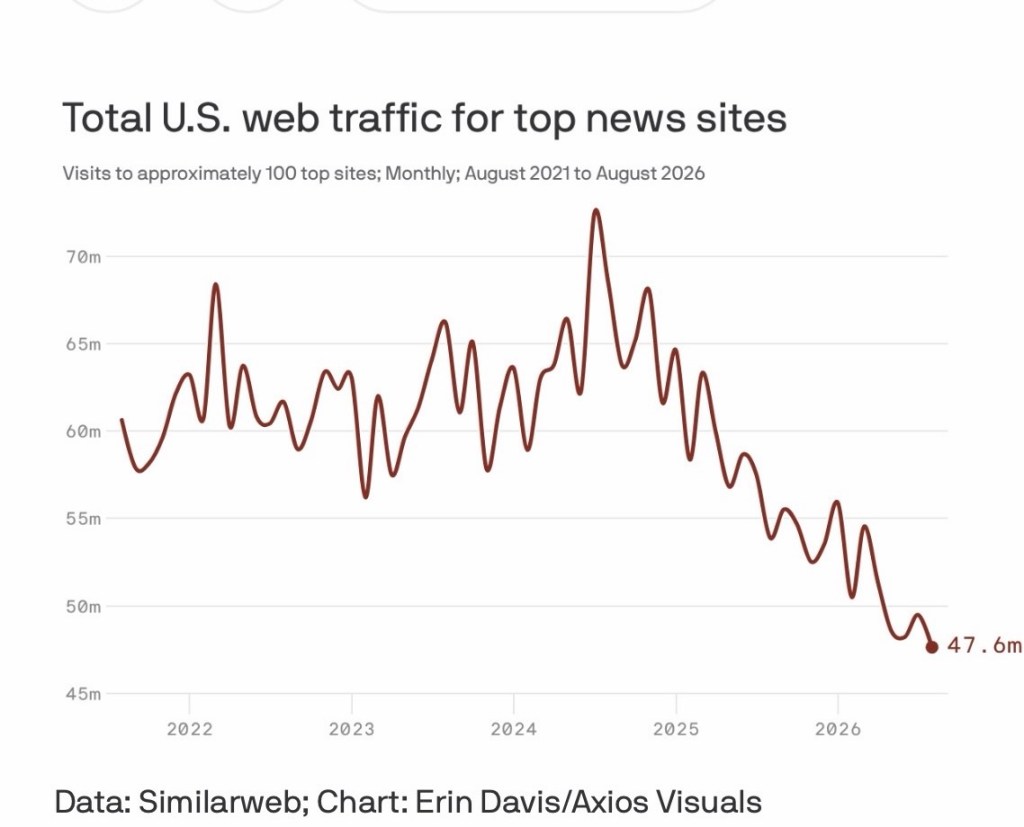
That’s because the notion of an exchange value of “content for traffic” doesn’t apply to AI ingestion of news content that is killing traffic referrals from web platforms to news outlets, as the graph below indicates.
So what next?
There is already litigation over ingestion that will end up in the US Supreme Court and maybe our’s too. The Trump administration has lined up in support the ingesters. The Carney government is sitting on the fence.
His MPs on the Finance committee are recommending he get off of it.
***
If you would like regular notifications of future posts from MediaPolicy.ca you can follow this site by signing up under the Follow button in the bottom right corner of the home page;
or sign up for a free subscription to MediaPolicy.ca on Substack.
This post is copyrighted by Howard Law, all rights reserved. 2026.


