August 23, 2026
On Friday night Mark Carney said no to the “shit deal” that Canadian journalist Jen Gerson warned us might be coming.
In the absence of a lot more information than we’ve already been given, the post-mortem on the breakdown of negotiations will continue to be spun by whomever’s talking, be it Mark Carney or Donald Trump.
Canadian journalist Terry Glavin reminded us this weekend that “there’s also a good reason to be at least somewhat skeptical about the way Prime Minister Carney has explained the impasse, and by all means, be skeptical about the spin put about by sources close to the talks and various Liberal-friendly sock puppets. Peter Menzies, who has spent a lifetime in journalism and media policy, has noticed the ubiquity of “strategic leakers” informing reporters assigned to the trade talks. Menzies advises vigilance.”
Times two, I say (except for the sock puppet comment).
There might have been one such strategic leak last week about where the Online News Act stood in the midst of last week’s negotiations. The answer was: it’s awaiting a formal death announcement.
On Thursday, Toronto Star investigative reporter Justin Ling reported that “sources” (note the plural) were telling him that Carney had already thrown the Online News Act under the bus as part of a projected settlement and that “publishers” had been advised to be “ready for the death” of the bill.
Ling also reported “another source briefed by Canadian officials confirmed that the Online News Act would be a likely concession, but stressed that things could change before Friday’s new deadline.”
Note “likely.”
Unless someone in the source-chain is lying, “likely” and “briefed by Canadian officials” is intended to be reliable information.
I did ask Newsmedia Canada CEO Paul Deegan if indeed publishers were warned by “Canadian officials” about dropping the legislation that pays out $100 million annually to Canadian news outlets.
“I am not aware of any conversation, officially or otherwise, between publishers and government about the future of the Online News Act one way or the other, nor am I aware of any such conversations with any publisher or group of publishers,” he told me.
“Ministers and staff were extremely tight-lipped, which was entirely expected and appropriate, given the sensitivity of the final negotiations which were underway in Washington.”
On Friday morning the reaction in the Québec media to Ling’s tip off was of mushroom cloud dimensions. Among the Québécois opinion-movers pushing the red button were the respected University of Montréal law professor Pierre Trudel and Bloc MP Martin Champoux. The Bloc’s press release was punctuated by the words “appeasement” and “capitulation.”
If the Québec branch of the federal Liberal Party has one job it is, at the very least, not to severely aggravate nationalist sentiments on matters of media and culture. The toss-up federal by-election in Chicoutimi is next Monday, a separatist party leads the polls going into a provincial election at the beginning of October, and there will be three more federal by-elections in Québec later this fall.
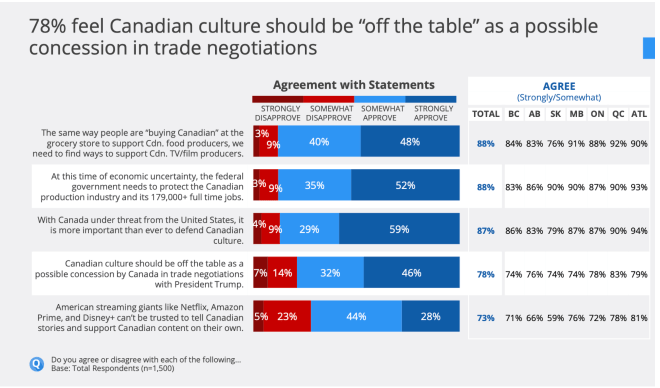
No doubt all of this circulated back to the Prime Minister’s Office and was likely just one more thing to remind Carney that public opinion polling was making it clear he had misread the room of Canadian opinion on taking significant tariffs and making cultural concessions.
In the aftermath of the breakdown on Friday night, Ontario Premier Doug Ford went on television to make it clear that he’d been uncomfortable all of last week about the projected landing spot on auto, steel and aluminium tariffs. The landing spot was 15% for auto and 25% for steel and aluminum, effectively the global benchmark for Trump tariffs. Don’t bother with the nuances to those heart-stopping numbers.
On culture, Carney told reporters following his Saturday morning press conference that the sticking points included “the French language” and “culture.” He offered no specifics (although in one of his answers he referred to the American hostility to bilingual product labelling).
Whatever cultural concessions were in the works, the deal is off for now.
As trade lawyer Barry Appleton wrote this weekend, “the public got there first.” Carney got there later.
“Polling in the week of the negotiation put support for making concessions at thirty-nine per cent,” noted Appleton. “Six in ten Canadians were against conceding further before the deadline arrived. A government facing that number was discovering the edge of what it could sign more than it was choosing refusal.”
This disconnect with public opinion, and the popular appetite to stand up to Trump’s aggression, has been Carney’s weakness going back to his 2025 election. It’s responsible for both the surrender of the digital services tax and overruling the CRTC on streamer contributions to Canadian content.
I can offer from my own career experience as a trade union negotiator: ninety per cent of the job is to get the right read on your membership. It’s not only that you are accountable to the rank and file, as Carney is to Canadians, but more importantly their willingness to fight and take pain is your bargaining power. Overestimate or underestimate that fighting spirit at your peril.
Carney’s “I’m the adult in the room” persona is what got him elected. But it’s clear now he underestimated the Canadian people and was on the verge of presenting us with a bad deal as a fait accompli without giving us the opportunity to stand up to an American government brazenly determined to turn us into a vassal state, a Belarus to their Russia, when we’d rather be Ukraine.
I’m not convinced the Prime Minister has got the message yet.
He set September 8th as the date for imposing Canadian retaliatory tariffs. That gives him time to get past the three federal by elections next Monday. More importantly, the extra two weeks seem like an invitation to the Americans to reconsider and get back to the table with a better offer.
A fresh American offer with radically lower tariffs and no Canadian concessions seems unlikely. Let’s hope the Prime Minister is reading the right room, the Canadian room.
***
If you would like regular notifications of future posts from MediaPolicy.ca you can follow this site by signing up under the Follow button in the bottom right corner of the home page;
or sign up for a free subscription to MediaPolicy.ca on Substack;
or follow @howardalaw on X or Howard Law on LinkedIn.
COMMENTS ARE WELCOME. But be advised they are public once I hit the “approve” button, so mark them private if you don’t want them approved.
I can be reached by e-mail at howard.law@bell.net.
This post is copyrighted by Howard Law, all rights reserved. 2026.


