The lady is not for turning: Julie Miville-Dechêne’s campaign for kids and porn regulation

August 16, 2025

Senatrice Julie Miville-Dechêne does not give up easily.

The senator appointed by Justin Trudeau in 2018 is now engaged in her third try to get the pornography-regulating Bill S-209 passed through Parliament before it gets killed off by another election call. Her previous bills died that way: S-203 by the 2021 election and S-210 by the 2025 election. Both times, her Bill passed the Senate but got a frosty reception from the governing Liberals.

Described in MediaPolicy’s post earlier this week, Bill S-209 would introduce age verification technology to force pornography websites to screen out children under 18 years of age so that impressionable kids don’t view, and internalize, violent sexual behaviour. Adult access to pornography remains uncontested.

The issue of children viewing porn is definitely down her feminist alley as the former head of Québec’s Council on the Status of Women, but the Senator works hard and champions many underdog and progressive causes.

In 2022 she and fellow Senator Paula Simons fought relentlessly (but ultimately not successfully) to carve out Canadian YouTubers from the scope of the Online Streaming Act. In vindication, the CRTC later agreed with them and exempted YouTube videos from broadcasting regulation for the foreseeable future.

In 2023 Miville-Dechêne initiated legislation in the Senate that requires Canadian governments and large companies to report on their global supply chains so that the federal government can enforce prohibitions against imports of goods manufactured by forced and child labour. The Liberals played ball on that one and it was sponsored in the House by Toronto MP John McKay and it passed with broad support.

Her pornography bill has already stirred the Kraken of a regulation-free Internet, so if S-209 does make it to a House of Commons Committee in the next few months, expect some debate, especially about age verification technology that could also be used to stop children from opening social media accounts, were the federal government to consider legislating that.

MediaPolicy asked Miville-Dechêne about the long and uncompleted journey of “An Act to restrict young persons’ online access to pornographic material.”

***

Media Policy: It’s a little unusual for a bill to have the support of the Senate and the opposition parties, but not the government. What can you say about any discussions you have had with the Justice Minister?

Julie Miville-Dechêne: Not much, I had a confidential discussion very late in the game [in 2024] with [former] minister Virani. But let me say that in general, my conversations with Liberals were mind boggling. 

I don’t think they knew what pornographic sites have become, hardcore and violent, so our conversation was difficult. It’s not ‘70s era erotica, a form of sexual liberation. They brought up the importance for young people searching for their identity or sexual orientation to have free access to porn sites, as if seeing violent stuff was the path to sexual identity. 

There’s a whole generation at risk, we need to get something done. Studies show a correlation between viewing and harm. Kids think this is what sex is all about. The British Commissioner for children did surveys and found that 47% of youth aged 16 to 21 stated that girls expect sex to involve choking.

MP: So the former Prime Minister didn’t see it that way?

JMD: In talking to media in 2024 he called S-210 a Conservative Bill which would do shady things with personal data. It was easier I suppose than to state that the sponsor was a feminist, an independent senator. The Trudeau government never proposed any improvement to the Bill as they do with private member bills that they like. On the other hand, there was support for the Bill from all the other political parties, not just the Conservatives, but the Bloc and the NDP as well.

MP: What was it about the government’s own online harms Bill C-63 that you thought did not adequately address underage access to hardcore porn?

JMD: I was very disappointed. Nowhere in their Bill did it say that, to minimize harms to minors, age verification or age estimation is expected. Nowhere. There was only an indication that digital operators must adopt “age-appropriate design” for their services. That’s not specific enough. In the UK’s Online Safety Act, social media platforms and large search engines must also prevent children from accessing pornography and material that promotes or encourages suicide, self-harm and eating disorders. This has to be kept off children’s feeds entirely. By comparison, the Liberal Bill C-63 was vague and weak. 

MP: An important practical consideration for your bill seems to be the effectiveness of age verification and estimation technology. The most recent technology doesn’t require personal information or facial recognition but claims to be able to use videos of human hand movements. Privacy lawyer David Fraser dismisses age estimation as “magic fairy dust technology.” What is the current state of the age verification/estimation technology as you understand it?

JMD: It’s obviously improving fast. I did rely on the expert on privacy matters, Privacy Commissioner Phillipe Dufresne. Because I introduced two similar bills on age verification since 2020, M. Dufresne took it upon himself to research the matter and speak with his counterparts in other countries. He testified on my Bill before the House of Commons Committee and proposed stronger safeguards

I took his advice and I rewrote section 12 of the new Bill S-209 where Parliament instructs the government on what standards it should enforce for age verification technology. The bill says that government can only approve a verification method that is “highly effective,” operated by a third party and not the pornographers themselves, collects solely personal information strictly necessary for age estimation purposes, and requires the destruction of the data once age verification is completed.

We are not re-inventing the wheel here.  Germany has been verifying age for a decade on national porn sites and it’s working fine. Around twenty US states are doing age verification. Also, age verification is already happening in Canada when gambling, buying alcohol or cannabis over the Internet. 

Age assurance technology is getting better. I have added age estimation to age verification in the bill because facial age estimation is now more precise, two years plus or minus, and there are also other emerging technologies like estimation of age through hand scanning which is said to be 98% accurate. No identity card is needed. 

As you know, the UK started age verification and age estimation on July 25th of this year and are engaged in five million new age checks. Opponents are claiming it is a disaster because a few sites were blocked without reasons. I would argue that tech platforms are the ones who have to adjust themselves to block only what is in the law. Some might say they are acting upon an interest in the law not working.

MP: Let’s say the technology is not here yet but reasonably close to happening, does this mean the government might not implement this law until cabinet is satisfied with the technology?

JMD: I would say at this point it is more a question of transparency than technology, in the sense that the public should know what government will ask age verifiers to do in terms of privacy before authorizing them to check the age of Canadians. Right now, the bill says it must be implemented in a year after Royal Assent, but I expect that will be discussed in the House review of the Bill.

But Europe and countries like France, Spain and the UK are already in the process of implementing age assurance, why should we be the only country to think the technology is not ready? I think this debate should be put in the context of protecting children as soon as possible, because harm is being done now. 

In Canada, on this issue I have support from feminists, Christian groups and worried parents. It goes beyond left-right I think.

MP: Seems so. A Leger poll conducted last year says that public support for your bill is high. But that support might change if administrative overreach ends up including something as mainstream as hot sex scenes on Netflix or HBO. Is the definition of pornography in the bill —“dominant characteristic,” “sexual purpose”— too broad? 

JMD: I don’t think it’s that broad. Depiction for a sexual purpose of a person’s genital organs or anal region and breasts must be the dominant characteristic of the film or video. It’s the same elsewhere. In the UK, pornographic material is defined as ‘primarily intended for sexual arousal’. But for movies or series on Netflix, we also have the “legitimate purpose” exemption in section 7 (2) which states that no offense will occur if there is a legitimate purpose related to arts, education, science, or medicine. Movies and television series are generally considered a form of art. 

MP: Okay, but I was just watching an HBO show —I would definitely not consider it pornographic in any way—that had a teen aged sex scene, body parts under clothes, and they acted out a spin-the-bottle sex game where the girl choked the boy as he masturbated. Is that “pornography” or is it exempted as “artistic” erotica?

JMD: I don’t think a single scene meets the test of ‘dominant characteristic.’An expert scholar Janine Benedet wrote a brief to the House committee hearing on S-210 that stated: The scaremongering that accompanies any attempt to define pornography in legislation is depressingly familiar. I have over the years heard predictions that any legal interventions in this area would result in the “banning” of works such as Lolita, American Psycho, Fifty Shades of Grey, and now Game of Thrones.

MP: The US Supreme Court just ruled 6-3 in favour of a Texas age verification law not unlike S-209. Even the dissent was limited to the “level of constitutional scrutiny,” meaning how much of an intrusion on free expression or privacy is too much. If that means age verification laws take hold in the US, one will think that it will here too?

JMD: It’s interesting question, because historically, the American courts have upheld the 1st Amendment of their Constitution, the freedom of expression, more strongly than in Canada.  

So, the latest decision, last June was an important one: the Texas government had a legitimate interest in preventing minors’ access to porn and the law is appropriately tailored because it permits age verification of users through established methods.

Opponents of age verification will point to the fact that the US Supreme Court is now controlled by a majority of conservatives. True, but in first instance, it was a conservative trial judge who blocked the Texas Law, and in appeal court, the conservative justices were divided for and against age verification. So, it is an oversimplification to say that this is only a conservative issue. 

MP: I believe US Supreme Court Justice Alito observed that 15-year-olds are far more tech savvy than their parents?

JMD: He’s right on this. So, you can imagine I was flabbergasted to hear technology expert Michael Geist in a Senate committee stating the responsibility of protecting children from porn with parental controls is solely with parents, like him, not with public authorities.  Professor Geist statedI believed then and believe now that addressing the issue is my responsibility, which includes education, frank conversations and an assessment of whether to use internal blocking tools or filters.

Obviously, not all parents are as knowledgeable as Professor Geist, and this is why the State has long imposed age verification in stores selling alcohol and cigarettes.

MP: Many US states and the UK are looking at age verification for viewing all social media content, not just pornography. What’s your view of that issue?

JMD: There are pressure and policy being brought forward in Australia and France to restrict social media for children and permit only teenagers of a certain age. So yes, it is a trend, not only pushed by the conservatives. I’m still reflecting on the issue. I find it is more complicated than age verification to limit exposure to porn because social media is also a form of socialization for kids. But addiction to social media exists, harm exists, so it is not an easy proposal. A Québec commission recently recommended restricting social media to 14 years and over. 

MP: David Fraser is on YouTube describing you personally as “oblivious” to freedom of expression concerns and that supporters of your legislation are “finger waggers and pearl clutchers.” What’s your view of the freedom of expression and privacy interests raised by this kind of regulation?

JMD: I’m not a puritan if this is what he means, far from it. I’m a feminist and I was a public proponent of strong sexual education when I was head of Quebec’s Council on the Status of Women.

I’m a strong believer in freedom of expression. I was a journalist for 25 years, and then the ombud for news and current affairs at Radio Canada, so I have reflected and written on these questions. I don’t believe an age verification for porn sites which takes seconds unduly limits the freedom of expression of adults. It’s a very limited restriction. Adults can still access the sites. Asking an adult to identify themselves in a sex shop has never been seen as a limit to his freedom of expression. I also think no right is absolute. Here, we have to balance the inconvenience of proving you are an adult with protecting all children from harm. 

***

If you would like regular notifications of future posts from MediaPolicy.ca you can follow this site by signing up under the Follow button in the bottom right corner of the home page; 

or sign up for a free subscription to MediaPolicy.ca on Substack;

or follow @howardalaw on X or Howard Law on LinkedIn.

I can be reached by e-mail at howard.law@bell.net.

This blog post is copyrighted by Howard Law, all rights reserved. 2025.

“The most dangerous (or not) Internet bill you never heard of.” Bill S-209 is ready for Parliamentary prime time

August 12, 2025

There’s a media bill coming to the House of Commons this fall that will create a stir.

It’s called “An Act to enact the Protection of Minors in the Digital Age Act and to amend the Criminal Code,” Bill S-209. (“S” because it originated in the Senate).

It isn’t another child porn law (that’s already illegal). Rather it’s legislation that bans children (under 18) from viewing online porn and makes it a crime for porn websites to permit it, enforced by requiring the pornographers to subscribe to a commercial age verification service for all site visitors.

What follows is a cheat sheet describing the bill and some context. 

The point of the bill, according to its sponsor Senator Julie Miville-Dechêne, is to stop the serious harm to impressionable kids and teens resulting from exposure to hardcore porn, particularly the violence and aggression that has become widely available even on free sites. The dangerous stuff —hitting, slapping, choking— normalizes sexual behaviour that boys and girls should practice and accept among themselves, both as youth and later as adults. 

So far —and this bill has bounced around Parliament since 2022— no one is litigating the harm.

But how to fix it?

The first thing the bill does is to identify what pornography is going to be off limits. There is a series of legal fences drawing the line between regulated and unregulated websites and content:

  • The porn site must be a commercial service. But only website operators are responsible: search engines and ISPs are not liable.
  • Websites that allow kids to view porn aren’t breaking the law if the content is for a “legitimate purpose” relating to science, education, medicine or ——this is the question-begging  loophole— “the arts.”
  • The definition of porn is carefully drafted: “pornography means any photographic, film, video or other visual representation, whether or not it was made by electronic or mechanical means, the dominant characteristic of which is the depiction, for a sexual purpose, of a person’s genital organs or anal region or, if the person is female, her breasts.” I italicized the words inviting interpretation. 
  • Websites will be expected to implement age verification technology.
  • The characteristics of acceptable age verification technology will be set by government regulation described in section 12 of the bill. Notably the pornographer must contract with a third party service (of which there is a growing industry) that protects data privacy and destroys the data as soon as viewer age is verified. 
  • Porn sites that violate the law can be convicted of a crime but the penalty is a large fine ($250,000 for a first offence) rather than jail. As the likely offenders will be foreign sites that ignore Canadian laws, the legislation provides for a yet-to-be-named government regulator to warn the site and back it up by going to court to seek a site-blocking injunction. The site blocking powers include a de minimus rule that tolerates blocking non-pornographic content on the same site. 
  • The bill comes into effect one year after it passes the House.

The bill has the support in principle of a majority of MPs in the House. The NDP,  Bloc and Conservatives support it. The Liberals do not. 

An earlier, slightly less well tuned, version of the bill got through the Senate and made its way to the House of Commons, only to be wiped off the order paper by the April 2025 federal election. Prior to the election writ dropping, the bill had languished undebated in committee for nine months, suggesting the three parties in support of the bill in principle had other priorities.

The policy support for protecting vulnerable youth, especially girls, comes from both progressive and conservative directions. Getting tough on porn is a long time conservative issue, now making common cause with feminist-inspired safety concerns. Miville-Dechêne is in the latter camp having once led Québec’s Council on the Status of Women (and a 25-year career as a prominent television journalist). 

The bill also has some solid polling support, I’ve provided a link to a Leger poll below.

The Liberals under Justin Trudeau fought the bill and held it up in the House until it died. An interview with Miville-Dechêne that I will publish this weekend provides some insight into that.

Now that the bill is back in a new session of Parliament we will have to see if the Carney PMO takes a different approach to the issue. 

The bill has passed second reading in the Senate without serious opposition and third reading approval ought to happen quickly. Then the bill goes to the House where the all important gatekeeping in House committee must be navigated. Even if the bill is opposed by the Liberal government, S-209 is not a “private member’s bill” that can be shunted to the back of the queue. As a Senate bill, and without a majority government controlling committee votes, S-209 might grab the Parliamentary spotlight sometime in the next year. 

The bill was once denounced by Michael Geist as “the most dangerous Internet bill you never heard of.” Canadian privacy activist David Fraser has a YouTube video that parses the legalities of the legislation, salted with some unlawyerly insults of the bill’s supporters.

The kind of things you will hear in opposition to the bill include:

  • Age verification technology may not protect privacy and we should rely on parental, not state, regulation.
  • Site blocking injunctions may go beyond “de minimus” intrusions on non pornographic content and usher in fast and loose censorship of the Internet.
  • Regulating porn is for Puritans, “finger waggers and pearl clutchers.” (Fraser’s words)

It’s also important context that age verification for porn bleeds into broader policy issues.

Other countries are further ahead of Canada on age verification for porn sites, in multiple American state jurisdictions as well as the United Kingdom. The US Supreme Court just ruled it constitutional.

But age verification is also the enforcement mechanism for legislation that goes beyond access to porn to viewing all sorts of social media content deemed harmful, so opponents see S-209 as the proverbial slippery slope. The Americans and the British are well underway with this and Canada’s federal justice minister is contemplating the revival of the Liberals’ own online harms bill.

These kinds of debates echo the big question that you’ve read about here and elsewhere for the past five years: is policy based regulation of content over the Internet acceptable, or is the wild and free Internet untouchable?

***

If you would like regular notifications of future posts from MediaPolicy.ca you can follow this site by signing up under the Follow button in the bottom right corner of the home page; 

or sign up for a free subscription to MediaPolicy.ca on Substack;

or follow @howardalaw on X or Howard Law on LinkedIn.

I can be reached by e-mail at howard.law@bell.net.

This blog post is copyrighted by Howard Law, all rights reserved. 2025.

How much online hate and misinformation do Canadians see? Do your politics matter?

Graphic from “Spot Fake News Online,” News Media Canada

January 1, 2025

In the previous MediaPolicy post, we looked at the Pollara/Dais poll of Canadians’ news consumption and trust in news journalism. 

It confirmed what other polls had already established. Overall, Canadians go to mainstream outlets for their news while younger Canadians increasingly get their news on social media platforms such as Instagram, YouTube, Snapchat and TikTok. 

Across generations, the lack of trust in content distributed on social media is high.

The other half of the Dais Report (based on the Pollara survey) lasers in on the harms from online misinformation and hate. Just so I don’t bury the lede, the most salacious finding was that right-wing Canadians are far more prone to believe misinformation than left-wingers are. I’ll get to that lower down in this post.

The scope of Dais investigation overlaps but does not quite match the focus of the Liberals’ proposed online harms legislation, Bill C-63 or the Conservatives’ alternative, Bill C-412. Maybe that is because the idea of State intervention to combat harms to children, deep fakes, and revenge porn are uncontroversial. It’s the debate over hate and misinformation that heats controversy.

Majority support for fighting online harms

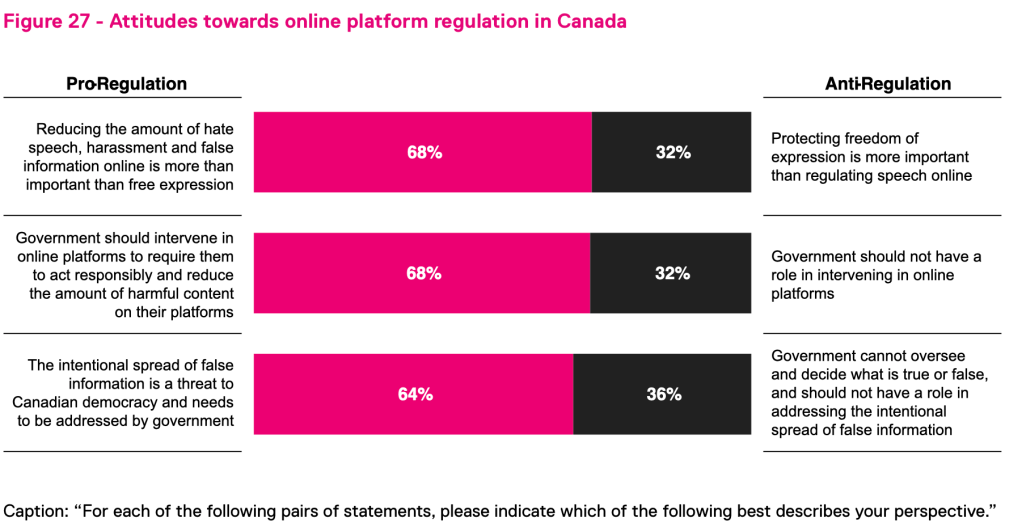
The Dais report looks at public attitudes towards the State stepping in to the ring to regulate online misinformation and hate. The bottom line: two out of three Canadians say fighting online harms trumps the freedom to misinform or hate:

An even stronger majority in favour of State action gets teased out of the poll numbers when differentiating between specific harms and consolidating “strongly” and “somewhat” support:

This polled majority support for State action against online harms is consistent with results in three previous polls.

Is public sentiment an endorsement of the Liberal bill? There is only a modest level of public awareness of the specifics of Bill C-63. Only nine per cent of Canadians think they know details of the bill and another 28% are “vaguely” aware. This is typical of public attitudes towards proposed legislation so the Dais/Pollara survey has to be taken as a snapshot of uncrystallized public opinion on the bill. As well, there has been no poll testing whether combatting online harms is a vote-changer in the upcoming election, as there was with the Conservative proposal to defund the CBC.

Nevertheless a take away from all this polling suggests that the public criticism of Bill C-63 is out of step with public opinion.

the hate you see

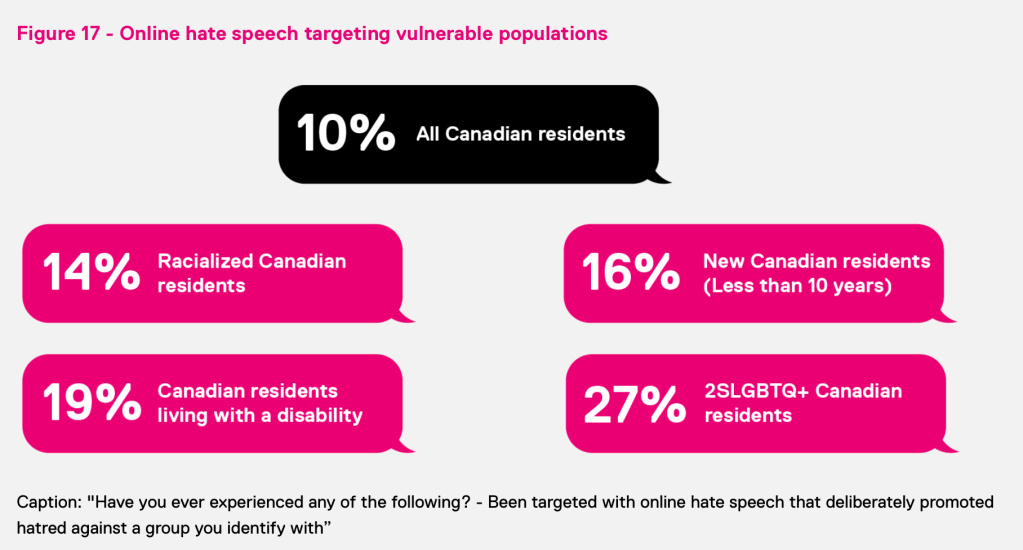
The Dais poll asked survey respondents to self-identify and then, based on the results, concluded that Canadians are seeing a troubling amount of online “hate.”  Check out the third line of this graphic:


As for personal targeting, members of racialized and LGBTQ communities experience more of it:

An omission in the survey, which Dais would best be able to explain, is the experience of women being targeted by misogyny and Jews by antisemitism.

Of course hate may be in the eye of the survey respondent and not all hate is illegal. How bad does hate have to be before we censor or punish it?

The legislative standard for illegal hate was written by our Supreme Court adjudicating the Criminal Code and human rights legislation. The legal “hallmarks of hate” are those that vilify and dehumanize members of certain communities, inciting violent and non-violent attacks upon them. 

Here’s the Court describing illegally hateful messages:

The messages conveyed the idea that Black and Aboriginal people were so loathsome that white Canadians could not and should not associate with them. Some of the messages associated members of the targeted groups with waste, sub-human life forms and depravity. By denying the humanity of the targeted group members, the messages created the conditions for contempt to flourish.

Moreover, the level of vitriol, vulgarity and incendiary language contributed to the Tribunal’s finding that the messages in the case were likely to expose members of the targeted groups to hatred or contempt. The tone created by such language and messages was one of profound disdain and disregard for the worth of the members of the targeted groups. The trivialization and celebration in the postings of past tragedy that afflicted the targeted groups created a climate of derision and contempt that made it likely that members of the targeted groups would be exposed to these emotions. Some of the posted messages invited readers to communicate their negative experiences with Aboriginal people. The goal was to persuade readers to take action. Although the author did not specify what was meant by taking action, the posting suggested that it might not be peaceful. The Tribunal found that the impugned messages regarding Aboriginal Canadians and Jewish people attempted to generate feelings of outrage at the idea of being robbed and duped by a sinister group of people.

While incitement to violence is a powerful justification for censorship of hate, the common understanding of incitement as direct cause and effect may not capture hate’s long term poisoning of the mind: Jews are too rich (so take away their property); Indigenous are idle (so don’t hire them); Blacks are violent (so keep them in a ghetto).

The incitement to violence is just a further matter of accumulating a critical mass of dehumanization. The bereaved Afzaals of London Ontario probably would like to know how many haters and hate messages it took to incite the man who murdered their family with a pick-up truck.

It’s really not surprising that Canadians’ majority support for action against online hate is so high. Whether or not expanding the existing anti-hate legislation that is already on the books through C-63 is the answer, there are many informed discussions to consider. And it’s important to keep in mind that much of the bill doesn’t deal with hate speech.

taking the misinformation quiz

The Dais report also puts a lot of focus on misinformation. Neither the Liberal nor Conservative bills propose to regulate misinformation, other than where it’s present in harm to children, deep fakes, and hate speech.

It’s not well known that Canadian television and radio regulations have long prohibited “false or misleading news” in broadcasting. I can find no cases where the CRTC took action on those grounds (although a there have been censures and licence revocations for the “abusive comment” of misogyny and racism over the airwaves).

When Parliament updated the Broadcasting Act in Bill C-11 in 2022 it excluded regulation of “abusive comment” and “false or misleading news” from applying to content distributed on social media platforms such as YouTube. The federal cabinet went even further by excluding podcasts, keeping them unregulated.

Nevertheless, the Dais Report looks at the size of the online misinformation problem in Canada. This is where I promised the salacious stuff.

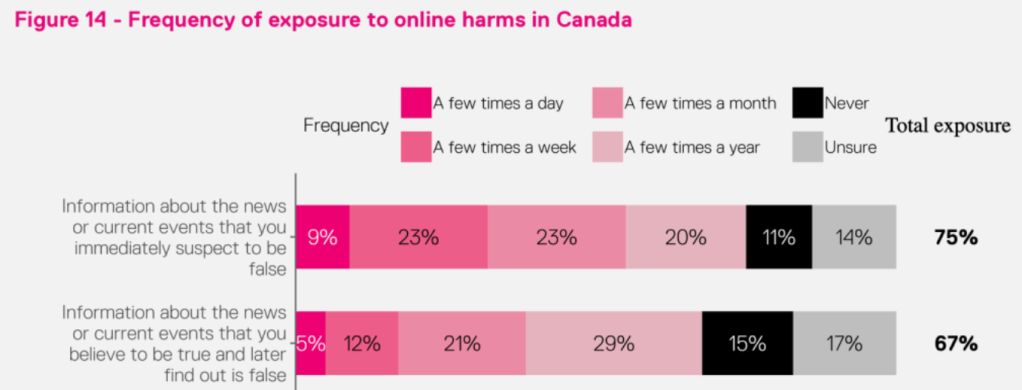
First, the polling confirms that Canadians see a lot of “fake news”:


Next, Dais looked at who is especially vulnerable to misinformation, or credulous of it, depending upon self-identified political views of the respondents; right, centre or left wing.

The pollster posed eight true/false questions about current affairs, described below with the correct answers (7 are false, one is true), in order to assign respondents to membership in “low, medium or high misinformation groups.”

Membership in the “low” misinformation group required at least six correct answers out of eight. Respondents were allowed to qualify their answers as “somewhat” true or false, or respond “don’t know.”

Seventy-eight per cent of left-wing identifying respondents scored six or better. Thirty-two per cent aced the test.

Across town in right-wing territory, only 34% scored six or better. Only six per cent nailed all eight.

Men and women performed about the same overall. Older Canadians did dramatically better than the younger generation (62% versus 45% for six or better). University-educated Canadians topped high school and college graduates. And finally, Québec respondents outperformed the rest of Canada by a considerable margin:

If you aren’t wound up enough by this point, consider that left-wing, university-educated, boomers from Québec have to be feeling pretty good about themselves.

Happy New Year.

***

If you would like regular notifications of future posts from MediaPolicy.ca you can follow this site by signing up under the Follow button in the bottom right corner of the home page; 

or sign up for a free subscription to MediaPolicy.ca on Substack;

or follow @howardalaw on X or Howard Law on LinkedIn.

I can be reached by e-mail at howard.law@bell.net.