
July 17, 2025
Travis Dhanraj’s lawyer is shovelling more coal into the litigation furnace by calling upon disaffected CBC staff to e-mail her with their complaints.
In a video interview with Candace Malcolm of Juno News, Kathryn Marshall issued a series of claims to illustrate former news host Dhanraj’s allegation that there are systemic violations of employees’ human rights at the CBC. Marshall said her inbox was full of e-mails from former staff and invited more.
It’s doubtful that any e-mails Marshall solicits from CBC staff past and present would be legally admissible in the human rights proceedings she says she is initiating on Dhanraj’s behalf.
But they can be theatre props in the public trial that Conservatives hope to schedule at the Culture and Identity (formerly Heritage) parliamentary committee in the Fall.
The feeding frenzy of conservative attacks on the CBC occasioned by the Dhanraj controversy is hardly surprising, it’s a permanent feature of our political landscape.
The blood in the water would be salacious evidence of feuding between Dhanraj and the CBC Parliamentary bureau, described by Marshall in her Juno interview. Specifically, her claim is that “a very close knit gang of Ottawa correspondents” were resentful of Dhanraj’s success in getting Conservative Party guests on his show and tried to bar those guests.
Marshall said she has “names, receipts and e-mails.” Those revelations, says Marshall, are “the CBC’s nightmare.”
Marshall also told Juno News that the CBC sought to punish Dhanraj for his X-post about then CBC President Catherine Tait by taking away his show, demoting him, and demanding he sign a gag order. She described CBC’s actions as “Stalinist” and later in the interview accused Dhanraj’s union the Canadian Media Guild of collaborating with the CBC (which would be illegal).
You get the picture.
The point of this kind of public campaign as an accessory to a legal claim is to define the public narrative. So far that story is not only how Dhanraj was treated by the CBC, but the credibility of CBC news journalism itself.
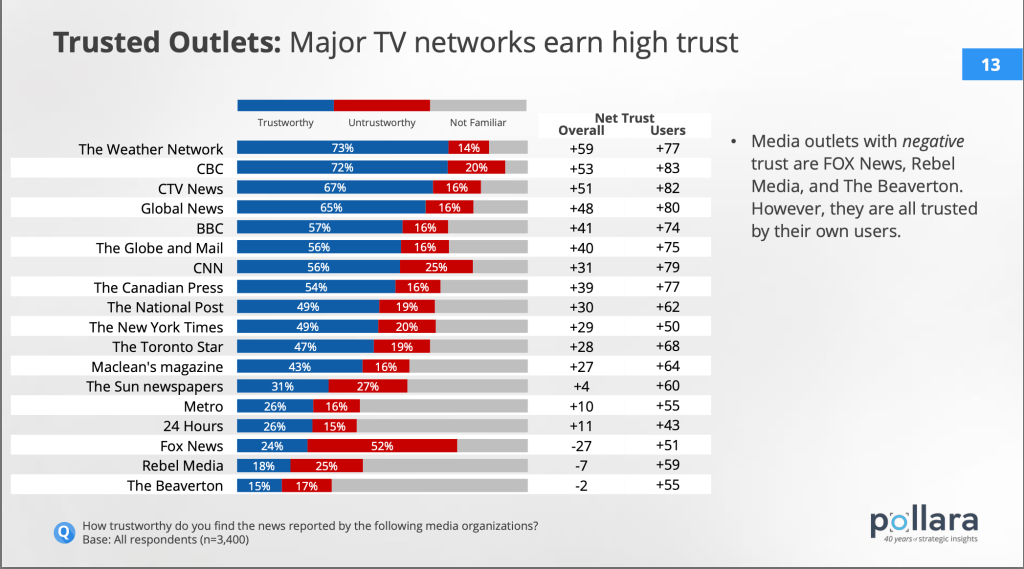
The credibility of the CBC might appear to be in jeopardy according to Dhanraj and conservative critics, but that does not seem consistent with public polling.
Last week Pollara released its annual poll on Canadian news media. CBC News continues to top the charts on both consumption and public trust. In fact, it went up over the last year, as the graphic below shows.
Still, the endless right-wing barrage against the CBC destabilizes the public broadcaster (I exempt from this tar-brushing the perceptive podcast episode posted today by The Hub’s Full Press, which is worth your time).
The CBC has done nothing to counter the Dhanraj narrative of a corrupt news culture —-it’s issuing rote denials while awaiting the filing of Dhanraj’s human rights complaint. The result is that a bunkered public broadcaster leaves a vacuum for others to fill and they are obliging.
The appointment of a new CBC President in January is now seven months old. After an early spate of interviews given by Marie-Philippe Bouchard, we’ve heard very little about any new direction or bold plans to meet criticisms or disappointments expressed about the public broadcaster.
That might be because Bouchard doesn’t know yet if the Prime Minister intends to keep his campaign promise to boost CBC funding by 11% this year, and more over time. That was complicated by this week’s disclosure that as part of its spending review the Carney government has asked CBC to submit a draft plan for deep budget cuts in 2026-2027.
Or it could be that Culture and Identity Minister Steven Guilbeault is still working on a new bill to implement election promises of better CBC governance and long-term financial independence that would require amendments to the Broadcasting Act.
MediaPolicy asked the CBC if there are any significant announcements coming and was told to expect something in the Fall. A similar inquiry to the Minister’s office did not get a reply in time for publication.
***
AI-generated image
This past week TikTok ramped up political pressure to convince the Carney government to undo the federal government’s 2024 decision to ban TikTok the company from Canada, but not the app.
The Liberals’ decision on TikTok followed US legislation to ban both the company and the app on the grounds of national security. Subsequently it was given a stay of execution by Donald Trump in his effort to force a sale of the Chinese-owned social media company to American interests.
Like the US law, the Canadian ban is based on undisclosed and/or hypothetical national security concerns about data security and the distribution of malevolent content, sponsored by China.
TikTok says it is winding up its Canadian operations to comply with the federal ban. Meanwhile it has bought media advertising pleading its case to the Canadian public, posted a posturing letter asking for a meeting with Industry Minister Melanie Joly, planned layoffs of its 350 Canadian staff and withdrawn its funding of Canadian creator development and event sponsorships.
Aside from the sponsorship largesse, TikTok is a major distributor of Canadian cultural content. According to Scott Benzie of the creator group Digital First Canada, TikTok has engineered its algorithm to be a heavy distributor of local content for users that activate the location service on the app, perhaps as high as 50% of “Nearby” and “For You” video recommendations. That’s something that foreign streamers won’t commit to.
With a lawsuit against the federal government on the go, TikTok says Ottawa has taken “measures that bear no rational connection to the national security risks it identifies.”
For its part, the government insists its investigation under the Investment Act in 2023 revealed “clear and legitimate concerns.”
When the ban was announced in November 2024, then Innovation minister François-Philippe Champagne said “I’m not at liberty to go into much detail, but I know Canadians would understand when you’re saying the government of Canada is taking measures to protect national security, that’s serious.”
The entire mess feels a lot like the Facebook ban on Canadian news even though the circumstances are quite different.
Michael Geist has published several articles on the TikTok ban, including this one, which apart from the familiar Liberal-bashing on digital policy I found persuasive (and it’s worth marking the occasion).
Another angle on the problem is something every Canadian is painfully aware of these days: when the American elephant rolls over, we can easily get crushed. And the crushers run the White House.
The troubling question is who isn’t cynical about the merits of the American ban of TikTok in the first place? Or that we are just obediently playing a vassal state by following suit?
The answer to the dilemma is for Carney to publicly defend the ban with as much disclosure of the national security threat assessment as possible, or to repeal it.
***
The Big Tech/Big Hollywood court challenge to mandatory cash contributions to Canadian media funds might get an answer from the Federal Court of Appeal before Labour Day.
Until then, the MediaPolicy boycott of streamer subscriptions (Netflix, Amazon and AppleTV) continues. I don’t miss two of them.
In their absence, I’ve made better use of my CraveTV subscription. That allows me to recommend an excellent new Canadian series, Empathie, a sad and funny drama set in a Montréal mental health facility.
***
If you would like regular notifications of future posts from MediaPolicy.ca you can follow this site by signing up under the Follow button in the bottom right corner of the home page;
or sign up for a free subscription to MediaPolicy.ca on Substack;
or follow @howardalaw on X or Howard Law on LinkedIn.
I can be reached by e-mail at howard.law@bell.net.
This blog post is copyrighted by Howard Law, all rights reserved. 2025.
 MediaPolicy.ca