
March 21, 2026
There was a brief political buzz this week when US Congressman Lloyd Smucker (R-PA) introduced a bill in the House Ways and Means Committee to ask the Trump administration to pronounce Canada’s Online Streaming Act Bill C-11 an unfair trade practice.
The technical term for the congressional request is a “section 301” investigation under the US federal Trade Act that can lead to retaliatory tariffs against other nations, Canada in this case, or it can fizzle out.
On the eve of CUSMA trade negotiations, Smucker’s congressional action is the expected statement of American intent. He and other Congressional representatives have sporadically demanded White House intervention since Parliament passed Bill C-11 in April 2023. In Canada, Smucker’s move was met with a smattering of told-you-sos from the foes of the Online Streaming Act, as was the case when Joe Biden’s White House expressed the same opposition to C-11.
The allegation of “unfair trade practice,” taken seriously, requires the Trump administration to recant its endorsement of CUSMA in 2018, a treaty that Smucker enthusiastically supported.
That’s because the Online Streaming Act, and the CRTC’s implementation of it that includes a 5% cash levy on US streamers to replenish Canadian media funds, almost certainly does not violate CUSMA, which may be why neither the Biden administration nor the Trump White House ever filed a complaint against C-11 that would have gone to a trade arbitrator for final resolution.
It’s not a violation of the CUSMA trade deal to impose financial or regulatory obligations on foreign companies that hurt their bottom line so long as Canadian companies are subject to broadly equivalent regulatory requirements that hurt their’s. That’s clearly the case in the Online Streaming Act and the CRTC levy.
None of that matters a whit, of course.
After plenty of lobbying, the US streamers believe they have the tariff-mad Donald Trump in their corner and they may well be right. With Paramount Plus having swallowed Warner Brothers Discovery under the new ownership of friend-of-Trump Larry Ellison, the streamers are even tighter with the White House than before. So who cares that Canadians obeyed the trade deal that Trump signed?
Netflix is all in for trade action too. This is mostly a case of smash and grab: they will take what they can get from the White House. In Europe, Netflix plays ball with regulators because they have no better option. In Israel, Netflix succeeded in getting streaming regulations scrapped at Trump’s request. As for Canada, Netflix told the CRTC two years ago it could live with a 2% cash levy (Disney seemed to be okay with something closer to 3%) —so quaintly pre-Trump, yes?—but if the new White House administration is willing to go to the mats for Hollywood, why not go for broke?
Meanwhile, the Carney government is sending some mixed messages to the US on how highly we value our culture.
Of course there was last summer’s Carney-cave on the digital services tax, but strictly speaking that was a corporate tax dispute rather than cultural legislation.
Most recently, our federal government’s projection of its own budgetary spending in the next three years suggests that Canadians love culture so much that the Prime Minister is prepared to make the deepest cuts to the CBC, the Canadian Media Fund (CanCon), the Canadian Periodical Fund (news journalism), the Canada Book Fund (Canadian books), and the Canada Music Fund (CanCon) since Stephen Harper took a cleaver to them.
The Main Estimates tabled in the House of Commons by Carney’s treasury board look something like this for 2026-2027:
- CBC: eliminate $192M from the $1.5B parliamentary grant (13% cut);
- Canada Media Fund: eliminate $68M from the $203M budget (33%);
- Canadian Periodical Fund: eliminate $13M from the $86M budget (15%) with a further $14M cut in 2028/29;
- Canada Book Fund: eliminate $3.4M from the $40M budget (8%);
- Canada Music Fund: eliminate $16M from the $40M budget (40%);
- TV5: eliminate $2M from the $13M budget (15%).
Funding for the Canada Council for the Arts, the Indigenous Screen Office, and the Local Journalism Initiative is frozen.
All of this violates the Liberal government’s election platform that left no wiggle room in promising to increase CBC funding by “an initial $150M” —implemented in 2025-26 budget —before moving on to future increases. At least the government hasn’t resorted to blaming Donald Trump’s tariff squeeze, well known to all when these election promises were made.
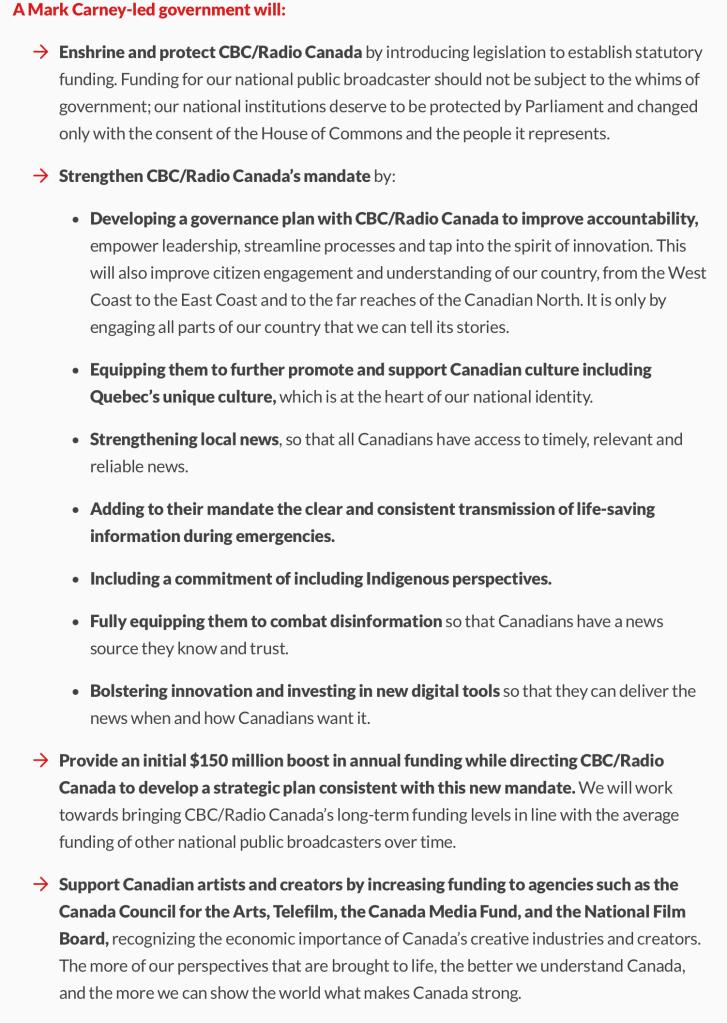
These cuts require a budget to make them final. But they aren’t a trial balloon. The Main Estimates were approved by cabinet’s treasury board and tabled in the House of Commons on February 26th, citing them as the government’s promised “comprehensive expenditure review.” Two weeks earlier, Heritage minister Marc Miller appeared before the Commons Heritage committee to praise the government’s increased cultural spending in the 2025-26 budget.
If there’s been any public outcry about Carney’s deep cuts to cultural spending, it’s been lost in the din. Somewhere, Stephen Harper is turning purple with indignation at the double standard.
As trade talks loom, it appears that Canada will defend its culture down to the last budget cut.
***
If you would like regular notifications of future posts from MediaPolicy.ca you can follow this site by signing up under the Follow button in the bottom right corner of the home page;
or sign up for a free subscription to MediaPolicy.ca on Substack;
or follow @howardalaw on X or Howard Law on LinkedIn.
COMMENTS ARE WELCOME. But be advised they are public once I hit the “approve” button, so mark them private if you don’t want them approved.
I can be reached by e-mail at howard.law@bell.net.
This blog post is copyrighted by Howard Law, all rights reserved. 2026.

 MediaPolicy.ca
Deservedly sarcastic piece! Thank you for starting to man the ramparts.
LikeLiked by 1 person