
Narcity news post
March 30, 2026
Today is the CRTC’s deadline for the public to weigh in on the application by several independent television stations to officially designate Facebook and Instagram as digital news intermediaries under the Online News Act and force Meta to bargain news licensing fees with the broadcasters.
Despite Meta’s ongoing “ban” on Canadian news, there’s still plenty of Canadian news to consume on Facebook and Instagram.
Forty-four per cent of Canadians surveyed by Reuters in its 2025 Digital News Report said they still got news from social media.
But if news is banned from the two biggest social media platforms, Facebook and Instagram, how come so many Canadians find news on social media?
As you suspected, it’s because the Meta ban is selective.
For example, I follow the news site Narcity Canada on Facebook. I keep up with the biggest stories in the news cycle by reading its artfully presented posts linking to Canadian Press stories. Narcity also writes and posts travel and lifestyle news stories written by its own journalists, but not as much as it posts Canadian Press stories.
As the steady flow of Narcity posts suggest to the casual observer, Facebook appears to be a digital news intermediary that “makes news content produced by news outlets available to persons in Canada,” ban or no ban.
But the key is the phrase “produced by news outlets”: news publishers that would have a claim against Meta for licensing revenue if their news content wasn’t banned. If a news publisher has no claim, it isn’t banned.
This is Meta CEO Mark Zuckerberg’s legal strategy and, so far, it seems to be working: if Meta forbids Canadian “news outlets” to post news stories, or refuses to suffer others posting their stories, then he figures Meta doesn’t trigger its legal obligation to negotiate the mandatory licensing payments that the Online News Act contemplates.
That’s his plan, in theory anyway. The practice is different. Meta’s swiss cheesey news “ban” has holes:
- According to CRTC filings, Meta only half heartedly deletes user posts of news stories published by Canadian news outlets. Some posts remain for months or years as pointed out by the broadcasters who found their own news content posted by others on Facebook and Instagram.
- My own observation is that Meta doesn’t appear to be deleting news items posted by persons employed by banned news outlets (I’m not outing anyone!)
- As pointed out as a flagrant example by the litigating news companies, Facebook allows Rogers to post news videos from its Breakfast Television current affairs show, my guess is someone has decided wrongly that’s not news.
But most significantly to Meta avoiding cash liability, it seems to be quietly making its own calls on who is a news outlet, and who isn’t.
Despite the stream of Narcity top news stories of the day, the CRTC does not seem perturbed by this kind of thing in its December 2025 staff letter that wound up its staff investigation into the Meta ban.
Back in 2024, Narcity publisher Chuck Lapointe publicly celebrated Meta green lighting his publication’s return to Facebook. His post indicated this was a mindful decision by Meta and linked it to a ruling by the Independent QCJO Panel that Narcity doesn’t publish enough of its own news reporting to become eligible as a “news organization” to collect federal journalism subsidies under the Income Tax Act.
Replatformed by Meta, Narcity’s posts are a firehose of Canadian Press’s current events reporting, with less frequent posts of its own lifestyle and travel news.
Presumably Meta had Narcity sign-off on any compensation based on this policy:
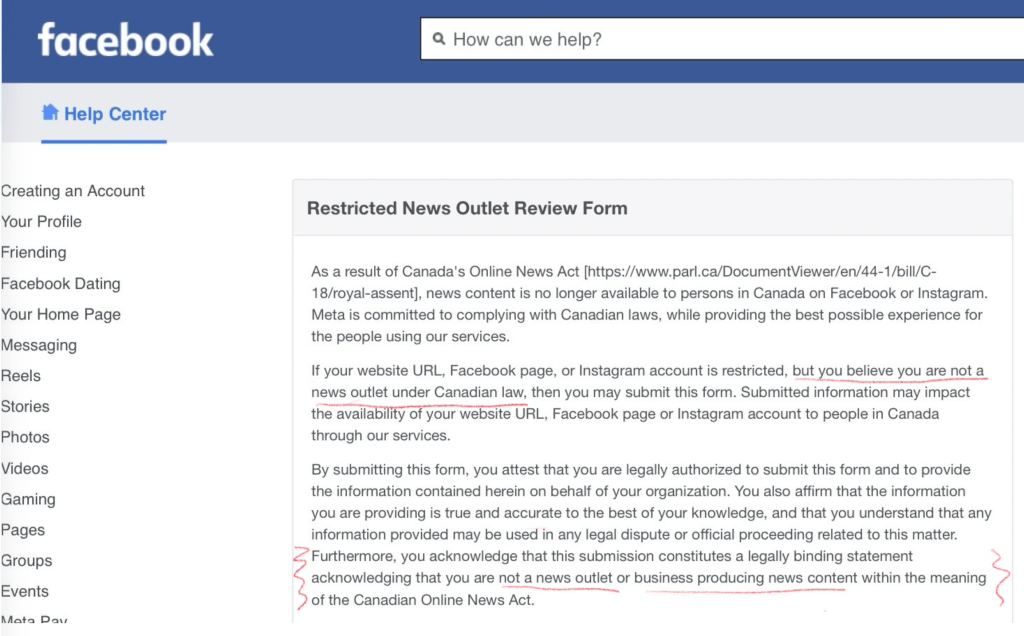
In the meantime, social media influencers like Mario Zelaya can post their own news content on Facebook, as can Canada Proud or freelance journalists like Rachel Gilmore. Meta doesn’t owe Gilmore or Zelaya any compensation for their content because a “news outlet” must employ at least two journalists under the Online News Act.
The bottom line is that Meta is not banning all news or news reporting, it’s only banning news published by news organizations that might make a legal claim for compensation as a “news outlet.” The rest, it doesn’t ban.
That draws the eye to section 51 of the legislation. It’s the undue preference provision which prohibits Meta from giving “undue or unreasonable preference to any individual or entity” while unjustly discriminating against or disadvantaging a news outlet.
***
The first two in a string of consumer lawsuits against Meta and YouTube has resulted in jury findings of liability and multi-million dollar damages against the social media platforms in Los Angeles and New Mexico.
The civil convictions were based on Meta’s and YouTube’s addictive design features, causing mental health damage to children.
The New Mexico case, where the jury awarded $375 USD million in damages, was also based on Meta and YouTube concealing the risks of sexual exploitation of children.
The juries made their decisions against YouTube and Meta regardless of the fact that US juries are prohibited by federal law from considering the harmful nature of the posted content —-shielded under a 1996 law that gives immunity to online common carriers of content posted by third parties— so plaintiffs must convince juries that the platforms’ addictive design features and the lack of default safety mechanisms are to blame for human harm.
***
If you would like regular notifications of future posts from MediaPolicy.ca you can follow this site by signing up under the Follow button in the bottom right corner of the home page;
or sign up for a free subscription to MediaPolicy.ca on Substack;
or follow @howardalaw on X or Howard Law on LinkedIn.
COMMENTS ARE WELCOME. But be advised they are public once I hit the “approve” button, so mark them private if you don’t want them approved.
I can be reached by e-mail at howard.law@bell.net.
This blog post is copyrighted by Howard Law, all rights reserved. 2026.

 MediaPolicy.ca