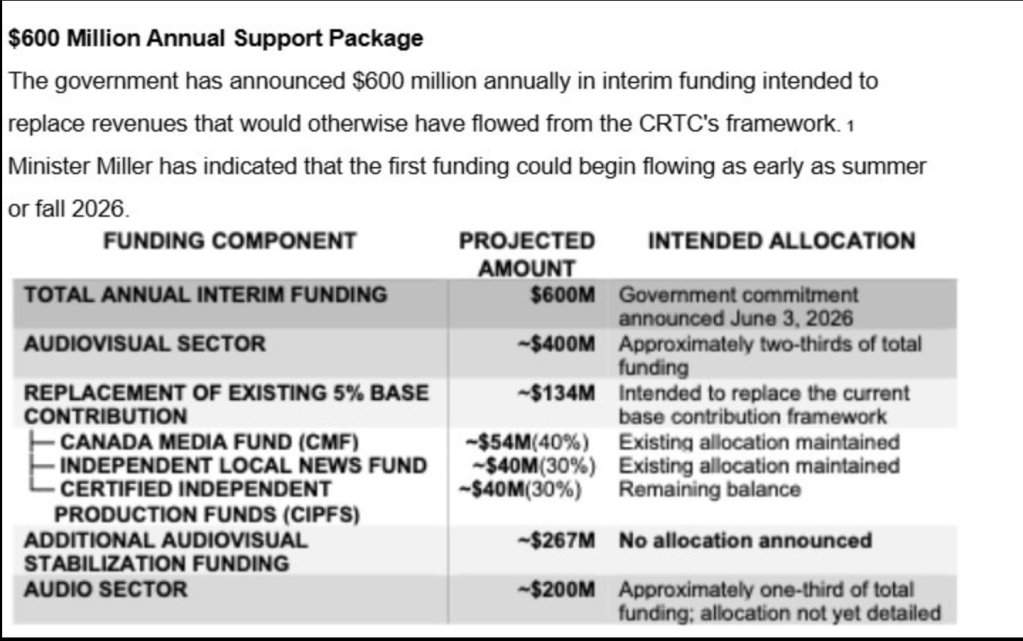
CanCon’s future is now: a conversation with Brad Danks

June 3, 2026

Brad Danks is the CEO of OUTtv Media Global, based in Vancouver. Most Canadians know OUTtv as the Canadian LGBTQ television channel. I interviewed Danks back in 2022 when the parliamentary debate over the Online Streaming Act was cooking on high heat.

He’s a bit of a unicorn: a broadcaster who is perfectly comfortable talking policy. With his eye cast on the future of Canadian broadcasting, Danks just wrote a 60,000 word, seven-part series Beyond the Walled Garden published in Cartt.ca last month. It’s time we caught up.

MediaPolicy: Brad, instead of a very long introductory paragraph to set up this Q&A, I’m just going to give you my undergrad-level synopsis of your Cartt.ca series. I promise I didn’t use AI. So here goes, this is me channelling you:

We’ve been trying to renovate the current CRTC regulatory model using the tools granted by the Online Streaming Act Bill C-11, but that is just “optimizing for managed decline.” It’s triage. A policy model that is singularly devoted to production financing for a domestic market runs counter to competing in the global supply of content. The regulatory framework must be to make it possible for Canadian content producers to monetize content on a global scale.

And increasingly, it is Canada’s small and medium-sized content producers, not the big three broadcasting companies, Bell, Rogers, and Québecor, that represent Canada’s best hope. That’s because OUTtv and our fellow SME Canadian services can succeed in creating specialized, authentic content that is both relatable and popular with foreign audiences who find affinity with it. It’s effectively the YouTuber creator strategy, scaled up. This distribution strategy is what the CRTC and our funding institutions need to spend more time and resources on supporting. And that means incentivizing and rewarding broadcasters that make and distribute their own proprietary content, don’t partner away their IP for a quick buck, don’t blow the budget on American shows, and grow their businesses by finding audiences around the world.

A crucial part of doing that is AI. The integration of AI tools is the key to success for SMEs seeking loyal audiences scattered across the in-between spaces in foreign markets. But our funding institutions that are CRTC-adjacent, like the Canada Media Fund, take no notice of AI development as worthy of subsidy or support. We need to encourage and reward the sharing of digital and AI infrastructure for Canadian SMEs through regulatory incentives and support. The data-collector Numeris is a salutary example.

At the same time, we can’t neglect SMEs succeeding in the Canadian domestic market. Unfortunately, the CMF’s and CRTC’s performances on this have been awful. The cable companies get away with clogging proper access for SMEs to reach cable audiences and monetize their content.

How did I do?

Danks – Good. The key point is that the system was designed for a different era. In that era, Canada had a technologically walled garden. Foreign content arrived through Canadian services, and in exchange for the licensed right to broadcast that content — at significant profit — the broadcasters were obligated to subsidize Canadian production. It was a cross-subsidy, and it worked. The problem is that the wall is coming down. Gradually at first because of streaming, and now faster because of AI. We have been propping up a structural problem without a long-term plan to replace it. The deeper problem is that we kept funding production without funding the infrastructure that connects that content to audiences. It’s like building cars without roads. The cars get made, but they have nowhere to go.

MediaPolicy – You’ve been writing for years that Canadian broadcasting regulation has been overinvested in the so-called national champions — the big and vertically integrated broadcasters Bell, Rogers and Québecor and at one time Shaw as well— who are supposed to save Canadian content. Do you still think that?

Danks – Yes, the Big 3 were supposed to be exactly that — the CRTC said as much in the Let’s Talk TV decision in 2015. Here’s the quote:

“The Commission expects that vertically integrated companies … will continue to have the opportunity to leverage their resources and audience reach … Their critical mass provides these companies with the financial capital required to succeed both domestically and internationally.”

And later in paragraphs 42 and following: “Canadian programming must seek out and develop international audiences.” That is the Commission acknowledging that domestic demand alone is no longer sufficient and that Canadian programming must increasingly compete in global markets. On paper, the Commission was telling the Big 3 they already had the scale to compete internationally. The bargain was giving them flexibility on where to spend their CanCon dollars.

MP: I think you’re about to tell me the Big 3 have not lived up to that bargain over the last ten years.

Danks – I’ve joked for years about a “MapleBox,” a Canadian BritBox we never built. The Big 3 didn’t step up. But a different group of companies has, Canadian-controlled programming services. I’m calling them the CSPs. They are the small and medium-sized operators that own libraries and reach audiences through their own SVODFAST, broadcast, and platform partnerships — OUTtv, Blue Ant, Gusto, Stingray, Anthem, and others. They are not production companies, nor are they cable or online distributors. They are building the MapleBox, one deal at a time. My view is simple. They should be supported by the system, and they are not.

MP: Not supported, in what ways?

Danks – The failure runs in four directions.

The first is the structural disadvantage of independent services in the cable television system. Since the 2011 vertical integration policy and the packaging changes from Let’s Talk TV in 2015, independent specialty services have been progressively marginalized on cable platforms. The large vertically integrated companies control both the pipes and many of the channels that travel through them. They have every commercial incentive to promote their own services and every available tactic to constrain competitors. The upcoming Market Dynamics decision is specifically about whether the Commission will finally address that imbalance.

The second is regulatory speed, and I’ll say more about that in a moment. We have active files before the Commission, so I’ll keep this brief. We have been materially harmed by delays. We have filed urgent applications, with the financial consequences documented and fully understood by Commission staff, and been told decisions may take not just months but years. The delay itself is the injury.

The third is the Canada Media Fund which provides very crucial programming subsidies. The CMF’s primary financing mechanism, the Broadcaster Envelope, allocates funding based on a broadcaster’s track record of supporting Canadian programming, measured primarily against domestic cable viewership. 

For a service like OUTtv, which has been deliberately building international distribution while domestic cable subscribers decline,  because that is the right long-term strategy, the CMF treats the right strategic choice as underperformance. Our envelope allocation shrinks as our international reach grows, because the system measures what we are moving away from, not what we are building toward.

The fourth is the complete absence of export support. The CMF measures Canadian audience and domestic production output. It does not measure export revenue, international subscriber growth, or the audience relationships being built in foreign markets. A service that invests resources in building global distribution, which the Broadcasting Act itself identifies as a policy objective, is invisible to the performance metrics that determine how much public support it receives. The system rewards businesses focused entirely on the domestic market, which is the market contracting fastest.

The common thread is that the system measures what it was designed to measure in 1985, and those measurements no longer align with the outcomes Canadian content policy is supposed to produce.

MP: You mentioned regulatory speed, or lack thereof. Give me an example.

Danks – The clearest one is the OneSoccer channel. Its owner Timeless complained to the CRTC in 2022 that Rogers was refusing to carry it. The Commission found in OneSoccer’s favour in 2023. Rogers challenged their Canadian ownership. The CRTC rejected that. Rogers appealed to the Federal Court of Appeal, and in May 2026 the court dismissed the appeal. It ruled that Rogers had raised a “forest of issues,” every one of them “without merit.” Four years, wins at every level, and the channel still isn’t on Rogers cable. They’re only now headed into arbitration over terms, just before Canada co-hosts the World Cup. The delay itself was the outcome, regardless of the merits. In a market that moves quarterly, a regulatory cycle measured in years isn’t just inconvenient. It works exactly like a tax. It raises the cost of capital, reduces what companies can reinvest, and pushes them toward lower-risk options. A system that rewards the use of delay is not one that works for independents.

MP: So what does Bill C-11 do, at least hypothetically, for Canadian SMEs like you?

Danks – So far, very little. C-11 gave the CRTC the tools. It didn’t determine how they’d be used. The open question is whether those tools get used to build the CSP layer, the Canadian-controlled services that retain IP and reach audiences directly. Or are the tools used just slow the decline of the existing model with new money from foreign streamers? The second part of the Market Dynamics decision is rumoured to be released in July. It will be the first real test of which way it goes.

MP: What are you hoping to see in that Market Dynamics decision?

Danks – Three things. The first is CSP access to distribution platforms. Canadians should be able to access Canadian services through the online distributors they actually use — Amazon, Apple TV, Roku, smart TV platforms — just as carriage rules ensured access on cable.

Second, prominence. It’s not enough to be available if no one can find you. A separate Canadian shelf that nobody visits is not the answer.

Third, the protections that already exist for independents on the cable side, like the standstill rule, the wholesale framework, a dispute process that resolves things, they all need to be improved and extended into the online world, not dismantled. This is the decision that determines whether there is a domestic foundation left to build on. WildBrain shut down four Canadian children’s channels after disputes with the large distributors. If this decision doesn’t fix access and the dispute process, we’ll keep losing the very companies the system should be building.

MP: You’ve introduced the term “Canadian-controlled programming services” (CSPs). What are they, and why aren’t they just producers?

Danks – A producer makes content. A CSP owns it, distributes it, and builds the audience relationship that compounds in value over time. OUTtv, Blue Ant, Gusto, Stingray, Anthem — these are the companies that actually built what the national champions were supposed to build. They are not production companies, nor are they cable or online distributors. They hold a different position in the value chain. The part that captures the long-term value. Right now, the system doesn’t recognize them as a category at all. That is the gap the Cartt.ca series pointed at.

MP: The independent producers might hear this as an attack on them and their copyright. Is this a zero-sum fight over CanCon IP?

Danks – It shouldn’t be heard that way, and it isn’t zero-sum. Producers are the creative engine. CSPs are the systems that deliver their work to a global audience and return value to them. They are different functions in the same value chain, and both have to be strong. 

But there is a deeper reason why Canadian producers are better off working with Canadian CSPs than with foreign platforms, and it has nothing to do with nationalism. The system can regulate us. The CRTC can attach conditions to our licences, require us to work with Canadian producers in ways that benefit both parties, mandate joint exploitation of IP across international windows, and enforce those conditions if we don’t meet them. It cannot do the same things to a major foreign platform, not in the same way, not with the same reach. When a foreign platform commissions a Canadian production, the producer gets paid and the platform gets the rights. What happens to those rights afterward is largely outside the regulatory system’s reach. When a Canadian CSP is the partner, we are inside the same regulatory structure as the producer. We have structural reasons to maintain relationships that work for both parties. Our licence depends on it. Our CMF access depends on it. Our standing in future proceedings depends on it. That accountability is not a constraint on us. It is exactly what makes us a better long-term partner. 

The major platforms face no equivalent structural incentive to make those relationships work. That is the difference.

MP: Can you elaborate on why retaining IP by Canadian services matters?

Danks – Two reasons. First, all rights and all monetization flow from IP. 

Second, in an AI world, creating derivative versions in different languages, formats, and genres becomes far cheaper, which raises the value of owning the underlying IP. But the real issue is not creation, it’s retention. The current system requires Canadian ownership at the production stage and then lets that ownership leak downstream through financing structures that assign international rights to whoever puts up the money. You can satisfy every ownership rule on paper and still hand the long-term value to a foreign platform. Owning IP on paper is not the same as keeping it, and keeping it is what the system doesn’t protect.

MP: Should the federal government be realigning its support — through the CMF, Telefilm, or the production tax credit — to better support CSPs?

Danks – Yes, and urgently. The CMF was built in 1985 to measure what mattered which was domestic linear audience and production hours. That is not what matters now. A CSP investing in global distribution, building audience relationships in fourteen countries, retaining IP across multiple revenue windows — that is exactly the outcome the system should be rewarding. Instead, that service is penalized because the metrics don’t capture what it’s doing. Comparable support for export capability needs to become a priority. The instruments for these policies already exist. They just need to be redirected.

MP: Do you worry the Commission will never get a chance to address these issues? There’s been anxiety about how much of C-11 will survive CUSMA and trade retaliation.

Danks – Yes, I think we should all be worried about the scope of US retaliation and the trade-offs required. On the contribution obligation itself, the anxiety is mostly misplaced. European jurisdictions impose comparable or higher obligations, and the streamers continue to operate there. The precedent is clear. But here is what I want more people to hear. There is a whole set of policies that carry zero trade risk because they sit entirely outside CUSMA. Building Canadian-controlled services that own IP and reach audiences directly — we can do that regardless of where the trade talks land. The trade conversation has been crowding out the one policy direction that needs no permission from Washington.

MP: Okay, so what’s your elevator speech to the heritage minister?

Danks – Turn the policy lens toward what builds the Canadian system. Start at home. Canadian services, whether they ever export or not, need a fair foundation to operate from. That foundation is real access to audiences through the platforms Canadians use, prominence so they can be found, and a dispute process that resolves things in months rather than years. The Market Dynamics decision is the test of whether that foundation gets built. Without it, there is nothing to export.

For those services ready to grow beyond Canada, the Broadcasting Act already calls for an environment that encourages the development and export of Canadian programs globally. Export is not a by-product. It is a core objective and increasingly the only realistic path to replacing the distribution capacity we have lost to streaming over the past 15 years. The companies already doing this have built it without support. That must change.

The job now is to align the CRTC, the CMF, tax policy, and export development behind the same goal. That goal is to support Canadian services that serve Canadians well and can own and distribute what the system produces. No single decision does it alone. But every decision that fails to ask ‘does this build something durable?’ is a decision for managed decline, whether it calls itself that or not.

***

If you would like regular notifications of future posts from MediaPolicy.ca you can follow this site by signing up under the Follow button in the bottom right corner of the home page; 

or sign up for a free subscription to MediaPolicy.ca on Substack;

or follow 
@howardalaw on X or Howard Law on LinkedIn.

COMMENTS ARE WELCOME. But be advised they are public once I hit the “approve” button, so mark them private if you don’t want them approved. 

I can be reached by e-mail at howard.law@bell.net.

This blog post is copyrighted by Howard Law, all rights reserved. 2026.

CanCon Corks bobbing on the ocean: the CRTC’s new ruling on Hollywood streamers in Canada

May 24, 2026

The other shoe dropped this week when the CRTC delivered two rulings that nearly complete its new regulatory framework for Netflix and the rest of the Hollywood streamers, as well as Canadian television broadcasters. 

The reaction to the rulings from the Hollywood streamers and their Canadian enablers offered more heat than light. Media reports played them as a trade story and some breathlessly speculated on Culture & Identity minister Marc Miller’s inscrutable comments on X. 

Across the border, a steady stream of ominous threats and faux outrage from American trade officials is expected soon.

In the interest of a more cool-blooded debate, let me offer some analysis of the CRTC’s new rulings on direct streamer investments in Canadian content  (“Canadian Programming Expenditures,” or CPE) and the distribution and prominence of that content on streaming platforms, made “discoverable” so that shows made by Canadians don’t end up as wine corks bobbing on an ocean of global content.

The bottom line is that the CRTC’s expected ruling on those direct CPE investments came in at 15% of the revenues that streamers earn in the Canadian market.

That 15% includes a 5% subset of the (still unpaid) cash levy in favour of Canadian media financing funds imposed by the Commission in June 2024 as an “initial” CPE contribution, thus the feverish cries of “tripled contributions.” 

While the bar for streamers was set at 15%, the Commission lowered the parallel CPE contributions of Canadian broadcasters from 30% (or more) of their Canadian revenues down to 25%. The broadcasters have been fuming about their CPE obligations for years since cable subscriptions and Canadian television revenues began their downward descent around 2017 while the Hollywood streamers surged in growth and remained unregulated until the Online Streaming Act was finally legislated in 2023. 

The gap separating Hollywood streamer and Canadian broadcaster CPE is now reduced but still a substantial 10% of revenues (although it’s probably less than 10% when you take into account that more than a third of the streamer CPE consists of their cash dollars going out the door to media funds). 

Whatever number you ascribe to the remaining gap between streamer and broadcaster CPE contributions to CanCon, the Commission excuses this remaining favouritism shown to the streamers as being “equitable” as opposed to “equal” contributions. You be the judge if it’s equitable. The streamers insist its “discriminatory.”

The CRTC’s companion ruling on discoverability is poised to be a genuine victory for Canadian content and a vindication of the federal Liberals’ crawl-over-broken-glass efforts to legislate the Online Streaming Act. How big a victory depends on how soon and firmly the CRTC follows up on the key regulatory principles in the ruling:

  • The Commission states an expansive definition of “discoverability”: “Canadian content and services are discoverable if they are made available and visible to audiencesincluding when an audience is not actively seeking such content and services.”The emphasis is on the streamers making their Canadian content highly visible on their platforms, irrespective of whether Canadians are patriotically seeking it out through keyword searches or on the streamers’ ghettoized “Canada” tabs.
  • To make this happen, the CRTC tasks each streamer to offer the Commission “measurable outcomes” in making Canadian shows prominent with transparent and annual measurements using standardized data. The Commission has told streamers that Canadian content should be “presented consistently when audiences browse landing pages, recommendations, categories, carousels and playlists” and not just “dedicated spotlight categories” for Canadian content.  And just in case the streamers don’t get the message, the Commission says it expects “equitable” platform exposure of Canadian content in Canada, a deliciously vague objective that should keep entertainment lawyers well employed. 
  • And the Commission expects streamers “to facilitate the installation, integration and/or promotion of [Canadian broadcasting services of exceptional importance] and local streaming apps and stations on Smart TVs, set top boxes or other devices so that they are easily visible to consumers.” This is bold stuff. It’s not clear how the Commission is going to implement this in cases where screen interfaces are installed by television manufacturers: the Québec provincial government says it’s going to legislate it.

Source: CRTC

Taking these Commission pronouncements on discoverability at face value, this is good news for Canadian content. As television broadcaster Brad Danks wrote in his recent series of articles in Cartt.ca, we are overdue to pivot from our singular focus on regulatory support for production financing in favour of supporting distribution, prominence and the cultivation of loyal audiences at home and abroad. 

From here, the streamers’ self-designed discoverability strategies will have to pass muster before the Commission in the final phase of the legislation’s implementation, the application of “tailored conditions of service.” That will likely take another year to complete, assuming a light-speed effort by the Commission. Beyond that, the Commission is allowing the streamers three years to meet these higher expectations of CanCon discoverability. That will put us seven years from Royal Assent to full implementation of the Online Streaming Act.

Of course, the streamers want no part of any of this, neither CPE nor discoverability, judging from their cede-no-quarter opposition to any regulatory obligations, court appeals and weaponization of American trade power over the last three years.

The streamer fury is highly performative. But let me speculate on at least four things about the Commission’s latest rulings that might genuinely stick in their collective craw. 

The first is copyright. The streamers notched a big win last November when the Commission announced its new rule about whether non-Canadian services could hold copyright ownership in the Canadian shows eligible for its CPE quota for direct CanCon investments (as opposed to paying copyright-owning Canadian producers to license their shows for Canadian release or global distribution). 

It’s a complex issue that I wrote about here. In brief, in any production partnership the owner of majority copyright in a show holds an advantage in negotiations over return on investment, revenue sharing and the long-term commercial exploitation of the intellectual property flowing from a successful production. 

During parliamentary hearings in October 2022, Netflix identified copyright ownership as its number one priority. But despite the clear language in the Online Streaming Act favouring copyright remaining vested in independent Canadian producers, the Commission sided with Netflix and the other Hollywood streamers. Incensed by that ruling, I wrote about ithere.

Alas I incensed too soon. The Commission evidently had more to say about copyright. In this most recent ruling, the Commission claws back some of that apparent streamer victory. Under the heading “enhanced partnerships,” the CRTC directs the streamers to earmark about a third of their 15% CPE for co-ventures with independent Canadian producers in which the Canadians retain majority copyright. 

By my figuring, the streamers will have to cede majority copyright to independent Canadian producers in Canadian shows in its programming budget amounting to a 4.5% envelope of Canadian revenues within its 15% overall CPE. That leaves the streamers contributing 6.55% of revenues in media fund cash payments (see below) and 4% for direct content investments in shows where they can retain majority copyright. 

Another unwelcome surprise for the streamers was the CRTC rethinking the mulligan it gave the streamers back in June 2024 when it extended an option for streamers to shave off 1.5% of their initial 5% cash levy to media funds to 3.5%. The deal was that the streamers could withhold that 1.5% (of a total 2%) contribution to the Canada Media Fund provided they invested the money directly in Canadian shows. It was essentially a downpayment on their yet-to-be-determined CPE. In setting a final CPE number of 15% the Commission eliminated the 1.5% opt-out. That leaves the streamers paying out of pocket to media funds at the full “initial” 5%. 

The Commission then tacked on to that 5% an additional cash levy of 1.55% of revenues to feed a new Services of Exceptional Importance Fund —more or less demanded by federal cabinet and Parliament— to replace the per subscriber “wholesale rates” that Canadian cable operators pay to vital services such as CPAC, the Weather Network, APTN, Uvagut TV, Omni, TV5, and CBC/Radio-Canada news in official minority language regions. The major Canadian broadcasters will pay the 1.55% levy too.

The last of the craw-stickers is probably the Commission’s rejection of the streamer proposal to count their marketing expenses towards their fulfillment of CPE spends. The Commission reaffirmed its existing policy that only small and medium sized Canadian broadcasters get that break. The streamers and the big Canadian broadcasters will not get it, in the name of maximizing contributions to production financing. On the other hand, the Commission told the streamers it remains open to them pitching a detailed plan on whether their financial sponsorship of creator training and development ought to count in CPE calculations. 

That’s the impact of the rulings on the streamers. There were some controversial results for Canadian media companies too, not limited to the “equitable” 10% CPE gap with streamers.

The Commission followed through with its preliminary view expressed in the notice of consultation by abolishing the mandatory spending category of “programs of national interest,” (PNI) a subset of CPE spending quotas to support feature films, drama series, comedy shows and documentaries. The notice of consultation didn’t elaborate much on the Commission’s thinking except to wonder aloud if the US streamers were going to flood the market with so many Canadian movies and serials that the Commission could relieve Canadian broadcasters of their PNI spending obligation. 

The major Canadian broadcasters had been begging for this for years because shows in those PNI genres are difficult to make profitably (a foundational point made in 2020 by the federal government’s Yale Committee that recommended legislating the Online Streaming Act). For example, Corus Entertainment has been quite vocal that its survival depends on making more lifestyle programming at a higher profit and getting out of Commission-directed expenditures on dramas.  On the flip side, Canadian independent producers and creative guilds warned that when the Commission previously experimented by repealing special funding requirements for programs of national interest it backfired spectacularly with declining production investments, prompting the Commission reinstate the priority spending a few years later.

Citing no evidence for its 180-degree reversal from the Yale Report, the Commission nevertheless decided that while news, children’s programming, and French language content is unprofitable and “at risk,” English-language drama and documentaries are not.

I do not exaggerate when I say this is a repudiation of a half century of Canadian media policy built on a comprehensive regime of CRTC regulation and government subsidies that puts dramas at the heart of “at risk” content. The Policy Direction that the federal cabinet issued to the CRTC in June 2023 gave the Commissioners a lot of instructions and priorities on a great many issues, but not one of them deprioritized the historic funding for English language feature films and dramas. 

What Minister Miller thinks of this I cannot say. But his government funds Canadian feature films and drama series to the tune of well over a half billion dollars annually through the Canada Media FundTelefilm Canada and the federal CPTC production tax credit. 

There were other issues close to the hearts of Canadian broadcasters that remain unresolved in these new Commission rulings.

News is one. The CRTC elected to maintain its existing policy which is that about 35 independent television stations (including the Global News network) can draw subsidies from the Independent Local News Fund but that Bell CTV, Rogers City-TV and Québecor TVA cannot. In fact, the big three will have to continue underwriting their cash-hemorrhaging network stations at current levels or 15% of their 25% CPE (about $380 million), whichever is more. By doing this the CRTC is confirming its 2016 ruling which was, if you will excuse the vulgarity, that the telcos can suck it up. 

Source: CRTC

The consolation prize for news broadcasters is that the Commission will schedule new hearings on the sustainability of news programming sometime in the future. When we get there, that future may look much different than today, depending on what happens with funding from the Online News Act and the federal government’s new proposal to extend federal journalism tax credits to broadcasters.

As for the much-anticipated production financing for content made by Indigenous producers, and by producers from equity-deserving groups, that has been kicked down the road, but hopefully not too far. The major broadcasters and streamers will be expected to table a plan to improve production financing in those communities in the third and final regulatory phase of “tailored conditions of service.” 

***

If you would like regular notifications of future posts from MediaPolicy.ca you can follow this site by signing up under the Follow button in the bottom right corner of the home page; 

or sign up for a free subscription to MediaPolicy.ca on Substack;

or follow 
@howardalaw on X or Howard Law on LinkedIn.

COMMENTS ARE WELCOME. But be advised they are public once I hit the “approve” button, so mark them private if you don’t want them approved. 

I can be reached by e-mail at howard.law@bell.net.

This blog post is copyrighted by Howard Law, all rights reserved. 2026.
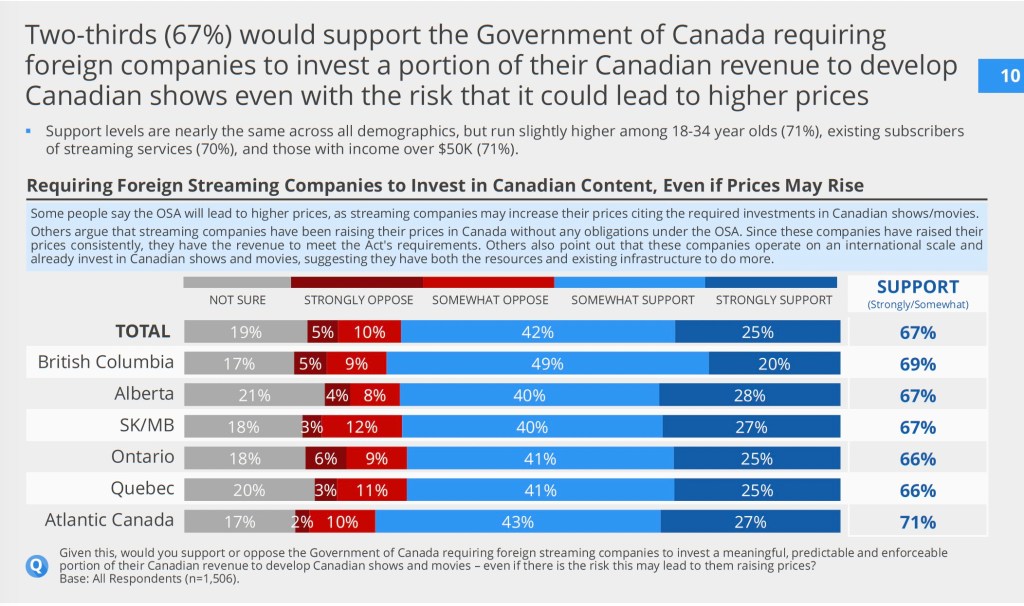
When you’re the last to know.

AI Photo Illustration

April 25, 2026

We, the people, were the last to know.

On Thursday, CBC president Marie-Phillipe Bouchard told Heritage committee MPs the $150 million increase in the public broadcaster’s parliamentary grant for 2025 was “temporary.”

In fact, she said in response to a question from Bloc MP Martin Champoux, “we knew it was temporary.”

Bouchard’s answer is a revelation because, until the Carney government published its Main Estimates for the 2026-27 federal budget, neither the Prime Minister nor the author of the 2025 federal budget that included the $150 million, Finance minister François-Phillipe Champagne, told the public that the new CBC money was temporary. 

Announced this February, the 2026-27 budget projection cuts $192 million from the public broadcaster.

The Prime Minister, who promised the $150 million in his April 2025 election platform as a downpayment on a larger funding increase, also told voters on the campaign trail that that in addition to the $150 million “we expect that in the coming years, we will continue to increase that funding until it can be compared to that provided by other public broadcasters.” (On budget day November 4, 2025 a carefully worded press release avoided the characterization of either a temporary or permanent increase).

And while Canadians might have taken the Prime Minister and the Finance minister at their word, it seems the CBC president knew otherwise. “We knew it was temporary.”

A follow up question from the Bloc’s Champoux, a former journalist, might have been “when did you know it was temporary?” And who told you?

But the question never came. Conservative MP Bernard Généreux followed up, but only to rib Bouchard over the Liberal budget cut and how perhaps the CBC had more to fear from the government than would-be CBC defunder Pierre Poilievre.

Liberal backbencher Bienvenu-Olivier Ntumba then asked Bouchard about the impact of parliamentary cuts on Radio-Canada. The CBC president replied that some staffing resources shared equally between French and English language services would be affected if cuts were “significant.” 

The government’s main budget estimates have scheduled a $192 million cut to the CBC budget, representing the repeal of the $150 million increase from the 2025 budget. An earlier $42 million boost under the Trudeau government in 2024, renewed in the 2025 parliamentary grant, was also repealed for 2026-27. 

Heritage minister Marc Miller appears before the committee on May 5th (update: now rescheduled to May 7th).

***

In our last MediaPolicy post, we reported on the stale news — I was on vacation, okay? — that the CRTC had reversed itself and agreed to provide a three cents per subscriber increase to the parliamentary news service CPAC.

Minutes before or after I hit the publish button on that post, CPAC CEO Christa Dickenson announced the termination of CPAC’s evening news show. The $2.8 million boost to her $13 million budget from the CRTC rate increase wasn’t enough to stabilize finances, according to Dickenson. The cancellation of the show meant 12 staff layoffs, including show host Michael Serapio.

An online hue and cry followed in response to the CPAC announcement and Heritage minister Marc Miller joined in with a tweet suggesting that the CRTC’s delay in implementing the Online Streaming Act was to blame:

As I retweeted at the time, oh my.

By linking the CPAC layoffs to a live CRTC file dealing with requests to deliver financial relief to “services of exceptional importance,” the minister seemed to be saying that the independent regulator ought to giddy up and deliver it to CPAC.

That special funding was requested by CPAC on July 2, 2025, citing its services of exceptional importance including the now eliminated evening shows, and is still under consideration by the Commission.

Miller’s impatience with the languid pace of CRTC decision making on implementation of the Online Streaming Act is shared widely, for good reason. But now the Commission’s eventual decision on funding services of exceptional importance will either be a yes (submitting to its minister) or no (defying its minister). 

A footnote to this story: on the same day that Miller was tweeting about CPAC, the CRTC followed up its increase to CPAC’s subscriber rate with a two cent increase for TV5, the French language news service. 

CPAC’s Dickenson appears before the Heritage committee this coming Tuesday, April 28th.

***

One of the better kept secrets in minister Miller’s thoughts is what he has in mind by appointing a special advisory committee on the future of Canada’s audio visual industry.

The ministerial appointments are mostly not the usual suspects and stakeholders, bending instead towards active industry executives, producers and investors.

The committee’s mission is framed by the minister in high level language: 

The Government of Canada is reviewing how it supports the audiovisual sector. The current framework for federal audiovisual support was built for a different era and needs to evolve so Canadian stories can thrive, both at home and globally. The goal is to make sure that federal support remains effective, efficient and transparent, and that it can support the full spectrum of Canadian voices and stories. The work includes reviewing audiovisual policy and institutions.

Parsing that brief statement, change is certainly in the wind, but what? Presumably, committee members asked the Minister for something more detailed when they were recruited. It’s a good bet they aren’t signing on for a mere reorganization of government departments Telefilm, CAVCO, the National Film Board or the Canada Media Fund.

The CanCon-funding Canada Media Fund immediately expressed support for the minister’s “modernization” agenda. This suggested that the CMF, jointly governed and funded by the federal government and Canadian cable companies, knows what that agenda is. Asked for comment on its understanding of what in Miller’s agenda it is endorsing, the CMF replied “the CMF shares the Minister’s view that the current framework was built for a different era and needs to evolve.”

The rest of us, we’re on a need to know basis.

In the absence of more information, it is reasonable to speculate that the Liberals are going to re-launch something like the dead-ended 2016-17 federal policy review conducted by Heritage minister Melanie Joly that dismissed pleas for what became the Online Streaming Act in 2023 and instead called for more government support of exported Canadian content and a Canadian spending commitment from Netflix.

If you want to get a flavour of what an export strategy might look like, I recommend Ken Whyte’s latest Substack post which admires how Korea has remodelled its cultural production policies since the 1990s. (Coincidentally, Whyte served on Melanie Joly’s advisory committee in 2017). 

***

If you would like regular notifications of future posts from MediaPolicy.ca you can follow this site by signing up under the Follow button in the bottom right corner of the home page; 

or sign up for a free subscription to MediaPolicy.ca on Substack;

or follow @howardalaw on X or Howard Law on LinkedIn.

COMMENTS ARE WELCOME. But be advised they are public once I hit the “approve” button, so mark them private if you don’t want them approved. 

I can be reached by e-mail at howard.law@bell.net.

This blog post is copyrighted by Howard Law, all rights reserved. 2026.
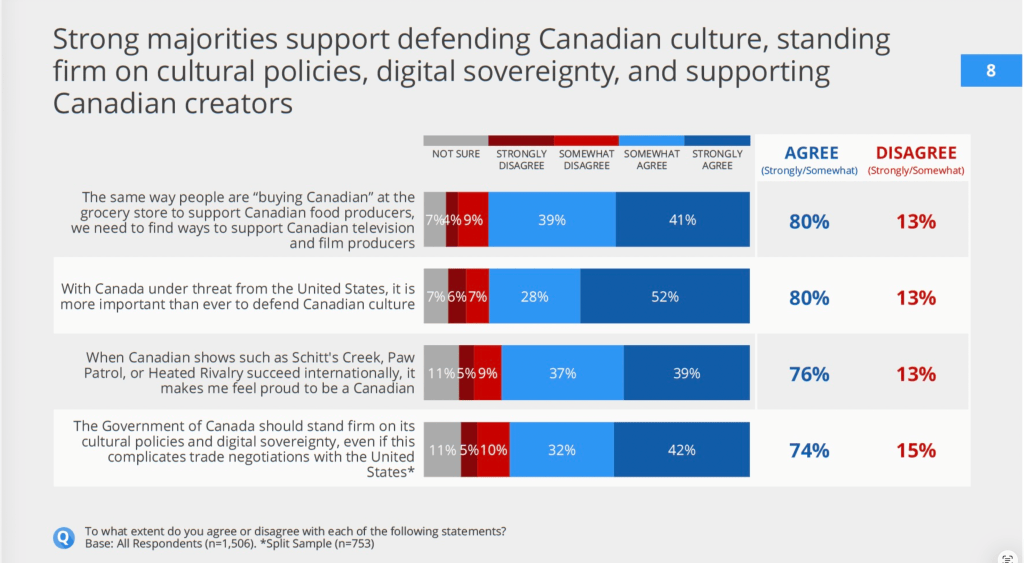
Catching Up on MediaPolicy – Streamers spending less in Canada – CPAC gets a raise – Independent TV stations want interim funding – Bloc MP rips Rebel News

Slide from Profile 2025

April 21, 2026

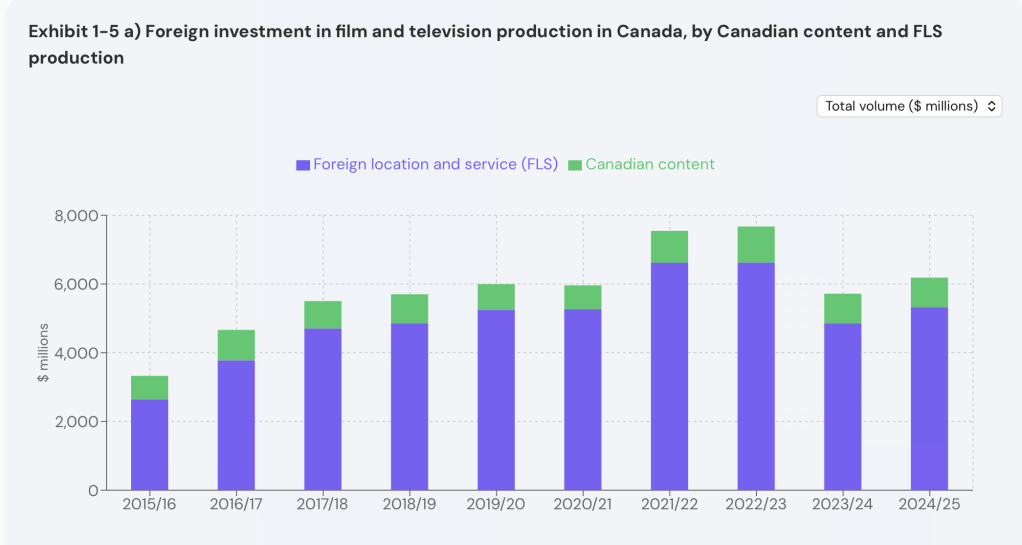
This week the Canadian Media Producers Association released its annual Profile snapshot of how much money is being spent in Canadian video production, both for Canadian content and American shows shot on Canadian soil.

It’s best to draw conclusions from these Profile reports over an arc of multiple years. But there’s no mistaking what is going on.

The numbers are anemic this year and suggest that the lucrative FLS (“foreign location shooting”) business in shooting US shows is a little better than last year but not going to recover to its 2022 peak. 

We are past peak spending by global streamers and the viral FLS growth that Canada enjoyed from in 2015-17 has now, in real terms, appeared to have levelled off. In inflation adjusted dollars, Canada is back at 2018.

Aside from FLS, Canadian content spending is also down, even without taking inflation into account. 

That’s because the CRTC’s required investment and spending requirements for Canadian broadcasters continue to tail off with the decline in earnings. But CanCon investments by US streamers also continue to drop although you wouldn’t know it from parsing the statement that Hollywood’s Motion Picture Association gave to Cartt.ca in response to the CMPA report:

Global studios and streamers, including MPA-Canada member studios, are leading investment in the Canadian film, television, and streaming industry. In addition to driving the majority of production spending and employment in Canada, global studios and streamers have proudly become one of the largest sources of private financing for Canadian productions, providing more financing than the Canada Media Fund (CMF) and Telefilm combined. The report clearly makes the case MPA-Canada’s members have been making for years: global investors are already a vibrant and indispensable capital partner of the Canadian screen sector.

The MPA is making a couple of points here, the first being that Hollywood continues to shoot a lot of US production here in Canada, thanks to our world class facilities and production crews, a low Canadian dollar, and Canadian taxpayer support through subsidies. As I mentioned, FLS has receded to 2018 levels now.

MPA’s other claim is that US studios have proudly become “one of” the largest sources of private financing for Canadian content. That’s certainly a true statement of fact (the other “one of” being Canadian private investment). More to the point, it’s policy hieroglyphics for saying the streamers’ investment largesse ought to win them a mulligan from cash contributions to Canadian media funds, something they are opposing in court.

Revealed in the report’s fine print, streamer investments have declined in the last four years, from $480 million to $408 million in English language production, a 22% drop in real dollars. In French language productions, streamer investment has declined from $13 million to $7 million although the story there is not the decline but the size of the investment.

***

The creaking of the floorboards beneath the feet of publicly funded Canadian television news is getting louder.

In a decision that split the CRTC panel hearing the case, the non-profit parliamentary news channel CPAC finally obtained the increase to its regulator-fixed cable subscriber rate that it has been asking for since July 2024. The rate of 13 cents per monthly subscriber ordered by the Commission in 2018 will go up to 16 cents this fall. All cable companies must absorb the cost within the CRTC-capped price of a basic cable subscription. In an odd twist to the story, CPAC is owned by five cable companies Rogers, Eastlink, Cogeco, Québecor’s Vidéotron, and Access Communications.

Based on its 2024 regulatory filing, CPAC is a $14 million operation and lost $1.38 million in 2024. According to CPAC CEO Christa Dickenson, it’s now a $13 million operation and the three cent bump will bring in $2.8 million.

The Commission reversed itself from a ruling in November 2025 that it was deferring making a decision on the applications from CPAC, TV5 and Vue et Voix for higher subscriber fees because other CRTC panels are seized with the two high level reviews of television and streaming services that were publicly heard in the spring and fall of 2025 and which are due to be published “in the coming months.” Many months later, there remains a graveyard silence on those files.

During that stretch of time, CPAC very publicly warned that it was about to hit a financial wall and its programming was at risk. CPAC broadcasts Parliamentary proceedings as well as occasional coverage of court proceedings, political conventions, conferences and general elections.

What also happened in the intervening time was that nothing was announced for CPAC in the Carney government’s main budget estimates in February. In 2024, the Trudeau administration cut a $5 million cheque to upgrade its equipment. But historically CPAC has only been funded by cable subscriber fees, having been cut adrift from the CBC in the 1990s. It is not licensed to sell advertising. 

Update: Within minutes of publishing this MediaPolicy post, CPAC CEO Christa Dickinson posted on LinkedIn that despite the additional revenue expected from the increase in the subscriber rate, CPAC was cancelling its French and English language evening political shows and laying off 12 staff, including the host Michael Serapio.

***

Another loud floorboard creak just emanated from independently owned local television stations in Québec.

Executives from RNC Media and Télé Inter-Rives are making pleas for the CRTC or the federal government to do something quick about the shortfall in the Independent Local News Fund that supports as much as 70% of newsroom expenses to 17 independent stations across Canada. 

The stations relying on the ILNF media fund have been waiting since CRTC’s 2022 approval of the Rogers-Shaw merger to sort out the consequences of admitting 15 additional Global News stations to the $17 million ILNF pool sponsored by Canadian cable companies. The doubling of stations effectively cuts the news subsidies in half.

The Commission thought it had squared this circle in 2024 by ordering Netflix and the US streamers to inject a further $42 million into the ILNF. But the extra money is in escrow while the streamers fight the levy in court.  

Bloc MP Martin Champoux is advocating for the federal government to step into the breach. He is recommending the federal government extend federal QCJO labour tax credits from the current program supporting only online journalism provided by print publishers to include news websites operated by broadcast companies. The CAQ government in Québec did just that in March with its provincial news subsidies that parallel the federal QCJO program. 

***

It is always entertaining for the discomfitters to be discomfitted. Rebel News editor-in-chief Shiela Gunn Reid was ripped by Bloc MP Champoux at the parliamentary Heritage committee hearings for allowing her boss, Ezra Levant, to spin nonsense about the committee proceedings being “cancelled” to prevent Gunn Reid from speaking.

Karyn Pugliese has the story here.

***

If you would like regular notifications of future posts from MediaPolicy.ca you can follow this site by signing up under the Follow button in the bottom right corner of the home page; 

or sign up for a free subscription to MediaPolicy.ca on Substack;

or follow 
@howardalaw on X or Howard Law on LinkedIn.

COMMENTS ARE WELCOME. But be advised they are public once I hit the “approve” button, so mark them private if you don’t want them approved. 

I can be reached by e-mail at howard.law@bell.net.

This blog post is copyrighted by Howard Law, all rights reserved. 2026.
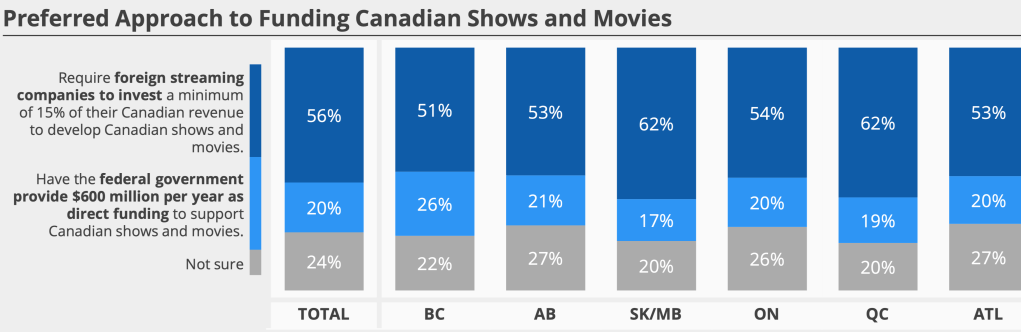
Catching up on MediaPolicy – CRTC will adjudicate Meta’s ban on Canadian news outlets – US juries find Meta and YouTube liable for online harms to children

Narcity news post

March 30, 2026

Today is the CRTC’s deadline for the public to weigh in on the application by several independent television stations to officially designate Facebook and Instagram as digital news intermediaries under the Online News Act and force Meta to bargain news licensing fees with the broadcasters.

Despite Meta’s ongoing “ban” on Canadian news, there’s still plenty of Canadian news to consume on Facebook and Instagram.

Forty-four per cent of Canadians surveyed by Reuters in its 2025 Digital News Report said they still got news from social media.

But if news is banned from the two biggest social media platforms, Facebook and Instagram, how come so many Canadians find news on social media?

As you suspected, it’s because the Meta ban is selective.

For example, I follow the news site Narcity Canada on Facebook. I keep up with the biggest stories in the news cycle by reading its artfully presented posts linking to Canadian Press stories. Narcity also writes and posts travel and lifestyle news stories written by its own journalists, but not as much as it posts Canadian Press stories.

As the steady flow of Narcity posts suggest to the casual observer, Facebook appears to be a digital news intermediary that “makes news content produced by news outlets available to persons in Canada,” ban or no ban.

But the key is the phrase “produced by news outlets”: news publishers that would have a claim against Meta for licensing revenue if their news content wasn’t banned. If a news publisher has no claim, it isn’t banned.

This is Meta CEO Mark Zuckerberg’s legal strategy and, so far, it seems to be working: if Meta forbids Canadian “news outlets” to post news stories, or refuses to suffer others posting their stories, then he figures Meta doesn’t trigger its legal obligation to negotiate the mandatory licensing payments that the Online News Act contemplates.

That’s his plan, in theory anyway. The practice is different. Meta’s swiss cheesey news “ban” has holes:

  • According to CRTC filings, Meta only half heartedly deletes user posts of news stories published by Canadian news outlets. Some posts remain for months or years as pointed out by the broadcasters who found their own news content posted by others on Facebook and Instagram.
  • My own observation is that Meta doesn’t appear to be deleting news items posted by persons employed by banned news outlets (I’m not outing anyone!)
  • As pointed out as a flagrant example by the litigating news companies, Facebook allows Rogers to post news videos from its Breakfast Television current affairs show, my guess is someone has decided wrongly that’s not news.

But most significantly to Meta avoiding cash liability, it seems to be quietly making its own calls on who is a news outlet, and who isn’t.

Despite the stream of Narcity top news stories of the day, the CRTC does not seem perturbed by this kind of thing in its December 2025 staff letter that wound up its staff investigation into the Meta ban.

Back in 2024, Narcity publisher Chuck Lapointe publicly celebrated Meta green lighting his publication’s return to Facebook. His post indicated this was a mindful decision by Meta and linked it to a ruling by the Independent QCJO Panel that Narcity doesn’t publish enough of its own news reporting to become eligible as a “news organization” to collect federal journalism subsidies under the Income Tax Act.

Replatformed by Meta, Narcity’s posts are a firehose of Canadian Press’s current events reporting, with less frequent posts of its own lifestyle and travel news.

Presumably Meta had Narcity sign-off on any compensation based on this policy:

In the meantime, social media influencers like Mario Zelaya can post their own news content on Facebook, as can Canada Proud or freelance journalists like Rachel Gilmore. Meta doesn’t owe Gilmore or Zelaya any compensation for their content because a “news outlet” must employ at least two journalists under the Online News Act.

The bottom line is that Meta is not banning all news or news reporting, it’s only banning news published by news organizations that might make a legal claim for compensation as a “news outlet.” The rest, it doesn’t ban.

That draws the eye to section 51 of the legislation. It’s the undue preference provision which prohibits Meta from giving “undue or unreasonable preference to any individual or entity” while unjustly discriminating against or disadvantaging a news outlet.

***

The first two in a string of consumer lawsuits against Meta and YouTube has resulted in jury findings of liability and multi-million dollar damages against the social media platforms in Los Angeles and New Mexico.

The civil convictions were based on Meta’s and YouTube’s addictive design features, causing mental health damage to children.

The New Mexico case, where the jury awarded $375 USD million in damages, was also based on Meta and YouTube concealing the risks of sexual exploitation of children.

The juries made their decisions against YouTube and Meta regardless of the fact that US juries are prohibited by federal law from considering the harmful nature of the posted content —-shielded under a 1996 law that gives immunity to online common carriers of content posted by third parties— so plaintiffs must convince juries that the platforms’ addictive design features and the lack of default safety mechanisms are to blame for human harm.

***

If you would like regular notifications of future posts from MediaPolicy.ca you can follow this site by signing up under the Follow button in the bottom right corner of the home page; 

or sign up for a free subscription to MediaPolicy.ca on Substack;

or follow @howardalaw on X or Howard Law on LinkedIn.

COMMENTS ARE WELCOME. But be advised they are public once I hit the “approve” button, so mark them private if you don’t want them approved. 

I can be reached by e-mail at howard.law@bell.net.

This blog post is copyrighted by Howard Law, all rights reserved. 2026.

2026 will be Canada’s cage match

“G-S-P !

G-S-P !

G-S-P !”

December 31, 2025

You already knew it: Canada’s 2026 is going be a battle, a pivotal moment in our history.

CUSMA talks begin this spring. They will be brutal. Even in the innocent days of cross border free trade, the US played rough when it came to a trade dispute over Canadian culture.

This US President wants high tariff walls to keep Canadian goods out of America and to grab Canadian jobs. Going the other way he wants open borders and unregulated markets for US exports such as streaming services and social media apps.

Given the thousands of Canadian manufacturing jobs and family farms at stake in the trade talks, and the inevitable reprise of 51st state threats —-“we just have to have Greenland  Canada”— it may seem parochial at first to focus on media policy. But with 660,000 jobs in our media and cultural sectors, focus I shall.

Here are some of the upcoming headlines.

The CUSMA trade talks

An internet meme recently popped up in my X feed that put two contemporaneous statements from Google spokespersons next to each other.

In the first, Google addressed the digital regulators of a foreign government —-in this case the European Union—- with the utmost respect. In the second statement to a much different forum, Google demanded US Congress stomp all over the EU.

This is how the tech bros roll. They’ve enlisted the Trump administration in their cause and the tiff with the EU has escalated from White House accusations of European censorship of American content to barring the architect of the EU Digital Services Act and four advocates of the EU regulating online hate and disinformation from travelling in the US.

Canada, you’re warned.

So no surprise, when CUSMA talks begin the US is going to come loud and hard against Canada regulating media in our own country, whether it’s the Online Streaming Act C-11 or the Online News Act C-18. I don’t have a high degree of confidence that PM Mark Carney won’t flush them like he did the carbon tax, the digital services tax, the emissions cap, etc. 

It’s not that we shouldn’t reconsider Canadian media policy any time we want, but it would be better to do so because Canadians wish it. The polls say we don’t: at least not during the trade talks.

What’s at stake here is not only those two pieces of legislation, C-11 and C-18, but our right to take future action on any media policy that might cost the tech bros money or convenience. Think AI. Or online harms.

I make no prediction. On the one hand, as a banker and a corporate lifer I think Carney would happily throw cultural regulation under the bus.

On the other, if he does that he can kiss his Québec caucus goodbye. Or, the NDP might find its gag-point and bring down the Liberal minority government.

CanCon

I just can’t figure out the CRTC. The commissioners alternate between putting a bold $200 million cash levy on streaming services and, on the other hand, their timorous ruling on CanCon video content.

The Commission has three big decisions to release in the new year, arising out of the Online Streaming Act (having missed the December 2025 deadline set by cabinet).

The most consequential is the second instalment of the aforementioned CanCon video streaming ruling which will deal with issues that could carve out regulatory conditions for a generation:

  • How much money will Netflix and the California streamers have to spend on Canadian shows?
  • Will the Commission reduce CanCon spending for Canadian broadcasters (it will) and by how much?
  • Will the Commission swap out obligations for Canadian broadcasters to make CanCon dramas in favour of underwriting their unprofitable news operations?

The Commission owes us two other big ones in broadcasting distribution and audio streaming. There are lots of issues packed into those two rulings, but the one I am watching is whether the Commission will make Spotify and the music streamers grow the Canadian listening audience for Canadian artists (it’s currently less than 10%).

There are some wild cards in play.

The Federal Court heard the streamers’ appeal against the $200 million levy in June and judgment is overdue.

The legalities of appeal are narrow and amount to whether the Commission dotted the i’s and crossed the t’s. They don’t allow the streamers to easily challenge the CRTC’s wisdom on the size of the levies, nor what they are spent on (i.e. CanCon dramas and broadcast news).

Still, if the Court strikes down the levies on technical grounds just before the CUSMA talks begin it will significantly assist American negotiators or, if our Prime Minister’s climb down on the digital services tax is any guide, assist him in dumping trade ballast.

Another wild card is Québec’s new streaming law, Bill 109. It’s the CAQ’s claim to regulate streamers in case the federal CRTC disappoints on French language content on screens and AirPods. 

When CUSMA talks begin, Québec’s bill will be sited in the same American crosshairs as the federal C-11. With a Parti Québécois election victory in the offing, and possibly another referendum on separation we could hear a lot more about this provincial law.

Next, we can speculate on whether Global TV News makes it to 2027 in one piece. Its parent company Corus refinanced its debt this year and managed to land some new television programming to replace the profitable Disney and Discovery content that Rogers poached from them. 

But Corus still lives hand to mouth, and the news division loses a lot of money. The Shaw family ownership can’t find a Canadian buyer. Even Mark Carney wouldn’t dare exempt the 15-city Global News network from Canadian ownership rules and watch Fox or one of the other US television chains march in and set up shop in every major Canadian city.

The last question mark is a boutique policy issue but carries huge consequences for the survival of the Canadian film and television industry. The CRTC’s ruling that allows US streamers to own majority copyright in their new Canadian dramas turned four decades of Canadian cultural policy on its head. 

The domino that might fall is whether the Liberal government would harmonize the CRTC’s new rules about the ownership of intellectual property in Canadian dramas with its own rules that govern federal subsidies to Canadian programs. The CRTC ruling invites American trade negotiators to demand it.

Online Harms

If Justice Minister Sean Fraser tables an online harms bill in Parliament, it will be time for some soul searching by all of us.

How seriously do we take the online harms of race-baiting and anti-semitic hate, humiliation of women and girls, and harm to our adolescent and teenage children? Are we virtue signalling our concern or do we really want to do something about it?

On the other hand, we shouldn’t be so naive to think that these platforms won’t err on the side of censorship rather than pay fines for permitting harmful content on their services. That’s the sort of malicious compliance Meta meted out by banning Canadian news from Facebook and Instagram rather than comply with the Online News Act.

You can see this debate play out in its beta-version with Bill S-209, tabled by an independent Senator. That bill is legislation that would require porn sites and social media apps to exclude minors from accessing hardcore porn by using third party age verification services. 

Again, the harm is obviously serious, but how seriously do we take the harm? Even though the risks are remote, how much are we willing to gamble the privacy of porn site visitors and social media followers whose identities might be hacked and exposed?

All eyes will be on Australia which has grabbed global attention by banning teen access to social media, a move that requires age verification of adult social media accounts.

AI

It would be guesswork to predict what happens next with the amazing explosion of AI technology, its impact on economic growth and social harm, and government efforts to regulate it.

The most pressing policy questions are in the hands of AI Minister Evan Solomon who has frequently telegraphed his reluctance to impede the development of Canada’s fledgling AI industry by “over indexed” regulations.

But neither has Solomon warmed to the Big Tech campaign to create an American-style “text mining” exception in Canadian copyright law. If he did, he would be sinking any chances that Canadian news organizations and cultural creators have to force AI giants into paying license fees for scraping online content to feed their products. Hugh Stephens has an excellent summary of the current state of affairs, here.

The worst case scenario for content creators is very bad but grimly not a lot worse than the best case scenario.

Even if AI companies submit to paying license fees —-and there have already been a few licensing agreements struck between AI companies and a select group of big news publishers and content creators—– it’s entirely possible that in the next five years AI will so disrupt the direct interface between news organizations and news consumers that news outlets will pine for the days when Google and Meta were taking their hyperlinks for free but at least sending audience traffic their way.

Either the US or Canada may raise AI commerce or the mitigation of its harms at the CUSMA bargaining table. The Trump administration appears to be all in for making American AI into the global masters of the Internet.

But as many have pointed out there is a back eddy at state-level where MAGA politicians are as concerned about AI harms as anyone.

CBC Radio-Canada

After the CBC’s near death experience in the last federal election, policy wonks everywhere had suggestions on how the public broadcaster might re-capture the popular imagination with a strong programming line-up that resonates across the entire country.

We’ve had a statement of intent from the new CBC President: more local news, especially in the West, but what else?

If the Prime Minister gives away the media policy store to the Americans, what the CBC does becomes even more important. 

Bandwidth

Whatever the government wants to do on media and cultural policy in 2026, bandwidth could be a problem.

I don’t mean download speeds. I mean the administrative bandwidth in the federal Heritage Department. Bureaucrats will be on call 24/7 during trade talks; the department is already charged with developing legislation to overhaul the governance of the CBC; and there are any number of quiet policy reviews and projects going on.

This could be the busiest year ever for media and cultural policy and the unhappy timing of Steven Guilbeault’s exit from cabinet means that we have a rookie Heritage minister, Marc Miller (who may or may not be as invested in C-11 or C-18 as Guilbeault).  

Compounding that lack of experience is Carney’s decision to shuffle the deputy ministers who do the grinding work of getting things done in government. Long time Heritage deputy Isabelle Mondou just got shuffled to the Privy Council Office. Good luck to the new guy, Francis Bilodeau.

***

If you would like regular notifications of future posts from MediaPolicy.ca you can follow this site by signing up under the Follow button in the bottom right corner of the home page; 

or sign up for a free subscription to MediaPolicy.ca on Substack;

or follow 
@howardalaw on X or Howard Law on LinkedIn.

COMMENTS ARE WELCOME. But be advised they are public once I hit the “approve” button, so mark them private if you don’t want them approved. 

I can be reached by e-mail at howard.law@bell.net.

This blog post is copyrighted by Howard Law, all rights reserved. 2025.

Catching up on MediaPolicy – CUSMA snooker – CRTC copyright ruling appealed – shareholder vote on Netflix v Paramount – the Oscars on YouTube

AI image

December 20, 2025

This week the US Trade Representative Jamieson Greer told US Congress what American stakeholders want from CUSMA trade talks with Mexico and Canada in 2026.

Greer’s report was an opportunity to be performative about US interests. As a member of President Trump’s cabinet, he wasn’t offering a blueprint for trade negotiations or even hinting at what’s the most important to his boss.

Only Donald Trump knows what he really wants. Does he want to run the table and steamroll Canada and Mexico?

Well, imagine a snooker game with a full rack of balls on the felt. What strikes you immediately upon reading Greer’s report is how many meaty issues there are in a long list of industrial sectors.

For those concerned about Trump’s cultural hit list, you would be surprised how brief and perfunctory Greer’s comments were. 

As we’ve known for some time, the US streamers hate our Online Streaming Act. Google and Meta hate our Online News Act. Prime Minister Mark Carney already gave away our digital services tax, the thing the US companies hated the most. 

On the other hand, the American companies canvassed by Greer like the Digital Trade chapter in the CUSMA trade agreement just fine.

As a very permissive set of trade rules, it may be up to Canadian negotiators to carve out of the Digital Trade provisions a wider scope to exercise our sovereign right to set the terms of AI services. 

***

In case you missed it, read my rant about the CRTC’s ruling on copyright and intellectual property in Canadian video content.

Sounds like a snoozer when I describe it that way, but Canadian ownership of CanCon copyright is central to whether the federal government’s Bill C-11 the Online Streaming Act accomplishes what it was meant to do.

My rant was that the CRTC effed it up. The Canadian Media Producers Association appears to agree: it just filed a court appeal against the ruling.

The CMPA’s legal filing, asking the federal court to hear its appeal, argues one of the things I wrote about in the blog post: Bill C-11 was written to ensure that Canadian TV and film producers reap the fruits of their labour, what industry insiders call the “long-term commercial exploitation of intellectual property.”

Mere copyright “in the title” of a show isn’t that, says the CMPA.

In the words of the statute, the Commission is supposed to consider whether Canadian producers enjoy “a right or interest in relation to a program, including copyright, that allows them to control and benefit in a significant and equitable manner from the exploitation of the program.”

That means revenue, in other words a stake in the profit earned by Canadian shows from distribution and other monetization opportunities until the lemon is squeezed dry.

***

This week the board of Warner Brothers Discovery rejected Paramount’s hostile takeover bid. That leaves the winning suitor Netflix as Hollywood Rex for now, but WBD shareholders vote on Netflix’s $82 billion offer in January. 

Paramount isn’t rushing out an improved bid: CEO David Ellison is making the case to WBD shareholders for his all-cash bid, arguably better chances than Netflix of clearing anti-trust hurdles, and the fact that Netflix’s offer for the WBD studio and streaming assets doesn’t include taking WBD’s lagging television assets off the hands of shareholders. 

In the meantime, Donald Trump’s son-in-law Jared Kushner withdrew from Paramount’s financing consortium. Then business analysts questioned whether Larry Ellison’s money was good: his participation in his son David’s takeover bid is through a revocable trust, subject to change by Ellison senior. (Update, 22/12/25 – Ellison Sr. responds with personal guarantee).

Almost unnoticed in all of this, Pa Ellison is now officially a part-owner of TikTok-USA after the Chinese company ByteDance completed the sale of its American operations to a consortium of US interests, including Ellison.

***

Netflix may be the undisputed king of streaming. But YouTube is the lord of video consumption.

YouTube’s market dominance is a reflection on the growing popularity of short-form video of course. Yet not long ago I posted about YouTube’s plan to go all out into bidding for the rights to big events in premium, long-form video. 

Last week YouTube scooped the exclusive global rights to the Oscar awards, beginning in 2029. That seems like a big deal for boomers raised on Hollywood glamour, although we could remind ourselves that at 20 million viewers, the Oscars trail the Super Bowl (130 million) and Game 7 of the World Series (50 million). 

No word yet on the consequences for Bell Media’s CTV network which has held the Canadian distribution rights for the Oscars since 2003. 

***

There’s a new American opinion poll published by Pew Research which rattled my optimism about the future of news journalism.

According to the poll, young people are more likely than older Americans to trust news influencers, concede a wide definition of who they recognize as a journalist, and are more likely to find it acceptable for journalists to be advocates for a cause and sport their ideological colours brightly.

***

The Washington Post’s newest AI widget (proprietor Jeff Bezos holds a minority interest in the AI app Perplexity) is in Beta. It has a long, long way to go.

A six minute daily podcast features two AI agents summarizing WAPO’s top three stories of the day. You can customize your topics or WAPO’s algorithm will figure you out. 

Other than saving on two journalist salaries, the added value of this AI widget is a mystery. It’s a downmarket product offering from an upmarket news outlet.

Real life podcasters at the NYT Daily, fear not. 

***

If you would like regular notifications of future posts from MediaPolicy.ca you can follow this site by signing up under the Follow button in the bottom right corner of the home page; 

or sign up for a free subscription to MediaPolicy.ca on Substack;

or follow @howardalaw on X or Howard Law on LinkedIn.

COMMENTS ARE WELCOME. But be advised they are public once I hit the “approve” button, so mark them private if you don’t want them approved. 

I can be reached by e-mail at howard.law@bell.net.

This blog post is copyrighted by Howard Law, all rights reserved. 2025.

Catching up on MediaPolicy – Netflix is Rex – Miller is minister – CRTC vets Meta’s news ban

AI image

December 7, 2025

This week’s blockbuster news is that Netflix edged out Paramount to buy Warner Brothers for $82 USD billion. The deal immediately depleted the supply of adjectives at the disposal of media analysts. 

If the deal closes as scheduled in late 2026, Netflix buys up the world’s biggest movie archive and keeps it out of the hands of a major rival with the second biggest (Netflix is number three).

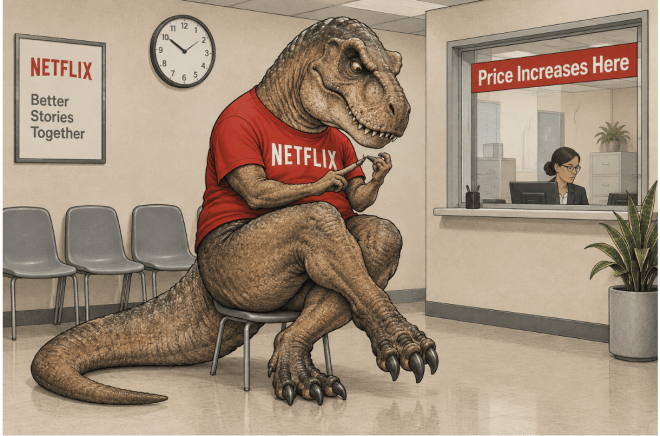
Netflix is paying a heavy price tag and arguably overpaid (you know who pays for inflated merger valuations, it’s subscribers and workers). Netflix goes from its status as the streaming industry’s 900-pound gorilla to, I dunno, T-Rex stature?

The public commentary on the deal is mostly doomsaying. 

It speeds up the chiselling of the tombstone for the theatrical release industry.

In a press release, Netflix CEO Ted Sarandos said shareholder value would flow from adding HBO and the full Warner Brothers archive to the Netflix “best in class streaming service:” his pro forma commitment to theatre release was relegated to a subordinate sentence clause.

But if the merciless dispatch of theatrical-release seems inevitable, and just the law of the marketplace jungle, what is of long term concern is the anti-competitive effect on the pipeline of big-budget premium video entertainment. The Globe & Mail’s Barry Hertz has a good analysis here.

The Netflix deal is a prime candidate for anti-trust review by the Trump administration (especially as Netflix outbid Friend-of-Trump Paramount). 

That review could go in any direction but things to watch for include (a) Trump reviving his threat to levy tariffs on foreign movies and the offshore shooting of Hollywood blockbusters, and/or (b) using the anti-trust hammer to get something that he personally wants, which could be commitments to US-based production or some vanity trophy we can’t imagine right now.

It’s not that Sarandos can’t see that coming. In his press release he said the acquisition would allow Netflix to expand its US based production, a gimme that doesn’t commit him to a rate of new releases equal to “Netflix plus Warner Brothers” but only “Netflix plus a dollar.”

Any Trump-driven re-shoring of studio production could hurt the two offshore leaders of Hollywood production, the UK and Canada (and hurt Hollywood too, but that’s a longer discussion).

Beyond that, the effect on Canadian-owned broadcasting could be massive. Netflix is buying Warner Brothers’ Home Box Office streaming service and catalogue which may or may not be integrated into the Netflix platform, once subscription pricing is figured out. The press release suggests HBO content will be on the Netflix platform, at least in the US. 

Here in Canada, there is no HBO streaming service and Bell Media holds the exclusive license to distribute HBO on the only Canadian streaming service of consequence, Crave TV.

You would have to question whether Netflix has any interest in continuing that Canadian licensing arrangement when it expires and, in fact, Netflix has an excellent opportunity to severely wound its only Canadian-owned competitor.

Without that profitable HBO content, Bell’s ability to keep funding Canadian content takes a big hit. 

***

Canada has a new Heritage minister, Marc Miller.

That’s the fallout from Steven Guilbeault’s cabinet resignation over Prime Minister Mark Carney scrapping the Trudeau/Guilbeault policies on oil production, emissions, pipelines, oil tankers and clean energy regulations.

Miller continues a long tradition of the Liberals appointing an MP from the island of Montréal to the Heritage portfolio.

But of course Miller is the first anglophone the Libs have picked for that job since Hamilton’s Shiela Copps —-who was born ready to butt heads with the US on cultural sovereignty. She did the job from 1996 to 2003 under Prime Minister Jean Chrétien. 

The feisty Miller is prone to speaking with candour, as a rule. That’s already got him into a spat with CAQ premier François Legault who didn’t like Miller insisting on making a distinction between “the decline” and “fragility” of the French language in Canada and Québec. The Bloc dutifully piled on.

Guilbeault was the federal champion of Canadian and French language content in Québec and as the new Heritage minister no less will be expected of Miller. His life will get very interesting in about six months when CUSMA negotiations begin.

Will Miller become the political reincarnation of Shiela Copps? It’s up to Mark Carney, just as it was up to Jean Chrétien.

***

It looks like the CRTC’s investigation into whether Meta is selectively enforcing its made-in-Canada ban on news content has come an end. The CRTC’s brief discharge letter to Meta was published last week.

You can still find news items on Facebook and Instagram in Canada, despite Meta’s avowal that it banned news to take itself outside of the scope of the compulsory licensing of “news content” in the Online News Act.

Meta must have satisfied the Commission staff that it is sticking to its ban by taking down news items posted by Canadian users and by deleting user screenshots of articles. If you want to know how the Commission reached its conclusion, you won’t find it in the letter. 

What remains unresolved, or perhaps resolved only to the Commission’s private satisfaction, is Meta permitting posts from news outlets like Narcity and The Peak who successfully applied to Meta for what they describe as “exemptions” from the news content ban.

Without more transparency, one can only guess if Meta’s exemption of hand picked news outlets violates the statutory prohibition against digital platforms discriminating for or against selected news outlets. 

In the case of Narcity, its publisher claimed that Meta granted an exemption because Narcity was refused certification for federal journalism labour tax credits on the grounds that it doesn’t publish enough original news on current affairs. 

But certification for federal subsidies program doesn’t mean that a news outlet isn’t producing some news content, or pieces of news content, as defined by the Online News Act, which Meta says its banning to avoid paying for it. 

The Peak also recently announced that Meta gave it “an exemption” and I invite you to have a look at the news articles it’s allowed to post on Facebook and Instagram.

If you go looking, keep in mind that the “news content” that Meta is supposed to be banning in order to escape the gravitational pull of the Act includes “any portion” of news content. 

The Commission’s original inquiry into the news ban appears to have been its own idea, so the fact that it hasn’t published its reasons at any length is not a total surprise. No Canadian news organization has filed a complaint. 

***

If you would like regular notifications of future posts from MediaPolicy.ca you can follow this site by signing up under the Follow button in the bottom right corner of the home page; 

or sign up for a free subscription to MediaPolicy.ca on Substack;

or follow @howardalaw on X or Howard Law on LinkedIn.

COMMENTS ARE WELCOME. But be advised they are public once I hit the “approve” button, so mark them private if you don’t want them approved. 

I can be reached by e-mail at howard.law@bell.net.

This blog post is copyrighted by Howard Law, all rights reserved. 2025.

Catching Up on MediaPolicy – Ranting about CanCon – Danish news subsidies – Meta lobbies Feds on age verification – the NFB’s gripping sailing documentary

November 29, 2025

I’ve fallen behind on catching you up on media policy news because I felt compelled to write a series of three posts commenting on the CRTC’s ruling on Canadian content. The last one, the rant I promised, was published this week in Cartt.ca.

While I was ranting, one of the things I let slide was telling you about a new report out of Denmark proposing to refashion its policy design for government aid to news journalism.

The Danes are serious about news subsidies: they spend 540 million krone ($120M CDN) every year on private media in nation of six million people (Canada spends about $200 million in country of 42 million).

According to the Reuters Oxford Digital News Report, Denmark’s “public trust in media” score is 56% and it ranks sixth out of 180 in the Reporters Without Borderspress freedom index at 86.93. By comparison, Canada’s trust score is 39% with a press freedom index of 78.5, 21st in the world.

The Danes also have something we don’t: a 2018 Media Liability law that established an independent national press council and conferred the force of law on editorial independence from ownership. 

The Danish subsidy report was commissioned by government and written by a committee led by Rasmus Nielsen, the former chief of the Reuters Institute for the Study of Journalism.

Despite the ocean separating us, there are strong parallels between the Danish system of news subsidy and Canada’s jigsaw of federal programs: we have the QCJO subsidy of journalist salaries, the Local Journalism Initiative that funds 700 full time reporters in under-serviced regions across the country, and the Canadian Periodical Fund which supports editorial expenditures by community weeklies. 

The untranslated 144-page Danish report covers a lot of ground, but Nielsen’s own English language summary of it captures the essence: a weighted emphasis on supporting news outlets that are regional, local or “independent” (owners of single-titles) rather than mere incumbency as a news organization. 

***

The Senate deliberations of Senatrice Julie Miville-Dechêne’s Bill S-209, that would require age verification for online pornography is on hold until February while the Senate justice committee deals with other matters.

During the pause, the Canadian Press reports that Meta has joined the fray by lobbying the federal Liberals to step in with their own bill that would shift the age verification responsibility from pornography websites and social media platforms to app stores.

Meta obviously doesn’t run an App Store, as do Google and Apple, and the latter two Big Tech companies are cheesed about what Meta is up to.

Meanwhile, Canadian children continue to be exposed to online pornography featuring choking and slapping. The CP story is well done and informative.

Meta is having a good month of course. It won the anti-trust trial brought by the US Justice Department that claimed Meta was running a monopoly in personal social networking. In the interim five year period between filing and judgment, TikTok greatly improved its market share.

Matt Stoller has a very good analysis of the lawsuit, the trial, the judge, and why he thinks Big Tech will never be slowed down by anti-trust litigation: he says it takes public policy and legislatures to change things.

A test of his theory may happen soon: the trial judge in the Google Ad Tech case will be handing down her decision on whether to dismantle that illegal monopoly in the new year.

Meanwhile a consortium of US school boards just filed a new lawsuit against Meta and several other Tech companies.

Their allegation against Meta in particular is that company documents reveal CEO Mark Zuckerberg squelched evidence of harm to teenage girls while Meta designed lax safety features, including ineffective measures to expel sex traffickers from the platform. Of course, the allegations must be proven in court, probably over several years.

This does raise the question of whether Americans (and Canadians) should count on US courts to adjudicate Big Tech’s excesses by giving full due process and demanding conclusive evidence of the allegations, or whether governments should just cut to the chase, stop litigating whether the harms to kids persist, and legislate a solution.

In related stories, Australia’s social media ban on under 16s comes into force in December. The EU Parliament just passed a non-binding resolution to do the same.

***

The National Film Board’s website is recommending “Ghosts of the Sea,” a riveting documentary about the ill-fated Norwegian father-and-son sailors, Peter and Thomas Tangvald.

The filmmaker is Thomas’ half sister Virginia, who settled in her mother’s hometown of Montreal. The father Peter was married seven times and two of his wives died at sea.

I’ll say this: the film offers a visceral take on “intergenerational trauma.”

I think you will enjoy the one hour and 37 minute film and I absolutely guarantee you’ll have strong opinions afterwards. 

***

If you would like regular notifications of future posts from MediaPolicy.ca you can follow this site by signing up under the Follow button in the bottom right corner of the home page; 

or sign up for a free subscription to MediaPolicy.ca on Substack;

or follow @howardalaw on X or Howard Law on LinkedIn.

I can be reached by e-mail at howard.law@bell.net.

This blog post is copyrighted by Howard Law, all rights reserved. 2025.

The CRTC’s ruling on television copyright: for a branch-plant CanCon economy

November 27, 2025

In October 2022 Netflix was appearing at the Senate committee reviewing the proposed Bill C-11, the Online Streaming Act, when the Conservative senator Fabian Manning pitched a softball question: what was the Hollywood giant’s “main priority” in amending a bill it didn’t welcome?

The Canadian spokesperson for the streamer was succinct in his answer: “If I had to choose just one, it would be the issue of copyright ownership.”

Last week, Netflix got what it wanted

Continue reading at Cartt.ca…