April 29, 2026
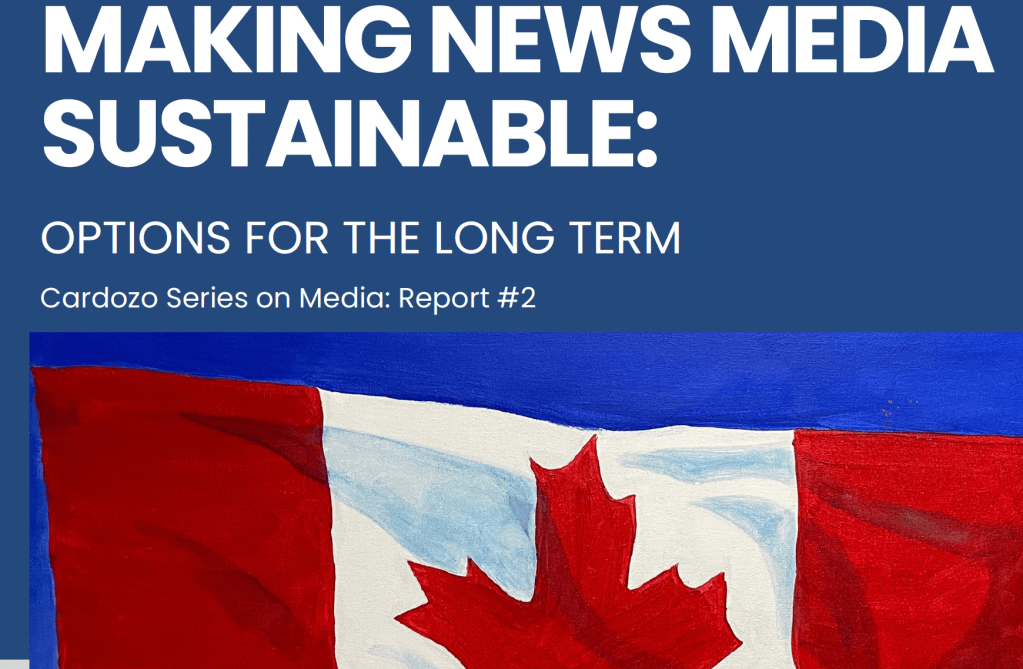
Today, Senator Andrew Cardozo released his new report “Making News Media Sustainable,” co-authored with yours truly, on future policy options for supporting Canadian news journalism. It’s about subsidies.
Our project is to put forward new ideas. For discussion. The working assumption is that public support of private journalism is here to stay in one form or another, so what can we offer in terms of continuous improvement? The Senator already put forward his ideas about public support for the CBC in a 2024 report here, so this new report focusses on public support to privately owned news journalism.
Some of our ideas will roil the waters. Just to choose one, we suggest that federal news subsidies should be reduced or eliminated to heavily indebted news organizations (i.e. Postmedia) that are using public money, in whole or in part, to pay off their controlling owners and creditors.
There are other ideas that you might call technocratic, invoking the subtle art of policy design, such as offering news organizations an opportunity to go paywalled, or to stay paywalled, and forego journalist salary subsidies in favour or more enticing subscription tax credits offered to citizens. To work properly, the federal government would have to launch a seriously generous news voucher program for citizens, whether or not they pay taxes.
Another idea, that we lean on pretty hard, is that the federal government end its arbitrary exclusion of broadcasting companies from accessing subsidies for their news websites that are indistinguishable from the digital operations of print publishers. By coincidence, yesterday the Carney government announced in its Economic Update that the Finance Department will launch a public consultation “to seek the views of Canadians and stakeholders on extending the Canadian Journalism Labour Tax Credit to audio and audiovisual news production.”
We give a lot of attention in the report to the under appreciated history of innovation success in Canadian news journalism, both with respect to digital technology and content strategies. There have been many successes to admire or replicate, both from start-ups and legacy news organizations. One policy idea that emerges from that experience is public funding of innovation-related expenses, such as IT staff salaries.
We also applaud the gaining traction of non-profit news journalism. It is no silver-bullet to cure all that ails the beleaguered industry. But it clearly can be tapped for greater potential.
One of the challenges to change-management in our sprawling news industry is that we lack a cohesive public policy for supporting news journalism. Policy initiatives have been ad hoc, reactive, and initiated under overlapping jurisdictions of federal government, provincial governments, and the federal regulator, the CRTC. Unsurprisingly, there is no central institute equipped to collect and analyze a broad and deep well of industry data that might guide the best decisions for supporting journalism.
And our closing advice in the 100-page report: the policy solutions for news journalism may not be one-size fits all. We have an array of Canadian news markets where consumers seek or passively consume the news of the day: national, regional, local, by language, by content silo, by platform preference, etc.
The biggest conundrum, the one that reveals our deepest policy conviction in writing the report, is the enormous gap between the number of Canadians who will pay for news (about 20%) and those who won’t. That 20% number is stubborn: even hypothetically lower paywall prices don’t seem to budge it very far.
All Canadians vote (well, 68% of those eligible in the last federal election), whether they consume news or not. As the loss of advertising revenue to Big Tech platforms has destabilized news organizations that distribute trustworthy news for free and without a subscription, the threat of a news consumption deficit becoming a democratic deficit is something that only the naive would avoid looking straight in the eye.
Finally, we have a lot to say about the connection between public trust and public subsidies to news journalism.
We don’t subscribe to the idea that a penny of subsidies means a pound of distrust: the healthy and unhealthy skepticism expressed around the world about news media is powerfully influenced by many things other than subsidies and, for example, is far more profound in the United States where there is precious little subsidy of news journalism. Regardless, care must be taken regardless by making greater efforts to make the gatekeeping of Canadian news subsidies arm’s length from the government.
The report begins with a brief executive summary. It’s followed by a landscape review of subsidy programs, a comparison to policy initiatives in non-Canadian jurisdictions, and then an extended series of policy issues inviting you to engage in the debate over what is to be done.
***
If you would like regular notifications of future posts from MediaPolicy.ca you can follow this site by signing up under the Follow button in the bottom right corner of the home page;
or sign up for a free subscription to MediaPolicy.ca on Substack;
or follow @howardalaw on X or Howard Law on LinkedIn.
COMMENTS ARE WELCOME. But be advised they are public once I hit the “approve” button, so mark them private if you don’t want them approved.
I can be reached by e-mail at howard.law@bell.net.
This blog post is copyrighted by Howard Law, all rights reserved. 2026.

 MediaPolicy.ca
Hey Howard
Thanks for this and all you do
Hey, any thoughts on these Rogers buyouts??? Is there an AI connection there?
Best wishes to ya
Jim
LikeLike
Customer service seems like a big target.
LikeLike