
AI Photo Illustration
April 25, 2026
We, the people, were the last to know.
On Thursday, CBC president Marie-Phillipe Bouchard told Heritage committee MPs the $150 million increase in the public broadcaster’s parliamentary grant for 2025 was “temporary.”
In fact, she said in response to a question from Bloc MP Martin Champoux, “we knew it was temporary.”
Bouchard’s answer is a revelation because, until the Carney government published its Main Estimates for the 2026-27 federal budget, neither the Prime Minister nor the author of the 2025 federal budget that included the $150 million, Finance minister François-Phillipe Champagne, told the public that the new CBC money was temporary.
Announced this February, the 2026-27 budget projection cuts $192 million from the public broadcaster.
The Prime Minister, who promised the $150 million in his April 2025 election platform as a downpayment on a larger funding increase, also told voters on the campaign trail that that in addition to the $150 million “we expect that in the coming years, we will continue to increase that funding until it can be compared to that provided by other public broadcasters.” (On budget day November 4, 2025 a carefully worded press release avoided the characterization of either a temporary or permanent increase).
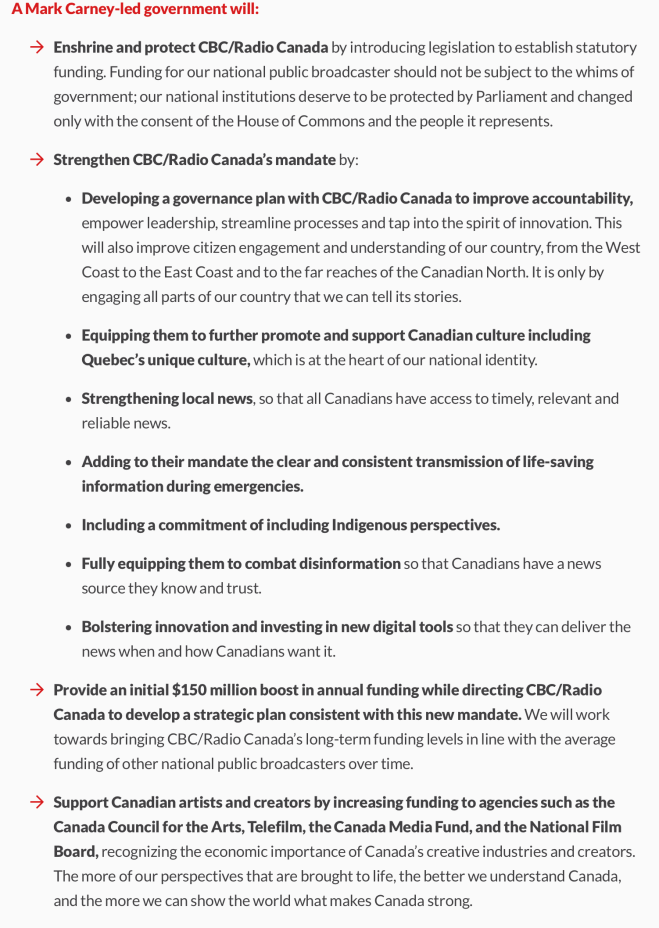
And while Canadians might have taken the Prime Minister and the Finance minister at their word, it seems the CBC president knew otherwise. “We knew it was temporary.”
A follow up question from the Bloc’s Champoux, a former journalist, might have been “when did you know it was temporary?” And who told you?
But the question never came. Conservative MP Bernard Généreux followed up, but only to rib Bouchard over the Liberal budget cut and how perhaps the CBC had more to fear from the government than would-be CBC defunder Pierre Poilievre.
Liberal backbencher Bienvenu-Olivier Ntumba then asked Bouchard about the impact of parliamentary cuts on Radio-Canada. The CBC president replied that some staffing resources shared equally between French and English language services would be affected if cuts were “significant.”
The government’s main budget estimates have scheduled a $192 million cut to the CBC budget, representing the repeal of the $150 million increase from the 2025 budget. An earlier $42 million boost under the Trudeau government in 2024, renewed in the 2025 parliamentary grant, was also repealed for 2026-27.
Heritage minister Marc Miller appears before the committee on May 5th (update: now rescheduled to May 7th).
***
In our last MediaPolicy post, we reported on the stale news — I was on vacation, okay? — that the CRTC had reversed itself and agreed to provide a three cents per subscriber increase to the parliamentary news service CPAC.
Minutes before or after I hit the publish button on that post, CPAC CEO Christa Dickenson announced the termination of CPAC’s evening news show. The $2.8 million boost to her $13 million budget from the CRTC rate increase wasn’t enough to stabilize finances, according to Dickenson. The cancellation of the show meant 12 staff layoffs, including show host Michael Serapio.
An online hue and cry followed in response to the CPAC announcement and Heritage minister Marc Miller joined in with a tweet suggesting that the CRTC’s delay in implementing the Online Streaming Act was to blame:
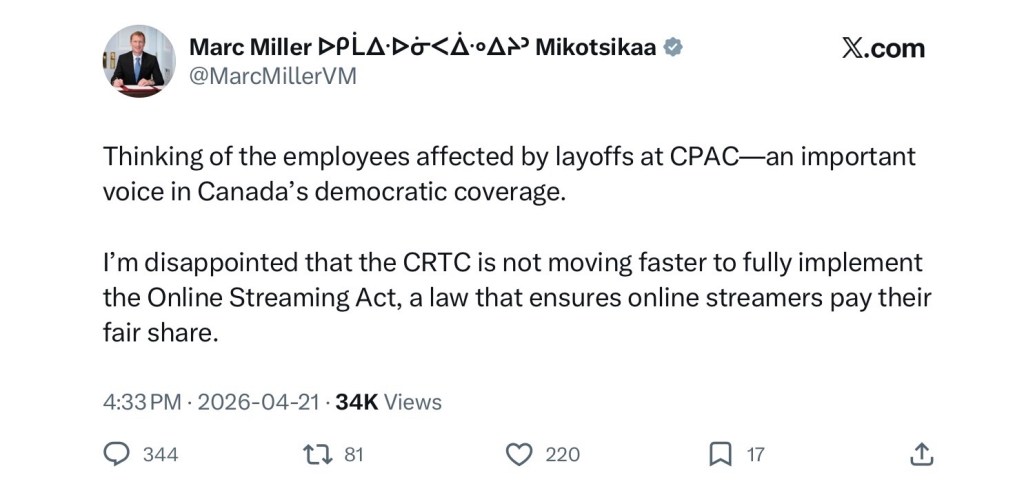
As I retweeted at the time, oh my.
By linking the CPAC layoffs to a live CRTC file dealing with requests to deliver financial relief to “services of exceptional importance,” the minister seemed to be saying that the independent regulator ought to giddy up and deliver it to CPAC.
That special funding was requested by CPAC on July 2, 2025, citing its services of exceptional importance including the now eliminated evening shows, and is still under consideration by the Commission.
Miller’s impatience with the languid pace of CRTC decision making on implementation of the Online Streaming Act is shared widely, for good reason. But now the Commission’s eventual decision on funding services of exceptional importance will either be a yes (submitting to its minister) or no (defying its minister).
A footnote to this story: on the same day that Miller was tweeting about CPAC, the CRTC followed up its increase to CPAC’s subscriber rate with a two cent increase for TV5, the French language news service.
CPAC’s Dickenson appears before the Heritage committee this coming Tuesday, April 28th.
***
One of the better kept secrets in minister Miller’s thoughts is what he has in mind by appointing a special advisory committee on the future of Canada’s audio visual industry.
The ministerial appointments are mostly not the usual suspects and stakeholders, bending instead towards active industry executives, producers and investors.
The committee’s mission is framed by the minister in high level language:
The Government of Canada is reviewing how it supports the audiovisual sector. The current framework for federal audiovisual support was built for a different era and needs to evolve so Canadian stories can thrive, both at home and globally. The goal is to make sure that federal support remains effective, efficient and transparent, and that it can support the full spectrum of Canadian voices and stories. The work includes reviewing audiovisual policy and institutions.
Parsing that brief statement, change is certainly in the wind, but what? Presumably, committee members asked the Minister for something more detailed when they were recruited. It’s a good bet they aren’t signing on for a mere reorganization of government departments Telefilm, CAVCO, the National Film Board or the Canada Media Fund.
The CanCon-funding Canada Media Fund immediately expressed support for the minister’s “modernization” agenda. This suggested that the CMF, jointly governed and funded by the federal government and Canadian cable companies, knows what that agenda is. Asked for comment on its understanding of what in Miller’s agenda it is endorsing, the CMF replied “the CMF shares the Minister’s view that the current framework was built for a different era and needs to evolve.”
The rest of us, we’re on a need to know basis.
In the absence of more information, it is reasonable to speculate that the Liberals are going to re-launch something like the dead-ended 2016-17 federal policy review conducted by Heritage minister Melanie Joly that dismissed pleas for what became the Online Streaming Act in 2023 and instead called for more government support of exported Canadian content and a Canadian spending commitment from Netflix.
If you want to get a flavour of what an export strategy might look like, I recommend Ken Whyte’s latest Substack post which admires how Korea has remodelled its cultural production policies since the 1990s. (Coincidentally, Whyte served on Melanie Joly’s advisory committee in 2017).
***
If you would like regular notifications of future posts from MediaPolicy.ca you can follow this site by signing up under the Follow button in the bottom right corner of the home page;
or sign up for a free subscription to MediaPolicy.ca on Substack;
or follow @howardalaw on X or Howard Law on LinkedIn.
COMMENTS ARE WELCOME. But be advised they are public once I hit the “approve” button, so mark them private if you don’t want them approved.
I can be reached by e-mail at howard.law@bell.net.
This blog post is copyrighted by Howard Law, all rights reserved. 2026.


4 thoughts on “When you’re the last to know.”