
“Six billion dollars”
May 10, 2026
There’s no other way to say it. It was a goofy week for Canadian media policy.
On Tuesday, cabinet minister Marc Miller popped up at the Commons Heritage Committee. MPs wanted to hear from him before voting on the government’s main budget estimates for 2026-2027.
At last someone put him on the spot about the Liberals cutting nearly $200 million from the CBC just a few months after delivering on Prime Minister Carney’s signature election promise of adding $150 million to the $1.4 billion parliamentary grant.
In response to Conservative MP Bernard Généroux’s sardonic admiration of the government’s sleight of hand, Miller replied (in this Google translation):
“With all due respect, Mr. Généreux, I think one needs to better understand how budget estimates are made. We see an immediate picture of CBC/Radio-Canada’s funding profile, but that doesn’t factor into the subsequent bailout estimates. It’s a flawed equation to say we’re giving 150 to take away 200. This is part of the budget cycle.”
Silly Opposition MPs. Don’t they know about the double-tap of Supplementary budget estimates that often follow the Main Estimates?
By the way, the French word Miller used was “renflouement,” translated as “bailout” or “refloating.” Or perhaps it means “later, when we can make a favourably timed announcement of more money for the CBC in a Supplementary Estimate .”
The committee’s attention then turned to the government’s recent announcement in the Spring Economic Update that it will hold public consultations on extending the federal QCJO journalism labour tax credit to broadcasting companies. Making the government’s intentions known, the minister said, “it’s how, not if.”
One salacious policy hint he dropped: the government expects a discussion of a subsidy ceiling on the largest broadcasters in favour of smaller ones.
Then Miller said an odd thing (twice, so not by accident): the additional cost of the expanded program would be $6 billion dollars. That’s 100 times the cost of the existing QCJO program for print media.
By the time his interlocutor, Bloc MP Martin Champoux, followed up on that eye-popping number, Miller had left the committee room.
As you might expect, the Twittersphere went off like a Roman candle. Six. Billion. Dollars. Try to imagine Mike Myers’ Dr. Evil delivering that line.
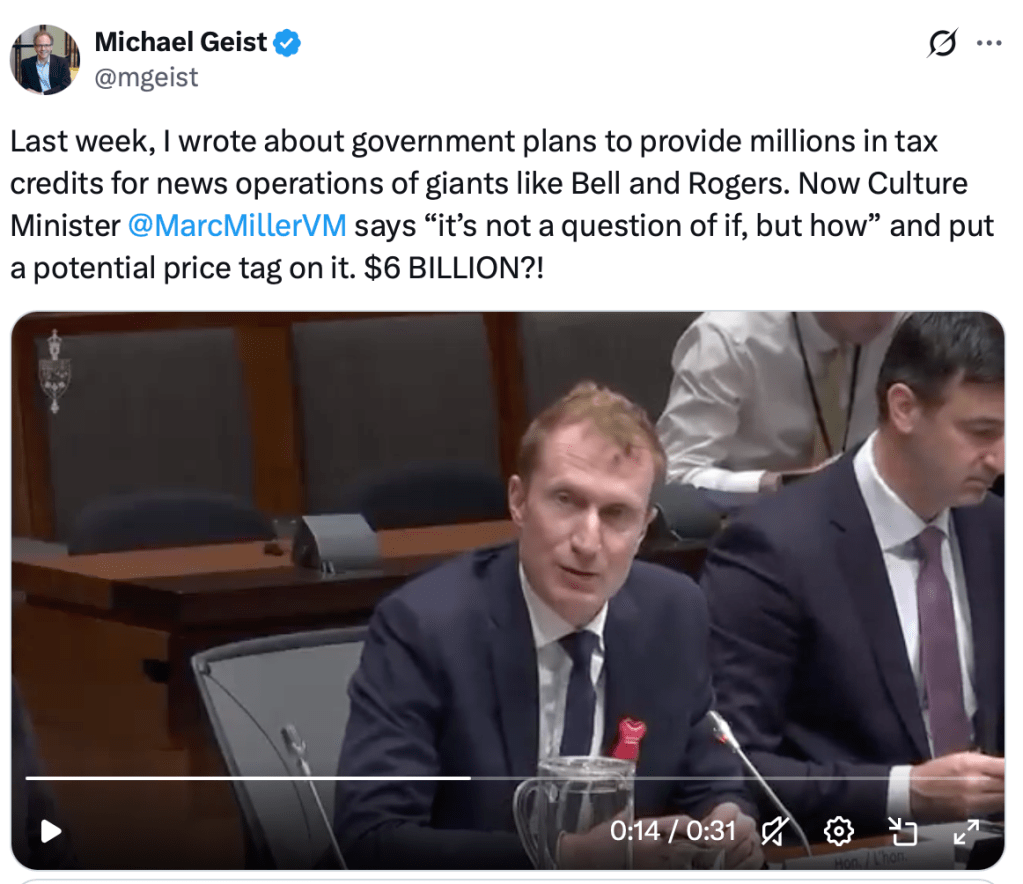
Two days later, Miller ‘fessed up in an X post saying he misspoke. He had mixed up the $75M per year journalism labour tax credit for print media with the $1 billion per year budget for federal film and television productions tax credits (over the next six years, ergo the $6 billion figure).
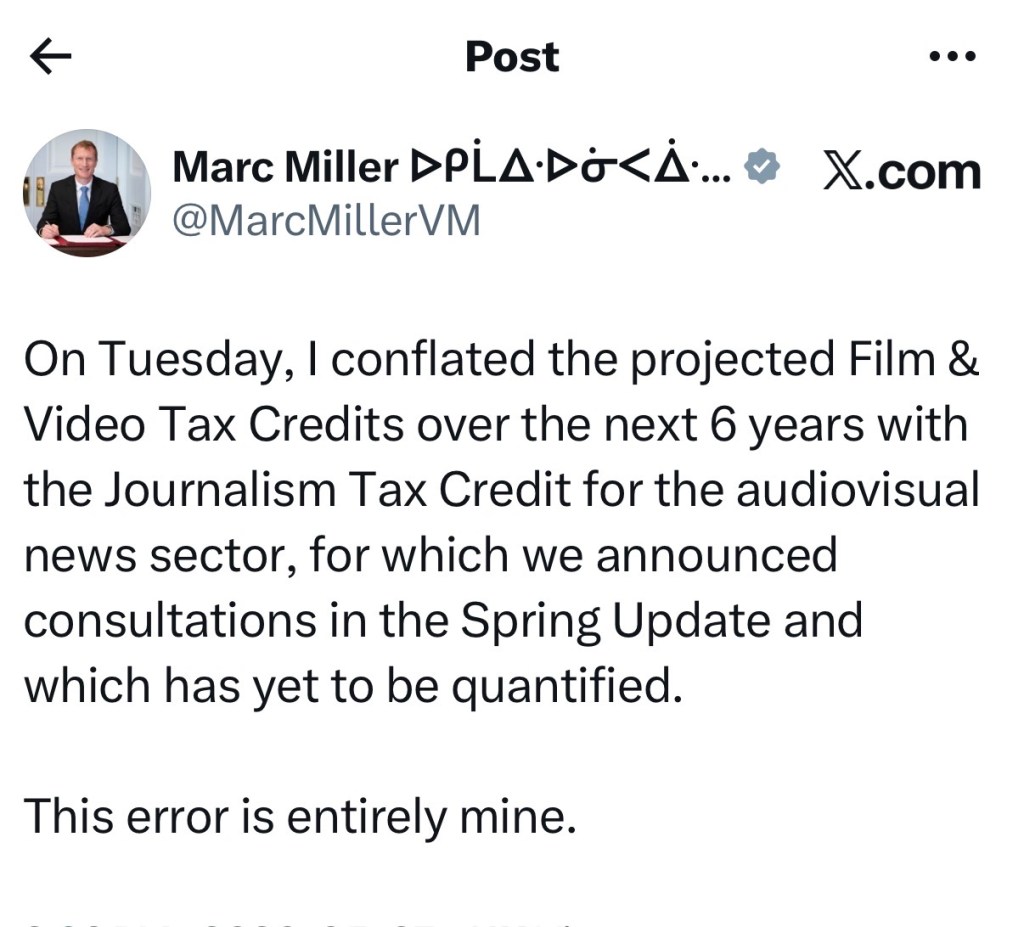
Okay. Happens all the time.
So what might be the cost of a program for supporting broadcast news? Grabbing the nearest napkin and pen, I came up with a number somewhere between $82 million and $115 million. Let me show you my math:
To begin, the program cost of the federal labour tax credit is driven by journalist headcount based on 35% of journalist wages on the first $85,000 of salary.
Going to the best available source for headcounts, the news producer head count for the Google funds distributed under the Online News Act by the Canadian Journalism Collective, expressed as full-time equivalents working a 40-hour week, is 3,549 for broadcasting companies and 4,179 for publishers. Bottom line: the broadcasting headcount is 85% of print journalists, a figure I need for this arithmetic.
As for a hypothetical broadcasting program cost fixed as an 85% percentage of the known costs of federal print media subsidies, you need to first establish the combined cost of labour tax credit for print journalists at daily newspapers ($75M), Aid to Publishers for community weeklies and magazines ($71M), another program for free distribution weeklies ($13M) and the Local Journalism Initiative (LJI) for 700 additional reporters in local media ($20M, although not all in print media). It adds up to $179M for print media journalists.
But there’s a caveat to that $179M figure: the payout in the Aid to Publishers and LJI subsidies are much higher than the 35% wage subsidy in the labour tax credit, although how much higher is difficult to pin down.
Rough guess of a final print media subsidy? Calculating the total print journalism program costs at an across-the-board 35% wage subsidy spits out a final number of $135M for print media journalists.
Next step: the broadcasting headcount is 85% of that $135M, leading to an estimated program cost of $115M for TV and radio news outlets.
But there’s one final adjustment to the numbers: the existing labour tax credit is scheduled to fall back from 35% to its original 25% next year, a 29% reduction. If that goes through, the $115 million for broadcasting support drops to as low as $82M. And if a ceiling is put on subsidies to large broadcasters, even further.
So, not $6 billion, no.
***
The next goofy thing is ironic, not funny.
I subscribe to The Hub, a commentary and news reporting website that is cerebral in its writing and conservative in its point of view. I listen religiously to its biweekly Full Press podcast.
On Thursday, publisher Rudyard Griffiths informed subscribers that he was abandoning The Hub’s years long refusal to accept QCJO labour tax credits or distributions of Google money under the Online News Act. I estimate the value of the two income streams to his publication at $60,000 annually. Griffiths cited softening advertising revenues and promised to park the cash in a reserve fund.
As he put it, “We are using that latitude to park any payroll subsidies in a segregated “rainy day” fund—available if we ever truly need it, but walled off from day-to-day operations so our journalism doesn’t become dependent on government money. If we ever draw on these subsidy dollars, we will tell you.”
There’s no need for “I told you so’s” here, although Griffiths has been vocal for years in his opposition to journalism wage subsidies, as well as passing judgement on those news organizations that accept them (“the soft, silent takeover of the nation’s press.”)
The Hub’s walk-back dittos the Western Standard which did it in September 2025, also stating it was doing so reluctantly.
As far as I know, this leaves just two news organizations who could qualify for the labour tax credits (which require ongoing publication of original news content) but make a point of refusing subsidies.
One is the hyper partisan Juno News. The other is the watchdog news outlet Blacklock’s Reporter which specializes in access-to-documents news reporting on the federal government and, it’s fair to say, offers no quarter to government and expects none.
***

Moving on, I was distressed reading journalist Shauna Rae’s winning essay for the Dalton Camp Award, juried by Friends of Canadian Media. I’m a long time member of Friends and a volunteer on its policy committee, but I don’t have any connection to the annual writing award that honours Camp, the veteran political strategist who died in 2002.
You can read Rae’s short piece and evaluate the message in her own words. To summarize, she is of the view that journalists should feel free to report the news as their truth, rather than the truth.
This is hardly a newly minted journalist creed even though I believe it is very much in the minority.
It’s a call for “openly activist and participatory” (Rae’s words) journalism in the fight against privilege and power, in a binary world of oppressor and oppressed. It feeds directly into identity politics of racial and gender inequality and the dispossession and gross mistreatment of Indigenous peoples; identity politics in the sense that individuals are ascribed membership status as either oppressor or oppressed. Taken to the global stage, it underpins an anti-Israel news narrative.
Rae’s justification for activist journalists throwing off the shackles of objectivity is that no such thing as objectivity exists.
Objectivity may be the world’s biggest straw man. Outside of university seminars dwelling upon political theory I don’t think I’ve ever met anyone, let alone a journalist, who posits the existence of objective truth. The overwhelming majority of journalists (that I’ve ever met) adhere to the journalist creed of “pursuing the truth” while practicing professional norms of fairness and accuracy in fact gathering.
But, fill your boots with openly activist and participatory journalism if you wish. It’s a free and independent press that allows Rae and any other journalists to wear the activist mantle if they choose. Their work will be judged on its merits.
What disturbs me so deeply—and I know this will sound harsh— is the intellectual nihilism behind the activist creed. It’s the idea that in the absence of indisputable objectivity that anything goes. It’s the idea that you can defend any news reporting narrative as fair and deserving of credibility no matter how closely it operationalizes the writer’s agenda for making change in the world.
Mostly it disappoints me because that’s not how change happens. And do we ever need change.
***
At the risk of making this weekly update too long, there is another item that I didn’t want to go stale.
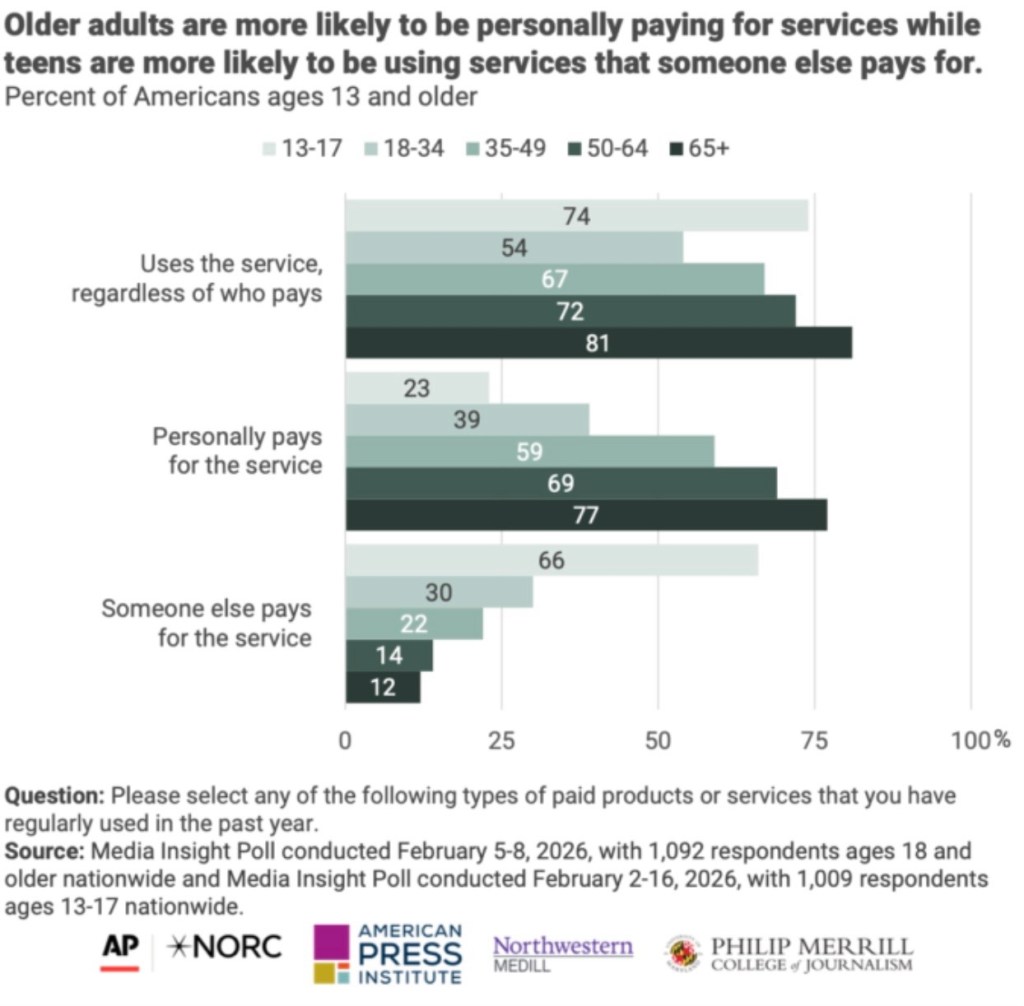
It’s a survey conducted by the Media Insights Project on where Americans get their news and whether they pay for it. That has implications for how much emphasis we Canadians might put on public policy subsidizing paid news subscriptions as a reliable delivery vehicle for reporting on current events to a broad based democratic polity. It’s an issue that Senator Andrew Cardozo and I raised in our recent report, “Making News Media Sustainable.”
A key conclusion in the survey was “the majority of Americans — 7 in 10 — access a paid media service of some kind, even if they don’t pay for it themselves.”
We already knew that Americans pay for digital news subscriptions at a slightly higher rate than Canadians, which tends to fluctuate between 15% and 20%.
The public policy consequence is that such a low uptake on paid news subscriptions makes it hard to rely on the subscription business model as a comprehensive way of delivering news when so many Canadians are stuck on getting free news (there is data suggesting lower prices of digital news subscriptions don’t tempt people much).
The low uptake on digital news is mitigated by the fact that half of Canadians live in a household with access to a cable TV package that includes news channels (alas, news is a serious money loser for television networks).
The Media Insights survey’s conclusion that “7 in 10” Americans have access to “a paid media service” even if they don’t pay for it suggests that young people are watching cable TV or else making liberal use of a streaming password shared by someone else who paid for it. Thanks Mom and Dad.
The asterisk to that “7 in 10” statistic, and the limitation of the survey question’s relevance to news policy, is that it was about paid media services, not paid news media services. There’s this thing called Netflix, you know.
Still, it’s an encouraging set of public policy data on news consumption. Which reminds me to refer you again to the Cardozo-Law study where we recommend the federal government experiment with a generous news voucher program for news subscriptions.
***
If you would like regular notifications of future posts from MediaPolicy.ca you can follow this site by signing up under the Follow button in the bottom right corner of the home page;
or sign up for a free subscription to MediaPolicy.ca on Substack;
or follow @howardalaw on X or Howard Law on LinkedIn.
COMMENTS ARE WELCOME. But be advised they are public once I hit the “approve” button, so mark them private if you don’t want them approved.
I can be reached by e-mail at howard.law@bell.net.
This blog post is copyrighted by Howard Law, all rights reserved. 2026.

 MediaPolicy.ca
Love this wordsmithing:
By the way, the French word Miller used was “renflouement,” translated as “bailout” or “refloating.” Or perhaps it means “later, when we can make a favourably timed announcement of more money for the CBC in a Supplementary Estimate .”
LikeLike