August 1, 2026
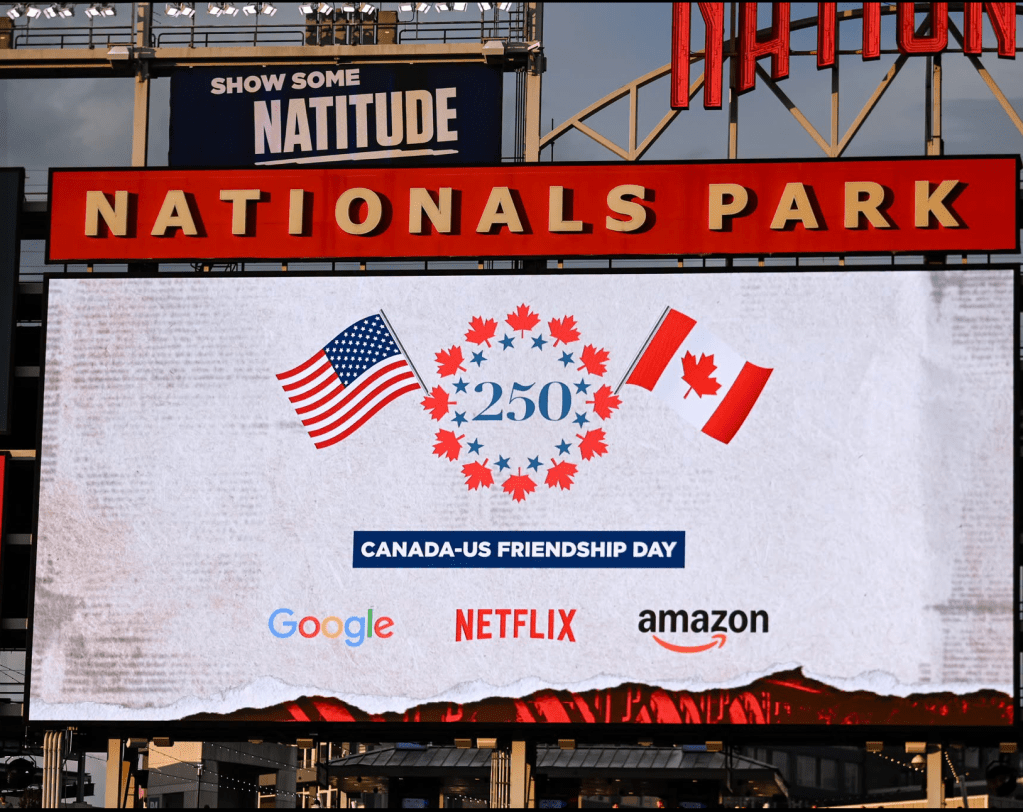
On July 28th the Toronto Blue Jays suited up for nine innings against the Washington Nationals on “Canada-US Friendship Day.” The game was played in the US capital, home to the Nationals, the onetime franchise of the Montreal Expos. The friendship day was sponsored by the Canadian embassy in Washington, partnering with the Nationals’ organization.
The Jays won 6-3 and “Canada” came before “US” on the centre field jumbotron. How sweet it is.
Only as you can see above, the event was also sponsored by Google, Amazon, and Netflix, three of the Big Tech and Hollywood companies that have mobilized US Congress to demand the gelding of Canada’s Online Streaming Act. A spokesperson for the Canadian embassy told MediaPolicy that the Nationals arranged the corporate sponsorships.
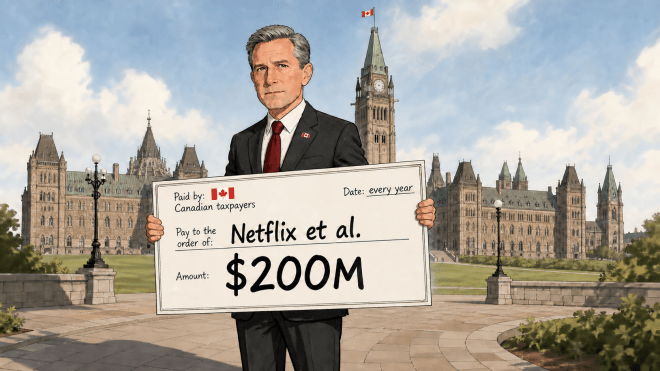
Our cross border friendship was celebrated the same week that the Wire Report broke a story about the federal Attorney General’s court filing on behalf of Prime Minister Mark Carney’s government. The AG advised the Federal Court of Appeal that it was rolling back every cent of the CRTC’s five percent cash levy on Netflix, Google, Amazon and the rest of the foreign streamers and replacing it with federal cash.
That’s old news of course, but the court had asked for clarification with an eye to dismissing the streamers’ appeal to strike down the CRTC levies on the grounds that the outcome no longer mattered. The court hearing was thirteen months ago in June 2025 and the final decision on a matter of pressing national importance remains outstanding. It sounds like the judges are looking for a back door to the courthouse.
Even though it was old news, the revelation that the government would instruct the CRTC that its streamer cash levy must be set at zero caused a stir because Culture and Identity minister Marc Miller had explicitly told reporters on June 14th that the cash levy would be lower but not zero, chastising the Opposition Bloc Québécois for suggesting otherwise. That sounded plausible because even Netflix had agreed to a two per cent levy back in 2023.
But now confusion reigned. A brief statement given by the minister’s office to the Globe and Mail misdescribed the levies. The Canadian Association of Broadcasters publicly expressed surprise at “zero” because it had been quietly advised otherwise in the past few weeks.
The Carney government keeps assuring the public that in due course it will publish its official policy direction to the CRTC on what it wants to see in place of the 15% streamer contribution to Canadian content (currently set at 6.5% cash contributions to Canadian media funds and another 8.5% in licensing or commissioning Canadian content for its own services).
Carney also told reporters that the government would meet with the CRTC commissioners “in the coming weeks” to “discuss” Canadian content.
In a formal sense, a “policy direction” and “discussion” is not as blatant a transgression against the CRTC’s independence from government as it seems.
The Broadcasting Act contemplates the federal government issuing to the CRTC “directions of general application on broad policy matters with respect to…any of the objectives of the regulatory policy set out in section 5(2),” a laundry list of broad regulatory goals.
But the statute does not permit a cabinet policy direction to overrule or modify the specific orders of a CRTC decision concerning streamers. Ironically, in drafting the Online Streaming Act the government intentionally denied itself this more direct power to second guess CRTC rulings in application to foreign streamers, while retaining the kill switch for rulings that involve licensed Canadian broadcasters.
So given the government’s self imposed restriction on the legal power to overrule the CRTC and the necessity to rely entirely on policy directions of “general application on broad policy matters,” how can the Carney and Miller instruct the CRTC to set cash levies at zero? And how can they dictate a specific number other than 15% for direct investments in Canadian content?
In the Broadcasting Act‘s formal process for issuing such a “broad” direction, minister Miller gets an otherwise forbidden face-to-face with the CRTC commissioners because of the federal cabinet’s statutory duty to “consult” the CRTC before publishing its marching orders in the Canada Gazette. It’s an opportunity for, um, candour that might not be appropriate in a published policy direction. Let’s not expect the meeting to be open to the media.
Depending on how this all plays out, it’s possible that some interested party might sue the Carney government for stretching too far the meaning of a “direction of general application on broad policy matters.”
There’s already litigation on the very same point. Telco provider SaskTel has gone to Federal Court of Appeal to challenge the federal cabinet’s very specific directions to the CRTC on requiring SaskTel and other telcos to rent out aggregated high-speed access on its wireline network to other Internet retailers. The legalese of the Telecommunications Act on “policy directions” is the same as the Broadcasting Act.
The majority Carney government probably is not agonizing over potential lawsuits. To speak plainly, the Liberals say they have an annual budget of $600 million in their pocket to replace $200 million in streamer levies and otherwise make supporters of Canadian content happy.
All of this is in the name of rewarding American trade pressure and the constant ratcheting threats of more American trade pressure.
Last November, members of a key US Congressional committee expressed their thanks to Canada for repealing our digital services tax and asked us to do the same with the Online Streaming Act.
Now that’s what I call friendship.
***
***
If you would like regular notifications of future posts from MediaPolicy.ca you can follow this site by signing up under the Follow button in the bottom right corner of the home page;
or sign up for a free subscription to MediaPolicy.ca on Substack;
or follow @howardalaw on X or Howard Law on LinkedIn.
COMMENTS ARE WELCOME. But be advised they are public once I hit the “approve” button, so mark them private if you don’t want them approved.
I can be reached by e-mail at howard.law@bell.net.
This post is copyrighted by Howard Law, all rights reserved. 2026.


https://policyoptions.irpp.org/fr/2026/07/recul-carney-souverainete-culturelle-crtc/
LikeLike