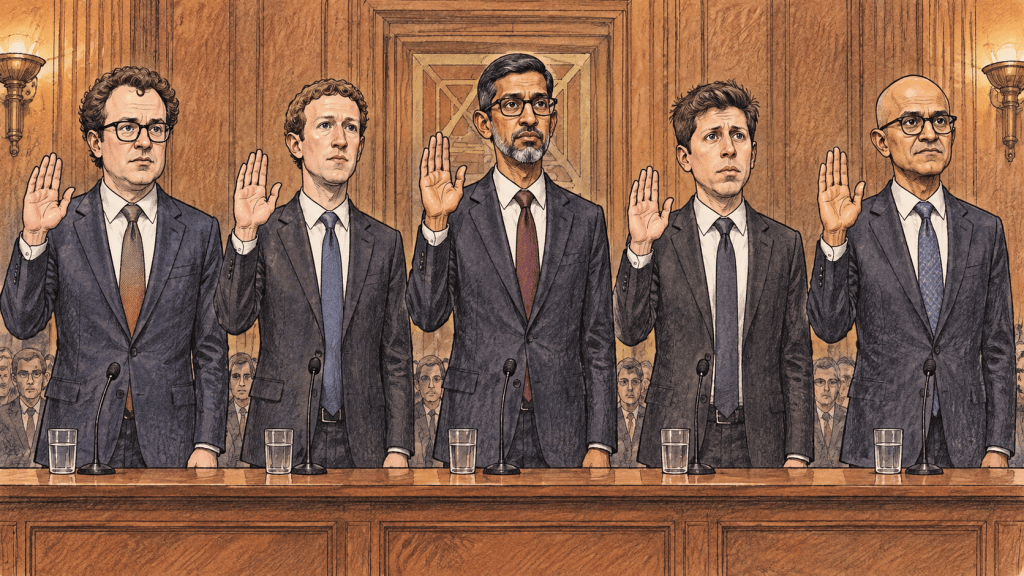
(AI illustration)
November 15, 2026
We reported last week that Meta temporarily backed away from its self declared entitlement to all online content belonging to its business customers for the purposes of ingesting AI training data.
Possibly the other AI majors concluded it was the right time to claim the high ground. Anthropic, OpenAI, Google and Microsoft have issued statements saying they will honour a common “robot.txt” instruction from online publishers that denies permission to AI web crawlers from scraping publisher data for Large Language Model training.
It’s a positive signal. The AI majors must sense their vulnerability to judicial and legislative intervention.
However.
Only Anthropic has implemented its commitment. The others say it’s coming soon.
None of the AI companies are disgorging or acknowledging the training data they have already scraped.
Even the most recent commitments are voluntary. As yet, they have no force in regulatory law or licensing agreements.
***
The front-of-mind public battle between the AI majors and media publishers over intellectual property certainly appears to be a new chapter in a fight that began over hyperlinks on Google Search and Facebook.
At the risk of encouraging fatalism, I noted that Meta Canada’s Rachel Curran was publicly speculating that the Carney government is about to cave (not her term) on the Online News Act in order to readmit Canadian news organizations and their content to Meta platforms.
Another dangling comment came from culture & identity minister Marc Miller who cast shade on the Online News Act in an interview with CTV’s Vassy Kapelos. Miller characterized both the ONA and the Online Streaming Act as “noble” laws but “they haven’t worked the way we hoped they would.”
Other nations appear undeterred.
After a long delay, Australia legislated its News Bargaining Incentive that enforces financial consequences for Meta if it follows through with its threat to ban domestic news in retaliation for mandatory licensing payments to news publishers.
Bigger news is breaking in Indonesia, a country of 230 million and Facebook’s third biggest market after India and the United States. According to reports, Indonesia is proposing to revise its copyright laws to require Big Tech platforms to compensate news publishers for hyperlinked news snippets as well as AI ingestion.
***
A new Angus Reid poll marks another milestone in the long decline of cable television viewership in Canada. It says 50% of Canadians subscribe to cable, down from 88% in 2012 (a year after Netflix arrived). And 84% of Canadians say they pay for at least one streaming service.
Bell Media’s Crave is in fourth place behind Amazon Prime, Netflix and Disney+.
These new figures and the downward trend in cable subscriptions won’t surprise anyone. But there are some other numbers worth noting:
- Nothing has changed in terms of generational habits: the cable television audience is aging out.
- Streaming subscription churn is climbing slowly and the poll attributes that to cost rather than content.
- Nonetheless the number of streaming junkies (subscribers to 4 or more services) is on the rise.
If the pollster’s conclusion that streaming subscribers are increasingly sensitive to cost, I suggest that has implications for Mark Carney’s claim that he needed to give away Canada’s Netflix tax based on his assumption of price inelasticity, i.e. that streaming services would succeed in passing along their costs to subscribers.
Note: I can’t tell from full report, but it seems that Angus Reid surveyed individuals rather than households. That might affect the results.
***
If you would like regular notifications of future posts from MediaPolicy.ca you can follow this site by signing up under the Follow button in the bottom right corner of the home page;
or sign up for a free subscription to MediaPolicy.ca on Substack;
or follow @howardalaw on X or Howard Law on LinkedIn.
I can be reached by e-mail at howard.law@bell.net.
This post is copyrighted by Howard Law, all rights reserved. 2026.


