
(AI illustration)
November 9, 2026
How does Prime Minister Carney’s $600 million make-good for Canadian content compare to the money he nixed back in June, the CRTC’s $200 million cash levies on foreign video and audio streamers?
I do love a bar graph (or five). Nevertheless, these snapshots reveal only one side of the elephant (I’ll explain below).
Here is Table 1. It demonstrates the policy problem. As conventional broadcasting has declined since its peak in 2017, so have the CRTC-mandated contributions to Canadian media Funds that supplement private investment and public funding.
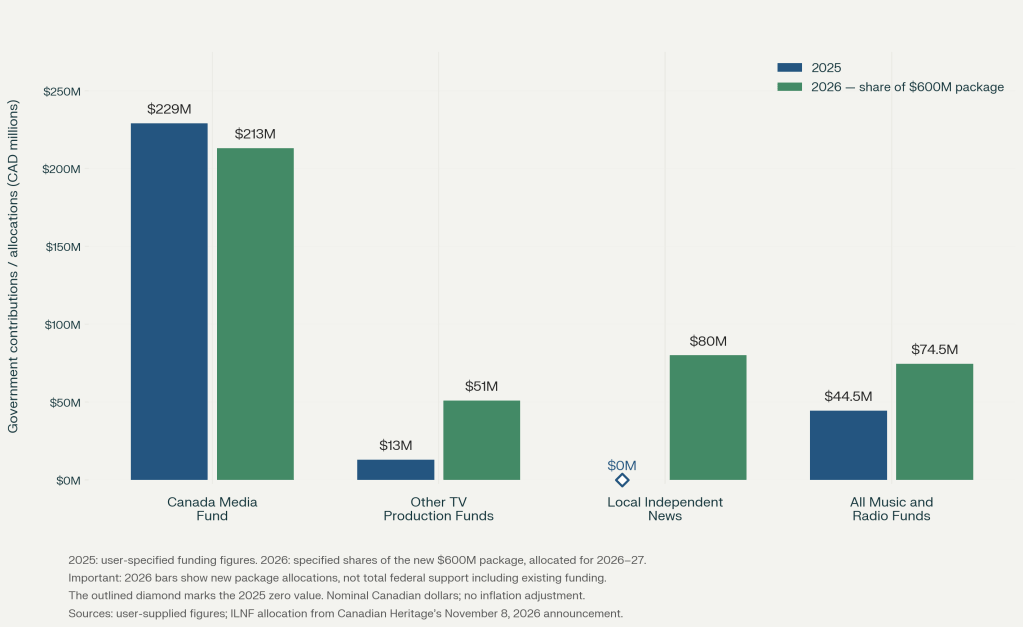
The Canada Media Fund finances Canadian dramas, documentaries and children’s programming.
Other TV Production Funds include corporately sponsored (e.g. Bell, Québecor or Rogers) or specialty (e.g. Indigenous and Black Screen Offices) Funds. They play a similar role to the Canada Media Fund.
Local Independent TV News pays the bills for a big portion of newsroom expenditures for Independent local TV stations such as Hamilton’s CHCH-TV and Gatineau’s CHOT-TV. It excludes national networks like CTV, TVA and City-TV but now includes Global News because it’s no longer owned by a cable company.
All Radio and Music Funds include the suite of musician development organizations (e.g. FACTOR, Starmaker and their French language compatriots) as well as the Community Radio Fund of Canada and the Indigenous Music Office.
Many of these Funds receive both support from CRTC levies and government subsidies.
(Notes 1 and 2 below correspond to Table 1).
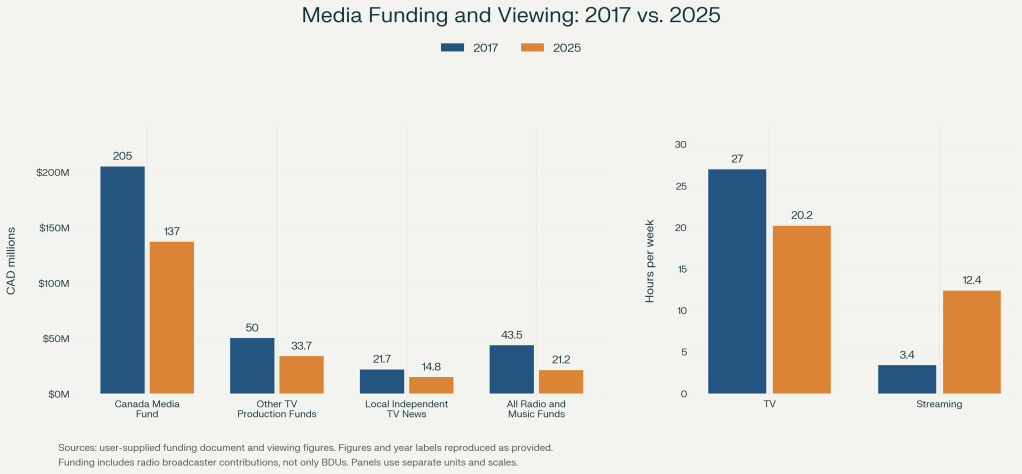
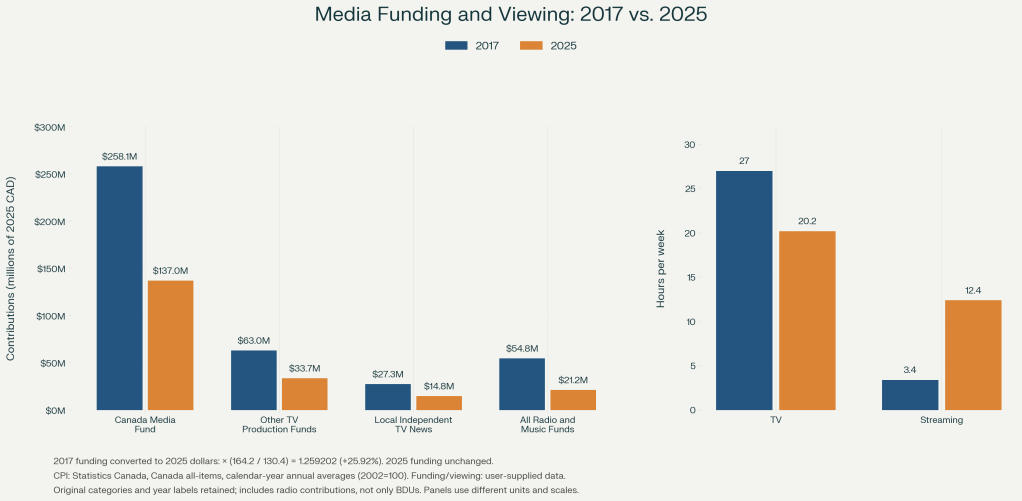
You see the decline. But of course it’s worse when the funding data is adjusted for inflation, so here’s Table 2 which does that by restating the 2017 funding in 2025 dollars. In this table, the funding decline is more pronounced:
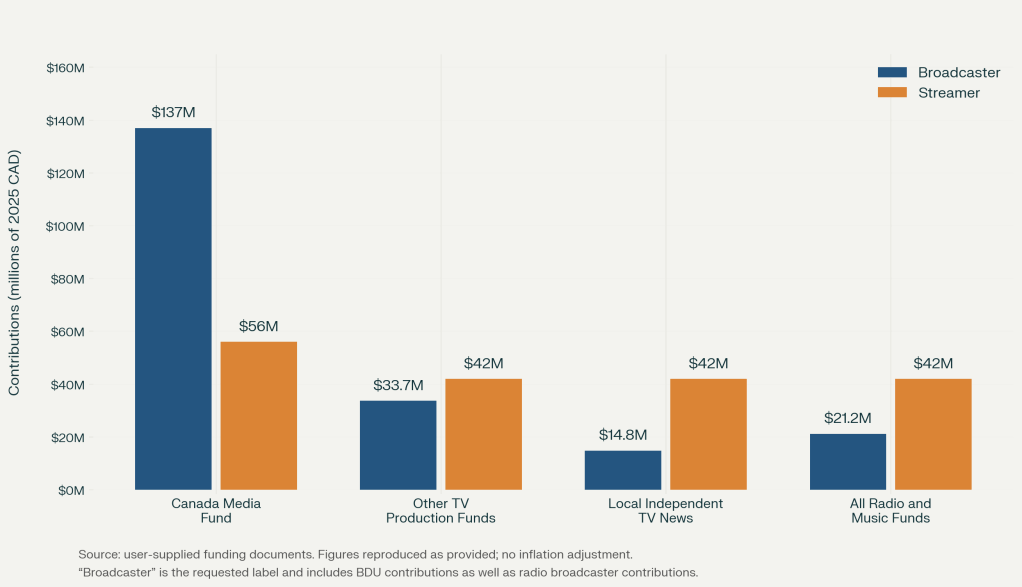
That’s the policy problem. What about the remedy? Table 3 was the ill-fated CRTC solution to the problem by levying an estimated $200M (in 2025 dollars) of annual contributions from Netflix, Spotify and the other streaming services:
On to the next concept. As I said, many of these CRTC-supported Funds have been historically co-financed with direct government contributions. After striking down the CRTC’s Netflix tax, Carney’s $600M make-good pot of federal money can be compared to contributions made by Canadian broadcasters in Table 4. (Notes 3,4,5)
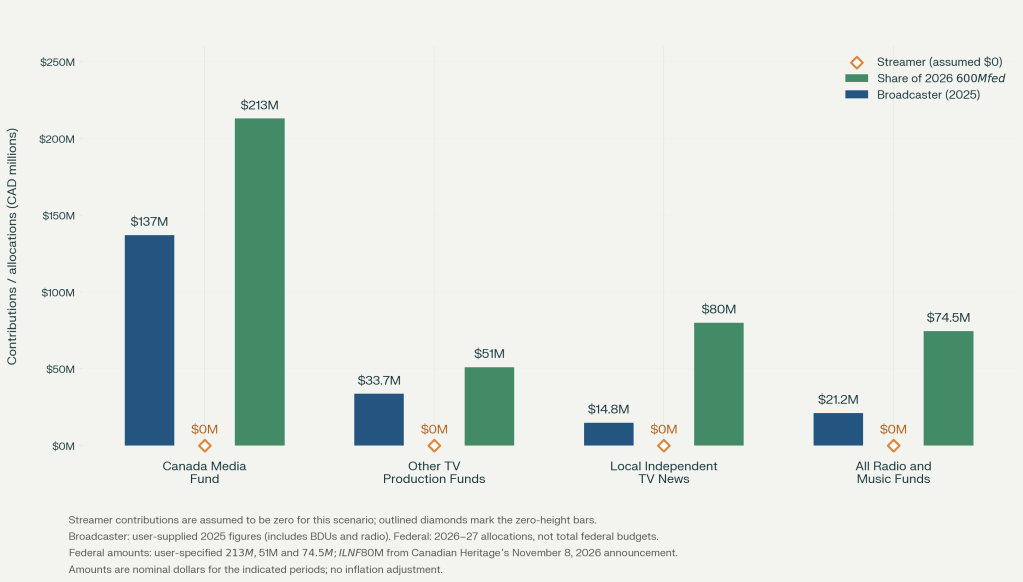
And finally Table 5 illustrates how Carney’s $600M for the 2026/27 budget year compares to federal spending in the previous year:
Here are some notes and caveats:
(1) I sourced this data using my AI Chatbot, Perplexity. I like that product because it shows sources and conflicts in data collection. I would normally drill down into the actual sources to verify, but in this case it would be too time consuming.
There could be all sorts of problems with data or unrevealed assumptions. For example, it’s possible that “one-time” regulatory or government contributions are included in an annual figure. Reader beware.
(2) The “Viewing” data in Table 1 is a proxy for broadcaster and streamer revenue earned from subscriptions and advertising dollars. I am seeking to illustrate the criss-crossing fortunes of traditional television and streaming.
(3) We should be careful about assuming the $600M in government funding will be there again in 2027/28, let alone in five or ten years. My guess is that the government will re-evaluate the whole scheme once the CRTC has implemented Carney’s forthcoming policy direction on how much to demand from broadcasters and streamers in direct investments in Canadian content for their own platforms.
(4) We should also keep in mind that although the $600M is for budget year 2026/27 it may represent more than just twelve months of funding. It is probably intended to make up for the loss of Netflix Tax contributions in both 2025/26 and 2026/27.
(5) The spectacular increase in funding for the Independent Local TV News Fund should be considered in the context that the number of local stations supported by the Fund has doubled from 17 to 35, owing to the participation of the Global News network of stations.
***
If you would like regular notifications of future posts from MediaPolicy.ca you can follow this site by signing up under the Follow button in the bottom right corner of the home page;
or sign up for a free subscription to MediaPolicy.ca on Substack;
or follow @howardalaw on X or Howard Law on LinkedIn.
I can be reached by e-mail at howard.law@bell.net.
This post is copyrighted by Howard Law, all rights reserved. 2026.


