Carney’s “cave” to Trump on the DST roils Canadians

July 2, 2025

Mark Carney’s shock repeal of Canada’s digital services tax on the eve of Canada Day was greeted by a gloating fan-dance by President Trump’s press secretary who claimed that “Carney and Canada caved to Donald Trump and the United States of America.”

In a brief news interview the Prime Minister suggested that the corporate tax measure, designed to capture offshoring of Canadian revenues by US tech companies, was never going to be in the final trade deal that he is working on with Donald Trump. MediaPolicy expressed its view on all of this in Monday’s post.

This might end up as a historic moment of humiliation, pending future events.

The backlash against Carney has come from all sides. He may be fortunate that Parliament is not in session and his minority government doesn’t have to face the music until the Fall. No doubt, that was his calculation.

Today the Toronto Star published an open letter signed by Canadians for Digital Sovereignty who describe themselves as “a group of patriotic Canadians and civil society organizations who care deeply about the future of Canada.” The letter expresses the concern that backing off the digital services tax will embolden Trump to press other trade demands, in particular where Big Tech and Hollywood are involved.

Carney might regard some coalition members as the usual suspects in public policy matters affecting digital and cultural sovereignty, but the inclusion of others suggest a broader opposition that ought to disquiet the Prime Minister.

The members of the coalition hail from English speaking Canada. From what I have seen on social media, their French-speaking counterparts in Québec are angered by Carney’s DST climb-down and their displeasure will be expressed.

Here’s the Open Letter:

Open Letter: Canada cannot afford to concede more to foreign tech giants

Dear Prime Minister Carney and Minister Champagne, 

We are a group of patriotic Canadians and civil society organizations who care deeply about the future of Canada. We are disappointed by the government’s decision yesterday to both halt collection of the Digital Services Tax and eventually repeal the Digital Services Tax Act. As a result, on Canada Day, foreign tech giants will enjoy an immediate $2.5 billion windfall and a $7.2 billion tax break over the next 5 years. While we recognize the difficult choices facing the government, we feel that we cannot ‘build Canada strong’ while surrendering ever more of our digital sovereignty and security.

We urge the Government of Canada to:

(i)                  Find ways to use foreign tech giants’ massive untaxed profits to fund homegrown alternatives, despite proposing that Parliament repeal the Digital Services Tax Act 

(ii)                Strengthen Canada’s digital sovereignty in trade negotiations and in undertaking a reset of Canada’s forward digital policy agenda, and

(iii)              Make no further concessions to foreign tech giants, including on legislation passed by Parliament (the Online Streaming ActOnline News Act) or in addressing urgent matters including combatting online harms, regulating artificial intelligence, ensuring the integrity of the information environment (including for health information), protecting privacy, among other measures to rein in foreign tech giants’ negative impacts on our economy and society.

 Foreign tech giants, especially U.S.-based companies, have made hundreds of billions of dollars in Canada in recent decades and yet have not paid their fair share in taxes. Many enjoy tax breaks on digital advertising paid for by Canadians thanks to a loophole in the Income Tax Act. We are one of the largest digital markets in the world, with a highly online population, skilled workers, and innovative companies. Yet in 2023 alone, U.S. tech giants made $20.7 billion in Canada from distributing online content. U.S. tech giants are crushing domestic competition, dominating our markets and imposing a range of externalities on Canadians. They profit from the amplification of online harms, including the spread of false and manipulated information, hurting the mental and physical health of children along with all Canadians. They are eroding the economic basis for the professional news media and feeding the toxification of our increasingly digital public sphere upon which our democracy depends.

The Digital Services Tax is a modest yet much-needed measure that will ensure foreign tech giants are more fairly taxed and held accountable for their enormous power over Canada’s society and economy. We are disturbed to see the alignment of CEOs of Alphabet, Meta, Apple, Amazon and X Corp. with the current U.S. administration’s agenda, which threatens Canada’s political and economic independence.

Rather than repealing the DST, we urge you to consider how foreign tech giants’ massive unfair profits in Canada could be taxed to invest in Canada’s digital sovereignty, building homegrown alternatives to U.S. monopolies. At many times in our history, Canada has invested to build communications infrastructure in the national interest. Canadian companies can help build platforms, networks, and tools that reflect Canadian values, strengthen our cultural and information ecosystems, and nourish our diversity as a country with two official languages and three founding peoples – Indigenous, French, and English – so that Canadians in communities across our far-flung country can better serve their own needs to communicate and connect.

We note that the U.K. did not make concessions to their digital services tax to get a trade deal with the US.

We stand ready to help our government, to inform and rally Canadians to help build our digital sovereignty and a better digital society.

Regards, 

Organizational signatories

ACTRA National
Amanda Todd Legacy Society
Broadbent Institute
Canadian Anti-Monopoly Project 
Canadian Centre for Policy Alternatives
Canadian Centre for Child Protection
Canadian Federation of Nurses Unions
Canadian Medical Association
Canadian Media Guild
Canadians for Tax Fairness
Centre for Media, Technology and Democracy
Children’s Healthcare Canada
Community Radio Fund of Canada
The Dais 
Documentary Organization of Canada
Friends of Canadian Media
Goodbot Society
Inspiring Healthy Futures
Open Media
Pediatric Chairs of Canada
Reset Tech
Unifor National & Local 87-M

Individual signatories
Mike Ananny, former advisor to Canadian Heritage on the future of CBC/Radio-Canada, and Associate Professor of Communication and Journalism, University of Southern California

The Right Honourable Adrienne Clarkson, CC

Linda McQuaig, author and journalist

Taylor Owen, Director of the Centre for Media, Technology and Democracy and Associate Professor at McGill University

John Ralston Saul, CC

Leslie Regan Shade, Professor Emerita, Faculty of Information, University of Toronto

Paul Valée, CEO of Tehama.io 

Dwayne Winseck, Director Global Media and Internet Concentration Project, and Professor School of Journalism and Communication, Carleton University

***

If you would like regular notifications of future posts from MediaPolicy.ca you can follow this site by signing up under the Follow button in the bottom right corner of the home page; 

or sign up for a free subscription to MediaPolicy.ca on Substack;

or follow @howardalaw on X or Howard Law on LinkedIn.

I can be reached by e-mail at howard.law@bell.net.

This blog post is copyrighted by Howard Law, all rights reserved. 2025.
Carney blinked.

June 30, 2025

Mark Carney blinked. He blinked hard and killed the billion-dollar Canadian digital services tax on US tech giants. He did it because Donald Trump threatened to punch Canada in the nose. 

After years of calling the shots as a business CEO and bank governor, the Prime Minister is discovering how tough it is to play the weaker hand when negotiating —-well, trying to negotiate—- with a bully like the United States. 

Trump not only wanted the DST to be cancelled, he demanded on Sunday morning it be repealed as a condition of further negotiations over tariffs, trade and continental security.  On Sunday evening Canada folded.

Carney cancelled the DST literally hours before the Silicon Valley titans were obliged to send us about a couple of billion dollars in corporate tax remittances, after years of Canada delaying the tax in the hope of coming up with an alternative measure to address the problem of US tech giants reducing their global tax bill by offshoring revenues earned in Canada and countless other jurisdictions. A deal with former President Joe Biden fell through because US Congress would not ratify it.

The rapid chain of events on Sunday had a whiff of Kabuki theatre: it’s plausible that weeks ago Carney made the decision to clear ballast from his trade agenda, much as he did with a carbon tax he once endorsed, but he needed Trump’s threat of walking away from the trade talks to do so. Whether Carney and Canada got anything from Trump in exchange for this unilateral concession we may never know.

It’s an understatement to say there is a disturbing pattern taking hold. Canada spent $1.3 billion on border security to rebuff Trump’s first round of trade tariffs triggered on the phony pretext of fentanyl smuggling.

We enacted and then suspended most of our retaliatory tariffs in hopes of expedited trade negotiations.

We joined hands with NATO allies to click our heels at Trump’s demand that NATO countries more than double their defence spending to 5% of GDP.

And as a ten out of ten on the cringe scale, who can forget Ontario Premier Doug Ford’s bumbling bluff to cut electrical power exports to the United States.

Carney is gambling that Trump won’t see the DST climb-down as weakness and be emboldened. If Canada was the European Union of 400 million souls, an ocean away from the US, the Prime Minister might have chosen a different strategy.

What’s the right way for Carney to play this in the next few weeks?

I spent my trade union career negotiating against powerful companies, usually playing the weaker hand unless the rank and file were angry enough, for a long enough period of time, to face down their employers. One of the key responsibilities of the negotiator is to figure out your own strength.

This is Carney’s challenge. How resilient are Canadians in our collective commitment to economic defence against the Trump onslaught? We get riled up by Trump’s “51st state” threats. But are we tough enough for a grinding trade war of attrition that lasts until Trump’s economy tanks and he has to face mid-term voters next year?

This is a question that the Prime Minister must ask himself every day. It is a question we must ask ourselves.

Our first test of bargaining solidarity is for our politicians, especially our provincial premiers. I suppose we could ask them to just shut up and let the winner of the federal election speak for Canada and certainly not head south to cut their own deal with the US President at Mar-a-Lago. 

But voters expect their elected officials to speak up for their constituencies —-Alberta Premier Danielle Smith has every right to remind us that the oil patch is as important as the auto industry— or else they will no longer be elected officials. But there is a line to be drawn and respected.

The same test of solidarity can be expected of non-elected political agents. The chorus of domestic critics of the tax on Uber, Google, and the other digital titans has mischaracterized the tax as just another cynical cash-grab from Big Tech companies that are better left unregulated. 

Canadian journalists have tried to correct that misimpression, reporting on the DST as a story of global tax policy. The story is that Canada was a relative latecomer to the international consensus among OECD nations that US Big Tech was offshoring revenues earned in other countries to tax havens like Ireland and that national digital taxes were the best way to combat it until the cheating stopped. 

Most European Union nations have already implemented their digital services taxes. While the US President still has those levies in his trade crosshairs, any changes will come at the negotiating table where the EU can pursue a solution to the offshoring problem. In a recent announcement, US Treasury Secretary Scott Bessent said that the US was prepared to mirror OECD/G20 nations’ tax policies on a minimum corporate tax even though the US will not ratify a tax treaty on the matter. 

The details of this recent understanding between the OECD and the US are still hazy. 

The EU is keeping its DSTs, for now, because it has some things that Canada doesn’t. Like, the EU nations’ DSTs were already implemented and they had not delayed them out of good will as Canada did. Like the trade of EU nations is less exposed to the United States than Canada’s is. Like, the EU can fall back on an internal trading bloc of 400 million.

The EU will discover, as Canada is, that a solid front at the bargaining table is the only way to defend economic opportunity and political sovereignty against Trump’s trade war. 

If it’s all over quickly because we can’t keep a grip on our internal solidarity, we will have lost the trade war. And losing the trade war could mean losing our country

***

If you would like regular notifications of future posts from MediaPolicy.ca you can follow this site by signing up under the Follow button in the bottom right corner of the home page; 

or sign up for a free subscription to MediaPolicy.ca on Substack;


or follow @howardalaw on X or Howard Law on LinkedIn.

I can be reached by e-mail at howard.law@bell.net.

This blog post is copyrighted by Howard Law, all rights reserved. 2025.

Catching Up on MediaPolicy – Carney’s US publisher – CRTC confronts chokepoints in online distribution – our best Canadian songs

Mark Carney is due for a follow up to his 2021 book Value(s)

June 29, 2025

I start this week with a recommendation, but not Mark Carney’s first book Value(s) (2021).

Instead it’s book publisher Ken Whyte’s latest Substack post cuffing the Prime Minister for cutting a deal for his unreleased second book with an American publisher.

Aside from the PM striking this discordant note during a trade war, it’s inviting to contrast the Liberals fighting the good fight for Canadian broadcasting and news journalism to their neglect of book publishing where foreign publishers claim 95% of Canadian sales and 98% of profits. 

To be fair, book publishing lies outside of federal regulatory jurisdiction and many of the titles printed by Canadian book publishers are subsidized by federal Canada Council grants and the Canada Book Fund. 

Still, I have to sign on to this statement from Whyte:

There aren’t many silver linings to Trump’s second term, but one has to be that it has highlighted the perils of outsourcing so much of our economy and culture to the US. We were lulled into a cultural complacency, thinking it didn’t matter that another country’s norms, values, and market demands dominated our markets and our discourse.

***

Speaking of “outsourcing our culture to the US,” doing something about it is the CRTC’s full time job lately.

The Commission is almost done public hearings on yet another file implementing the Online Streaming Act. This one’s inscrutably labelled “market dynamics.” It’s about getting the big players in distribution to bring Canadian content to market.

Not a sexy policy issue compared to defining Canadian content or ordering foreign streamers to pony up $200 million for Canadian media funds. But crucial.

In the Market Dynamics proceeding, the Commission is revisiting its expectations of cable companies to distribute Canadian content and then doing the same for online distributors like Roku, Amazon and PlutoTV. 

It’s the Commission’s job to sniff out the danger of big distributors exploiting their gatekeeper power over smaller content programming companies. Unchecked, this chokepoint market power can stifle cultural competition and the survival of independent Canadian broadcasters. 

It’s a messy file because the related policy problems of market power in distribution and cultural gatekeeping by distributors bleeds into two other CRTC files focussed on Canadian content obligations for online television broadcasters like Netflix and music streamers like Spotify

What unites all three CRTC proceedings is the holy grail of “discoverability”: making Canadian content prominent for Canadian audiences so they consume it.

There’s a long list of what prominence means in an online environment.

It might include marketing campaigns, event sponsorships, online fan pages, favourable home screen positioning for Canadian shows and playlists, “For You” recommendations, and even ranked outcomes in response to content searches. In other words, something better than the ghettoized “Made-in-Canada” menus on offer, heavily populated with titles that frequently aren’t Canadian by any definition.

Based on their legal filings, the global giants are opposed to any regulated prominence for online Canadian content. They plead the uniformity of their platforms across a global audience and their pursuit of a frictionless connection between platforms and subscribers. Regulation, as they see it, is someone else choosing your clothes for you.

The Canadian Association of Broadcasters retorts that the reality is that online programming is bought, sold and distributed on market-by-market basis around the world and platforms are not global monoliths. That means unique Canadian requirements can be customized to each global’s “dot ca” Canadian streaming services. 

In filings to the CRTC, cultural advocate Friends of Canadian Media has sketched out a regulatory scheme in which the Commission assigns online distributors a target CanCon budget of 30% of their Canadian revenues. That commitment can be satisfied by the cash and prominence value of commercial deals with the Canadian programmers they put on their platform. There’s already a down payment on the 30%: the Commission’s 2024 ruling that foreign online undertakings fork out 5% cash contributions to Canadian media funds.

The Friends proposal mirrors what the Commission previously said it has in mind.

In its very first public pronouncement on implementing the Online Streaming Act in May 2023, the Commission identified prominence rules as the non-cash component in each streamer’s regulatory load. Prominence efforts would be assessed a monetary value as a supplement to cash investments in Canadian programming. 

Whatever these three Commission rulings end up saying in broad strokes about discoverability, the detailed prominence rules for each streamer or online platform are supposed to be nailed down by the Commission in yet another regulatory phase that won’t even begin until 2026.

But the prominence of online Canadian content is only part of the cultural gatekeeping problem, and not the most difficult for the Commission.

Before prominence comes “access.” Canadian audio and video programmers that are big (Bell, Rogers or Québecor), medium-sized (e.g. Stingray or Corus) or small (e.g. APTN or OneSoccer) first have to elbow their way onto crowded distribution platforms and get paid a fair market rate by distributors or else they needn’t trouble themselves about prominence.

As Corus stated its filing, it’s unrealistic for Canadian programmers to go solo with their own streaming apps as a core business model.

If the online streaming step-outs launched by Canadian broadcasters are too small to go toe to toe with Netflix and the Hollywood streamers, that makes the alternative ——getting on global distribution platforms like Roku and Amazon—- increasingly indispensable as Canadians shift from cable to streaming. That puts the distributors in the driver’s seat in any negotiations over prominence and compensation of Canadian broadcaster content. 

If this problem of market power in online distribution has a familiar ring to it, it should.

For the last two decades the same power game has played out between Canadian cable companies and Canadian broadcasters over access, prominence and compensation.

In 2011 the Commission responded with a Wholesale Code setting out rules of fair play, enforceable through Commission orders for access and prominence as well as binding arbitration over commercial rates for distributor payments for programmer content. The Code was revised and strengthened in 2015 and tweaked again when the Commission approved the Rogers-Shaw merger in 2022.

Ever since, commercial fist fights have broken out and, in the public eye, play out as David and Goliath stories. Litigation before the Commission abounds.

The large cable distributors Bell, Rogers, Telus and Québecor are often accused of bullying Canadian programmers, threatening to kick them off the cable dial for audience underperformance, whether real, imagined or exaggerated.

Programmers see it all as a cynical bargaining ploy to renew expiring commercial deals at lower rates of compensation. 

In turn, the cable companies routinely accuse programmers of gaming the regulatory system by manipulating the fair play rules to hold on to expiring commercial rates negotiated during better times in the industry. 

The Wholesale Code’s fair play rules are up for inspection in the Market Dynamics proceeding. The big Canadian companies want the rules either heavily edited (Québecor and Bell) or gutted (Rogers). 

The Canadian programmers are defending the Wholesale Code. They have allies in second-tier Canadian cable companies, such as the Nova Scotia based Bragg Communications and the Montréal-headquartered Cogeco, who believe the big Canadian broadcasters make them overpay for the programming that audiences want in their cable package.

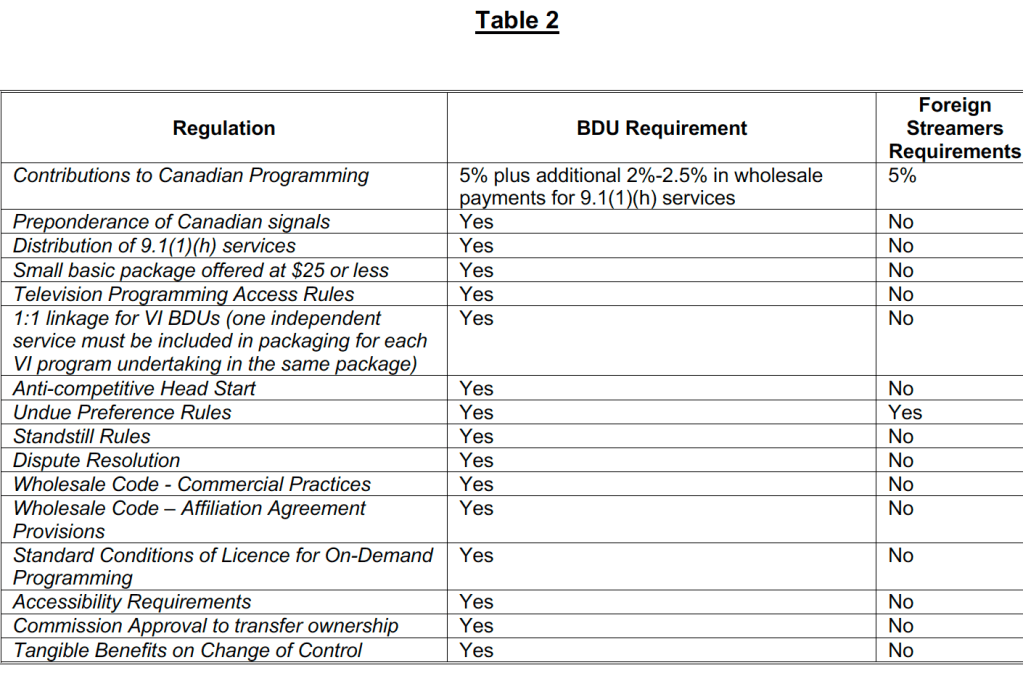
The programmers also want the spirit of the fair play rules to be mapped over (see Bell’s chart below) to online distribution by the global giants and, now that Rogers operates its Xfinity platform for streaming apps, their Canadian imitators too. 

It’s an uphill if not impossible regulatory battle for Canadian programmers.

In a strange move that they never properly explained, the Trudeau Liberals hamstrung the Commission when writing the Online Streaming Act by withholding the Commission’s key lever to impose binding arbitration on online distributors.

But other regulatory powers over online access and distributor favouritism remain intact, at least in the legislation and perhaps soon in CRTC regulations.

If the Commission trains are running on time, we’ll get a ruling on Market Dynamics in late 2025. 

[Disclosure: I am a volunteer member of Friends of Canadian Media’s policy advisory committee. The Friends proposal above wasn’t my idea, but as Kim Mitchell might say “damn, I wish I wrote that.”]

***

One of the more tone-deaf utterances offered by Netflix during CRTC proceedings was that it doesn’t need to be told to make Canadian content more prominent on its service, because entertainment writers at Canadian news outlets are doing the job of promoting CanCon so well.

Nevertheless, here’s a sincere MediaPolicy shout-out to the dwindling corps of Canadian journalists regularly reviewing a global ocean of content and spotlighting great Canadian shows and music.

And here’s a gold star and thanks to the writers at the Globe and Mail who, after consulting with other critics far and wide, just put together a song playlist from their top 100 Canadian albums. There’s a handy gizmo: you can upload it to your Spotify account. 

And don’t forget: our homegrown bands will front Canada Day celebrations on Tuesday, broadcast or streamed on CBC.

***

If you would like regular notifications of future posts from MediaPolicy.ca you can follow this site by signing up under the Follow button in the bottom right corner of the home page; 

or sign up for a free subscription to MediaPolicy.ca on Substack;

or follow @howardalaw on X or Howard Law on LinkedIn.

I can be reached by e-mail at howard.law@bell.net.

This blog post is copyrighted by Howard Law, all rights reserved. 2025.

Catching Up on MediaPolicy – News subscriptions stall – Guilbeault parries Québec cultural demands – Bell’s proposal for local TV news

June 22, 2025

The 2025 Reuters Oxford Digital News Report was published this week, offering both global and Canadian break-out numbers. 

It’s a trite observation that digital technology has turned media on its head, disrupting the advertising revenue that once paid our bar tabs for the consumption of media. The disruption has hit hardest in news journalism and stoked alarm about its knock on effect upon liberal democracy.

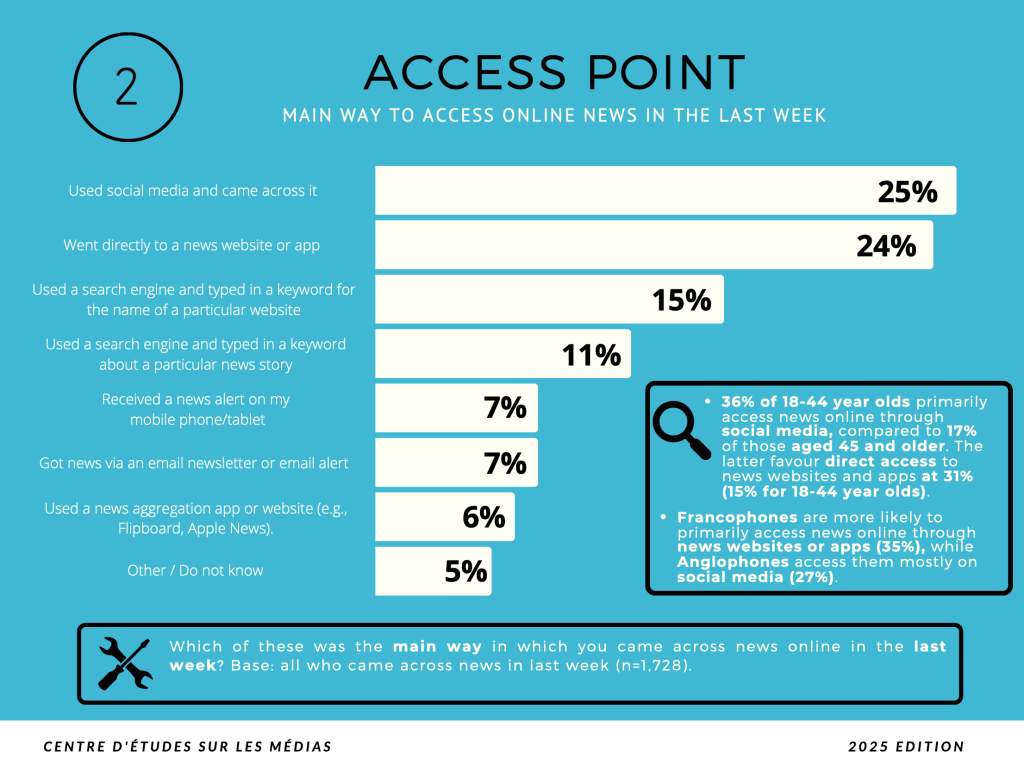
That’s probably why recurring polls and surveys tracking the arc of that disruption seize our attention, even if the trends are slow moving. For example, this year’s Rubicon crossed was that social media surpassed news websites as the leading access point for online news.

Cue the Reuters report, for my money the leading annual global survey. It tracks metrics on news consumption, platform preferences, news avoidance, misinformation, fear of misinformation, and “trust in media,” which is essentially a hybrid metric tracking legitimate skepticism of news journalism, alienation from public institutions, and audience polarization.

The global report also generates break out national numbers and additional polling for individual countries. Canada’s supplementary report on news consumption was written by University of Laval researchers Colette Brin and Sébastien Charlton.

Canada saw a 1% down tick in online news subscriptions from 15% in 2024 to 14%. In 2016 it was 9% but has been flat since getting a bump from the Covid pandemic and the 2020 US election.

Globally, the willingness of the local population to pay for online news ranges from 42% in Norway to nine per cent in Italy. Canada’s 14% is just slightly under the global water line of 18% of the adult population.

There was startling data that Canadians are world leaders in our readiness to shell out for foreign news subscriptions, clocking in at half of Canadian news subscribers. Together with Ireland, Canada’s sign up for foreign news sources is a global outlier.

But what really got my attention was a graph from the global study revealing that 71% of non-news payers say they can’t be tempted to subscribe through innovative options to bundle multiple news services, access more non-news content, or by pick-and-pay news content falling short of a full subscription. They just won’t pay for news, full stop.

As Hunter S. Thompson might have said, not paying is a matter of principle. 

That suggests (excuse my confirmation bias) that in the best case scenario there is limited room to grow the subscription-model for Canadian news. The vast majority of Canadians are casual news consumers who will not pay to keep up to date on current affairs. 

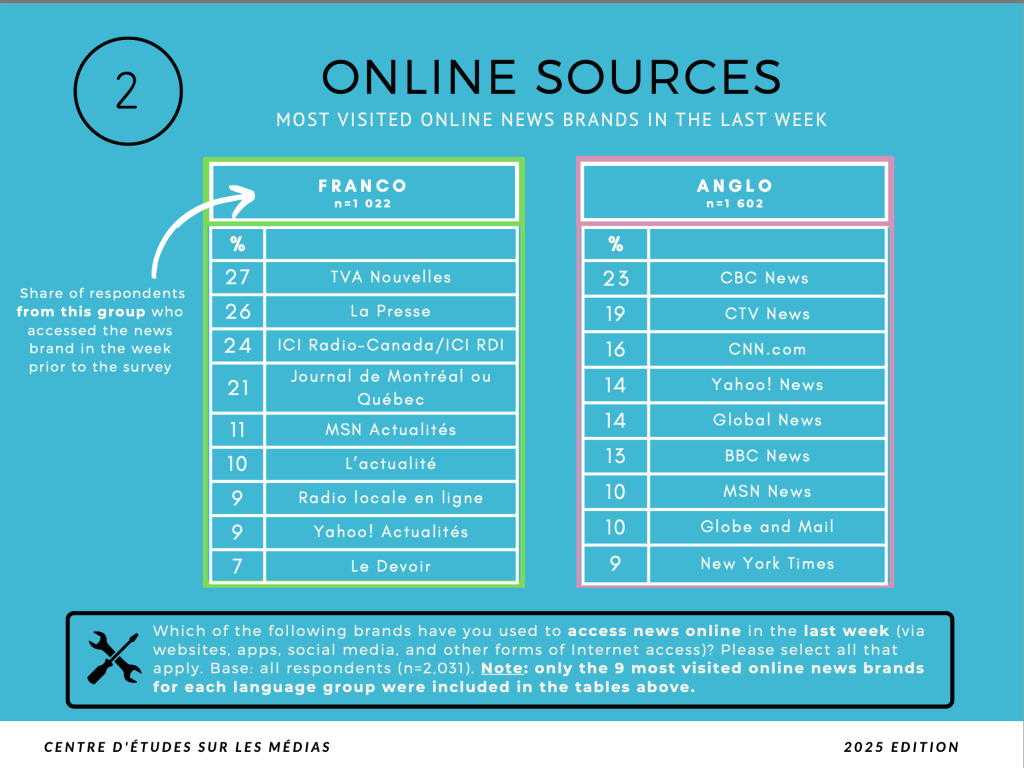
The good news, if you can call it that, is that the free-distribution CBC, CTV, Global News, the Canadian Press and hundreds of community news outlets continue to post news online (see the graphic below, where CBC leads the pack among English speakers).

Should that change, I’m not counting on the news subscription model to bail out liberal democracy. It’s more likely (and this is also reflected in the Report) that Canadians will turn to social media influencers to deliver news, reliably or otherwise. 

***

A couple of follow-up stories for you:

Last month the CAQ Québec government tabled its Bill 109, aiming to deliver seismic changes to the rock bottom consumption levels for French language music on global streaming platforms operating in Québec.

The tabling of the bill by Culture Minister Matthieu Lacombe was timed to coincide with Québec City hosting the 20th anniversary of the UNESCO Convention on the Protection and Promotion of the Diversity of Cultural Expression.

Unamended since its inception in 2005, the Convention is an aspirational international standard for sovereign nations willing to step into the commercial media market and push back against the domination of English-language and mostly American content. 

Lacombe was looking for other countries to sign off on an upgrade to the Convention, specifically to match Bill 109’s claim to cultural diversity as a fundamental right of citizens backed up by regulatory efforts to move the needle on the consumption of domestic media content.

The Québec City meeting didn’t deliver for Lacombe. A few countries said yes, but more gave a muffled maybe.

The muffled included Canada’s federal government. Culture and Identity (and Official Languages) Minister Steven Guilbeault issued a statement that endeavoured to navigate the narrow channel between the cultural nationalism embedded in Lacombe’s bill and, on the port bow, the exclusive federal jurisdiction over broadcasting. Not to mention, Guilbeault’s boss the Prime Minister must be thinking it’s not an ideal time to piss off Donald Trump by making more announcements about regulating foreign streamers.

All this is happening on a parallel time track with the CRTC’s upcoming public consultation on regulating foreign music streamers operating in Canada. 

Apple, which has more of a flair for corporate arrogance than you might think, filed a policy brief with the CRTC that sassed the Québec cultural groups who have asked the CRTC to build a stronger regulatory regime for music streaming. Said Apple:

Apple opposes the requests of groups such as ACCORD and APEM to obtain further information from online audio services in an effort to dictate approaches that supposedly will result in more streams of Canadian songs. Setting aside the remarkable fact that these organizations apparently think that they would be better at running the streaming services than the services themselves, these requests lead to a dead end. As Apple explained in its response to APEM’s application of more than one year ago, much of the information being requested is either not provided to Apple or does not even exist.”

American Big Tech disses Québec cultural leaders. Game on!

In addition to Apple, the world-leading music platform Spotify filed information with the CRTC culled from its annual report “Loud and Clear.” 

The Spotify document claimed surging growth in musician earnings in the global market for French-language music. Musician earnings have doubled globally and in Canada since 2017 thanks to rising royalty payments to music labels. Spotify told MediaPolicy that earnings growth was experienced at all levels, from the poorest bands to superstars (but not broken out by language group). 

The policy implication of Spotify’s claim is that it’s part of the supply-side solution to domestic music and that the demand-side of music consumption ought to be left to the unregulated market.

The earnings data reported by Spotify is 10,000-foot stuff. Royalty payments are probably 20% of total label and musician earnings, says the company. But without the streamers opening their books to public analysis it’s hard to say how well things are working out for individual bands, or in particular for Québec musicians who may be making money in the global francophonie but have less than 10% of their own domestic market. 

The same data problem exists on the consumption side of the equation. Spotify has never contradicted the repeated claims made by Québec’s cultural groups that their third party data shows that less than 10% of streaming in Québec is in French and that French-language songs rarely crack the charts

In response, Spotify says that half of Québec’s streaming audience “regularly” consumes French language music but chooses not to define “regularly” or provide its internal data on the proportion of English versus French language songs.

The coyness about data may come to a point in September when Spotify executives must appear before CRTC commissioners. 

***

In last week’s post, MediaPolicy offered an update on the CRTC’s decision to extend news subsidies from the Independent Local News Fund (ILNF) to the Global News network of local stations. 

Some of the Commissioners were nevertheless unhappy with the funding gap remaining between 34 independent local stations and the 45 operated by “vertically integrated” media companies Bell, Rogers and Québecor. If you want more context, check out last week’s post.

If some Commissioners think that the Big Three are getting the short end of the stick on news subsidies, imagine what the telcos think.

Bell owns 35 local stations in its CTV and Noovo networks and, according to filings, loses $40 million annually on news.

Here’s Bell’s illustration of the news funding gap it provided to the Commission:

But being sensitive to how the big telcos are viewed by their admiring public, Bell isn’t having too much of a moan. 

Instead, Bell’s ask of the Commission is that they be allowed to reassign the remaining $13 million of their cable division’s funding of community programming to their broadcasting division’s network of local news stations. 

In return, Bell wants the Commission to repeal its 2016 regulations requiring the vertically integrated Big Three to allocate 11% of their programming budgets for conventional television to local news.

Also, Bell wants the Commission to remove minimum exhibition requirements for weekly hours of news programming. 

***

The best podcast I listened to this week was four Americans debating trade, Trump and culture war, courtesy of Canada’s Munk Debates

The New York Times’ Ezra Klein was on the panel and he was allowed to post the full length audio on his podcast.

Klein provided the intellectual content; Kellyanne Conway provided the MAGA hubris

***

If you would like regular notifications of future posts from MediaPolicy.ca you can follow this site by signing up under the Follow button in the bottom right corner of the home page; 

or sign up for a free subscription to MediaPolicy.ca on Substack;

or follow @howardalaw on X or Howard Law on LinkedIn.

I can be reached by e-mail at howard.law@bell.net.

This blog post is copyrighted by Howard Law, all rights reserved. 2025.
Catching Up on MediaPolicy – CRTC rules on local news funding – NPR and PBS closer to defunding – who is the media now?

June 14, 2025

The latest CRTC ruling (2025-133) on local television news has delivered a predictable outcome, but also the beginnings of an adult conversation about a broader CRTC strategy.

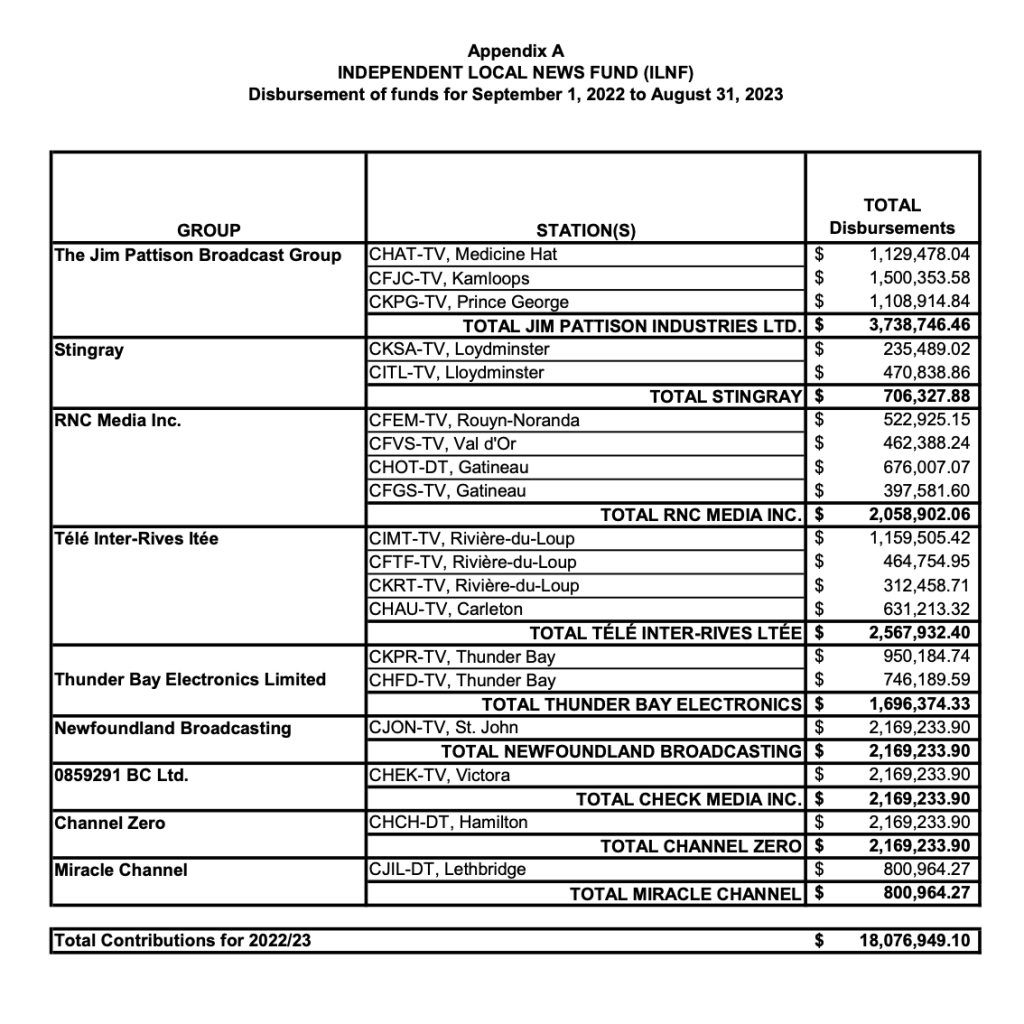
The Commission’s bottom line was that the CRTC-created Independent Local News Fund that subsidizes unprofitable local news production at sixteen stations not owned by Canada’s three major broadcasting groups will be extended to fifteen Global News stations. The ILNF’s $18 million annual kitty that is courtesy of a tithe on major cable companies is scheduled to be swollen by another $40 million from the Commission’s cash levy on online streamers.

The Commission was bound to reclassify the Corus-owned Global stations as “independent” once they were cut loose from Shaw Cable in the CRTC-approved Rogers-Shaw merger. Denying them admission to the ILNF would have been difficult to explain and now the streamer money makes the numbers work.

The level of ILNF subsidy works out to approximately 70% of news production costs, a dramatic figure, although it varies from station to station depending on how much they spend on news and how many hours they produce. 

A CRTC rule caps any station owner in a single regional market from drawing more than 12% of the $18 million (now $58 million) fund.

In this recent ruling, the CRTC added an “entity” cap which restricts the 15-station Global News network to 45% of the available money, somewhat less than the majority share they would be paid without a national cap.

Those are the headline numbers.

There’s some unfinished business.

The Commission says its going to develop an incentive —details to come later— to reward local news stations for increasing their news coverage of underserved communities (read Indigenous, minority French and Anglo communities and equity-seeking groups). 

As part of that ruling, the Commission has imposed a quid pro quo for receipt of ILNF cash: stations must post all of their television news content on their websites; whether its available for free or subject to paywalls isn’t clear from the ruling. Many stations already distribute their video content digitally for free.

So far, so predictable. 

But three —three!— Commissioner dissents from the ruling suggest that a more wholistic vision of broadcast news funding is coming. And in fact a general rethink of news funding is one of the issues the Commission is reviewing in its current consultation on audio-visual broadcasting by television and streaming operators. 

Ontario Commissioner Bram Abramson decided to speak his mind in a way you rarely find in Commission rulings, suggesting the tweaking of the ILNF to satisfy Global’s admission to the subsidy club is only an “interim” (read, “timid”) step with more to talk about.

Abramson makes the taboo suggestion that the Commission consider access to the ILNF subsidy by local stations owned by the three major networks, the 45 stations operated by the “vertically integrated” (“VI”) Québecor (5), Rogers (5) and BCE (35) that own both cable services and local stations. 

Abramson’s view is that what’s more important than ownership of stations is the market they operate in, in particular the extent of local “news poverty,” meaning the availability of news from other local news outlets. 

Québec commissioner Stéphanie Paquette weighed in on this as well, arguing that because the French language markets are dominated by Québecor’s TVA network, which is ineligible for ILNF money, that means the production of French language news gets shortchanged by the only-for-independents ILNF.  

Going back to the establishment of the ILNF by the Commission in 2016, the “VIs’” local stations aren’t eligible for that Fund. But they are eligible for a different CRTC cross-subsidy that redirects cable company patronage of their own hyperlocal  community stations to their own network TV stations. But depending upon how you do the calculations, that VI news subsidy is worth half or three-quarters of an ILNF dollar.

The CRTC’s standing justification for two sets of subsidy rules for VIs and independents is that the big three networks have greater access to pooled news resources as well as deeper pockets for capital investment. 

There’s compelling policy logic to the Commission’s traditional approach, however the bright red line between the financial capacity of VI and non-VI television stations can get muddied in practice, particularly where some of the ILNF-eligible stations are owned by big media companies that don’t happen to run cable operations. 

Stingray and Pattison come to mind. Each company closed television stations last month in the rural Prairies, Stingray in  Lloydminster (population 31,000) and Pattison in Medicine Hat (population 63,000). The closure of the Pattison station was influenced by the capital cost of renovating the television studio that had sustained major flood damage.

The Jim Pattison Group is a multi-billion dollar, multi-industry conglomerate.

The other notable thoughts from the Abramson dissent were directed at free content. The Commissioner was of the opinion that the availability of industry cross subsidies ought to be subject to a public policy favouring the free distribution of news programming under the conditions of a “Creative Commons”: in other words, a general policy of favouring free news content.

The implications of that thinking are far reaching. Certainly Google and Meta have been making the same claim: that the public interest in accessing news content overrides the desirability of mandatory news licensing payments through legislation like the federal Online News Act, Bill C-18. 

***

The Republican defunding of “biased” public broadcasting by PBS and NPR in the United States is on track after the House budget bill narrowly passed and was sent on to the Senate.

Judging from this New York Times report, Republican House Speaker Mike Johnson was able to mollify Republican holdouts with promises of reinstating some federal funding in the near future.

***

I attended a journalism conference recently where a focus on “essential standards of news reporting” inevitably turned into discussion about who is a journalist. 

I’ll spare you my soapbox thoughts on the matter but I recommend an entertaining article in The Hub about online influencers straddling the line between partisan activist and journalist. 

***

If you would like regular notifications of future posts from MediaPolicy.ca you can follow this site by signing up under the Follow button in the bottom right corner of the home page; 

or sign up for a free subscription to MediaPolicy.ca on Substack;

or follow @howardalaw on X or Howard Law on LinkedIn.

I can be reached by e-mail at howard.law@bell.net.

This blog post is copyrighted by Howard Law, all rights reserved. 2025.
Catching up on MediaPolicy – Aussies closing in on Meta – Prairie TV stations go dark – Spotify cites Canadian success

Sarah McLachlan will be a Canada Day headliner on CBC

June 7, 2025

Now that Parliament is back, and Culture and Identity Minister Steven Guilbeault is re-seated for a second tour of duty in his portfolio, there may be speculation about whether the Liberal government will do anything to bring Facebook and Instagram back into the scope of the Online News Act Bill C-18.

The Minister will keep an eye on Australia.

The Australians’ 2021 New Media Bargaining Code served as Canada’s model for Canada’s legislation that compels Google to pay $100 million annually in licensing payments to online Canadian news organizations.

In both countries, Meta’s response to bargaining codes was to ban news content from Facebook and Instagram in order to avoid regulation. In Australia, that meant Meta refused to renew the annual $65 million (AUS) value of its expiring voluntary agreements with news organizations which earned it an exemption from regulation in 2021. 

Australia’s Labor government caught everyone’s attention last December when it announced that it would respond to Meta’s actions by legislating mandatory licensing payments regardless of the company’s ban on Australian news. 

If and when it is enacted, a “News Bargaining Incentive” would provide a default cash levy on Meta, Google and TikTok if those platforms refused to bargain with news organizations, irrespective of any ban on news content.

The Incentive would be set at a price in excess of the estimated value of a voluntary agreement with news organizations. In late January the Australian government announced that a pre-legislative consultation paper would be “released shortly” but an election intervened. 

Now that the Labor government has returned to a majority Parliament in a surprise comeback that paralleled the re-election of Canada’s Liberals, the expectation will be that it releases a white paper and legislates as promised in “late 2025.”

None of that will take place in a vacuum as the American tech platforms will seek the aid of the Trump administration and Congressional trade retaliation. Their lobby organization CICA has released a statement that characterizes the Incentive as “arbitrarily” targeting “select foreign companies” just like the Digital Services taxes that 11 OECD nations have enacted to collect corporate tax revenues that are alleged to be evaded by Big Tech. 

An overview of different national versions of a news bargaining code is offered here.

There are also various attempts at the state level in the US. The Californian version was a flop as Google’s modest financial commitments have been scaled down in lock step with the Governor’s budget cuts to its parallel subsidy program. However legislation has been tabled in Oregon, New York, Washington and Illinois.  

***

Three independent Canadian television stations closed last month.

In mid-May, Stingray’s twin stations in Lloydminster (respectively affiliated with CityTV and CTV) shuttered. Ownership cited plunging revenues and audience.

Then last week Pattison’s Medicine Hat station also went dark.

It’s an attention-grabber for the CRTC which is poised to release a ruling later this week on revised cash allocations from the Independent Local News Fund (ILNF). 

In a June 2023 submission to the CRTC, the umbrella organization representing 19 independent television operators —not counting the 15 Global News stations cut loose in the Rogers Shaw merger— reported that collectively they cover 70% of news production costs from $18 million in ILNF grants.

***

Just as the window closed on submissions to the CRTC on audio regulation, industry leader Spotify published a news release touting the success of Canadian artists on its platform.

The gist of Spotify’s claim is that Canadian artists are growing their earnings on Spotify by expanding their global audiences.

The Canadian news release cites Spotify’s annual “Loud and Clear” global report on musician earnings that was posted in March. The break-out of Canadian data hasn’t been published other than summarized in the June 4th news release. 

Significantly, the Spotify report does not cite any changes to consumption of Canadian music in domestic audiences in Québec or the rest of Canada. As far as we know, the CanCon share of domestic market remains at 10% of the Canadian audience and, in the French language market, less than that.

***

If you’re making beer and cedar deck plans for Canada Day, it looks like a good CanCon line-up for the televised broadcast from Ottawa, Vancouver, Yellowknife, and Summerside. It’s on CBC. 

***

If you would like regular notifications of future posts from MediaPolicy.ca you can follow this site by signing up under the Follow button in the bottom right corner of the home page; 

or sign up for a free subscription to MediaPolicy.ca on Substack;

or follow @howardalaw on X or Howard Law on LinkedIn.

I can be reached by e-mail at howard.law@bell.net.

This blog post is copyrighted by Howard Law, all rights reserved. 2025.

Catching up on MediaPolicy – Can Québec shove aside the federal Bill C-11? – CBC bonus pay, the epilogue – Will Page’s “screwed losers.”

Former CBC President Catherine Tait defended “bonus pay” in 2024

June 1, 2025

Last week MediaPolicy offered an analysis of whether the Québec CAQ government’s Bill 109 might trigger a constitutional conflict with the federal government’s Online Streaming Act Bill C-11 over who can regulate video and audio streaming platforms with the goal of making French language content more prominent in Québec.

Having federal and provincial governments running active public policy on exactly the same thing is a bit of a problem, something Julie Miville-Dechêne immediately pointed out on the floor of Senate.

The Senate’s Government Representative, Marc Gold, replied that the federal government was thinking about Bill 109 and “may have more to say on this in the coming days.”

What the Carney government might or might not say in the coming days will probably follow some off the record conversations with CAQ Culture Minister Mathieu Lacombe who has already said publicly he doesn’t have to negotiate with Ottawa.

The legal question of whether it’s Parliament or the Québec National Assembly that has jurisdiction over the “discoverability” of Internet-borne content is a juicy orange for the many devoted fans of Canadian constitutional law.

Legal expert Pierre Trudel of the Université de Montréal published his view in Le Devoir. He argues that Québec can take legislative action “to ensure that French-language works can be easily found in the mass of available content, even by someone who isn’t searching for them,” because nowadays the delivery of online content depends so heavily upon consumer data that it becomes a matter of provincially-regulated commercial affairs and consumer protection.

Trudel offers as a legal precedent a 1978 Supreme Court case. In that 6 to 3 majority ruling, the Court upheld a Québec consumer protection law governing the exposure of children to advertising content even when it was applied to federally regulated television programming.

***

In the quiet lull following its miraculous survival of Election 2025, the still-funded CBC released its commissioned report from Mercer compensation consultants that answers some of the outstanding questions about the $18 million in “bonus payments” to 1,200 executives and non-union staff that fed the news cycle for so many months in 2024.

The headline is that Mercer recommended to CBC management that its at-risk “performance pay” component of total compensation is a common practice, a good thing, and ought to be retained in the name of effective staff recruitment and retention. In spite of the advice, CBC management rejected the recommendation to stay the course on performance pay and instead converted those dollars into wages. 

And perhaps that puts an end to the melodrama manufactured by MPs of all parties, as well as many members of the media commentariat, using the bonus payments as a stick to beat the CBC and its unpopular President because she refused to cancel payments owed under employment contracts in a year that the public broadcaster laid off 141 staff and then narrowly avoided mass layoffs. 

Before closing the book on this, there are a few parting observations worth making:

  • Every MP ripping former President Catherine Tait for not cancelling performance pay was well aware of what Mercer confirmed: an at-risk component of total employee compensation is a prevalent business practice throughout the economy. The idea is to keep high achieving employees hungry for success through good performance. It’s not a perq. It’s not a cash grab. 
  • If the unspoken script to the drama is that CBC employees get paid too much, the Mercer Report put that one to bed. CBC executives and non union employees are paid smack in the middle of the spectrum of total compensation for similar work. In fact they would be slightly below median earnings were it not for a solid pension plan.
  • Between MPs asking the wrong questions, Tait clamming up in response to political attacks, and the limited information in the Mercer Report, we still don’t know anything about a number of key questions. Did legal entitlement to performance pay depend in any way on whether the CBC was laying off employees ? (Probably not). Did Tait have any option to reduce or cancel them? (Unlikely). Did employees achieve their targets for full at-risk pay or are the payments gimmes for most employees ? (Unknown).
  • More importantly, now that $18 million of budgeted at-risk pay is being integrated into fixed salary, will that be at a dollar-for-dollar rate or discounted because there is no longer an at-risk portion?

The fact that none of these questions have been pursued, let alone answered, tells you what performative nonsense this has been.

***

Back to the issue of Canadian content made discoverable on the big streaming platforms: I recommend the latest episode of Dan Runcie’s Trapital podcast hosting Will Page, the high profile expert on global music streaming and ex-Chief Economist for Spotify.

Page says that after a decade and a half of audio streaming that fuels “glocalization” of music — where musical cultures cross pollinate across national and linguistic borders — he was surprised at the growth in the US dominance of the global music earnings when he had expected the opposite.

That has implications for Canada:

“I ask you to go to the YouTube artist charts for Brazil…. Google it up and pull down those top 100 artists in Brazil this week.

And you’ll find one, maybe two international artists on that chart is singing in Portuguese, very little Spanish. And if you’re lucky, I think The Weeknd is ranked 95, and Bruno Mars is ranked 65…

Other than that, it’s an entirely Portuguese chart. So there you go. There’s a top 10 global music market that just said, “thank you and good night” to the English language.

If you are a non-English speaking country with a strong identity, glocalization is a force for good. If however, you are an English speaking country that’s not American, glocalization leaves you screwed. So we have winners and we have losers.”

Page has lots more to say about Canada and Canadian music. You can listen to the podcast here.

***

If you would like regular notifications of future posts from MediaPolicy.ca you can follow this site by signing up under the Follow button in the bottom right corner of the home page; 

or sign up for a free subscription to MediaPolicy.ca on Substack;

or follow @howardalaw on X or Howard Law on LinkedIn.

I can be reached by e-mail at howard.law@bell.net.

This blog post is copyrighted by Howard Law, all rights reserved. 2025.
Quebec’s Bill 109 is the wild card in the Bill C-11 deck

Québec Culture Minister Mathieu Lacombe

May 28, 2025

Last week, Québec’s culture minister Mathieu Lacombe slid a wild card into Prime Minister Mark Carney’s deck by tabling Bill 109 in the National Assembly.

The bill contemplates doing for Quebec exactly what the federal Online Streaming Act, Bill C-11, mandated the CRTC to do two years ago for all of Canada: regulate streaming platforms so that original French-language content reaches more French-speaking Canadians.

The Lacombe bill claims a constitutional jurisdiction it doesn’t have (until the Supreme Court tells us otherwise), a legislative space in broadcasting that belongs entirely to the federal government. It could provoke a direct confrontation with the Québec-anchored federal Liberals.

The clash, if that is what it comes to, has been heading this way slowly but surely.

…..Continue reading at CARTT.ca

***

Hugh Stephens: The Online Streaming Act Was Already Complicated and Controversial Enough, But Now Quebec Enters the Fray (No Surprise: It’s Happened Before)

***

If you would like regular notifications of future posts from MediaPolicy.ca you can follow this site by signing up under the Follow button in the bottom right corner of the home page; 

or sign up for a free subscription to MediaPolicy.ca on Substack;

or follow @howardalaw on X or Howard Law on LinkedIn.

I can be reached by e-mail at howard.law@bell.net.

This blog post is copyrighted by Howard Law, all rights reserved. 2025.

Catching up on Media Policy: Canada dips in the World Press Freedom index after journalist arrests – Trump’s 100% tariffs on Hollywood

May 6, 2025

The annual World Press Freedom index is not something all national governments dread.

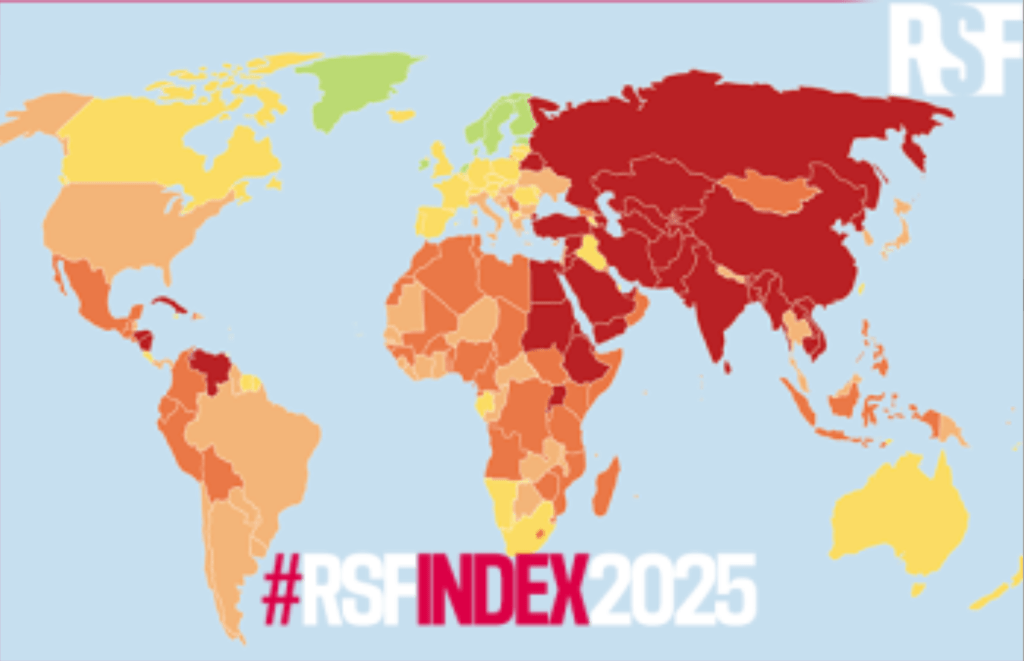
If you’re Norway (1st of 180 surveyed nations) or China (178th) you aren’t going to sweat what Reporters Without Borders, a Paris-based NGO best known for public campaigns against the murder or imprisonment of journalists, has to say.

But in between, maybe liberal democracies that think highly of themselves are in for a humbling moment.

This year, Canada’s global ranking is 21st, down from 14th because its index score, spread across five categories of political, legal, economic, social and safety considerations, fell from 81.7 to 78.75 out of 100 points. The US is 57th, France is 25th and the United Kingdom is 20th.

In who’s opinion, you might ask: in each of 180 nations, Reporters Without Borders asks local news journalism experts and practitioners to respond to a series of standardized “press freedom” questions that plumb the depths of journalists’ ability to report on the news without interference.

According to the RWB website:

Press freedom is defined as the ability of journalists as individuals and collectives to select, produce, and disseminate news in the public interest independent of political, economic, legal, and social interference and in the absence of threats to their physical and mental safety.

The Canadian report does not moot the debate over Canadian media subsidies and regulation, to the contrary across 180 nations strong public service broadcasting tends to drive higher scores.

The Index is as much a monitor of a healthy Press as freedom from state power. Broader social, political and economic factors that support or attack a free press play an important role in the scoring.

The editorial notes that accompany Canada’s score suggest that the police arrests of Canadian journalists covering volatile news sites —blockades, demonstrations and encampment clearings— drove down our ranking.

That concern also appears in Reporters Without Borders election-related statement that called for better training of Canadian police in their treatment of journalists as the top public policy priority.

RWB’s other recommendations included protecting the CBC from defunding, a ban on police spyware aimed at journalists, and a rebuilding of Canada’s “broken” access to government information mechanisms (the new Prime Minister having shown some interest in the latter).

RWB also noted the existence of “a patchwork of [media subsidies] policies” that beg for “a comprehensive and consistent strategy that helps enable the media to innovate and find news models of sustainability.”  

The latter point was included in my own list of things for the next Culture & Identity Minister to do, posted last week: Miles to Go: the Media Policy work of the 45th Parliament.

In next year’s report, we’ll likely see an impact on ratings from CTV’s firing of Rachel Gilmore as a guest election fact checker because of trolling by right-wing actors.

***

This is my last post for a month thanks to our first real vacation since pre-pandemic times. It’s a bit of a science experiment: can four adults manage a two-year old while travelling? Should be possible.

I couldn’t leave without commenting on Donald Trump’s latest announcement of a 100% tariff on Hollywood’s movie production outside the U.S.

It will be a popular move in the US. Hollywood is making less audio visual content globally and in the United States owing to a number of factors, most noticeably budget cutbacks in response to the saturation of the subscription streaming business.

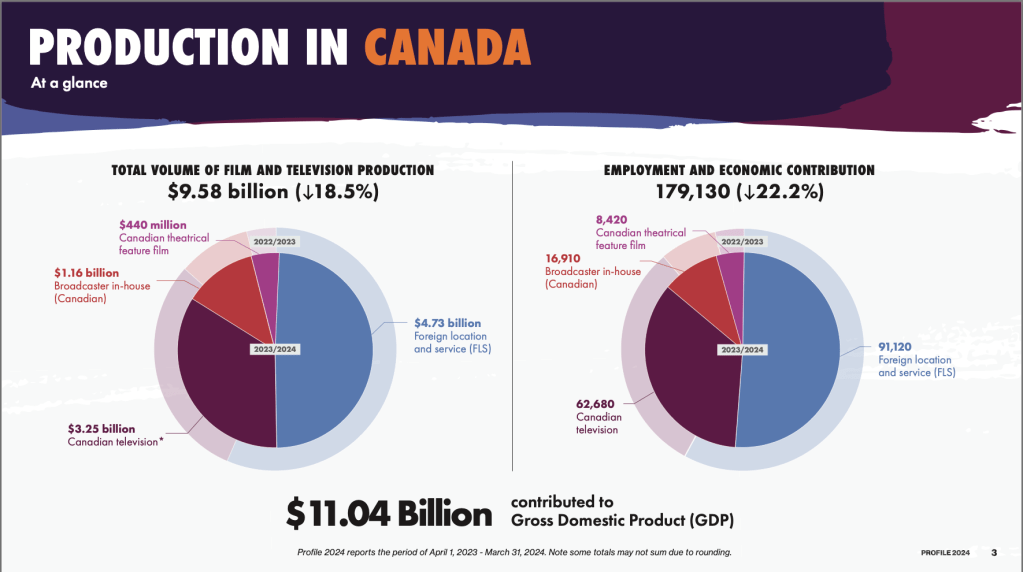
Canada is Hollywood’s biggest non-American supplier of movies and television shows: half of Canada’s $9.58 billion in annual production is for American shows and much of our Canadian content is widely exported to the American market for second runs. The employment hit could be substantial, as this screen capture from the CMPA’s Profile report reveals:

The obvious Canadian counter-tariff is a 100% surcharge on American-made shows exported to Canada. Those would hit Canadian broadcasters filling their schedules with American programming (Corus, TVA, CTV, Bell Crave, etc) but also Netflix and the other American streamers who sell to Canadian subscribers.

It’s not likely that Hollywood asked for the Trump tariff: the studios rely upon the high-quality, competitively priced production centres across Canada, but mostly Toronto and Vancouver.

The tariff disrupts their supply chains and their budgeting, not unlike the Trump tariffs hitting the auto industry.

A White House spokesperson walked back the President’s announcements within hours —-“no final decisions“— suggesting a WTF phone call from the Motion Picture Association.

Shortly afterwards, Trump’s “Hollywood ambassador” Jon Voight made a public statement suggesting that his recommendations to the President had been to boost tax incentives and subsidies for domestic production, negotiate international co-production treaties, and apply tariffs in some situations.

At the CRTC, the Motion Picture Association and the US streamers have put almost all of their strategic capital on securing a minimal commitment to offering Canadian content because the studios spend so much money making American movies in Canada.

That strategy is now in shreds.

A recommended article on the tariff is by Barry Hertz in the Globe & Mail.

***

If you would like regular notifications of future posts from MediaPolicy.ca you can follow this site by signing up under the Follow button in the bottom right corner of the home page; 

or sign up for a free subscription to MediaPolicy.ca on Substack;

or follow @howardalaw on X or Howard Law on LinkedIn.

I can be reached by e-mail at howard.law@bell.net.

This blog post is copyrighted by Howard Law, all rights reserved. 2025.
Miles to go: the Media Policy work of the 45th Parliament

May 1, 2025

The federal election is over and the CBC is still standing. That’s a milestone achieved, for now.

This next Liberal term of government will probably run light on media policy compared to the last four years of legislative turmoil that swirled around the Online Streaming Act Bill C-11, the Online News Act Bill C-18, the future of the CBC, and Online Harms Act C-63, the latter bill being split into two parts and then wiped off the Parliamentary agenda by the election.

If media or cultural issues appear front and centre of public attention during the 45th Parliament, it will likely be a result of trade negotiations with the Trump administration.

The exception is the CBC: the reinvigoration, rebranding, reinvention or re-whatever of the public broadcaster is a winning file for the Liberals and long overdue. The Carney campaign promised more money, more secure long term funding, more local news and more anything to counterweight online misinformation and foreign interference.

The money —a promised 11% increase of $150 million to the Parliamentary grant — will be in the budget bill. The rest must find its way into law through amendments to the Broadcasting Act. That means getting in and out of the procedural swamp of a Parliamentary committee (the new “Culture and Identity” committee) where there is no reason to expect the Conservatives or the Bloc to hand the Liberals a “win.”

It’s going to take a strong minister to get this CBC overhaul done. In March, the Prime Minister appointed Steven Guilbeault as Culture and Identity minister, doubling up with his Quebec lieutenant duties.

Guilbeault is the wrong guy for the job at this point in history. This seems harsh and counterintuitive in many ways. He’s done the job before (2019-2021). He’s smart, decent, competent and temperate. And he is fluently bilingual. So what’s not to like?

The minister’s number one job in this Parliament is the CBC make-over and selling it to English Canada.

That requires gut-instincts about culture and popular attitudes that you can’t easily learn on the island of Montreal. To be pragmatic about the political task at hand, the face of the CBC’s redemption in English-Canada, particularly the west, cannot be the much vilified environmentalist Guilbeault, no matter how unfair that tag may be.

There are other candidates that fit better: fourth-term Toronto MP Julie Dabrusin knows the cultural file as Guilbeault’s former Parliamentary Secretary, she’s bilingual, and if it matters to anyone she was born and educated in Montreal.

The other media policy file that may move forward is a retabled online harms act. You may recall that when the Liberals put forward C-63 last year it contained a raft of amendments to the hate crimes provisions of the Criminal Code and a separate regulatory scheme that would require social media platforms to establish their own binding content codes that manage the online harms to kids, revenge porn, fomentation of hate, and incitement of violence or terrorism.

The Conservatives have no interest in the content codes other than to politicize them as censorship. The Tories have their own version of an Internet crime bill that focusses on harms to children and jailing the perpetrators.

If the Liberals have any sense they will ditch the anti-hate criminal amendments which will just chew up the Parliamentary agenda with public debate over jailing free speech. But they should go full steam ahead with the content codes: it’s a winning file and the Liberals can probably get the support of the Bloc to get it through committee.

Outside of Parliament, the battle at the CRTC over implementation of the Online Streaming Act is going to peak in the next few months.

In the next few weeks the Commission begins hearings on three major policy files covering the first-time regulation of video and audio streamers, as well as online distribution chokepoints. Also, the US streamers’ legal challenges to the initial “five per cent” cash contributions to Canadian media funds will be heard in Federal Court in mid June.

Assuming the court upholds the Commission’s levies, it all points to a crescendo of policy pronouncements and trade confrontations in the fall and winter of 2025-26.

Because of this, all other media policy files will probably get ignored.

One such file is the Meta ban on news distribution over Facebook and Instagram, the very unfortunate outcome of the Bill C-18 battle that hurts journalism start-ups and news websites in smaller communities. Pierre Poilievre’s campaign proposal was to just cave to Meta, which the Liberals are unlikely to do and in any event that would just be an invitation for Google to demand the end of its $100 million in annual licensing payments.

(On that point, the Google-appointed Canadian Journalism Collective released the first instalment of a list of eligible news outlets this week).

There is no principled way to solve this policy puzzle, which means it might be solved in trade negotiations.

Another file that needs attention but won’t get it is an overdue redesign of the federal QCJO subsidies to news journalism. The opportunity here is to do some good policy work that doesn’t require legislative amendments and Parliamentary bandwidth.

Lastly, now that we have a new Prime Minister maybe we can get the Liberals to reconsider their ill-tempered and ill-considered support of password sharing on news subscription websites in the government’s litigation with Blacklock’s Reporter.

The government has convinced itself (and a trial level judge) that it’s siding with the angels by giving an expansive and elitist interpretation of the “fair dealing” or “research” exception to copyright: it simply does not match up against the common sense reality of running a paywalled news business.

The fact that Blacklock’s is editorially a thorn in the side of the government is the bad energy behind all of this. It’s a vindictive abuse of state power, made possible only because Blacklock’s is not the Globe and Mail or the Toronto Star. It’s time for fresh government eyes on this.

***

If you would like regular notifications of future posts from MediaPolicy.ca you can follow this site by signing up under the Follow button in the bottom right corner of the home page; 

or sign up for a free subscription to MediaPolicy.ca on Substack;

or follow @howardalaw on X or Howard Law on LinkedIn.

I can be reached by e-mail at howard.law@bell.net.

This blog post is copyrighted by Howard Law, all rights reserved. 2025.