
Catching Up on MediaPolicy – the new season of Stursberg’s CBC – the federal budget – Le Devoir’s Meta work around – Australia will regulate Netflix

Image by OpenAI

Are you not entertained? Richard Stursberg wants CBC audiences to say yes

November 8, 2025

This week MediaPolicy posted a guest column from Richard Stursberg, the former Vice President of CBC’s English language service, reflecting on the public broadcaster’s recently announced Five Year Plan

You won’t be sorry you spent five minutes with it. It’s a compelling read. Stursberg is one of the few commentators who puts as much emphasis on CBC’s entertainment programming as he does the news service.

Stursberg sets a simple performance bar for the CBC: is it good television? And then he offers a hypothetical new season(s) of great shows that could meet that standard and bring a real buzz to the CBC’s CanCon offerings, while satisfying our Canadian cultural cravings. 

The CBC just got its $150 million booster shot in the federal budget. That money fulfilled an election promise. The 11% increase to the $1.4 billion Parliamentary grant (70% of CBC’s overall $2 billion revenue) won’t necessarily go into a bigger budget for entertainment programming: the Five Year Plan prioritizes local and regional news reporting. But it does give the public broadcaster more options. 

The CBC’s new money was the Carney government’s sole increase to cultural funding in this week’s budget. Culture and Identity minister Steven Guilbeault told the Globe and Mail that the public broadcaster had also been spared from the “15% savings” spending review announced by the government several months ago.

Budget announcements for the Canada Media Fund, the Canada Music Fund, TV5MondePlus, Telefilm, the National Film Board and Special Measures for Journalism (community weeklies) are all multi-year extensions of supplemental funding previously put in place by the Justin Trudeau government.

On the other hand, the budget document includes projected cuts to Canadian Heritage expenditures which might be either civil servant salaries or “recalibrated” program spending. Guilbeault pointed out to the Globe that the $93 million savings figure was 5%, not 15% of expenditures.

The numbers on recalibrated programs might include the scheduled reduction of the federal labour tax credit from 35% to 25% of journalist salaries on January 1, 2027. As well, Guilbeault told the Globe the government was exploring a merger of the Canada Media Fund, Telefilm and the National Film Board.

The budget document included a brief note that changes are in the works for the Canadian Periodical Fund that subsidizes weeklies and magazines (the government only told me that the details would be communicated at a later date).
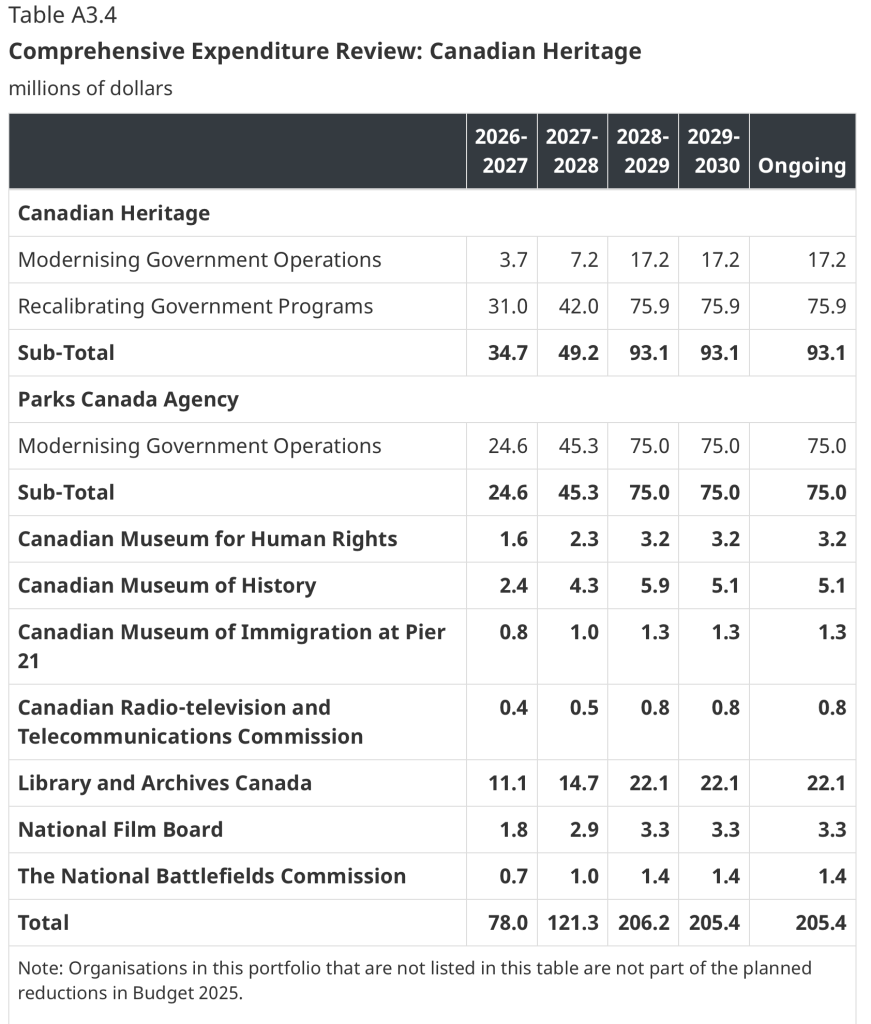
The status quo on cultural funding shouldn’t be surprising, given other priorities in 2025.

Still, TV and radio news outlets were miffed that the government didn’t end its arbitrary exclusion of broadcasting companies from accessing federal aid for their online news websites that —-but for the television and radio properties operated by their parent companies—- would be eligible for the $75 million pool of journalist salary subsidy available to all online news outlets. 

***

There’s a useful explainer posted in Paula Clark’s Substack about the Blacklock’s Reporter litigation with the federal government over Parks Canada’s sharing of a paywall password obtained from an individual subscription, giving unlimited access to every article in the Reporter’s database. 

The watchdog news website was in court last month, appealing a controversial trial ruling in favour of the government which appeared to bless the government’s actions and give short shrift to copyright protection. 

Among the many legal frailties of the trial judge’s decision is that it appears to expand the public right of “fair use” sharing of quotations or text snippets to authorize redistribution of full articles and, thanks to the password sharing, Blacklock’s entire news archive.

It’s a legally complicated appeal, which is why’s Clark’s piece is helpful. 

***

As you know, in 2023 Meta responded to Parliament passing the Online News Act by banning most news content from Facebook and Instagram in Canada (a news outlet can pay Meta to post content as an advertisement).

The ban hit the many Canadian news outlets relying heavily upon Meta platforms for content distribution. While the news blackout probably impacted free sites harder, paywalled sites were affected too.

The marketing director at Le Devoir is claiming a measurable success in making up for the lost distribution by working a lot harder at its direct engagement with readers, especially demonstrating the value of content to new subscribers.

Meta hasn’t entirely given up on Canadian news journalism of course. Just last week The Hub published a well argued commentary advocating against the federal government pursuing a digital sovereignty strategy. Meta sponsored the article.

***

The Australian government has moved the yardsticks on implementing something like Canada’s Online Streaming Act for Netflix and the other foreign video streamers, a move it has been mulling over since early 2023.

The legislation hasn’t been tabled with details yet, but the announcement suggests the streamers will have to spend 7.5% of their Australian revenues on local entertainment programming. Australian-owned television companies are already required to meet spending quotas for local content and they see the new law as a measure to “level the playing field.” 

The news coverage of the announcement is unclear as to the impact of the legislation, as Netflix already invests in video production shot in Australia. It may depend upon the definition of local Australian content.

Significantly for Canadian observers, Australia is not proposing that the foreign streamers make financial contributions to Australian programming through contributions to third party production funds. 

A report by the Australian Broadcasting Corporation speculates on whether the announcement will provoke a reaction from the Trump administration.

***

If you have the twenty minutes, I recommend Natalia Antelava’s incendiary interview of Google’s Richard Gingras in Coda, just for sheer entertainment if not enlightenment. Gingras is Google’s former VP of News and is currently the board chair of Canada’s Village Media.

Antelava goes after Gingras for some of Google’s controversial decisions in foreign autocracies, like agreeing to Vladimir Putin’s demand to spike a voting app set up for the Russian 2021 elections by the dissident, Alexei Navalny, who later died, possibly poisoned, in a Putin prison.

However on the main interview topic of the power asymmetry between Google and the news industry, Gingras sticks to his story that Google’s relationship with publishers is collaborative, not exploitive, which requires him to engage in some grimace-inducing denialism about Google’s abuse of market power over news outlets in Search and digital advertising, both of which have been ruled illegal monopolies by US courts.

Another tidbit: Gingras claims that Google CEO Sundar Pichai was embarrassed by the now famous line-up of tech CEOs attending the Trump inauguration and suggests the photo op was “cleverly staged” by the White House.

“That’s the last photo Sundar ever wanted taken,” says Gingras. “We don’t support this administration.”

Only the ballroom.
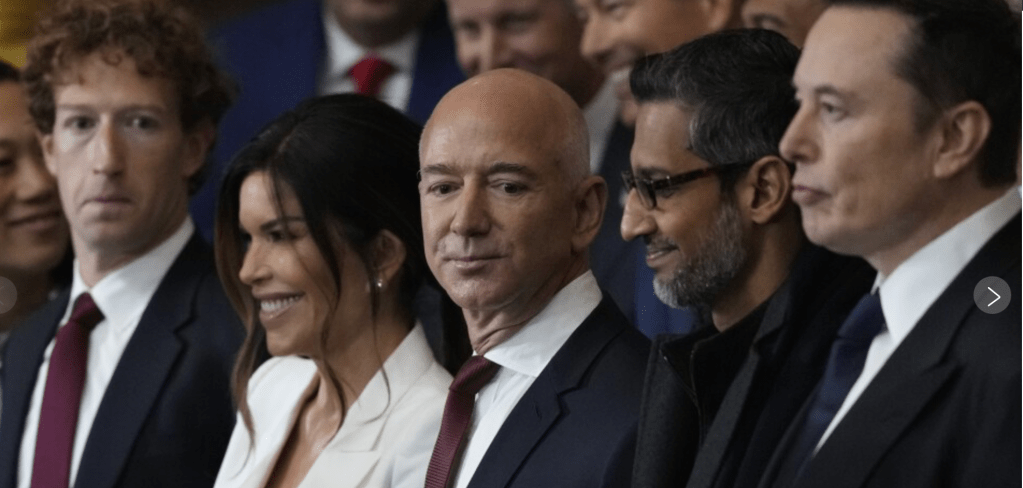
Associated Press photo of Tech CEOs Zuckerberg, Bezos, Pichai and Musk.

***

If you would like regular notifications of future posts from MediaPolicy.ca you can follow this site by signing up under the Follow button in the bottom right corner of the home page; 

or sign up for a free subscription to MediaPolicy.ca on Substack;

or follow 
@howardalaw on X or Howard Law on LinkedIn.

I can be reached by e-mail at howard.law@bell.net.

This blog post is copyrighted by Howard Law, all rights reserved. 2025.
Catching Up on MediaPolicy – I love France – Google’s houdini escape – elbows up on digital sovereignty – you’re dead to me

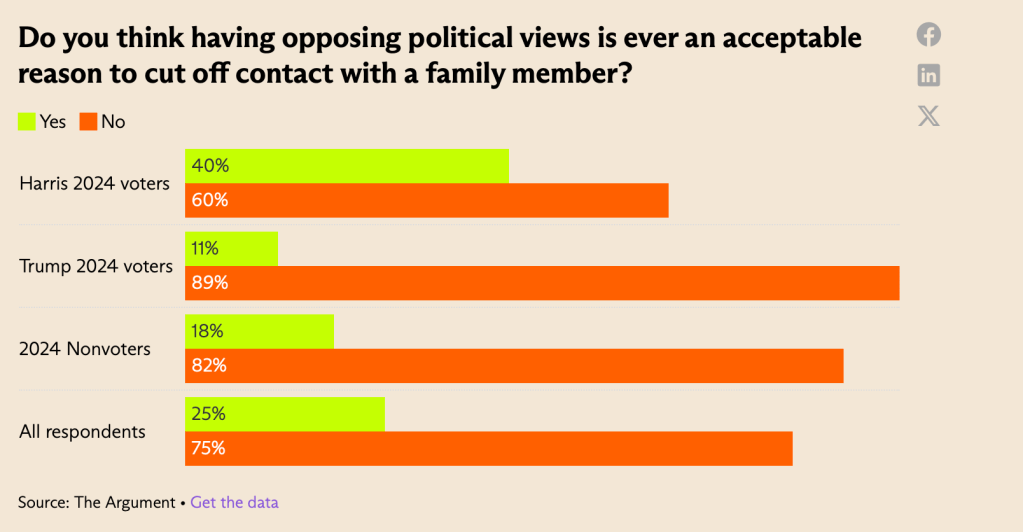
Polling graphic from The Argument

September 6, 2025

French journalist unions have won a share of the licensing fees negotiated by publishers with AI companies whom are paying for the news content they scrape off the Internet, according to a report in Nieman Lab.

If not for the French: always the first to fight for content creators. Several years ago, journalist unions got their members a share of the “Google money” paid out in Europe under its news licensing framework in the last few years. Le Monde reporters earn an additional 275 euros per year. 

Now that there is a new content licensing deal between Le Monde and OpenAI reporters get 25% of the cash. No reports on how much that is.

***

Speaking of our friends at Google, the US trial judge who ruled that Google holds an illegal and anti-competitive monopoly in Search has, by many accounts, let Google off the hook by rejecting most of the Justice Department’s remedies. 

By his own description, the judge exercised occupational “humility” by going easy on Google. The most significant thing he had to say, much cheered by Google, was that whatever skullduggery allowed Google to solidify its dominant market position over Search, the competition for the AI market is a horse race. 

The judge handed out consolation prizes by requiring some limited data sharing with Google’s search competitors, a remedy disparaged by the CEO of Duck Duck Go as “a nothing burger.” 

Also, the judge ruled that Google’s multi-billion dollar agreements with Samsung and Apple for making Google the default search app on their phones can continue. Those commercial agreements were significant in the judge’s earlier finding that Google’s monopoly was illegal.

On the other hand, Google is looking a gift horse in the mouth and will appeal both the limited remedy and the original finding of monopoly. 

There is plenty of good analysis to read on the ruling.

The Big Tech giant may have escaped the worst consequences of the Search monopoly-ruling but it has other concerns. A US Justice Department anti-trust lawsuit against its domination of digital advertising is well underway and yesterday European Union regulators fined Google nearly three billion euros for the same market domination. The regulator’s fine was immediately entangled by US-EU trade tensions and could be delayed.

Meanwhile Google’s share price bumped 8%, so at least someone is happy.

***

When Mark Carney scrubbed Canada’s digital services tax in June, a new coalition Canadians for Digital Sovereignty published an Open Letter calling on the Prime Minister to defend Canadian regulation of the Internet and Big Tech.

On the eve of the federal Liberals’ cabinet retreat this week, the coalition published a well-timed and lengthier piece, more like a manifesto. 

It’s an elaboration on what it means to defend “digital sovereignty,” a new catchphrase describing a public policy gamut stretching from communications infrastructure to software and the regulation of online content. Or as one Comment column in the Globe and Mail put it recently, more Canadian autonomy over “data, code and compute.”

The basic idea is to recognize the new geopolitical environment in which digital technology is increasingly controlled by states, namely the United States, and becomes more than just a regulatory issue but a matter of economic self sufficiency and political security.

An executive summary of the new Open Letter is here:

***

I made a needed correction to last week’s MediaPolicy’s report that independent Canadian broadcaster Wildbrain had abandoned its CRTC licenses and pulled its suite of family channels from cable TV.

I reported that Wildbrain is selling out to American interests, which its spokesperson says it isn’t, rather it is taking advantage of its new status as a digital-only broadcaster by removing Canadian ownership requirements from its public share structure. 

***

I am enjoying a left-wing American Substack I just discovered, The Argument

It published a poll on political attitudes that was interesting but I am not inclined to just map its findings over to the Canadian experience.

But still, I was left agape by the poll finding that 40% of Kamala Harris voters would consider cutting off contact with a family member “for opposing political views.” Only 11% of Trump voters would do that. 

***

If you would like regular notifications of future posts from MediaPolicy.ca you can follow this site by signing up under the Follow button in the bottom right corner of the home page; 

or sign up for a free subscription to MediaPolicy.ca on Substack;

or follow 
@howardalaw on X or Howard Law on LinkedIn.

I can be reached by e-mail at howard.law@bell.net.

This blog post is copyrighted by Howard Law, all rights reserved. 2025.

First glimpse of the AI media apocalypse

Image generated by WordPress/Open AI tool

July 9, 2025

Two news items about AI technology just grabbed headlines.

The first was the revelation by the UK news outlet Mail Online that its traffic referral from Google’s search engine is nosediving thanks to Google’s “AI Overview.” 

The Overview AI tool is a huge upgrade on Google’s old practice of providing a top ranked text reply to search queries, usually mined from Wikipedia. Overview threatens to divert any but the most hardened skeptics from a page full of search results to a single high quality synopsis, sporting just two or three priority links. 

The decline of web traffic is a calamity for news and information websites that count heavily on advertising revenue from referred traffic. No one is saying this out loud, but it might drive more unpaywalled news websites to a subscription model. That has implications for media policy that supports the vast array of unpaywalled media serving the largest audience cohort: casual news consumers. 

But paywalled or not, as the publisher of the conservative opinion website The Hub groused it’s the “centre-left” mainstream media that’s likely to dominate the few hyperlinks offered by Overview. And that’s if Overview actually keeps displaying the links, Google’s AI competitors might not even bother.

Overview has the potential to accelerate  the shift of ad revenue from news creators to platforms like Google. Not only does Google already monopolize Search and exercise illegal market power in digital advertising, but like all AI companies it is harvesting news journalism without licensing the content.

Another story that surfaced last week was an apparent AI song “recorded” by a fictional band hitting it big on Spotify.

AI-music is the latest, and most profound, evolution of Muzak and its heir, the day-long passive music algorithm. This is a big challenge to music as an art and as a business. As such, it will have a major impact on how Canadian music is created, monetized and heard.

***

As a follow up to the most boring post I ever wrote, I can report that the CRTC’s public hearings on the distribution of Canadian content wrapped up on Monday with a closing appearance from the Canadian Association of Broadcasters. 

CRTC Vice-Chair Adam Scott is on the panel. Because of, or in spite of, the fact that his background is telecommunications rather than broadcasting he often puts his finger on the crucial questions.

Scott asked the CAB spokespersons what they thought of the regulatory scheme proposed by Friends of Canadian Media for foreign online distributors. 

The algebra of the Friends’ proposal is to establish an overall contribution to Canadian content roughly equivalent to that already made by Canadian cable companies; say, an expenditure tethered to 30% of Canadian operating revenue.

From that 30%, says Friends, online distributors could deduct their 5% cash contribution to Canadian media funds as well as the non-cash value of their marketing and prominence of Canadian shows on home screens and recommendation tabs. The flexibility of the “deduction” approach opens the door to bespoke contributions by different online businesses. 

CAB President Kevin Desjardins colourfully described the Friends proposal as more like a piece of cheese offered to the streamers than a mousetrap, meaning the CAB would still like to see some general commitments to Canadian content that all online distributors would have to meet. 

What was disappointing, Desjardins told Scott, was that the foreign streamers have avoided any formal commitments to Canadian content other than being left alone to carry on their business in Canada. He suggested that the Commission insist the streamers submit proposals in the post-hearing phase of the public consultation. 

Another question raised by the Commission got my union-antennae twitching.

In 2022 the Liberal government decided to handcuff the CRTC on the available tools to regulate online distribution platforms in the instances where Amazon, Apple, Roku et al might be willing to carry Canadian programming but only on their one-sided terms for revenue splits or screen prominence. 

Instead of conferring dispute resolution powers of arbitration on the CRTC, Bill C-11 restricted the Commission to adjudicating a standard of  “good faith negotiations,” backed up by powers to fine violators.

As any union rep (or small commercial party) knows, good faith doesn’t tip the scales of power imbalance. 

Canadian labour law remains mired in the good faith swamp after decades of jurisprudence that tries to distinguish between hard bargaining and illegal “surface” bargaining, ie the powerful party going through the motions while quietly messaging  “it’s my way or the highway.” In this legal fiction, the actual content of proposals is almost irrelevant. The stronger party can be as hard nosed as it likes.

The CAB referred the Commission to the American FCC’s definition of good faith bargaining. But it looks a lot like surface bargaining, to be honest.

In the labour world, Ontario passed a law in 1986 on the resolution of first contract negotiations following unionization, when corporate intransigence is at its worst. The main feature was binding arbitration, exactly what has been denied to the CRTC.

But the “good faith” standard was upgraded from the vexing “hard vs soft bargaining” distinction to a multi-factor test in which the Labour Board scrutinizes “the uncompromising nature of any bargaining position adopted without reasonable justification.”

If the CRTC pursued this kind of thinking about good faith, it would have an evidence-based opportunity to require an intelligible “justification” for playing hard ball and that it be reasonable.

***

Perhaps there’s been enough said about Prime Minister Carney’s blink on the Digital Services Tax.

Nah.

Hugh Stephens posted his view, similar to what you read in MediaPolicy. In the course of his piece, he links to a 2020 background study published by the Library of Parliament shortly after Royal Assent to the 2019 Bill C-82, which was the enabling legislation for the DST. 

The Library study takes the tax narrative from its origins in OECD discussions in 2013 to February 2020, a month after Joe Biden was inaugurated as US President.

It’s a useful read in a couple of ways.

First, the blow by blow history makes it clear that many of the urban legends around the DST are wrong. It was never a “data tax,” or an “audience tax,” or a “make Big Tech pay” tax.

It was a response to the problem of digital companies operating in Canada without “a permanent establishment” that makes the company’s product, like a factory or a mine. Without changes to the permanent establishment rule, foreign digital companies can freely offshore their Canadian revenues (or just pay tax on them in their home countries). 

The other thing that the Library study does is follow the negotiation narrative among OECD countries and with the US.

A first-term Trump was opposed to the DSTs being legislated in Europe and threatened retaliation. Once Trump lost the election to Biden, the UK and France moved quickly.

Canada lagged for reasons best known to the Finance Minister and the PM. Perhaps they were waiting to see if President Biden could get Congress to ratify a new tax treaty that would curb the use of offshore tax havens and agree to a minimum global corporate tax rate.

We know the outcome. Nice guys finish last. 

***

If you would like regular notifications of future posts from MediaPolicy.ca you can follow this site by signing up under the Follow button in the bottom right corner of the home page; 

or sign up for a free subscription to MediaPolicy.ca on Substack;

or follow @howardalaw on X or Howard Law on LinkedIn.

I can be reached by e-mail at howard.law@bell.net.

This blog post is copyrighted by Howard Law, all rights reserved. 2025.

Catching up on MediaPolicy – End of the CBC? – Bell settles Warner Bros lawsuit – CRTC investigates Meta’s news ban – the Rage of Google

October 12, 2024

This week MediaPolicy published an interview with Chris Waddell, author of the 2020 book “End of the CBC?” Waddell is not advocating defunding the CBC, but recommends sweeping change.

The post’s viewing numbers are off the charts (for this modest blog) which tells me there is a real thirst for this kind of discussion.

***

You will recall the reporting on the Warner Brothers Discovery studio and streamer allowing its content deals with Corus and Bell to lapse and making a new Canadian distribution deal with Rogers instead.

I think Rob Malcomson saw this coming. In 2021 the Bell regulatory executive told the CRTC that if it approved the Rogers-Shaw merger it would be giving Rogers the hammer in the Canadian market for content rights by granting Rogers 47% of the English Canadian market.

Three years later, Rogers shoved Bell and Corus aside and grabbed rights for a significant bundle of Warner Brothers Discovery (WBD) content that Bell and Corus had profited from over the years while investing in their own Canadian programming to build around that branded American content.

When BCE announced in response to the Rogers coup that it was suing its American business partner — Bell also buys WBD’s premium Home Box Office content for Canadian distribution on Bell Crave— all eyes were on the text of the non-compete agreement that Bell said restrained their Hollywood supplier from taking all that content to Rogers for two more years.

This week Bell announced the lawsuit was settled. The WBD deal with Rogers remains intact.

In exchange, Bell says it gets “expanded content” from WBD. The announcement then lists some big shows that, as far as I can tell, it already offers in its Crave/HBO package. Bell was unable to clarify whether it really meant to say “extended access,” in terms of pushing out further the undisclosed expiry date on HBO content. The press release says the new deal “ensures Crave subscribers have continued access to a vast library of premium content for the foreseeable future.”

The more enigmatic paragraph in the announcement was that Bell is “strengthening and deepening our relationship with Warner Bros. Discovery, marking a significant milestone as we move forward together. With our commitment to develop co-productions, and the extended pipeline of extremely valuable content for subscribers, we’ve ensured Crave is well-positioned for continued growth and success.” (Emphasis added).

Throughout the Parliamentary and regulatory journey of the Online Streaming Act, Bell has pushed for regulatory “incentives” that might induce the global streamers to partner with Bell in financing big budget Canadian productions and then distributing them with a bigger payoff for Bell. The partnership idea found favour in the federal government’s cabinet instructions to the CRTC on implementation of the new Act.

Perhaps Bell’s settlement with WBD is part of that strategy.

***

The CRTC must be feeling the heat from MediaPolicy or the federal Liberals —you can guess which— on Meta’s porous ban on Canadian news, designed to shield the social media company from liability for licensing payments to news outlets under the Online News Act, Bill C-18.

Last week the Commission told Meta to explain why some Canadian news content continues to appear on Facebook and Instagram without Meta self-identifying as a digital news intermediary, subject to the legislation. Meta’s response was due yesterday.

Michael Geist has an interesting blog post arguing a couple of points.

The first is that news posts on Meta platforms originating from entities that might not qualify as “news outlets” operated by “eligible news businesses” under C-18 would therefore not be “making news available” as defined by the Act. It would follow that Meta would not be carrying on any news hosting making it liable for licensing payments. 

This begs the question of what Canadian news organizations fall outside the definition of “news outlets” as defined in C-18, a deep but fascinating rabbit hole to dive down. Is that Rebel News? Narcity? The Conversation? MediaPolicy?

The other point Geist argues is that screen shots of Canadian news stories originating from bona fide news outlets, but uploaded by citizens to Meta platforms, may fall outside the definition of “news content” because —this is going to bake your noodle—-the ownership of the screen shot news has migrated from the news outlet to the citizen as a consequence of “user rights” under copyright law and therefore is no longer content from news outlets liable for licensing payments under the Act.

Go figure.

***

There are two recent news items about governments regulating social media platforms that seem to go together well. 

The New York Times has an explainer about the big wins rung up in the US by NetChoice, Big Tech’s lobby coalition, relying on expansive First Amendment free speech rights.

On the other hand, government regulation came out on top in Brazil: a court order shut down Elon Musk’s X platform for a month after he refused to moderate content advocating a military coup. Musk relented. The migration of Brazilians from X to rival platforms seemed to have done the trick.

***

The US Department of Justice’s trust-busting case against Google, ruled in August by the US Third Circuit federal court to be an illegal monopolist under the Sherman Act, is now at the remedy stage where consequences will be considered. The DOJ’s last great anti-trust victory was over AT&T and it resulted in the court breaking up the telecommunications giant in a court remedy known as “structural separation.”

Matt Stoller provides a good summary and predicts a no-holds-barred political fight in the near future, enticingly headlined “The Rage of Google.”

***

If you would like regular notifications of future posts from MediaPolicy.ca you can follow this site by signing up under the Follow button in the bottom right corner of the home page; 

or e-mail howard.law@bell.net to be added to the weekly update; 

or follow @howardalaw on X or Howard Law on LinkedIn.