Catching up on MediaPolicy – Village Media expands to middle America – Meta says Canadian news ban is good for its stock price – Paramount and US states face off over Warner Bros. merger

Facebook post, Narcity Canada

July 25, 2026

The late and first Lord Thomson of Fleet, Canada’s Roy Thomson, built the ground floor of his media empire on home turf in northern Ontario. During the 1930s and 1940s he expanded into a string of radio stations and 20 daily Canadian newspapers, most of them in mid sized and small towns. He bought the British establishment newspaper, The Times. Today his grandson David Thomson owns the Globe and Mail and the global media giant Thomson Reuters. 

Now that’s a tough act to follow but Village Media’s Jeff Elgie seems to have picked up the Thomson vibe, if not the empire.

Village Media is a network of digital community media websites in 27 modestly sized Ontario communities. Like Thomson, Elgie started in Ontario’s near north. 

This week Elgie announced a joint venture of a further 15 community sites in Wisconsin, Pennsylvania and Illinois in partnership with the Knight Foundation, the well known American charitable fund with close historical ties to news journalism. The partners will quite literally find out whether the Village business model plays in Peoria, Illinois. 

Including Peoria, the tentative list of fifteen US communities are all under 115,000 in population. 

The green light for launch in each case will depend upon Elgie’s success in recruiting the local staff he wants. Village will run the network day to day and control editorial. 

Village Media’s business model is strictly digital publishing, 100% ad supported, and seeks out smaller markets that have a strong local identity but an unsaturated supply of local journalism: watering news deserts, in other words.

Unlike many single-outlet Canadian digital news start-ups, Village’s multi-location network provides operational scale and financial ballast for launching start-ups in additional communities. 

And although Elgie has licensed his proprietary digital publishing software to Canadian community news networks outside of Ontario, he has yet to expand his own operations into other provinces. 

He told me that his move across the border into the US market was motivated by the right market opportunity and the personal connections between Village (whose board is chaired by Google’s former VP News Richard Gingras) and the Knight Foundation. 

Knight is investing in the three state news network —unlike Canadian charitable tax rules, US laws permit “program related investments” in for-profit news journalism — and according to Elgie it is possible that Knight might liquidate its investment in a couple of years if its collaboration with Village Media is successful and move on to similar local news projects in other states.

Elgie says he is not ruling out future expansion for Village Media into other Canadian markets but for now the US project with Knight fits within his corporate bandwidth. 

***

For months MediaPolicy has been following this story: is Meta cheating on its ban on postings of Canadian news articles on Facebook and Instagram?

The Meta ban began in August 2023 as a legal maneuver designed to escape from mandatory licensing payments under the Online News Act. That left Google as the only “digital news intermediary” liable to make payments to Canadian news outlets.

It took 18 months of Meta’s news ban being in place before a Canadian news entity —in this case, the “LITS” coalition of local independently-owned television stations— challenged it by filing a complaint with the CRTC. The LITS allegation is that despite its “news ban” Meta turns a blind eye to the posting of original Canadian news content by unbanned news outlets or by ordinary Canadian citizens.

Meanwhile, mainstream news outlets, their news reporting, and even their opinion commentary all remain banned from the two Meta platforms. 

LITS wants the CRTC to name Meta as a digital media intermediary under the Online News Act in order to trigger the mandatory news licensing scheme in the statute.

The legal filings are complete now. The Commission closed its portal for public comment (File 2026-0066-8) at the end of March.

Meta’s lawyer filed its response in April (see the letter below). Meta says it tries its best to maintain the integrity of its ban by deleting hyperlinks to original news content as users post them. Of interest to legal beagles, Meta insists the posting of news content screen shots falls outside the Online News Act’s definition of the “news.” 

The days pass like months in Ottawa but the CRTC may some day sort out the LITS allegations of which Exhibit A is that Meta allows Rogers City-TV to post digital content from its Breakfast Television show while blocking digital content from BT’s direct morning show competitor, Hamilton’s CHCH-TV.

MediaPolicy’s Exhibit B (not filed at the Commission) is that Meta has allowed Narcity Canada to post breaking news stories from Canadian Press on a daily basis. Canadian Press qualifies as a news outlet under the Online News Act.

Mostly a travel and lifestyle site, Narcity does not publish enough of its own original news to qualify for federal QCJO subsidies and, by implication, news payments under the Online News Act. According to Narcity CEO Chuck Lapointe, he signed Meta’s waiver that says Narcity is not a “news outlet” under the Online News Act and will not claim compensation from Meta. 

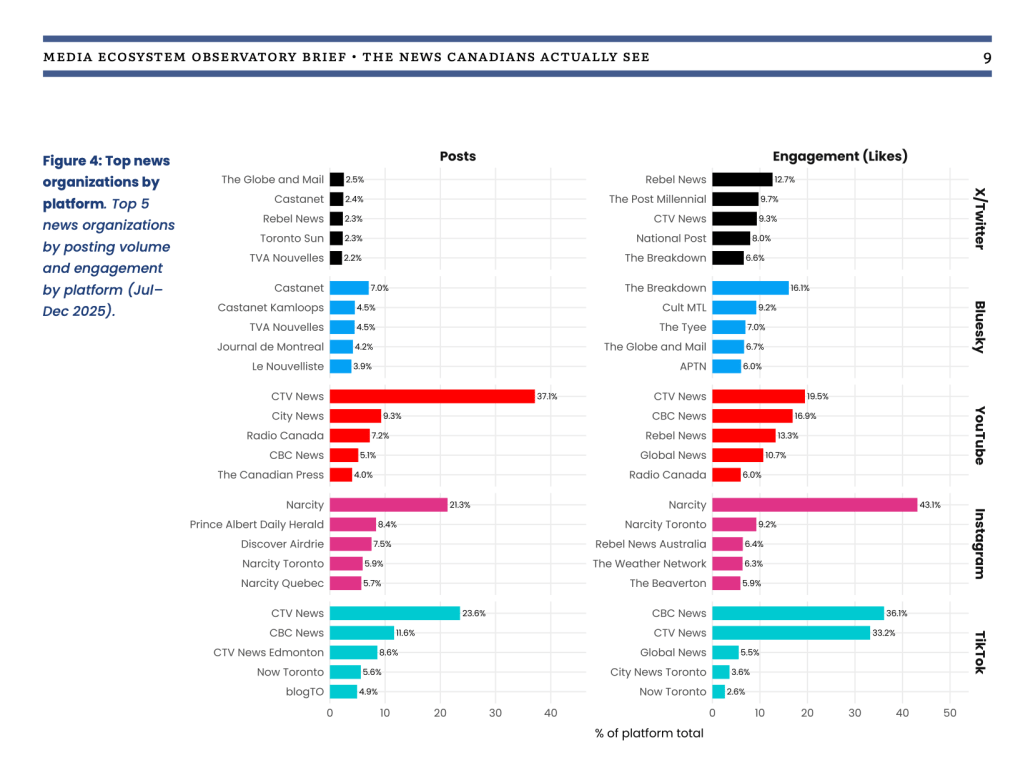
In case you think I am nitpicking about the selective nature of the news ban, a recent academic study found that Narcity is now the leading Canadian publisher of news on Instagram (the study did not have data on Facebook posts).

In this graph from the study, note which Canadian news organizations lead in posts and engagement on YouTube and TikTok, compared to Meta’s news-embargoed Instagram:
And in case you are wondering why Canadian Press did not intervene in the CRTC proceeding initiated by LITS and has nothing to say about CP content being published daily on Facebook and Instagram by Narcity, well so am I. My direct inquiry to Canadian Press on this matter did not elicit a reply. 

In related news, the municipal council of Sturgeon County in the greater Edmonton region had Meta’s Canadian spokesperson Rachel Curran in front of them last week to answer questions about the $13 billion data centre planned for the area. 

When the questions turned from the proposed data centre to the Meta news ban, Curran had a quotable defence for it:

These publishers share information and articles on our platforms because it benefits them in the form of distribution. We have a responsibility not to do things that are going to unnecessarily exert downward pressure on our stock price.”

***

Paramount can see the finish line in obtaining approval of its $111 USD billion merger with Warner Brothers Discovery. But first it faces a court hearing in two weeks: numerous Attorney Generals for California and 12 other states will ask for an injunction blocking the deal while they seek to derail the merger on anti-trust grounds.

Paramount’s Ellison family ownership has the wind at its back. The US Department of Justice took a pass on blocking the merger and this week both Canadian and European Union competition authorities did the same. 

Paramount is offering the courts a legal justification that will be familiar to Canadians who followed the Rogers-Shaw merger, blessed by the CRTC in 2022: that no matter how big a streamer, film studio and television company that Paramount becomes, it’s still a smaller media conglomerate than Netflix, Google, or Apple. 

***

If you would like regular notifications of future posts from MediaPolicy.ca you can follow this site by signing up under the Follow button in the bottom right corner of the home page; 

or sign up for a free subscription to MediaPolicy.ca on Substack;

or follow 
@howardalaw on X or Howard Law on LinkedIn.

COMMENTS ARE WELCOME. But be advised they are public once I hit the “approve” button, so mark them private if you don’t want them approved. 

I can be reached by e-mail at howard.law@bell.net.

This post is copyrighted by Howard Law, all rights reserved. 2026.

Catching Up on MediaPolicy – Ranting about CanCon – Danish news subsidies – Meta lobbies Feds on age verification – the NFB’s gripping sailing documentary

November 29, 2025

I’ve fallen behind on catching you up on media policy news because I felt compelled to write a series of three posts commenting on the CRTC’s ruling on Canadian content. The last one, the rant I promised, was published this week in Cartt.ca.

While I was ranting, one of the things I let slide was telling you about a new report out of Denmark proposing to refashion its policy design for government aid to news journalism.

The Danes are serious about news subsidies: they spend 540 million krone ($120M CDN) every year on private media in nation of six million people (Canada spends about $200 million in country of 42 million).

According to the Reuters Oxford Digital News Report, Denmark’s “public trust in media” score is 56% and it ranks sixth out of 180 in the Reporters Without Borderspress freedom index at 86.93. By comparison, Canada’s trust score is 39% with a press freedom index of 78.5, 21st in the world.

The Danes also have something we don’t: a 2018 Media Liability law that established an independent national press council and conferred the force of law on editorial independence from ownership. 

The Danish subsidy report was commissioned by government and written by a committee led by Rasmus Nielsen, the former chief of the Reuters Institute for the Study of Journalism.

Despite the ocean separating us, there are strong parallels between the Danish system of news subsidy and Canada’s jigsaw of federal programs: we have the QCJO subsidy of journalist salaries, the Local Journalism Initiative that funds 700 full time reporters in under-serviced regions across the country, and the Canadian Periodical Fund which supports editorial expenditures by community weeklies. 

The untranslated 144-page Danish report covers a lot of ground, but Nielsen’s own English language summary of it captures the essence: a weighted emphasis on supporting news outlets that are regional, local or “independent” (owners of single-titles) rather than mere incumbency as a news organization. 

***

The Senate deliberations of Senatrice Julie Miville-Dechêne’s Bill S-209, that would require age verification for online pornography is on hold until February while the Senate justice committee deals with other matters.

During the pause, the Canadian Press reports that Meta has joined the fray by lobbying the federal Liberals to step in with their own bill that would shift the age verification responsibility from pornography websites and social media platforms to app stores.

Meta obviously doesn’t run an App Store, as do Google and Apple, and the latter two Big Tech companies are cheesed about what Meta is up to.

Meanwhile, Canadian children continue to be exposed to online pornography featuring choking and slapping. The CP story is well done and informative.

Meta is having a good month of course. It won the anti-trust trial brought by the US Justice Department that claimed Meta was running a monopoly in personal social networking. In the interim five year period between filing and judgment, TikTok greatly improved its market share.

Matt Stoller has a very good analysis of the lawsuit, the trial, the judge, and why he thinks Big Tech will never be slowed down by anti-trust litigation: he says it takes public policy and legislatures to change things.

A test of his theory may happen soon: the trial judge in the Google Ad Tech case will be handing down her decision on whether to dismantle that illegal monopoly in the new year.

Meanwhile a consortium of US school boards just filed a new lawsuit against Meta and several other Tech companies.

Their allegation against Meta in particular is that company documents reveal CEO Mark Zuckerberg squelched evidence of harm to teenage girls while Meta designed lax safety features, including ineffective measures to expel sex traffickers from the platform. Of course, the allegations must be proven in court, probably over several years.

This does raise the question of whether Americans (and Canadians) should count on US courts to adjudicate Big Tech’s excesses by giving full due process and demanding conclusive evidence of the allegations, or whether governments should just cut to the chase, stop litigating whether the harms to kids persist, and legislate a solution.

In related stories, Australia’s social media ban on under 16s comes into force in December. The EU Parliament just passed a non-binding resolution to do the same.

***

The National Film Board’s website is recommending “Ghosts of the Sea,” a riveting documentary about the ill-fated Norwegian father-and-son sailors, Peter and Thomas Tangvald.

The filmmaker is Thomas’ half sister Virginia, who settled in her mother’s hometown of Montreal. The father Peter was married seven times and two of his wives died at sea.

I’ll say this: the film offers a visceral take on “intergenerational trauma.”

I think you will enjoy the one hour and 37 minute film and I absolutely guarantee you’ll have strong opinions afterwards. 

***

If you would like regular notifications of future posts from MediaPolicy.ca you can follow this site by signing up under the Follow button in the bottom right corner of the home page; 

or sign up for a free subscription to MediaPolicy.ca on Substack;

or follow @howardalaw on X or Howard Law on LinkedIn.

I can be reached by e-mail at howard.law@bell.net.

This blog post is copyrighted by Howard Law, all rights reserved. 2025.

Catching up on MediaPolicy – End of the CBC? – Bell settles Warner Bros lawsuit – CRTC investigates Meta’s news ban – the Rage of Google

October 12, 2024

This week MediaPolicy published an interview with Chris Waddell, author of the 2020 book “End of the CBC?” Waddell is not advocating defunding the CBC, but recommends sweeping change.

The post’s viewing numbers are off the charts (for this modest blog) which tells me there is a real thirst for this kind of discussion.

***

You will recall the reporting on the Warner Brothers Discovery studio and streamer allowing its content deals with Corus and Bell to lapse and making a new Canadian distribution deal with Rogers instead.

I think Rob Malcomson saw this coming. In 2021 the Bell regulatory executive told the CRTC that if it approved the Rogers-Shaw merger it would be giving Rogers the hammer in the Canadian market for content rights by granting Rogers 47% of the English Canadian market.

Three years later, Rogers shoved Bell and Corus aside and grabbed rights for a significant bundle of Warner Brothers Discovery (WBD) content that Bell and Corus had profited from over the years while investing in their own Canadian programming to build around that branded American content.

When BCE announced in response to the Rogers coup that it was suing its American business partner — Bell also buys WBD’s premium Home Box Office content for Canadian distribution on Bell Crave— all eyes were on the text of the non-compete agreement that Bell said restrained their Hollywood supplier from taking all that content to Rogers for two more years.

This week Bell announced the lawsuit was settled. The WBD deal with Rogers remains intact.

In exchange, Bell says it gets “expanded content” from WBD. The announcement then lists some big shows that, as far as I can tell, it already offers in its Crave/HBO package. Bell was unable to clarify whether it really meant to say “extended access,” in terms of pushing out further the undisclosed expiry date on HBO content. The press release says the new deal “ensures Crave subscribers have continued access to a vast library of premium content for the foreseeable future.”

The more enigmatic paragraph in the announcement was that Bell is “strengthening and deepening our relationship with Warner Bros. Discovery, marking a significant milestone as we move forward together. With our commitment to develop co-productions, and the extended pipeline of extremely valuable content for subscribers, we’ve ensured Crave is well-positioned for continued growth and success.” (Emphasis added).

Throughout the Parliamentary and regulatory journey of the Online Streaming Act, Bell has pushed for regulatory “incentives” that might induce the global streamers to partner with Bell in financing big budget Canadian productions and then distributing them with a bigger payoff for Bell. The partnership idea found favour in the federal government’s cabinet instructions to the CRTC on implementation of the new Act.

Perhaps Bell’s settlement with WBD is part of that strategy.

***

The CRTC must be feeling the heat from MediaPolicy or the federal Liberals —you can guess which— on Meta’s porous ban on Canadian news, designed to shield the social media company from liability for licensing payments to news outlets under the Online News Act, Bill C-18.

Last week the Commission told Meta to explain why some Canadian news content continues to appear on Facebook and Instagram without Meta self-identifying as a digital news intermediary, subject to the legislation. Meta’s response was due yesterday.

Michael Geist has an interesting blog post arguing a couple of points.

The first is that news posts on Meta platforms originating from entities that might not qualify as “news outlets” operated by “eligible news businesses” under C-18 would therefore not be “making news available” as defined by the Act. It would follow that Meta would not be carrying on any news hosting making it liable for licensing payments. 

This begs the question of what Canadian news organizations fall outside the definition of “news outlets” as defined in C-18, a deep but fascinating rabbit hole to dive down. Is that Rebel News? Narcity? The Conversation? MediaPolicy?

The other point Geist argues is that screen shots of Canadian news stories originating from bona fide news outlets, but uploaded by citizens to Meta platforms, may fall outside the definition of “news content” because —this is going to bake your noodle—-the ownership of the screen shot news has migrated from the news outlet to the citizen as a consequence of “user rights” under copyright law and therefore is no longer content from news outlets liable for licensing payments under the Act.

Go figure.

***

There are two recent news items about governments regulating social media platforms that seem to go together well. 

The New York Times has an explainer about the big wins rung up in the US by NetChoice, Big Tech’s lobby coalition, relying on expansive First Amendment free speech rights.

On the other hand, government regulation came out on top in Brazil: a court order shut down Elon Musk’s X platform for a month after he refused to moderate content advocating a military coup. Musk relented. The migration of Brazilians from X to rival platforms seemed to have done the trick.

***

The US Department of Justice’s trust-busting case against Google, ruled in August by the US Third Circuit federal court to be an illegal monopolist under the Sherman Act, is now at the remedy stage where consequences will be considered. The DOJ’s last great anti-trust victory was over AT&T and it resulted in the court breaking up the telecommunications giant in a court remedy known as “structural separation.”

Matt Stoller provides a good summary and predicts a no-holds-barred political fight in the near future, enticingly headlined “The Rage of Google.”

***

If you would like regular notifications of future posts from MediaPolicy.ca you can follow this site by signing up under the Follow button in the bottom right corner of the home page; 

or e-mail howard.law@bell.net to be added to the weekly update; 

or follow @howardalaw on X or Howard Law on LinkedIn.