June 22, 2025
The 2025 Reuters Oxford Digital News Report was published this week, offering both global and Canadian break-out numbers.
It’s a trite observation that digital technology has turned media on its head, disrupting the advertising revenue that once paid our bar tabs for the consumption of media. The disruption has hit hardest in news journalism and stoked alarm about its knock on effect upon liberal democracy.
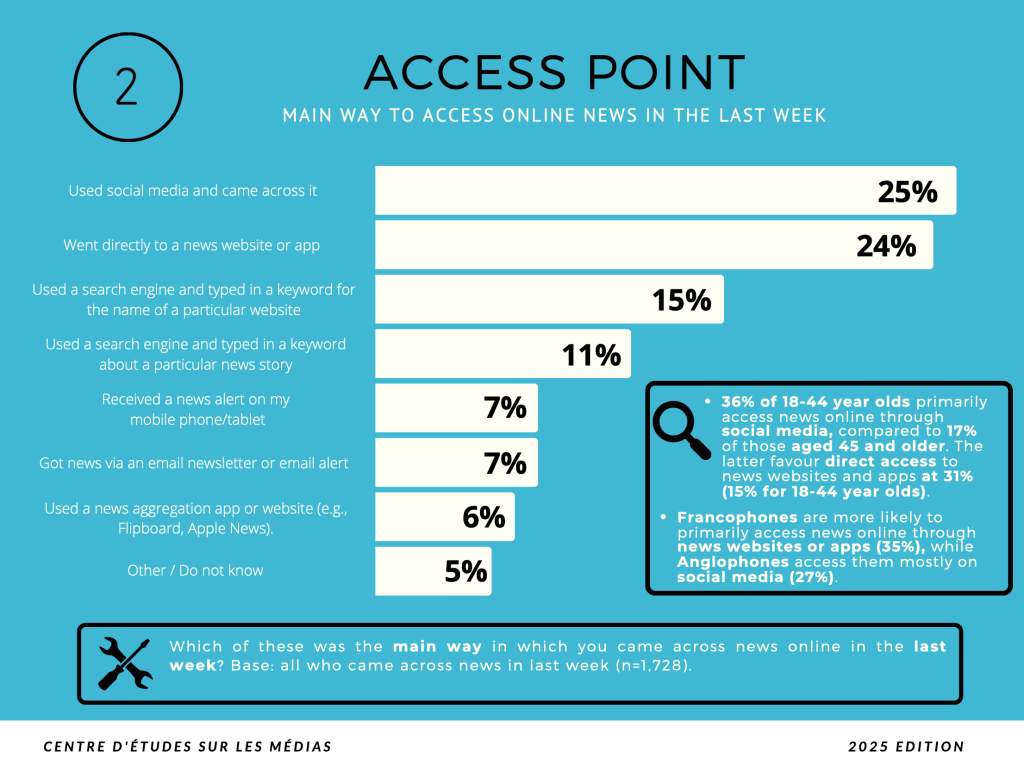
That’s probably why recurring polls and surveys tracking the arc of that disruption seize our attention, even if the trends are slow moving. For example, this year’s Rubicon crossed was that social media surpassed news websites as the leading access point for online news.
Cue the Reuters report, for my money the leading annual global survey. It tracks metrics on news consumption, platform preferences, news avoidance, misinformation, fear of misinformation, and “trust in media,” which is essentially a hybrid metric tracking legitimate skepticism of news journalism, alienation from public institutions, and audience polarization.
The global report also generates break out national numbers and additional polling for individual countries. Canada’s supplementary report on news consumption was written by University of Laval researchers Colette Brin and Sébastien Charlton.
Canada saw a 1% down tick in online news subscriptions from 15% in 2024 to 14%. In 2016 it was 9% but has been flat since getting a bump from the Covid pandemic and the 2020 US election.

Globally, the willingness of the local population to pay for online news ranges from 42% in Norway to nine per cent in Italy. Canada’s 14% is just slightly under the global water line of 18% of the adult population.
There was startling data that Canadians are world leaders in our readiness to shell out for foreign news subscriptions, clocking in at half of Canadian news subscribers. Together with Ireland, Canada’s sign up for foreign news sources is a global outlier.
But what really got my attention was a graph from the global study revealing that 71% of non-news payers say they can’t be tempted to subscribe through innovative options to bundle multiple news services, access more non-news content, or by pick-and-pay news content falling short of a full subscription. They just won’t pay for news, full stop.
As Hunter S. Thompson might have said, not paying is a matter of principle.
That suggests (excuse my confirmation bias) that in the best case scenario there is limited room to grow the subscription-model for Canadian news. The vast majority of Canadians are casual news consumers who will not pay to keep up to date on current affairs.
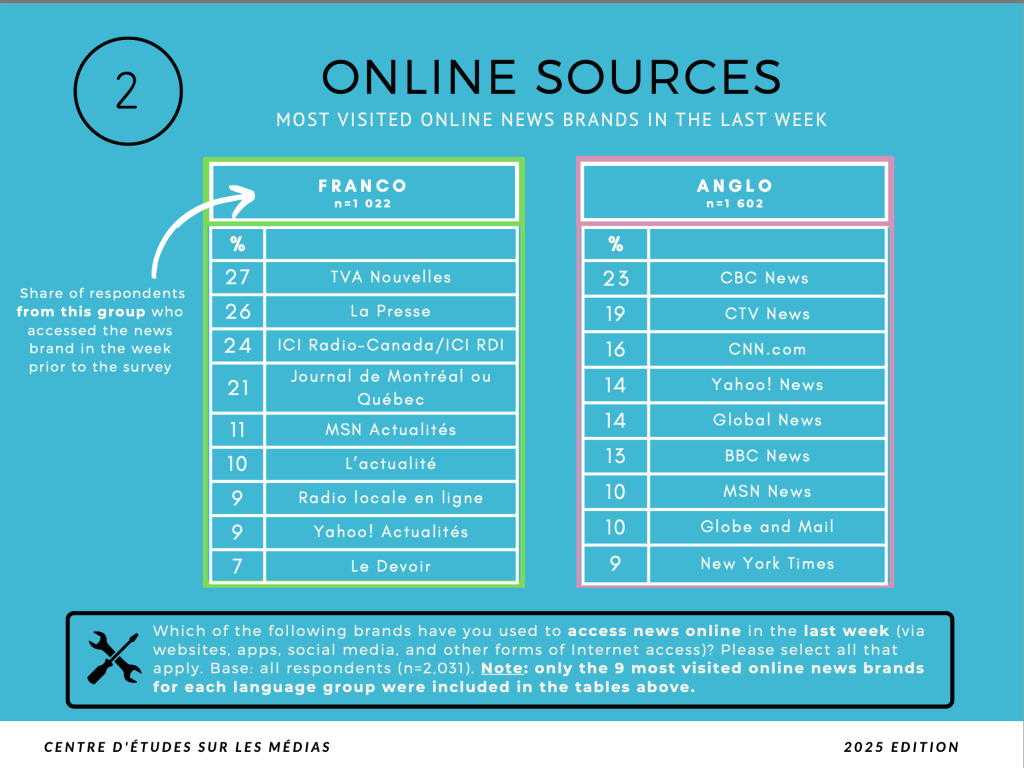
The good news, if you can call it that, is that the free-distribution CBC, CTV, Global News, the Canadian Press and hundreds of community news outlets continue to post news online (see the graphic below, where CBC leads the pack among English speakers).
Should that change, I’m not counting on the news subscription model to bail out liberal democracy. It’s more likely (and this is also reflected in the Report) that Canadians will turn to social media influencers to deliver news, reliably or otherwise.
***
A couple of follow-up stories for you:
Last month the CAQ Québec government tabled its Bill 109, aiming to deliver seismic changes to the rock bottom consumption levels for French language music on global streaming platforms operating in Québec.
The tabling of the bill by Culture Minister Matthieu Lacombe was timed to coincide with Québec City hosting the 20th anniversary of the UNESCO Convention on the Protection and Promotion of the Diversity of Cultural Expression.
Unamended since its inception in 2005, the Convention is an aspirational international standard for sovereign nations willing to step into the commercial media market and push back against the domination of English-language and mostly American content.
Lacombe was looking for other countries to sign off on an upgrade to the Convention, specifically to match Bill 109’s claim to cultural diversity as a fundamental right of citizens backed up by regulatory efforts to move the needle on the consumption of domestic media content.
The Québec City meeting didn’t deliver for Lacombe. A few countries said yes, but more gave a muffled maybe.
The muffled included Canada’s federal government. Culture and Identity (and Official Languages) Minister Steven Guilbeault issued a statement that endeavoured to navigate the narrow channel between the cultural nationalism embedded in Lacombe’s bill and, on the port bow, the exclusive federal jurisdiction over broadcasting. Not to mention, Guilbeault’s boss the Prime Minister must be thinking it’s not an ideal time to piss off Donald Trump by making more announcements about regulating foreign streamers.
All this is happening on a parallel time track with the CRTC’s upcoming public consultation on regulating foreign music streamers operating in Canada.
Apple, which has more of a flair for corporate arrogance than you might think, filed a policy brief with the CRTC that sassed the Québec cultural groups who have asked the CRTC to build a stronger regulatory regime for music streaming. Said Apple:
Apple opposes the requests of groups such as ACCORD and APEM to obtain further information from online audio services in an effort to dictate approaches that supposedly will result in more streams of Canadian songs. Setting aside the remarkable fact that these organizations apparently think that they would be better at running the streaming services than the services themselves, these requests lead to a dead end. As Apple explained in its response to APEM’s application of more than one year ago, much of the information being requested is either not provided to Apple or does not even exist.”
American Big Tech disses Québec cultural leaders. Game on!
In addition to Apple, the world-leading music platform Spotify filed information with the CRTC culled from its annual report “Loud and Clear.”
The Spotify document claimed surging growth in musician earnings in the global market for French-language music. Musician earnings have doubled globally and in Canada since 2017 thanks to rising royalty payments to music labels. Spotify told MediaPolicy that earnings growth was experienced at all levels, from the poorest bands to superstars (but not broken out by language group).

The policy implication of Spotify’s claim is that it’s part of the supply-side solution to domestic music and that the demand-side of music consumption ought to be left to the unregulated market.
The earnings data reported by Spotify is 10,000-foot stuff. Royalty payments are probably 20% of total label and musician earnings, says the company. But without the streamers opening their books to public analysis it’s hard to say how well things are working out for individual bands, or in particular for Québec musicians who may be making money in the global francophonie but have less than 10% of their own domestic market.
The same data problem exists on the consumption side of the equation. Spotify has never contradicted the repeated claims made by Québec’s cultural groups that their third party data shows that less than 10% of streaming in Québec is in French and that French-language songs rarely crack the charts.
In response, Spotify says that half of Québec’s streaming audience “regularly” consumes French language music but chooses not to define “regularly” or provide its internal data on the proportion of English versus French language songs.
The coyness about data may come to a point in September when Spotify executives must appear before CRTC commissioners.
***
In last week’s post, MediaPolicy offered an update on the CRTC’s decision to extend news subsidies from the Independent Local News Fund (ILNF) to the Global News network of local stations.
Some of the Commissioners were nevertheless unhappy with the funding gap remaining between 34 independent local stations and the 45 operated by “vertically integrated” media companies Bell, Rogers and Québecor. If you want more context, check out last week’s post.
If some Commissioners think that the Big Three are getting the short end of the stick on news subsidies, imagine what the telcos think.
Bell owns 35 local stations in its CTV and Noovo networks and, according to filings, loses $40 million annually on news.
Here’s Bell’s illustration of the news funding gap it provided to the Commission:

But being sensitive to how the big telcos are viewed by their admiring public, Bell isn’t having too much of a moan.
Instead, Bell’s ask of the Commission is that they be allowed to reassign the remaining $13 million of their cable division’s funding of community programming to their broadcasting division’s network of local news stations.
In return, Bell wants the Commission to repeal its 2016 regulations requiring the vertically integrated Big Three to allocate 11% of their programming budgets for conventional television to local news.
Also, Bell wants the Commission to remove minimum exhibition requirements for weekly hours of news programming.
***
The best podcast I listened to this week was four Americans debating trade, Trump and culture war, courtesy of Canada’s Munk Debates.
The New York Times’ Ezra Klein was on the panel and he was allowed to post the full length audio on his podcast.
Klein provided the intellectual content; Kellyanne Conway provided the MAGA hubris.
***
If you would like regular notifications of future posts from MediaPolicy.ca you can follow this site by signing up under the Follow button in the bottom right corner of the home page;
or sign up for a free subscription to MediaPolicy.ca on Substack;
or follow @howardalaw on X or Howard Law on LinkedIn.
I can be reached by e-mail at howard.law@bell.net.
This blog post is copyrighted by Howard Law, all rights reserved. 2025.


 MediaPolicy.ca