November 3, 2024
I was never into Bryan Adams’ music.
It might have been the look, the leather jacket. Or the bubble gum lyrics.
Okay, he could write a tune. Twenty Juno awards. A Grammy. 48th on the all-time Billboard 100. The international chart-topping Waking Up the Neighbours album in 1991.
But he never wrote The Canadian Railroad Trilogy. Or Bobcaygeon. Or Know Yourself. Or Les Étoiles Filantes.
He did have a thing or two to say about the CRTC’s definition of a Canadian song for radio-play quotas.
When his songs from Neighbours didn’t qualify as Canadian because of a Seventies-era rule about Canadians collaborating with international talent in the co-writing of music and lyrics —his songs got plenty of radio play regardless— he got mad. His manager got even madder. He was the performing artist of the songs. For pete’s sake, he was a recipient of the Order of Canada. He was insulted.
His anger got the better of him. “I never thought much about CanCon anyway,” he said. “I always thought that it did nothing but breed mediocrity.”
Government, Adams said, should just stay out of the music industry.
The epilogue was that CRTC caved and changed the songwriting rule. More recently in 2022, the Commission announced a further relaxation of it.
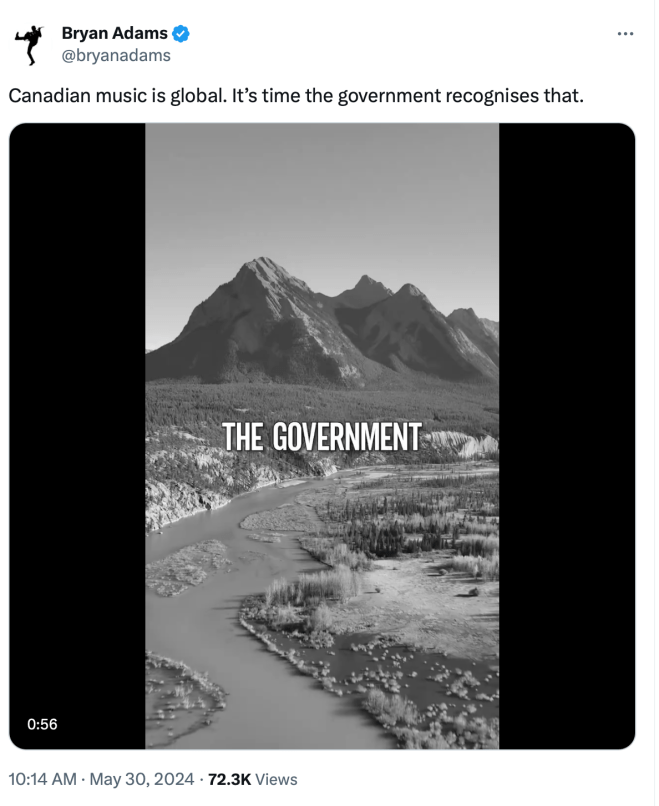
Adams jumped into the culture debate again in May 2024 (days prior to a major CRTC ruling on music streaming), releasing a video pre-emptively opposing the application of Canadian content rules to streaming.
A few months later and now he’s posted on Instagram as the celebrity face of the public campaign launched by the global streamers attacking the CRTC’s five per cent “streaming tax” on Spotify, Apple, Amazon Prime, YouTubeMusic and the major platforms.
So why is a Canadian icon headlining for Big Music?
The answer to that question is an opportunity to evaluate what’s happening for Canadian music at the CRTC and what it means for Canadian artists and audiences.
***
On June 4th this year the streamers and the big music labels were angered when the CRTC announced its ruling on “initial basic contributions.” Those are cash levies from Canadian operating revenues, to be paid out by the big video and audio streamers to various Canadian media subsidy funds.
Netflix, Disney and the other Hollywood streamers were assessed a five per cent cash contribution (although in the end it’s a 3.5% levy). The bill is over $100 million annually.
As for music streamers like industry-leader Spotify, it’s the full five per cent of Canadian revenues, a $60 million per year payment collectively owed by the major music platforms.
The CRTC justified the 3.5 % levy on video streamers by linking it to the five per cent paid every year by Canadian cable television companies, beginning in 1995 as contributions to the Cable Production Fund, the forerunner of today’s Canada Media Fund that helps to finance Canadian television shows. After years of steady decline, cable TV contributions to the CMF were still $165 million last year:

But on the music side of the house, the CRTC only assesses a modest one-half per cent levy on Canadian radio stations. As an outlier, the CRTC explicitly requires satellite radio operator Sirius Canada to pay four per cent because the Canadian content quotas for Sirius are so much lighter than radio.
In reaction to June 4th, the music streamers went a little bug-eyed.
It’s tough for them to make the case they can’t afford it: the Swedish-owned Spotify is no longer sacrificing profits for market share, has cut costs, raised prices and is making good money now. The other leading streamers Apple, Amazon and YouTube are owned by Big Tech.
Nonetheless, the streamers had asked the CRTC that they pay nothing —more precisely Spotify told the CRTC it was hoping for “a very low basic fee”— and here the Commission was hitting them up for cash at ten times the rate paid by Canadian radio businesses. A similar levy in France is 1.2 % of revenues and 2.4% in Spain (in the latter case, extracted from the music labels’ share of streamers’ revenue).
The CRTC did not offer much of an explanation of the tenfold disparity between radio’s 0.5% and the streamers’ 5%. Nor did the Commission explain why in the first place it was calibrating the streamers’ contributions to Canadian music funds to a television fund. The Commission’s main point seemed to be the money was, well, needed for a declining pool of radio operators’ cash contributions —from $60M to $40M in the last ten years— to important musician development funds FACTOR and Starmaker; and their French-language counterparts Musicaction and Fonds RadioStar. Divided up among several media funds including the newly established Indigenous Music Office, the $60 million from the streamers fills that $20 million hole:

And so, the streamer campaign against the CRTC levy was launched.
First, the music streamers appealed the CRTC levy to Federal Court, a litigation they are unlikely to win but might delay the payment of the levy.
Next came public announcements from the streamers and the big music labels resisting regulatory proposals, whether it’s cash payments to media funds or Canadian song quotas.
Then on September 30th came the campaign to rile music consumers, “Scrap the Streaming Tax,” pushed out on streaming platforms and social media.

The ongoing campaign is organized by the US Digital Media Association (DiMA) which counts Spotify, Amazon, Apple and YouTube among its members. Says it’s CEO Graham Davies:
The streaming tax needs to be scrapped because Canadians are already feeling the pinch from rising inflation and economic pressures. The addition of a streaming tax is an unnecessary burden. This tax is not only a financial strain on consumers, but it also undermines the role that streaming services have played in promoting Canadian culture and artists and enabling the music sector’s investment in talent.
Of course, DiMA had anticipated the CRTC’s June 4th ruling, lining up support in US Congress to make sabre-rattling threats about trade retaliation against Canada before anyone knew how much the “streaming tax” would be. Spotify promised price increases in response to any streaming levy.
The price increase came the day after campaign launch. Spotify’s June 3, 2024 American price increase was held back and not implemented Canada until October 1st when it was announced at 15%.
A week later on October 9th, the campaign unleashed its star power: a new social media post from Bryan Adams. His “scrap the tax” message (not to be confused with Pierre Poilievre’s ‘axe the tax’) also suggested he hasn’t got rid of the stone in his shoe about CanCon co-writing rules:
The Canadian Government’s new music streaming tax is gonna cost you MORE to listen to the music you love on line.
A while back, the minister Heritage said she wanted to engage with artists about this new tax. Well, that never happened. No calls, no meetings—nothing. And now they’ve slipped this new tax through – wanna know where your money’s gonna go?
I’ll tell you – It’s going to prop up outdated broadcasting models such as CanCon, which were originally built to help Canadian creators.And CanCon needs to change, not be propped up. For example, the way it’s set up now, if an artist decides they want to work with a non-Canadian – then the work is no longer recognised as Canadian, and therefore radio stations are less likely to play it.
How does this help Canadian artists – particularly emerging ones? It doesn’t, these rules just make it harder for new artists to breakthrough and share music on a global scale.Canadians deserve better. Scrap the tax / and change the rules. Because music…is global.
***
CRTC music regulation —what Adams is referencing as “CanCon”—is about more than co-writing rules.
Regulation of media enterprises operating in Canada has two goals. The first is to subsidize the production of Canadian video and audio entertainment, either through program spending commitments by the enterprises or the payment of cash levies to “media funds” that distribute them to independent Canadian television producers or musicians who make content.
The second goal is content “discoverability,” meaning that the videos and songs made by those Canadians are given an extra push so they appear on consumers’ radars.
In music, radio stations do a lot of discoverability. The CRTC gives them Canadian airplay quotas: 35% on commercial radio (and 65% French language selections from Canadian and global sources on French radio) and 50% on the CBC. Before streaming, radio was the major venue for emerging Canadians bands to gain an audience. So far no one has put a dollar figure to it, but it’s uncontroversial to say that the exposure of radio is worth a lot more to Canadian musicians than cash from the one-half per cent of revenues that radio operators pay to media funds. Ultimately, Canadian radio stations provide considerably more to Canadian music in exposure than the $40 million to development funds.
There are exceptions to the one-half per cent: the multi-channel format of satellite radio isn’t friendly to airplay quotas, so the CRTC license for Sirius Radio favours cash payments (four per cent of revenues) over quotas.
The foreign music streamers walked into this regulated Canadian world and told the CRTC they wanted to do neither cash nor discoverability. Where Netflix grudgingly conceded it would cough up two per cent, the music streamers offering nothing. On discoverability, the streamers all said the same thing: our consumer-centred song and playlist recommendations and curation are sacrosanct. We won’t change them for anybody.
So, what about Canadian music’s opportunities in the digital age? When the debate over regulating music streaming was mooted in Parliamentary committees in 2022, Gord Sinclair of The Tragically Hip described the Kingston Ontario band’s regulatory-fueled exposure as the difference between Canadians making a living at music, or not:
Over the years, we wrote some good songs, we worked hard and we had great fans, but in the beginning we were beneficiaries of CanCon, the partnership between private broadcasters and government. This was not a handout. For us, it was a leg-up. With the help of our managers, we recorded an EP and got signed to a label and, with their help, we were able to get some airplay on radio. That gave us enough exposure across the country to take the show on the road, as so many great Canadian entertainers have done.
Canadians excel at live performance. The sheer size of the country is our greatest asset. The road is long and hard, with vast distances between gigs. You can’t have a day job and aspire to be a performer in Canada. You either learn to love the life and your travelling companions or you break up. The late great Ronnie Hawkins always said that Canadians have to work 10 times as hard to get a tenth as far.
The artists who do endure have honed their talent to a very high standard. Canadian musicians are seasoned travelers. They’ve learned to play live and to live on the road, and that’s what sets us apart. Somehow, during the years and hours of staring out the van window at granite and black spruce, you discover what it means to be a Canadian. You realize that despite its size, distinct regions and communities, there is more that binds us together in this country than separates us. The Hip wrote songs from that perspective. Many of them resonated with our fellow Canadians and enjoy enduring popularity.
Through the travel, the space, the time and the weather, the songwriter searches for meaning and what gives us a common identity. Nations create and preserve themselves through the stories they tell. Words set to rhythm and melodies are our stories. They allowed us to enjoy a long fruitful career until Gord Downie’s untimely death.
Walt Whitman wrote, “The proof of a poet is that his country absorbs him as affectionately as he has absorbed it.” In 2022, five years after the loss of Leonard Cohen and Gord, we must ask ourselves where our next generation of poets will come from. How can we help them discover themselves?
Times change. In the 30 years that the Hip were performing, we went from producing vinyl records and cassettes to CDs, videos and DATs through Napster, and to iTunes and YouTube, and now to streaming and its dominant platform, Spotify. Through it all, until recently, there have been live shows to make ends meet, but people no longer buy the physical products our industry produces. In the digital age, people haven’t given up on music—just the idea of paying for it. That business model is unsustainable.
We are all stakeholders of the arts, and the future has never been more dire. For years, traditional broadcasters, in partnership with the federal government, have helped develop and sustain Canadian recording artists. The Canada Music Fund provides critical support for music in this country. What will happen if that funding disappears?
Gord Downie wrote in our song Morning Moon that if “something’s too cheap, somebody’s paying something”. Every song ever recorded can now be streamed for less than $10 a month. The somebodies in this case will be the future you and me when we realize that we’ve undervalued the contribution of Canadian musicians and songwriters.
There is no better art form to preserve, promote and export our culture than music, but after two years of pandemic-induced venue closures and cancelled performances, our domestic industry is in peril. Artists must see a glimmer of hope for a career in music or they will simply give up. Where will our next Joni Mitchell come from if we abandon our young artists? Artistic development takes time.
If we don’t actually value something at a level necessary to sustain it, it will surely disappear.
Streaming is here to stay, but the platforms and ISPs must contribute to the long-term health of the arts in some way. They must look on it as an investment. Streaming is a great way for artists to have their material heard, to discover new music and to be discovered, but in an industry that has seen the majority of its revenue streams disappear, how can an artist earn a living? Streaming can help, but regulations must adapt to allow Canadian culture to flourish in the digital age. It has to begin at home.
Ditto, says the Québec-based music industry.
From the first day of public debate over the Online Streaming Act, spokespersons for French-language music organizations pointed to the drastic underconsumption of French-language music in Québec relative to the provincial population of native French speakers.
Across Canada, only 2.8% of music streams were French language songs, despite 22% of Canadians being native French speakers. Only 122 songs from Québec were among the 10,000 most played tracks in Canada.
Inside the language citadel of Québec, only 8.6% of streams were French language, including foreign bands, despite the province being populated 80% by French speakers. The dismal rate of stream consumption was compared to 50% of physical format music sales in Québec being French language.
The Québec spokespersons attributed this to the streamers’ algorithms and their lack of active measures to close the gap through song curation or user recommendations.
The major streaming services and music labels have never addressed this “French language problem” in any public forum. Recently, the publicist for the “scrap the streaming tax” coalition said that consumption of French language music is up globally (impliedly representing an export opportunity for Québec artists). For Canada, she simply noted the top French language songs streamed in Canada are by Canadian bands:

From streaming industry publicist
Unfortunately, Spotify’s spokesperson did not respond to MediaPolicy’s follow up inquiry asking about the French language consumption gap.
The streamers are dug in, not just against paying regulatory fares but against any tinkering or tweaking their curation or recommendations. A defence of their position was provided this summer by Will Page, the Scottish-born economist who worked for Spotify for seven years.
In a July 8th appearance on Michael Geist’s podcast, Page said Canadian musicians are doing well on Spotify finding a global audience, which is what the platform is about.
But within the Canadian market, homegrown bands recently captured a mere 900 out of the top 10,000 songs. An underwhelming result, said Page, but he pointed out that Canadian superstars like Drake, Justin Bieber and The Weeknd overrepresent Canada in the top tranche of music consumption. He said these conflicting results on overall Canadian “presence” versus superstar “prominence” are an “intuitive trade off.” He did not explain whether he means “one out of two ain’t bad” or that it’s an axiomatic choice driven by the laws of music consumption. Still, there’s “wiggle room” to have both presence and prominence, he said, “but don’t fool yourself that you can have both.”
Unfortunately, Page did not address the deficit in consumption of French language music on streaming platforms (Page did not respond to a series of MediaPolicy questions about his podcast presentation).
He did note that Canadian Punjabi language artists are hitting it over the fence by using the global platform to reach into the Indian market and, you guessed it, that is another “trade off.”
The discussion of song discoverability on the global platforms inevitably opens up a debate over algorithmic-driven curation and song recommendations. Page acknowledged that the closely guarded corporate secrets of algorithms are “a black box” that even he doesn’t fully understand. But he still argued against regulators asking platforms to tweak them to increase consumption of Canadians songs.
Black box or not, Page knew enough to explain the “slipstream” coding of platform algorithms, that they’re good at matching the music appeal of an unknown band with a famous band, thereby pushing undiscovered music to the bigger audience. “If you had geoblocking” of foreign music entering Canada over the Internet, he said, you couldn’t match to more successful bands outside of Canada. (No one has proposed geo-blocking music on the Canadian Internet.)
You only “get one bite at the cherry” Page continued: the algorithm can’t pair a small Canadian band to both a bigger Canadian band and a well-known foreign band. He didn’t say if he saw this inside the black box.
Whatever is in the black box, the streaming platforms aren’t giving tours. Like Fight Club, the first rule of commercial algorithms is, don’t talk about algorithms.
A regulator that was willing to take bold steps on the discoverability of Canadian music would first take two relatively easy steps when faced with the platforms’ array of consumer-controlled, human-curated, and algorithm-driven music services as illustrated in this chart created by Page for Music Canada:

For human-curated services (editorial, algotorial, station/radio) operated by the streamers’ song pickers, Canadian radio quotas would be mapped over to streaming in some form.
On the other end of the spectrum, no regulator is going to touch services that exist for consumers to pick their own “user curated” music.
It’s the middle path —algorithm-driven song selection and recommendations— that makes for regulatory controversy.
But at least in English-speaking Canada, no one of influence is beating down the CRTC’s door asking for regulation of algorithms. The streamers, global music labels, and even the independent Canadian music labels are all on the same page: hey, leave those streamer algorithms alone.
In Québec, it’s a consensus in the opposite direction: algorithms are not sacred, English Canadian hang-ups about them are silly, and regulatory efforts are needed to close the French-language consumption gap. The province’s nationalist CAQ government is publicly committed to introducing legislation in 2025 that, in some fashion, will address the problem. Meanwhile industry representatives are asking the CRTC to do its own empirical study of the consumption gap in preparation for public hearings on music discoverability (current data from Luminate does not include YouTube’s user-uploaded songs and playlists).
So far, the federal Liberals are ducking the issue. After surviving the political theatre that characterized Parliamentary debate over the possibility of regulating YouTube’s video curation, Ottawa (or at least the Prime Minister’s office) has no appetite for that kind of a fight over music. A cabinet order to the CRTC in December 2023 encouraged the CRTC to butt out of algorithms, something the Commission was already inclined to do. This regulatory shyness ignores a stark policy mandate from Parliament in Bill C-11 for streamers to make song recommendations for Canadian songs, in both official languages:

Whether it’s from Ottawa or Québec City, we haven’t heard the last of debate over the consumption gap in French-language music.
***
In the end there are two reasons why Canadians and the CRTC pay attention to what the music streamers are doing for Canadian music.
The first is cultural: do we want Canadian audiences to have a real opportunity to notice, consume and hopefully enjoy the music produced by Canadian artists?
The second is also cultural, but first appears as industrial policy: are there enough Canadian artists earning enough money to make a career out of music? This was what The Tragically Hip’s Gord Sinclair spoke passionately about to Members of Parliament considering the Online Streaming Act.
This bottom-line concern about musician incomes is reflected in many regulatory debates in Parliament and the CRTC, even though strictly speaking the Broadcasting Act (as amended by the Online Streaming Act) is concerned with the supply and exposure of Canadian music, not the welfare of Canadian musicians.
Most music consumers are well aware that global streaming platforms can be credited with saving the music industry from the catastrophe of pirated and illegal music distribution. But streaming completely rearranged market share, earnings, delivery platforms and every other aspect of the music industry.
In the graphic below prepared by Will Page tracking Canadian music earnings, one can follow the steep demise and recovery of music revenues over two decades (although inflation is not accounted for) thanks to streaming revenue taking over from physical formats and downloads. CRTC data backs this up change in the online audio market: in 2014, downloads enjoyed 83% of the action compared to 17% for streaming and, by 2023, it reversed to the point that streaming owned 97% of the online market in contrast to 3% for downloads.
The money earned from radio play (within ‘neighbouring rights’ income) remains a secondary and modest source of earnings:

How are musicians faring?
A detailed study completed in 2021 (based on 2019 data) by economist Gerry Wall noted that results are heavily skewed towards a few superstars like The Weeknd, Drake, Shawn Mendes and Justin Bieber, all signed to major music labels, who claimed 90% of Canadian streams. Among seven million global artists on streaming platforms, one in a thousand artists earned $100,000 USD or more from streaming revenue, annually (although streamers don’t pay musicians directly, they pay rights holders that have contracts with musicians).
A more useful earnings benchmark might be the average industrial salary of $65,000 CDN, assuming that’s closer to the figure needed to keep musicians pursuing their craft full-time. We are unlikely to get an undisputed account of musician earnings under the streaming business model given that the data is spread among so many private parties.
Nonetheless the musician middle class, concludes the Wall report, has been hollowed out over time. And the situation is worse in Québec. That may be because of the nature of a smaller domestic market: as advocates say, the algorithms reward songs with at least a million streams. That is more difficult to achieve in a smaller market unless French language artists enjoy extraordinary export success in international markets.
***
When Bryan Adams intervened in the CanCon debate with this first political video in May 2024, his punch line was “hey, Justin Trudeau, music is global.”
That’s not quite right.
Music distribution is global.
Music, around the globe, is a kaleidoscope of styles, cultures, and traditions. Adams excels at one of its most lucrative: Anglo-American rock and roll.
Here on northern half of the continent, the music kaleidoscope includes Canada, Québec, Cree and Kahnawake.
Put that lyric to a beat.
***
If you would like regular notifications of future posts from MediaPolicy.ca you can follow this site by signing up under the Follow button in the bottom right corner of the home page;
or e-mail howard.law@bell.net to be added to the weekly update;
or follow @howardalaw on X or Howard Law on LinkedIn.


 MediaPolicy.ca