Mark Carney, Canada’s cultural export

September 24, 2026

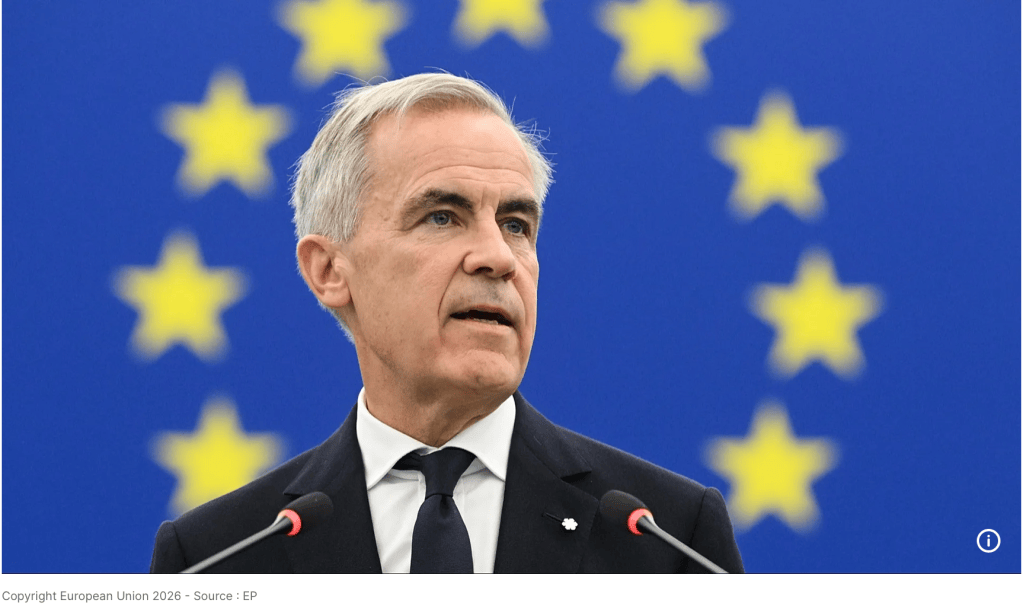
In this historical moment, Prime Minister Mark Carney has become our greatest cultural export. He is considered in his pronouncements, good natured and unflappable. He is the global anti-Trump.

Occasionally, the imperious CEO gets loose. In a rare appearance in the House of Commons for Question Period, Carney was obliged to grind out the parry and return of Opposition barbs.

Having gamely returned service to Pierre Poilievre’s first serves on issues of affordability, Carney swivelled to meet the incoming from Bloc Québécois Leader Yves-François Blanchet on the PM’s repeal of the Digital Services Tax and Netflix cash contributions to Canadian media funds.

“Mr. Speaker,” said Blanchet, “the Prime Minister personally cancelled contributions of any kind by tech giants to the economy or the arts in Quebec and Canada, including through taxes or content creation, simply to appease the American President. The effort fell flat. Although I remain unconvinced, the Prime Minister claims to have walked away from the negotiation table for language and culture-related reasons. Since the effort failed, should the Prime Minister consider reinstating the digital services tax and allowing cultural contributions by the web giants?“

After a reply offered in banal Parliamentary vocabulary, the Prime Minister steadied for Blanchet’s follow up volley.

Blanchet suggested that Carney’s strategy to build closer ties to the European Union meant that Canadian alignment with the EU’s bolder approach to digital taxes and streamer contributions would make sense after breaking off trade talks.

The Prime Minister stood up and delivered a curt, “No, Mr. Speaker.” And sat down. Pointe finale.

Now it helps to watch this on video so you can appreciate the dismissive tone and body language. The clip also captures the bemusement rippling through the Bloc MPs seated behind Blanchet.

As the Prime Minister probably appreciated afterwards, that kind of answer won’t cut it in Québec, a province that loves legislation regulating streamers so much it has two.

***

With the House of Commons sitting again, Parliamentary committees picked up from where they left off in the spring.

In the modern age of an all powerful Prime Minister’s Office, these independent committees frequently resemble teenager house parties when the parents go out of town. Don’t destroy the place and you can do much pretty much anything you want.

The Finance committee is chaired by Karina Gould, the Toronto–area MP and former cabinet minister who made an impressive run for the Liberal leadership in 2025. This week Gould delivered the Liberal committee majority’s report on public submissions for the upcoming 2026 budget.

It’s not all that newsworthy when the Finance Committee reports on its “pre-budget” consultation. Its MPs make loads of budget recommendations in policy areas already covered by fellow MPs sitting on other Parliamentary committees like Canadian Heritage. And in a Budget that remains in the tight fisted grip of the Finance Minister and the PM, the Finance MPs’ recommendations are far from being a first draft of the final Budget.

On culture, the Finance MPs made eleven recommendations.

Some are guaranteed never to see the light of day.

A recommendation that Internet Service Providers (i.e. Bell, Rogers, Québecor) begin paying the same five per cent culture levy that their cable divisions pay is a non-starter.

Recall how in June 2017 Prime Minister Justin Trudeau humiliated Canadian Heritage committee chair and fellow Liberal MP Hedy Fry by holding a pre-emptive news conference to dismiss out of hand her committee’s recommendation favouring an ISP tax.

Other recommendations may be under more serious consideration by the PMO. For example, this omnibus recommendation on public spending on news journalism captures several of them:

Support the sustainability and growth of newsroom jobs by maintaining the Canadian Journalism Labour Tax Credit at the current 35% rate and expanding eligibility criteria to include owner-operators, employees in broadcasting, and partners in news businesses. Budget 2026 should also direct at least 25% of federal advertising spending toward private-sector Canadian news outlets, address disparities in tax treatment for advertising, and extend the Local Journalism Initiative indefinitely to support the creation of original civic journalism in underserved communities. 

The other recommendation that caught my eye was the strengthening of the intellectual property rights of news organizations in response to the ingestion of their content by AI large language models such as ChatGPT, Gemini, and Claude:

The committee further recommends that the Government of Canada protect Canadian news publishers’ intellectual property in the context of artificial intelligence by requiring government AI suppliers to commit to the principles of transparency, consent, and attribution when using copyright-protected content, requesting that the Competition Bureau examine competition issues in search and AI markets, including crawler practices.

And here is a companion recommendation that applies to any kind of Canadian media:

Ensure that artificial intelligence (AI) developers obtain permission and provide compensation for the use of copyright-protected works in training data, reject any new or expanded copyright exceptions for text and data mining, and require transparent disclosure and record-keeping of training sources to support a functioning licensing market.

There are many public policy issues packed into those two paragraphs.

But to news publishers, the issue is simple. They want to be compensated (or even asked permission) by the AI giants for ingesting their content, first for the “training data” that birthed the LLMs’ vocabulary and gave them the context to understand news content, and also for the “output” summaries that LLMs provide to inquisitive users like you and me.

The news publishers’ claim is that AI ingestion is not only without permission and compensation, it’s grabbing intellectual property that news publishers might use to make their own LLMs in open-sourced applications. As well, the LLMs are using ingested news content to create de facto news outlets that directly compete with the news publishers.

Faced with litigation from news publishers, the AI global giants have signed off some pick-and-choose deals with top news outlets.

It’s reminiscent of what happened ten years ago in news hyperlinking by Google and Facebook, ultimately leading to the Online News Act C-18. The web giants made a few deals on the cheap with big news organizations and stonewalled the smaller news publishers.

To those unlucky news outlets, the web giants offered instead free distribution of their hyperlinks in order to draw traffic to their websites. Even if that quid pro quo was ever adequately remunerative to publishers big and small for hyperlinks, it’s not on offer from AI companies for ingestion, including again Google and Meta.

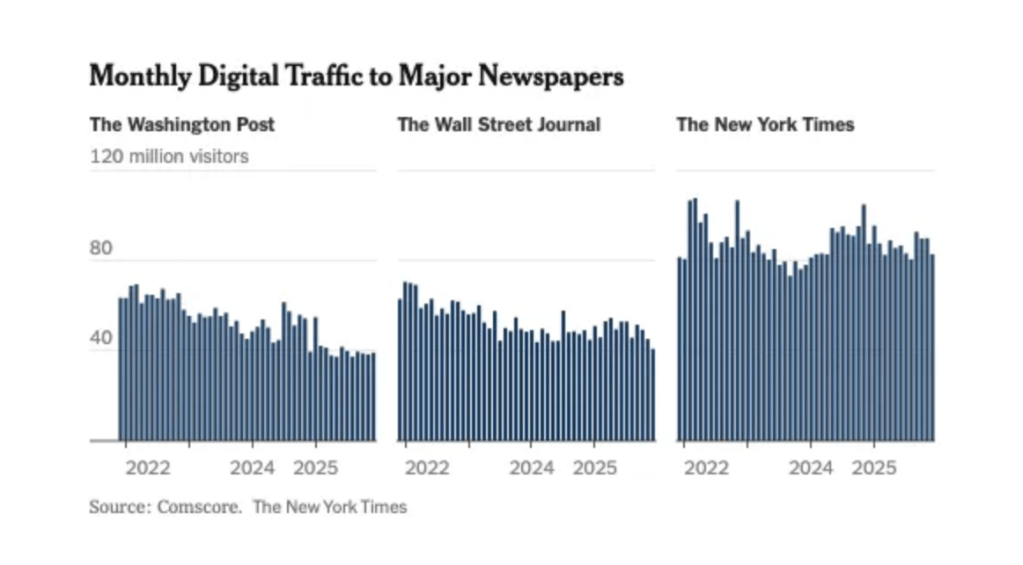
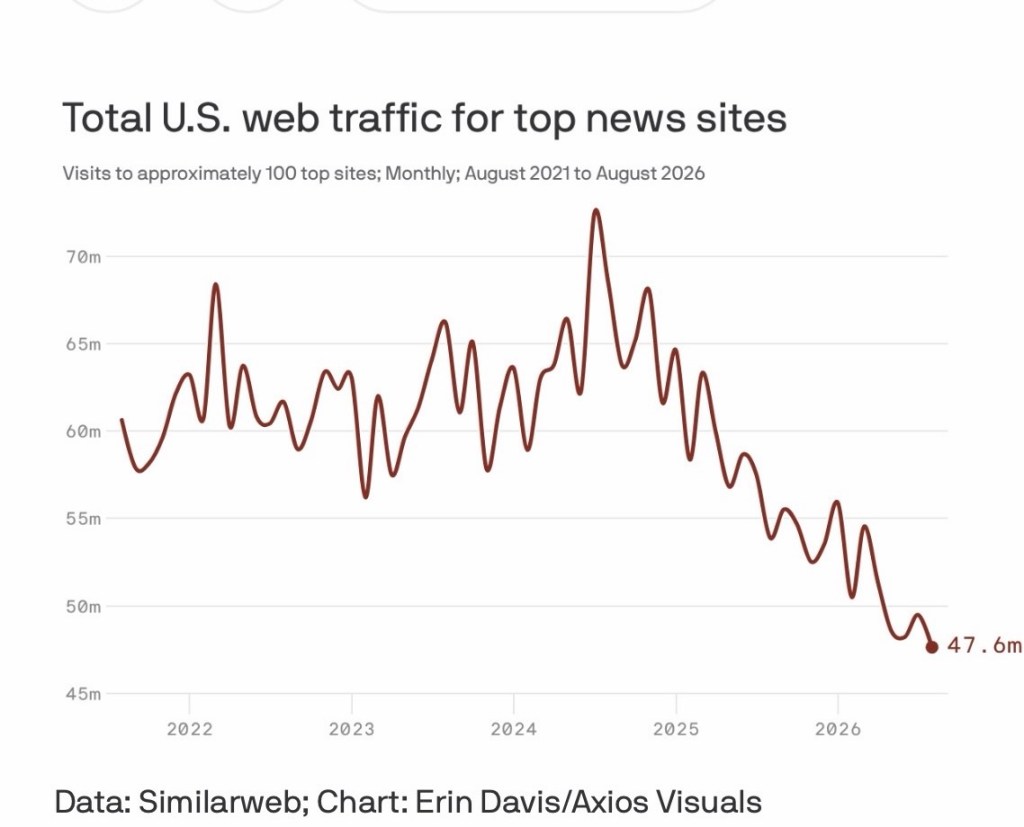
That’s because the notion of an exchange value of “content for traffic” doesn’t apply to AI ingestion of news content that is killing traffic referrals from web platforms to news outlets, as the graph below indicates.
So what next?

There is already litigation over ingestion that will end up in the US Supreme Court and maybe our’s too. The Trump administration has lined up in support the ingesters. The Carney government is sitting on the fence.

His MPs on the Finance committee are recommending he get off of it.

***

If you would like regular notifications of future posts from MediaPolicy.ca you can follow this site by signing up under the Follow button in the bottom right corner of the home page; 

or sign up for a free subscription to MediaPolicy.ca on Substack.

This post is copyrighted by Howard Law, all rights reserved. 2026.

CanCon Corks bobbing on the ocean: the CRTC’s new ruling on Hollywood streamers in Canada

May 24, 2026

The other shoe dropped this week when the CRTC delivered two rulings that nearly complete its new regulatory framework for Netflix and the rest of the Hollywood streamers, as well as Canadian television broadcasters. 

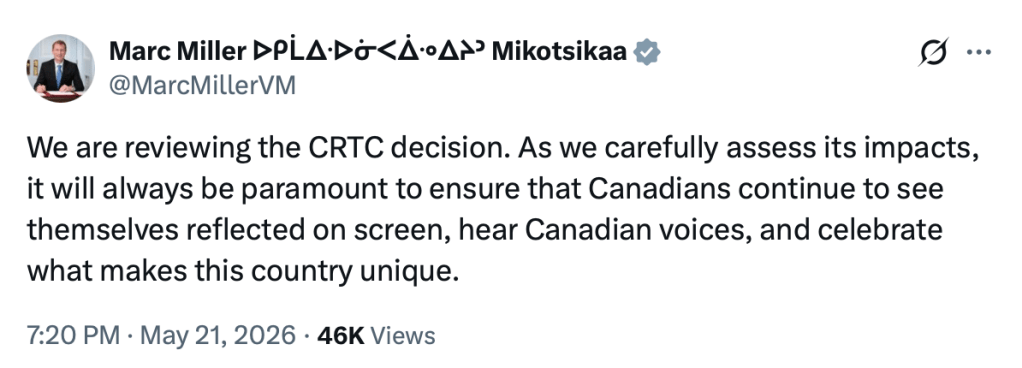
The reaction to the rulings from the Hollywood streamers and their Canadian enablers offered more heat than light. Media reports played them as a trade story and some breathlessly speculated on Culture & Identity minister Marc Miller’s inscrutable comments on X. 

Across the border, a steady stream of ominous threats and faux outrage from American trade officials is expected soon.

In the interest of a more cool-blooded debate, let me offer some analysis of the CRTC’s new rulings on direct streamer investments in Canadian content  (“Canadian Programming Expenditures,” or CPE) and the distribution and prominence of that content on streaming platforms, made “discoverable” so that shows made by Canadians don’t end up as wine corks bobbing on an ocean of global content.

The bottom line is that the CRTC’s expected ruling on those direct CPE investments came in at 15% of the revenues that streamers earn in the Canadian market.

That 15% includes a 5% subset of the (still unpaid) cash levy in favour of Canadian media financing funds imposed by the Commission in June 2024 as an “initial” CPE contribution, thus the feverish cries of “tripled contributions.” 

While the bar for streamers was set at 15%, the Commission lowered the parallel CPE contributions of Canadian broadcasters from 30% (or more) of their Canadian revenues down to 25%. The broadcasters have been fuming about their CPE obligations for years since cable subscriptions and Canadian television revenues began their downward descent around 2017 while the Hollywood streamers surged in growth and remained unregulated until the Online Streaming Act was finally legislated in 2023. 

The gap separating Hollywood streamer and Canadian broadcaster CPE is now reduced but still a substantial 10% of revenues (although it’s probably less than 10% when you take into account that more than a third of the streamer CPE consists of their cash dollars going out the door to media funds). 

Whatever number you ascribe to the remaining gap between streamer and broadcaster CPE contributions to CanCon, the Commission excuses this remaining favouritism shown to the streamers as being “equitable” as opposed to “equal” contributions. You be the judge if it’s equitable. The streamers insist its “discriminatory.”

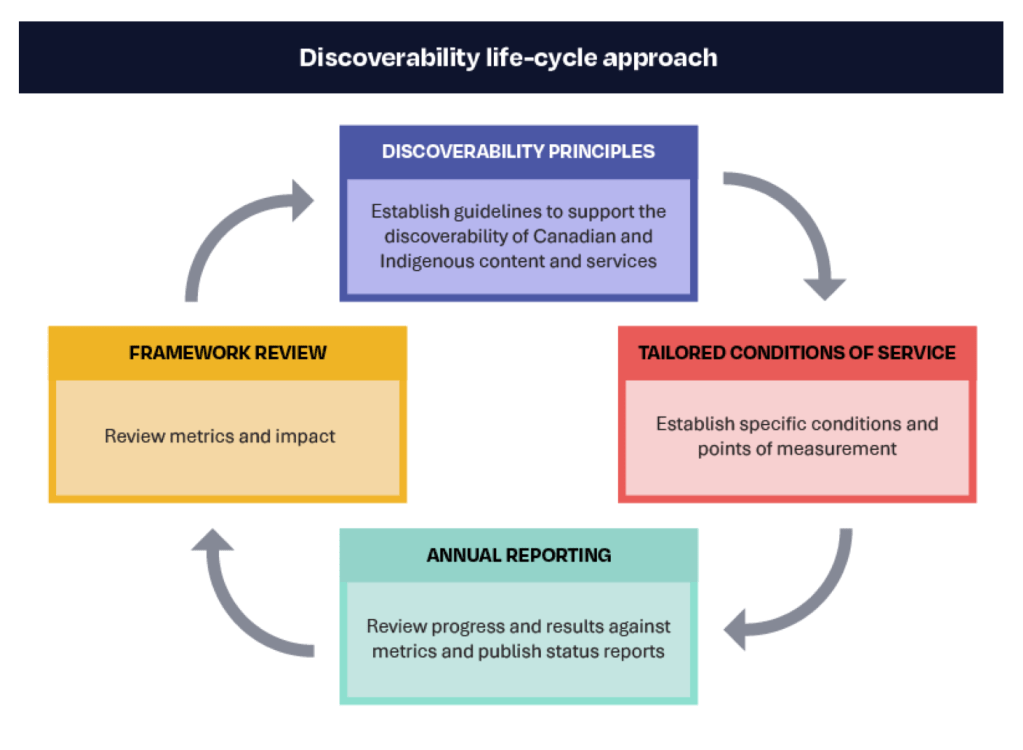
The CRTC’s companion ruling on discoverability is poised to be a genuine victory for Canadian content and a vindication of the federal Liberals’ crawl-over-broken-glass efforts to legislate the Online Streaming Act. How big a victory depends on how soon and firmly the CRTC follows up on the key regulatory principles in the ruling:

  • The Commission states an expansive definition of “discoverability”: “Canadian content and services are discoverable if they are made available and visible to audiences, including when an audience is not actively seeking such content and services.”The emphasis is on the streamers making their Canadian content highly visible on their platforms, irrespective of whether Canadians are patriotically seeking it out through keyword searches or on the streamers’ ghettoized “Canada” tabs.
  • To make this happen, the CRTC tasks each streamer to offer the Commission “measurable outcomes” in making Canadian shows prominent with transparent and annual measurements using standardized data. The Commission has told streamers that Canadian content should be “presented consistently when audiences browse landing pages, recommendations, categories, carousels and playlists” and not just “dedicated spotlight categories” for Canadian content.  And just in case the streamers don’t get the message, the Commission says it expects “equitable” platform exposure of Canadian content in Canada, a deliciously vague objective that should keep entertainment lawyers well employed. 
  • And the Commission expects streamers “to facilitate the installation, integration and/or promotion of [Canadian broadcasting services of exceptional importance] and local streaming apps and stations on Smart TVs, set top boxes or other devices so that they are easily visible to consumers.” This is bold stuff. It’s not clear how the Commission is going to implement this in cases where screen interfaces are installed by television manufacturers: the Québec provincial government says it’s going to legislate it.

Source: CRTC

Taking these Commission pronouncements on discoverability at face value, this is good news for Canadian content. As television broadcaster Brad Danks wrote in his recent series of articles in Cartt.ca, we are overdue to pivot from our singular focus on regulatory support for production financing in favour of supporting distribution, prominence and the cultivation of loyal audiences at home and abroad. 

From here, the streamers’ self-designed discoverability strategies will have to pass muster before the Commission in the final phase of the legislation’s implementation, the application of “tailored conditions of service.” That will likely take another year to complete, assuming a light-speed effort by the Commission. Beyond that, the Commission is allowing the streamers three years to meet these higher expectations of CanCon discoverability. That will put us seven years from Royal Assent to full implementation of the Online Streaming Act.

Of course, the streamers want no part of any of this, neither CPE nor discoverability, judging from their cede-no-quarter opposition to any regulatory obligations, court appeals and weaponization of American trade power over the last three years.

The streamer fury is highly performative. But let me speculate on at least four things about the Commission’s latest rulings that might genuinely stick in their collective craw. 

The first is copyright. The streamers notched a big win last November when the Commission announced its new rule about whether non-Canadian services could hold copyright ownership in the Canadian shows eligible for its CPE quota for direct CanCon investments (as opposed to paying copyright-owning Canadian producers to license their shows for Canadian release or global distribution). 

It’s a complex issue that I wrote about here. In brief, in any production partnership the owner of majority copyright in a show holds an advantage in negotiations over return on investment, revenue sharing and the long-term commercial exploitation of the intellectual property flowing from a successful production. 

During parliamentary hearings in October 2022, Netflix identified copyright ownership as its number one priority. But despite the clear language in the Online Streaming Act favouring copyright remaining vested in independent Canadian producers, the Commission sided with Netflix and the other Hollywood streamers. Incensed by that ruling, I wrote about ithere.

Alas I incensed too soon. The Commission evidently had more to say about copyright. In this most recent ruling, the Commission claws back some of that apparent streamer victory. Under the heading “enhanced partnerships,” the CRTC directs the streamers to earmark about a third of their 15% CPE for co-ventures with independent Canadian producers in which the Canadians retain majority copyright. 

By my figuring, the streamers will have to cede majority copyright to independent Canadian producers in Canadian shows in its programming budget amounting to a 4.5% envelope of Canadian revenues within its 15% overall CPE. That leaves the streamers contributing 6.55% of revenues in media fund cash payments (see below) and 4% for direct content investments in shows where they can retain majority copyright. 

Another unwelcome surprise for the streamers was the CRTC rethinking the mulligan it gave the streamers back in June 2024 when it extended an option for streamers to shave off 1.5% of their initial 5% cash levy to media funds to 3.5%. The deal was that the streamers could withhold that 1.5% (of a total 2%) contribution to the Canada Media Fund provided they invested the money directly in Canadian shows. It was essentially a downpayment on their yet-to-be-determined CPE. In setting a final CPE number of 15% the Commission eliminated the 1.5% opt-out. That leaves the streamers paying out of pocket to media funds at the full “initial” 5%. 

The Commission then tacked on to that 5% an additional cash levy of 1.55% of revenues to feed a new Services of Exceptional Importance Fund —more or less demanded by federal cabinet and Parliament— to replace the per subscriber “wholesale rates” that Canadian cable operators pay to vital services such as CPAC, the Weather Network, APTN, Uvagut TV, Omni, TV5, and CBC/Radio-Canada news in official minority language regions. The major Canadian broadcasters will pay the 1.55% levy too.

The last of the craw-stickers is probably the Commission’s rejection of the streamer proposal to count their marketing expenses towards their fulfillment of CPE spends. The Commission reaffirmed its existing policy that only small and medium sized Canadian broadcasters get that break. The streamers and the big Canadian broadcasters will not get it, in the name of maximizing contributions to production financing. On the other hand, the Commission told the streamers it remains open to them pitching a detailed plan on whether their financial sponsorship of creator training and development ought to count in CPE calculations. 

That’s the impact of the rulings on the streamers. There were some controversial results for Canadian media companies too, not limited to the “equitable” 10% CPE gap with streamers.

The Commission followed through with its preliminary view expressed in the notice of consultation by abolishing the mandatory spending category of “programs of national interest,” (PNI) a subset of CPE spending quotas to support feature films, drama series, comedy shows and documentaries. The notice of consultation didn’t elaborate much on the Commission’s thinking except to wonder aloud if the US streamers were going to flood the market with so many Canadian movies and serials that the Commission could relieve Canadian broadcasters of their PNI spending obligation. 

The major Canadian broadcasters had been begging for this for years because shows in those PNI genres are difficult to make profitably (a foundational point made in 2020 by the federal government’s Yale Committee that recommended legislating the Online Streaming Act). For example, Corus Entertainment has been quite vocal that its survival depends on making more lifestyle programming at a higher profit and getting out of Commission-directed expenditures on dramas.  On the flip side, Canadian independent producers and creative guilds warned that when the Commission previously experimented by repealing special funding requirements for programs of national interest it backfired spectacularly with declining production investments, prompting the Commission reinstate the priority spending a few years later.

Citing no evidence for its 180-degree reversal from the Yale Report, the Commission nevertheless decided that while news, children’s programming, and French language content is unprofitable and “at risk,” English-language drama and documentaries are not.

I do not exaggerate when I say this is a repudiation of a half century of Canadian media policy built on a comprehensive regime of CRTC regulation and government subsidies that puts dramas at the heart of “at risk” content. The Policy Direction that the federal cabinet issued to the CRTC in June 2023 gave the Commissioners a lot of instructions and priorities on a great many issues, but not one of them deprioritized the historic funding for English language feature films and dramas. 

What Minister Miller thinks of this I cannot say. But his government funds Canadian feature films and drama series to the tune of well over a half billion dollars annually through the Canada Media Fund, Telefilm Canada and the federal CPTC production tax credit. 

There were other issues close to the hearts of Canadian broadcasters that remain unresolved in these new Commission rulings.

News is one. The CRTC elected to maintain its existing policy which is that about 35 independent television stations (including the Global News network) can draw subsidies from the Independent Local News Fund but that Bell CTV, Rogers City-TV and Québecor TVA cannot. In fact, the big three will have to continue underwriting their cash-hemorrhaging network stations at current levels or 15% of their 25% CPE (about $380 million), whichever is more. By doing this the CRTC is confirming its 2016 ruling which was, if you will excuse the vulgarity, that the telcos can suck it up. 

Source: CRTC

The consolation prize for news broadcasters is that the Commission will schedule new hearings on the sustainability of news programming sometime in the future. When we get there, that future may look much different than today, depending on what happens with funding from the Online News Act and the federal government’s new proposal to extend federal journalism tax credits to broadcasters.

As for the much-anticipated production financing for content made by Indigenous producers, and by producers from equity-deserving groups, that has been kicked down the road, but hopefully not too far. The major broadcasters and streamers will be expected to table a plan to improve production financing in those communities in the third and final regulatory phase of “tailored conditions of service.” 

***

If you would like regular notifications of future posts from MediaPolicy.ca you can follow this site by signing up under the Follow button in the bottom right corner of the home page; 

or sign up for a free subscription to MediaPolicy.ca on Substack;

or follow 
@howardalaw on X or Howard Law on LinkedIn.

COMMENTS ARE WELCOME. But be advised they are public once I hit the “approve” button, so mark them private if you don’t want them approved. 

I can be reached by e-mail at howard.law@bell.net.

This blog post is copyrighted by Howard Law, all rights reserved. 2026.
Catching up on MediaPolicy – Europe indicts TikTok – Age verification bill S-209 clears Senate committee – Bezos and the WAPO layoffs – CPC frenzy over “the Canadian media summit”

February 8, 2026

The European Commission has fired a shot across the bow of TikTok, and by implication other social media, by finding the social media giant culpable of addictive algorithm design and inadequate safety measures.

The Commission explained its  preliminary ruling, which TikTok can either appeal or fix, as follows:

TikTok seems to fail to implement reasonable, proportionate and effective measures to mitigate risks stemming from its addictive design.

For example, the current measures on TikTok, particularly the screentime management tools and parental control tools, do not seem to effectively reduce the risks stemming from TikTok’s addictive design. The time management tools do not seem to be effective in enabling users to reduce and control their use of TikTok because they are easy to dismiss and introduce limited friction. Similarly, parental controls may not be effective because they require additional time and skills from parents to introduce the controls.

At this stage, the Commission considers that TikTok needs to change the basic design of its service. For instance, by disabling key addictive features such as ‘infinite scroll’ over time, implementing effective ‘screen time breaks’, including during the night, and adapting its recommender system.

The EU finding is made against the Chinese-owned app in the European market, not the American-owned TikTok across the Atlantic. But it will heat up the tension between the US and the EU over the regulation of online harms impacting US-owned apps operating in Europe.

The momentum of regulatory intervention around the globe picked up more steam when Spain indicated its intention to follow Australia and France in banning underage social media accounts. 

As for Canada, Heritage Minister Marc Miller isn’t saying yet if a ban on underage access is part of the online harms bill he is preparing.

Last Monday, the influential Taylor Owen and his McGill colleague Helen Hayes called for a moratorium on underage access to social media while online harms legislation gets tabled, works its way through Parliament, and gets implemented.

Judging from Canada’s last two pieces of media legislation, the Online Streaming Act and the Online News Act, the length of the entire process might be measured in years.

What might advance the timetable at the front end is Senate Bill S-209 that would require age verification for porn sites and possibly any social media site that permits porn. The bill passed committee last week and will likely get approved by the full Senate in the next few weeks, putting the governing Liberals on the spot.

Last week Senatrice Julie Miville-Dechêne, the bill’s sponsor, obtained committee approval for a series of technical amendments as well as a change that defined porn more narrowly to get at “X-rated” content and scope out the nudity and implied sexual activity common in mainstream drama. The new definition requires the exhibition of explicit sexual activity and exposed genitalia for the purpose of sexual excitement.

As drafted, S-209 still leaves the decision on whether to scope in porn-permissive social media apps to the federal government, either in a House vote on the bill or afterwards. 

***

Last weekend MediaPolicy noted the diverging fortunes of the New York Times and the Washington Post with the Times getting the Trump-bump in digital views and the Post sagging in the other direction. 

Then on Tuesday the Washington Post announced a breathtaking round of newsroom layoffs, 300 of 800 staff. By Saturday, publisher Will Lewis had resigned.

The public reaction was what you might expect: a mix of shock and anger. Former Post Editor-in-Chief Marty Baron posted his condemnation of the layoffs and put at least part of the blame on multi-billionaire proprietor Jeff Bezos’ decision to ingratiate himself to Donald Trump. That included Bezos killing a planned editorial board endorsement of Kamala Harris’ presidential candidacy, which reputedly cost the Post 200,000 subscriptions, as well as vocal support for Trump’s demolition of the White House east wing and making a donation to the ballroom project to be built on its foundations. Recently, Bezos’ Amazon Prime reputedly overpaid the Trump family for the streaming rights to the documentary Melania.

Then American anti-monopoly advocate Matt Stoller published a long Substack post where he suggested that Bezos bought the Post in 2013 as political insurance against the Obama administration taking anti-trust action against his Amazon e-commerce business. The insurance policy, Stoller suggested, has become unnecessary or overpriced as Bezos literally put his money on Trump. 

One piece of context is that while the Post’s declining audience numbers may be attributable to anti-Trump readers voting with their feet, the conservative and pro-Trump Wall Street Journal is experiencing the same decline, although not as steep as the Post.

There were also layoffs in Canadian journalism, suitably smaller in number. Bell Media CTV laid off 60, including 11 television journalists. 

***

The gong show otherwise known as the right-wing frenzy over mainstream media went viral last week when a video clip surfaced of Reynolds Mastin publicly thanking Prime Minister Mark Carney for “having our backs” and gushing that “we have your back too.” 

There it was, proof of the blood pact between the federal Liberal Party and the mainstream news media.

But who the heck is Reynolds Mastin?

Mastin is the President of the Canadian Media Producers Association (CMPA), the industry group representing independent Canadian production companies that make entertainment programming. He was chairing the CMPA’s annual Prime Time conference in Ottawa when he made the remarks.

Readers may know, Mastin is not a journalist and he (and the CMPA) has nothing to do with news journalism. He was encouraging Carney to resist American trade pressure on the Online Streaming Act which requires US streamers to contribute to the Canada Media Fund.

Independent movie and television producers draw CanCon subsidies from the Canada Media Fund to make dramas and comedies. The CMF doesn’t spend a dime on news, although some make the mistake of thinking it does.

Nevertheless, the timing was was perfect for frenzy: the Conservative Party was in the midst of its annual convention in Calgary.

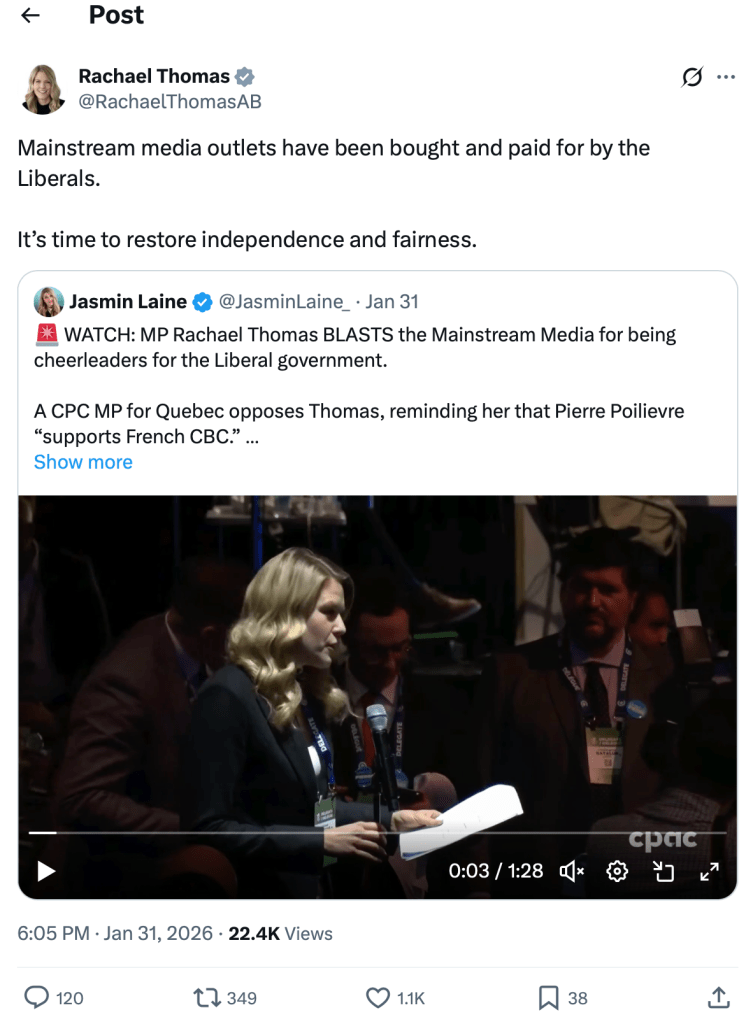
Here is Conservative Heritage critic Rachael Thomas MP describing “the Canadian media summit” as a news journalism event:

Thomas’ falsehoods then found their way into Conservative fund raising e-mails.

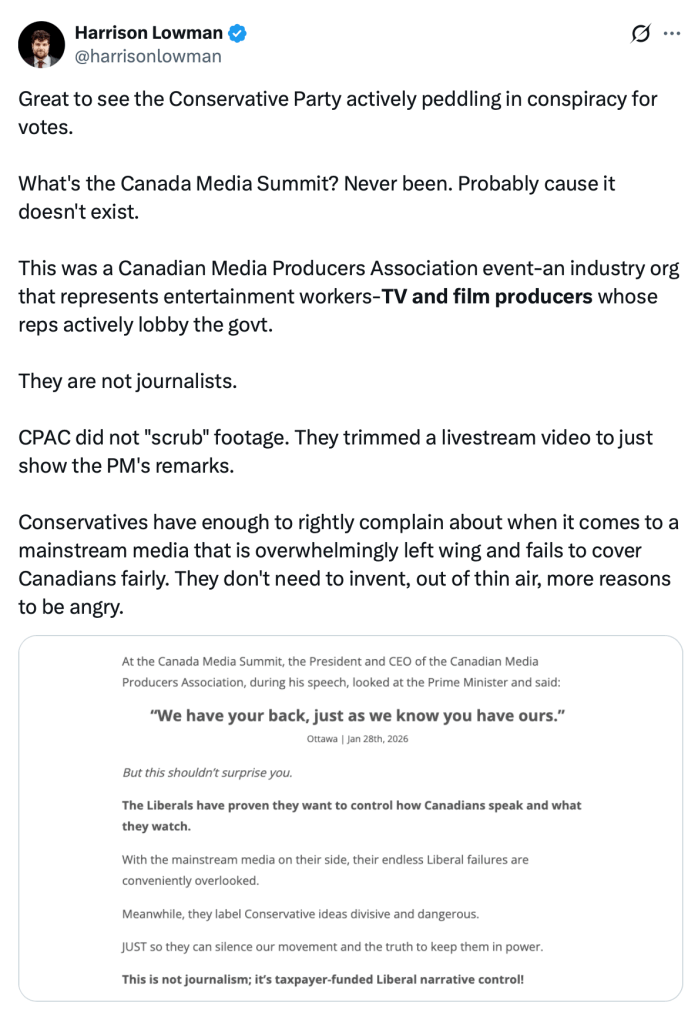
At that point, some conservative pundits urged Conservatives to do a fact check. The managing editor of The Hub, Harrison Lowman, was as brave as he was blunt:

Now speaking of Mr. Lowman and The Hub, I can recommend an excellent podcast he did in January with ex-New York Times editorial page editor James Bennet. 

In June 2020, Bennet (whose brother is a Democratic Senator) cleared for publication an opinion column from Republican Senator Tom Cotton arguing that Donald Trump ought to deploy the military if necessary to deal with rioting and looting that flared in the aftermath of the police murder of George Floyd. 

Bennet’s employment did not survive the newsroom uprising that followed. 

A similar newsroom conflagration occurred the same month at Canada’s National Post when columnist Rex Murphy opined that Canada “is not a racist country.” 

In any event, I found myself gripped by the full 35 minutes of Lowman’s interview of Bennet and you may find it worth the time as well.

***

If you would like regular notifications of future posts from MediaPolicy.ca you can follow this site by signing up under the Follow button in the bottom right corner of the home page; 

or sign up for a free subscription to MediaPolicy.ca on Substack;

or follow 
@howardalaw on X or Howard Law on LinkedIn.

COMMENTS ARE WELCOME. But be advised they are public once I hit the “approve” button, so mark them private if you don’t want them approved. 

I can be reached by e-mail at howard.law@bell.net.

This blog post is copyrighted by Howard Law, all rights reserved. 2026.
2026 will be Canada’s cage match

“G-S-P !

G-S-P !

G-S-P !”

December 31, 2025

You already knew it: Canada’s 2026 is going be a battle, a pivotal moment in our history.

CUSMA talks begin this spring. They will be brutal. Even in the innocent days of cross border free trade, the US played rough when it came to a trade dispute over Canadian culture.

This US President wants high tariff walls to keep Canadian goods out of America and to grab Canadian jobs. Going the other way he wants open borders and unregulated markets for US exports such as streaming services and social media apps.

Given the thousands of Canadian manufacturing jobs and family farms at stake in the trade talks, and the inevitable reprise of 51st state threats —-“we just have to have Greenland  Canada”— it may seem parochial at first to focus on media policy. But with 660,000 jobs in our media and cultural sectors, focus I shall.

Here are some of the upcoming headlines.

The CUSMA trade talks

An internet meme recently popped up in my X feed that put two contemporaneous statements from Google spokespersons next to each other.

In the first, Google addressed the digital regulators of a foreign government —-in this case the European Union—- with the utmost respect. In the second statement to a much different forum, Google demanded US Congress stomp all over the EU.

This is how the tech bros roll. They’ve enlisted the Trump administration in their cause and the tiff with the EU has escalated from White House accusations of European censorship of American content to barring the architect of the EU Digital Services Act and four advocates of the EU regulating online hate and disinformation from travelling in the US.

Canada, you’re warned.

So no surprise, when CUSMA talks begin the US is going to come loud and hard against Canada regulating media in our own country, whether it’s the Online Streaming Act C-11 or the Online News Act C-18. I don’t have a high degree of confidence that PM Mark Carney won’t flush them like he did the carbon tax, the digital services tax, the emissions cap, etc. 

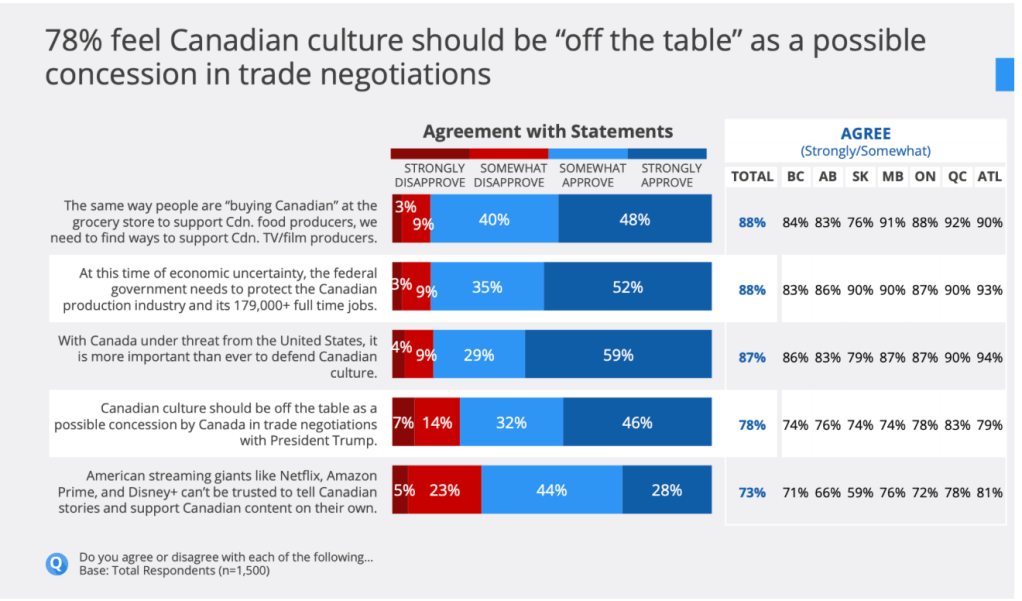
It’s not that we shouldn’t reconsider Canadian media policy any time we want, but it would be better to do so because Canadians wish it. The polls say we don’t: at least not during the trade talks.

What’s at stake here is not only those two pieces of legislation, C-11 and C-18, but our right to take future action on any media policy that might cost the tech bros money or convenience. Think AI. Or online harms.

I make no prediction. On the one hand, as a banker and a corporate lifer I think Carney would happily throw cultural regulation under the bus.

On the other, if he does that he can kiss his Québec caucus goodbye. Or, the NDP might find its gag-point and bring down the Liberal minority government.

CanCon

I just can’t figure out the CRTC. The commissioners alternate between putting a bold $200 million cash levy on streaming services and, on the other hand, their timorous ruling on CanCon video content.

The Commission has three big decisions to release in the new year, arising out of the Online Streaming Act (having missed the December 2025 deadline set by cabinet).

The most consequential is the second instalment of the aforementioned CanCon video streaming ruling which will deal with issues that could carve out regulatory conditions for a generation:

  • How much money will Netflix and the California streamers have to spend on Canadian shows?
  • Will the Commission reduce CanCon spending for Canadian broadcasters (it will) and by how much?
  • Will the Commission swap out obligations for Canadian broadcasters to make CanCon dramas in favour of underwriting their unprofitable news operations?

The Commission owes us two other big ones in broadcasting distribution and audio streaming. There are lots of issues packed into those two rulings, but the one I am watching is whether the Commission will make Spotify and the music streamers grow the Canadian listening audience for Canadian artists (it’s currently less than 10%).

There are some wild cards in play.

The Federal Court heard the streamers’ appeal against the $200 million levy in June and judgment is overdue.

The legalities of appeal are narrow and amount to whether the Commission dotted the i’s and crossed the t’s. They don’t allow the streamers to easily challenge the CRTC’s wisdom on the size of the levies, nor what they are spent on (i.e. CanCon dramas and broadcast news).

Still, if the Court strikes down the levies on technical grounds just before the CUSMA talks begin it will significantly assist American negotiators or, if our Prime Minister’s climb down on the digital services tax is any guide, assist him in dumping trade ballast.

Another wild card is Québec’s new streaming law, Bill 109. It’s the CAQ’s claim to regulate streamers in case the federal CRTC disappoints on French language content on screens and AirPods. 

When CUSMA talks begin, Québec’s bill will be sited in the same American crosshairs as the federal C-11. With a Parti Québécois election victory in the offing, and possibly another referendum on separation we could hear a lot more about this provincial law.

Next, we can speculate on whether Global TV News makes it to 2027 in one piece. Its parent company Corus refinanced its debt this year and managed to land some new television programming to replace the profitable Disney and Discovery content that Rogers poached from them. 

But Corus still lives hand to mouth, and the news division loses a lot of money. The Shaw family ownership can’t find a Canadian buyer. Even Mark Carney wouldn’t dare exempt the 15-city Global News network from Canadian ownership rules and watch Fox or one of the other US television chains march in and set up shop in every major Canadian city.

The last question mark is a boutique policy issue but carries huge consequences for the survival of the Canadian film and television industry. The CRTC’s ruling that allows US streamers to own majority copyright in their new Canadian dramas turned four decades of Canadian cultural policy on its head. 

The domino that might fall is whether the Liberal government would harmonize the CRTC’s new rules about the ownership of intellectual property in Canadian dramas with its own rules that govern federal subsidies to Canadian programs. The CRTC ruling invites American trade negotiators to demand it.

Online Harms

If Justice Minister Sean Fraser tables an online harms bill in Parliament, it will be time for some soul searching by all of us.

How seriously do we take the online harms of race-baiting and anti-semitic hate, humiliation of women and girls, and harm to our adolescent and teenage children? Are we virtue signalling our concern or do we really want to do something about it?

On the other hand, we shouldn’t be so naive to think that these platforms won’t err on the side of censorship rather than pay fines for permitting harmful content on their services. That’s the sort of malicious compliance Meta meted out by banning Canadian news from Facebook and Instagram rather than comply with the Online News Act.

You can see this debate play out in its beta-version with Bill S-209, tabled by an independent Senator. That bill is legislation that would require porn sites and social media apps to exclude minors from accessing hardcore porn by using third party age verification services. 

Again, the harm is obviously serious, but how seriously do we take the harm? Even though the risks are remote, how much are we willing to gamble the privacy of porn site visitors and social media followers whose identities might be hacked and exposed?

All eyes will be on Australia which has grabbed global attention by banning teen access to social media, a move that requires age verification of adult social media accounts.

AI

It would be guesswork to predict what happens next with the amazing explosion of AI technology, its impact on economic growth and social harm, and government efforts to regulate it.

The most pressing policy questions are in the hands of AI Minister Evan Solomon who has frequently telegraphed his reluctance to impede the development of Canada’s fledgling AI industry by “over indexed” regulations.

But neither has Solomon warmed to the Big Tech campaign to create an American-style “text mining” exception in Canadian copyright law. If he did, he would be sinking any chances that Canadian news organizations and cultural creators have to force AI giants into paying license fees for scraping online content to feed their products. Hugh Stephens has an excellent summary of the current state of affairs, here.

The worst case scenario for content creators is very bad but grimly not a lot worse than the best case scenario.

Even if AI companies submit to paying license fees —-and there have already been a few licensing agreements struck between AI companies and a select group of big news publishers and content creators—– it’s entirely possible that in the next five years AI will so disrupt the direct interface between news organizations and news consumers that news outlets will pine for the days when Google and Meta were taking their hyperlinks for free but at least sending audience traffic their way.

Either the US or Canada may raise AI commerce or the mitigation of its harms at the CUSMA bargaining table. The Trump administration appears to be all in for making American AI into the global masters of the Internet.

But as many have pointed out there is a back eddy at state-level where MAGA politicians are as concerned about AI harms as anyone.

CBC Radio-Canada

After the CBC’s near death experience in the last federal election, policy wonks everywhere had suggestions on how the public broadcaster might re-capture the popular imagination with a strong programming line-up that resonates across the entire country.

We’ve had a statement of intent from the new CBC President: more local news, especially in the West, but what else?

If the Prime Minister gives away the media policy store to the Americans, what the CBC does becomes even more important. 

Bandwidth

Whatever the government wants to do on media and cultural policy in 2026, bandwidth could be a problem.

I don’t mean download speeds. I mean the administrative bandwidth in the federal Heritage Department. Bureaucrats will be on call 24/7 during trade talks; the department is already charged with developing legislation to overhaul the governance of the CBC; and there are any number of quiet policy reviews and projects going on.

This could be the busiest year ever for media and cultural policy and the unhappy timing of Steven Guilbeault’s exit from cabinet means that we have a rookie Heritage minister, Marc Miller (who may or may not be as invested in C-11 or C-18 as Guilbeault).  

Compounding that lack of experience is Carney’s decision to shuffle the deputy ministers who do the grinding work of getting things done in government. Long time Heritage deputy Isabelle Mondou just got shuffled to the Privy Council Office. Good luck to the new guy, Francis Bilodeau.

***

If you would like regular notifications of future posts from MediaPolicy.ca you can follow this site by signing up under the Follow button in the bottom right corner of the home page; 

or sign up for a free subscription to MediaPolicy.ca on Substack;

or follow 
@howardalaw on X or Howard Law on LinkedIn.

COMMENTS ARE WELCOME. But be advised they are public once I hit the “approve” button, so mark them private if you don’t want them approved. 

I can be reached by e-mail at howard.law@bell.net.

This blog post is copyrighted by Howard Law, all rights reserved. 2025.

Canadians in a dangerous time.

December 28, 2025

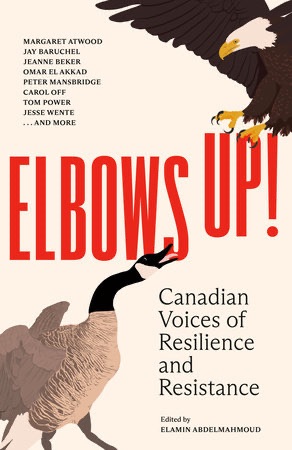
I am ever grateful for my library card. After waiting just a few weeks for 100+ Torontonians to read this book before me, I got my turn with this new anthology of thirty Canadian artists and writers reacting to Donald Trump’s threats to crush our economy so he can annex our country.

Elbows Up! (subtitled “Canadian Voices of Resilience and Resistance”) is of course a riff on the Prime Minister’s election slogan that helped to put him where he is now. Whether in fact we are conducting ourselves that way is, I think it’s best to say, a work in progress. 

The editor of this book, CBC host Elamin Abdelmahmoud, pitches the relevance of this collection as a cultural reboot of a similar publication in the turbulent year of 1968: The New Romans: Candid Canadian Opinions of the US.

The 2025 remake has less to say about the annexationist threat to the south than it does about being and feeling Canadian in dangerous times. 

A few contributions stood out for me. Tom Power (the host of CBC’s radio show Q) offers a guileless and heart warming account of his journey from not-a-clue teenager to Newfoundlander patriot to passionate Canadian. The secret of his self discovery: sharing music, half-finished beers and sunrises with other dissolute musicians touring Canada. It’s a metaphor for community that anyone ought to find relatable, even if they find it in less dingy environments. 

Author Iain Reid has a stunner of a short story (“The Appointment”) that is curiously de-contextualized from history and nationality. I’m not sure what it’s doing in this book, but it’s terrific.  

Actor Jay Baruchel goes on a rant about how the American media juggernaut has smothered (English language) Canadian content. It’s hard for me to judge how good this piece is because that’s what I sound like all of the time, but I certainly nodded my head in agreement throughout. It should not be lost on readers that this book was published by a foreign book publisher because after years of foreign acquisitions the Canadian-owned press has been reduced to fighting for scraps.

But the disappointment I felt reading this book was its insularity. There’s not a single conservative voice. There’s one Québec writer. Presumably these missing voices, our fellow Canadians, have something to say in our moment of national peril. 

Yet there are several contributions from writers who come from the cultural left perspective that Canada is not morally legitimate and, as a polity, is the perpetrator of a colonial and Euro-Caucasian supremacist domination of the powerless. Some of these pieces are well written and carry intellectual weight. But you can’t get to the end of this anthology without feeling that the project was put together for an audience demographic of about 20% of Canadians. That’s not the path to national resilience and resistance against annexation. 

My last comment is that I want to point out the short, inspiring piece written by Dr. Jillian Horton who spoke to my innermost convictions and fears, and maybe your’s too:

It is our Canada.

We are a nation like almost every other —-built on violence, cruelty, oppression, as well as ingenuity, hard work, tenacity, community, faith, hope, and the sacrifices of those who came before us. But that is only one truth about us…a puzzle piece, not the whole story. That story has taken a turn at just the right moment. Sometimes saying what you will never become —-whether that is a fascist state or the 51st—- is the thing that brings the most clarity.

***

If you would like regular notifications of future posts from MediaPolicy.ca you can follow this site by signing up under the Follow button in the bottom right corner of the home page; 

or sign up for a free subscription to MediaPolicy.ca on Substack;

or follow @howardalaw on X or Howard Law on LinkedIn.

COMMENTS ARE WELCOME. But be advised they are public once I hit the “approve” button, so mark them private if you don’t want them approved. 

I can be reached by e-mail at howard.law@bell.net.

This blog post is copyrighted by Howard Law, all rights reserved. 2025.

Catching up on MediaPolicy – CUSMA snooker – CRTC copyright ruling appealed – shareholder vote on Netflix v Paramount – the Oscars on YouTube

AI image

December 20, 2025

This week the US Trade Representative Jamieson Greer told US Congress what American stakeholders want from CUSMA trade talks with Mexico and Canada in 2026.

Greer’s report was an opportunity to be performative about US interests. As a member of President Trump’s cabinet, he wasn’t offering a blueprint for trade negotiations or even hinting at what’s the most important to his boss.

Only Donald Trump knows what he really wants. Does he want to run the table and steamroll Canada and Mexico?

Well, imagine a snooker game with a full rack of balls on the felt. What strikes you immediately upon reading Greer’s report is how many meaty issues there are in a long list of industrial sectors.

For those concerned about Trump’s cultural hit list, you would be surprised how brief and perfunctory Greer’s comments were. 

As we’ve known for some time, the US streamers hate our Online Streaming Act. Google and Meta hate our Online News Act. Prime Minister Mark Carney already gave away our digital services tax, the thing the US companies hated the most. 

On the other hand, the American companies canvassed by Greer like the Digital Trade chapter in the CUSMA trade agreement just fine.

As a very permissive set of trade rules, it may be up to Canadian negotiators to carve out of the Digital Trade provisions a wider scope to exercise our sovereign right to set the terms of AI services. 

***

In case you missed it, read my rant about the CRTC’s ruling on copyright and intellectual property in Canadian video content.

Sounds like a snoozer when I describe it that way, but Canadian ownership of CanCon copyright is central to whether the federal government’s Bill C-11 the Online Streaming Act accomplishes what it was meant to do.

My rant was that the CRTC effed it up. The Canadian Media Producers Association appears to agree: it just filed a court appeal against the ruling.

The CMPA’s legal filing, asking the federal court to hear its appeal, argues one of the things I wrote about in the blog post: Bill C-11 was written to ensure that Canadian TV and film producers reap the fruits of their labour, what industry insiders call the “long-term commercial exploitation of intellectual property.”

Mere copyright “in the title” of a show isn’t that, says the CMPA.

In the words of the statute, the Commission is supposed to consider whether Canadian producers enjoy “a right or interest in relation to a program, including copyright, that allows them to control and benefit in a significant and equitable manner from the exploitation of the program.”

That means revenue, in other words a stake in the profit earned by Canadian shows from distribution and other monetization opportunities until the lemon is squeezed dry.

***

This week the board of Warner Brothers Discovery rejected Paramount’s hostile takeover bid. That leaves the winning suitor Netflix as Hollywood Rex for now, but WBD shareholders vote on Netflix’s $82 billion offer in January. 

Paramount isn’t rushing out an improved bid: CEO David Ellison is making the case to WBD shareholders for his all-cash bid, arguably better chances than Netflix of clearing anti-trust hurdles, and the fact that Netflix’s offer for the WBD studio and streaming assets doesn’t include taking WBD’s lagging television assets off the hands of shareholders. 

In the meantime, Donald Trump’s son-in-law Jared Kushner withdrew from Paramount’s financing consortium. Then business analysts questioned whether Larry Ellison’s money was good: his participation in his son David’s takeover bid is through a revocable trust, subject to change by Ellison senior. (Update, 22/12/25 – Ellison Sr. responds with personal guarantee).

Almost unnoticed in all of this, Pa Ellison is now officially a part-owner of TikTok-USA after the Chinese company ByteDance completed the sale of its American operations to a consortium of US interests, including Ellison.

***

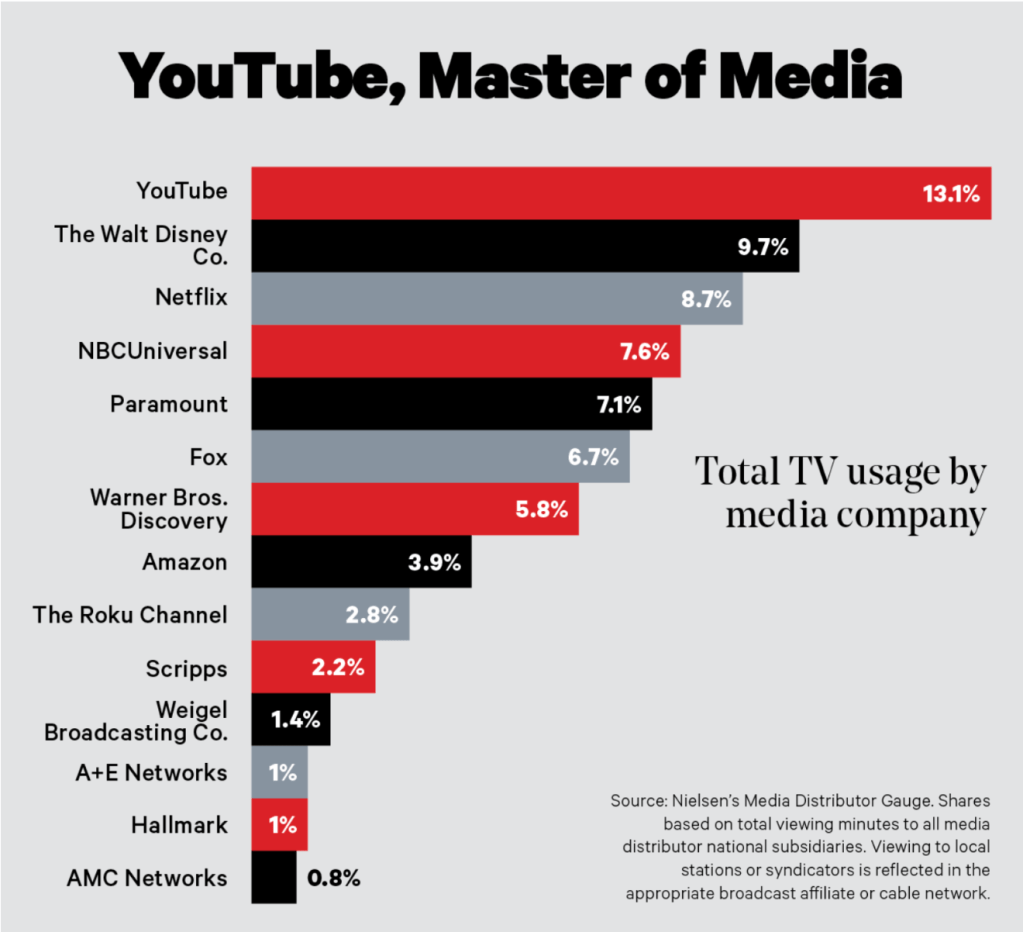
Netflix may be the undisputed king of streaming. But YouTube is the lord of video consumption.

YouTube’s market dominance is a reflection on the growing popularity of short-form video of course. Yet not long ago I posted about YouTube’s plan to go all out into bidding for the rights to big events in premium, long-form video. 

Last week YouTube scooped the exclusive global rights to the Oscar awards, beginning in 2029. That seems like a big deal for boomers raised on Hollywood glamour, although we could remind ourselves that at 20 million viewers, the Oscars trail the Super Bowl (130 million) and Game 7 of the World Series (50 million). 

No word yet on the consequences for Bell Media’s CTV network which has held the Canadian distribution rights for the Oscars since 2003. 

***

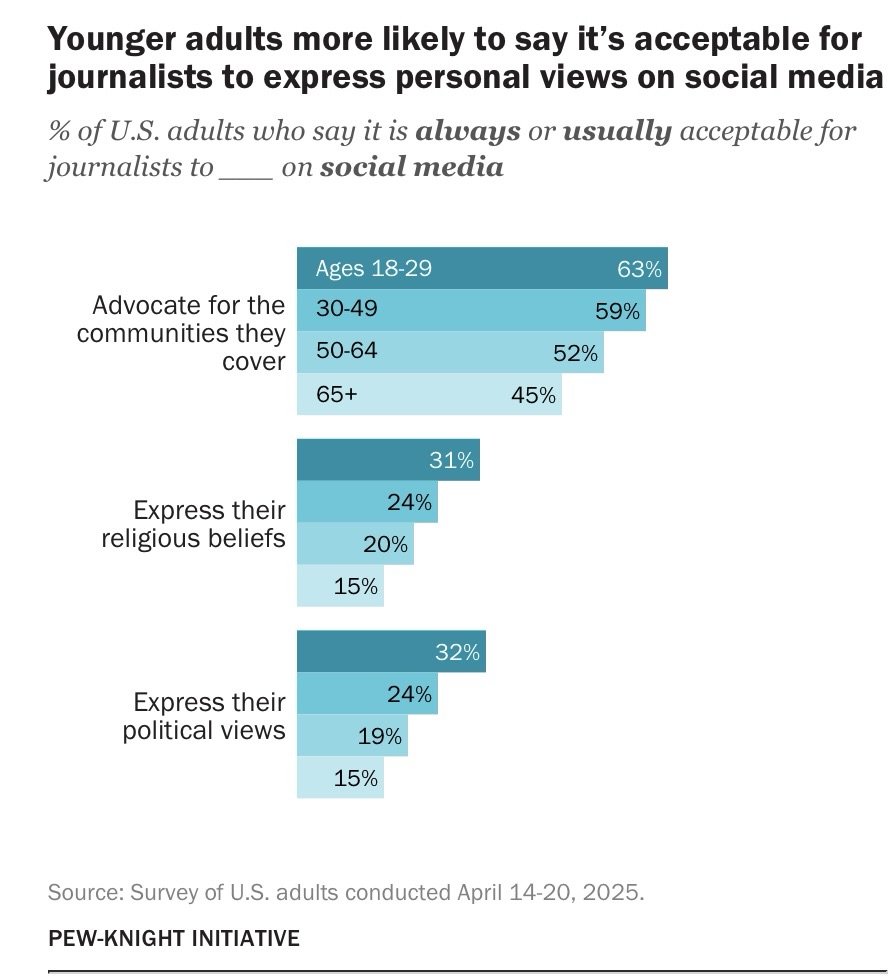
There’s a new American opinion poll published by Pew Research which rattled my optimism about the future of news journalism.

According to the poll, young people are more likely than older Americans to trust news influencers, concede a wide definition of who they recognize as a journalist, and are more likely to find it acceptable for journalists to be advocates for a cause and sport their ideological colours brightly.

***

The Washington Post’s newest AI widget (proprietor Jeff Bezos holds a minority interest in the AI app Perplexity) is in Beta. It has a long, long way to go.

A six minute daily podcast features two AI agents summarizing WAPO’s top three stories of the day. You can customize your topics or WAPO’s algorithm will figure you out. 

Other than saving on two journalist salaries, the added value of this AI widget is a mystery. It’s a downmarket product offering from an upmarket news outlet.

Real life podcasters at the NYT Daily, fear not. 

***

If you would like regular notifications of future posts from MediaPolicy.ca you can follow this site by signing up under the Follow button in the bottom right corner of the home page; 

or sign up for a free subscription to MediaPolicy.ca on Substack;

or follow @howardalaw on X or Howard Law on LinkedIn.

COMMENTS ARE WELCOME. But be advised they are public once I hit the “approve” button, so mark them private if you don’t want them approved. 

I can be reached by e-mail at howard.law@bell.net.

This blog post is copyrighted by Howard Law, all rights reserved. 2025.

Catching up on MediaPolicy – Netflix is Rex – Miller is minister – CRTC vets Meta’s news ban

AI image

December 7, 2025

This week’s blockbuster news is that Netflix edged out Paramount to buy Warner Brothers for $82 USD billion. The deal immediately depleted the supply of adjectives at the disposal of media analysts. 

If the deal closes as scheduled in late 2026, Netflix buys up the world’s biggest movie archive and keeps it out of the hands of a major rival with the second biggest (Netflix is number three).

Netflix is paying a heavy price tag and arguably overpaid (you know who pays for inflated merger valuations, it’s subscribers and workers). Netflix goes from its status as the streaming industry’s 900-pound gorilla to, I dunno, T-Rex stature?

The public commentary on the deal is mostly doomsaying. 

It speeds up the chiselling of the tombstone for the theatrical release industry.

In a press release, Netflix CEO Ted Sarandos said shareholder value would flow from adding HBO and the full Warner Brothers archive to the Netflix “best in class streaming service:” his pro forma commitment to theatre release was relegated to a subordinate sentence clause.

But if the merciless dispatch of theatrical-release seems inevitable, and just the law of the marketplace jungle, what is of long term concern is the anti-competitive effect on the pipeline of big-budget premium video entertainment. The Globe & Mail’s Barry Hertz has a good analysis here.

The Netflix deal is a prime candidate for anti-trust review by the Trump administration (especially as Netflix outbid Friend-of-Trump Paramount). 

That review could go in any direction but things to watch for include (a) Trump reviving his threat to levy tariffs on foreign movies and the offshore shooting of Hollywood blockbusters, and/or (b) using the anti-trust hammer to get something that he personally wants, which could be commitments to US-based production or some vanity trophy we can’t imagine right now.

It’s not that Sarandos can’t see that coming. In his press release he said the acquisition would allow Netflix to expand its US based production, a gimme that doesn’t commit him to a rate of new releases equal to “Netflix plus Warner Brothers” but only “Netflix plus a dollar.”

Any Trump-driven re-shoring of studio production could hurt the two offshore leaders of Hollywood production, the UK and Canada (and hurt Hollywood too, but that’s a longer discussion).

Beyond that, the effect on Canadian-owned broadcasting could be massive. Netflix is buying Warner Brothers’ Home Box Office streaming service and catalogue which may or may not be integrated into the Netflix platform, once subscription pricing is figured out. The press release suggests HBO content will be on the Netflix platform, at least in the US. 

Here in Canada, there is no HBO streaming service and Bell Media holds the exclusive license to distribute HBO on the only Canadian streaming service of consequence, Crave TV.

You would have to question whether Netflix has any interest in continuing that Canadian licensing arrangement when it expires and, in fact, Netflix has an excellent opportunity to severely wound its only Canadian-owned competitor.

Without that profitable HBO content, Bell’s ability to keep funding Canadian content takes a big hit. 

***

Canada has a new Heritage minister, Marc Miller.

That’s the fallout from Steven Guilbeault’s cabinet resignation over Prime Minister Mark Carney scrapping the Trudeau/Guilbeault policies on oil production, emissions, pipelines, oil tankers and clean energy regulations.

Miller continues a long tradition of the Liberals appointing an MP from the island of Montréal to the Heritage portfolio.

But of course Miller is the first anglophone the Libs have picked for that job since Hamilton’s Shiela Copps —-who was born ready to butt heads with the US on cultural sovereignty. She did the job from 1996 to 2003 under Prime Minister Jean Chrétien. 

The feisty Miller is prone to speaking with candour, as a rule. That’s already got him into a spat with CAQ premier François Legault who didn’t like Miller insisting on making a distinction between “the decline” and “fragility” of the French language in Canada and Québec. The Bloc dutifully piled on.

Guilbeault was the federal champion of Canadian and French language content in Québec and as the new Heritage minister no less will be expected of Miller. His life will get very interesting in about six months when CUSMA negotiations begin.

Will Miller become the political reincarnation of Shiela Copps? It’s up to Mark Carney, just as it was up to Jean Chrétien.

***

It looks like the CRTC’s investigation into whether Meta is selectively enforcing its made-in-Canada ban on news content has come an end. The CRTC’s brief discharge letter to Meta was published last week.

You can still find news items on Facebook and Instagram in Canada, despite Meta’s avowal that it banned news to take itself outside of the scope of the compulsory licensing of “news content” in the Online News Act.

Meta must have satisfied the Commission staff that it is sticking to its ban by taking down news items posted by Canadian users and by deleting user screenshots of articles. If you want to know how the Commission reached its conclusion, you won’t find it in the letter. 

What remains unresolved, or perhaps resolved only to the Commission’s private satisfaction, is Meta permitting posts from news outlets like Narcity and The Peak who successfully applied to Meta for what they describe as “exemptions” from the news content ban.

Without more transparency, one can only guess if Meta’s exemption of hand picked news outlets violates the statutory prohibition against digital platforms discriminating for or against selected news outlets. 

In the case of Narcity, its publisher claimed that Meta granted an exemption because Narcity was refused certification for federal journalism labour tax credits on the grounds that it doesn’t publish enough original news on current affairs. 

But certification for federal subsidies program doesn’t mean that a news outlet isn’t producing some news content, or pieces of news content, as defined by the Online News Act, which Meta says its banning to avoid paying for it. 

The Peak also recently announced that Meta gave it “an exemption” and I invite you to have a look at the news articles it’s allowed to post on Facebook and Instagram.

If you go looking, keep in mind that the “news content” that Meta is supposed to be banning in order to escape the gravitational pull of the Act includes “any portion” of news content. 

The Commission’s original inquiry into the news ban appears to have been its own idea, so the fact that it hasn’t published its reasons at any length is not a total surprise. No Canadian news organization has filed a complaint. 

***

If you would like regular notifications of future posts from MediaPolicy.ca you can follow this site by signing up under the Follow button in the bottom right corner of the home page; 

or sign up for a free subscription to MediaPolicy.ca on Substack;

or follow @howardalaw on X or Howard Law on LinkedIn.

COMMENTS ARE WELCOME. But be advised they are public once I hit the “approve” button, so mark them private if you don’t want them approved. 

I can be reached by e-mail at howard.law@bell.net.

This blog post is copyrighted by Howard Law, all rights reserved. 2025.

Catching Up on MediaPolicy – Ranting about CanCon – Danish news subsidies – Meta lobbies Feds on age verification – the NFB’s gripping sailing documentary

November 29, 2025

I’ve fallen behind on catching you up on media policy news because I felt compelled to write a series of three posts commenting on the CRTC’s ruling on Canadian content. The last one, the rant I promised, was published this week in Cartt.ca.

While I was ranting, one of the things I let slide was telling you about a new report out of Denmark proposing to refashion its policy design for government aid to news journalism.

The Danes are serious about news subsidies: they spend 540 million krone ($120M CDN) every year on private media in nation of six million people (Canada spends about $200 million in country of 42 million).

According to the Reuters Oxford Digital News Report, Denmark’s “public trust in media” score is 56% and it ranks sixth out of 180 in the Reporters Without Borders’ press freedom index at 86.93. By comparison, Canada’s trust score is 39% with a press freedom index of 78.5, 21st in the world.

The Danes also have something we don’t: a 2018 Media Liability law that established an independent national press council and conferred the force of law on editorial independence from ownership. 

The Danish subsidy report was commissioned by government and written by a committee led by Rasmus Nielsen, the former chief of the Reuters Institute for the Study of Journalism.

Despite the ocean separating us, there are strong parallels between the Danish system of news subsidy and Canada’s jigsaw of federal programs: we have the QCJO subsidy of journalist salaries, the Local Journalism Initiative that funds 700 full time reporters in under-serviced regions across the country, and the Canadian Periodical Fund which supports editorial expenditures by community weeklies. 

The untranslated 144-page Danish report covers a lot of ground, but Nielsen’s own English language summary of it captures the essence: a weighted emphasis on supporting news outlets that are regional, local or “independent” (owners of single-titles) rather than mere incumbency as a news organization. 

***

The Senate deliberations of Senatrice Julie Miville-Dechêne’s Bill S-209, that would require age verification for online pornography is on hold until February while the Senate justice committee deals with other matters.

During the pause, the Canadian Press reports that Meta has joined the fray by lobbying the federal Liberals to step in with their own bill that would shift the age verification responsibility from pornography websites and social media platforms to app stores.

Meta obviously doesn’t run an App Store, as do Google and Apple, and the latter two Big Tech companies are cheesed about what Meta is up to.

Meanwhile, Canadian children continue to be exposed to online pornography featuring choking and slapping. The CP story is well done and informative.

Meta is having a good month of course. It won the anti-trust trial brought by the US Justice Department that claimed Meta was running a monopoly in personal social networking. In the interim five year period between filing and judgment, TikTok greatly improved its market share.

Matt Stoller has a very good analysis of the lawsuit, the trial, the judge, and why he thinks Big Tech will never be slowed down by anti-trust litigation: he says it takes public policy and legislatures to change things.

A test of his theory may happen soon: the trial judge in the Google Ad Tech case will be handing down her decision on whether to dismantle that illegal monopoly in the new year.

Meanwhile a consortium of US school boards just filed a new lawsuit against Meta and several other Tech companies.

Their allegation against Meta in particular is that company documents reveal CEO Mark Zuckerberg squelched evidence of harm to teenage girls while Meta designed lax safety features, including ineffective measures to expel sex traffickers from the platform. Of course, the allegations must be proven in court, probably over several years.

This does raise the question of whether Americans (and Canadians) should count on US courts to adjudicate Big Tech’s excesses by giving full due process and demanding conclusive evidence of the allegations, or whether governments should just cut to the chase, stop litigating whether the harms to kids persist, and legislate a solution.

In related stories, Australia’s social media ban on under 16s comes into force in December. The EU Parliament just passed a non-binding resolution to do the same.

***

The National Film Board’s website is recommending “Ghosts of the Sea,” a riveting documentary about the ill-fated Norwegian father-and-son sailors, Peter and Thomas Tangvald.

The filmmaker is Thomas’ half sister Virginia, who settled in her mother’s hometown of Montreal. The father Peter was married seven times and two of his wives died at sea.

I’ll say this: the film offers a visceral take on “intergenerational trauma.”

I think you will enjoy the one hour and 37 minute film and I absolutely guarantee you’ll have strong opinions afterwards. 

***

If you would like regular notifications of future posts from MediaPolicy.ca you can follow this site by signing up under the Follow button in the bottom right corner of the home page; 

or sign up for a free subscription to MediaPolicy.ca on Substack;

or follow @howardalaw on X or Howard Law on LinkedIn.

I can be reached by e-mail at howard.law@bell.net.

This blog post is copyrighted by Howard Law, all rights reserved. 2025.

The CRTC’s ruling on television copyright: for a branch-plant CanCon economy

November 27, 2025

In October 2022 Netflix was appearing at the Senate committee reviewing the proposed Bill C-11, the Online Streaming Act, when the Conservative senator Fabian Manning pitched a softball question: what was the Hollywood giant’s “main priority” in amending a bill it didn’t welcome?

The Canadian spokesperson for the streamer was succinct in his answer: “If I had to choose just one, it would be the issue of copyright ownership.”

Last week, Netflix got what it wanted. 

Continue reading at Cartt.ca…

What did the CRTC just do to CanCon?

November 22, 2025

Earlier this week the CRTC released a major ruling on Canadian content. MediaPolicy provided a quick bottom line reaction but you could do just as well with any of the many media reports.

More depth of analysis is called for but I’m going to do that over two posts.

Today I was going to go on a rant. But I will save that for the next post, because I think those interested in policy supporting Canadian television drama often find themselves in a situation not unlike a novice driver raising the hood of a car engine to gape at a maze of parts. An explainer might help, so here goes, with the opinionating to follow.

The important thing to get about the CanCon engine is that the interconnected parts include Canadian broadcasters, government agencies, Hollywood streamers and independent Canadian filmmakers who collectively follow CRTC regulations that put Canadian television dramas on a screen to be enjoyed by a Canadian audience whose dollars rarely cover the costs of those shows.

As a general rule CanCon is unprofitable in our modestly populated country. If we had a population of 340 million, we wouldn’t need a CanCon policy.

That’s why as a matter of Canadian cultural policy we offer production subsidies bankrolled by Canadian cable companies as well as federal and provincial governments. It’s the feds and the provinces that put up most of the money. 

At the heart of the CanCon engine are the “independent” Canadian TV and filmmakers—by law, independently-owned at arms length from Canadian broadcasters— who make Canadian drama and comedy and sell it to broadcasters and, coming soon, to Hollywood streamers too. 

As a matter of Canadian cultural policy it’s the Canadian producers, and only them, who get the subsidies that make up half of filming budgets (though eligible for these subsidies, the broadcasters rarely make their own dramas in-house). Federal policy aptly describes the independents as the vital cog in the broadcasting machine.

Living hand to mouth in relative anonymity, these modestly capitalized enterprises have been the creative force behind CanCon for decades, at least as important as the big broadcasters whom the public knows better. As far as television drama is concerned, the broadcasting engine runs on the content the independents make. 

Until now, we haven’t had a Hollywood-style system for making Canadian television dramas. No wannabe studio giants here. The Canadian independents are many and mostly small, moving from project to project, slowly building a sustainable business, locked into frenemy relationships with the Canadian broadcasters who buy their stuff.

But those Canadian broadcasters, big and small, are on their way down, if not out (watch this space). 

Netflix and the streamers are increasingly on top. The federal Liberals’ Online Streaming Act, Bill C-11, was the engine overhaul necessary if the ascendant streamers are to be recruited to finance and distribute Canadian drama, filling the growing void for that programming that results from Canadian broadcasters steadily losing cable subscribers and advertising revenue.

The streamers are not willing conscripts to the cause. Just ask them. They despise the mandatory cash contributions to Canadian media funds that subsidize television dramas and local news.

But making their own Canadian content might be something the streamers could live with. This recent CRTC ruling was about setting the conditions for that.

From their point of view, the streamers would like total freedom of action to make Canadian content on their own terms. Those terms include hiring the creative talent they want and dictating commercial terms to the independent Canadian production houses they engage to make the content. The CRTC is trying to bend to the streamers’ desires without the regulatory engine seizing up.

On hiring the top creative talent that drive a production, the CRTC has long sponsored the famous ten-point headcount that certifies dramas as CanCon, a certification that the broadcasters need in order to meet the CRTC’s quotas for CanCon spending. 

Until this week, that headcount system was straightforward enough. The idea is that in the long run Canadian talent will make Canadian content, without a need for a state-arbitrated test of “what is Canadian.”

The ten points recognize up to eight talent roles: Director (2 points), Screenwriter (2 points), first and second lead actors, cinematographer, art director, music composer and picture editor. 

If a production house hires enough Canadians to rack up at least six points, the CRTC certifies their program. In addition to the six-point talent, the CRTC requires the producer —the quarterback of the entire production who does the hiring and approves the scripts— to be a Canadian and demonstrably in charge of the creative team without interference from investors. As well, 75% of the set production and post-production payroll must be paid to Canadian workers.

There are equally compelling cultural arguments to leave this system alone, or to change it up. Last week, the CRTC changed it up, although much of it might seem mundane at first glance. 

There’s a new category of Showrunner (2 points), a recognition of the Hollywood practice of a putting a hybrid writer/producer in charge of a production. The screenwriter’s guild ain’t thrilled, but the CRTC is just adapting to reality. 

There’s an ecumenical nod towards giving points for hiring a Canadian behind-the-screen team of hair, make-up and costume designers. Collectively, a Canadian team can earn one point.

Ditto, the CRTC is now adding the special effects director to its approved list. 

In a move towards critics who believe that certification of Canadian content ought to be less about the nationality of talent and more about the Canadian narrative, look and feel of the story, the Commission is giving points for visibly Canadian locales, landscapes, and characters.

It’s also giving credit for dramas based on Canadian novels as well as soundtracks featuring a majority of previously recorded Canadian songs.

All of this Canadianography earns “bonus” points, shorthand for saying that a more effusively Canadian drama can be certified as CanCon with less Canadian talent.

This was an unexpected development, as the Commission’s preliminary view published last year was that it wasn’t going to do this. However the Commission cites the feedback from a public opinion poll it commissioned and interprets as supporting a popular desire for more classically Canadian stories. 

With a longer list of roles into which Canadian hires are credited towards CanCon certification, the Commission expanded the 10 point test to as much as a 14 point test, but made it scaleable (smaller productions might combine roles) up or down: so long as 60% of the roles are filled by Canadians, the spirit of the old six out of ten test is met.

But crucially the importance of Canadian directors, writers and actors has been diluted. This will please the Hollywood streamers who can be expected to tell the Canadian independent producers that if they want the commission they will hire more of the streamers’ key Hollywood people. 

There are however more seismic changes afoot and let me draw the connection between those big moves and the incremental amendments to the point system. 

First, the all-powerful producer who pilots the production, approves the script, and hires the six-point creative team might not have to be Canadian after all.

In this newest CRTC ruling, when Netflix commissions a CanCon project and insists upon taking a majority copyright position in the production, which it will do routinely, the lead producer can be an American so long as two of the three junior producers are Canadian. 

That brings us to the second big change: the Canadian ownership of copyright and intellectual property in a drama production.

This is a bit of long winded explanation but stick with me and follow the money.

Until now the Commission has never bothered with any rules regulating ownership of copyright in a production.

In the past the Commission didn’t need to impose Canadian ownership on the control of copyright in a CanCon program because all the financing partners were Canadian: the independent producer selling the show, the broadcaster commissioning the show, the federal and provincial governments providing the first layers of subsidy for the show and the public-private Canada Media Fund providing the second layer.

The Media Fund and Canadian governments that control the CanCon subsidies want to support the capitalization and long term viability of the independents. They insist that the independent producer —not its broadcast partner— must own 100% of the copyright and intellectual property flowing from the production. 

The Media Fund supercharges that by green-lighting its subsidy only if hiring of Canadians on a production is a full ten points out of ten. Since the Media Fund subsidy is crucial to CanCon financing, ten points becomes the norm even if the CRTC and federal subsidies only require six.

But since the CRTC has never been in charge of subsidies and is only concerned with getting Canadian content to broadcasting screens, its thinking was that one Canadian media business is as good as another, be it an independent producer or broadcaster.

Then we decided to regulate the US streamers. Oops, now the CRTC needs a copyright rule.

The new reality is that if the CRTC is going to require the streamers to spend money making CanCon, the streamers are going to want as much control of the return on their investment across Canada and a global audience as they can get. That return comes from domestic release, global release, long term residency in the Netflix library, control of spin-offs and sequels, trademark revenue, etc. 

That means three things are important: copyright, copyright and copyright. 

When Netflix appeared before Parliamentary committees considering Bill C-11, the Online Streaming Act, its Canadian policy director bluntly stated that the amendment Netflix wanted the most was copyright ownership of the CanCon it would be required to commission.

He then disarmingly claimed that the streamer wouldn’t necessarily want majority ownership of every CanCon production it commissioned ——even though it does exactly that when commissioning US shows that are shot in Canada. 

The Commission knew it had to find a balance between Netflix’s commercial interests and the viability of Canadian independents, the standard bearers for cultural production. The question was, where to strike the compromise?

Last week it struck that compromise by offering the streamers one of three options: 100% Canadian ownership of copyright, minority American ownership, and majority American ownership (to a maximum of 80%).

The first bucket of 100% Canadian ownership is status quo, allowing for the tweaks to the six-point rule. 

The minority US ownership bucket means that Netflix can choose a non-Canadian lead producer although technically the Canadian production house retains an equal share of creative control.

The majority US ownership bucket obviously means that Netflix effectively owns the show and the lion’s share of its success. The only price it must pay is to move up from six to eight points (or 80%) on hiring Canadians with the aid of Canadianography points, hairstylists, make up artists, etc.

Chart from Canadian Media Producers Association, circulated to its members

Nevertheless it’s important to mark this mental footnote: the new CRTC copyright rule does not apply to subsidies controlled by Canadian governments and the Canada Media Fund, at least for now. As mentioned above, those rules currently guarantee that the Canadian independent owns the copyright, in fact for 25 years. But the streamers can ignore those federal copyright rules if they forego the subsidies.

What does the CRTC copyright rule mean when it comes to making money on a show? 

“Copyright” is just the price of admission to commercial negotiations over profit sharing that is supposed to match investment to the return on that investment. Still, whomever controls the majority of copyright holds the hammer in negotiations over splitting profits and return on investment, often described as the long term commercial exploitation of intellectual property.

It’s perhaps unknowable how much extra muscle that gives the deep pocketed Netflix than it currently flexes as an equity investor in the occasional CanCon production (for example, CBC/APTN’s North of North). 

But copyright is an undeniably important part of leverage in commercial negotiation, which is why Netflix tried so hard but unsuccessfully to persuade Parliamentarians to guarantee streamer copyright interests in Bill C-11. 

Conversely, the Canadian independents wanted Parliament to guarantee full Canadian ownership. The final text of the bill genuflected support for the independents’ interests, but provided no guarantees, handing the difficult task of balancing interests to the CRTC.

Now that the CRTC has opened the door to the streamers’ majority ownership of copyright —expect them to rush through it at pace— the question is whether the CRTC will allow Netflix and Hollywood to dictate commercial terms to Canadian independents, treating them in effect as employees on wages set by the studios. 

The Commission is hardly unaware of the problem, addressing it in this crucial paragraph:

The Commission adopts the following guiding principles in negotiations among production partners: 

Fair compensation and exploitation: Ensure that remuneration, rights, and revenues are allocated in a way that fairly reflects the financial and human contributions to the production, while ensuring Canadian producers retain significant, equitable control and benefit from long-term exploitation. 

Good-faith negotiation: Production partners negotiate in good faith.

The Commission may assess the effectiveness of these non-binding principles in the future. (emphasis added).

In other words, Netflix be nice.

More on this in a further post.

***

If you would like regular notifications of future posts from MediaPolicy.ca you can follow this site by signing up under the Follow button in the bottom right corner of the home page; 

or sign up for a free subscription to MediaPolicy.ca on Substack;

or follow 
@howardalaw on X or Howard Law on LinkedIn.

I can be reached by e-mail at howard.law@bell.net.

This blog post is copyrighted by Howard Law, all rights reserved. 2025.