
December 29, 2024
Despite the power of algorithms, somehow the Internet failed to alert me to an August 2024 Pollara poll animating a lengthy report on Canadian news journalism and online harms from The Dais, TMU’s public policy think tank.
The Dais report probed how Canadians get our news, how misinformation is consumed, the prevalence of hate speech, and public attitudes about using government to fix it. (This is the fifth annual report from the Dais, a two-minute video on its 2023 report can be viewed here.)
The poll results on consuming and trusting news sources in 2024 match similar observations by Reuters, Pollara, and the McGill University’s school of Media & Technology.
The Dais analysis of online harms —it includes false information among the harms— is the juicy stuff. I’ll keep that warm for my next post.
Mainstream media dominates
As for news sources, The Dais report confirms what we already knew: “legacy” television news is far and away the most popular news source for Canadians:

In fact, the Dais report shows that “yesterday’s man” of Canadian media is creeping even higher over time (Figure 5). And look above in Figure 4 who’s standing next to television on the podium: news websites and radio. It’s a clean sweep for mainstream media and the news organization that make it up.
On the other hand, the 2024 Reuters Digital Report for Canada lumped together a collection of “social media” platforms to claim third place for news consumption (whereas the Dais Report above breaks out those platforms, individually).
The results are of course skewed by age cohort (Figure 6 in the Dais Report). Younger Canadians (16-29 years) are more likely to source their news from search engines and social media, also observed by Pollara earlier this year.
As for trust in the news that Canadians are consuming, again it’s mainstream media that rules. And the under-fire CBC is the king of credibility (Fig.10):

In a separate poll, Pollara came to the same CBC results in 2024.
As an aside on the issue of trust in CBC News, the Dais notes that the public broadcaster’s 48% for “high” trust is elevated by a 64% score in Québec for Radio-Canada but weighted down by a 34% “high trust” in Alberta. Then again, those skeptical Albertans gave Global News and CTV the same score and even rated the Globe and Mail at 21%.
Perhaps the biggest token of skepticism is found in the Dais’ Figure 7. While noting television news’ dominant trust in comparison to other news sources, almost as many survey respondents replied that they didn’t trust any news sources, running the gamut from mainstream media to the entire Internet.

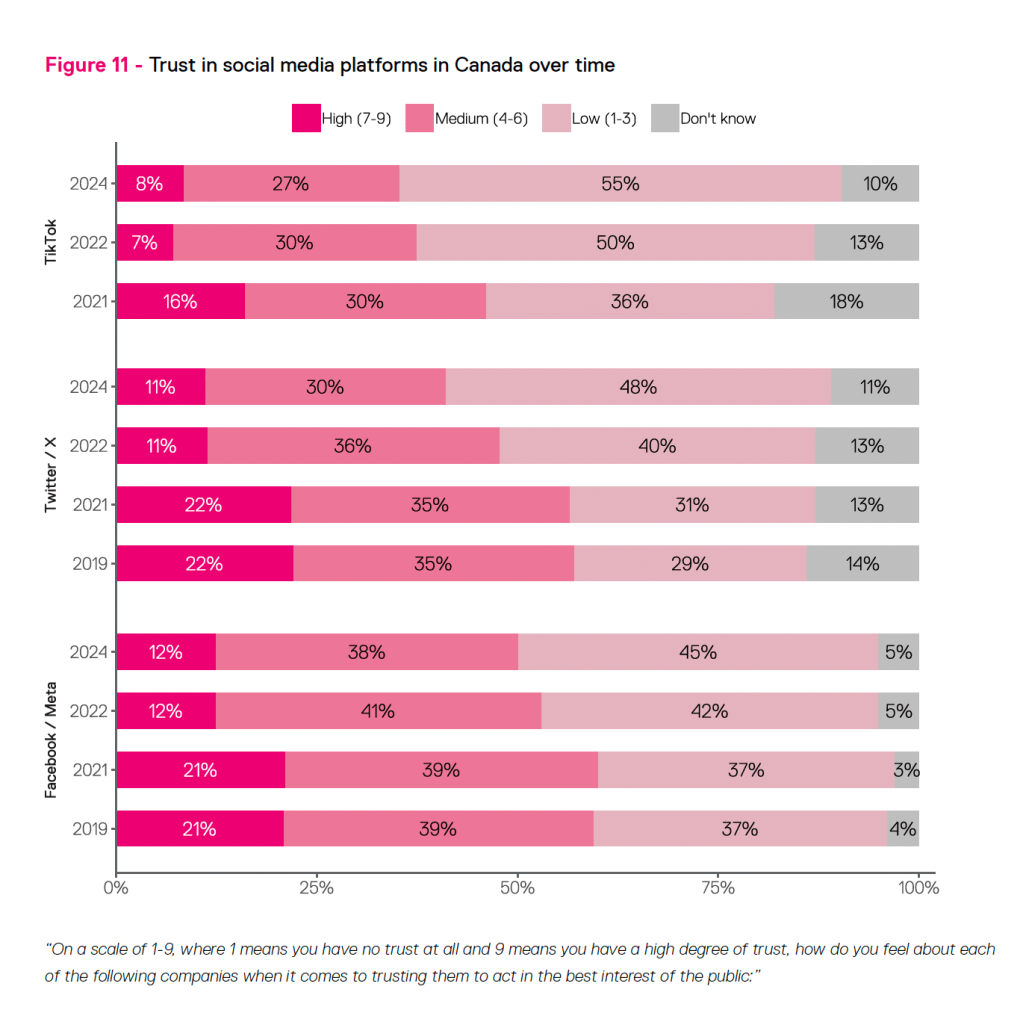
On the other side of the trust coin, popular trust of social media platforms is very low (and getting lower over time), even among the young Canadians who flock to them:
As MediaPolicy wrote this summer, the good news is that we are still a nation of news consumers. News avoidance and exhaustion is a real thing, but it’s not the main problem.
The main problem is the unravelling of news media’s business model, but the second biggest problem is Canadians’ declining trust in media and many other public institutions. That’s a world wide phenomenon, particularly acute in the United States. In Canada, the percentage of the public saying “yes” to the question “I think you can trust most of the news, most of the time” has declined from 55% in 2016 to 39% in 2024.
In the next post, we’ll look at The Dais report’s insights into misinformation, hate speech and public attitudes towards government regulation.
***
If you would like regular notifications of future posts from MediaPolicy.ca you can follow this site by signing up under the Follow button in the bottom right corner of the home page;
or e-mail howard.law@bell.net to be added to the weekly update;
or follow @howardalaw on X or Howard Law on LinkedIn.

 MediaPolicy.ca
2 thoughts on “Pollsters took the pulse of Canadian media consumers in 2024”