
(AI image)
December 23, 2025
The Online Harms bill is coming back to the House of Commons.
The Liberal Bill C-63 that died on the order table when the April 2025 federal election was called was initially a three-in-one omnibus.
It was an anti-hate bill that increased prison terms for existing Criminal Code hate speech offences and hate-motivated crimes as well as codifying the judge-made law on defining hate.
It also reinstated the abolished right of individuals to bring human rights complaints against hate speech.
And it charged social media companies with the responsibility of developing and enforcing safety practices to mitigate online harms, particularly to kids. This was the long expected policy piece that was born of lengthy public consultations, taking aim at Facebook and Instagram.
Michael Geist was right (he is, occasionally) in condemning C-63 as three controversial bills wedged into one. Others agreed and the Justice Minister Arif Virani split the legislation into two bills. But the election call killed them anyway and when the government reformed the new Justice Minister Sean Fraser messaged he wasn’t committed to C-63 as it stood.
Since then, Fraser has tabled bills that are policy-cousins to C-63. Bill C-9 takes up the supercharging of prison terms for hate-motivated offences, permits the police to charge hate offences without waiting for the green light from the Attorney-General, and picks up the judge-made law on defining hate (detestation or vilification is hate, but disdain or dislike is not.)
As part of a broader criminal justice reform, Fraser also introduced Bill C-16 to make it easier to prosecute blackmail threats of online sexual humiliation and deem the posting of deep fake sex videos a criminal act.
Senator Julie Miville-Dechêne’s Bill S-209, a proposal to use age verification technology to keep kids away from online porn, is paused in Senate committee but will probably re-emerge in February.
Now the Hill Times is reporting that Fraser will return some time in the new year with an online harms bill that may offer an organized government policy on online hate, harms and safety.
***
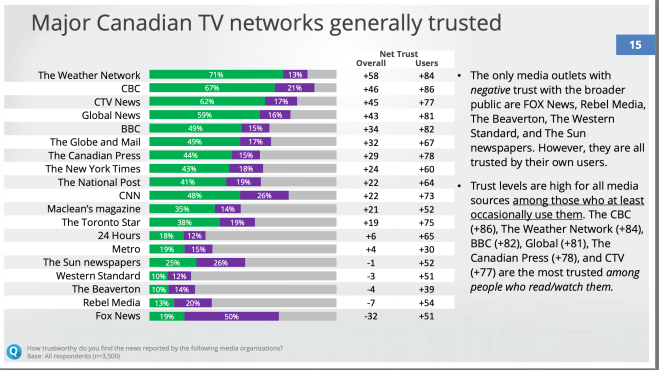
There are the standard ways that we like to take the temperature of public opinion on media.
The go to is whether one “trusts” media. Asked that simply, the polling outcomes reflect likes and dislikes of news outlets as much as reliability or manipulation.
I like this news outlet; I trust it. I hate this news outlet; I don’t trust it.
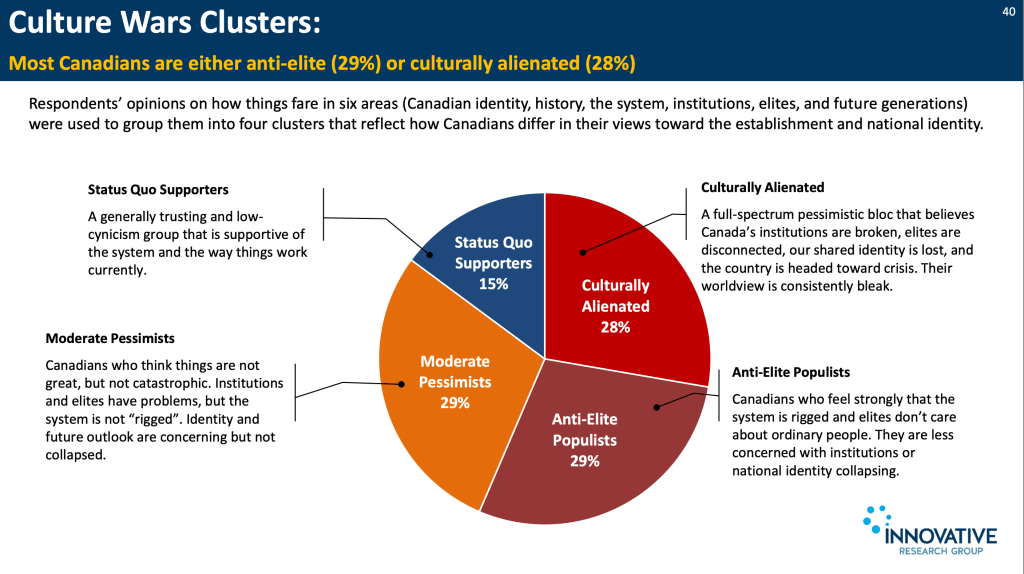
Occasionally pollsters try to dig a little deeper. The latest poll from Innovative Research doesn’t probe trust-in-media per se but rather the thing that drives trust and mistrust of public institutions: “cultural alienation,” a state of disengagement from the other, where the other is believed to be harmfully powerful.
The Innovative poll reports shocking levels of popular alienation from Canadian “elites” (another piece of terminology, like “trust,” that can barely shoulder the weight it is asked to bear).
As for the pollster, it describes “culturally alienated” thus: “A full-spectrum pessimistic bloc that believes Canada’s institutions are broken, elites are disconnected, our shared identity is lost, and the country is headed toward crisis. Their worldview is consistently bleak.”
According to the poll, there is a large pool of culturally alienated Canadians, about 28%.
The culturally alienated are joined in their disaffection by “anti-elite populists” who are “Canadians who feel strongly that the system is rigged and elites don’t care about ordinary people. They are less concerned with institutions or national identity collapsing.” That’s another 29%. I know a lot of people matching the description and I am guessing so do you.
Added together, the numbers look dire.
Now if that puts you into too dark a mood, keep in mind the poll was taken from a standing opinion panel of opted-in respondents, not a random sample of Canadians, so it is disproportionately asking questions of opinionated Canadians.
Also, the results might be skewed pessimistic by the questions. Many of the mood-testing questions are necessarily binary, asking respondents to answer yes or no to questions like “Canadian institutions are broken” and “Canadian elites don’t care about ordinary Canadians.”
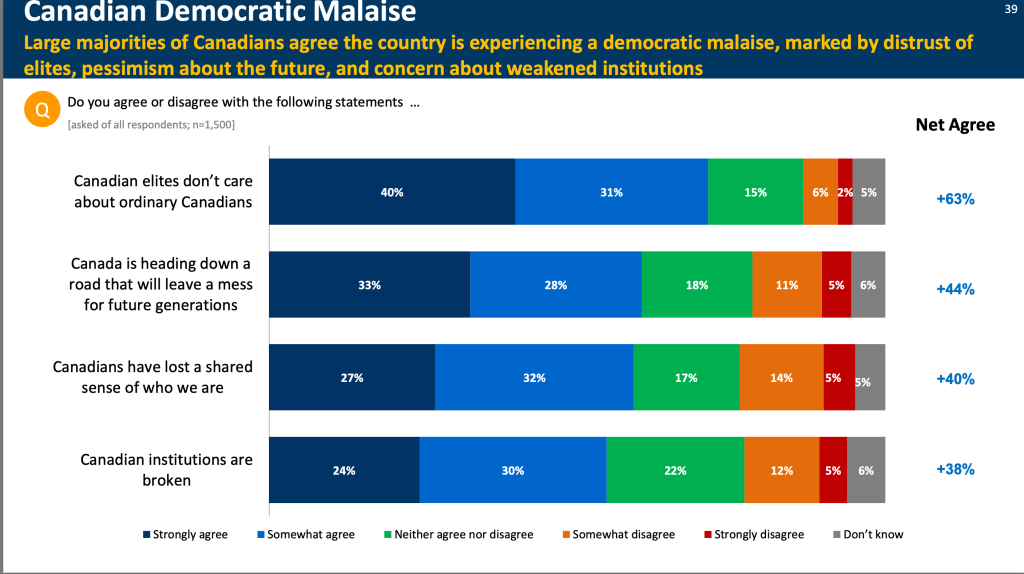
Ask an emotional question, get an emotional answer.
I keep telling myself, it isn’t as bad as it looks. That makes me a moderate pessimist, apparently.
***
An all-party committee of the Manitoban legislature is recommending Premier Wab Kinew’s NDP government follow the lead of provincial governments in Ontario and Québec to financially support local media.
If the NDP acts on the recommendation, it will copy the Ontario procurement practice of reserving 25% of $200 million in government ad spends for placement with local media.
Also, the MLAs propose that Manitoba offer a journalist salary subsidy similar to Québec which provides a 35% salary subsidy (up to $26,250 annually) that stacks on top of the federal 35% salary subsidy (up to $29,000).
***
If you would like regular notifications of future posts from MediaPolicy.ca you can follow this site by signing up under the Follow button in the bottom right corner of the home page;
or sign up for a free subscription to MediaPolicy.ca on Substack;
or follow @howardalaw on X or Howard Law on LinkedIn.
COMMENTS ARE WELCOME. But be advised they are public once I hit the “approve” button, so mark them private if you don’t want them approved.
I can be reached by e-mail at howard.law@bell.net.
This blog post is copyrighted by Howard Law, all rights reserved. 2025.

 MediaPolicy.ca
I join you in moderate pessimism. And we also share the attribute that our pessimism does not stop us from trying to improve things.
>
LikeLiked by 1 person