
The Leader of the Opposition gets his sunglasses stuck in his teeth
May 30, 2026
Last week I published my take on the CRTC’s latest ruling on how much Netflix and the Hollywood streamers will have to invest in Canadian programming and how they will make that content highly visible on their platforms.
As for what the Commission did for Canadian broadcasters, I was harshly critical of the decision to relieve them of minimum investments in English-language dramas and documentaries based on the sanguine hunch that US streamers might do it for them. I wish I could be harsher.
I highly recommend a Substack column by Derrek Lennox who casts cultural sovereignty as a project of building an infrastructure of empathy among Canadian communities. Worth the short read.
***
Opposition leader Pierre Poilievre is calling for the federal government to cancel the CRTC’s Netflix ruling on the grounds that it will cause subscription prices to rise —he’s calling it “a Netflix tax”—and goad the Trump administration into even more trade retaliation.
As yet, Poilievre isn’t recycling his old accusation that the Online Streaming Act’s promotion of Canadian content is “government censorship….pro-government, liberal-leaning, boring, statist content that is approved of by the establishment crowd in general and the liberal glitterati in particular.” Ouch!
Indeed according to Poilievre, the legislation is a Liberal tool intended to “favour certain kinds of pro-government content online while discouraging content that the government does not want us to see, in some cases taking that content off the Internet together.”
Sticking to the better messaging point, he says the new CRTC ruling is a consumer tax because the streamers will pass along regulatory charges to the public.
Poilievre isn’t wrong about that being possible, but here’s some context.
Netflix upped the price on its standard plan from $14 monthly to $15 in 2020. Then to $16.50 in 2022. Then to $19 in 2025. That was twice the rate of inflation.
As for the CRTC ruling, the cash cost to Netflix and the Hollywood streamers is not the 15% of Canadian revenues set as an overall investment in Canadian content, mostly in their own shows on their own platforms.
The out of pocket cash cost is not the 15% but an included 6.55% of revenues, paid to Canadian media funds supporting news, entertainment, and a short list of public service programming such as APTN, Omni multilingual, Ugavut TV or CPAC.
The streaming market —the highly concentrated streaming market— will determine how much of this 6.55% cash levy that Netflix can pass along to subscribers.
Still, you would expect at least some of that 6.55% levy to drive the 2028 price increase higher. As much as, I dunno, twice the rate of inflation?
***
Kudos to Max Fawcett, the National Observer columnist who stepped up to take one for his team.
It began with a Blacklock’s Reporter story reporting on the journalism subsidies collected over the last ten years by the Observer from the three major federal programs. That wouldn’t be especially newsworthy except for the fact that Observer publisher Linda Solomon Wood is one of five news publishers sitting on a panel that decides which news outlets get a piece of the Local Journalism Initiative.
A past recipient of the National Newspaper Award for best columnist, Fawcett went on Ryan Jespersen’s Edmonton talk radio show and gave a scorching elevator speech defending the Observer and the federal programs.
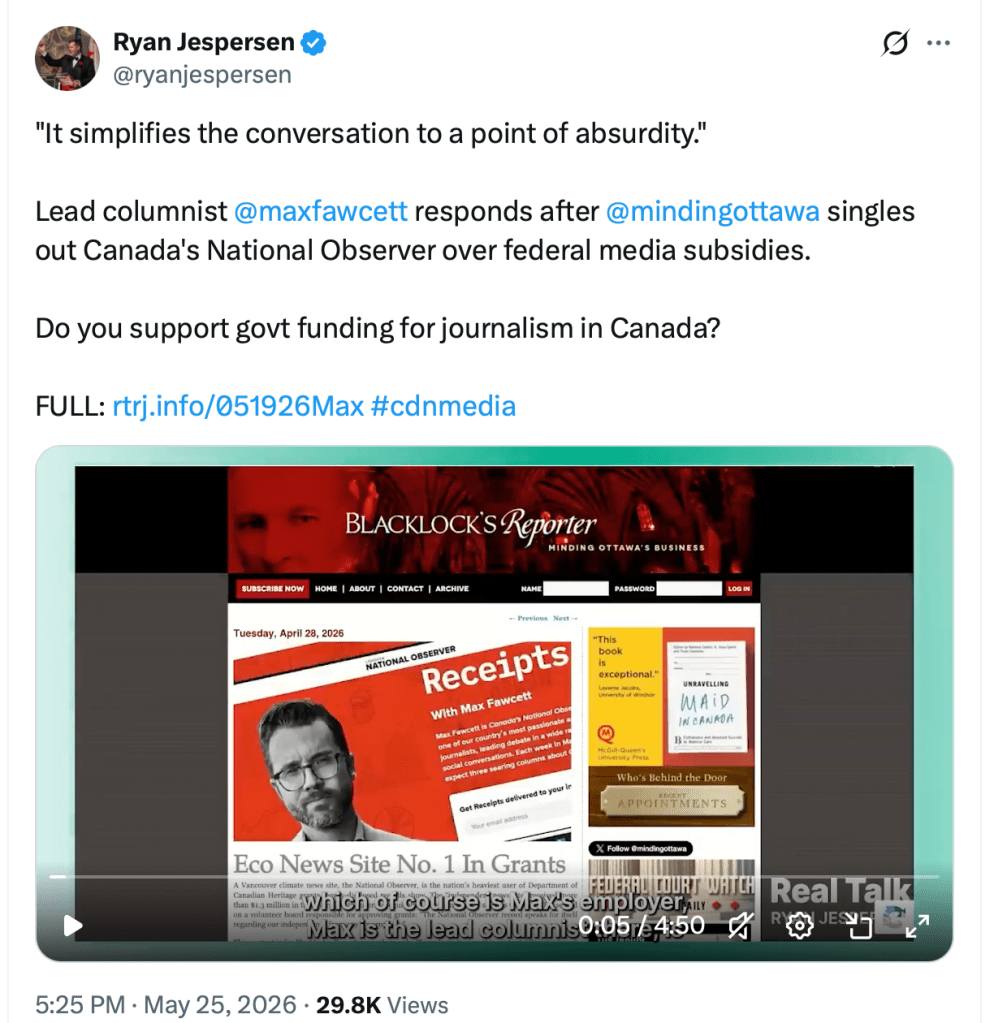
He didn’t address the point raised by Blacklock’s reporting that maybe his boss should not be sitting on the panel that carves up limited funds in the federal Local Journalism Initiative.
Wood and the other members of the judging panel did recuse themselves when their own publications were reviewed. The Observer was awarded two out of the 700 one-year job subsidies this year and three last year.
Still, Canadian Heritage would do well to consider putting academics and retired journalists in charge of the LJI disbursements, as it does for the QCJO program.
On the general topic of journalism subsidies, I came across a parliamentary brief that Torstar just submitted to the Heritage committee’s investigation into the state of news journalism. I confess to a love-hate relationship with Torstar (I was the Unifor union rep at the Toronto Star for many years) but I found this submission has a lot of policy gravitas.
***
The Online News Act, directing Google payments for news links, is under threat. But not just from looming CUSMA trade negotiations, rather from AI technology.
This has been known for some time. Google’s Search’s AI Overviews and AI Mode offer comprehensive answers to questions, before you get to the page after page of ten blue links.
Google’s referral traffic to news sites has already plummeted and it will get worse as late adapters get comfortable with AI tools. If the Online News Act was intended to compensate news publishers for populating Google’s blue links, that intention is being steadily eclipsed.
The next AI wave is now hitting Google Search which enjoys a 90% world market share. You can read the long versions at TechCrunch or in Press Gazette, but two of the new features of an overhauled Google AI mode stood out to me.
The first is what you already get on most AI chatbots: Google Search will engage in a conversation with you, deducing your research mission and offering help. Its response will be gussied up by creating multimedia answers to your question. Clicking through hyperlinks to original news sources, even if these are still offered, will be for suckers. I will remain one of those suckers, but I expect most will not look the gift horse in the mouth and let AI mode take over their brains, although maybe not for the more discerning news consumers who still want to check the underlying reporting.
But the truly revolutionary AI feature will be creating autonomous research agents that become your auto piloted research apps for the next days, weeks or years and periodically bring to your attention breaking news and developments relevant to your search query.
At some point, I may break down and create an AI agent for “what is happening in Canadian media policy.” Just as a science experiment, mind you. Right now, I read e-newsletters offering links to media news.
The point is, the new Google may well kill Search referrals to original news sites. Kill them dead.
That appears to be the goal, anyway. And with that death goes any Google argument that its intermediation of hyperlinks, as they currently argue, makes them a benefactor to the news industry whose content they ingest.
On the other hand, the alternative (and unofficial) government intention behind legislating the Online News Act was not just compensating news outlets for their journalism, but effectively levying an anti-competition fine against Google Search for its oligopoly power over advertising in the absence of any action by the federal Competition Bureau. Google isn’t able to exercise that kind of monopoly power in the AI market, at least not yet.
As for the impact on the Online News Act, any retreat from offering news hyperlinks means Google will certainly buck against renewing its $100M/yr deal to fund news journalism that expires in 2030.
That’s how much time the federal government has to wake up and acknowledge that Google and the other AI bots are ingesting Canadian news by scraping their websites without a license. What is needed are amendments to an Online News Act v.2.0, starting with a new definition of a “digital news intermediary.”
***
If you would like regular notifications of future posts from MediaPolicy.ca you can follow this site by signing up under the Follow button in the bottom right corner of the home page;
or sign up for a free subscription to MediaPolicy.ca on Substack;
or follow @howardalaw on X or Howard Law on LinkedIn.
COMMENTS ARE WELCOME. But be advised they are public once I hit the “approve” button, so mark them private if you don’t want them approved.
I can be reached by e-mail at howard.law@bell.net.
This blog post is copyrighted by Howard Law, all rights reserved. 2026.


One thought on “Catching Up on MediaPolicy – a Netflix tax? – Fawcett defends boss, subsidies – the Online News Act v. 2.0.”