June 11, 2026
Even if you haven’t, Prime Minister Mark Carney has moved on from last week’s announcement of a $600 million taxpayer bailout of US streamers who were scheduled to make cash contributions to Canadian media funds.
Within days, federal government announced two other big things that bear heavily upon Canadian media policy.
The first was the “AI for all” federal policy which focusses mostly on AI investment, AI adoption by businesses and consumers, and some money for safety research. The words “creator copyright” or “content licensing” do not appear in the federal plan. That means that the unlicensed and uncompensated ingestion of online news and information content by AI companies will continue, although the Liberals say we should “stay tuned.”
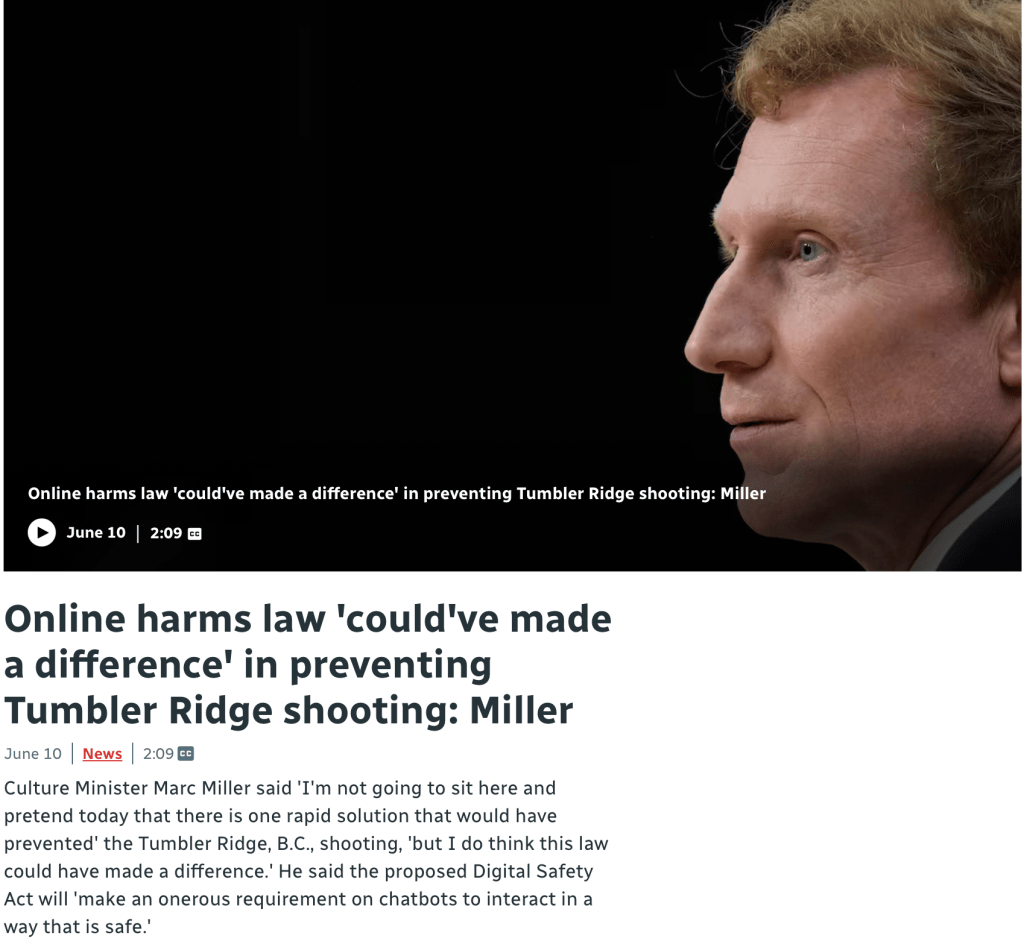
The other big thing was Bill C-34, the Safe Social Media Act, a reprise and redesign of the old Bill C-63 that sets up a regulatory regime of self-policing against harmful content by social media companies and now AI chatbots too. It effectively overtakes Bill S-209, the Senate bill that targets youth access to online pornography available for free on social media apps.
C-34 was tabled by the Heritage minister Marc Miller for First Reading in the House and will likely go into the theatrical window of Parliamentary committee in October. You’re going to hear a lot about the merits or dismerits of the government’s plan over many months and MediaPolicy.ca will offer updates as we go along. Together I hope we can educate ourselves as the public commentary comes, which will be thick and fast I guarantee you.
Social media content can be addictive and harmful, especially to impressionable kids. No one is going to dispute that reality, the arguments over C-34 are going to be over how far the government should intervene. Public polling demonstrates mass popular support for federal regulation of online harms and in particular age bans for kids.
The bill focusses on harm to kids, revenge porn, fomenting hate, inciting violence, and content published by terrorist and extremist cells. Again, all of them consensus picks for government action.
The platforms to be regulated are social media companies and AI chatbots, the latter being a response to and a painful reminder of OpenAI’s culpability in the Tumbler Ridge shootings.
The core of the bill is to make online platforms liable for harmful content by requiring them to meet a standard of self-policing the addictive and harmful content. Ultimately, a new government digital regulator (not the CRTC, praise be) will be the arbiter of whether the platform’s design features and content curation are good enough.
There’s lots to dig into there, and more to explain, but later.
As we go along you can expect that the contested features of the bill, wrapped in fine points of legalese or technological detail, are sitting to two powder kegs. One, is the harm to children. The other, is the fear that the age restrictions embedded in the legislation will usher in the end of anonymous online content consumption and create a treasure trove of personal data for hackers to steal.
***
If you would like regular notifications of future posts from MediaPolicy.ca you can follow this site by signing up under the Follow button in the bottom right corner of the home page;
or sign up for a free subscription to MediaPolicy.ca on Substack;
or follow @howardalaw on X or Howard Law on LinkedIn.
COMMENTS ARE WELCOME. But be advised they are public once I hit the “approve” button, so mark them private if you don’t want them approved.
I can be reached by e-mail at howard.law@bell.net.
This blog post is copyrighted by Howard Law, all rights reserved. 2026.

 MediaPolicy.ca
One thought on “Feds table Bill C-34, the Safe Social Media Act”