June 16, 2026
I will make a confession. I was at first overwhelmed by the breadth and detail of the federal government’s new Safe Social Media Act Bill C-34. The dense legalese of the bill is a terrific sleep aid.
But of course both the good and bad vibes in the legislation deserve a hearing if you are keen to follow the ups and downs of the bill’s parliamentary journey, soon to unfold.
In sorting all of that out, you really need to know: what does the proposed statute actually say and do?
Read the bill. But if I’ve discouraged you, here’s an explainer.
The top of line summary is that the bill creates a Digital Safety Commission to shepherd in a regulatory regime to protect children from online harm and reduce harms for adults.
Some of the harms, like child porn, hate and some forms of the online incitement of violence, are already illegal. The bill is intended to supplement the state’s formidable powers of criminal investigation, arrest and prosecution.
Other harms like revenge porn (my shorthand for posting intimate content without consent), bullying or inducing kids to self-harm, or the hate or incitement falling short of illegality is often called “awful but lawful” content because the speech embedded in the online content is free speech.
But free speech, like the banana peel on the sidewalk, has never been free of consequences or civil liability.
Awful but lawful online content has been the subject of years and years of civil lawsuits launched against US-headquartered social media platforms around the world, slow walking towards a day of reckoning before the US Supreme Court. This Canadian bill is about making the awful unlawful in Canada if it’s harmful enough.
The legal breakthrough is that the bill creates a legal duty of care ——the one that an American or Canadian court may or may not create in some distant future—- that social media platforms, AI chatbots, and porn sites must live up to.
If you read the bill, you will see that it is organized by codifying those legal duties for social media, AI chatbots, and “other” regulated services. Then for each of those categories, the statute describes the content of those duties and how the online services can stay out of legal trouble for hosting it.
Most of the action in the bill is for social media apps. I’ll get to that below.
As for AI chatbots, regulation is narrowed down to the AI companies doing or not doing a few simple things:
- Not posing as a human, especially a lawyer or medical professional.
- Not using emotionally manipulative techniques or being deceptive about being an AI agent.
- Ending interactions with users by refusing to provide information on self-harm or harm to others and instead directing the user to health services.
Interestingly, the bill does not require AI companies to report these dangerous or self-harming users to the police, something that took no small measure of political forbearance after the Tumbler Ridge shooting. Calling the cops will still be up to the AI company.
Also as an overall safety measure, the bill requires AI chatbots to submit a Digital Safety Plan to the new Digital Safety Commission. The Plan must assess the potential harms in their services, the measures they take to mitigate those risks, and how effective those measures are.
As for porn sites (just one of the potential members of the third “other” class of regulated online services) the main obligation is to protect children from viewing porn by setting up age verification or age estimation technology.
This age gating raises concerns about the secure storage of private data, meaning the risk that porn viewers will be publicly embarrassed or blackmailed. A key provision in the bill, picked up from Bill S-209, is that online age verification services are supposed to delete the personal data the moment they have confirmed the age of majority.
As for social media apps, they will be age gated for all users if they carry porn (sorry, not sorry Elon).
Even if they don’t carry porn, social media apps will be temporarily age gated (below age 16) until such time their proprietors satisfy the Digital Safety Commission that they have a Digital Safety Plan that assesses harms to children and adults, puts online design features and measures in place that reduce harms, and then documents how effective they were. “Temporary” age gating may last months or years, although the mere requirement will light a fire under the social media platforms to submit their Digital Safety Plans to the Commission on day one.
But any age verification requirement for social media apps, even if temporary, suggests that all adult users will be subject to it, or at very least those adults who don’t get through the gate with a minimum of fuss and information. For example, your social media platform may be satisfied by a quick scan of your social media profile and activity.
As for protecting kids from the proliferating harms on social media apps, the federal cabinet will have the power to set regulations (that first get published in the Canada Gazette for debate) detailing at least some of what is expected in a Digital Safety Plan.
At the very least, the Carney government might see this regulation-making opportunity to take credit for some high level principles of child safety —- perhaps a command to “do something about addictive design”—- while leaving the fine points of implementation to the platforms drafting their Digital Safety Plans and the Commission that has to approve those Plans.
In fact it will be important to hear the presentations made at parliamentary committees considering Bill C-34 as to how much of the line by line of the Digital Safety Plans will be left to the social media companies to conceptualize and design versus how much will be effectively dictated by cabinet regulation and the Commission’s own views of how tough the Plans must be.
On that score, the bill already includes clear measures expected of the social media apps:
- There must be blocking tools for users to shut out noxious harassers and child predators.
- There must be user tools for flagging harmful content to bring to the attention of platform.
- The social media companies must label “synthetic” content (deep fakes).
- Bot-driven content must be labelled once it is discovered.
- And there must be a public facing “resource person” to deal with user concerns.
As for actual content take-downs by the social media platforms, they are only required in limited circumstances, i.e. child porn, revenge porn and terrorist material.
These content take-downs are required on at least an interim basis within 24 hours of being flagged. But a final platform decision on the take-down is only due “as soon as feasible.” Since it’s likely there will be some contested judgments on making these difficult take-down calls, the social media companies must provide an internal appeal process (for both content viewer and content poster) and then ultimately a complaint can be made to the Commission.
All of this will be superintended by the five commissioners appointed by cabinet to the Digital Safety Commission.
The Commission’s powers are broadly similar to most federal administrative tribunals. After all, the whole point of the bill is to take the law and liability out of the hands of civil law and the civil courts and transfer them to a body capable of holding tech platforms accountable for harmful content on offer to 40 million Canadians.
Three Commission powers pop out already as notable.
The first is the ladder of substantial fines and “administrative monetary penalties” that the Commission can use, or threaten to use, to keep the Big Tech platforms in line. Depending on the circumstances, the fines can range from $5 million to $20 million, or from 1.5% to 5% of the tech platform’s global revenues.
The second is the possibility of secret Commission hearings that can be invoked when there a privacy concerns (for example revenge porn or anything concerning children).
The third is the Commission’s power to compel platforms to give data access to independent (but government-vetted) research academics. This will hopefully give the public interest independent information about how well the platforms are meeting their obligations.
This summary will have to do for now.
There’s enough in this lengthy and detailed bill to attract scrutiny and that has already begun.
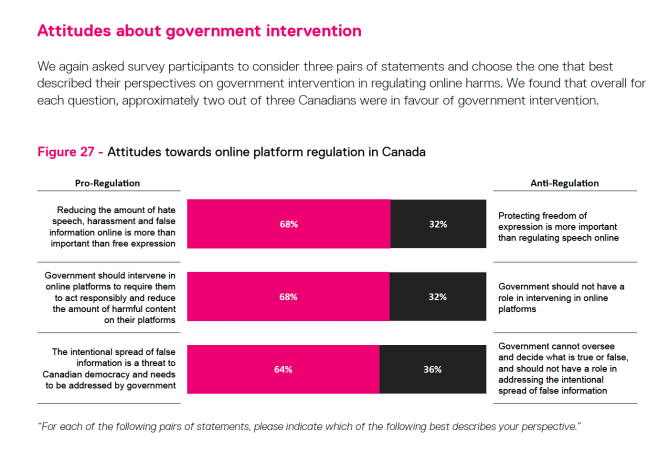
As I wrote in my last post, this bill sits on at least two powder keg issues. One is protecting children and adults from poisonous content. The other is the possibility of creating a slippery slope of the state interfering with free speech through the proxy of platform accountability.
It would be easy to dismiss either policy perspective as being motivated by either nanny statism or, on the other hand, a dogged resistance to regulating any Internet content any time out of a fear for digital privacy, especially where porn is concerned.
From what I have already read, and from my own observations, here is a short list of issues that will and should get attention during the parliamentary debate:
- Flag-a-mania. The statute contemplates ordinary Canadians flagging harmful content, even if it is not about them. They (and those that posted the content) get due process from both the platform and the Commission. It’s not hard to see that devolving into a new form of “lawfare.”
- Age gating. This is going to happen no matter what because of the ban on children accessing porn. The question is not the digital security of personal data — leaks and hacks are always possible — but whether technology can reduce that unlikely event to something next to impossible. Social media platforms can make this easier by simply banning pornography from their platforms and leave that business to the porn sites.
- The statute gives the platforms a get-out-jail-free card by relieving them of any obligation to pro-actively search for harmful content. I am sure they already do this voluntarily and may even incorporate that into a Digital Safety Plan, but enshrining this grant of platform immunity into law could be controversial.
- The statute leaves a lot of digital rule-making to be determined by a combination of cabinet regulations, Commission guidelines, and platform Digital Safety Plans. That is a lot of regulatory power held in reserve and without fulsome debate in Parliament. On the other hand, it may be practically unavoidable.
***
If you would like regular notifications of future posts from MediaPolicy.ca you can follow this site by signing up under the Follow button in the bottom right corner of the home page;
or sign up for a free subscription to MediaPolicy.ca on Substack;
or follow @howardalaw on X or Howard Law on LinkedIn.
COMMENTS ARE WELCOME. But be advised they are public once I hit the “approve” button, so mark them private if you don’t want them approved.
I can be reached by e-mail at howard.law@bell.net.
This blog post is copyrighted by Howard Law, all rights reserved. 2026.


Really nice explainer. Clear. And the policy context really comes across as balanced.
>
LikeLike