June 14, 2026
There are few things more refreshing than CTV’s Vassy Kapelos grilling cabinet ministers.
The host of Question Period had culture and identity minister Marc Miller in the dock on Saturday to ask him bluntly why Canadians would expect that his new Safe Social Media Act Bill C-34 won’t be given away upon President Donald Trump’s insistence, as were the Digital Services Tax and the CRTC’s assessment of cash and investment contributions to Canadian content by US streaming services.
Miller’s answer: there will be no surrender by the Liberals on his new bill. Protecting kids is not on the table, he said, “hard stop.” The minister thinks that similar legislative efforts being passed or proposed in Washington and various US state houses to protect children from online harms bodes well for Canada pursuing the same strategy.
Also, he said protecting children is more important than “redistributing money within an industry,” a reference to the CRTC ruling. (Public polling on conceding ground on the Online Streaming Act under US trade pressure is here.)
As for overruling the CRTC on streamer contributions, Miller said he wouldn’t comment publicly. That lasted about ten seconds once Kapelos went after him for “capitulation” to US trade pressure and American companies.
Kapelos asked Miller what Canada got, or might get, in CUSMA trade talks for coughing up the Digital Services Tax and the CRTC ruling.
“I’m not going to tell you,” replied the minister.
The minister then gave up some fresh talking points on the CRTC ruling and the $600M in federal funds that includes replacement of the streamer contributions:
- The CRTC “is not the final arbiter” on implementing the Online Streaming Act, the government is.
- The Prime Minister may have overruled the CRTC’s 15%-of-revenues assessment on foreign streamers but it is only because the 15% number wasn’t the right one. When the minister formally instructs the CRTC “in a few months” on the make-over of the overturned decision, there will be “a number.”
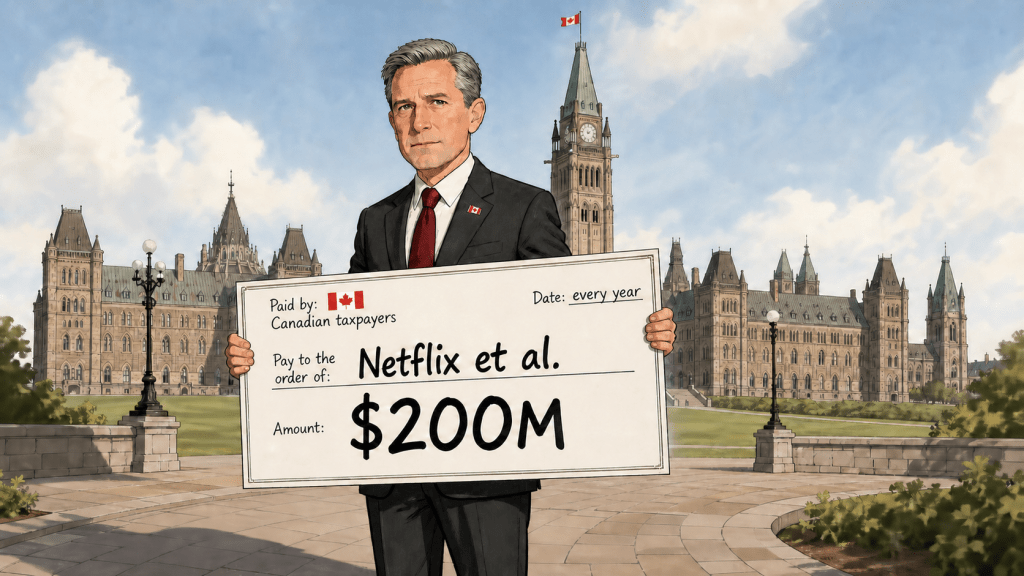
- The annual $600M in federal funds announced on June 3rd will compensate for giving away the $200M in annual streamer contributions ordered two years ago by the CRTC in part because that streamer money is “tied up in court.” (The escrowed streamer funds from 2025-26 will have to be refunded to the streamers).
- The federal $600M will include money for “independent journalism.”
***
There was an unexpected media policy post from Narcity publisher Chuck Lapointe last week that is worth reading.
Narcity is a Canadian news outlet with a heavy bent towards travel content. But it also publishes conventional news content and on a daily basis it re-posts Canadian Press news stories on Facebook in order to draw traffic to Narcity’s websites.
Lapointe can get away with this despite the Meta banishment of news from its Canadian platforms because he signed off a Meta waiver saying his news product is not the kind of content that triggers financial compensation from Meta under the Online News Act, Bill C-18.
Speaking of Meta, Lapointe’s policy post points out how foreign platforms now completely dominate the Canadian market in digital advertising with the well known impact on the ability of Canadian media to monetize their content.
A good policy move, he says, would be for Ottawa to put new federal dollars in the hands of Canadian advertisers on the condition they spend it on Canadian digital platforms. That kind of voucher system might spur innovation by Canadian digital outlets competing for that ad spend.
It’s a smart idea that’s been circulating in various US states for some time now. In Canada, Senator Andrew Cardozo and I included the recommendation of an advertising voucher in our recent report, Making News Media Sustainable.
***
The US Federal Department of Justice has signed off on the blockbuster Paramount-Warner Brothers Discovery merger.
As often happens in government reviews of big mergers, the field of competition is configured to offer a rationale for the thumbs up or down. In this case, the FCC is saying it’s “pro-competitive” for Hollywood studios and streamers to consolidate in order to compete more effectively with Silicon Valley tech/media companies.
The merger story isn’t over. Some US state attorney generals, including California, are banding together to litigate an anti-trust action against it.
The merger also hasn’t been approved by the Canadian Competition Bureau. The European Union and the United Kingdom are also reviewing it: an early approval or the launch of further EU investigations might be announced in July.
***
Back to the Online News Act for a moment and attention all journalists.
An independent researcher from Simon Fraser University is running a survey on newsroom opinions on the consequences of the Online News Act. (She confirmed to me that she isn’t getting funding from foreign platforms. Her research appears to be supported by a federal grants).
English : The Online News Act and its consequences for Canadian Journalism
En français : La Loi sur les nouvelles en ligne et ses conséquences pour le journalisme canadien
***
If you would like regular notifications of future posts from MediaPolicy.ca you can follow this site by signing up under the Follow button in the bottom right corner of the home page;
or sign up for a free subscription to MediaPolicy.ca on Substack;
or follow @howardalaw on X or Howard Law on LinkedIn.
COMMENTS ARE WELCOME. But be advised they are public once I hit the “approve” button, so mark them private if you don’t want them approved.
I can be reached by e-mail at howard.law@bell.net.
This blog post is copyrighted by Howard Law, all rights reserved. 2026.


2 thoughts on “Catching Up on MediaPolicy – Miller explains the Netflix bailout – Federal ad vouchers to support Canadian media? – US DOJ approves the Paramount/ Warner Bros merger”