August 19, 2026
It is commonplace to observe that it pleases the Trump administration to throw its weight around when it comes to Big Tech’s global dominance.
The propensity to claim extraterritorial sovereignty through trade negotiations on digital trade, which has its own chapter in the CUSMA agreement between Canada and the US, is coming to a head.
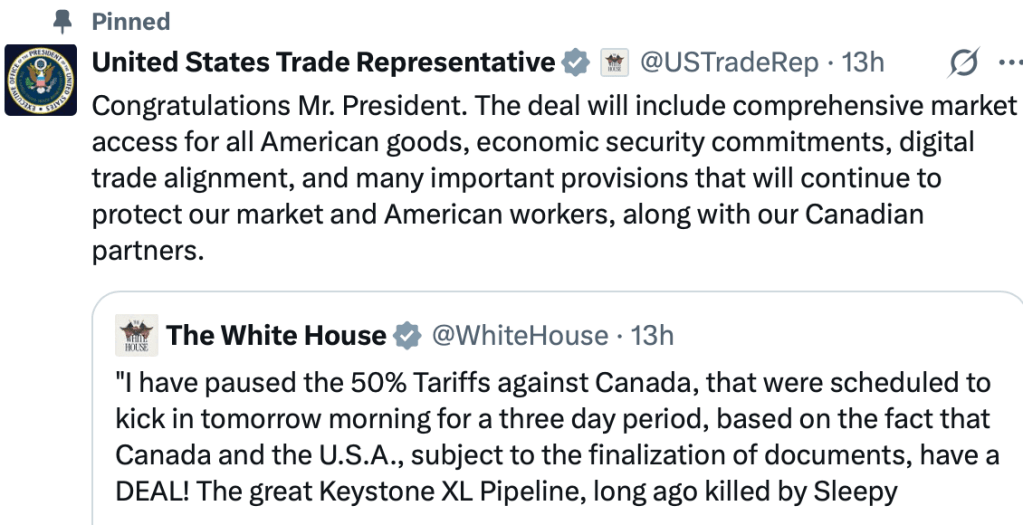
That was apparent yesterday when the President announced a three day pause on his threatened tariff increases on Canadian goods and services because a tentative deal might be taking shape. His trade negotiator, USTR Jamieson Greer, tweeted enigmatically that one of the checked off bargaining items is “digital trade alignment.”
As Canadian trade commentator Barry Appleton writes, the details behind Greer’s statement are a warning that we may soon discover that the Prime Minister’s “AI for All” national strategy for AI adoption and digital sovereignty is in for a heavy edit if it depends on US “alignment.”
One of the immediate applications of “alignment” with whatever it is that pleases the President and his tech bros is Carney’s Safe Social Media Act, Bill C-34. It was tabled in the House on June 10th, just prior to the summer recess. It is the government’s plan to regulate online harms in AI chatbots, social media apps, and porn sites. The core of the bill is the requirement of digital safety plans that meet Canadian federal standards.
This is the bill that culture and identity minister Marc Miller described as non-negotiable in trade talks, “hard stop.”
You may recall that Miller’s cabinet predecessor, former Liberal MP Steven Guilbeault, said the same thing about the Online Streaming Act.
While the US has no domestic equivalent of the Online Streaming Act that the Trump administration loathes, US Congress is in fact edging towards its own version of the Safe Social Media Act.
As I noted in an earlier post, the US Senate and the House of Representatives have both passed potential legislation but are quarrelling over how tough the bill should be in imposing a “duty of care” on digital platforms which would feature digital safety plans that meet US federal standards.
The Senate and the House have been in this stalemate for nearly two years but whatever legislation eventually emerges will be what the Trump administration seeks in “alignment” from Canada, the EU, and everyone else.
Goosing Congress along is this week’s opening of the social media trial of the decade pitting 29 US states against Meta. The state Attorney Generals are flamboyantly claiming $1.4 trillion in damages for what whistleblowers describe as Meta knowingly imperilling the mental health of youth. Earlier trials in New Mexico and California went against Meta. Meta’s current market cap is about $1.4 trillion.
It’s possible that one of the non-aligned views of regulating online harms will be a ban on youth accounts altogether. Australia has imposed one (for under-16), the United Kingdom is considering one, and ten US states have done so. Meta itself has a corporate policy banning under-13 accounts. The Trump administration’s official position is opposed to age bans.
Recently in Europe, the French constitutional court struck down the Republic’s under-15 ban as “a disproportionate restriction” on freedom of expression of young people .
The French court ruling suggests we should expect a similar lawsuit in Canada should C-34 become law. The Carney government’s bill proposes to use age bans as an interim measure, the better to spur the AI and social media companies to come up with effective online safety plans, like special youth accounts with design and content access features.
Just my two cents worth, but considering the wisdom and widespread popular support for legislative action to protect kids online, I find it hard to believe a Canadian court wouldn’t back up the Carney strategy of giving Big Tech a choice between developing safer online products or else comply with an age ban to protect vulnerable youth from unsafe content as a constitutionally permissible limit on children’s right to free expression (which includes the right to consume it, like the right to read).
Of course it may not matter what the Canadian online safety act ends up saying, or whether it’s constitutional, if we’ve already bargained away digital “alignment.”
Hard stop.
***
If you would like regular notifications of future posts from MediaPolicy.ca you can follow this site by signing up under the Follow button in the bottom right corner of the home page;
or sign up for a free subscription to MediaPolicy.ca on Substack;
or follow @howardalaw on X or Howard Law on LinkedIn.
COMMENTS ARE WELCOME. But be advised they are public once I hit the “approve” button, so mark them private if you don’t want them approved.
I can be reached by e-mail at howard.law@bell.net.
This post is copyrighted by Howard Law, all rights reserved. 2026.


Good stuff.
David Nostbakken PhD (He/Him)
President/CEO
McLuhan Foundation
https://mcluhanfoundation.org/
613 296 6692
[cid:image001.png@01D921BC.E9295A70]
LikeLike