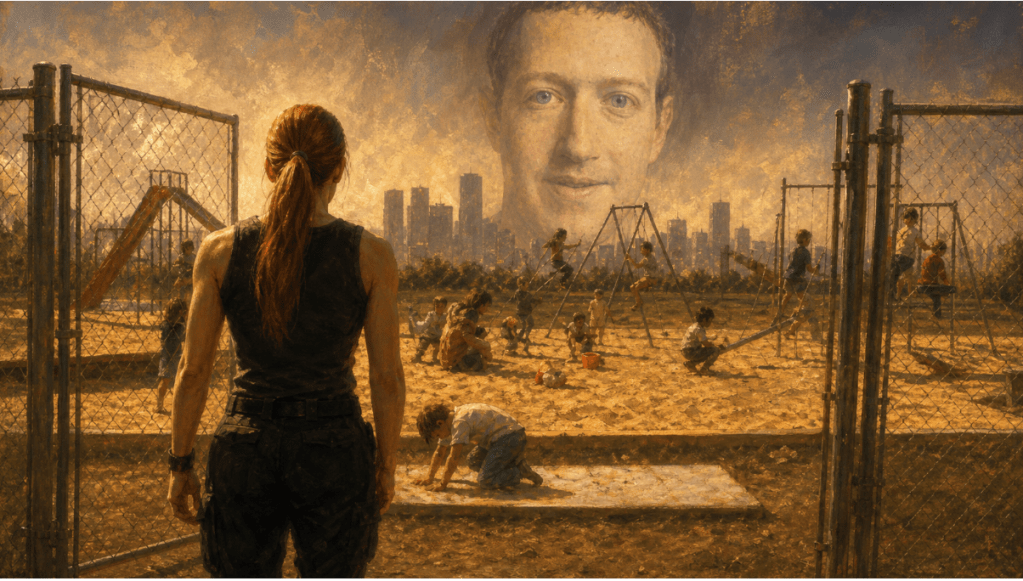
(AI illustration)
August 28, 2026
Meta’s big trial settled after only five days of testimony and before CEO Mark Zuckerberg was scheduled to take the stand.
The social media giant just paid off 47 US states with $18 billion (USD) to resolve lawsuits seeking reparations and safety features as a result of online harms allegedly inflicted on American children by its Facebook and Instagram products.
With more lawsuits pending, Meta continues to deny liability.
The big dollar figure equates to four months of Meta’s annual profit but the money will be paid out over 10 years. As well, thirty per cent of the amount is tied to YouTube and TikTok agreeing to a similar settlement.
Regardless, the state Attorneys General crowed victory.
“For years, Meta intentionally deceived the public about the addictive and harmful design features that have wreaked havoc on youth mental health,” according to Virginia Attorney-General Jay Jones. The deal “will put an end to these dangerous practices and deliver meaningful relief that will protect children from online harm.”
The settlement funds will mostly flow to children’s mental health services.
Front-loading meaningful policy action with lawsuits may be anarchic, but it moves the US closer to comprehensive federal regulation of online harms against children and provides a first draft of regulatory digital safety plans. Meta and the Attorneys General would be well aware of that.
Whatever that US regulation ends up looking like —there’s currently head butting between the House of Representatives and the US Senate over the content of digital safety plans— it will be an obvious benchmark for other countries seeking to do the same thing, as Canada is doing with the Liberals’ Bill C-34, The Safe Social Media Act. Given speculation about the apparent agreement at abortive US-Canada trade talks over “digital alignment,” the regulatory footprint in the US becomes even more relevant.
Under the terms of the settlement, there will be a hard two-hour cap for under-18s’ daily screen time, limits on continuous scrolling time, and no access after midnight.
There will be limits on addictive features such as Likes and other emojis. Push notifications will be prohibited during school hours.
Meta will also disable extreme make-up and cosmetic surgery image filters, a nod to concerns about the harmful role of social media in body image. There is no outright ban on so called body image postings.
There are also no limitations on Meta’s algorithmic personalized recommendations. Instead, teens will have an option to adopt a non-personalized feed.
Importantly, most of the hard controls are in the apps’ default settings that can be undone with parental consent. Meta has promised to provide simpler settings and tools for parents.
Of note to policy makers: the age verification protocols that underpin the entire regulatory regime are not concretely sketched out in the settlement. The important details are set as a deliverable from Meta in a year’s time.
That’s no small matter: Meta and YouTube’s Google ownership are looking to foist age verification on each other as legislatures choose between imposing that responsibility on either app stores like Google Play or individual social media apps such as Instagram.
Going forward, the settlement may or may not grease the skids leading to US federal regulation of online harms to children. It depends on YouTube, TikTok and Snapchat responding positively as well as Congressional leaders sorting out their differences over the strength of regulatory standards requiring digital safety plans from social media companies.
The Canadian C-34 makes it clear that a Canadian digital regulator will have the power to set its own standards if the safety features offered by Meta and the other social media companies in their digital safety plans are found wanting. As the ultimate hammer, the regulator can ban youth accounts.
Meta says it is not implementing the terms of settlement in Canada. We will see if that sticks, but Meta might be tempted to retain its leverage to settle the lawsuits filed by Canadian school boards or haggling over the draft of Bill C-34.
***
Michael Geist has a new blog post reporting on a Canadian judge granting an injunction against a social media influencer who triggered a digital mobbing against a Toronto lawyer that included anti-semitic dog whistling and threats to children.
Geist suggests that the injunction could lead to a new “tort” —the basis of civil liability for damages — of “networked harassment.”
***
Barry Hertz has a story in the Globe & Mail providing circumstantial evidence that the dominant Canadian film theatre chain Cineplex squeezes film distributors into exclusive exhibition deals that result in independent theatres losing important films.
The issue came to light when the independent Carlton multiplex theatre in downtown Toronto abruptly lost exhibition rights to Matt Johnson’s new release “Tony,” a biopic of the belated writer and chef Tony Bourdain, just prior to the scheduled opening and after tickets had been pre-sold.
The Carlton is wedged geographically between neighbouring Cineplex theatres. The Toronto-headquartered Cineplex controls 70% of film theatres in Canada.
In the Globe story, the Carlton refers to “the hegemonic theatrical exhibition market share that exists in this country” and invites disgruntled patrons to complain to the Canadian Competition Bureau.
***
If you would like regular notifications of future posts from MediaPolicy.ca you can follow this site by signing up under the Follow button in the bottom right corner of the home page;
or sign up for a free subscription to MediaPolicy.ca on Substack;
or follow @howardalaw on X or Howard Law on LinkedIn.
COMMENTS ARE WELCOME. But be advised they are public once I hit the “approve” button, so mark them private if you don’t want them approved.
I can be reached by e-mail at howard.law@bell.net.
This post is copyrighted by Howard Law, all rights reserved. 2026.


Howard, I am glad you are on the ramparts for us. Tim
>
LikeLike