Last week, Québec’s culture minister Mathieu Lacombe slid a wild card into Prime Minister Mark Carney’s deck by tabling Bill 109 in the National Assembly.
The bill contemplates doing for Quebec exactly what the federal Online Streaming Act, Bill C-11, mandated the CRTC to do two years ago for all of Canada: regulate streaming platforms so that original French-language content reaches more French-speaking Canadians.
The Lacombe bill claims a constitutional jurisdiction it doesn’t have (until the Supreme Court tells us otherwise), a legislative space in broadcasting that belongs entirely to the federal government. It could provoke a direct confrontation with the Québec-anchored federal Liberals.
The clash, if that is what it comes to, has been heading this way slowly but surely.
If you would like regular notifications of future posts from MediaPolicy.ca you can follow this site by signing up under the Follow button in the bottom right corner of the home page;
or sign up for a free subscription to MediaPolicy.ca on Substack;
If you’re Norway (1st of 180 surveyed nations) or China (178th) you aren’t going to sweat what Reporters Without Borders, a Paris-based NGO best known for public campaigns against the murder or imprisonment of journalists, has to say.
But in between, maybe liberal democracies that think highly of themselves are in for a humbling moment.
This year, Canada’s global ranking is 21st, down from 14th because its index score, spread across five categories of political, legal, economic, social and safety considerations, fell from 81.7 to 78.75 out of 100 points. The US is 57th, France is 25th and the United Kingdom is 20th.
In who’s opinion, you might ask: in each of 180 nations, Reporters Without Borders asks local news journalism experts and practitioners to respond to a series of standardized “press freedom” questions that plumb the depths of journalists’ ability to report on the news without interference.
According to the RWB website:
Press freedom is defined as the ability of journalists as individuals and collectives to select, produce, and disseminate news in the public interest independent of political, economic, legal, and social interference and in the absence of threats to their physical and mental safety.
The Canadian report does not moot the debate over Canadian media subsidies and regulation, to the contrary across 180 nations strong public service broadcasting tends to drive higher scores.
The Index is as much a monitor of a healthy Press as freedom from state power. Broader social, political and economic factors that support or attack a free press play an important role in the scoring.
That concern also appears in Reporters Without Borders election-related statement that called for better training of Canadian police in their treatment of journalists as the top public policy priority.
RWB’s other recommendations included protecting the CBC from defunding, a ban on police spyware aimed at journalists, and a rebuilding of Canada’s “broken” access to government information mechanisms (the new Prime Minister having shown some interest in the latter).
RWB also noted the existence of “a patchwork of [media subsidies] policies” that beg for “a comprehensive and consistent strategy that helps enable the media to innovate and find news models of sustainability.”
In next year’s report, we’ll likely see an impact on ratings from CTV’s firing of Rachel Gilmore as a guest election fact checker because of trolling by right-wing actors.
***
This is my last post for a month thanks to our first real vacation since pre-pandemic times. It’s a bit of a science experiment: can four adults manage a two-year old while travelling? Should be possible.
I couldn’t leave without commenting on Donald Trump’s latest announcement of a 100% tariff on Hollywood’s movie production outside the U.S.
It will be a popular move in the US. Hollywood is making less audio visual content globally and in the United States owing to a number of factors, most noticeably budget cutbacks in response to the saturation of the subscription streaming business.
Canada is Hollywood’s biggest non-American supplier of movies and television shows: half of Canada’s $9.58 billion in annual production is for American shows and much of our Canadian content is widely exported to the American market for second runs. The employment hit could be substantial, as this screen capture from the CMPA’s Profile report reveals:
The obvious Canadian counter-tariff is a 100% surcharge on American-made shows exported to Canada. Those would hit Canadian broadcasters filling their schedules with American programming (Corus, TVA, CTV, Bell Crave, etc) but also Netflix and the other American streamers who sell to Canadian subscribers.
It’s not likely that Hollywood asked for the Trump tariff: the studios rely upon the high-quality, competitively priced production centres across Canada, but mostly Toronto and Vancouver.
The tariff disrupts their supply chains and their budgeting, not unlike the Trump tariffs hitting the auto industry.
A White House spokesperson walked back the President’s announcements within hours —-“no final decisions“— suggesting a WTF phone call from the Motion Picture Association.
Shortly afterwards, Trump’s “Hollywood ambassador” Jon Voight made a public statement suggesting that his recommendations to the President had been to boost tax incentives and subsidies for domestic production, negotiate international co-production treaties, and apply tariffs in some situations.
At the CRTC, the Motion Picture Association and the US streamers have put almost all of their strategic capital on securing a minimal commitment to offering Canadian content because the studios spend so much money making American movies in Canada.
If you would like regular notifications of future posts from MediaPolicy.ca you can follow this site by signing up under the Follow button in the bottom right corner of the home page;
or sign up for a free subscription to MediaPolicy.ca on Substack;
The federal election is over and the CBC is still standing. That’s a milestone achieved, for now.
This next Liberal term of government will probably run light on media policy compared to the last four years of legislative turmoil that swirled around the Online Streaming Act Bill C-11, the Online News Act Bill C-18, the future of the CBC, and Online Harms Act C-63, the latter bill being split into two parts and then wiped off the Parliamentary agenda by the election.
If media or cultural issues appear front and centre of public attention during the 45th Parliament, it will likely be a result of trade negotiations with the Trump administration.
The exception is the CBC: the reinvigoration, rebranding, reinvention or re-whatever of the public broadcaster is a winning file for the Liberals and long overdue. The Carney campaign promised more money, more secure long term funding, more local news and more anything to counterweight online misinformation and foreign interference.
The money —a promised 11% increase of $150 million to the Parliamentary grant — will be in the budget bill. The rest must find its way into law through amendments to the Broadcasting Act. That means getting in and out of the procedural swamp of a Parliamentary committee (the new “Culture and Identity” committee) where there is no reason to expect the Conservatives or the Bloc to hand the Liberals a “win.”
It’s going to take a strong minister to get this CBC overhaul done. In March, the Prime Minister appointed Steven Guilbeault as Culture and Identity minister, doubling up with his Quebec lieutenant duties.
Guilbeault is the wrong guy for the job at this point in history. This seems harsh and counterintuitive in many ways. He’s done the job before (2019-2021). He’s smart, decent, competent and temperate. And he is fluently bilingual. So what’s not to like?
The minister’s number one job in this Parliament is the CBC make-over and selling it to EnglishCanada.
That requires gut-instincts about culture and popular attitudes that you can’t easily learn on the island of Montreal. To be pragmatic about the political task at hand, the face of the CBC’s redemption in English-Canada, particularly the west, cannot be the much vilified environmentalist Guilbeault, no matter how unfair that tag may be.
There are other candidates that fit better: fourth-term Toronto MP Julie Dabrusin knows the cultural file as Guilbeault’s former Parliamentary Secretary, she’s bilingual, and if it matters to anyone she was born and educated in Montreal.
The other media policy file that may move forward is a retabled online harms act. You may recall that when the Liberals put forward C-63 last year it contained a raft of amendments to the hate crimes provisions of the Criminal Code and a separate regulatory scheme that would require social media platforms to establish their own binding content codes that manage the online harms to kids, revenge porn, fomentation of hate, and incitement of violence or terrorism.
The Conservatives have no interest in the content codes other than to politicize them as censorship. The Tories have their own version of an Internet crime bill that focusses on harms to children and jailing the perpetrators.
If the Liberals have any sense they will ditch the anti-hate criminal amendments which will just chew up the Parliamentary agenda with public debate over jailing free speech. But they should go full steam ahead with the content codes: it’s a winning file and the Liberals can probably get the support of the Bloc to get it through committee.
Outside of Parliament, the battle at the CRTC over implementation of the Online Streaming Act is going to peak in the next few months.
In the next few weeks the Commission begins hearings on three major policy files covering the first-time regulation of video and audio streamers, as well as online distribution chokepoints. Also, the US streamers’ legal challenges to the initial “five per cent” cash contributions to Canadian media funds will be heard in Federal Court in mid June.
Assuming the court upholds the Commission’s levies, it all points to a crescendo of policy pronouncements and trade confrontations in the fall and winter of 2025-26.
Because of this, all other media policy files will probably get ignored.
One such file is the Meta ban on news distribution over Facebook and Instagram, the very unfortunate outcome of the Bill C-18 battle that hurts journalism start-ups and news websites in smaller communities. Pierre Poilievre’s campaign proposal was to just cave to Meta, which the Liberals are unlikely to do and in any event that would just be an invitation for Google to demand the end of its $100 million in annual licensing payments.
There is no principled way to solve this policy puzzle, which means it might be solved in trade negotiations.
Another file that needs attention but won’t get it is an overdue redesign of the federal QCJO subsidies to news journalism. The opportunity here is to do some good policy work that doesn’t require legislative amendments and Parliamentary bandwidth.
Lastly, now that we have a new Prime Minister maybe we can get the Liberals to reconsider their ill-tempered and ill-considered support of password sharing on news subscription websites in the government’s litigation with Blacklock’s Reporter.
The government has convinced itself (and a trial level judge) that it’s siding with the angels by giving an expansive and elitist interpretation of the “fair dealing” or “research” exception to copyright: it simply does not match up against the common sense reality of running a paywalled news business.
The fact that Blacklock’s is editorially a thorn in the side of the government is the bad energy behind all of this. It’s a vindictive abuse of state power, made possible only because Blacklock’s is not the Globe and Mail or the Toronto Star. It’s time for fresh government eyes on this.
***
If you would like regular notifications of future posts from MediaPolicy.ca you can follow this site by signing up under the Follow button in the bottom right corner of the home page;
or sign up for a free subscription to MediaPolicy.ca on Substack;
Just released, the Poilievre platform proposes to more than double the funding of the federal Local Journalism Initiative (LJI), from $20 million per year to $45 million. That potentially adds a further 400 journalist jobs in local print media markets across Canada. The locations of those markets line up nicely with Conservative Party ridings in rural areas and outside major metropolitan areas.
The reaction in some conservative circles to Poilievre’s announcement could be described as vein-bulging disbelief. They had half expected a federal news voucher policy, like the Liberals’ now expired reader tax credit. But this?
In The Hub, a conservative publication that rarely allows daylight to show between itself and the Party, Sean Speer fumed the LJI funding was “a massive concession to the Trudeau agenda and a fundamental failure of conservative politics.” The remarks were made on a podcast, so I am not sure whether the word “conservative” was supposed to be capitalized.
The Hub Publisher Rudyard Griffiths chimed in that the federal government controls news content through the LJI, a serious accusation but without a basis in fact.
The Hub’s dismay with Poilievre’s position on subsidies should be put in context.
If elected Prime Minister, Poilievre will defund the English language services of the CBC with its 2,000 journalists.
Oddly in consideration of his repeated castigations, Poilievre’s platform is silent on the federal $65 million QCJO subsidies to about 3,000 print media journalists, dispensed at 35% of salary.
He has promised immunity to Meta for liability under the Online News Act, which puts at risk Google’s compliance with their commitment to pay $100 million per year compensation to news outlets employing 9,000 journalists (at about 15% of salary).
He has also promised $20 million to fund “Indigenous journalism” without providing specifics.
The Hub’s feeling of betrayal by Poilievre runs deep. In the past few months the publication has gone out of its way to celebrate its refusal to take federal subsidies or compensation from Google, proclaiming its disdain for this financial support as part of its marketing campaign for more paid subscriptions.
What’s not well advertised is that two years ago The Hub publisher Griffiths sought and obtained official designation from the Canada Revenue Agency as a “QCJO” news publisher and, more recently, the seal of approval from the Canada Journalism Collective that is administering the Google money.
I asked him about this apparent contradiction and he confirmed that The Hub has the designations, but spurned the money. A month ago The Hub very publicly donated its $22,000 in Google cash to a charity.
As for the QCJO designation, he says The Hub wanted it for the purpose of Press credentials and never applied for the salary subsidy or reader tax credit program. As for seeking and then giving away the Google money, he said The Hub wanted to follow its application through the CJC process so it could verify the integrity of the distribution.
The Hub’s argument with subsidies is about the independence of the press from government, a non trivial concern of course, but the relevant discussion is “independence” from the many vectors of power in our liberal democracy, not only government but big corporations, sponsors, political parties, billionaires, readers demanding ideological conformity and powerful local families.
The Hub‘s success in winning official status raises the concern of how best to administer QCJO designation when it results in the certification of a news outlet so utterly committed to a northstar political party, one that may be governing Canada come Tuesday morning.
That concern is usually shrugged off by those who point to the historic practice of print media mixing its news reporting with politics through opinion journalism and explicit party endorsements. It got us where we are today, so why worry about the close ties between some media and their political champions?
One way to stop worrying about those political allegiances is found in program design for the subsidies. One of the best ways for a news outlet to prove its bona fides of good journalism is through its committment to original and accurate news gathering as the main course in the journalism meal, with opinion as the dessert.
The QCJO criteria for designation has always required that news outlets engage in original news gathering with a fairly high bar for professional standards. The weakness of those rules is that lack of a high bar for volume of news gathering, requiring only that news gathering be carried out on “ongoing basis.” The “ongoing” is left to eyeballing by a certification committee after a news organization has submitted details of its self selected “best three weeks” of news reporting.
If an outlet like The Hub with its acres of opinion writing and occasional news story can get QCJO designation, the bar for frequency of news reporting can’t be very high.
In fact Griffiths told me that as a non-profit he nevertheless decided against seeking the charitable status that would allow him to issue tax receipts to donors because the rules of the government’s less known “RJO” program for non-profits sets the news gathering bar at 51% of published content, a test he says he could not meet.
And then there is accuracy in news reporting, another thing that demonstrates good journalism and, when not done well, undermines public trust.
Recently, The Hub has repeatedly described federal subsidies to news journalism as totalling “$425 million per year.”
Included in that figure is the $100 million Google money as an “indirect” federal subsidy, a highly editorialized way of describing government-enforced news licensing payments between private parties.
More seriously, its “$425 million” figure includes $154 million from the Canada Media Fund, a media fund that spends all of its money on Canadian television dramas, documentaries and children’s programming and exactly zero dollars on news journalism. That’s a hugely misleading reporting error.
There is yet another way to demonstrate good journalism: keeping a safe distance from corporate influence. News organizations of all stripes have a chequered history on this, frequently allowing advertisers and sponsors to pay for content in one way or another. Nevertheless “advertorial” that is written and paid for by a sponsor, clearly marked as non-journalist content, is generally accepted and long tolerated.
But the arms length independence from corporate money can get squishy.
The Hub published an article in October that opposed the federal government’s Online Streaming Act, also contested in a “Scrap the Streaming Tax” public campaign launched the previous month by the American Digital Media Association (DiMA) against the CRTC’s ruling that music streamers pay five per cent of revenue to Canadian media funds.
DiMA’s member organizations Spotify, Apple, Youtube and Amazon are notorious news subjects in their opposition to the CRTC’s implementation of the bill and DiMA’s campaign art was used by The Hub to illustrate the content of the article.
DiMA even paid for the article, a fact that was acknowledged at the bottom of the article but still, in my opinion, constituting a repudiation of independent journalism.
***
While I’m on about The Hub, they posted a terrific podcast in their Full Press series hosted by Harrison Lowman and starring independent journalists Tara Henley and Peter Menzies. The topic was the notorious “shit show” of Rebel News turning the election debate press conferences on their end on consecutive nights.
It got going on the first night when a Rebel News reporter chose to ask the only non-Christian leader why he wasn’t speaking out against “ongoing attacks against Christians” and Church burnings, a provocatively staged but nonetheless legitimate question.
But the second night was when it all went to hell and the press conference became so unruly that the election commission cancelled it.
The Full Press podcast has some very intelligent commentary on the whole mess, very relevant to the Internet-induced era of wide open journalism.
***
If you would like regular notifications of future posts from MediaPolicy.ca you can follow this site by signing up under the Follow button in the bottom right corner of the home page;
or sign up for a free subscription to MediaPolicy.ca on Substack;
Of all the silver linings in Donald’s Trump’s aggression against Canada, I’ve been gratified to discover the renewed popular passion for Canadian culture.
The pinning-jelly-against-the-wall quest for a distillation of Canada’s national essence always interests me: I’ve pondered it myself in a previous post and celebrated the thoughts of others on the subject.
Unfortunately, what Marche offered us last week was a fact-free rant against the CBC.
His starting point is a much celebrated allegation: that Justin Trudeau is a proud “post-nationalist” who does not value Canada’s rich history because it is marred by the dispossession of Indigenous peoples and wrongs committed against minorities. Says Marche, our “cultural industries” eagerly signed on to Trudeau’s project of denigrating “so-called Canada” and “the self-critique quickly narrowed into a negligible, impotent stream of identity politics to the exclusion of virtually any other perspective.”
Having named all “cultural industries” in the indictment (including his own, the book publishing industry), Marche’s chief culprit is the CBC. Just to give you a flavour:
The most egregious, and most important, case is the CBC. The CBC has spent a decade turning itself into a big national scold. Literally, their ad campaign from 2023 featured the slogan: “It’s not how Canadian you are. It’s who you are in Canada.” That’s how they chose to promote themselves – a sneer at anyone who might think of themselves as a patriot. I am not sure, at this moment, whether the CBC even likes Canada. You certainly can’t tell by listening to them.
There are no facts or examples provided for this grave condemnation of the public broadcaster as “a big national scold” that “sneers” at “patriots.”
I watch, listen and read the CBC every day: I’ve never witnessed scolding, sneering or anything of the kind. What’s the CBC guilty of? Broadcasting North of North? Or Sort Of?
Once rolling, Marche doesn’t stop:
The Conservatives have, if anything, underestimated the problem. I say this as a small-l liberal: When the head of the CBC cannot name a single Conservative voice on their platform, when they are opposed, as such, to the political views of somewhere around half the country, they are failing in their mandate to represent the country. It is as simple as that.
A small point, Marche’s link is to a podcast that doesn’t verify his statement: former CEO Catherine Tait declined Paul Wells’ invitation to identify “the most interesting conservative commentators on CBC,” she didn’t say she didn’t know any.
A bigger point is whether the CBC invites conservative commentators onto its shows. On that point, I seem to recall Andrew (“defund the CBC”) Coyne making some rather good conservative arguments on CBC’s flagship At Issue panel for the last decade or so. From my own observation, the CBC regularly seeks out conservative voices on its television news panels, although I suspect it’s difficult when there appears to be a Conservative boycott on the public broadcaster.
Marche’s zippy one-liners continue: the CBC engages in a “ritualized fetish for self-purification”; “its politics seems to derive from the sociology department at York University,” and “the CBC is a force of [information] pollution, they are an active vector of polarization.”
Anyway, you get the gist. By the end of the tirade, Marche tables an unobjectionable list of principles underlying a strong Canadian cultural nationalism. Count me in.
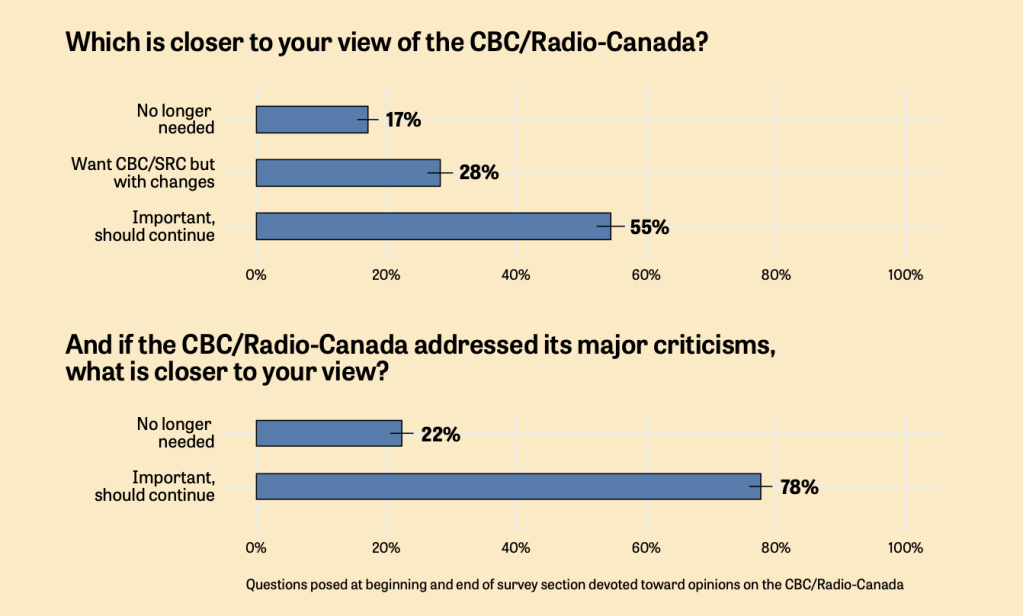
But in the end, Mr.Marche is not a satisfied CBC customer and I am. What about everyone else?
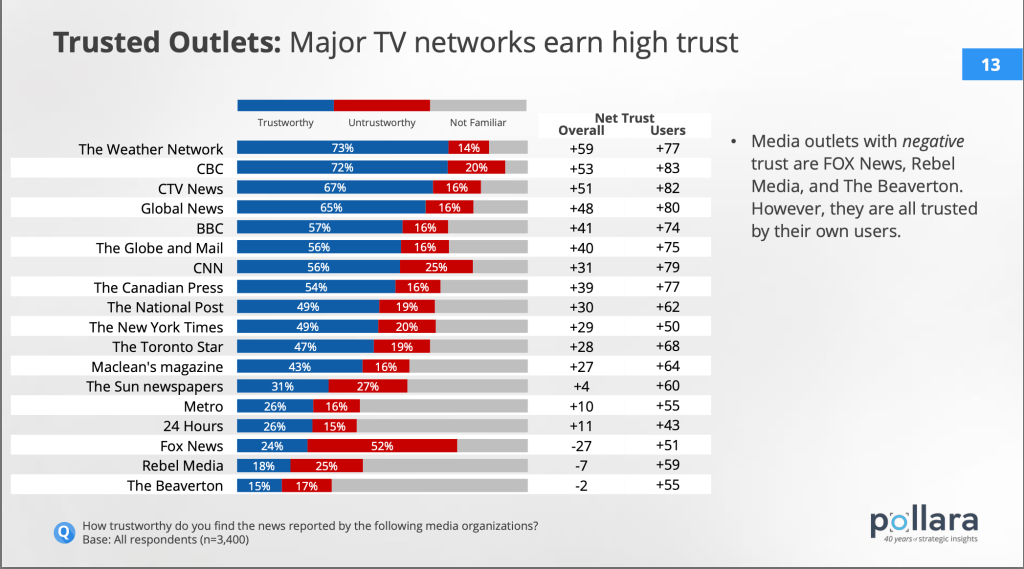
Here’s some feedback from the Reuters-Oxford study of the Canadian news market, the first graph covering radio and television and the second chart covering online news:
These aren’t the numbers you hear about when critics are taking a run at the CBC.
When they do, one of those cherry-picked numbers is the “CBC’s two per cent market share.”
If you look it up, that’s a reference to the CBC National News channel’s share of the cable audience. It may surprise you, but two per cent for a single channel in the 500-cable channel universe isn’t bad. CBCNN’s cost is covered by cable subscriptions and advertising, basically Pierre Poilievre’s formula for a defunded CBC.
The other sore thumb is the CBC’s five per cent share of prime-time evening television ratings. It’s competitors CTV and Global no longer disclose their ratings, but they are believed to be higher. That’s not surprising: the evening prime time is when CTV and Global carry popular US programming, while CBC does not.
Here’s a chart from CRTC data (unfortunately a year behind) you might find interesting.
Since 2015 (Table 30), the CBC has slipped in the relevant television ratings (network stations) against the private broadcasters.
Since 2009 (Table 32), the CBC’s production spending on Canadian content slipped a lot, while the CanCon spending of the private networks and specialty channels climbed. The explanation is that the CBC’s Parliamentary funding is stagnant and, in response to new viewing habits, it has shifted its budget from television to online.
This is neither an apology for those television ratings nor a scolding for those that ignore the CBC’s strong ratings on radio and online.
“Not bad” or “good enough” is not the bar, not for the public broadcaster. The CBC should be appreciated and reasonably well loved across the country and if it’s perceived as projecting itself as too urban, too central Canadian, or too progressive that’s a problem it needs to address like it’s life depends upon it.
Which it probably does.
***
If you would like regular notifications of future posts from MediaPolicy.ca you can follow this site by signing up under the Follow button in the bottom right corner of the home page;
or sign up for a free subscription to MediaPolicy.ca on Substack;
Today the Conservatives became the last political party to publish their “full platform,” which in 2025 seems to be a euphemism for “not nearly as full as before and very late.”
The 30-page Conservative document is down from 160 pages in the 2021 edition. The Liberals have chopped their 2021 page length from 86 pages to 55. That means less real estate for each policy section, including culture, arts and media.
Perhaps because of brevity, the Conservative document is a challenge to decode.
Of course, the Tories say upfront they would defund English-language CBC and permit it to carry on as a “non-profit supported by listeners, donations, sponsorships, ad revenue and licensing revenue.” They expressly exempt Radio-Canada from defunding and in fact promise “to maintain all funding in support of Quebec and Francophone culture.”
The Conservatives would also “repeal Liberal censorship laws.” Since there are none, we’ll just assume that’s a reference to the entirety of the Online Streaming Act which Pierre Poilievre has long promised to reverse.
The Conservatives would “restore Canadians news on Meta and other platforms.” That either means repealing the Online News Act and returning $100 million to Google, or simply granting Meta an exemption from the Act so that it will agree to end its Facebook and Instagram bans against most Canadian news outlets. The CPC reference to “other platforms” is unclear, as there are no other Big Tech companies banning Canadian news.
The Conservatives say nothing about undoing the Liberals’ federal “QCJO” subsidies for journalism salaries at private Canadian print news outlets, but it’s doubtful they’ve had a change of heart about abolishing the $65 million annual program.
Nevertheless the CPC platform proposes to double government full funding of journalist salaries in the Local Journalism Initiative federal program, from $20 million to $45 million annually. A further “$25 million in support of Indigenous language media” is promised, although there are no details beyond that.
The Conservatives also promise to “fund the first made-in-Canada documentaries about Canadians’ contributions to winning the World Wars so future Canadians do not forget the courage and sacrifice of those generations and their stories live on.”
Not to quibble, such state-commissioned documentaries would notbe “the first.” The phrasing of the promise raises the question of whether the federal cabinet would be directing one of the CRTC, the National Film Board, the Canada Media Fund, or private broadcasters to make patriotic content. That might be a first.
The Liberals have a light cultural platform when compared to previous election platforms. They restate Mark Carney’s recent campaign promise to increase CBC funding by 11% and commit to long-term stability in funding.
Other than that the Liberals promise to “increase funding to agencies such as the Canada Council for the Arts, Telefilm, the Canada Media Fund, and the National Film Board.” For those of you that don’t track these things, in practice “increasing” funding often turns out to be adjusting budgets to keep up with inflation.
What’s noticeably absent in the Liberal platform is the government’s Online Safety Act, Bill C-63, which died on the order table in February. Perhaps it fell to the editor’s red pen.
The NDP did not publish a single platform document but provided a series of issue-oriented documents, none of which dealt with the culture, media or the arts; traditional NDP policies.
The Greens and the Bloc Québécois published lengthy documents with detailed cultural proposals that I won’t attempt to summarize.
The Bloc is the only party to propose extending tax rules that provide corporate tax relief to Canadian businesses that advertise in legacy Canadian media to the placement of ads online.
Here are the party platforms (except for the NDP):
The gladiator stands staggered on the sandy floor of the Colosseum, waiting for the thumbs up or down. On federal election day, April 28, the CBC will discover its fate: live or die.
The Mark Carney Liberals have promised to defend the Canadian Broadcasting Corporation and even increase its funding.
On the other hand, Conservative leader Pierre Poilievre “can’t wait” to keep his promise to defund all English-language services of the public broadcaster as no longer needed. “The CBC provides opinions and coverage that are widely available in a competitive media marketplace,” states the CPC with confidence….
It’s no shocker that cultural issues, even CBC funding, haven’t emerged on any list of key ballot box issues in the upcoming federal election. Most pollsters don’t even bother asking.
The Canadian Media Producers Association nudged the political parties this week by publishing an Abacus poll on how Canadians feel about Canadian content. The CMPA represents television show producers that make almost all CanCon entertainment shows that TV companies buy and broadcast.
The cresting wave of Canadian patriotism is reflected in the CMPA/Abacus polling results. By a measure of 80% to 90%, Canadians believe that our cultural identity is important and would like to see that reflected in more and better Canadian stories on their screens through TV network investments and public funding.
The core value of protecting Canadian culture and identity from the influence of the United States is captured in this graph:
The results have a small skew by political affiliation: Conservative and Green voters are slightly less enthusiastic, but nevertheless a strong majority of those voters back Canadian content.
What’s also unmissable is the evenly spread support across Canada. In sovereignty there must be unity.
Is it a ballot box issue? The same poll says that 58% of Canadians want their political party of choice to back cultural issues, only 3% don’t. That leaves 39% as indifferent. The majority sentiment exists in each voter pool, by party.
Today I attended an all-party forum in Toronto on cultural issues sponsored by the Coalition for Diversity of Cultural Expression. Unfortunately all 50 of the Conservative candidates running in the City of Toronto were busy and the Party went unrepresented.
The CDCE held a similar meeting in Montréal on Monday. Despite the fact that Pierre Poilievre has promised to leave Radio-Canada and cultural spending in Québec alone (“no impact,” he said) he didn’t send anyone to the debate for which he was ripped in La Presse by arts columnist Mario Girard.
Liberal Culture and Identity Minister Steven Guilbeault used the opportunity to declare cultural issues as being off the trade negotiations table.
We’ll know more when the major parties table their full election platforms.
***
CTV and CBC dominate federal election news reporting on TikTok, but a study released by Reset Tech observes that 13% of videos uploaded by non-Canadian media and influencer accounts make up 45% of election-related video views. Americans, it seems, make popular videos about Canadian elections.
As observed in the Globe and Mail coverage of the report, TikTok videos may be playing a larger role in election coverage because of Meta’s self imposed news ban that blocks mainstream news reporting on Facebook and Instagram.
The Hill Times profiled some of the Canadian TikTokers making election content. Top spot went to a pro-Liberal account, second place to a pro-Conservative, and there is one Canadian journalist in the top ten.
MediaPolicy was able to review Reset Tech’s interim report and other than the viral success of videos uploaded by foreign-based accounts, there wasn’t anything sinister to be found, at least to date.
Of the number of videos uploaded by the top 50 accounts commenting on the election, “progressive” and “conservative” accounts were each at 40%. The remainder belong to neutral accounts such as CTV, CBC and mainstream media.
But by number of views, progressives led conservatives, 40% to 25%. The viewership gap was even wider for videos posted by non-Canadian accounts: half were progressives and 14% were conservative.
TikTok’s Canadian director Steve de Eyre published an explanation of the platform’s approach to content moderation during the election campaign. He describes the policy thus:
Support, criticism, or parody of political leaders and their policies: Allowed.
Misleading AI-generated content of political leaders, false claims about the voting process, or incitement of hate or violence: Not allowed.
Reset will release a final report after the election.
***
Two recommended reads for you.
The first is for serious policy nerds: the McGill Centre for Media, Technology and Democracy has published a comprehensive history and analysis of the Online News Act. It’s lengthy but it has an executive summary.
The other recommendation is more fun (and short). David Wilson, historian and the Editor of the Canadian Dictionary of Biography, has published a timely piece about D’Arcy McGee, an expansionist United States and Canadian sovereignty, circa 1865.
***
If you would like regular notifications of future posts from MediaPolicy.ca you can follow this site by signing up under the Follow button in the bottom right corner of the home page;
or sign up for a free subscription to MediaPolicy.ca on Substack;
The stock markets roiled by Donald Trump’s tariff yo-yo vaporized a lot of personal savings (ouch), but especially if you held Big Tech stock. Or owned the company.
Alas, shed a tear for Zuckerberg, Bezos, Musk and the bros. It must be a weird space to be in: grovelling before Trump in the hopes of an unimpeded path to worldwide AI “dominance,” losing billions in share value on any given day of the week and fending off federal anti-trust lawsuits.
The US Federal Trade Commission’s anti-trust suit against Zuckerberg’s Meta starts at the trial level on Monday and is expected to go day to day through July. The government is challenging the Facebook-WhatsApp-Instagram business as an anti-competitive monopoly in “personal social networking services.”
Matt Stoller will be covering the trial in his Big Tech on Trial Substack.
As the politics play out, the FTC’s litigation team has its work cut out for it on showing monopoly power.
To win its case, the FTC must prove that Meta has a monopoly in a relevant market, and that its acquisitions of Instagram and WhatsApp helped Meta maintain that monopoly through something other than competition on the merits.
The FTC can show monopoly power with direct evidence, like the ability to profitably raise prices or diminish quality. But because Meta does not charge consumers money for its services, it’s difficult to show the classic direct evidence of a price increase. Even so, the FTC has introduced evidence that Meta can engage in price discrimination, one sign of market power, by increasing the number of ads shown to users who have greater demand for social networking. In any event, the FTC will likely rely on indirect evidence of Meta’s market power: high market share plus the existence of barriers to entry that prevent others from whittling away at Meta’s share.
Underpinning whether Meta has a monopoly is the threshold question of how to define the “relevant market” in which it has that power. The relevant market for assessing competition is twofold: a product market and a geographic market. The FTC proposes that Meta is a monopolist in a market for “Personal Social Networking Services” (we’ll call it the “PSN market”) in the United States, which is distinguished by a social purpose: a way to connect with family and friends. Inside that market are Facebook, Instagram, Snapchat, and MeWe. Meta, for its part, disputes that definition and points to other apps that it says it competes with, like LinkedIn, Reddit, and YouTube. The bigger that Meta can make the relevant market, the smaller Meta’s market share in that market, and the more likely it is to defeat the FTC’s case.
“The principle is a fair idea,” he told reporters on the campaign trail. “It’s that these businesses earn revenue here in Canada, so the principle is that they should contribute where they earn the revenue. So I think, on this question, we should keep it in place.”
The Conservatives endorsed the DST in their 2021 election platform at the rate of 3% of Canadian operating revenues, the same amount adopted by the Liberals last year.
The Liberals in 2021 promised a “minimum global corporate tax.” It was successfully negotiated with the US Biden administration but blocked in US Congress and repudiated by the Trump administration. The fallback DST of 3% was implemented instead.
Because of federal regulations, the Canadian independent producers who made the series retain the intellectual property in the show, including the global streaming rights they licensed to Netflix which was a major pre-production investor.
That in itself is hardly unprecedented and neither is it surprising that Netflix is making a big deal of its investment and licensing deal because of the ongoing battle over its obligations to broadcast Canadian content.
What’s more noteworthy is the reporting that the production infrastructure costs of shooting in the high north were so steep that CBC, APTN and Red Marrow —the recipient of all manner of tax and broadcaster subsidies to make the series —— needed a deep pocketed foreign streaming partner to make a show with high on-screen production values and an authentic locale (as opposed to shooting in Sudbury).
It’s a reminder that our television subsidy regime feeds shows that are a million dollars per episode, not five million like American hits.
The CBC is by far the biggest spender on Canadian dramas and comedies at $195 million per year (Bell is second at $93 million) but it still has to spread that cash far enough to cover several series each season in different regions of the country, as viewers and taxpayers expect.
Speaking of the CBC, I’ve got an analysis of the defund v. defend debate coming out next week on the Institute for Research on Public Policy’s website Policy Options.
***
For those of you who wanted to know when the CRTC would reschedule its public consultation on radio and audio streaming, it’s September 18th.
The video and television hearing kicks off on May 14. The consultation on “market dynamics and sustainability” (the gatekeeping of content distribution) begins June 18.
The three-day court date for the streamers’ legal challenge to the CRTC’s five per cent levies benefiting Canadian media funds is set for June 9.
***
The possibility of a merger between Montréal’s LaPresse and the six financially vulnerable “CN2i” Québec news outlets is off.
The LaPresse offer to CN2i staff, which reports imply required an unpalatable number layoffs, was blocked at the last minute and LaPresse informed its own employees that merger discussions were at an end.
With LaPresse out of the picture, Pierre-Karl Pélédeau’s Québecor appears to be poised to make its own merger offer to CN2i. The media-telco conglomerate Québecor owns daily tabloids in Montréal and Québec City as well as the TVA television network and Vidéotron cable.
***
It’s always important to media policy to keep an eye on long-term audience trends, especially in news programming.
ThinkTV is the media marketing group that regularly pumps out polling numbers to remind advertisers where the customers are watching, listening or reading.
Its latest report affirms that television and radio continue to hold their own as the top and third most popular media respectively for national news. The way the polling chart is laid out, you can see that mainstream media is vested in video, audio and text, online or otherwise:
On the same note, American media whiz Evan Shapiro has a new post where he suggests that local news is in high demand regardless of age cohort, although he sees a watershed between GenZ/Millenials and GenX/boomers in terms of platform preferences.
The task is for local TV and radio news operators is to fish for the younger generations where they swim.
None of this is breaking news, but it’s Shapiro’s chart that caught my attention. Check out the age statistics on this one (keeping in mind it’s the American market):
***
And lastly, I recommend Ken Whyte’s latest blog post on book publishing and the trade war. This quote stayed with me:
Search ‘books and tariffs’ on Google and you’ll find a bunch of articles in which booksellers and librarians are begging to dodge the draft into Buy Canada. Frankly admitting that they depend overwhelmingly on US product, they’re asking Ottawa to exempt American books from Canada’s slate of retaliatory tariffs. Otherwise costs will rise, customers will be unhappy, business will suffer. We’ve locked arms with Danielle Smith.
***
If you would like regular notifications of future posts from MediaPolicy.ca you can follow this site by signing up under the Follow button in the bottom right corner of the home page;
or sign up for a free subscription to MediaPolicy.ca on Substack;
The headline is a promised increase of $150 million to the existing $1.4 billion annual Parliamentary grant.
The Liberals’ messaging is that the CBC must be better funded to complete its mission of strengthening local news while neutralizing misinformation.
This is the same pitch that Heritage Minister Pascale St.-Onge made in February when she proposed doubling CBC funding to strengthen Canada’s news media in counterbalance to American-controlled and Big Tech-dominated media.
The Carney campaign is on board and signalled a long-term goal of increasing Parliamentary funding to close the gap with the per capita financing of public broadcasting in the UK, France, and Europe.
Carney also indicated he would pursue St.-Onge’s proposal to enshrine long-term funding in the Broadcasting Act instead of it remaining subject to the budget cycle.
Perhaps a surprise is that the Liberals have no plan to attach the new money to CBC exiting the advertising market.
Carney’s disinterest in St.Onge’s proposal to direct the CBC to stop selling advertising on its public affairs programming may be a pragmatic concession to the fact that the CBC’s $275 million yearly intake of ad revenue still exceeds his proposed budget increase of $150 million.
As far as I know, there is no public figure identifying how much of the CBC’s $275 million in ad revenue is connected to public affairs content. In its 2021 election platform, the Liberal Party promised $100 million annually to the CBC for withdrawing advertising from news and public affairs programming but the platform was never implemented.
***
The business journalists of the land have already done a thorough jobcovering the renewed $11 billion, 12-year hockey rights deal between the NHL and Rogers for Canadian audiences.
In a world of escalating costs for sports rights, it’s not surprising that the price doubled since first inked in 2014. The consensus view is that Rogers badly needs Canadian NHL teams to go on deep playoff runs over the next decade if this deal is going to pay.
Rogers owns the Toronto Maple Leafs so it follows that a national broadcasting policy supporting Canadian companies should require the Leafs to win the Cup every year. I am sure you agree.
Two, more serious, reflections on how this deal fits in with broadcasting matters:
First, it’s important that it was Rogers (or any Canadian broadcaster) that secured this multi-year deal given that Apple, Amazon and Paramount are always sniffing around for major league sports rights.
Second, the renewed deal makes it possible to continue the strange accommodation between CBC and Rogers that has been well covered in the media, especially David Shoalts’ 2018 book, Hockey Fight in Canada.
In 2014, Rogers outbid both Bell and the CBC for the public broadcaster’s national hockey rights. (CBC was never seriously competitive in the high-stakes auction).
But the story had an ugly epilogue. The CBC was awarded the consolation prize of broadcasting Saturday night national hockey as an extra platform for Rogers. For free. The advertising revenue for those CBC broadcasts went entirely to Rogers while CBC even agreed to pay its own production costs.
In the deal with CBC, Rogers obtained a truly national distribution of its broadcasts (its six City-TV stations can’t match the CBC network of 27 local stations), the better to monetize its rights so it can pay the NHL.
By broadcasting Rogers’ games for free, the CBC got relief from filling a gaping hole in its prime time TV schedule with costly alternative programming. Rogers predated on that vulnerability.
In the end, the public broadcaster has less revenue to pay for non-sports programming. The NHL gets paid. Rogers gets windfall revenue at the CBC’s out of pocket expense. And, considered from this angle, Canadian taxpayers are subsidizing Rogers and the NHL.
***
This week in Canadian news journalism’s Inside Baseball…
That’s a big-time free agent signing, as they say in baseball.
Gingras was for many years Google’s global Vice President for News. That made him the point-man for Google’s efforts to defeat legislation in Canada, Australia, Europe and (successfully) in the United States; legislation tithing Google to pay mandatory licensing fees for news content linked on Google Search.
Google continues to argue to this day that the presence or absence of news content makes no difference to its 90% market share of global search.
Village Media is, like most Canadian news outlets, a recipient of Google cash. But Elgie has been vocally opposed to the compulsory nature of C-18. Also Elgie was part of the Canadian Journalism Collective’s coalition of small independents that won Google’s favour to become the administrator of Google’s $100 million in C-18 payments to news outlets.
Just prior to Village Media’s announcement of his Board appointment, Gingras published an elegant rumination on the importance of journalism in liberal democracy that I would tack on to a recommended reading list along with Sean Illing’s Paradox of Democracyand Yuval Harari’s Nexus.
The mercifully shorter piece by Gingras tracks the argument made by Illing and Harari that liberal democracy contains the seeds of its own destruction.
By this they mean that liberal democracy’s centrifugal strength and centripetal weakness is in each case our unfettered freedom of expression, the essential ingredient to a democracy that protects rights and minorities but also the opens the door wide to demagoguery and the populist tyranny of the majority.
Gingras has a few things to say about the role that journalism can play in saving liberal democracy.
One way is for journalists to “practice the discipline,” to pursue objectivity in news reporting in the same manner that we expect judges or police officers to pursue objectivity in their own public roles.
Another way is for community news organizations to build citizen engagement that keeps the focus on civil dialogue and tolerance, the key to respecting the rights of citizens.
On this point he shouts out the work of Nobel Peace Prize winner Maria Ressa’sRapplerand Village Media’s emerging media project Spaces.
In an interview I had with CEO Jeff Elgie last year he described Spaces as a cross between Facebook and Reddit, a volunteer-moderated chat board for local communities with sub-chats such as things to do, local history, welcoming new Canadians, and local walks and photography.
Gingras and Elgie think Spaces is the next big thing, so I am eager for the Toronto Space to launch.
***
If you would like regular notifications of future posts from MediaPolicy.ca you can follow this site by signing up under the Follow button in the bottom right corner of the home page;
or sign up for a free subscription to MediaPolicy.ca on Substack;