“The most dangerous (or not) Internet bill you never heard of.” Bill S-209 is ready for Parliamentary prime time

August 12, 2025

There’s a media bill coming to the House of Commons this fall that will create a stir.

It’s called “An Act to enact the Protection of Minors in the Digital Age Act and to amend the Criminal Code,” Bill S-209. (“S” because it originated in the Senate).

It isn’t another child porn law (that’s already illegal). Rather it’s legislation that bans children (under 18) from viewing online porn and makes it a crime for porn websites to permit it, enforced by requiring the pornographers to subscribe to a commercial age verification service for all site visitors.

What follows is a cheat sheet describing the bill and some context. 

The point of the bill, according to its sponsor Senator Julie Miville-Dechêne, is to stop the serious harm to impressionable kids and teens resulting from exposure to hardcore porn, particularly the violence and aggression that has become widely available even on free sites. The dangerous stuff —hitting, slapping, choking— normalizes sexual behaviour that boys and girls should practice and accept among themselves, both as youth and later as adults. 

So far —and this bill has bounced around Parliament since 2022— no one is litigating the harm.

But how to fix it?

The first thing the bill does is to identify what pornography is going to be off limits. There is a series of legal fences drawing the line between regulated and unregulated websites and content:

  • The porn site must be a commercial service. But only website operators are responsible: search engines and ISPs are not liable.
  • Websites that allow kids to view porn aren’t breaking the law if the content is for a “legitimate purpose” relating to science, education, medicine or ——this is the question-begging  loophole— “the arts.”
  • The definition of porn is carefully drafted: “pornography means any photographic, film, video or other visual representation, whether or not it was made by electronic or mechanical means, the dominant characteristic of which is the depiction, for a sexual purpose, of a person’s genital organs or anal region or, if the person is female, her breasts.” I italicized the words inviting interpretation. 
  • Websites will be expected to implement age verification technology.
  • The characteristics of acceptable age verification technology will be set by government regulation described in section 12 of the bill. Notably the pornographer must contract with a third party service (of which there is a growing industry) that protects data privacy and destroys the data as soon as viewer age is verified. 
  • Porn sites that violate the law can be convicted of a crime but the penalty is a large fine ($250,000 for a first offence) rather than jail. As the likely offenders will be foreign sites that ignore Canadian laws, the legislation provides for a yet-to-be-named government regulator to warn the site and back it up by going to court to seek a site-blocking injunction. The site blocking powers include a de minimus rule that tolerates blocking non-pornographic content on the same site. 
  • The bill comes into effect one year after it passes the House.

The bill has the support in principle of a majority of MPs in the House. The NDP,  Bloc and Conservatives support it. The Liberals do not. 

An earlier, slightly less well tuned, version of the bill got through the Senate and made its way to the House of Commons, only to be wiped off the order paper by the April 2025 federal election. Prior to the election writ dropping, the bill had languished undebated in committee for nine months, suggesting the three parties in support of the bill in principle had other priorities.

The policy support for protecting vulnerable youth, especially girls, comes from both progressive and conservative directions. Getting tough on porn is a long time conservative issue, now making common cause with feminist-inspired safety concerns. Miville-Dechêne is in the latter camp having once led Québec’s Council on the Status of Women (and a 25-year career as a prominent television journalist). 

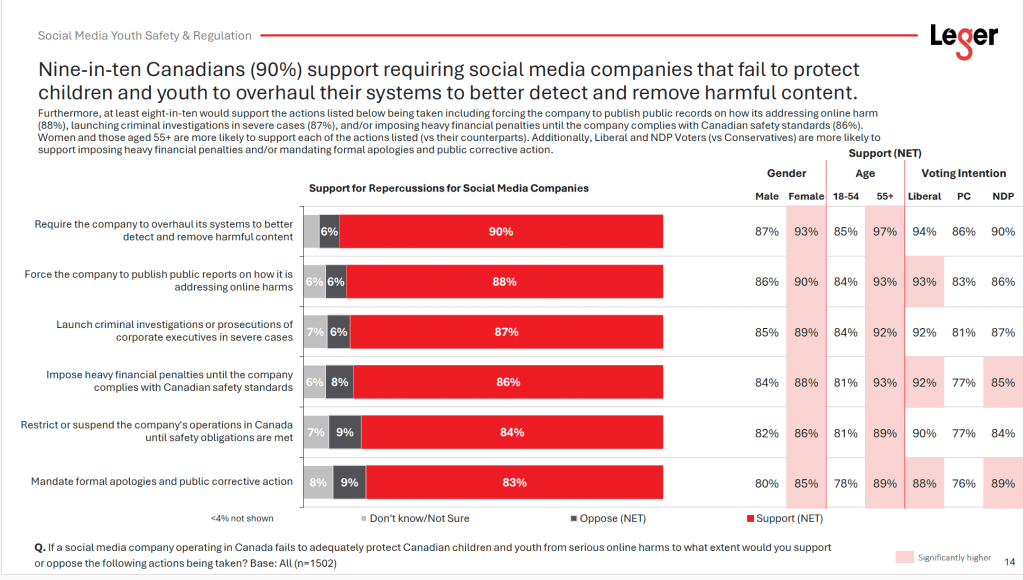
The bill also has some solid polling support, I’ve provided a link to a Leger poll below.

The Liberals under Justin Trudeau fought the bill and held it up in the House until it died. An interview with Miville-Dechêne that I will publish this weekend provides some insight into that.

Now that the bill is back in a new session of Parliament we will have to see if the Carney PMO takes a different approach to the issue. 

The bill has passed second reading in the Senate without serious opposition and third reading approval ought to happen quickly. Then the bill goes to the House where the all important gatekeeping in House committee must be navigated. Even if the bill is opposed by the Liberal government, S-209 is not a “private member’s bill” that can be shunted to the back of the queue. As a Senate bill, and without a majority government controlling committee votes, S-209 might grab the Parliamentary spotlight sometime in the next year. 

The bill was once denounced by Michael Geist as “the most dangerous Internet bill you never heard of.” Canadian privacy activist David Fraser has a YouTube video that parses the legalities of the legislation, salted with some unlawyerly insults of the bill’s supporters.

The kind of things you will hear in opposition to the bill include:

  • Age verification technology may not protect privacy and we should rely on parental, not state, regulation.
  • Site blocking injunctions may go beyond “de minimus” intrusions on non pornographic content and usher in fast and loose censorship of the Internet.
  • Regulating porn is for Puritans, “finger waggers and pearl clutchers.” (Fraser’s words)

It’s also important context that age verification for porn bleeds into broader policy issues.

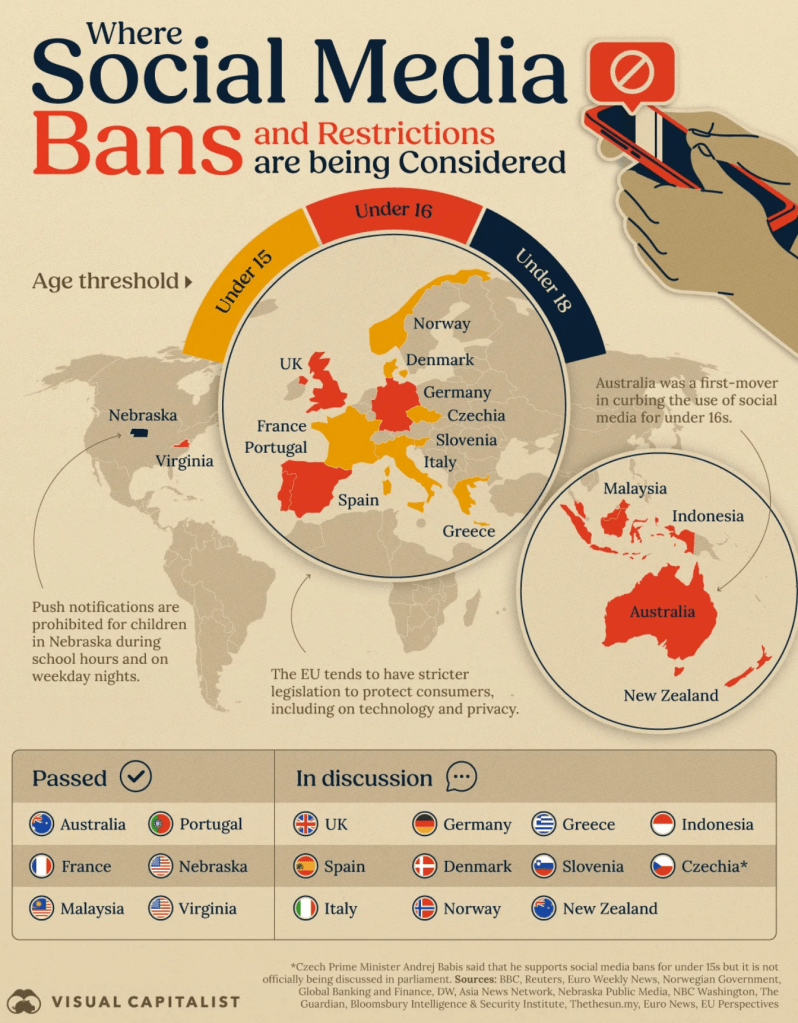
Other countries are further ahead of Canada on age verification for porn sites, in multiple American state jurisdictions as well as the United Kingdom. The US Supreme Court just ruled it constitutional.

But age verification is also the enforcement mechanism for legislation that goes beyond access to porn to viewing all sorts of social media content deemed harmful, so opponents see S-209 as the proverbial slippery slope. The Americans and the British are well underway with this and Canada’s federal justice minister is contemplating the revival of the Liberals’ own online harms bill.

These kinds of debates echo the big question that you’ve read about here and elsewhere for the past five years: is policy based regulation of content over the Internet acceptable, or is the wild and free Internet untouchable?

***

If you would like regular notifications of future posts from MediaPolicy.ca you can follow this site by signing up under the Follow button in the bottom right corner of the home page; 

or sign up for a free subscription to MediaPolicy.ca on Substack;

or follow @howardalaw on X or Howard Law on LinkedIn.

I can be reached by e-mail at howard.law@bell.net.

This blog post is copyrighted by Howard Law, all rights reserved. 2025.

Catching Up on MediaPolicy – Election news deserts – “the Americans will run over us”- Andrew Coyne’s true secrets

August 5, 2025

The Public Policy Forum has followed up its February reportThe Lost Estate” on the state of local news with a study of news poverty at election time. 

“Uncovered” advocates scaling up a philanthropy-funded news pilot project launched during April’s federal election in select Canadian cities and rural areas. 

The harm identified in the Report is the lack of public engagement with federal MP candidates over election issues that have special resonance in the local area, for example fishery issues on either coast.

The report includes vignettes of five local races where news poverty might have been a big problem in April. The most glaring was the news desert of Bonavista in Newfoundland and Labrador, a rural riding won by the Conservatives in a razor-thin judicial recount.

On the other hand, the report finds that Yellowknife NWT was well served during election time by a robust local news ecosystem in an isolated regional hub.

The report echoes what TMU’s Local News Research Project identified some time ago: the worst effects of deteriorating news ecosystem are felt in rural areas but also in neglected suburbs of media-rich cities (Richmond BC and Vaughan ON are two such vignettes in the Uncovered study).

Uncovered recommends more philanthropic fundraising for local reporting in future federal elections. 

The message running throughout the Report is the importance of local news as a gateway to civic engagement —-and voter education—- for Canadians that are exhausted by polarizing national and international news and hungry for information about local issues that more directly affect their daily lives. 

***

The meme of New France’s fall to the English runs throughout the L’Actualité feature story, “What will remain of our national idols?”

Québec’s Culture Minister Mathieu Lacombe enthusiastically reposted this feature story in L’Actualité written by Guillaume Bourgault-Côté on Bill 109. That legislation tabled just prior to the summer recess is the CAQ government’s bid to compel foreign streamers to make French language audio and video content more prominent in Quebec. 

I’ve written about this issue more than once, I think it’s a political sleeper.

Lacombe’s bill is probably unconstitutional because the plan to make streamers offer a library of French language content as well as giving it prominence on the prime real estate of streamer and SmartTV home pages intrudes on federal jurisdiction over Internet broadcasting in the Online Streaming Act.

Were the CRTC already taking bolder steps to make French language content more easily discovered, his bill could be dismissed as performative politics. But the Commission hasn’t, at least not yet.

The L’Actualité story covers all of this familiar ground. Bourgault-Côté opines that “digital giants are now burying local cultures under tons of American productions. Quebec, supported by Senegal, France, and Switzerland, among others, is leading the resistance… while Ottawa dithers.”

Louise Beaudoin, the former provincial culture minister who wrote the key government report creating the policy foundation for Bill 109, is quoted saying “we absolutely must be as numerous as possible. Otherwise, the Americans will run us over.”

But the good inside baseball stuff comes at the end of the feature.

Bourgault-Côté chronicles the political tension between Lacombe and federal Culture minister Steven Guilbeault over the Carney government’s tip-toed support for Lacombe’s efforts to entrench stronger international legal standards, specific to Internet streaming, in amendments to the 2005 UNESCO convention on cultural diversity.

The energy in that tension is Lacombe’s opportunity to drive Bill 109 into the public eye during an election year in Québec and a minority Parliament in Ottawa. 

Lacombe’s CAQ is trailing the Parti Québécois in the polls and language policy is one way to make up that ground. 

In Ottawa, the Bloc Québécois may take up the standard. A federal Liberal minority government that owes its incumbency to its voter base in Québec cannot afford to leave too large a gap between a cautious approach to regulating foreign streamers and cultural nationalism. 

And then there’s the uncomfortable situation for the new leader of the provincial Liberals, former federal Heritage minister Pablo Rodriguez (the sponsor of Bill C-11, the Online Streaming Act). If it comes to a federal-provincial scrap over Bill 109 or Canada’s approach to strengthening the UNESCO convention, whose side is Mr Rodriguez on? 

The next UNESCO event is scheduled in Barcelona at the end of September and no doubt Lacombe will try to put the federal Liberals on the spot. 

And when Lacombe’s Bill becomes law and his government implements regulations on French language content, there’s the strong possibility of a legal challenge by the foreign streamers. At that point, the federal government will have to decide whether to endorse the streamer argument that a provincial government has no jurisdiction over online broadcasting. 

***

Here’s a short but interesting read. Harrison Lowman interviews Andrew Coyne in the The Hub

I think we could designate Coyne as Canada’s best known English-speaking intellectual, thanks to his considerable talent but also his privileged positions in the Globe and Mail editorial pages and CBC’s At Issue television panel. 

I’ve long written off Coyne as an irredeemable libertarian (sorry, libertarians) who is only brilliant when I agree with him (which is usually when he’s being pragmatic about domestic policy or commenting on international affairs). 

In the interview, Coyne gives us some insights into his thinking about what it means to be Canadian as opposed to North American.

His comments about the Canadian Charter of Rights suggest his free market liberalism is tempered by a pragmatism and respect for collectivist public policy. It takes a true policy nerd to say I’m a fan of constitutionally reasonable limits on freedom.

But when it comes to media and cultural issues, what Coyne is missing or dismissing is an appreciation of the overwhelming, anti-competitive American market power in the Canadian attention economy. 

That was why he could never see how the Online News Act was (at least in its original design) a competition remedy to Google and Meta abusing their gatekeeper power to stiff Canadian news outlets on a fair licensing fee for their content.

Same thing with the foreign media-tech juggernaut in video and audio entertainment.  Same thing with his support for defunding the CBC. 

***

The AI Death Star posts that recently appeared in this space raised the question of where the AI giants are going to get reliable information for their products if they put news outlets out of business. 

That prompted a reader to remind me about the agricultural aphorism “don’t eat your seed corn.”

Wouldn’t you know it, the Globe and Mail’s Ian McGugan had the same thought in this insightful analysis.

***

If you would like regular notifications of future posts from MediaPolicy.ca you can follow this site by signing up under the Follow button in the bottom right corner of the home page; 

or sign up for a free subscription to MediaPolicy.ca on Substack;

or follow @howardalaw on X or Howard Law on LinkedIn.

I can be reached by e-mail at howard.law@bell.net.

This blog post is copyrighted by Howard Law, all rights reserved. 2025.

Catching Up on MediaPolicy – Our Canadian AI Death Star – do our musicians stand a chance?

AI generated image – OpenAI

July 31, 2025

The latest development in the AI Death Star powering up to blast news journalism is Google’s AI Mode.

AI Mode is the longer form iteration on Google’s AI Overviews that presents brief information summaries in response to user inquiries on the Search platform. AI Mode has been released in the US and UK, but not Canada yet. It’s reported to be able to handle more complex information requests.

What AI Overviews and AI Mode have in common is they greatly reduce click throughs to news publishers’ websites that normally display as an algorithm-driven search response or links that might even be cited in the summary response.  That means less eyeballs and less advertising revenue for news outlets. Way less.

That outcome raises the obvious question: if news outlets become AI road kill, who will feed fresh content to AI?

All of this ought to be on Evan Solomon’s mind. The former career journalist is now the federal AI Minister. In a recent interview in Toronto Life, he said “my job is to develop a sovereign AI strategy while asking, ‘How can we make sure it causes more good than harm?”’

Solomon touted the opportunity for Canada to thrive in a job-rich AI sector. A more vigorous follow-up question might have been how he saw that happening. 

He didn’t point, but might have, to the recent announcement by Bell Canada and the Toronto-headquartered AI outfit Cohere of a co-venture targeting business and government clients in need of AI tools and the supporting infrastructure.

A Globe and Mail story makes it clear that Cohere is a favoured Canadian company, part of an evolving federal strategy for digital sovereignty. 

That includes a $240M allocation from the federal government’s $2 Billion “sovereign compute” program that is aimed at match-making Canadian suppliers with Canadian consumers of AI tools. 

“Cohere,” the Minister told the Globe, “is a really important company for us.”

Cohere, it might be noted, is being sued in the United States by various news publishers for ingesting copyrighted content without a license or compensation. As a former journalist, Solomon must have connected the public policy dots. 

***

The plight of the Canadian “musician middle class” —maybe we could just acknowledge it is more accurately described as an artist working class—  is the subject of the best thing I have read yet on the topic, Luc Rinaldi’s long feature “The Death of the Middle-Class Musician” that was just published in The Walrus.

There is a street narrative out there that says the music streaming gorilla Spotify is a soul-sucking, musician-impoverishing monster. Might be true, might not.

Rinaldi’s piece is sympathetic to musicians (hands up those who are unsympathetic) and, given the difficulty in obtaining data on musician earnings, provides strong indirect evidence that there is a real threat to Canada sustaining its supply of homegrown music. And that is despite the fact that Canada has a reasonably generous program of public and CRTC-generated subsidies, by international standards. 

But Rinaldi also wisely puts his finger on the important thing, namely the supply and demand for music in a sea of global content:

“The carrot that’s being dangled in front of an artist is their dream,” says Kurt Dahl, a Saskatoon-based entertainment lawyer…. “When people’s dreams are in play, they’re often not as rational or reasonable as they might be in the regular business world.”

 “You’re up against everything, from everywhere, all the time,” says Patrick Rogers, chief executive officer of Music Canada, an organization that represents the country’s major labels. “And if you’re willing to take on that challenge, the industry is in a position to help you.”

The challenge for media policy in music streaming is that the Internet-driven fragmentation of media creation and consumption has over rewarded a tiny elite of hit-makers, well beyond what existed pre-Internet. Everyone else lives on scraps.

Or at least that’s the view of media thinker Doug Shapiro, and he’s a smart guy. 

His latest blog puts forward his theory on this but i couldn’t get past the paywall ($18 per month, forget it) to read the whole thing. However his earlier and unpaywalled version is available here.

A crude summary of what he’s saying is that the “informational and reputational cascades” of popular content work fabulously well on the Internet. 

Roughly translated, he’s saying that algorithms perfectly capture our human tendency to sift through an ocean of content by paying attention to what other people found to be good content (informational) or what we need to consume because its a pleasing experience to connect with other human beings through a common culture (reputational). Maybe a little too perfectly.

***

If you would like regular notifications of future posts from MediaPolicy.ca you can follow this site by signing up under the Follow button in the bottom right corner of the home page; 

or sign up for a free subscription to MediaPolicy.ca on Substack;

or follow @howardalaw on X or Howard Law on LinkedIn.

I can be reached by e-mail at howard.law@bell.net.

This blog post is copyrighted by Howard Law, all rights reserved. 2025.

Catching Up on MediaPolicy – Kings, jesters and cable lords – the AI Death Star – PBS and NPR defunded – the next Dhanraj leak – how to fix the CBC

July 24, 2025

It’s a sheepish admission I make this week, but sometimes American culture wars can be so darn entertaining.

Take the recent exchange of verbal gun fire between President Trump, the US cable lords, and late night TV hosts that began with Stephen Colbert slagging his show’s owner, Paramount, for paying off on a meritless Trump lawsuit against CBS.

In case you’ve been ignoring it all, here’s a short news report from Global News explaining it.

More to my low brow taste, I enjoyed Jon Stewart’s satiric bird-flip to all those bending the knee to Trump, “Go Fuck Yourself.”

***

And then there’s the end of the world as we know it, otherwise known as AI.

I say this only half facetiously. What AI tools like Google Overview appear poised to do to news journalism may well be catastrophic, it depends on consumer adoption. 

But it’s entirely plausible that Big Tech’s scraping of copyrighted Internet content —-there are now third party web crawlers that steal and sell paywalled stories to AI companies —— could mean that a handful of global AI engines become our dominant “news” outlets so long as there remain employed journalists somewhere to be scraped.

The US Senate is holding some hand wringing hearings on AI scraping but, so far, it has a performative feel to it. Congress doesn’t do anything anymore without the White House saying so.

Our own federal government is taking a wait and see approach. Or to put it in their own words, AI Minister Evan Solomon is “closely monitoring the ongoing court cases and market developments.” 

***

There are no obituaries written yet for public broadcasting in the United States.

Congress finally passed the defunding of NPR radio and PBS television. In the US, public broadcasting was not as robustly funded as it is around the rest of the world. The annual Congressional allocation of $500M (USD) was about half of CBC funding for eight times the population and ten times the number of stations.

The federal dollars were only a sliver of overall funding of 1,000 local NPR stations, 350 PBS outlets and the national flagship operations. But funding was always heavily weighted towards local stations and local programming: the “left wing” national content that Republicans so despise is almost entirely privately funded. 

The precise consequences of defunding at the national and local level will unfold in the coming months after the scheduled September payment doesn’t arrive.

Perhaps it’s not a surprise that NPR CEO Edith Chapin just quit. 

***

The real-life CBC drama of Travis Dhanraj’s lawsuit and public campaign against his former employer released another episode this week. 

The National Post posted a story sporting a “leaked” audio clip of Dhanraj and his union representative in a meeting with CBC manager Andree Lau. The occasion was a discussion of his April 2024 X-post criticizing CBC President Catherine Tait for declining to be interviewed about CBC finances on his show, Canada Tonight.

The edited audio file is a bit of a nothing burger. Dhanraj tries to get Lau to spar with him about the journalistic ethics of CBC coming down hard on him for the post. He gets the better of the argument, mostly by default. That’s about it.

It’s not clear from the clip whether the meeting was a formal grievance meeting, normally a privileged and off the record discussion. CBC responded to the Post story by saying Dhanraj broke his promise not to record the meeting.

***

The McGill University Centre for Media, Technology and Democracy released a report on its two-year study of what is to be done about the CBC. The Hill Times covered it here and CBC News reported on it too.

You may recall that the Centre published an opinion poll in October 2024 that revealed very high public support for the CBC, qualified by strong desire for “changes.”

One of the weird things about this result is that the CBC-is-no-longer-needed vote goes up after a hypothetical addressing of major criticisms.

As the report authors observe dryly, it’s difficult to distill “a single perspective” about what needs improvement other than the fact that 78% of Canadians want to keep the CBC running.

One thing the report is very good on is that “Canadians need to be assured of the value of the product they will be paying for. Regular and in-depth demographic reviews of the audience should be established to determine the kind of content Canadians require and the way they need to receive it. Models for this form of consolation include nation-wide town hall meetings, citizens’ assemblies and comprehensive surveys of the public (not merely existing members of the CBC/Radio Canada’s audience).”

In addition, the report says that Parliament should enshrine a cycle of five-year mandate reviews of the CBC so that the relevance of the public broadcaster to what Canadians want keeps up to date.

Times two, I say.

The report goes on to say that the CBC must “create meaningful, not performative, representation [in its content]. This goal addresses equity, diversity and inclusion, but more broadly, political and regional diversity as well.”

Put bluntly, the CBC needs to convincingly reflect an audience that is broader than the heavily urban demographics of its newsroom if it’s going to be funded and enjoyed by all Canadians.

Parliamentary funding of CBC is of course the bottom line, whether up or down. The Carney government has adopted former Heritage Minister Pascale St.-Onge’s report on the CBC and made European levels of funding its aspirational long-term target. According to St.-Onge, that would mean the moving the yardsticks from $32 per Canadian annually to $62.

Give the authors of the report credit, they have broken the taboo on pointing out that French-language Radio Canada already matches European levels of funding of $79 per head while English-language services (from which Indigenous language programming is financed) languish at $25 per capita.

The taboo remains powerful enough that the report doesn’t recommend what to do about this funding gap.

In the end the authors suggest their own idea of what Canadians want out of the CBC: “information sovereignty.” In other words, a public broadcaster that protects the national interest in reliable news and information.

Their argument is made in the context of rising existential threats to our national security; including extreme weather catastrophes, pandemics, threats to our territorial sovereignty, and the surprising aggression from the United States, a country that controls much of the media we already consume. They might have added AI as yet another existential threat to information sovereignty, as noted above in today’s post.

The 80-page report comes with a three page Executive Summary.

***

If you would like regular notifications of future posts from MediaPolicy.ca you can follow this site by signing up under the Follow button in the bottom right corner of the home page; 

or sign up for a free subscription to MediaPolicy.ca on Substack;

or follow @howardalaw on X or Howard Law on LinkedIn.

I can be reached by e-mail at howard.law@bell.net.

This blog post is copyrighted by Howard Law, all rights reserved. 2025.

Catching Up on MediaPolicy – The CBC’s nightmare – Canadian ban on TikTok down to the wire – ‘Empathie’ on Crave

July 17, 2025

Travis Dhanraj’s lawyer is shovelling more coal into the litigation furnace by calling upon disaffected CBC staff to e-mail her with their complaints. 

In a video interview with Candace Malcolm of Juno News, Kathryn Marshall issued a series of claims to illustrate former news host Dhanraj’s allegation that there are systemic violations of employees’ human rights at the CBC. Marshall said her inbox was full of e-mails from former staff and invited more.

It’s doubtful that any e-mails Marshall solicits from CBC staff past and present would be legally admissible in the human rights proceedings she says she is initiating on Dhanraj’s behalf. 

But they can be theatre props in the public trial that Conservatives hope to schedule at the Culture and Identity (formerly Heritage) parliamentary committee in the Fall. 

The feeding frenzy of conservative attacks on the CBC occasioned by the Dhanraj controversy is hardly surprising, it’s a permanent feature of our political landscape.

The blood in the water would be salacious evidence of feuding between Dhanraj and the CBC Parliamentary bureau, described by Marshall in her Juno interview. Specifically, her claim is that “a very close knit gang of Ottawa correspondents” were resentful of Dhanraj’s success in getting Conservative Party guests on his show and tried to bar those guests.

Marshall said she has “names, receipts and e-mails.” Those revelations, says Marshall, are “the CBC’s nightmare.”

Marshall also told Juno News that the CBC sought to punish Dhanraj for his X-post about then CBC President Catherine Tait by taking away his show, demoting him, and demanding he sign a gag order. She described CBC’s actions as “Stalinist” and later in the interview accused Dhanraj’s union the Canadian Media Guild of collaborating with the CBC (which would be illegal).

You get the picture.

The point of this kind of public campaign as an accessory to a legal claim is to define the public narrative. So far that story is not only how Dhanraj was treated by the CBC, but the credibility of CBC news journalism itself.

The credibility of the CBC might appear to be in jeopardy according to Dhanraj and conservative critics, but that does not seem consistent with public polling.

Last week Pollara released its annual poll on Canadian news media. CBC News continues to top the charts on both consumption and public trust. In fact, it went up over the last year, as the graphic below shows.

Still, the endless right-wing barrage against the CBC destabilizes the public broadcaster (I exempt from this tar-brushing the perceptive podcast episode posted today by The Hub’s Full Press, which is worth your time).

The CBC has done nothing to counter the Dhanraj narrative of a corrupt news culture —-it’s issuing rote denials while awaiting the filing of Dhanraj’s human rights complaint. The result is that a bunkered public broadcaster leaves a vacuum for others to fill and they are obliging. 

The appointment of a new CBC President in January is now seven months old. After an early spate of interviews given by Marie-Philippe Bouchard, we’ve heard very little about any new direction or bold plans to meet criticisms or disappointments expressed about the public broadcaster.

That might be because Bouchard doesn’t know yet if the Prime Minister intends to keep his campaign promise to boost CBC funding by 11% this year, and more over time. That was complicated by this week’s disclosure that as part of its spending review the Carney government has asked CBC to submit a draft plan for deep budget cuts in 2026-2027.

Or it could be that Culture and Identity Minister Steven Guilbeault is still working on a new bill to implement election promises of better CBC governance and long-term financial independence that would require amendments to the Broadcasting Act.

MediaPolicy asked the CBC if there are any significant announcements coming and was told to expect something in the Fall. A similar inquiry to the Minister’s office did not get a reply in time for publication.

***

AI-generated image

This past week TikTok ramped up political pressure to convince the Carney government to undo the federal government’s 2024 decision to ban TikTok the company from Canada, but not the app. 

The Liberals’ decision on TikTok followed US legislation to ban both the company and the app on the grounds of national security. Subsequently it was given a stay of execution by Donald Trump in his effort to force a sale of the Chinese-owned social media company to American interests.

Like the US law, the Canadian ban is based on undisclosed and/or hypothetical national security concerns about data security and the distribution of malevolent content, sponsored by China.

TikTok says it is winding up its Canadian operations to comply with the federal ban. Meanwhile it has bought media advertising pleading its case to the Canadian public, posted a posturing letter asking for a meeting with Industry Minister Melanie Joly, planned layoffs of its 350 Canadian staff and withdrawn its funding of Canadian creator development and event sponsorships.

Aside from the sponsorship largesse, TikTok is a major distributor of Canadian cultural content. According to Scott Benzie of the creator group Digital First Canada, TikTok has engineered its algorithm to be a heavy distributor of local content for users that activate the location service on the app, perhaps as high as 50% of “Nearby” and “For You” video recommendations. That’s something that foreign streamers won’t commit to.

With a lawsuit against the federal government on the go, TikTok says Ottawa has taken “measures that bear no rational connection to the national security risks it identifies.”

For its part, the government insists its investigation under the Investment Act in 2023 revealed “clear and legitimate concerns.”

When the  ban was announced in November 2024, then Innovation minister François-Philippe Champagne said “I’m not at liberty to go into much detail, but I know Canadians would understand when you’re saying the government of Canada is taking measures to protect national security, that’s serious.”

The entire mess feels a lot like the Facebook ban on Canadian news even though the circumstances are quite different.

Michael Geist has published several articles on the TikTok ban, including this one, which apart from the familiar Liberal-bashing on digital policy I found persuasive (and it’s worth marking the occasion).

Another angle on the problem is something every Canadian is painfully aware of these days: when the American elephant rolls over, we can easily get crushed. And the crushers run the White House. 

The troubling question is who isn’t cynical about the merits of the American ban of TikTok in the first place? Or that we are just obediently playing a vassal state by following suit? 

The answer to the dilemma is for Carney to publicly defend the ban with as much disclosure of the national security threat assessment as possible, or to repeal it. 

***

The Big Tech/Big Hollywood court challenge to mandatory cash contributions to Canadian media funds might get an answer from the Federal Court of Appeal before Labour Day.

Until then, the MediaPolicy boycott of streamer subscriptions (Netflix, Amazon and AppleTV) continues. I don’t miss two of them.

In their absence, I’ve made better use of my CraveTV subscription. That allows me to recommend an excellent new Canadian series, Empathie, a sad and funny drama set in a Montréal mental health facility.

***

If you would like regular notifications of future posts from MediaPolicy.ca you can follow this site by signing up under the Follow button in the bottom right corner of the home page; 

or sign up for a free subscription to MediaPolicy.ca on Substack;

or follow @howardalaw on X or Howard Law on LinkedIn.

I can be reached by e-mail at howard.law@bell.net.

This blog post is copyrighted by Howard Law, all rights reserved. 2025.

The ticking media bombshell: Conservatives want hearings on Travis Dhanraj quitting the CBC

Television host and journalist Travis Dhanraj – CBC Photo

July 12, 2025

The fireworks ignited by television host Travis Dhanraj’s public resignation from the CBC will not be a flash in the pan. Not if the Conservative Party has anything to say about it.

The Conservatives are demanding summer Parliamentary hearings, a sequel to the political inquisition that followed the CBC’s annual payment of performance pay to some staff in late 2023.

Conservative headquarters also launched a volley of fundraising e-mails [download, below] citing Dhanraj’s “bombshell” resignation and reiterating its campaign promise to defund the CBC under the leadership of Pierre Poilievre, now standing in the August 18th by-election in Battle River-Crowfoot.

Dhanraj is a veteran television reporter and host who returned to the CBC in 2021 as a National Affairs correspondent and two years later, to much fanfare, as the host of Canada Tonight. At the time, CBC’s press release highlighted Dhanraj’s commitment to “unfiltered” and “diverse” journalism.

But last week Dhanraj announced his “involuntary resignation,” denouncing the CBC’s commitment to diversity as performative and promising detailed revelations to come. The CBC denied the allegations and cited confidentiality obligations as the reason for the brevity of its public reply. It also announced his resignation had been refused.

It’s difficult to recap the sequence of events leading up to Dhanraj’s pyrotechnic departure: much of it is connecting dots but will become easier to piece together once his lawyer Kathryn Marshall files a human rights complaint on his behalf.

The jumping off point appears to be Dhanraj posting a tweet in April 2024 that criticized the CBC for not making then-CEO Catherine Tait available as a news subject on his show, presumably to answer questions about the performance pay.

A public statement issued by his lawyer in February 2025 suggested that at one point he went on medical leave because of the psychological harm caused by CBC management’s alleged retaliatory actions towards him. 

In his own public statement, Dhanraj characterized his resignation this way:

It comes after trying to navigate a workplace culture defined by retaliation, exclusion, and psychological harm. A place where asking hard questions — about tokenism masquerading as diversity, problematic political coverage protocols, and the erosion of editorial independence — became a career-ending move.

In further statements, Dhanraj’s lawyer linked “the colour of his skin” to CBC’s alleged exclusion of conservative perspectives and news guests. Specifically, she said that CBC assumed when it hired him that as a brown man his news hosting would focus on liberal perspectives, to the exclusion of conservative guests and issues. A proven connection to race might violate the federal human rights code, if discriminatory.

Marshall welcomed a Parliamentary hearing and suggested that Dhanraj’s experience was “systemic” and goes to the heart of the CBC’s workplace culture and delivering on its public mandate:

Obviously, the issues that Travis has highlighted in his resignation letter and which will be part of a future legal proceeding are very serious, and they’re not just isolated to Travis. I’ve heard from a lot of other CBC employees who have similar stories. It’s a systemic issue, and it’s a workplace culture issue that goes very deep at CBC, which is very concerning given the amount of public funds going to the corporation and its public-interest mandate.

Sooner or later the Conservatives will take this up at the Culture and Identity committee, with MP Rachael Thomas grabbing the spotlight in the prosecutorial role she relishes. But it may bring more thunder than lightning due to the stifling effects of pending litigation.

If the Conservatives go as far as attempting a filibuster of other Parliamentary business (like government bills), the balance of voting power in committee will be held by Bloc Québécois MP Martin Champoux.  

***

If you would like regular notifications of future posts from MediaPolicy.ca you can follow this site by signing up under the Follow button in the bottom right corner of the home page; 

or sign up for a free subscription to MediaPolicy.ca on Substack;

or follow @howardalaw on X or Howard Law on LinkedIn.

I can be reached by e-mail at howard.law@bell.net.

This blog post is copyrighted by Howard Law, all rights reserved. 2025.

First glimpse of the AI media apocalypse

Image generated by WordPress/Open AI tool

July 9, 2025

Two news items about AI technology just grabbed headlines.

The first was the revelation by the UK news outlet Mail Online that its traffic referral from Google’s search engine is nosediving thanks to Google’s “AI Overview.” 

The Overview AI tool is a huge upgrade on Google’s old practice of providing a top ranked text reply to search queries, usually mined from Wikipedia. Overview threatens to divert any but the most hardened skeptics from a page full of search results to a single high quality synopsis, sporting just two or three priority links. 

The decline of web traffic is a calamity for news and information websites that count heavily on advertising revenue from referred traffic. No one is saying this out loud, but it might drive more unpaywalled news websites to a subscription model. That has implications for media policy that supports the vast array of unpaywalled media serving the largest audience cohort: casual news consumers. 

But paywalled or not, as the publisher of the conservative opinion website The Hub groused it’s the “centre-left” mainstream media that’s likely to dominate the few hyperlinks offered by Overview. And that’s if Overview actually keeps displaying the links, Google’s AI competitors might not even bother.

Overview has the potential to accelerate  the shift of ad revenue from news creators to platforms like Google. Not only does Google already monopolize Search and exercise illegal market power in digital advertising, but like all AI companies it is harvesting news journalism without licensing the content.

Another story that surfaced last week was an apparent AI song “recorded” by a fictional band hitting it big on Spotify.

AI-music is the latest, and most profound, evolution of Muzak and its heir, the day-long passive music algorithm. This is a big challenge to music as an art and as a business. As such, it will have a major impact on how Canadian music is created, monetized and heard.

***

As a follow up to the most boring post I ever wrote, I can report that the CRTC’s public hearings on the distribution of Canadian content wrapped up on Monday with a closing appearance from the Canadian Association of Broadcasters. 

CRTC Vice-Chair Adam Scott is on the panel. Because of, or in spite of, the fact that his background is telecommunications rather than broadcasting he often puts his finger on the crucial questions.

Scott asked the CAB spokespersons what they thought of the regulatory scheme proposed by Friends of Canadian Media for foreign online distributors. 

The algebra of the Friends’ proposal is to establish an overall contribution to Canadian content roughly equivalent to that already made by Canadian cable companies; say, an expenditure tethered to 30% of Canadian operating revenue.

From that 30%, says Friends, online distributors could deduct their 5% cash contribution to Canadian media funds as well as the non-cash value of their marketing and prominence of Canadian shows on home screens and recommendation tabs. The flexibility of the “deduction” approach opens the door to bespoke contributions by different online businesses. 

CAB President Kevin Desjardins colourfully described the Friends proposal as more like a piece of cheese offered to the streamers than a mousetrap, meaning the CAB would still like to see some general commitments to Canadian content that all online distributors would have to meet. 

What was disappointing, Desjardins told Scott, was that the foreign streamers have avoided any formal commitments to Canadian content other than being left alone to carry on their business in Canada. He suggested that the Commission insist the streamers submit proposals in the post-hearing phase of the public consultation. 

Another question raised by the Commission got my union-antennae twitching.

In 2022 the Liberal government decided to handcuff the CRTC on the available tools to regulate online distribution platforms in the instances where Amazon, Apple, Roku et al might be willing to carry Canadian programming but only on their one-sided terms for revenue splits or screen prominence. 

Instead of conferring dispute resolution powers of arbitration on the CRTC, Bill C-11 restricted the Commission to adjudicating a standard of  “good faith negotiations,” backed up by powers to fine violators.

As any union rep (or small commercial party) knows, good faith doesn’t tip the scales of power imbalance. 

Canadian labour law remains mired in the good faith swamp after decades of jurisprudence that tries to distinguish between hard bargaining and illegal “surface” bargaining, ie the powerful party going through the motions while quietly messaging  “it’s my way or the highway.” In this legal fiction, the actual content of proposals is almost irrelevant. The stronger party can be as hard nosed as it likes.

The CAB referred the Commission to the American FCC’s definition of good faith bargaining. But it looks a lot like surface bargaining, to be honest.

In the labour world, Ontario passed a law in 1986 on the resolution of first contract negotiations following unionization, when corporate intransigence is at its worst. The main feature was binding arbitration, exactly what has been denied to the CRTC.

But the “good faith” standard was upgraded from the vexing “hard vs soft bargaining” distinction to a multi-factor test in which the Labour Board scrutinizes “the uncompromising nature of any bargaining position adopted without reasonable justification.”

If the CRTC pursued this kind of thinking about good faith, it would have an evidence-based opportunity to require an intelligible “justification” for playing hard ball and that it be reasonable.

***

Perhaps there’s been enough said about Prime Minister Carney’s blink on the Digital Services Tax.

Nah.

Hugh Stephens posted his view, similar to what you read in MediaPolicy. In the course of his piece, he links to a 2020 background study published by the Library of Parliament shortly after Royal Assent to the 2019 Bill C-82, which was the enabling legislation for the DST. 

The Library study takes the tax narrative from its origins in OECD discussions in 2013 to February 2020, a month after Joe Biden was inaugurated as US President.

It’s a useful read in a couple of ways.

First, the blow by blow history makes it clear that many of the urban legends around the DST are wrong. It was never a “data tax,” or an “audience tax,” or a “make Big Tech pay” tax.

It was a response to the problem of digital companies operating in Canada without “a permanent establishment” that makes the company’s product, like a factory or a mine. Without changes to the permanent establishment rule, foreign digital companies can freely offshore their Canadian revenues (or just pay tax on them in their home countries). 

The other thing that the Library study does is follow the negotiation narrative among OECD countries and with the US.

A first-term Trump was opposed to the DSTs being legislated in Europe and threatened retaliation. Once Trump lost the election to Biden, the UK and France moved quickly.

Canada lagged for reasons best known to the Finance Minister and the PM. Perhaps they were waiting to see if President Biden could get Congress to ratify a new tax treaty that would curb the use of offshore tax havens and agree to a minimum global corporate tax rate.

We know the outcome. Nice guys finish last. 

***

If you would like regular notifications of future posts from MediaPolicy.ca you can follow this site by signing up under the Follow button in the bottom right corner of the home page; 

or sign up for a free subscription to MediaPolicy.ca on Substack;

or follow @howardalaw on X or Howard Law on LinkedIn.

I can be reached by e-mail at howard.law@bell.net.

This blog post is copyrighted by Howard Law, all rights reserved. 2025.

Catching up on MediaPolicy – dirge for the DST – Hollywood gets state cash – online harms legislation still cooking – who stole the music grants?

CBC explainer on the repeal of the Digital Services tax

July 5, 2025

Soon the wake for Canada’s digital services tax (DST) will be over and the news cycle will re-fire for the next trade battle with the United States.

Prime Minister Carney’s repeal of the DST was mocked by the victorious White House as a Canadian “cave.” Within hours, Canadian critics were queueing up, condemning Carney’s move as “bootlicking” (Lloyd Axworthy) and “bending the knee” (Le Devoir). On the other hand, Jean Charest described it as “a legitimate choice in a world of very bad choices.”

The MediaPolicy take on it is here.

The CBC has a hip two-minute cut-for-social video explainer narrated by the tattoo-embossed Nick Parker.

And for another take, here’s Paul Wells interviewing Canadian tax expert Allison Christians.

President Trump has promised to re-announce tariffs this week. Carry on Canada.

***

Two months ago when Donald Trump blurted out his desire to tariff US movies filmed abroad he got a tepid response from the supposed beneficiaries, Hollywood studios and the Big Tech streamers.

That’s because the studios and streamers make so many movies in Canada, at a competitive and government-subsidized cost, with world class quality.

What Hollywood really wanted was production subsidies from the US federal government, but so far that has not happened.

Now California is stepping up to the plate. Governor Gavin Newsom is prepared to double existing state subsidies to the tune of $750 million, quite a slice of the pie in what is otherwise a major austerity budget for the state.

***

The Canadian Press has reported that Justice Minister Sean Fraser is having a close look at the federal Liberals’ online harms legislation before re-tabling it.

Bill C-63 died on the order table when Mark Carney called a federal election in March. The core of the Online Harms Bill was to require social media platforms to establish content safety codes, legislation that polling suggests is a winner.

The add-ons to the bill were more controversial. The opportunity for private citizens to file anti-hate complaints against each other under federal human rights legislation, abolished by Parliament in 2012, is to be revived.

And the anti-hate provisions in the Criminal Code are to be strengthened with more severe punishments. MediaPolicy offered some perspective on that, here and here.

Prior to the election, then Justice Minister Arif Virani reluctantly split the controversial from the core elements of the bill into separate legislation. Neither bill was taken up by Parliamentary committees in the months leading up to the election call.

The CP story quotes the new Minister as wanting to make his own “fresh consideration of the path forward.”

At the very least the Minister may steal the best ideas from the Conservative election promise on deep fakes.

***

There are two 15-minute weekend reads on media that I can recommend.

In his personal blog “Fagstein,” the Montreal Gazette’s Steve Faguy has posted a short history of the CRTC’s decades long struggle to keep local television news solvent.

He’s done a great job. I know how hard it was as I tried to do the same in a shorter space in chapter six of my book on the Online Streaming Act. Faguy’s post is the learning resource that has been missing.

The other read is a feature story from the Globe and Mail’s Josh O’Kane. He’s updated his whodunnit reporting on the cyber-theft of $10 million from FACTOR, the music funding organization that distributes dollars contributed by government, radio stations and (subject to a court appeal) music streaming companies to Canadian musicians.

***

If you would like regular notifications of future posts from MediaPolicy.ca you can follow this site by signing up under the Follow button in the bottom right corner of the home page; 

or sign up for a free subscription to MediaPolicy.ca on Substack;

or follow @howardalaw on X or Howard Law on LinkedIn.

I can be reached by e-mail at howard.law@bell.net.

This blog post is copyrighted by Howard Law, all rights reserved. 2025.

Carney’s “cave” to Trump on the DST roils Canadians

July 2, 2025

Mark Carney’s shock repeal of Canada’s digital services tax on the eve of Canada Day was greeted by a gloating fan-dance by President Trump’s press secretary who claimed that “Carney and Canada caved to Donald Trump and the United States of America.”

In a brief news interview the Prime Minister suggested that the corporate tax measure, designed to capture offshoring of Canadian revenues by US tech companies, was never going to be in the final trade deal that he is working on with Donald Trump. MediaPolicy expressed its view on all of this in Monday’s post.

This might end up as a historic moment of humiliation, pending future events.

The backlash against Carney has come from all sides. He may be fortunate that Parliament is not in session and his minority government doesn’t have to face the music until the Fall. No doubt, that was his calculation.

Today the Toronto Star published an open letter signed by Canadians for Digital Sovereignty who describe themselves as “a group of patriotic Canadians and civil society organizations who care deeply about the future of Canada.” The letter expresses the concern that backing off the digital services tax will embolden Trump to press other trade demands, in particular where Big Tech and Hollywood are involved.

Carney might regard some coalition members as the usual suspects in public policy matters affecting digital and cultural sovereignty, but the inclusion of others suggest a broader opposition that ought to disquiet the Prime Minister.

The members of the coalition hail from English speaking Canada. From what I have seen on social media, their French-speaking counterparts in Québec are angered by Carney’s DST climb-down and their displeasure will be expressed.

Here’s the Open Letter:

Open Letter: Canada cannot afford to concede more to foreign tech giants

Dear Prime Minister Carney and Minister Champagne, 

We are a group of patriotic Canadians and civil society organizations who care deeply about the future of Canada. We are disappointed by the government’s decision yesterday to both halt collection of the Digital Services Tax and eventually repeal the Digital Services Tax Act. As a result, on Canada Day, foreign tech giants will enjoy an immediate $2.5 billion windfall and a $7.2 billion tax break over the next 5 years. While we recognize the difficult choices facing the government, we feel that we cannot ‘build Canada strong’ while surrendering ever more of our digital sovereignty and security.

We urge the Government of Canada to:

(i)                  Find ways to use foreign tech giants’ massive untaxed profits to fund homegrown alternatives, despite proposing that Parliament repeal the Digital Services Tax Act 

(ii)                Strengthen Canada’s digital sovereignty in trade negotiations and in undertaking a reset of Canada’s forward digital policy agenda, and

(iii)              Make no further concessions to foreign tech giants, including on legislation passed by Parliament (the Online Streaming ActOnline News Act) or in addressing urgent matters including combatting online harms, regulating artificial intelligence, ensuring the integrity of the information environment (including for health information), protecting privacy, among other measures to rein in foreign tech giants’ negative impacts on our economy and society.

 Foreign tech giants, especially U.S.-based companies, have made hundreds of billions of dollars in Canada in recent decades and yet have not paid their fair share in taxes. Many enjoy tax breaks on digital advertising paid for by Canadians thanks to a loophole in the Income Tax Act. We are one of the largest digital markets in the world, with a highly online population, skilled workers, and innovative companies. Yet in 2023 alone, U.S. tech giants made $20.7 billion in Canada from distributing online content. U.S. tech giants are crushing domestic competition, dominating our markets and imposing a range of externalities on Canadians. They profit from the amplification of online harms, including the spread of false and manipulated information, hurting the mental and physical health of children along with all Canadians. They are eroding the economic basis for the professional news media and feeding the toxification of our increasingly digital public sphere upon which our democracy depends.

The Digital Services Tax is a modest yet much-needed measure that will ensure foreign tech giants are more fairly taxed and held accountable for their enormous power over Canada’s society and economy. We are disturbed to see the alignment of CEOs of Alphabet, Meta, Apple, Amazon and X Corp. with the current U.S. administration’s agenda, which threatens Canada’s political and economic independence.

Rather than repealing the DST, we urge you to consider how foreign tech giants’ massive unfair profits in Canada could be taxed to invest in Canada’s digital sovereignty, building homegrown alternatives to U.S. monopolies. At many times in our history, Canada has invested to build communications infrastructure in the national interest. Canadian companies can help build platforms, networks, and tools that reflect Canadian values, strengthen our cultural and information ecosystems, and nourish our diversity as a country with two official languages and three founding peoples – Indigenous, French, and English – so that Canadians in communities across our far-flung country can better serve their own needs to communicate and connect.

We note that the U.K. did not make concessions to their digital services tax to get a trade deal with the US.

We stand ready to help our government, to inform and rally Canadians to help build our digital sovereignty and a better digital society.

Regards, 

Organizational signatories

ACTRA National
Amanda Todd Legacy Society
Broadbent Institute
Canadian Anti-Monopoly Project 
Canadian Centre for Policy Alternatives
Canadian Centre for Child Protection
Canadian Federation of Nurses Unions
Canadian Medical Association
Canadian Media Guild
Canadians for Tax Fairness
Centre for Media, Technology and Democracy
Children’s Healthcare Canada
Community Radio Fund of Canada
The Dais 
Documentary Organization of Canada
Friends of Canadian Media
Goodbot Society
Inspiring Healthy Futures
Open Media
Pediatric Chairs of Canada
Reset Tech
Unifor National & Local 87-M

Individual signatories
Mike Ananny, former advisor to Canadian Heritage on the future of CBC/Radio-Canada, and Associate Professor of Communication and Journalism, University of Southern California

The Right Honourable Adrienne Clarkson, CC

Linda McQuaig, author and journalist

Taylor Owen, Director of the Centre for Media, Technology and Democracy and Associate Professor at McGill University

John Ralston Saul, CC

Leslie Regan Shade, Professor Emerita, Faculty of Information, University of Toronto

Paul Valée, CEO of Tehama.io 

Dwayne Winseck, Director Global Media and Internet Concentration Project, and Professor School of Journalism and Communication, Carleton University

***

If you would like regular notifications of future posts from MediaPolicy.ca you can follow this site by signing up under the Follow button in the bottom right corner of the home page; 

or sign up for a free subscription to MediaPolicy.ca on Substack;

or follow @howardalaw on X or Howard Law on LinkedIn.

I can be reached by e-mail at howard.law@bell.net.

This blog post is copyrighted by Howard Law, all rights reserved. 2025.

Carney blinked.

June 30, 2025

Mark Carney blinked. He blinked hard and killed the billion-dollar Canadian digital services tax on US tech giants. He did it because Donald Trump threatened to punch Canada in the nose. 

After years of calling the shots as a business CEO and bank governor, the Prime Minister is discovering how tough it is to play the weaker hand when negotiating —-well, trying to negotiate—- with a bully like the United States. 

Trump not only wanted the DST to be cancelled, he demanded on Sunday morning it be repealed as a condition of further negotiations over tariffs, trade and continental security.  On Sunday evening Canada folded.

Carney cancelled the DST literally hours before the Silicon Valley titans were obliged to send us about a couple of billion dollars in corporate tax remittances, after years of Canada delaying the tax in the hope of coming up with an alternative measure to address the problem of US tech giants reducing their global tax bill by offshoring revenues earned in Canada and countless other jurisdictions. A deal with former President Joe Biden fell through because US Congress would not ratify it.

The rapid chain of events on Sunday had a whiff of Kabuki theatre: it’s plausible that weeks ago Carney made the decision to clear ballast from his trade agenda, much as he did with a carbon tax he once endorsed, but he needed Trump’s threat of walking away from the trade talks to do so. Whether Carney and Canada got anything from Trump in exchange for this unilateral concession we may never know.

It’s an understatement to say there is a disturbing pattern taking hold. Canada spent $1.3 billion on border security to rebuff Trump’s first round of trade tariffs triggered on the phony pretext of fentanyl smuggling.

We enacted and then suspended most of our retaliatory tariffs in hopes of expedited trade negotiations.

We joined hands with NATO allies to click our heels at Trump’s demand that NATO countries more than double their defence spending to 5% of GDP.

And as a ten out of ten on the cringe scale, who can forget Ontario Premier Doug Ford’s bumbling bluff to cut electrical power exports to the United States.

Carney is gambling that Trump won’t see the DST climb-down as weakness and be emboldened. If Canada was the European Union of 400 million souls, an ocean away from the US, the Prime Minister might have chosen a different strategy.

What’s the right way for Carney to play this in the next few weeks?

I spent my trade union career negotiating against powerful companies, usually playing the weaker hand unless the rank and file were angry enough, for a long enough period of time, to face down their employers. One of the key responsibilities of the negotiator is to figure out your own strength.

This is Carney’s challenge. How resilient are Canadians in our collective commitment to economic defence against the Trump onslaught? We get riled up by Trump’s “51st state” threats. But are we tough enough for a grinding trade war of attrition that lasts until Trump’s economy tanks and he has to face mid-term voters next year?

This is a question that the Prime Minister must ask himself every day. It is a question we must ask ourselves.

Our first test of bargaining solidarity is for our politicians, especially our provincial premiers. I suppose we could ask them to just shut up and let the winner of the federal election speak for Canada and certainly not head south to cut their own deal with the US President at Mar-a-Lago. 

But voters expect their elected officials to speak up for their constituencies —-Alberta Premier Danielle Smith has every right to remind us that the oil patch is as important as the auto industry— or else they will no longer be elected officials. But there is a line to be drawn and respected.

The same test of solidarity can be expected of non-elected political agents. The chorus of domestic critics of the tax on Uber, Google, and the other digital titans has mischaracterized the tax as just another cynical cash-grab from Big Tech companies that are better left unregulated. 

Canadian journalists have tried to correct that misimpression, reporting on the DST as a story of global tax policy. The story is that Canada was a relative latecomer to the international consensus among OECD nations that US Big Tech was offshoring revenues earned in other countries to tax havens like Ireland and that national digital taxes were the best way to combat it until the cheating stopped. 

Most European Union nations have already implemented their digital services taxes. While the US President still has those levies in his trade crosshairs, any changes will come at the negotiating table where the EU can pursue a solution to the offshoring problem. In a recent announcement, US Treasury Secretary Scott Bessent said that the US was prepared to mirror OECD/G20 nations’ tax policies on a minimum corporate tax even though the US will not ratify a tax treaty on the matter. 

The details of this recent understanding between the OECD and the US are still hazy. 

The EU is keeping its DSTs, for now, because it has some things that Canada doesn’t. Like, the EU nations’ DSTs were already implemented and they had not delayed them out of good will as Canada did. Like the trade of EU nations is less exposed to the United States than Canada’s is. Like, the EU can fall back on an internal trading bloc of 400 million.

The EU will discover, as Canada is, that a solid front at the bargaining table is the only way to defend economic opportunity and political sovereignty against Trump’s trade war. 

If it’s all over quickly because we can’t keep a grip on our internal solidarity, we will have lost the trade war. And losing the trade war could mean losing our country

***

If you would like regular notifications of future posts from MediaPolicy.ca you can follow this site by signing up under the Follow button in the bottom right corner of the home page; 

or sign up for a free subscription to MediaPolicy.ca on Substack;


or follow @howardalaw on X or Howard Law on LinkedIn.

I can be reached by e-mail at howard.law@bell.net.

This blog post is copyrighted by Howard Law, all rights reserved. 2025.