
Image by OpenAI
Are you not entertained? Richard Stursberg wants CBC audiences to say yes
November 8, 2025
This week MediaPolicy posted a guest column from Richard Stursberg, the former Vice President of CBC’s English language service, reflecting on the public broadcaster’s recently announced Five Year Plan.
You won’t be sorry you spent five minutes with it. It’s a compelling read. Stursberg is one of the few commentators who puts as much emphasis on CBC’s entertainment programming as he does the news service.
Stursberg sets a simple performance bar for the CBC: is it good television? And then he offers a hypothetical new season(s) of great shows that could meet that standard and bring a real buzz to the CBC’s CanCon offerings, while satisfying our Canadian cultural cravings.
The CBC just got its $150 million booster shot in the federal budget. That money fulfilled an election promise. The 11% increase to the $1.4 billion Parliamentary grant (70% of CBC’s overall $2 billion revenue) won’t necessarily go into a bigger budget for entertainment programming: the Five Year Plan prioritizes local and regional news reporting. But it does give the public broadcaster more options.
The CBC’s new money was the Carney government’s sole increase to cultural funding in this week’s budget. Culture and Identity minister Steven Guilbeault told the Globe and Mail that the public broadcaster had also been spared from the “15% savings” spending review announced by the government several months ago.
Budget announcements for the Canada Media Fund, the Canada Music Fund, TV5MondePlus, Telefilm, the National Film Board and Special Measures for Journalism (community weeklies) are all multi-year extensions of supplemental funding previously put in place by the Justin Trudeau government.

On the other hand, the budget document includes projected cuts to Canadian Heritage expenditures which might be either civil servant salaries or “recalibrated” program spending. Guilbeault pointed out to the Globe that the $93 million savings figure was 5%, not 15% of expenditures.
The numbers on recalibrated programs might include the scheduled reduction of the federal labour tax credit from 35% to 25% of journalist salaries on January 1, 2027. As well, Guilbeault told the Globe the government was exploring a merger of the Canada Media Fund, Telefilm and the National Film Board.
The budget document included a brief note that changes are in the works for the Canadian Periodical Fund that subsidizes weeklies and magazines (the government only told me that the details would be communicated at a later date).
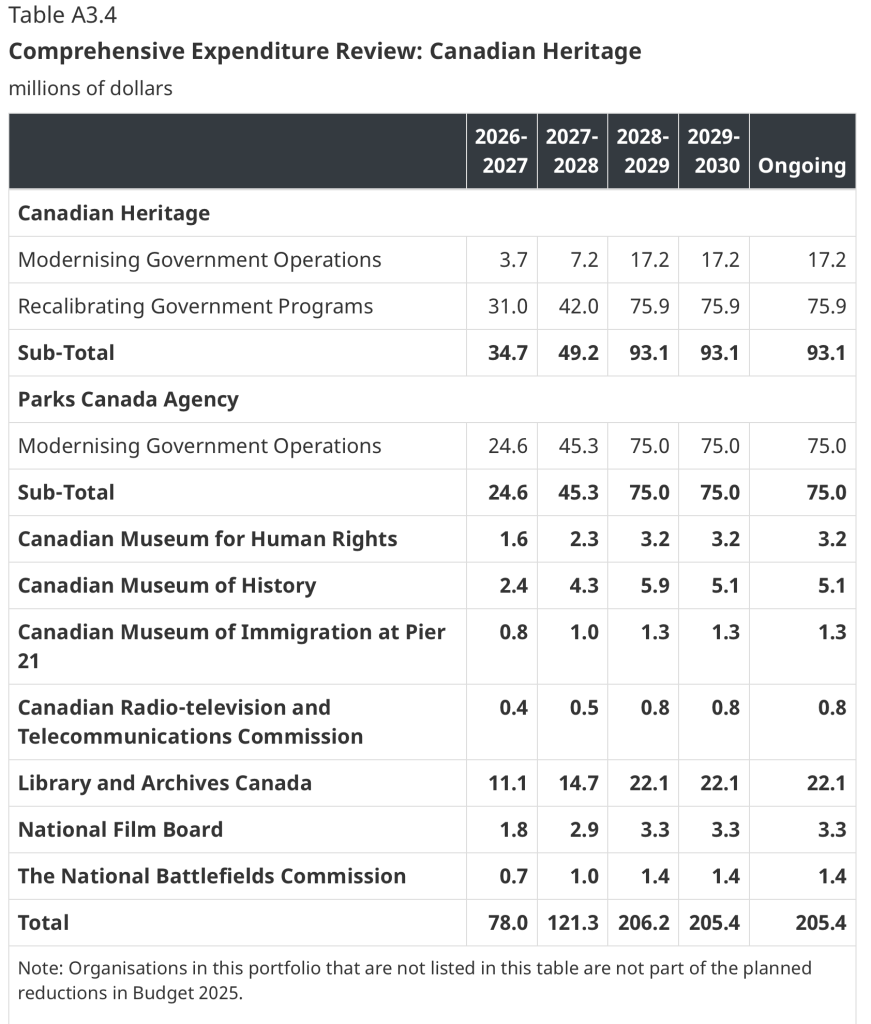
The status quo on cultural funding shouldn’t be surprising, given other priorities in 2025.
Still, TV and radio news outlets were miffed that the government didn’t end its arbitrary exclusion of broadcasting companies from accessing federal aid for their online news websites that —-but for the television and radio properties operated by their parent companies—- would be eligible for the $75 million pool of journalist salary subsidy available to all online news outlets.
***

There’s a useful explainer posted in Paula Clark’s Substack about the Blacklock’s Reporter litigation with the federal government over Parks Canada’s sharing of a paywall password obtained from an individual subscription, giving unlimited access to every article in the Reporter’s database.
The watchdog news website was in court last month, appealing a controversial trial ruling in favour of the government which appeared to bless the government’s actions and give short shrift to copyright protection.
Among the many legal frailties of the trial judge’s decision is that it appears to expand the public right of “fair use” sharing of quotations or text snippets to authorize redistribution of full articles and, thanks to the password sharing, Blacklock’s entire news archive.
It’s a legally complicated appeal, which is why’s Clark’s piece is helpful.
***
As you know, in 2023 Meta responded to Parliament passing the Online News Act by banning most news content from Facebook and Instagram in Canada (a news outlet can pay Meta to post content as an advertisement).
The ban hit the many Canadian news outlets relying heavily upon Meta platforms for content distribution. While the news blackout probably impacted free sites harder, paywalled sites were affected too.
The marketing director at Le Devoir is claiming a measurable success in making up for the lost distribution by working a lot harder at its direct engagement with readers, especially demonstrating the value of content to new subscribers.
Meta hasn’t entirely given up on Canadian news journalism of course. Just last week The Hub published a well argued commentary advocating against the federal government pursuing a digital sovereignty strategy. Meta sponsored the article.
***
The Australian government has moved the yardsticks on implementing something like Canada’s Online Streaming Act for Netflix and the other foreign video streamers, a move it has been mulling over since early 2023.
The legislation hasn’t been tabled with details yet, but the announcement suggests the streamers will have to spend 7.5% of their Australian revenues on local entertainment programming. Australian-owned television companies are already required to meet spending quotas for local content and they see the new law as a measure to “level the playing field.”
The news coverage of the announcement is unclear as to the impact of the legislation, as Netflix already invests in video production shot in Australia. It may depend upon the definition of local Australian content.
Significantly for Canadian observers, Australia is not proposing that the foreign streamers make financial contributions to Australian programming through contributions to third party production funds.
A report by the Australian Broadcasting Corporation speculates on whether the announcement will provoke a reaction from the Trump administration.
***
If you have the twenty minutes, I recommend Natalia Antelava’s incendiary interview of Google’s Richard Gingras in Coda, just for sheer entertainment if not enlightenment. Gingras is Google’s former VP of News and is currently the board chair of Canada’s Village Media.
Antelava goes after Gingras for some of Google’s controversial decisions in foreign autocracies, like agreeing to Vladimir Putin’s demand to spike a voting app set up for the Russian 2021 elections by the dissident, Alexei Navalny, who later died, possibly poisoned, in a Putin prison.
However on the main interview topic of the power asymmetry between Google and the news industry, Gingras sticks to his story that Google’s relationship with publishers is collaborative, not exploitive, which requires him to engage in some grimace-inducing denialism about Google’s abuse of market power over news outlets in Search and digital advertising, both of which have been ruled illegal monopolies by US courts.
Another tidbit: Gingras claims that Google CEO Sundar Pichai was embarrassed by the now famous line-up of tech CEOs attending the Trump inauguration and suggests the photo op was “cleverly staged” by the White House.
“That’s the last photo Sundar ever wanted taken,” says Gingras. “We don’t support this administration.”
Only the ballroom.
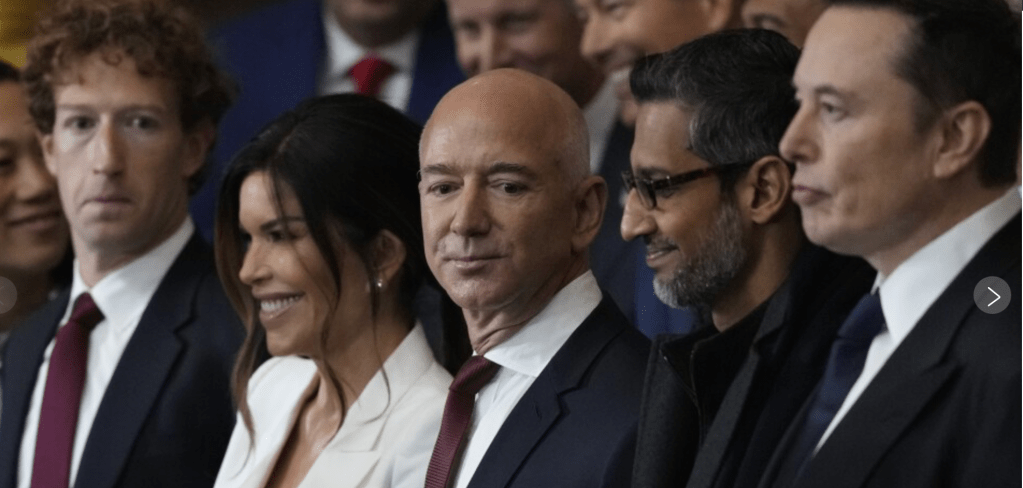
Associated Press photo of Tech CEOs Zuckerberg, Bezos, Pichai and Musk.
***
If you would like regular notifications of future posts from MediaPolicy.ca you can follow this site by signing up under the Follow button in the bottom right corner of the home page;
or sign up for a free subscription to MediaPolicy.ca on Substack;
or follow @howardalaw on X or Howard Law on LinkedIn.
I can be reached by e-mail at howard.law@bell.net.
This blog post is copyrighted by Howard Law, all rights reserved. 2025.











 MediaPolicy.ca