The Dais report probed how Canadians get our news, how misinformation is consumed, the prevalence of hate speech, and public attitudes about using government to fix it. (This is the fifth annual report from the Dais, a two-minute video on its 2023 report can be viewed here.)
The Dais analysis of online harms —it includes false information among the harms— is the juicy stuff. I’ll keep that warm for my next post.
Mainstream media dominates
As for news sources, The Dais report confirms what we already knew: “legacy” television news is far and away the most popular news source for Canadians:
In fact, the Dais report shows that “yesterday’s man” of Canadian media is creeping even higher over time (Figure 5). And look above in Figure 4 who’s standing next to television on the podium: news websites and radio. It’s a clean sweep for mainstream media and the news organization that make it up.
On the other hand, the 2024 Reuters Digital Report for Canada lumped together a collection of “social media” platforms to claim third place for news consumption (whereas the Dais Report above breaks out those platforms, individually).
The results are of course skewed by age cohort (Figure 6 in the Dais Report). Younger Canadians (16-29 years) are more likely to source their news from search engines and social media, also observed by Pollara earlier this year.
As for trust in the news that Canadians are consuming, again it’s mainstream media that rules. And the under-fire CBC is the king of credibility (Fig.10):
As an aside on the issue of trust in CBC News, the Dais notes that the public broadcaster’s 48% for “high” trust is elevated by a 64% score in Québec for Radio-Canada but weighted down by a 34% “high trust” in Alberta. Then again, those skeptical Albertans gave Global News and CTV the same score and even rated the Globe and Mail at 21%.
Perhaps the biggest token of skepticism is found in the Dais’ Figure 7. While noting television news’ dominant trust in comparison to other news sources, almost as many survey respondents replied that they didn’t trust any news sources, running the gamut from mainstream media to the entire Internet.
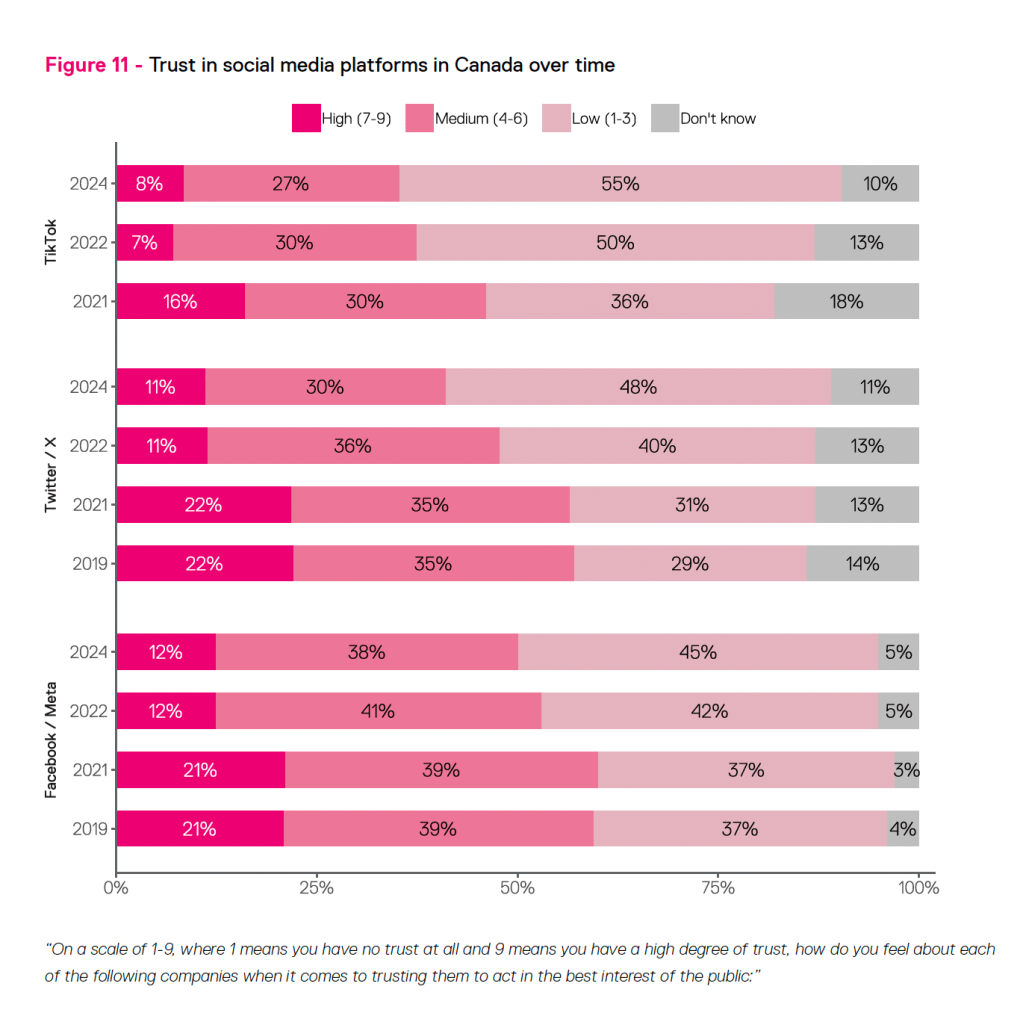
On the other side of the trust coin, popular trust of social media platforms is very low (and getting lower over time), even among the young Canadians who flock to them:
As MediaPolicy wrote this summer, the good news is that we are still a nation of news consumers. News avoidance and exhaustion is a real thing, but it’s not the main problem.
The main problem is the unravelling of news media’s business model, but the second biggest problem is Canadians’ declining trust in media and many other public institutions. That’s a world wide phenomenon, particularly acute in the United States. In Canada, the percentage of the public saying “yes” to the question “I think you can trust most of the news, most of the time” has declined from 55% in 2016 to 39% in 2024.
In the next post, we’ll look at The Dais report’s insights into misinformation, hate speech and public attitudes towards government regulation.
***
If you would like regular notifications of future posts from MediaPolicy.ca you can follow this site by signing up under the Follow button in the bottom right corner of the home page;
or e-mail howard.law@bell.net to be added to the weekly update;
It being the time of the year, retrospective lists abound.
The MediaPolicy 2024 wrapped list includes posts that are worth reading (again or for the first time) because they cover public policy that Pierre Poilievre has sworn to repeal or at least do something else that looks like he has wiped the Liberal policy slate clean.
***
Defunding or defending the CBC
The Poilievre banner campaign to defund the CBC is the right-wing answer to cancel culture. I don’t like you, I silence you.
A Sparks poll in January 2024 suggested overwhelming public support for the CBC, although a big slice of that is soft. Hence the importance of a public discussion of how to improve or re-engineer the public broadcaster.
MediaPolicy posted two interviews and a guest column from media commentators who know what they are talking about when it comes to the CBC: Chris Waddell, Richard Stursberg and Peter Menzies. I have a fourth instalment in this series on the way.
Online Harms
The Liberals’ Bill C-63 obliges social media platforms to come up with content moderation codes. It also empowers the government to order take-downs of revenge porn and content harmful to children. The Justice Minister has split off the more controversial portions of C-63 into a second bill: harsher criminal sanctions for Internet hate and access to human rights tribunals for victims.
The Conservatives are opposed to all of it (they have a more modest proposal) and none of it will pass before the next federal election.
In 2019 the Liberals passed the so-called “$600 million bailout” for Canadian news organizations (except for licensed broadcasters). The $600 million was the over-budgeted amount for five years: the actual spending was less than half of that.
MediaPolicy posted about the alleged relationship between that federal program and declining trust in news organizations. Also I looked at some policy prescriptions that might carry over into a Poilievre government despite his pledge to abolish the program.
News licensing payments
You say “link tax,” I say “compulsory news licensing payments.”
The Online News Act Bill C-18 blew up on the Liberals when Google and Meta decided to play hardball with enough gusto that US legislators would think twice about following Canada, Australia and Europe in making Big Tech platforms share their advertising revenue generated by news links.
I tried to get past the noise on this bill and pinpoint what I believe are the deeper truths about the legislation. The post is now a year old, but still helpful.
Poilievre says he will repeal this bill and, it would seem, refund Google its $100M in annual news licensing payments.
The Netflix Bill C-11
It took them forever, but the Liberals passed the bill that compels foreign streaming giants to share the responsibility with Canadian broadcasters to finance and distribute Canadian audio and video content.
Poilievre has been clear: he will “kill Bill C-11.”
Digital Services Tax
The DST is a stand-in for recouping $900 million in corporate tax avoidance by Big Tech in Canada. That doesn’t always come through clearly in news reports. Unfortunately, leading Canadian critics have displayed an obsequiousness (to Big Tech) or fear mongering (of US retaliation) that is unbecoming.
MediaPolicy posted what I will call a context piece on the DST that I hope is informative.
***
A note to readers, MediaPolicy posts will now be available on Substack. The MediaPolicy website on the WordPress platform will continue with its archive of previous postings and resource links.
If you are already an e-mail subscriber, you will continue to receive MediaPolicy posts and will not get a duplicate from Substack (unless you sign up for it).
Substack is a fascinating creature in the news ecosystem. Founded in 2017, it’s a platform for 17,000 writers, including journalists. You can find leading independent Canadian journalists: folks like Paul Wells (30,000 paid and unpaid subscribers); Jen Gerson of The Line (26k), Justin Ling (12k), Terry Glavin (12k), Ken Whyte (7k) and Patrick White (2k). On Subtstack, both writers and readers can pepper the blogosphere with rhetorical outbursts, à la Twitter/X. But for journalists and news junkies, the site’s real draw is full-length opinion and analysis.
A year ago, Substack had about 50 million unique visitors in the month of January. It boasts two million paying subscribers and over 20 million registered readers (after you have opened an account or surrendered your e-mail address to one of your favourite writers). The writer posts are usually partially paywalled, but not always (mine is not).
The most popular Substacker is Heather Cox Richardson (1.8 million), American historian and author of the non-paywalled Letters to an American. Popular Substackers, who usually charge a $5 monthly subscription fee, can make a decent living.
The question arises at to whether Substack is a candidate for stealing yet another big chunk of mainstream media’s franchise by peeling off well known staff journalists who are currently thankful for a regular paycheque.
Having lost classified ads, much of its display advertising, and a range of editorial products to the Internet leviathan, online newspapers have stayed in business by cutting news and news gatherers. To replace the lost news content, we have a great deal more opinion columns. Opinion is popular and, for the news proprietors, cheap. The key has been to concede more of the news hole to the best and well known opinionators.
What if Substack took those marquée writers and their audiences too?
If you mark off 45 minutes of your time, an engaging Canadaland podcast hosted by Jesse Brown and starring Paul Wells, Jen Gerson, and Chris Best (Substack’s Canadian co-founder) talks about the possibility of mainstream media losing its stars to Substack.
Gerson has a trenchant observation: the Canadian journalists enjoying success on Substack are generally those who made their bones and their reputations after years of service in mainstream media newsrooms. That career path, she suggests, doesn’t exist anymore.
Then there’s Substack’s Nazi problem. With that teaser, I recommend the podcast, here.
***
If you would like regular notifications of future posts from MediaPolicy.ca you can follow this site by signing up under the Follow button in the bottom right corner of the home page;
or e-mail howard.law@bell.net to be added to the weekly update;
On today the shortest day of the year it seems that nature is in pathos with the times: what a dark time and chaotic mess we are in.
I refer to the obvious, obviously. Our national politics are in turmoil. An economic terrorist to the south mocks our elected Prime Minister, our country and half-seriously threatens to annex us at economic gunpoint.
But this too shall pass, just as the days will get longer. Besides, it’s the weekend.
The more troubling thing that is not going to pass is the tectonic change in news media, particularly the frayed success of serious news outlets reaching the mass audience.
What I have in mind is how the November election in the United States illustrated a tipping point in the movement of the audience from doting on mainstream news outlets that mostly reside on traditional media to the massive but fragmented universe of YouTubers, Rumble channels, podcasters, Substackers, influencers and video shock jocks who can monetize outrage in echo-chamber audiences with relative ease.
Those media actors are —-prematurely—— crowing victory over mainstream media, captured by Elon Musk’s chortle “You are the Media now.“
Whether this perception of chaos in news journalism is just some kind of passing zeitgeist, well let’s check in again this time next year.
On that note, I was pleased to see that CBC is pleased to see that its YouTube pivot is bringing in the numbers hoped for.
CBC’s audience development guy Paul McGrath posted on LinkedIn that the CBC YouTube channel hit a billion views in 2024 (it’s unclear if he means all CBC digital or just English-language news):
I’m proud of this one. Together, we got 1 billion views on our YouTube channels this year. It’s the first time we’ve ever surpassed a billion views in a single calendar year. A new all-time record.
It actually happened on Nov. 11, but no one noticed because we don’t usually track views. We tend to focus on watch time and other metrics. Our goal is reaching and engaging new audiences and growing our channels. We’re getting better at that, and along the way we picked up a billion views.
What’s driving this?
YouTube Shorts is a big part of it, obviously. But it’s also because we made a big strategic bet on YouTube, we all got behind it and it’s paying off. YouTube is the biggest video viewing platform on the planet, and we’re prioritizing reaching and engaging new audiences there.
So far this year we’ve published over 30,000 videos, including over 500 full episodes of full season shows (we’ve taken a similar approach to the ITV deal that was announced this week).
So yeah, we focused on growing our channels and reaching and engaging new audiences. We got tactical about the nuts and bolts. And along the way we picked up a billion views.
Fishing where the fish are, or at least the younger fish that don’t watch CBC television, it’s a matter of survival for the CBC to attract the younger audience before the older audience ages out (McGrath has another post on this).
And YouTube is a good place to do it. By contrast, TikTok’s short-video format and slavish devotion to engagement metrics is more suitable for breaking news and partisan rants, not reflective commentary or explainers.
Here’s some insight into the opportunities for news journalism succeeding on YouTube. This chart from Press Gazette (unfortunately the data is a year old, before CBC made its big push) tells me two things: CBC ain’t doing bad when you look at the US and UK news organizations ahead of it and the Canadian news outlets behind it. And secondly, look at who is hitting it out of the park:
The chart-toppingVoxdoes not do breaking news. Arguably, this is what should be a lower priority for CBC in a world in which there are plenty of Canadian and global media companies happy to compete for that audience.
Instead, Vox excels at explainers and reflective journalism on issues that don’t break so much as they emerge and cook.
Sounds like public broadcasting to me.
***
I hope that you caught the MediaPolicy post last week of an interview with Peter Menzies on the state of the CBC.
As I describe in the introduction to the interview, Menzies is neither defunder nor defender of the CBC and his criticism is blunt. It’s something both defunders and defenders need to hear, agree or not.
His comments elicited a Letter to the Editor response from Chris Waddell, who also contributed to this MediaPolicy series of posts on the CBC.
I’m working on one more interview to complete the series.
***
Last week the Labor government in Australia announced it would pass legislation taxing Big Tech platforms to pay for news, even if they block news on their platforms.
The voluntary licensing agreements reached in 2021 between Meta and Google and Australian news outlets were reputedly worth about $190M annually. The value of the new tax, which will cover all large tech platforms, has not been set.
This week the government followed up with an announcementof direct government funding for news outlets worth $33M annually. That number is proportional (based on national population) to Canada’s QCJO subsidy to journalist salaries.
Detailed reporting on the Australian program has been sparse, so stay tuned.
A national election in Australia is expected in May 2025.
***
The futures of premium video – Graphic from Doug Shapiro
Let me shift gears and look at entertainment television programming.
Doug Shapiro’s chained-tweet narrative that I have been reposting on X might be summed up as this: the long term growth in video entertainment is being captured by YouTubers, TikTokers and the rest of the “creator economy.”
Faced with this trend, Hollywood’s gold-plated business of long-form premium video is in a torpor that it hasn’t shaken off, and we’ll all be watching closely to see if it does (hint: the go-to salvation for big media companies is typically mergers and corporate consolidation).
That raises the question of the impact of industry trends on the Canadian ecosystem of independent television producers who make Canadian content and, as a profitable side-gig, make shows for Hollywood.
The Canadian Media Producers Association just released its annual Profile report for 2023/24 that includes all sorts of metrics of industry health. The data runs up to March 31, 2024 and therefore captures the expected downturn after an atypical spike in the 22/23 report.
The way I look at the new 23/24 numbers, unfortunately the long-term flat-lining in Canadian content production has been restored (once inflation is taken into account).
This is relevant to the debate over the Online Streaming Act C-11 where opponents such as Michael Geist have suggested that things have never been better for Canadian producers and the production of Canadian content and therefore it is unnecessary to compel Netflix and the foreign streamers to contribute to Canadian content.
The other way of looking at it (available in my gift-friendly book about C-11, Canada v California) is that the post-2017 downturn in Canadian broadcasting revenues has shrunk the media funds and licensing fees available to finance Canadian programs, hence the stagnation.
***
I wish you a Merry Christmas and a Happy Hanukah. It’s so cool they fall on the same day this year. We’ll be honouring tradition by going out for Chinese food on Christmas Eve.
And thinking about the hostages.
Chag Urim Sameach.
***
If you would like regular notifications of future posts from MediaPolicy.ca you can follow this site by signing up under the Follow button in the bottom right corner of the home page;
or e-mail howard.law@bell.net to be added to the weekly update;
I enjoyed reading Peter Menzies’ comments (A Very Different CBC, December 16) – thanks for adding them to your continuing valiant efforts to generate a debate about the CBC’s future.
While I agree with much of what he suggests for the CBC (although I do believe it makes a difference if the international news Canadians read, see and listen to comes from US, British or French wire services rather than Canadian journalists) I do take issue on three specific grounds with his comments about journalism programs and his suggestion that journalists do not need university degrees.
First, the demographics of students in journalism schools has changed dramatically over the last 15 years so the student body is representative of today’s Canadian society with a strong presence of Asian, Muslim, Black and students of a much broader range of ethnic backgrounds than decades ago. To a significant degree these are the children of immigrants who came to Canada in the 1990s and early 2000s and in many cases are the first in their families to attend university, just like those like in many other university degree programs in 2024. It is far from a preserve of those from upper middle class suburbs.
That means their socioeconomic backgrounds, interests and expectations are very different than journalism students of 25 years ago. As they have graduated in recent years and populated newsrooms, they have brought with them to their employers their different perspectives on issues such as what is a story, how to cover it etc. Some of that has led to newsroom philosophical turmoil of recent years, valuably questioning and in some cases leading to long overdue changes in trdaitional newsroom practices and perspectives.
Second, a significant component of journalism education today involves technical training – recording and editing audio, recording and editing video, shooting photos, knowing how to post material on websites etc. Journalism employers are simply unwilling to pay for that training for their employees. They expect those they hire to walk into newsrooms with all these skills including an ability to present information in audio form, in front of a camera and in a multimedia environment as well as writing. If you don’t have these skills, when you apply you won’t get a job and your employer won’t pay the training costs to give them to you. Today’s journalism doesn’t use typewriters any more, and many more teenagers than one might think are not very tech-savvy.
Third, many of the issues journalists are expected to cover these days are complicated, complex and not easy to understand whether it is climate change, health care, the needs of an aging population, defence procurement, business, the economy, social or justice policy. A university journalism education is part journalism but also includes studies in elective fields that can enhance a student’s general and specific knowledge of the world around them. If they are interested in journalism employment after graduation, many are smart enough to take courses related to the type of journalism they want to practice. That makes them smarter and more aware of the issues in the subjects they want to cover resulting in better journalism. This is particularly true when there seems a viable future for specialized journalism but much less promising opportunities in news organizations that are still trying to cover everything for everyone. Subject matter education obtained as part of a journalism degree enhances a graduate’s job prospects significantly.
In the end I find it hard to imagine how someone could produce better journalism with less education.
Professor Emeritus, School of Journalism and Communication, Carleton University
***
If you would like regular notifications of future posts from MediaPolicy.ca you can follow this site by signing up under the Follow button in the bottom right corner of the home page;
or e-mail howard.law@bell.net to be added to the weekly update;
He is in fact prolific. And a great deal of his analysis and opinion work is in Canadian media policy. That befits a life spent in news journalism but also a lengthy stint serving on the CRTC (rising to Vice-Chair for Telecommunications). He writes a weekly Substack column.
I discovered his writing because over the last several years of Liberal government in Ottawa I noticed that he and I disagreed on seemingly everything. But I also noted that his was usually the perspective I had to grapple with in order to formulate my own.
As for the CBC and its future, Menzies is neither defender nor defunder. He is a critic and he is blunt in his criticism.
One thing that he and I agree upon is that the CBC must be the centrepiece of any cogent public policy for Canadian news journalism. That comes across in an essay he wrote with former CRTC chair Konrad von Finckenstein in 2023, And Now the News (to which Ivor Shapiro and I responded, here).
Here, Menzies answered my questions about the CBC:
Q. Let’s get right to the point. If something needs fixing at the CBC, what is it?
Too many Canadians, often for ideological but also for regional/cultural reasons simply don’t see their realties reflected in the broadcasts or in the online copy. That needs to be addressed and I’m not sure that’s possible at this stage. Its biggest problem is not that – at least for the English part – so many Conservatives want to kill it, it’s that a large number of people just don’t care if it lives or dies.
And we are moving into a post-Woke, post cancel culture time in which people have tired of reading and watching what they interpret as sermons disguised as news copy. There’s a growing backlash against moral instruction and a deep desire on the part of consumers to have news delivered to them in a fashion that trusts the reader to draw conclusions. There’s work to be done across the industry on that.
Q. It seems to me that the CBC is mired in the classic Canadian paradigm of metropolis and hinterland. Outside of central Canada, it’s viewed as a central Canadian institution with a central Canadian institutional culture. It seems to drive the politics about the CBC. How do you get at changing that?
You probably have to physically relocate. I remember, for instance, when CBC News Network started the day being anchored in Halifax, then moved with the sun to Toronto, then West to an anchor in Calgary and finally in Vancouver. If I had my way – just kidding, sort of – I’d put their head office in Baker Lake, which is the community closest to the nation’s geographical centre but Winnipeg would do.
It needs to have multiple homes spread across the country. The physical infrastructure is there; the mentality is not. Nothing against Toronto but its culture and interests are very unique.
Q. You’ve been writing frequently about a different CBC for several years now, and one constant message has been getting the CBC out of the advertising market in television and digital. You frame it as part of a holistic Canadian media policy, because it would be good for private media too.
Yes, Richard Stursberg said once at a CRTC hearing that the CBC is not a public broadcaster – it is a publicly-funded commercial broadcaster and that has stuck in my mind ever since. Corporately, it shape-shifts so that when it needs government money, it can play the public broadcaster violin but when it sees a commercial advantage, like online news advertising, it can put on its CNN of the North cape and play private sector media. This sort of dualistic life is eating its soul because advertisers want strong GTA numbers which over time impacts how people in a Toronto office measure success and works against the CBC fulfilling its mandate as a truly national institution.
It also undermines efforts by legacy private sector media to transition to digital only by competing there for advertising, which lowers rates and opportunities.
Q. But what about the audience benefits in going ad-free for CBC programming?
CBC Radio One is a leader in almost every major radio market in the country because it is ad free. Private radio broadcasters are generally okay with that because they don’t have to compete with them for advertising revenue.
It’s also popular locally because it’s locally produced and informs people about what’s going on in their community and is important to people. It’s less political – big P and little p – less preachy and people can relate to local on-air personalities. But then it switches to day time programming out of Toronto and, with apologies to folks there, the world according to Toronto doesn’t sell all that well in Antigonish, Thomson or Grande Prairie.
Q. Back to the holistic policy for Canadian journalism: you’ve endorsed the idea of CBC providing its news content to other news outlets for free, like a no-fee syndication service. A creative commons. How would you implement that?
Yes. CBC should be a sister or brother to other media within the national media ecosystem, not a competitor. So long as the content is produced through subsidy, it should be of benefit to everyone – domestically – through something similar to a creative commons license. This could be of significant assistance in so-called news deserts and would need to have reasonable limits but I really think that if we are going to have a publicly-funded broadcaster, the benefits that come from that need to flow through to private media as well. That’s much preferred to the direct subsidies we’ve got going now that destroy trust in media.
Q. To create a real CBC creative commons of local news, CBC might have to invest more in local?
They should do that anyway. Only what is local is real to most people. All media know that but these days almost all of them just offer lip service and centralize everything. CTV and Global used to have General Managers in Calgary, Edmonton, Halifax, St. John’s, etc. Now their breakfast and other shows get produced out of Toronto. Headlines in the Star Phoenix are written in Hamilton. It’s suicidal short termisim but it helps executives meet their numbers and get their bonuses. Bit of a rant there but the CBC mandate demands local. But they’ve wandered from that. Their mandate and their CRTC licence conditions are all a charade if no one ever has their performance measured against them.
Q. In an article you wrote for The Line in 2020 —with some hilarious commentary I might add— you suggested the CBC is obsessed with US current events and should stop. Care to elaborate?
Because they are centred in Montreal and Toronto, there is a gravitational pull within the CBC culture that influences their news curation and programming decisions and as I earlier mentioned the advertising incentive exaggerates that. They seem to want to compete with CNN, MSNBC, etc. rather than just serving Canadians. So every Monday morning the national news on radio tends to lead with USA USA USA because Toronto is very USA facing. Of course USA news is important but the entire reason the CBC exists – frig, the entire reason the Broadcasting Act exists – is to ensure that Canada doesn’t just become the 51st state, if not geographically then culturally. I just want them to do their job.
Q. As a follow up to that, some experts on the CBC like Waddell and Stursberg have endorsed a news curation strategy that involves reinvesting in global reporting as a way of “explaining the world to Canadians.” What do you think of that as a programming priority?
Sure, in an ideal world that might be nice but I wouldn’t do it at the risk of local. In an online world, there are multiple sources of international news that aren’t American that people can go to so I don’t see the same imperative there as I do for who’s covering school boards in Moncton because right now no one is doing that although I’m sure someone in Moncton will correct me. But you get the drift.
Q. Back to news curation, what do you think of CBC’s overall editorial performance?
Journalism in Canada these days is occasionally brilliant, too often disappointing and regularly just bad. There is a general malaise that has come from somewhere – I’m assuming the j-schools are teaching it – that abandons the aspiration to produce news as objectively as possible – the way consumers want it delivered.
I think it is absolutely killing the business. Plus, you now have to have a degree to get a job. Why? It’s not a profession, it’s a trade and a noble one at that. Whatever happened to the blue collar men and women holding the powerful to account? Now you have to have tens of thousands of dollars to go to university for four, five or six years which means chances are your reporters are from upper middle class suburban backgrounds. And why? The basics can be taught in four or five courses over eight or nine months followed by an apprenticeship. If you can’t get the basics down in six months, you won’t get them in six years. Which is a long-winded way of saying the CBC should stop – right now – insisting on university degrees. They misunderstand the business.
And because of that, they misunderstand Canadians.
Q. One thing you hear whenever the topic of reinvigorating the CBC comes up is a recommendation that it pick some priorities and make some hard decisions about programming and services, whether that’s to cut costs or redirect budgets. Do you have any thoughts about how to do that?
I think it’s worth asking whether we need CBC TV daytime programming at all or more than one radio network in each language and what the heck did we do turning Radio Canada International into a domestic multicultural broadcaster? Like, either do the job or don’t but don’t run that scam.
I think it has way too much water in its wine, tries to do too many things and take up too much space in the ecosphere. So I’d be fine with – in English anyway – trimming it down to a single 24-hour news channel with maybe four to six hours of prime time, 100% Canadian, entertainment content. In other words, merge CBC News Network – with mandated stories from coast to coast – and CBC.
Do the same with radio. A single English language radio network with local morning and afternoon drive shows, national programming evening only and move the music into the daytime slots – for instance and dump the national day time programs. I’m not saying this definitively but provocatively to prompt some “why not” thinking to clear out dead wood not only in programming but administratively and bureaucratically. Right now. Because if they don’t, someone’s going to do it for them.
Q. If Pierre Poilievre gets elected sometime in 2025, CBC English services might be walking the plank. In January there will be a new CEO with a new mandate. What would you do if you were in her shoes?
Well the new mandate already is a few weeks behind when we were expecting it but I’m sure Madam Bouchard has a pretty good idea where it’s going. She doesn’t have much time. She needs to move quickly and decisively, unrolling an action – not an aspirational – plan within 60 days and begin implementing it within 30 more days. It’s that simple.
***
If you would like regular notifications of future posts from MediaPolicy.ca you can follow this site by signing up under the Follow button in the bottom right corner of the home page;
or e-mail howard.law@bell.net to be added to the weekly update;
The closer we get to a federal election, the more the debate about the CBC heats up.
It’s televised too. Check out the Parliamentary video channels ParlVu and SenVu. Both the Commons Heritage committee (CHPC) and the Senate Transportation and Communications committee (TRCM) are conducting ongoing hearings where Parliamentarians question invited witnesses.
Unfortunately the CHPC is often a gong show as MPs posture for the cameras, so the policy content is low. On the other hand, the unelected Senators on TRCM continuously engage in a serious investigation. Geraldo or the Dick Cavett Show, your choice.
This week the Senate invited former CBC journalist (and union president) Kim Trynacity as well as Richard Stursberg, the former CBC Vice President who recently provided a guest column for MediaPolicy. Both witnesses emphasized that CBC television’s best bet to recover its audience ratings is to double down on local and regional news.
Trynacity made the point that we just can’t wish it so: funding shortfalls were taken out of local television years ago, money would have to be put back.
Stursberg suggested there are unexplored synergies between CBC radio news coverage and cbcnews.ca and that perhaps there are localities where resources from the inherently expensive television news operations could be diverted to sister platforms.
That’s a pragmatic idea if the gap between ratings and funding can’t be narrowed, but maybe not so enticing to audiences wedded to local news on that medium.
That’s just a taste of an illuminating policy dialogue.
On another policy topic I’ve video clipped three minutes of Stursberg’s time on the witness stand where he commented on accusations of journalistic “bias” against the CBC, the rallying cry that fuels Conservative fund raising to “defund the CBC.”
Stursberg reminded Senators of an external study on CBC editorial performance that he commissioned in 2010. The well publicized results suggested that CBC was being unfairly criticized for partisan bias.
The advice Stursberg gives now is that the CBC ought to subject itself to this kind of public accountability every year.
The review would be even more persuasive if expanded beyond partisan reporting (fair or not to political parties) to the hot button issues that routinely feed the culture war of impugning mainstream media.
On that point, check out this 3-minute video recorded in 2015 by former CBC news anchor Peter Mansbridge who vehemently denies partisan motivations lurking within the CBC. But he posits a “Toronto-centric” mindset of the Front Street journalist corps leaking into its journalist culture and news coverage.
While we are talking about bias and the CBC, this is the opportunity to revisit Pollara’s survey results from last July that I posted about at the time.
First, here’s the headline number on how much Canadians trust CBC News in comparison to other outlets:
Then there’s the question of “nobody’s watching the CBC:”
The latter chart is obviously a polling of audiences on all platforms, not just television.
Now here’s a clue to some of the CBC-bashing:
These trust gaps are clearly driven by party allegiance, a proxy for a diversity of world view and perhaps a visceral cynicism about media (only 25% of Conservative supporters trust the National Post).
Regardless, the exaggerated trust gap for the CBC is a concern, no matter how you look at it.
On the other hand, if the concern is that polarized opinion on CBC “bias” is dividing the country regionally, consider this outtake from the 2024 Sparks poll that compares opinions in Alberta to those in Québec:
***
The Liberals’ Online Harms bill has been plucked out of the Parliamentary wilderness. “Pre-study” hearings at the Commons Justice committee resume Monday.
Given the election calendar, don’t expect much progress. Also expect the Conservatives to filibuster in committee. The CPC has its own harms bill it wants to advance: ironically, it’s a crime bill (although directed only at harms against children).
***
Ontario Premier Doug Ford annoys me so much that I often wish I could vote twice, once for a different Premier and once for a different mayor (oops, he’s not really Mayor of Toronto, he just governs as if he was).
But today I thank my Premier for zipping it to Donald Trump after la grande orangequipped about Canada becoming the 51st American state. I suppose we shouldn’t take offence: after all Trump only wants to annex us, not insult us.
Globe editorialist Tony Keller has the story of Doug’s retort here, with a bucket of Canadian trash talk for Trump.
AI-generated photo of Donald Trump viewing the Matterhorn in the Swiss Alps
***
Let me recommend a gripping start-to-finish episode of Ezra Klein’s New York Times podcast —-only 80 minutes long!— acknowledging that it may be of more interest to my fellow progressives.
Klein interviews Faiz Shakir, a senior staffer from the Bernie Sanders camp, on whether Democrats are overdue to embrace “Bernieism.”
Shakir believes Democrats can win with economic populism, a brand and policy platform that is based on what he describes as the majoritarian sentiment in the United States that capitalism is rigged and an authentic politician with bulldozer appeal can deliver change “for you.”
***
If you would like regular notifications of future posts from MediaPolicy.ca you can follow this site by signing up under the Follow button in the bottom right corner of the home page;
or e-mail howard.law@bell.net to be added to the weekly update;
This week MediaPolicy published a report of the CRTC’s announcement on November 15th laying the groundwork for how Netflix and the other foreign video streamers will contribute to Canadian content under the Online Streaming Act.
Released on a Friday, the announcement flew quietly under the radar of the daily news cycle, possibly because there is no immediate price tag attached to Netflix’s future obligations to make or license Canadian shows.
Last June the CRTC imposed on the foreign streamers $140 million worth of annual contributions to Canadian television subsidy funds for news, drama and kid’s programming: last week’s much anticipated announcement might end up being worth five times as much in streamers’ programming budgets for Canadian content.
There are times when the impact of American public policy initiatives on Canadian media policy dwarves anything we might do north of the 49th.
As you may recall, the trial judge in an anti-trust suit begun by the Trump White House and several states against Google resulted in a legal ruling declaring Google an illegal monopoly in Search and search related advertising.
Following up, the collective of Attorneys Generals spearheaded by the federal DOJ have now tabled remedial requests to the trial judge.
Just for starters, they are requesting that Google divest its Chrome web browser and its Android mobile operating system. And there are important requests focussing directly on bootstrapping would-be competitors to Google in the Search market by giving them “catch-up” access to Google’s treasure trove of consumer data. Radical stuff for radical times.
There is a useful news summary from the New York Times. But if you can afford the time for a ten-minute read, I recommend Matt Stoller’s excellent explainer.
As I read Stoller’s piece, it easily came to mind how unlikely it is that Canadian news publishers would have successfully pursued the news licensing payments in the Online News Act if instead of Google’s monopoly on search referrals there was robust competition in the Search Engine market.
***
More than a few times MediaPolicy has raised the question of how Meta is getting away with its selective ban on Canadians news content, its response to our Online News Act.
The Heritage Minister raised the same question publicly but she is constrained by the fact that it’s the CRTC’s jurisdiction to investigate it.
It’s possible that federal cabinet considered but dismissed the idea of sending the CRTC a policy directive asking the Commission to look into why Meta permits the sharing of some news items, but not others, and why it has flat-out restored news posting privileges to outlets such as Narcity.
The Commission is twiddling around on this one. In early October it asked Meta to explain the rhyme and reason for allowing some news content on its Facebook and Instagram platforms while banning the vast majority of news organizations.
Meta filed a letter in response and, according to a Canadian Press story, it appears that Menlo Park submitted something, but it’s not clear what. And beyond whatever details of its selective ban it provided, Meta has claimed confidentiality and opposes the public release of its answers to the Commission.
This minor legal drama will play out in the fifth dimension of regulatory time.
Meanwhile the public is still in the dark as to whether the Commission thinks there is a basis for playing hardball with Meta by, for instance, officially designating its platforms under the Online News Act so that banned news organizations can file an “undue preference” complaint and get equal treatment to Meta’s favoured news outlets.
***
I’m pleased that so many followers of this blog liked Richard Stursberg’s guest column on the CBC, his advice for the incoming CBC President Marie-Philippe Bouchard. It’s now the most popular post in MediaPolicy’s short history.
Now there’s an interesting column from The Hub’s Managing Editor Harrison Lowman in which he identifies the “defund the CBC” problem as the public broadcaster’s news curation and journalism culture. His bottom line: fix it, don’t destroy an important Canadian institution and a vital provider of news journalism.
Lowman’s piece —-clearly not toeing the Conservative Party line—- was immediately disputed by The Hub’s Editor-At-Large and former Harper policy chief Sean Speer.
Speer’s says his support of defunding the CBC is not founded on an allegation of biased news reporting. Gosh no. It’s about the CBC’s declining audience share (him citing poor television viewership numbers, but ignoring strong digital and radio numbers). His colleague Lowman is just being “nostalgic” about the CBC.
***
If you would like regular notifications of future posts from MediaPolicy.ca you can follow this site by signing up under the Follow button in the bottom right corner of the home page;
or e-mail howard.law@bell.net to be added to the weekly update;
This week MediaPolicy hosted a guest column on the future of the CBC from Richard Stursberg, the author of The Tangled Garden: A Canadian Cultural Manifesto and the 2012 Tower of Babble, a memoir of running English language services at the CBC. The column welcomes the new President of CBC, Marie-Philippe Bouchard, with some advice.
You see exposed now, my naked agenda: more talk about how to reinvent the CBC and present an alternative to Pierre Poilievre’s promise to defund it. I hope to keep this going with more discussion on this platform.
***
Here’s one piece of my mind I offer about the CBC.
Pierre Poilievre has many political goals to be achieved by defunding the CBC, not the least of which is repaying donors so he can convince them his audacity is genuine.
The other purpose of “defund the CBC” is to effect a seismic shift in the media reporting universe. Silencing the CBC through defunding is the right-wing version of cancel-culture, something you might have heard is a bad thing. The reputed CBC “news bias” will be eliminated along with the work of 3000 unwanted journalists.
For a thought provoking video clip, here is CBC news host David Cochrane putting forth a plausible hypothetical in a Canada purged of the CBC:
***
On November 15 the CRTC announced that it is commencing hearings on March 31, 2025 that will dive into the meatiest of remaining regulatory issues for video streamers under the Online Streaming Act Bill C-11. MediaPolicy will have more to say about that in mid-week.
Even though the federal cabinet gave the Commission until December 2025 to complete the regulatory “framework” for the bill, the Commission’s laborious pace is awkward given the Conservative election promise to repeal it.
On Friday the Commission made it clear that the best case scenario for completing its work including the specific requirements for online and traditional broadcasters is in 2026 and, as expected, it will pause this work the moment that the election writ is dropped.
That means voters in the a federal election to be held no later than October 2025 will be relying a great deal on what political parties say the legislation is about, rather than how it is actually implemented. We deserve better.
The campaign against C-11 continues uninterrupted.
As covered by MediaPolicy in these twoposts, the coalition representing Spotify and the Big Tech music streamers recently launched the public campaign “Scrap The Streaming Tax,” a reference to the CRTC’s CanCon levy authorized by C-11. The Washington D.C.-based Digital Media Association (DiMA) behind the campaign was fortunate to land Canadian rocker Bryan Adams as an ally and supporter of the campaign.
Now DiMA has sponsored —-paid for—- an opinion column from The Hub’s Sean Speer in which Stephen Harper’s former policy chief proposes the repeal of Bill C-11.
The column, illustrated with art from DiMA’s “Scrap the Tax” campaign, signs off “this article was made possible by the Digital Media Association and the generosity of readers like you.”
***
The Parliamentary Heritage Committee has issued its final reporton hearings convened in reaction to the political campaigns and news throttles conducted in Canada by Meta and Google in 2022 and 2023. The modest title of the proceedings was: “Tech Giants’ Intimidation and Subversion Tactics to Evade Regulation in Canada and Globally.”
Alas, the committee’s majority report (the Conservative MPs dissented) is anti-climatic. When the hearings commenced, MPs demanded that Meta and Google cough up e-mails that might reveal “astroturfing” alliances between the Big Tech giants and grassroots Canadian organizations opposing Internet legislation.
In the end, there is nothing in the report about those e-mails. It’s just as well. The Big Tech funding patrons and campaign alliances were openly acknowledged by those Canadian organizations.
The Committee made five recommendations for regulating Big Tech’s activities in Canada, four of which are addressed by the Liberals’ Online Safety Act C-63 that currently languishes in Parliament.
The fifth recommendation is a reprise of the Heritage Committee’s 2017 proposal to “Close the Loophole” in section 19.1 of the Income Tax Act that exempts online advertising from the tax presumption against placing Canadian advertisements in foreign media operating in Canada. The policy idea is to encourage Canadian advertisers to reach online Canadian audiences through Canadian media.
A footnote: the Conservative Party’s dissenting statement declares its intention (or that of its committee MPs) to repeal the Online News Act, C-18. While the Party and its leader have repeatedly opposed and criticized the Bill that delivers $100 million annually to Canadian news organizations, this is the first time I have seen them commit to repealing it.
The ability of Canadian governments to regulate Big Tech operations is always limited by the reality that we are a small country and the US is a big one that uses trade power to defend the interests of its corporations. Anything we want to do differently from the US in respect to Big Tech is difficult; anything the US Congress does on its own accord would be easier to mirror in Canada.
So the impact of the Trump and Republican victories in the recent election upon Big Tech is all important. The Washington Post published a summary of the live Tech regulatory issues in 2025 such as AI, child safety, and Elon Musk (he’s his own issue).
The Post speculated that the selection of the new majority leader of the Republican Senate might be crucial to tech issues and indeed the job was captured by South Dakota’s John Thune, despite Musk’s vigorous opposition to his appointment. Thune is sometimes identified as a traditional Republican and more likely to work constructively across the aisle with Democrats.
***
If you would like regular notifications of future posts from MediaPolicy.ca you can follow this site by signing up under the Follow button in the bottom right corner of the home page;
or e-mail howard.law@bell.net to be added to the weekly update;
On the weekend MediaPolicy published a lengthy explainer about the new “Scrap the Streaming Tax” campaign launched by the global music streamers to fight CRTC regulation.
The post’s opening hook —-how Canadian rocker Bryan Adams stepped forward to become the celebrity face of the campaign—- adds a little colour to the debate over the regulatory environment for “CanCon,” something Adams once said “only breeds mediocrity.” This week, Adams launched his own channel on Bell Media’s iHeart radio.
The main point of my post was that the music streamers appear to making no efforts to come to grips with the biggest of cultural challenges within Canadian music: the enormous and baffling underconsumption of French language music on their streaming platforms in Québec.
Right on cue, La Presse published a story on its journalist’s discovery that part of Spotify’s song algorithm is, not surprisingly, a popularity index that rates songs based on global listens and the time freshness of that audience. The result is not a shock: the popularity index of French language Canadian music is not in the same ball park as English Canadian songs, to say nothing of the indexing of the most successful global artists.
La Presse’s attempt to get Spotify’s comments were met by stony silence, as were previous inquiries by MediaPolicy.
***
Former CBC executive Richard Stursberg wrote in his 2012 memoir of his tumultuous tenure at the helm of English language services that one of the things that the CBC excels at, and should focus on, is “smart talk,” his description of programming that curates debates about important public issues.
In the swirling discussion over the Conservative Party’s promise to defund the CBC, that smart talk is what CBC host Elamin Abdelmahmoud just put together on his Commotion podcast, first with a panel of three critics of the CBC and next with three defenders.
Separating the sparring teams was a good idea: you will be better informed and spared the tedious cross talk of face to face debate.
Harrison Lowman of The Hub warned the CBC “that your days are numbered,” something he does not relish personally, and that a dramatic re-engineering of the public broadcaster is required for survival. On the other hand, writer Rupa Subramanya is not for saving the CBC: she would defund CBC television, CBC2 music radio, and provide “tiny” funding for CBC Radio One (perhaps inadvertently, no comment on CBC.ca).
In the other room, National Observer columnist Max Fawcett regarded Subramanya’s claims that the free market will provide Canadians with their own media as “delusional.”
What makes the two podcasts so engaging is how everyone addresses the elephant in the room with honesty. That elephant is a composite of belief, caricature, misrepresentation and reality that CBC’s institutional culture is dominated by its location in downtown Toronto andthat this culture suffuses its programming throughout the rest of the country, creating resentments, hostility and worst of all indifference.
We live in an age of cultural wars that animate political polarization, with tribes suspecting the worst of each other. Together the two podcasts are a tonic. Which is what the CBC mandate can be.
***
A news story that is going to hang around and get a whole lot bigger is the federal government’s decision after a lengthy national security review to ban TikTok from operating on Canadian soil but allow private citizens to use the app. In short, it’s a “use at own risk” advisory.
There’s an informative story on this in the Globe and Mail (which has followed the federal government in banning its employees from using the app out of surveillance concerns).
US Congress had ordered the Chinese-owned TikTok to sell its American operations or face an Internet ban in that country. But with President-Elect Trump making friendlier noises about TikTok, that’s in doubt.
***
Life at Corus Entertainment must be a misery these days.
The profitable but debt-laden company is the target of acquisition by Canadian media rival Québecor which hopes to buy Corus at a discount. The unsecured creditors see this coming and are manueuvring for a more modest haircut on their loans.
Meanwhile, Rogers is showing no mercy to its vulnerable competitor. In addition to its scoop of Corus’ best American programming, it is now seeking to dump Corus’ kids channels from its cable service.
***
If you would like regular notifications of future posts from MediaPolicy.ca you can follow this site by signing up under the Follow button in the bottom right corner of the home page;
or e-mail howard.law@bell.net to be added to the weekly update;
Last week I was in Charlottetown attending a conference on local news.
I posted a brief summary of the keynote speech delivered by Steve Waldmanhere.
Waldman is the American journalist who heads the Local News Project and the Report for America intern program. If you want to place him in the Canadian constellation of public journalism, consider him an American counterpart to our Ed Greenspon or Margo Goodhand. The headline graphics above and below are from Waldman’s slide deck.
Waldman’s pitch, and the idea behind the conference, was that saving local news journalism is job one.
The argument he makes is that there is a great deal of evidence in the US suggesting that towns and rural areas living in news poverty —with too few or no community news outlets — are ripe for misinformation circulating on social media and also political polarization when searching for news on more partisan sources at the national level.
There is a connection, he says, between being underinformed or misinformed about local events, issues, and politics and on the other hand the rising national tide of political polarization where citizens sort themselves into tribes and stop listening to each other.
One should be cautious about copy and pasting Waldman’s analysis from the US to Canada, but his view will strike many as true.
***
The National Post scored some of outgoing CBC President Catherine Tait’s e-mails, commenting on the Conservative “defund the CBC” campaign, through an access to information request. Alas, her comments weren’t very juicy.
Tait’s replacement is due to be announced by the Heritage Minister any day now: LaPresse and Le Devoir had stories claiming it will be Marie-Philippe Bouchard. She is currently the CEO of the Canadian broadcasting consortium TV5 Unis that partners with global francophonie broadcaster TVMonde. She was at CBC-Radio Canada for 26 years before that.
Bouchard’s reputation precedes her, at least in Québec, where reaction to her possible appointment was roundly positive.
Appointing Bouchard to replace Tait would fall in line with the important tradition of alternating between Québec and English Canada.
Peter Menzies raised the obvious question: it’s the current state of English-language CBC that needs review in response to Pierre Poilievre’s promise to defund CBC but not Radio-Canada, so why not pick someone from another province?
The answer may be that she spent 12 of her 26 years at CBC working as legal and regulatory counsel for both sides of the corporation. You can expect the question to be raised again if Bouchard is appointed.
***
A notable absence from the Charlottetown local news conference was Jeff Elgie, CEO of the expanding Village Media chain of local digital media sites.
Elgie has seemingly defied gravity for the last ten years by growing from one local site in Sault Ste. Marie to more than thirty in Ontario. Along the way he’s built a popular proprietary publishing system and even added a legislature news bureau.
I interviewed Elgie back in March and it is one of the most popular posts in MediaPolicy’s short history (he’s only got a 100 or so employees, so it’s not what you think).
Besides launching his first Toronto site in the next weeks, his next big idea is “Spaces,” a social media platform for chat groups moderated by community hosts.
I just signed up, so wait for a report.
***
My recommended read is for media nerds only. Doug Shapiro has another crystal ball blog, this time about the impact of Generative AI on video creation. It has the feel of David Bowie’s famous 1999 “tip of the iceberg” prognostication about the Internet.
Here’s a teaser from Shapiro’s “GenAI as a New Form” about what might lie below the water line:
***
If you would like regular notifications of future posts from MediaPolicy.ca you can follow this site by signing up under the Follow button in the bottom right corner of the home page;
or e-mail howard.law@bell.net to be added to the weekly update;










 MediaPolicy.ca