Today the Conservatives became the last political party to publish their “full platform,” which in 2025 seems to be a euphemism for “not nearly as full as before and very late.”
The 30-page Conservative document is down from 160 pages in the 2021 edition. The Liberals have chopped their 2021 page length from 86 pages to 55. That means less real estate for each policy section, including culture, arts and media.
Perhaps because of brevity, the Conservative document is a challenge to decode.
Of course, the Tories say upfront they would defund English-language CBC and permit it to carry on as a “non-profit supported by listeners, donations, sponsorships, ad revenue and licensing revenue.” They expressly exempt Radio-Canada from defunding and in fact promise “to maintain all funding in support of Quebec and Francophone culture.”
The Conservatives would also “repeal Liberal censorship laws.” Since there are none, we’ll just assume that’s a reference to the entirety of the Online Streaming Act which Pierre Poilievre has long promised to reverse.
The Conservatives would “restore Canadians news on Meta and other platforms.” That either means repealing the Online News Act and returning $100 million to Google, or simply granting Meta an exemption from the Act so that it will agree to end its Facebook and Instagram bans against most Canadian news outlets. The CPC reference to “other platforms” is unclear, as there are no other Big Tech companies banning Canadian news.
The Conservatives say nothing about undoing the Liberals’ federal “QCJO” subsidies for journalism salaries at private Canadian print news outlets, but it’s doubtful they’ve had a change of heart about abolishing the $65 million annual program.
Nevertheless the CPC platform proposes to double government full funding of journalist salaries in the Local Journalism Initiative federal program, from $20 million to $45 million annually. A further “$25 million in support of Indigenous language media” is promised, although there are no details beyond that.
The Conservatives also promise to “fund the first made-in-Canada documentaries about Canadians’ contributions to winning the World Wars so future Canadians do not forget the courage and sacrifice of those generations and their stories live on.”
Not to quibble, such state-commissioned documentaries would notbe “the first.” The phrasing of the promise raises the question of whether the federal cabinet would be directing one of the CRTC, the National Film Board, the Canada Media Fund, or private broadcasters to make patriotic content. That might be a first.
The Liberals have a light cultural platform when compared to previous election platforms. They restate Mark Carney’s recent campaign promise to increase CBC funding by 11% and commit to long-term stability in funding.
Other than that the Liberals promise to “increase funding to agencies such as the Canada Council for the Arts, Telefilm, the Canada Media Fund, and the National Film Board.” For those of you that don’t track these things, in practice “increasing” funding often turns out to be adjusting budgets to keep up with inflation.
What’s noticeably absent in the Liberal platform is the government’s Online Safety Act, Bill C-63, which died on the order table in February. Perhaps it fell to the editor’s red pen.
The NDP did not publish a single platform document but provided a series of issue-oriented documents, none of which dealt with the culture, media or the arts; traditional NDP policies.
The Greens and the Bloc Québécois published lengthy documents with detailed cultural proposals that I won’t attempt to summarize.
The Bloc is the only party to propose extending tax rules that provide corporate tax relief to Canadian businesses that advertise in legacy Canadian media to the placement of ads online.
Here are the party platforms (except for the NDP):
The headline is a promised increase of $150 million to the existing $1.4 billion annual Parliamentary grant.
The Liberals’ messaging is that the CBC must be better funded to complete its mission of strengthening local news while neutralizing misinformation.
This is the same pitch that Heritage Minister Pascale St.-Onge made in February when she proposed doubling CBC funding to strengthen Canada’s news media in counterbalance to American-controlled and Big Tech-dominated media.
The Carney campaign is on board and signalled a long-term goal of increasing Parliamentary funding to close the gap with the per capita financing of public broadcasting in the UK, France, and Europe.
Carney also indicated he would pursue St.-Onge’s proposal to enshrine long-term funding in the Broadcasting Act instead of it remaining subject to the budget cycle.
Perhaps a surprise is that the Liberals have no plan to attach the new money to CBC exiting the advertising market.
Carney’s disinterest in St.Onge’s proposal to direct the CBC to stop selling advertising on its public affairs programming may be a pragmatic concession to the fact that the CBC’s $275 million yearly intake of ad revenue still exceeds his proposed budget increase of $150 million.
As far as I know, there is no public figure identifying how much of the CBC’s $275 million in ad revenue is connected to public affairs content. In its 2021 election platform, the Liberal Party promised $100 million annually to the CBC for withdrawing advertising from news and public affairs programming but the platform was never implemented.
***
The business journalists of the land have already done a thorough jobcovering the renewed $11 billion, 12-year hockey rights deal between the NHL and Rogers for Canadian audiences.
In a world of escalating costs for sports rights, it’s not surprising that the price doubled since first inked in 2014. The consensus view is that Rogers badly needs Canadian NHL teams to go on deep playoff runs over the next decade if this deal is going to pay.
Rogers owns the Toronto Maple Leafs so it follows that a national broadcasting policy supporting Canadian companies should require the Leafs to win the Cup every year. I am sure you agree.
Two, more serious, reflections on how this deal fits in with broadcasting matters:
First, it’s important that it was Rogers (or any Canadian broadcaster) that secured this multi-year deal given that Apple, Amazon and Paramount are always sniffing around for major league sports rights.
Second, the renewed deal makes it possible to continue the strange accommodation between CBC and Rogers that has been well covered in the media, especially David Shoalts’ 2018 book, Hockey Fight in Canada.
In 2014, Rogers outbid both Bell and the CBC for the public broadcaster’s national hockey rights. (CBC was never seriously competitive in the high-stakes auction).
But the story had an ugly epilogue. The CBC was awarded the consolation prize of broadcasting Saturday night national hockey as an extra platform for Rogers. For free. The advertising revenue for those CBC broadcasts went entirely to Rogers while CBC even agreed to pay its own production costs.
In the deal with CBC, Rogers obtained a truly national distribution of its broadcasts (its six City-TV stations can’t match the CBC network of 27 local stations), the better to monetize its rights so it can pay the NHL.
By broadcasting Rogers’ games for free, the CBC got relief from filling a gaping hole in its prime time TV schedule with costly alternative programming. Rogers predated on that vulnerability.
In the end, the public broadcaster has less revenue to pay for non-sports programming. The NHL gets paid. Rogers gets windfall revenue at the CBC’s out of pocket expense. And, considered from this angle, Canadian taxpayers are subsidizing Rogers and the NHL.
***
This week in Canadian news journalism’s Inside Baseball…
That’s a big-time free agent signing, as they say in baseball.
Gingras was for many years Google’s global Vice President for News. That made him the point-man for Google’s efforts to defeat legislation in Canada, Australia, Europe and (successfully) in the United States; legislation tithing Google to pay mandatory licensing fees for news content linked on Google Search.
Google continues to argue to this day that the presence or absence of news content makes no difference to its 90% market share of global search.
Village Media is, like most Canadian news outlets, a recipient of Google cash. But Elgie has been vocally opposed to the compulsory nature of C-18. Also Elgie was part of the Canadian Journalism Collective’s coalition of small independents that won Google’s favour to become the administrator of Google’s $100 million in C-18 payments to news outlets.
Just prior to Village Media’s announcement of his Board appointment, Gingras published an elegant rumination on the importance of journalism in liberal democracy that I would tack on to a recommended reading list along with Sean Illing’s Paradox of Democracyand Yuval Harari’s Nexus.
The mercifully shorter piece by Gingras tracks the argument made by Illing and Harari that liberal democracy contains the seeds of its own destruction.
By this they mean that liberal democracy’s centrifugal strength and centripetal weakness is in each case our unfettered freedom of expression, the essential ingredient to a democracy that protects rights and minorities but also the opens the door wide to demagoguery and the populist tyranny of the majority.
Gingras has a few things to say about the role that journalism can play in saving liberal democracy.
One way is for journalists to “practice the discipline,” to pursue objectivity in news reporting in the same manner that we expect judges or police officers to pursue objectivity in their own public roles.
Another way is for community news organizations to build citizen engagement that keeps the focus on civil dialogue and tolerance, the key to respecting the rights of citizens.
On this point he shouts out the work of Nobel Peace Prize winner Maria Ressa’sRapplerand Village Media’s emerging media project Spaces.
In an interview I had with CEO Jeff Elgie last year he described Spaces as a cross between Facebook and Reddit, a volunteer-moderated chat board for local communities with sub-chats such as things to do, local history, welcoming new Canadians, and local walks and photography.
Gingras and Elgie think Spaces is the next big thing, so I am eager for the Toronto Space to launch.
***
If you would like regular notifications of future posts from MediaPolicy.ca you can follow this site by signing up under the Follow button in the bottom right corner of the home page;
or sign up for a free subscription to MediaPolicy.ca on Substack;
If by some miracle you missed CBC host Jeff Douglas’ reprise of his 2000 “I am Canadian” video, I think you will enjoy “We are Canadian.” (click above).
Also, Friends of Canadian Media released a new campaign video this week: “FU__ the CBC.”
Yes vulgar, but the humour works (says me, who once considered calling this blog “I call bullshit.”).
Maybe it’s our Canadian superpower to punch above our weight in comedy, thanks to a guileless working class humour that has inspired 22 Minutes, the McKenzie Brothers, Corner Gas, Red Green, Trailer Park Boys, Shorsey, et cetera, et cetera.
Have fun.
***
One of the weirder things on Donald Trump’s trade list is Canadian GST paid on subscriptions to US streaming services. Yes, that GST.
As of this week, one less Canadian pays GST on a Netflix Canada subscription. I cut the cord this week. Sorry Ted, call Donald.
That provides me with a segue to recommend a 30-minute video explainer on tariffs and trade from Centre of Future Work whiz Jim Stanford (click below).
Economist Jim Stanford
Trump’s media trade hit list goes beyond the federal sales tax. MediaPolicy posted a few months ago about the Digital Services Tax that so torments the President and his Tech oligarchs.
Since this trade war will end in a trade negotiation, Canada needs to establish its own Canada First agenda (I claim trademark on this, Pierre).
Back in August, the Montréal digital news daily LaPresse and the six Québec regional outlets operating as the non-profit Coopérative Nationale de l’information Indépendante (CN2i) announced they were exploring “collaboration,” talks that might lead to merger.
There’s no outcome to those discussions as yet: but Pierre-Karl Pélédeau’s Québécor made a dramatic intervention last month by publicly expressing frustration that an exclusivity and confidentiality agreement between La Presse and CN2i was keeping Pélédeau from pitching a superior offer.
CN2i newsrooms are staffed by 145 journalists and Le Devoir reporting on the private talks speculates that these reporters (but not their non-editorial colleagues) might wind up in a merged La Presse newsroom. CN2i and La Presse already share editorial content and customer service.
There are old ties that bind. Up until 2015, La Presse shared a corporate roof under the Desmarais family’s Power Corporation with the six CN2i dailies in Ottawa-Gatineau (Le Droit), Trois-Rivières (Le Nouvelliste), Saguenay–Lac-Saint-Jean (Le Quotidien), Québec City (Le Soleil), Sherbrooke (La Tribune) and Granby (La Voix de l’Est).
CN2i wants to go all-digital by 2026, making it a natural fit with LaPresse. It’s a sign of the times that in a media-mad francophone environment, with extra provincial subsidies stacked on top of federal aid, the regional dailies are looking for synergies and scale to remain viable.
Québécor can offer synergies too: in addition to broadcasting properties, it operates Le Journal de Montréal and Le Journal de Québec. Pélédeau wants to make CN2i an offer but has been told nicely to cool his heels.
***
If you would like regular notifications of future posts from MediaPolicy.ca you can follow this site by signing up under the Follow button in the bottom right corner of the home page;
or sign up for a free subscription to MediaPolicy.ca on Substack;
This week MediaPolicy posted a report on a complaint filed directly with the CRTC by Honest Reporting Canada and the CIJA citing the CBC’s news coverage of Gaza as systematically anti-Israel and anti-Semitic. I don’t offer an analysis of their as yet unrebutted allegations.
But as audience complaints normally go first to the office of the CBC Ombudsperson I took the news item as an opportunity to provide examples of how the Ombud has navigated a steady flow of pro-Israel and pro-Palestine allegations of bias and bad journalism. It’s educating stuff.
By revisiting my earlier post here, I want to add another Ombud review that I overlooked.
It was a pro-Palestinian complaint about the CBC’s televised profile of the late Yahya Sinwar (before he was killed in combat by the IDF).
Sinwar was the Hamas mastermind of the October 7th massacre of 1,200 Israeli civilians, 250 hostage kidnappings and the solicited Israeli hunt and kill operation that resulted in perhaps 50,000 dead Gazans, innocents and terrorists alike.
The allegation was that the CBC report unfairly rendered Sinwar as a sinister and “psychopathic” figure without a matching effort to portray Israeli leaders and actions in a similar vein. (The “psychopath” label was applied by an Israeli journalist, not the CBC, the commentator acknowledging the term was too crude to be useful).
I found the Ombud’s response to the complaint compelling.
Most of all I appreciated his reminder that accusations of “one-sided” coverage need to be taken in the context of the CBC’s body of reporting work, not just one story:
Your third primary complaint was that doing this story represented a double standard, that Israeli officials were not scrutinized or described in similar ways as Yahya Sinwar. In this case, I must pause and say that in my experience, people’s perceptions of media coverage are greatly influenced by their own point of view on the issues at hand.
In recent months, I have received hundreds if not thousands of complaints from people who would second your assertion that CBC privileges the Israel perspective and undermines the views of Palestinians. But I have also received hundreds if not thousands more from people who want to know why pro-Palestinian views and claims are accepted without challenge, and Israeli officials are challenged and doubted at every turn.
I am not trying to turn your review into a broader thumbs up or thumbs down on CBC’s coverage of the Middle East. But I am saying that there are endless examples in that coverage of Israel being criticized, challenged or questioned. And that while you are entitled to conclude that the profile of Yahya Sinwar is evidence of a double standard, I do not share that view.
Although there may not have been precisely the same type of profile done about Benjamin Netanyahu or other Israeli leaders, there have been many reports over time that have included highly critical commentary about them. It was the fact that CBC had done so little reporting on Yahya Sinwar that made this profile valuable to the audience.
The strength of the CBC’s Ombud’s open door policy for audience complaints is its thoughtful and educational analysis of good (or bad) CBC journalism, both as a body of newsroom reporting work and story by story.
I won’t litigate in this space my personal support for Israel, or the caveats to that support, because this blog is about MediaPolicy, not Middle East policy.
But since October 7th I have perceived a widespread ignorance and lack of education about a hundred years of conflict over a contested homeland.
As in all things, we must do own research, a lot of it in this case.
***
The CRTC’s hearings on regulating video content kicks off on March 31st. It’s just published a third party research report that will add polling and focus group feedback to the public record.
The commissioned report was authored by the Ottawa-based Phoenix SPI that has also done work for the federal Privacy Commissioner.
The Phoenix drill-down is about audience views on Canadian programming, more specifically the genres of drama and news. The report combines a 1200-person poll with responses from 90-minute focus groups. The polls oversampled from rural, northern and official language minority communities. The focus groups targeted the same communities but also urban residents and members of equity seeking groups.
The polling numbers sometimes conflict with previous data culled from other sources. For example, outcomes from the Phoenix poll identify a higher market domination of video consumption by streaming platforms (73% of Canadians) with only 44% on cable television (whereas CRTC and Statistics Canada record about a 60% coverage of Canadian households). Whatever the correct figures are, the market dominance of US streamers should drive an even greater sense of urgency at the CRTC.
Since the Commission wants to know what kind of video programs Canadians “primarily watch,” it learned in this Phoenix poll that the leading genres are serial comedy/drama (68%) and news (61%). Happily, those are the CRTC’s top priorities for extra attention in content funding and distribution.
The poll also generated numbers on which objective and subjective elements of a revised definition of a Canadian television program were seen as important.
The poll appears to support the Commission’s bent towards the participation of Canadian producers, talent and crews ahead of identifiable Canadian themes, although it’s a nuanced difference and not black and white:
There was focus group feedback on Canadian programming that came out a little garbled.
Canadian shows were appreciated as good quality, dismissing the stereotype of CanCon mediocrity. Feelings of pride, connectedness and a certain disdain for the sensationalism and narrative choices of US programming were pointed out.
But then a significant number of voices downplayed the importance of filming Canadian content on location in Canada. This “apparent contradiction” suggested that only quality Canadian content mattered to the participants, not shooting location. The US streamers might take some encouragement from that, but tens of thousands of Canadian television workers will not.
As for news programming, the poll offered surprising results on the choice of video platform, ranking online sources (combined text, video and audio) far ahead of television. This flatly contradicts recent polling. The discrepancy may end up being important to policy choices made by the Commission.
In the end, these polling numbers on news journalism paint a familiar picture:
Canadians rank “trust” as the overwhelming priority in choosing their news sources and give high approval ratings to their news outlets for accurate reporting. In the focus groups, the most commonly trusted news source was CBC/Radio-Canada, followed by the mainstream private media. In fact the participants “considered public broadcasters more trustworthy because they are publicly funded as opposed to privately owned.” Haven’t heard that for a while, have you?
Canadians have a tepid approval rating for the overall news ecosystem that includes both the sources they choose (and presumably trust) and those they don’t.
***
In the fall of 1985 a friend of mine dragged me to the Horseshoe Tavern in downtown Toronto to see a band I had never heard of. “You have to see these guys,” he said.
The band, Blue Rodeo, was unbelievably good. Rock-country fusion, just my thing. ‘Why are these guys still playing the Horseshoe and how have they not got a record deal?’ I wondered.
Forty years, sixteen studio albums, eleven Junos and a lot of bar venues later, the group is the subject of a new documentary streaming on CBC Gem, Lost Together.
“Blue Rodeo showed that other model,” offers band friend and former NOW publisher Michael Hollett. “Just work your ass off in Canada and you can have a great life as a musician.”
***
If you would like regular notifications of future posts from MediaPolicy.ca you can follow this site by signing up under the Follow button in the bottom right corner of the home page;
or sign up for a free subscription to MediaPolicy.ca on Substack;
Before catching up on MediaPolicy, there are two posts I offer up to you.
The first is my speech to the Digital Media at the Crossroads conference from last weekend. It’s a well salted explainer of the CRTC’s implementation of the Online Streaming Act on music streaming, its first efforts having drawn court appeals, trade threats and the launch of the “Scrap the Streaming Tax” campaign.
The Commission is going to announce a further public consultation on audio (including radio) this week.
The US digital giants offshore revenue from their Canadian operations (and do the same in other OECD nations) in order to minimize corporate tax.
The DSTs enacted in Canada and Europe are a response to that tax avoidance.
Former US President Joe Biden recognized that when he negotiated a tax treaty to fix it but US Congress refused to ratify it.
The tech bros appear to have backed the right horse.
***
The Public Policy Forum just published a report on local news journalism, The Lost Estate. The report comes out of the Michener Foundation’s conference last October. Written by journalism A-listers Alison Uncles, Ed Greenspon and Andrew Phillips, the report covers familiar ground about the extent of Canadian news deserts and news poverty.
The Report’s public policy recommendations have evolved beyond those recommended in 2017 by Greenspon’s Shattered Mirror study and the roster of federal programs aiding news journalism enacted since then by the Trudeau Liberals.
Here they are:
Work harder at getting philanthropic foundations, community organizations and individuals to utilize current tax write-offs for donations to news journalism.
Make it easier for news organizations to go non-profit, unlocking those charitable donations.
Mirror these contributions to the operational costs of running newsrooms with a public-private-philanthropic capital investment fund for community rescues of failing news outlets.
Legislate a requirement that moribund media organizations must give a four-month public notice of closure so that local investors can save the outlet (this would require both provincial and federal action).
Redesign Ottawa’s Local Journalism Initiative that funds 400 reporting jobs by matching federal funding to charitable fundraising, something that the recipient news organizations would be responsible for undertaking.
Redesign the federal reporter subsidy by requiring staff retention and rewarding new hiring.
Introduce an advertiser tax credit for expenditures in local media.
Encourage more governments to increase their advertising expenditures in local media.
If there is a theme in these recommendations it is to juice the market-facing incentives in current programs while not abandoning government aid.
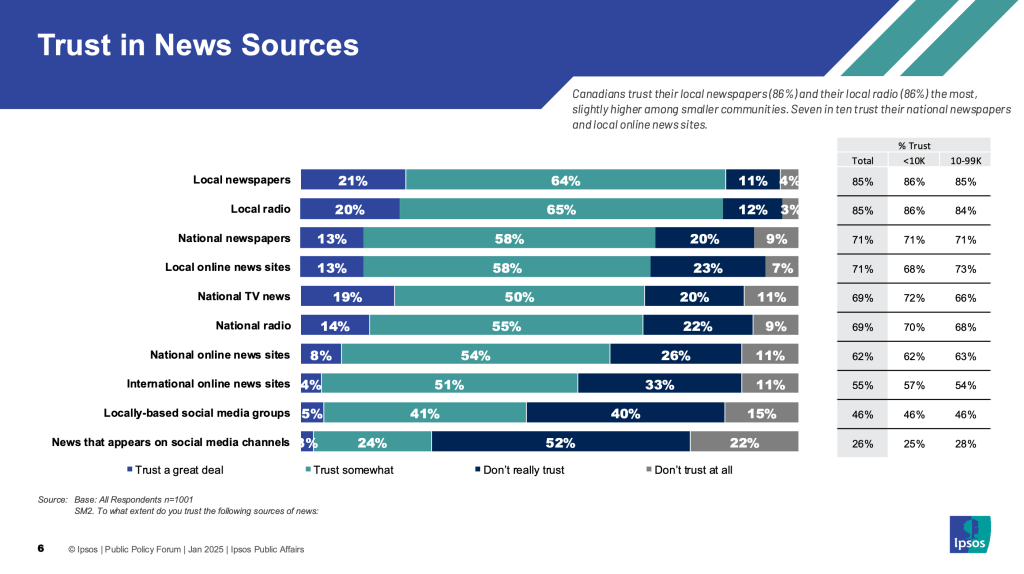
As an appendix to its Report, the Forum provided an Ipsos poll covering some familiar questions about public attitudes towards news journalism.
The results confirm a key trend in public opinion: mainstream media is highly trusted and information carried over social media is not.
On the other hand, two questions related to government subsidies to independent news journalism elicited concern that state sponsorship “might” stoke bias and a lack of independence from government.
The most trusted news sources are in fact the most subsidized by government, so give the public credit for agreeing with MediaPolicy: subsidies are a difficult to measure risk to public trust but so far not a harm.
***
I sometimes close this post by recommending content, but consider this more of a referral: the Hollywood-crafted and star-studded Super Bowl ads you didn’t get to see because the NFL sold the Canadian programming and advertising rights to Bell Media’s TSN.
Nobody quite does goofy the way that Hollywood can.
Are you not entertained? You decide.
***
Okay, changed my mind, I will recommend something serious.
I’m sure I wasn’t the only Canadian listening to Trump’s inauguration speech who noticed the President’s reference to “Manifest Destiny,” a long active but recently dormant part of America’s imperial DNA.
Here’s a good piece on that from the US National Public Radio news site.
***
From The Lost Estate Report:
FOR PHILANTHROPY
Expand issue definition: Philanthropy is growing rapidly in the United States around local news. In addition to the small handful of U.S. foundations that are interested in journalism and democracy, a second wave of foundations and donors that were funders of other issues — including domestic violence, hunger, homelessness and poverty — have come to realize they’re not going to make any progress if there’s no local news. Canadian philanthropists should follow suit.
Step up community foundation involvement: There are more than 200 community foundations across Canada, as well as thousands of private foundations. They are just now beginning to channel their impressive fundraising acumen towards local news initiatives: The Winnipeg Community Foundation, for instance, has funded reporting on religion by the Winnipeg Free Press, and the Toronto Foundation is one of several foundations that help to fund The Local. Community foundations should be encouraged to support local news coverage as part of their wider missions to encourage social vitality, community health and local democracy. More media organizations should be knocking on those doors, and more community foundations should be stepping up.
Help enable new local news models, including not-for-profits and charities: Major French-language news outlets such as La Presse and Le Devoir have become not-for-profits and then used that status to apply for Registered Journalism Organization status to take advantage of money from foundations and individual donors. Only four media organizations outside Quebec have done the same; that represents a major missed opportunity to develop a new source of revenue to support local news. RJO status would mean new startup ventures could accept philanthropic support or present an opportunity for community-based fundraising to claim back news outlets from the corporate chains that have abandoned local coverage.
Foundations can help with this step. Achieving charitable status can be complicated, but foundations can offer guidance on how to navigate the rules around registered philanthropic organizations, such as setting up “friends of” charities that can more easily raise money from supporters. If more outlets had charitable status, more foundation help could be unlocked for local journalism.
FOR GOVERNMENT
Reconceive the Local Journalism Initiative: Report for America in the United States provides a good model of a partnership with strategic intent that builds long-term capacity rather than plugging short-term holes. Its stated mission is to “strengthen our communities and our democracy through local journalism” and it funds reporters in local newsrooms for three-year terms, rather than the single year or less of the LJI. Among its other virtues: It provides training for journalists, unlike the LJI; its grants get smaller each year, shifting more onus each year on the news organization to finance its staff; and it helps news organizations learn how to fundraise within their communities. A homemade “Report for Canada” would roll in LJI funds to match those invested by philanthropy. This would provide the added governance benefit of distancing the program from the government of the day and placing authority in an independent board. Public contributions, as with academic granting agencies, would come in the form of multi-year funding.
Mandate a sales notice period: Communities should have an opportunity to rally support for news outlets that are threatened with closure by corporate owners. Specifically, there should be a notice period, perhaps 120 days, before a news operation can be shut down or sold to a non-local buyer. That would give communities time to gather support for local ownership. To help promote local buyers, governments can explore policy interventions that could include training and development, support with restructuring operations, access to expert resources, navigation support of federal and provincial programs, as well as low-cost or no-cost loans.
Tie the Labour Tax Credit to jobs: The LTC is the most important government program supporting news operations at the moment, worth an estimated $67 million in the 2024-25 fiscal year.[42] It should be continued, but with important changes. Organizations should not take money and cut content; the tax credit should carry an incentive to grow newsrooms and should be tied to the increase or preservation of editorial positions and other resources necessary to produce local content. The credit would be higher for those who increase their spending on journalism.
Drive local advertising with a tax cut: Along the same lines, local advertisers should receive a tax credit for spending their ad dollars with independent, locally owned media. As advertising dollars continue to flow to foreign-owned digital sites, depriving local media of funds they need, a tax credit would give advertisers a greater incentive to vote local while leaving the decision about which outlets get support to them, not government. Equitable tax credits for advertisers have the additional benefit of being more likely to withstand shifts in the political winds. That said, local advertising only helps if Main Street can withstand the competition from distant digital retailers, which presents a different set of challenges.
Direct government ad dollars to local news: Governments should earmark a portion of their substantial advertising budgets to local publishers and broadcasters. Ontario is showing the way by requiring that 25 percent of government ad budgets, including spending by four large provincial agencies, be directed to “Ontario-based publishers.” This program, which went into effect in September 2024, is explicitly aimed at “helping to support these publishers and their workers, who are creating local news content for people across the province.” Brought in by a Conservative government, it could be worth some $50 million a year to Ontario publishers. The federal government, other provinces and territories, and municipalities should follow suit. Governments are already spending substantial amounts on advertising and marketing. It makes no sense for them to talk about the need for vibrant local democracy and a healthy local news environment while they continue to funnel their own ad dollars to foreign-owned social media sites.
FOR PHILANTHROPY AND GOVERNMENT
Encourage capital formation: The best way to strengthen local news is to help it remain in local hands in whatever form entrepreneurs believe will work best in each community. In many cases, this will require capital. Programs to encourage capital formation for this purpose would go a long way to preserving the public good that is local news. A sustainable investment vehicle, co-funded by the federal government, provincial and territorial governments, the philanthropic sector, as well as NGOs, could draw lessons from government programs like the Social Finance Fund[43] and the Canada Rental Protection Fund,[44] where federal investment complements other public, private and philanthropic money. The government should explore any mechanism that makes crowding-in more effective, by utilizing a “first-in, last-out” methodology. For philanthropic organizations engaged in social impact investment, local journalism is a perfect match. The same is true for governments that have already put in place measures to encourage employee ownership or support.
***
If you would like regular notifications of future posts from MediaPolicy.ca you can follow this site by signing up under the Follow button in the bottom right corner of the home page;
or sign up for a free subscription to MediaPolicy.ca on Substack;
As a federal election gets closer, the fate of the CBC gets nearer.
The worst thing that can happen to the CBC (and the 78% of Canadians who support it) is that Pierre Poilievre gets elected to majority government. He will indeed defund the CBC, the only question is how quickly and completely.
The second worst thing that can happen is that the Conservatives don’t come to power and Ottawa hits the snooze button on re-engineering the public broadcaster. Recall, the McGill poll from November 2024 reaffirmed broad public support for the CBC but only if it addresses its major criticisms.
The public debate about those criticisms of the CBC, and what to do about them, finds commentators speaking from two different viewpoints. No, not for and against. But rather “news” versus “entertainment.”
Most of the high profile commentators are journalists who focus on the democratic imperative of saving CBC News in a shrinking journalism ecosystem. After all, about a third of Canada’s 10,000 professional journalists are employed by the public broadcaster. The journalist corps representing the other two-thirds, employed by privately owned media, is steadily shrinking despite the federal government financial aid that Poilievre also says he will defund.
There’s been a useful public debate on how CBC News could do the trifecta of improving programming, defending its audience share (at risk among young Canadians) and mollifying its critics in the political class.
Chris Waddell and Peter Menzies, both interviewed here on MediaPolicy, have offered useful ideas on how to do it. Their views were supplemented last week by the journalist and policy analyst Ed Greenspon and independent (and very much ex-CBC) news producer and writer Tara Henley.
If there’s at least one common theme to all these opinions, it’s to decentralize or re-regionalize CBC News. As it happens, this rhymes with the talking point that the new CBC President Marie-Philippe Bouchard is making by extolling “local” and “proximity” as the CBC’s greatest virtues.
Decentralizing CBC News would address at least two problems: first, give Canadians more of the local news they want. Second; mitigate the hinterland anger directed at a richly endowed public broadcaster that is dug deep into the Toronto streetscape where its main newsroom is steeped in a metropolitan bias, the natural outcome of where most of its employees live.
Another common theme among the news-first proponents is the lack of interest in preserving or improving CBC’s entertainment programming. Waddell and Henley want to toss it overboard entirely and cry uncle to the US streamers, while Greenspon just doesn’t mention it at all.
The CBC is the nation’s biggest platform for Canadian entertainment content, in particular television drama and documentaries (leave aside CBC sports television programming for now, that’s a different discussion).
The private Canadian broadcasters are spending less and less on “Programs of National Interest” (PNI)—-don’t be distracted by the awkward CRTC jargon—- for a variety of macroeconomic factors that can’t be bargained or reasoned with.
The ad market for television has deflated.
Canadian broadcaster revenues and profit margins have been falling steadily because of cord-cutting and the success of foreign television and music streamers.
Corus Entertainment (operator of StackTV and Global TV) is almost insolvent.
Bell Media runs its news division at a massive loss and is barely profitable only because of an entertainment portfolio anchored by its long-term deal to retail HBO programming in Canada.
Indeed, the trends are all going in the wrong direction.
Spending on Canadian TV dramas by the English language Canadian networks has shrunk 65% (in real dollars) over the last decade according to a recentstudy commissioned by the Director’s Guild.
Meanwhile the streamers have set a new, stratospheric bar in rising per hour production budgets. Canadian broadcasters can either respond with bigger budgets (they can’t or haven’t) or allow the gap in on-screen production values to widen. (The APTN/CBC/Netflix co-pro North of Northcould not have been made without the Netflix investment that made filming in Iqaluit possible).
Enter the CRTC’s white-flag-of-surrender idea of abolishing the regulatory category of “PNI” in hopes that when it orders Netflix, Amazon and Disney to make “Canadian content” the streamers will by default make dramas. Meanwhile, abolishing PNI for Canadian broadcasters would mean Bell, Global, Rogers and Québecor can opt to shift their spend from money-pit dramas to profitable unscripted television and lifestyle programming.
Quite apart from whether it’s a good idea to outsource Canadian television dramas to American studios looking to sell back into their own market, the question is whether Canadian broadcasters would ever make a drama series again if the CRTC doesn’t require it.
Those who were around to win the regulatory battle for Canadian television drama back in the 1980s will have an opinion on the matter.
If we have to take a defunded English language CBC out of the funding equation for Canadian television drama we subtract a programming budget north of $120 million annually, as the public broadcaster is the nation’s biggest buyer of Canadian dramas.
Bell spent $70 million on English-language Canadian drama in 2023-24 (its budget was $75 million ten years ago) and Corus spent $37 million (it was $96 million as Shaw and Corus combined in 2014).
Friends and foes of the Online News Act Bill C-18 will say the predictable things. What a spineless, election-motivated reversal.What a foreseeable debacle.
News Media Canada took the opportunity to hurry new survey results to press: a solid majority of Canadians want the federal government to spend more advertising in newspapers and less on social media.
According to its press release, “almost two thirds (63 per cent) of Canadians trust advertising in newspapers/news sites, while just 28 per cent trust ads they see on Facebook/Instagram.”
The publishers’ alliance applauded the Ontario government’s decision last July to boost ad spending on newspapers while pointing out that the federal advertising budget allocates only two per cent of its dollars to print.
***
I often recommend Ken Whyte‘s Substack column SHuSH and do so again.
Whyte is the owner and operator of the Canadian book publisher Sutherland House and as such automatically qualifies as an expert in the economics of Canadian media. He’s also the former editor of Maclean’s Magazine, ex-President of Rogers Publishing, and once Editor-in-Chief of the National Post. Additionally, he writes like a dream.
In his last column he contemplates what a Trump tariff on books would do to Canadian publishers who are mostly small independents that hold, collectively, a minority share of the Canadian market that is otherwise dominated by foreign giants.
Sound familiar?
***
If you would like regular notifications of future posts from MediaPolicy.ca you can follow this site by signing up under the Follow button in the bottom right corner of the home page;
or sign up for a free subscription to MediaPolicy.ca on Substack;
Batter up: Mark Zuckerberg (Meta), Lauren Sanchez, Jeff Bezos (Amazon), Sundar Pichai (Google) and Elon Musk (X).
January 25, 2025
The memorable line-up of US tech bros attending Donald Trump’s inauguration as special guests is an early candidate for Photo of the Year, although it’s possibly been eclipsed by Elon Musk’s nazi salute of the same day.
What the Trump victory means for Canadian regulation of Internet services seems ominous and Michael Geist is first out of the gate with “I told you so.”
In the months ahead you’ll find a different perspective here on MediaPolicy, I promise.
Thanks to Trump, we are headed into a nation-defining crucible, as Jean Charest just argued persuasively on CBC News. Of course media policy is just one thing on the table and you can’t eat cultural sovereignty.
Forty years ago, a majority of Canadians voted against a free trade deal with the United States as an over commitment of our economic fortunes to a single dominant trading partner.
But if we stick together and get decent political leadership, we can come out the other side as a greater country and more independent of the United States.
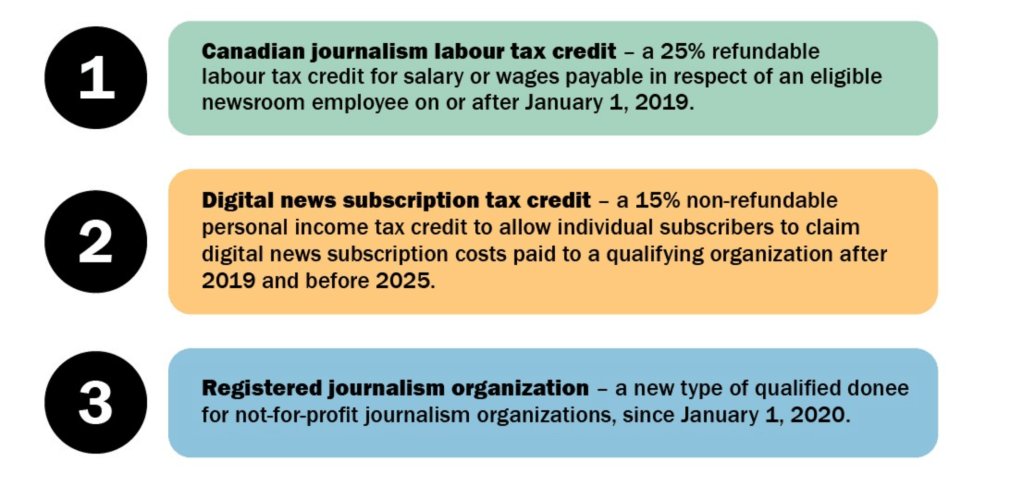
The Qualified Canadian Journalism Organization seal of approval unlocks reporter salary subsidies of 35% and reader tax credits of up to $75 per year in subscriptions paid.
The drift of Beeby’s article is that the news subsidies are bad —a debate for another day— and expensive to administer. Also, he says the costs of the entire program are not transparent because so little effort is made to publicize them.
The “$275 million” paid out in labour subsidies (spread out over six years, it’s worth mentioning) are reported in the government’s annual tax expenditure report.
The annual cost of the reporter subsidy was about $35 million until the government almost doubled its cost last year in response to the shortfall in anticipated news licensing payments from Google and Facebook. (The subsidy was boosted from 25% to 35% of a mid-range reporter salary of $85,000).
In addition to the $35 million labour subsidy, the reader tax credit has cost the public treasury about $15 million per year. With little fanfare, that subscription tax program expired on December 31, 2024.
The tax expenditure of a third QCJO program —-tax write-offs for private donations to non-profit journalism—- has never been released if it has even been tracked.
As for the Panel members’ compensation, Beeby notes that annual billings to the taxpayer have averaged $47,000. That’s divided among its five members. Most of their time is spent reviewing news articles submitted by QCJO applicants seeking to demonstrate “ongoing” (i.e. frequent) and “original” (i.e. not harvested from other sources) reporting of “news” (not opinion) that is of “general interest” (i.e. not niche or specialized).
I’m advised by panel Chair Colette Brin that its members bill the government on an hourly basis, with detailed timesheets, against the federal daily tariff of $275 to $450.
Since the program’s inception, the five panel members representing regions across the country have met online eighteen times rather than convene in Ottawa, except for a single in-person meeting costing $8000 in total travelling expenses.
Spitballing the three-part QCJO program cost at $90 million annually, the Panel’s administrative costs are 0.05% (half of a tenth of one per cent). The CRA did not provide Beeby with a costing of civil servants processing tax claims.
On the other hand, as Beeby points out, the lack of the government’s interest in pro-active transparency about the identity of the program recipients is baffling.
The Revenue Canada website does identify 191 news outlets whose readers are eligible for the now-expired QCJO reader tax credit (and therefore also the labour subsidy), but it does not reveal the unpaywalled news sites that only collect the labour subsidy. There may be as many as another 200 recipient news outlets basking in anonymity. As the reader tax credit has expired, it’s possible the list of 191 news outlets will disappear from public view.
The panel itself asked for more transparency as far back as 2019.
So have news organizations. Asked for comment, Paul Deegan of News Media Canada told MediaPolicy that “transparency is a necessary precondition for trust and accountability. We fully support making the list of QCJOs public, and we have asked the Government of Canada to do so.”
By comparison the $20 million per year Local Journalism Initiative, administered directly by Heritage Canada rather than Revenue Canada, requires recipient news organizations to identify the reporter subsidy on their mastheads.
In addition to identifying recipient news organizations so that readers can reach their own conclusions about accepting subsidies, there is the absence of employment and subscriber data that would permit public analysis of the programs’ effectiveness.
Did the $75 reader tax credit bring in new readers, or just subsidize the existing news junkies? Are labour-subsidized news organizations still laying off reporters or have numbers stabilized?
Transparency is the low hanging fruit in any public policy, especially a controversial one. It’s a harsh judgment on this federal government for not taking the simple steps here.
***
Here are two rabbit holes to dive down this weekend.
The first is an excellent backgrounder by Matt Stoller on the up-for-grabs US Congressional ban on TikTok, now delayed 90 days by President Trump. If you want a deeper (and Canadian) perspective, check out law professor Jon Penney’s guest column in the Globe and Mail.
The second is a Broadcast Dialogue podcast interview of Brodie Fenlon. The CBC Editor-in-Chief has many candid things to say, including some illuminating comments on the “niche casting” challenge for CBC News to meet younger audiences fragmented across the Internet, as well as TV viewers whose portal to content is the app menu embedded in foreign-made smart televisions.
***
If you would like regular notifications of future posts from MediaPolicy.ca you can follow this site by signing up under the Follow button in the bottom right corner of the home page;
or sign up for a free subscription to MediaPolicy.ca on Substack;
MediaPolicy posted twice this week. The first one returns to our dialogue about an improved CBC with an Open Letter from Ian Morrison, the founder and former spokesperson of Friends of Canadian Media.
The other post is an interview with publisher Holly Doan of the elbows-up investigative news site, Blacklock’s Reporter. With the Reporter in mind, I coined the phrase “journalism at its fiercest” and it seems from the volume of post views and twitter response to the interview that her publication very much has a fierce fan base. If you like Old School, you’ll love this interview.
***
This is the last weekend before all hell breaks loose in our relationship with the United States.
Cast your mind back in Canadian history and recall that perhaps the most nation-defining things we have ever done were dispossessing Indigenous peoples and then managing not to be dispossessed ourselves by our covetous neighbours (1776, 1812, 1837, 1844, 1866, 1870, let me know if I’ve left anything out).
The national achievements of the USA make for a longer list. Dispossessing Indigenous people and enslaving Africans, for starters. A game effort at national fratricide through civil war. Denying African American citizens their civil rights. Building a hemispheric and then a global military empire. Tipping the balance in two world wars. Quite a list.
Now the US might be entering its age of autocracy and Big Tech oligarchs.
That’s not a reference to the US judiciary but the description of a new governing paradigm that disposes of policy and sees the Tech bros travel to the king’s court in Mar-a-Lago to supplicate and trade favours. Once in thrall to the king, Klein’s guest Erica Frantz suggests, Trump owns them in the way that Vladimir Putin owns his own oligarchs.
That has implications for everything, one of which is media. Elon Musk owns X. The grovelling Mark Zuckerberg owns Meta. Add Amazon’s Jeff Bezos to the list. Other media moguls will have to pay homage to the king to protect or advance their interests.
Then there’s the unknown future of TikTok. The US Supreme Court has upheld the Congressional ban on its Chinese-ownership. Its CEO Shou Zi Chew is playing a tough hand by saying TikTok will turn the platform dark on Sunday when the ownership edict comes into effect.
Trump is trying to engineer a sale of TikTok to a new owner, which Shou says he will not do. (Spare a kind thought for a guy caught between the world’s two superpowers.)
The Orange King supposedly has his oligarch pal Elon Musk in mind as the new owner.
And Canada’s carnival barking Kevin O’Leary, for whom grovelling to a foreign power is too mild a description, is making this comical by putting himself forward as a potential buyer of TikTok.
O’Leary’s antics are just what Trump would like to see from all Canadians: a bended knee and a favour sought.
Not since the cross-border Fenian raids of the 1870s has the threat of American dispossession been so tangible.
***
If you would like regular notifications of future posts from MediaPolicy.ca you can follow this site by signing up under the Follow button in the bottom right corner of the home page;
or sign up for a free subscription to MediaPolicy.ca on Substack;
Career journalist Holly Doan makes a business out of turning over rocks in Ottawa.
The publisher of the investigative Blacklock’s Reporter “doesn’t get invited to parties” on Parliament Hill, she quips on X. There are no “access” or insider sources for Blacklock’s.
The ruling Liberals likely regard her publication’s single-minded fault-finding with their administration of government as either partisan or opportunistic, a reflection of the fact that the Liberals have been in power for nine of Blacklock’s thirteen years since its 2012 start-up.
The online news website specializes in documents: the routine notices that no one reads and the juicier ones obtained by doggedly pursuing access to information requests.
In 2020 Blacklock’s ran a story about internal research documents at the Canadian Mortgage and Housing Corporation revealing an interest in abolishing Canada’s legendary capital gains exemption for primary residences and coined the phrase “home equity tax.” The result was hot government denial —until documents proved otherwise— followed by the Liberal government publicly denying it would pursue such a policy. They’ve been on the defensive about any changes to the primary residence exemption ever since.
The Reporter accepts very little advertising and is dependent on annual subscriptions. It follows that it operates an airtight paywall and runs down any sign of password sharing. That vigilance has seen Doan litigating on and off for a decade against federal bureaucracies that have engaged in password sharing. There is no love lost between Blacklock’s and the federal civil service.
Doan refuses to apply for federal journalism subsidies and considers them antithetical to her publication’s independence from the government that Blacklock’s covers.
She tells us more about herself, Blacklock’s, journalism and even a little media policy in this interview.
***
Blacklock’s publisher Holly Doan
Q. What’s your backstory? How did you get into journalism?
I grew up in rural Manitoba. Dad was from Toronto, a wildlife biologist and senior bureaucrat. Mother’s people were early prairie sodbusters. Our family never discussed contemporary politics or journalism.
At school my marks were dismal in math and science but always A’s in history and English. A guidance counsellor suggested journalism. Honestly, I think he was checking a box. The local community college journalism program in Winnipeg was tough to get into, so I started a high school newspaper in grade 12 and used that as an entry application.
My father who excelled in the sciences didn’t understand my career choice. Much later in 1990 I produced a documentary for CBC Alberta about the rise of the Reform Party. It was edgy. The interview with leader Preston Manning was a little sharp. My dad, with his central Canadian private school upbringing, watched and remarked: “No wonder they want cuts to the CBC.”
Starting in 1982, I was a television and radio reporter and news anchor in four provinces, including five years at CBC Alberta covering the legislature. At CTV National News in Ottawa, I was on the bus for the 1993 federal election campaign, followed by three years as Beijing Bureau Chief and two years in the CTV Toronto Bureau.
In 2003, my husband Tom Korski and I formed our own company to produce political history documentaries for CPAC, the Cable Public Affairs Channel.
In 2012, we created Blacklock’s Reporter.
Tom is Blacklock’s editor responsible for content. He is a 43-year reporter with a background in private radio and print, including The Sun chain and the South China Morning Post of Hong Kong. He also worked on the desk at CTV National News in Toronto.
Q. You started Blacklock’s in 2012. How long before the business stood on its own two feet and not your savings account?
We launched Blacklock’s without investors or bank loans and a commitment to draw no more than the cost of a new minivan from personal savings. The old van would have to last.
While Blacklock’s has never lost money, like any small business the first years were lean. In 2015 there was a small bump in subscribers and we learned our first lesson in what kind of journalism Canadians will pay for. People were dissatisfied with the Harper government and wanted more information on what the feds were doing.
Readership spiked again in 2019, another election year. The pandemic generated an even greater demand for government accountability. A lot of public money was going out. There was uncertainty in people’s lives. Readers appeared to want specific information on things like questionable government contracting, vaccine mandates, take up on small business loan programs, and abuse of CERB relief.
Readership has grown year over year since, although more slowly in recent inflationary times as people mind household budgets. The most valuable measurement of how it’s going is the year-to-year re-subscription rate. Blacklock’s annual re-subs run to about 70%. We love welcoming new readers, but those who’re willing to pay $314 every year suggests habit and trust. Trust is everything. Don’t tell them, show them.
Q. Many news publications today have angel investors backstopping the business. What about Blacklock’s?
Blacklock’s has never accepted donations of any kind. No group subscription or institutional licence represents more than 1.5 per cent of total revenues. We do not accept government subsidies. Pretty proud of that.
Q. Who’s your competition in covering federal government? The Hill Times? The Globe and Mail?
Blacklock’s is the only media outlet in the Canadian Parliamentary Press Gallery that focuses on federal affairs, not politics.
We don’t cover election campaigns or conventions. We do not commission opinion columns. We mostly ignore news conferences and Question Period. Our focus is government reports, audits, debates, committees, Access to Information, Public Accounts, tribunal and Federal Court rulings.
As such, we are distinguishable and have no direct competition. That doesn’t stop us from being a little jealous when another media outlet gets ahold of a government document that makes news!
Q. Who’s your subscriber audience?
Good question. Aren’t all media trying to figure that out?
The earliest subscribers were non-governmental organizations that purchased institutional accounts accessed by multiple readers. Unions and industry associations were early adopters.
Now, individual readers from all ten provinces and one territory dominate our subscriber base. A large number are small business people but they come from all walks of life.
The largest concentration is in Ontario but Saskatchewan punches above its weight.
Q. Do you think you’ll see some big reader churn if the Conservatives are elected this year?
A staffer in the office of a Conservative MP told me: “When we were in power (during the Harper years) I was told never talk to Blacklock’s or Bob Fife [of the Globe and Mail.]”
I laughed. I’ve known Bob and his fearsome reputation for breaking stories for 30 years throughout Liberal and Conservative administrations. The staffer didn’t mean it this way, but it was a huge compliment!
Blacklock’s Reporter is accountability journalism. We write about federal government mismanagement, waste, and cronyism. The mission has not changed since 2012, we’ve just become a little more practiced at finding documents. Accountability journalism stands on the belief that by exposing problems, corrections will be made that’ll give Canadians better government.
People ask, what will it be like when you have to hold a new Conservative government to account? Won’t you lose subscribers?
My silly answer is just think of all the new friends I’ll have! The serious answer is politicians change but the bureaucracy and the wheels of government do not. If people are subscribing because they trust Blacklock’s to tell them details of federal programs, they’ll stay.
If people are subscribing because they think Blacklock’s matches their partisan view, they’ll drop us. Bring it on!
Q. If I was marketing your operation for you I would brand it “journalism at its fiercest.” Your headlines and tweets are aggressive and have an anti-government flavour, but below the headlines the stories are very disciplined, high quality watchdog stuff. How do you see yourself? Muckraker? Watchdog? Advocate for smaller government?
“Journalism at its fiercest.” I like that. Can I use it? Is it original or subject to copyright?
Seriously, readers will pay for media to be “aggressive” in holding government to account. To us, that means finding information useful to Canadians, not yelling questions in scrums. As former Ottawa Journal editor Grattan O’Leary said, “Freedom of the press was not won for the sake of the press. It was won for the sake of the people.”
It is true that five-word headlines do not capture context as well as a 600-word story. But have you seen newspaper headlines in the U.K.? They’re outrageous by Canadian standards. Canadian media is timid compared to press in other parts of the world.
Blacklock’s is committed to careful documentation; listing names of all reports and legislation so that readers are able to look those up. Blacklock’s never quotes unnamed sources. Words banned from Blacklock’s copy are “sources say” and “experts say.” Adjectives are sparse or non existent. Find a fact or don’t say it all.
But why should we hide all that good stuff behind a dull headline? Aren’t there enough of those already?
Q. You’ve butted heads with the federal government after numerous departments shared passwords to your paywalled content with thousands of civil servants, without paying for institutional licences. When you sued over that you were disparaged in the Justice Department filings.
In 2023 Alexander Gay, a lawyer with Justice Canada, told a judge: “Blacklock’s is yellow journalism, fake facts, and sensational headlines.” It’s a cliché, but there was a tiny gasp in the courtroom from a handful of Blacklock’s subscribers attending the hearing. It was a trial about copyright infringement, not defamation or the constitutional right to free expression.
They say “you know you’re over the target when you start catching flak.” This is especially true in Ottawa where government communications staff, whose job is to control or mitigate bad news, outnumber journalists by at least ten to one. This particular government, more than others I’ve covered, has a fetish for media control.
The best antidote to disparaging remarks is to “come with receipts”, that is, we do not report any story unless we already have documents or can cite sworn testimony. Ironically, the more Blacklock’s is attacked by officialdom, the more committed readers seem to become. We receive a lot of mail which I sometimes post on social media.
Q. As publisher of a private news organization reporting on Parliament and federal government, what are your views on the CBC?
Journalism is an apprenticeship system. The best training is long years of experience in the field. The second best training I’ve had was at CBC. But the corporation is not what it was when I worked there in the late 1980s and early 1990s.
CBC News has lost the love of many Canadians because, as Ombudsman Jack Nagler said in his final report, it has become “too timid” in representing a variety of views.
As a former television journalist, I have the old timers’ habit of watching all national newscasts and comparing and contrasting. How many stories do they have? Any scoops? When they cover the same story, whose is better? Which anchor is more pleasant?
I stopped watching CBC television a couple of years ago. They lead the national news with too much American content. By 13 minutes past the hour, they’ve mostly finished with the news. There isn’t much reporting from the regions. Don’t tell me it’s because there isn’t money! CBC is filling local newscasts with something, aren’t they?
When I worked for CBC Alberta, our newsroom was always being elevated to The National. I could get a story about Alberta government consolidation of services and departments on a national newscast. Why doesn’t CBC-TV News want to tell me more about my country? I’d love to hear about a noisy parent protest at a school board meeting in Halifax.
Then there’s activist journalism. As an older CBC radio producer said recently, “Holly, the younger ones come in here now with their opinions and they just want to change the world.” Those experienced editors who trained me are long gone.
What are the journalism schools teaching? Is it diversity, equity and inclusion? I can’t hire newbies who want to spend days writing ‘big think’ articles that quote academic experts. I wish they’d teach entire classes on Freedom of Information and document journalism.
Blacklock’s posts five original stories a day, five days a week. That’s damn hard work. Gone are the grubby, ink-stained scribes hustling for facts we saw in the movies. That’s what we aspire to though.
Whether the CBC survives does not impact Blacklock’s Reporter. The corporation is not competing with us on document journalism.
I believe in the concept of public broadcasting but am recently convinced that CBC has not demonstrated interest in changing and has evolved into a self serving bureaucracy that might as well be called the Department of Fisheries and Broadcasting.
I hope CBC survives in some streamlined form but it doesn’t look promising at this time of writing.
Q. As Blacklock’s publisher, you have been outspoken against federal subsidies to journalism. Expound on that, if you would.
Blacklock’s is opposed to newspaper subsidies because we believe they have eroded reader trust while not producing any demonstrable improvement in the product. Subsidies create an uneven playing field for independent media attempting to innovate. And worse, they create dependency. What will happen if subsidies are withdrawn by a future government?
Q. I feel like I’m setting up duck decoys for you to blast.
Next question: I read your 26-point submission to the Heritage Committee saying federal “QCJO” journalism subsidies are not just bad for independent journalism, they are fatal to public trust. I think I disagreed with almost every point. But would you consider applying for status as a Qualified Canadian Journalism Organization so that you could refuse subsidies but make your subscribers eligible for reader tax credits?
The Canada Revenue Agency directs tax filers looking for a media subscription tax credit to consult its list of “qualified” organizations. The list is comprised of publishers who sought subsidies. For example, the Western Standard was successfully vetted as a legitimate news organization by the CRA’s panel but never applied for actual subsidies. It is not listed.
I don’t want my company’s name on that list, either.
Would Blacklock’s apply if the subscription tax credit for readers was more than a skimpy 15%? No idea. Ask me again when something like that actually happens. Facts, right?
One positive aspect of an increased subscription tax credit might be Canadians would be encouraged to subscribe to journalism. Take away the direct newsroom subsidies, and we’d see what publications people really want. The subsidies mask marketplace failure.
Q. What about the Online News Act C-18? The public policy mischief identified for that legislation was that Google and Facebook abuse their market power in Search and Social by refusing to negotiate news licensing payments at all or only on their terms.Without endorsing C-18, do you see the mischief?
C-18 has been a legislative failure. I have no opinion on whether it should be scrapped or amended as Blacklock’s neither relied on Facebook nor Google prior to the Act being enacted and has not applied for any money from tech giants. We want to remain a square dealer without prejudice when reporting on this issue. If we must report on it!
Q. As publisher, can you update us on your copyright fight, your impermeable paywall?
It’s the story of David and Goliath.
Blacklock’s, a tiny publisher, relies on a password protected paywall to monetize journalism. Internet advertising is insufficient. We do not accept subsidies or donations. Our readers like this. With a porous paywall, we would not have been able to build a successful business or in fact any business.
The 2012 ‘Copyright Modernization Act’ implemented by Parliament introduced ‘technological protection measures’ to help creators like Blacklock’s and other media monetize their investment. A password has long been considered a protection measure. Canadians know you don’t share your password but government is advocating for this right.
From 2013 Blacklock’s passwords and content were shared on single subscriptions then worth $147 by 15 government departments without license or permission. Stories were then shared with thousands of readers in the public service. Distribution is proven through Access to Information and undisputed. For example, Health Canada shared the password by email with seven users, then cut and paste 122 stories to 1,193 email addresses.
Government refusal to pay has resulted in costly and prolonged litigation. The cases are defended by Justice Canada on behalf of the Attorney General of Canada. In May of 2024 a Federal Court judge ruled password sharing was acceptable for “any legitimate business reason” without any stated limit. The case is under appeal with no date set. [Blacklock’s statement is here: https://www.blacklocks.ca/note-from-blacklocks-editor/]
Q. We may have a change of government and perhaps a change of instructions to the Justice Department?
It’s not a good idea to rely on any hoped for change in government direction. If this is the way the Government of Canada and the Courts want to go in removing protections for the news media industry and other digital creators then our tiny company cannot stop them.
Canada would become the first G-7 country to undermine its own copyright law. We are prepared to lose again and seek leave to appeal to the Supreme Court. Failing that, Blacklock’s will testify at any future Commons committee with a statutory mandate to review weaknesses in the Copyright Act. Our story will be one of a government willing to change its own law protecting creators in order to win at all costs.
Q. My sense of your site, and all watchdog journalism, is that it’s dedicated to preventing the powerful from controlling the narrative, from hiding things. We’re about to elect a majority Poilievre government, with a big majority and (based on their communications strategy to date) great skill in shaping the political narrative. Seems fertile ground for a watchdog. What kind of issues do you predict Blacklock’s will be following?
Long experience teaches us that the first 12 months of any new government is spent repealing legislation, cancelling or revising programs introduced by predecessors.
For example, labour legislation nicknamed the “big union bosses” bills introduced by the Harper administration was immediately repealed by the Trudeau Liberals in 2015/16. Blacklock’s covered those bills from inception to repeal.
This will happen again. After that, no one can predict accurately what any new government will do or what news coverage should look like. Fortunately in the government accountability journalism business, the ground is always fertile. Always.
***
If you would like regular notifications of future posts from MediaPolicy.ca you can follow this site by signing up under the Follow button in the bottom right corner of the home page;
or sign up for a free subscription to MediaPolicy.ca on Substack;
If you’ve read MediaPolicy’s posts over the last three years, you may have noted an affection for opinion polls.
They are hardly a stand-in for policy debate: but public opinion surveys test the mood of the broad populace on any given issue while the political class thrashes it out clause by clause and tweet by tweet. That’s vital in a liberal democracy, no one will dispute.
But poll accuracy has become challenged by one big thing: no one answers the phone anymore. That’s why many pollsters have switched from “random sampling” to “opt-in panels” of poll respondents.
Random sampling is the gold standard, based on pollsters’ outbound telephone calls to about 1500 to 2500 members of the general population, chosen randomly with attention to general demographics. The random selection allows pollsters to afix the label of “accurate within a [ ] margin of error” to assure everyone that the poll is representative of public opinion.
The same “accurate within a margin of error” claim can’t be made for opt-in panels because they aren’t truly random.
The “opt-in” approach is an invitation to participate in a similar sized group of self-selected poll participants. This corps of volunteers can be tweaked by pollsters for demographic balance, but the real challenge is the motivations of the volunteers which can’t always be filtered out by poll questions like “who did you vote for in the last election?”
Plainly put, some volunteer respondents may be gaming the poll questions based on their perception of how the survey results will play in public. Also, it stands to reason that volunteers are more opinionated, more tuned into public policy than the cohort of randomly selected Canadians. “I don’t know” remains an important opinion.
The CBC Ombud Maxime Bertrand opined on this problem after media researcher Barry Kiefl cited a CBC Toronto radio show for relying on an Angus Reid opt-in poll without explaining its limitations. In fact, that pollster publishes a statement on its website to the effect that “if a randomly selected panel of respondents was asked the same questions as our volunteer panel, the margin of error would be ‘x’.” Arguably, that statement is bootstrapping the opt-in method as being more reliably representative of public opinion than it is.
Kiefl also observed that the Angus Reid spokesperson’s appearance on the CBC show was not just limited to reporting results, but added analysis and commentary like a CBC journalist would. Pollsters are not journalists: they run a business and have a stake in convincing the public that their results are accurate.
The Ombud agreed with Kiefl and in the course of his investigation the responsible CBC News manager did too: the limitations of polls should be noted during the newscast and the pollster’s guest appearance should be presented as opinion and not journalism.
***
The CRTC has announced another hearing on the implementation of the Online Streaming Act Bill C-11.
The notice elicited a bit of a yawn from the mainstream press which was more interested in whether a federal election would interrupt CRTC deliberations (the answer appears to be no, but the Commission won’t issue newsworthy decisions during the election period).
The major focus of the May 12th hearing is what the Commission describes as a review of its existing rules governing the competitive rules of engagement between programming and distribution undertakings, with the possibility of extending them online. The regulatory task is to use competition policy to countervail against the market power of big broadcasters and streamers whose gatekeeping poses a barrier to independent programmers gaining exposure for their Canadian content.
Done right, the Commission may open up a real policy discussion on getting the foreign streamers to make the “discoverability” of Canadian content on their Canadian platforms into a reality, instead of a box ticking excercise.
If you look today for Canadian video programming on any major US platform, you will only find it by keyword searching “Canadian” or else locating the “Canadian” page listing a handful of titles, most of which does not come close to being considered Canadian by any reasonable standard. It’s no better on music streaming platforms.
Also —and this surprised me— the Commission will look at the lack of discoverability tools for Canadian content on “smart TVs, mobile handsets, and streaming devices.”
Another issue that the Commission is mooting is whether we need new rules to ensure that programming covering “events of national and cultural significance” doesn’t disappear. The Commission has obviously taken note of the rising cost of sports broadcast rights for hockey and the Olympics. It may also be an opportunity to address situations like Rogers forcing the Canadian “OneSoccer” channel to crawl across broken glass to get onto cable distribution.
The Commission’s other big focus in this proceeding will be to review existing “access” regulations that support Canadian channels, especially independent broadcasters, getting carried on cable and perhaps have some of those supports extended to online platforms, the new home of program distribution.
The Commission did not give away any preliminary views on what it wants to do. But expect Rogers, Bell and Québecor to show up with demands for regulatory relief and US streamers to make exclamations of incredulity that any of these supports could apply online:
mandatory carriage of all local stations in a “skinny basic” cable package for $25 per month, per customer
While some of these rules are specifically designed for the cable environment, the principle of CBC and independent channels getting their Canadian content carried, and made prominent, on foreign online platforms is what is at stake.
The Commission will also review the existing “Wholesale Code” rules governing, to put it bluntly, the commercial bullying of independent channels and the cable divisions of Rogers, Bell and Québecor favouring their own channels.
***
If you would like regular notifications of future posts from MediaPolicy.ca you can follow this site by signing up under the Follow button in the bottom right corner of the home page;
or sign up for a free subscription to MediaPolicy.ca on Substack;