It’s not exactly breaking news, but YouTube is taking over television. Or to put it more vividly, YouTube is threatening to storm the Alamo of television programming, live sports and scripted drama.
The Hollywood Reporter has a lengthy feature story about how that’s happening in the US where, in addition to YouTube’s mushrooming ecosystem of self-broadcasting “creator” YouTubers, the paid subscription service YouTubeTV is a much bigger player in premium television programming than it is in Canada.
The Reporter story begins by breathlessly anticipating that YouTubeTV might, someday soon, elbow its way into the inner circle of exclusive rights to broadcasting NFL games (currently parcelled out among Disney’s Fox and ESPN, Amazon Prime, Comcast and a few others).
But an even bigger breakout for YouTube would be joining the platinum club of streamers like Netflix, Disney, Amazon and Paramount who dominate the market for premium scripted drama.
YouTube’s relationships with a seemingly endless parade of YouTuber stars could morph into something very different from, and competitive with, the fraternity of big studios and streamers, i.e Hollywood.
As AI drives down production costs for premium video, and advertising slowly migrates from television drama to the most successful YouTubers, we could witness an explosion of independent producers of scripted drama who toggle back and forth between selling to the big streamers or else broadcasting on their own YouTube channel.
YouTube CEO Neal Mohan is so cocky that the Reporter quotes him proclaiming “today, YouTube has become the epicentre of culture. And I don’t mean short-lived fads or a one-off hit show. I mean culture with a capital ‘C.’ The place where day after day, year after year, the events, conversations and voices that define the moment break through.”
The Reporter doesn’t put it this way, but YouTube is uniquely positioned to offer audiences both premium and non-premium content with an unbeatable distribution algorithm.
What the Reporter story doesn’t do is explore the deeper ideas about video consumption that media futurist Doug Shapiro is talking about in his most recent blog post “Big Media’s Structural Disadvantage”.
A dumbed down summary of Shapiro’s column is that the cheaply produced videos flooding YouTube and social media apps make our brains happy because it’s both addictive and passive, like a getaway spa session: we don’t have to expend energy (or money) finding just the right kind of premium content, we just lay there.
Shapiro’s argument is that tut-tutting about quality is a waste of time, this shift in audience attention is happening and the advertising dollars are following.
***
The CRTC has this handy way of telling you what’s on the commissioners’ collective mind when it publishes a post-hearing list of questions for industry and cultural groups to answer. What the questions tell you is where the public record is light on key issues and that the Commission wants to fill those gaps.
One of the intriguing ideas that Commissioner Bram Abramson kept raising during the hearings was a concept he called “pay or play.”
The idea he’s running up the flagpole is that each streamer might be allowed to make trade-offs of direct expenditures on Canadian audio content in favour of making special efforts to give prominence to Canadian content on its services, something that’s worth money to music labels and artists and hypothetically is a cost to audio streamers.
Abramson is only one of five commissioners deliberating on the audio file, but in question 20 of the CRTC’s list the commissioners ask “what kind of exchange rate between financial contributions and Canadian content aired would be appropriate? For example, for every 1% increase or decrease from a hypothetical baseline percentage of Canadian content, what should be the corresponding percentage or dollar-value change in the required financial contribution?” (Emphasis added)
As a speculative example, if the Commission expects Spotify to spend 30% of its Canadian revenues on Canadian content (including the 5% cash contribution to media funds) Spotify could reduce the 30% to 15% if it made heroic efforts to increase listening to Canadian songs through more recommendations or song selection for playlists.
More radically, the Commission might be thinking of reducing Spotify’s 5% media fund contributions by, say 1%, if it ups its streams of Canadian music from the current 10% of its top 10,000 songs to something like 20%.
That’s analogous to what the Commission already did with video content. Last year the Commission said it will allow Netflix to reduce its 2% cash contribution to the Canada Media Fund —-a contribution that Netflix appealed to Federal Court—-to 0.5% by using the money to buy more Canadian shows for its streaming service.
***
And now for something completely different: news subsidies and news consumers.
When writing about the sustainability of news organizations, I always think about the importance of news outlets making information about current affairs available to Canadians who aren’t news junkies.
My thinking is undoubtedly too binary, but you could divide the world into those who are interested enough in current affairs to pay for news, or at least coaxed into doing so, and those who say to themselves “if news is important, it will find me.”
If the news avoiders aren’t engaged with current affairs —unless it’s free, intriguing and right in front of them— our democracy is kind of screwed.
Cue this new poll conducted by the Globe Strategy Group in the US, summarized by Joshua Benton in Nieman Lab.
The poll divides Americans into active and passive news consumers and it would be fascinating if someone ran the same poll in Canada. The results don’t reveal a single litmus test that predicts who’s a news junkie and who’s not, but the results offer signposts to where the less engaged, passive consumers are to be found.
***
This week MediaPolicy posted an update on the Parliamentary journey of Bill S-209, the age verification law aimed at protecting children from pornography. Judging from the readership numbers (thanks to Reddit), folks are interested in this law which also raises issues of viewer privacy.
***
If you would like regular notifications of future posts from MediaPolicy.ca you can follow this site by signing up under the Follow button in the bottom right corner of the home page;
or sign up for a free subscription to MediaPolicy.ca on Substack;
I am guessing the five commissioners running the CRTC’s public hearing on radio broadcasting and audio streaming readSimon Gionet’s column inLe Devoir, published on the last day of hearings, September 29th.
The story conveyed the Québec’s music industry’s message: we’re getting slaughtered and the CRTC better do something about it.
The online streaming consumption of Francophone music in Québec is 4.6% per cent of the top 10,000 songs, according to the latest projections by l’Observatoire de la culture et des communications de l’Institut de la statistique du Québec.
Approximately five per cent. In a province that is 80% Francophone.
This is happening in an environment in which streaming is gradually displacing the sale of digital and physical music formats in Québec; 55% of those sales are French language music. It’s skewed by age: the Observatoire notes that consumption of French language music remains high in legacy media such as physical music sales and radio, but rock bottom on streaming services, the medium of choice for the younger generation.
At the CRTC, the response of foreign music labels and global streamers went like this:
Patrick Rogers of Music Canada (the big three labels Universal, Warner and Sony) told the CRTC “what we don’t support is [a CRTC requirement for] the inclusion of any music, Canadian or otherwise, that wouldn’t normally make‑up that listening experience.”
Xenia Manning, Spotify’s Director of Global Music Policy, offered her coy ignorance of the French language problem. When asked by a commissioner if the Observatoire’s “five per cent” number was accurate for the world’s biggest music streamer, Manning said “we could look into it.”
The best known spokesperson for Québec’s music industry is APEM’s Jérôme Payette. “The future of the music industry as we know it is truly at stake,” he told Le Devoir. “Our Francophone and Canadian musical culture risks virtually extinction or becoming completely invisible and marginalized if nothing is done.”
Make the streamers include 50% Canadian music in their song recommendations made to Canadian subscribers, including a French language quota;
Next, collect quarterly data on the consumption of music;
Take further action if the new numbers aren’t good enough, and
Look for an improvement from 2% to 8% consumption of French language music across Canada by 2029 (he didn’t specify a Québec-only number).
Payette’s parting shot to the Commission was “the CRTC has the opportunity… to show that we are capable of standing up to preserve our cultural sovereignty and our culture.”
***
Ah, the federal Heritage committee is back. How I have missed its performative politics.
All roads to Canadian cultural policy run through the ten MPs who sit on this Parliamentary committee, five Liberals, four Conservatives and the lone member from the Bloc Québécois.
It’s useful to parse the committee transcripts for clues on the government’s legislative intentions, as well as what mayhem to expect from Opposition MPs.
Going one Report further, the Conservatives won a new committee investigation into the state of news media, with subject matter, witnesses and committee dates to be determined.
As for the government agenda, Minister Steve Guilbeault appeared at the committee and promised something newsworthy about CBC’s plans for local news would emerge soon.
He was grilled by the Conservatives and the Bloc about where the rumoured Liberal budget cuts to his department’s programs might fall. He deferred to the Finance Minister’s budget on November 4th, but hinted about consolidating the administration of the Canada Media Fund for television, Telefilm, and another program (my guess, the National Film Board). It seems unlikely he can cut 15% of spending over three years without paring back program spending.
Travis Dhanraj with co-host Karman Wong and guest Kevin O’Leary
The Minister’s comments in French —“d’abord, je tiens à déplorer ce qui est arrivé à cet employé”—- were officially translated as “I condemn,” but were closer to “I lament.” He says he wasn’t briefed on the controversy by CBC President Marie-Philippe Bouchard, so his willingness to express regret stands out. Later in the transcript he qualifies his concern by saying “it’s possible that it went very badly for this individual, I’m sorry about that.”
The Committee is currently engaged in a review of AI impact on media and cultural industries to which MediaPolicy will return.
***
The Hollywood news outlet Deadlineis speculating about the rumoured Paramount purchase of Warner Brothers Discovery. Warner assets include studio production, the premier streaming platform HBO Max, and cable properties CNN, TNT Sports, and various nature and lifestyle channels.
Netflix might submit a competing bid, but Deadline immediately dashed that speculation by observing that Netflix wouldn’t want the cable assets (indeed, ask yourself why they would want anything other than the library of titles).
What’s not speculated upon is the knock-on effect on Canada, specifically Bell Media which is hanging on to exclusive Canadian distribution rights to HBO content as the ballast for Crave. Bell’s current deal for HBO still runs for an unknown number of years, probably until 2027 or 2028, and keeping access to premium US television dramas will always be job one.
The unanswered question is whether a Paramount-owned HBO would be more or less willing to renew Bell’s deal for Crave or instead go direct to Canadian consumers like Netflix and Disney Plus.
***
Go Jays.
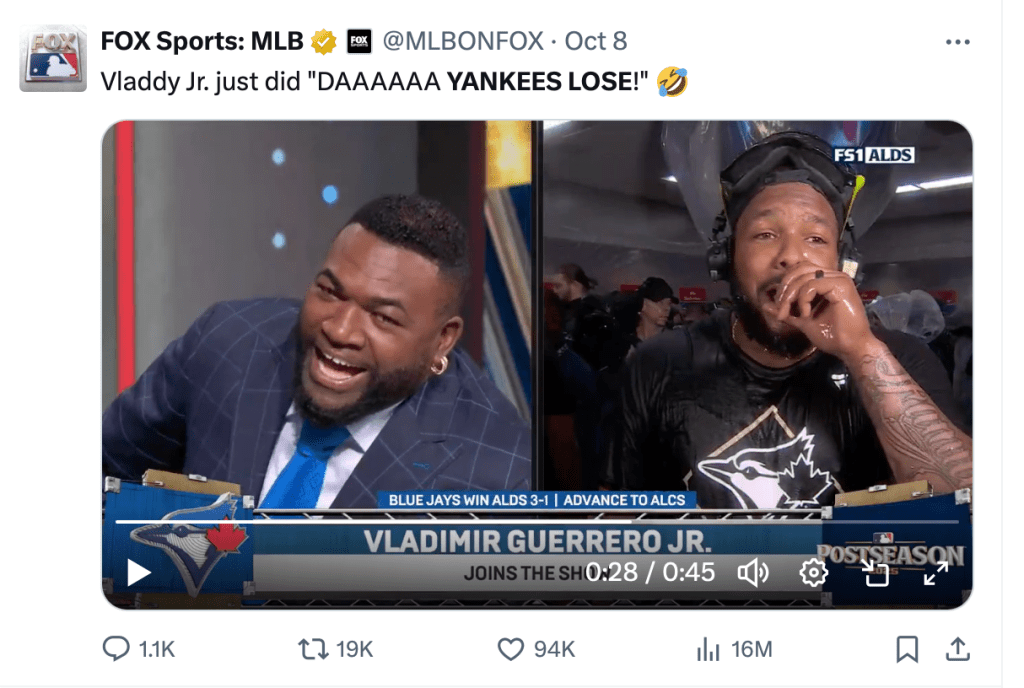
I thought I was too old for birthday presents, but thanks to @27vladdyjr and @davidortiz for this:
***
If you would like regular notifications of future posts from MediaPolicy.ca you can follow this site by signing up under the Follow button in the bottom right corner of the home page;
or sign up for a free subscription to MediaPolicy.ca on Substack;
The CRTC is shaping the regulatory path for streaming services in Canada in three big files: audio content, video content and media distribution. The public hearings for video and distribution were done before the summer break and this week the Commission kicked off hearings on music streaming and radio.
The Commission has to figure out what more the global streaming services must do for Canadian content, a year after the CRTC levied on the streamers a “5 per cent” cash contribution to Canadian media funds that match those paid by Canadian cable TV providers.
In music streaming, that could mean new requirements for streamer spending on Canadian songs and musicians through a combination of copyright payments and investments in musician development. It could also mean “prominence” requirements giving an extra push of Canadian songs to the attention of listeners, something that the streamers normally do only if music labels pay them.
The pro-CanCon advocacy group Friends of Canadian Media (I’m a volunteer) says the regulatory algebra should be straightforward.
The streamers’ spending requirements ought to be benchmarked at the same level of radio broadcasters’ budgeted spending on Canadian music and local programming, about 30% of revenues according to the Ontario Association of Broadcasters.
With the benchmark set, next would come the detailed arguments about what streamer expenditures on Canadian music count towards the 30%. The streamers will point to their current budget for copyright payments to Canadian musicians whose songs are uploaded to their platforms, but those don’t come anywhere near filling up a 30% bucket.
Then the “discoverability” requirements would get assessed and Friends has proposed that the Commission require the streamers to promote Canadian music with home-screen prominence, e-mailed song recommendations, more song picking of Canadian music in staff-curated playlists and an algorithmic responsiveness to listeners’ Search inquiries for different types of music. The cash value of these prominence measures to Canadian music producers would be calculated and set off against the streamers’ spending obligations.
The streamers are looking for two things and they want both.
They want the repeal of the five per cent cash levy that supports touring and special development projects for Canadian musicians under the stewardship of independent Canadian media funds. The streamers don’t want to pay and have appealed the levy to the courts.
Also they have filled the ears of the Trump administration and US Congress on how unfairly Canada is treating them (Canadian radio broadcasters pay only a one-half per cent cash levy because they already carry the heavy airtime quotas.)
The other thing the streamers want is no Canadian regulation. Or to put that in regulatory vocabulary, they want whatever efforts they care to make to support Canadian music deemed sufficient. It’s worth recalling that Canada is the first country to regulate streaming audio, even the Europeans haven’t done it yet.
This audio hearing is also the opportunity for Canadian radio broadcasters to bang away at air-time quotas for Canadian songs. As well, they want to water down the “MAPL” definition of what counts as Canadian music for the purpose of meeting those quotas.
The dispute about MAPL —which provides a point system for counting song contributions from performers and songwriters—- will drive some headlines if only because Canadian rock star Bryan Adams publicly trashs it. At some point, MediaPolicy will chime in (again) on that topic.
***
It is hard to keep up with dizzying pace of the Trump administration’s rolling offensive against mainstream media outlets (excepting Fox News of course).
The FCC Chair’s threats of regulatory action against Disney/ABC and the television stations that carried the Jimmy Kimmel comedy show were successful in getting Disney to kill the show after Kimmel lampooned the President’s response to a question about the assassination of his friend and ally, Charlie Kirk.
A day later, the President said that he expected NBC to fire two more late night comedians, Seth Meyers and Jimmy Fallon. He also promised more FCC regulatory action against television networks if they don’t put more conservative guests on air.
As well, this week Trump filed a $15 billion libel lawsuit against the New York Times. A district judge punted the statement of claim as too long and rhetorical, giving Trump’s lawyers a month to refile.
Stepping back from the daily drama, I recommend Matt Stoller’s most recent Substackthat sees recent developments as the consequence of successive Republican and Democrat administrations allowing rampant corporate consolidation of telecommunications and media over the last four decades.
Stoller argues that repression of free expression was made possible by a consolidated media landscape, compounded by monopolies in Big Tech.
He has a lengthy list of recommendations, combining anti-trust break-ups of major tech and media companies with new regulatory action that favours more diverse ownership of media.
The ambition of his wish list is considerable, perhaps unrealistic, but it looks to be a campaign proposal to the Democratic Party based on the idea the people are ready to break up Big Media into smaller and more lovable independent media outlets.
***
Lest this blog space seem to be picking on the Americans, I draw your attention to MediaPolicy’slast post spotlighting an on-air anti-Semitic rant from Radio-Canada‘s Washington correspondent.
Élisa Serret described Jewish influence in American politics as “a big machine” fuelled by Jewish money and claimed that “the Jews run Hollywood” and (a new one) that Jews are the mayors of America’s “big cities.”
There’s also a good opinion piecefrom the Globe and Mail‘s Tony Keller that you might like.
***
If you would like regular notifications of future posts from MediaPolicy.ca you can follow this site by signing up under the Follow button in the bottom right corner of the home page;
or sign up for a free subscription to MediaPolicy.ca on Substack;
The latest development in the AI Death Star powering up to blast news journalism is Google’s AI Mode.
AI Mode is the longer form iteration on Google’s AI Overviews that presents brief information summaries in response to user inquiries on the Search platform. AI Mode has been released in the US and UK, but not Canada yet. It’s reported to be able to handle more complex information requests.
What AI Overviews and AI Mode have in common is they greatly reduce click throughs to news publishers’ websites that normally display as an algorithm-driven search response or links that might even be cited in the summary response. That means less eyeballs and less advertising revenue for news outlets. Way less.
That outcome raises the obvious question: if news outlets become AI road kill, who will feed fresh content to AI?
All of this ought to be on Evan Solomon’s mind. The former career journalist is now the federal AI Minister. In a recent interview in Toronto Life, he said “my job is to develop a sovereign AI strategy while asking, ‘How can we make sure it causes more good than harm?”’
Solomon touted the opportunity for Canada to thrive in a job-rich AI sector. A more vigorous follow-up question might have been how he saw that happening.
He didn’t point, but might have, to the recent announcement by Bell Canada and the Toronto-headquartered AI outfit Cohere of a co-venture targeting business and government clients in need of AI tools and the supporting infrastructure.
A Globe and Mail story makes it clear that Cohere is a favoured Canadian company, part of an evolving federal strategy for digital sovereignty.
That includes a $240M allocation from the federal government’s $2 Billion “sovereign compute” program that is aimed at match-making Canadian suppliers with Canadian consumers of AI tools.
Cohere, it might be noted, is being sued in the United States by various news publishers for ingesting copyrighted content without a license or compensation. As a former journalist, Solomon must have connected the public policy dots.
***
The plight of the Canadian “musician middle class” —maybe we could just acknowledge it is more accurately described as an artist working class— is the subject of the best thing I have read yet on the topic, Luc Rinaldi’s long feature “The Death of the Middle-Class Musician” that was just published in The Walrus.
There is a street narrative out there that says the music streaming gorilla Spotify is a soul-sucking, musician-impoverishing monster. Might be true, might not.
Rinaldi’s piece is sympathetic to musicians (hands up those who are unsympathetic) and, given the difficulty in obtaining data on musician earnings, provides strong indirect evidence that there is a real threat to Canada sustaining its supply of homegrown music. And that is despite the fact that Canada has a reasonably generous program of public and CRTC-generated subsidies, by international standards.
But Rinaldi also wisely puts his finger on the important thing, namely the supply and demand for music in a sea of global content:
“The carrot that’s being dangled in front of an artist is their dream,” says Kurt Dahl, a Saskatoon-based entertainment lawyer…. “When people’s dreams are in play, they’re often not as rational or reasonable as they might be in the regular business world.”…
“You’re up against everything, from everywhere, all the time,” says Patrick Rogers, chief executive officer of Music Canada, an organization that represents the country’s major labels. “And if you’re willing to take on that challenge, the industry is in a position to help you.”
The challenge for media policy in music streaming is that the Internet-driven fragmentation of media creation and consumption has over rewarded a tiny elite of hit-makers, well beyond what existed pre-Internet. Everyone else lives on scraps.
Or at least that’s the view of media thinker Doug Shapiro, and he’s a smart guy.
His latest blog puts forward his theory on this but i couldn’t get past the paywall ($18 per month, forget it) to read the whole thing. However his earlier and unpaywalled version is available here.
A crude summary of what he’s saying is that the “informational and reputational cascades” of popular content work fabulously well on the Internet.
Roughly translated, he’s saying that algorithms perfectly capture our human tendency to sift through an ocean of content by paying attention to what other people found to be good content (informational) or what we need to consume because its a pleasing experience to connect with other human beings through a common culture (reputational). Maybe a little too perfectly.
***
If you would like regular notifications of future posts from MediaPolicy.ca you can follow this site by signing up under the Follow button in the bottom right corner of the home page;
or sign up for a free subscription to MediaPolicy.ca on Substack;
Two news items about AI technology just grabbed headlines.
The first was the revelation by the UK news outlet Mail Online that its traffic referral from Google’s search engine is nosediving thanks to Google’s “AI Overview.”
The Overview AI tool is a huge upgrade on Google’s old practice of providing a top ranked text reply to search queries, usually mined from Wikipedia. Overview threatens to divert any but the most hardened skeptics from a page full of search results to a single high quality synopsis, sporting just two or three priority links.
The decline of web traffic is a calamity for news and information websites that count heavily on advertising revenue from referred traffic. No one is saying this out loud, but it might drive more unpaywalled news websites to a subscription model. That has implications for media policy that supports the vast array of unpaywalled media serving the largest audience cohort: casual news consumers.
But paywalled or not, as the publisher of the conservative opinion website The Hubgroused it’s the “centre-left” mainstream media that’s likely to dominate the few hyperlinks offered by Overview. And that’s if Overview actually keeps displaying the links, Google’s AI competitors might not even bother.
Overview has the potential to accelerate the shift of ad revenue from news creators to platforms like Google. Not only does Google already monopolize Search and exercise illegal market power in digital advertising, but like all AI companies it is harvesting news journalism without licensing the content.
Another story that surfaced last week was an apparent AI song “recorded” by a fictional band hitting it big on Spotify.
AI-music is the latest, and most profound, evolution of Muzak and its heir, the day-long passive music algorithm. This is a big challenge to music as an art and as a business. As such, it will have a major impact on how Canadian music is created, monetized and heard.
***
As a follow up to the most boring post I ever wrote, I can report that the CRTC’s public hearings on the distribution of Canadian content wrapped up on Monday with a closing appearance from the Canadian Association of Broadcasters.
CRTC Vice-Chair Adam Scott is on the panel. Because of, or in spite of, the fact that his background is telecommunications rather than broadcasting he often puts his finger on the crucial questions.
Scott asked the CAB spokespersons what they thought of the regulatory scheme proposed by Friends of Canadian Media for foreign online distributors.
The algebra of the Friends’ proposal is to establish an overall contribution to Canadian content roughly equivalent to that already made by Canadian cable companies; say, an expenditure tethered to 30% of Canadian operating revenue.
From that 30%, says Friends, online distributors could deduct their 5% cash contribution to Canadian media funds as well as the non-cash value of their marketing and prominence of Canadian shows on home screens and recommendation tabs. The flexibility of the “deduction” approach opens the door to bespoke contributions by different online businesses.
CAB President Kevin Desjardins colourfully described the Friends proposal as more like a piece of cheese offered to the streamers than a mousetrap, meaning the CAB would still like to see some general commitments to Canadian content that all online distributors would have to meet.
What was disappointing, Desjardins told Scott, was that the foreign streamers have avoided any formal commitments to Canadian content other than being left alone to carry on their business in Canada. He suggested that the Commission insist the streamers submit proposals in the post-hearing phase of the public consultation.
Another question raised by the Commission got my union-antennae twitching.
In 2022 the Liberal government decided to handcuff the CRTC on the available tools to regulate online distribution platforms in the instances where Amazon, Apple, Roku et al might be willing to carry Canadian programming but only on their one-sided terms for revenue splits or screen prominence.
Instead of conferring dispute resolution powers of arbitration on the CRTC, Bill C-11 restricted the Commission to adjudicating a standard of “good faith negotiations,” backed up by powers to fine violators.
As any union rep (or small commercial party) knows, good faith doesn’t tip the scales of power imbalance.
Canadian labour law remains mired in the good faith swamp after decades of jurisprudence that tries to distinguish between hard bargaining and illegal “surface” bargaining, ie the powerful party going through the motions while quietly messaging “it’s my way or the highway.” In this legal fiction, the actual content of proposals is almost irrelevant. The stronger party can be as hard nosed as it likes.
The CAB referred the Commission to the American FCC’s definition of good faith bargaining. But it looks a lot like surface bargaining, to be honest.
In the labour world, Ontario passed a law in 1986 on the resolution of first contract negotiations following unionization, when corporate intransigence is at its worst. The main feature was binding arbitration, exactly what has been denied to the CRTC.
But the “good faith” standard was upgraded from the vexing “hard vs soft bargaining” distinction to a multi-factor test in which the Labour Board scrutinizes “the uncompromising nature of any bargaining position adopted without reasonable justification.”
If the CRTC pursued this kind of thinking about good faith, it would have an evidence-based opportunity to require an intelligible “justification” for playing hard ball and that it be reasonable.
***
Perhaps there’s been enough said about Prime Minister Carney’s blink on the Digital Services Tax.
Nah.
Hugh Stephens posted his view, similar to what you read in MediaPolicy. In the course of his piece, he links to a 2020 background study published by the Library of Parliament shortly after Royal Assent to the 2019 Bill C-82, which was the enabling legislation for the DST.
The Library study takes the tax narrative from its origins in OECD discussions in 2013 to February 2020, a month after Joe Biden was inaugurated as US President.
It’s a useful read in a couple of ways.
First, the blow by blow history makes it clear that many of the urban legends around the DST are wrong. It was never a “data tax,” or an “audience tax,” or a “make Big Tech pay” tax.
It was a response to the problem of digital companies operating in Canada without “a permanent establishment” that makes the company’s product, like a factory or a mine. Without changes to the permanent establishment rule, foreign digital companies can freely offshore their Canadian revenues (or just pay tax on them in their home countries).
The other thing that the Library study does is follow the negotiation narrative among OECD countries and with the US.
A first-term Trump was opposed to the DSTs being legislated in Europe and threatened retaliation. Once Trump lost the election to Biden, the UK and France moved quickly.
Canada lagged for reasons best known to the Finance Minister and the PM. Perhaps they were waiting to see if President Biden could get Congress to ratify a new tax treaty that would curb the use of offshore tax havens and agree to a minimum global corporate tax rate.
We know the outcome. Nice guys finish last.
***
If you would like regular notifications of future posts from MediaPolicy.ca you can follow this site by signing up under the Follow button in the bottom right corner of the home page;
or sign up for a free subscription to MediaPolicy.ca on Substack;
The CBC has a hip two-minute cut-for-social video explainer narrated by the tattoo-embossed Nick Parker.
And for another take, here’s Paul Wells interviewing Canadian tax expert Allison Christians.
President Trump has promised to re-announce tariffs this week. Carry on Canada.
***
Two months ago when Donald Trump blurted out his desire to tariff US movies filmed abroad he got a tepid response from the supposed beneficiaries, Hollywood studios and the Big Tech streamers.
That’s because the studios and streamers make so many movies in Canada, at a competitive and government-subsidized cost, with world class quality.
What Hollywood really wanted was production subsidies from the US federal government, but so far that has not happened.
Now California is stepping up to the plate. Governor Gavin Newsom is prepared to double existing state subsidies to the tune of $750 million, quite a slice of the pie in what is otherwise a major austerity budget for the state.
***
The Canadian Press has reported that Justice Minister Sean Fraser is having a close look at the federal Liberals’ online harms legislation before re-tabling it.
Bill C-63 died on the order table when Mark Carney called a federal election in March. The core of the Online Harms Bill was to require social media platforms to establish content safety codes, legislation that polling suggests is a winner.
The add-ons to the bill were more controversial. The opportunity for private citizens to file anti-hate complaints against each other under federal human rights legislation, abolished by Parliament in 2012, is to be revived.
And the anti-hate provisions in the Criminal Code are to be strengthened with more severe punishments. MediaPolicy offered some perspective on that, here and here.
Prior to the election, then Justice Minister Arif Virani reluctantly split the controversial from the core elements of the bill into separate legislation. Neither bill was taken up by Parliamentary committees in the months leading up to the election call.
The CP story quotes the new Minister as wanting to make his own “fresh consideration of the path forward.”
There are two 15-minute weekend reads on media that I can recommend.
In his personal blog “Fagstein,” the Montreal Gazette’s Steve Faguy has posted a short history of the CRTC’s decades long struggle to keep local television news solvent.
He’s done a great job. I know how hard it was as I tried to do the same in a shorter space in chapter six of my book on the Online Streaming Act. Faguy’s post is the learning resource that has been missing.
The other read is a feature story from the Globe and Mail’s Josh O’Kane. He’s updated his whodunnit reporting on the cyber-theft of $10 million from FACTOR, the music funding organization that distributes dollars contributed by government, radio stations and (subject to a court appeal) music streaming companies to Canadian musicians.
***
If you would like regular notifications of future posts from MediaPolicy.ca you can follow this site by signing up under the Follow button in the bottom right corner of the home page;
or sign up for a free subscription to MediaPolicy.ca on Substack;
The 2025 Reuters Oxford Digital News Report was published this week, offering both global and Canadian break-out numbers.
It’s a trite observation that digital technology has turned media on its head, disrupting the advertising revenue that once paid our bar tabs for the consumption of media. The disruption has hit hardest in news journalism and stoked alarm about its knock on effect upon liberal democracy.
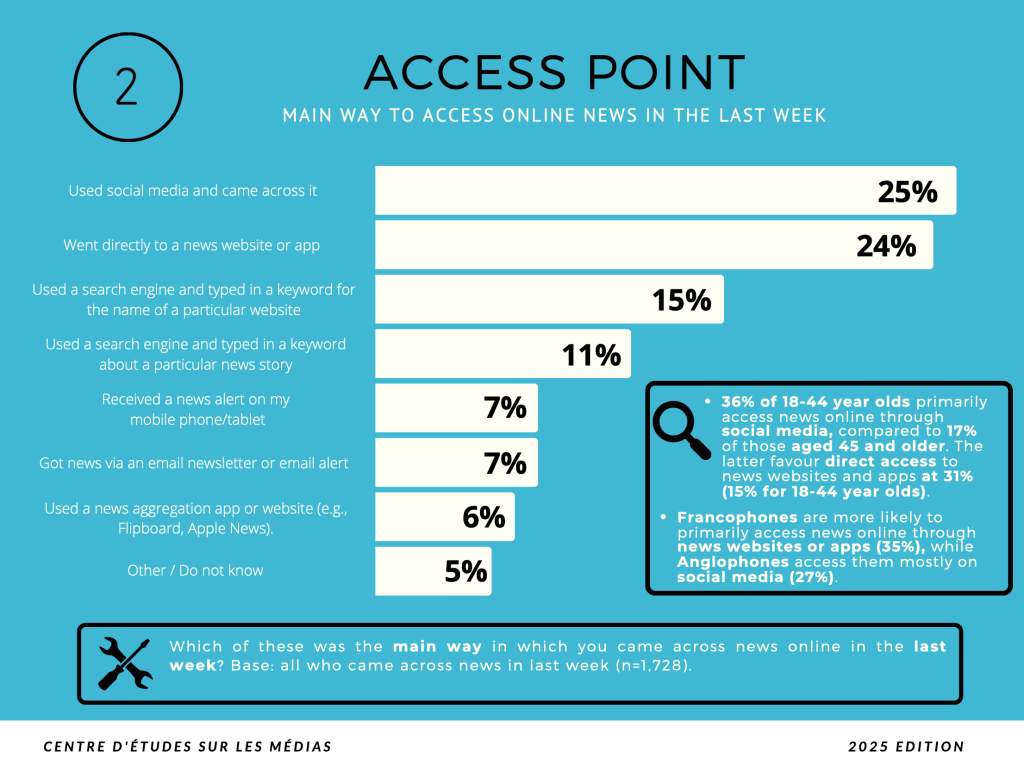
That’s probably why recurring polls and surveys tracking the arc of that disruption seize our attention, even if the trends are slow moving. For example, this year’s Rubicon crossed was that social media surpassed news websites as the leading access point for online news.
Cue the Reuters report, for my money the leading annual global survey. It tracks metrics on news consumption, platform preferences, news avoidance, misinformation, fear of misinformation, and “trust in media,” which is essentially a hybrid metric tracking legitimate skepticism of news journalism, alienation from public institutions, and audience polarization.
The global report also generates break out national numbers and additional polling for individual countries. Canada’s supplementary report on news consumption was written by University of Laval researchers Colette Brin and Sébastien Charlton.
Canada saw a 1% down tick in online news subscriptions from 15% in 2024 to 14%. In 2016 it was 9% but has been flat since getting a bump from the Covid pandemic and the 2020 US election.
Globally, the willingness of the local population to pay for online news ranges from 42% in Norway to nine per cent in Italy. Canada’s 14% is just slightly under the global water line of 18% of the adult population.
There was startling data that Canadians are world leaders in our readiness to shell out for foreign news subscriptions, clocking in at half of Canadian news subscribers. Together with Ireland, Canada’s sign up for foreign news sources is a global outlier.
But what really got my attention was a graph from the global study revealing that 71% of non-news payers say they can’t be tempted to subscribe through innovative options to bundle multiple news services, access more non-news content, or by pick-and-pay news content falling short of a full subscription. They just won’t pay for news, full stop.
As Hunter S. Thompson might have said, not paying is a matter of principle.
That suggests (excuse my confirmation bias) that in the best case scenario there is limited room to grow the subscription-model for Canadian news. The vast majority of Canadians are casual news consumers who will not pay to keep up to date on current affairs.
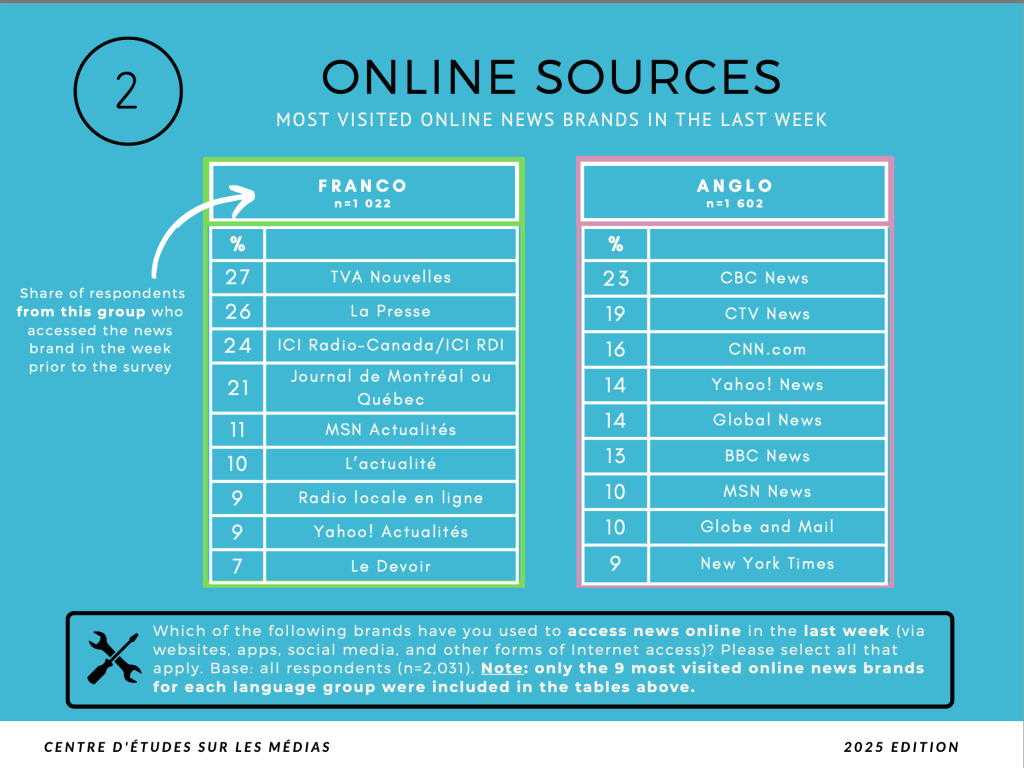
The good news, if you can call it that, is that the free-distribution CBC, CTV, Global News, the Canadian Press and hundreds of community news outlets continue to post news online (see the graphic below, where CBC leads the pack among English speakers).
Should that change, I’m not counting on the news subscription model to bail out liberal democracy. It’s more likely (and this is also reflected in the Report) that Canadians will turn to social media influencers to deliver news, reliably or otherwise.
***
A couple of follow-up stories for you:
Last month the CAQ Québec government tabled its Bill 109, aiming to deliver seismic changes to the rock bottom consumption levels for French language music on global streaming platforms operating in Québec.
The tabling of the bill by Culture Minister Matthieu Lacombe was timed to coincide with Québec City hosting the 20th anniversary of the UNESCO Convention on the Protection and Promotion of the Diversity of Cultural Expression.
Unamended since its inception in 2005, the Convention is an aspirational international standard for sovereign nations willing to step into the commercial media market and push back against the domination of English-language and mostly American content.
Lacombe was looking for other countries to sign off on an upgrade to the Convention, specifically to match Bill 109’s claim to cultural diversity as a fundamental right of citizens backed up by regulatory efforts to move the needle on the consumption of domestic media content.
The Québec City meeting didn’t deliver for Lacombe. A few countries said yes, but more gave a muffled maybe.
The muffled included Canada’s federal government. Culture and Identity (and Official Languages) Minister Steven Guilbeault issued a statement that endeavoured to navigate the narrow channel between the cultural nationalism embedded in Lacombe’s bill and, on the port bow, the exclusive federal jurisdiction over broadcasting. Not to mention, Guilbeault’s boss the Prime Minister must be thinking it’s not an ideal time to piss off Donald Trump by making more announcements about regulating foreign streamers.
All this is happening on a parallel time track with the CRTC’s upcoming public consultation on regulating foreign music streamers operating in Canada.
Apple, which has more of a flair for corporate arrogance than you might think, filed a policy brief with the CRTC that sassed the Québec cultural groups who have asked the CRTC to build a stronger regulatory regime for music streaming. Said Apple:
Apple opposes the requests of groups such as ACCORD and APEM to obtain further information from online audio services in an effort to dictate approaches that supposedly will result in more streams of Canadian songs. Setting aside the remarkable fact that these organizations apparently think that they would be better at running the streaming services than the services themselves, these requests lead to a dead end. As Apple explained in its response to APEM’s application of more than one year ago, much of the information being requested is either not provided to Apple or does not even exist.”
American Big Tech disses Québec cultural leaders. Game on!
In addition to Apple, the world-leading music platform Spotify filed information with the CRTC culled from its annual report “Loud and Clear.”
The Spotify document claimed surging growth in musician earnings in the global market for French-language music. Musician earnings have doubled globally and in Canada since 2017 thanks to rising royalty payments to music labels. Spotify told MediaPolicy that earnings growth was experienced at all levels, from the poorest bands to superstars (but not broken out by language group).
The policy implication of Spotify’s claim is that it’s part of the supply-side solution to domestic music and that the demand-side of music consumption ought to be left to the unregulated market.
The earnings data reported by Spotify is 10,000-foot stuff. Royalty payments are probably 20% of total label and musician earnings, says the company. But without the streamers opening their books to public analysis it’s hard to say how well things are working out for individual bands, or in particular for Québec musicians who may be making money in the global francophonie but have less than 10% of their own domestic market.
The same data problem exists on the consumption side of the equation. Spotify has never contradicted the repeated claims made by Québec’s cultural groups that their third party data shows that less than 10% of streaming in Québec is in French and that French-language songs rarely crack the charts.
In response, Spotify says that half of Québec’s streaming audience “regularly” consumes French language music but chooses not to define “regularly” or provide its internal data on the proportion of English versus French language songs.
The coyness about data may come to a point in September when Spotify executives must appear before CRTC commissioners.
***
In last week’s post, MediaPolicy offered an update on the CRTC’s decision to extend news subsidies from the Independent Local News Fund (ILNF) to the Global News network of local stations.
Some of the Commissioners were nevertheless unhappy with the funding gap remaining between 34 independent local stations and the 45 operated by “vertically integrated” media companies Bell, Rogers and Québecor. If you want more context, check out last week’s post.
If some Commissioners think that the Big Three are getting the short end of the stick on news subsidies, imagine what the telcos think.
Bell owns 35 local stations in its CTV and Noovo networks and, according to filings, loses $40 million annually on news.
Here’s Bell’s illustration of the news funding gap it provided to the Commission:
But being sensitive to how the big telcos are viewed by their admiring public, Bell isn’t having too much of a moan.
Instead, Bell’s ask of the Commission is that they be allowed to reassign the remaining $13 million of their cable division’s funding of community programming to their broadcasting division’s network of local news stations.
In return, Bell wants the Commission to repeal its 2016 regulations requiring the vertically integrated Big Three to allocate 11% of their programming budgets for conventional television to local news.
Also, Bell wants the Commission to remove minimum exhibition requirements for weekly hours of news programming.
***
The best podcast I listened to this week was four Americans debating trade, Trump and culture war, courtesy of Canada’s Munk Debates.
If you would like regular notifications of future posts from MediaPolicy.ca you can follow this site by signing up under the Follow button in the bottom right corner of the home page;
or sign up for a free subscription to MediaPolicy.ca on Substack;
Sarah McLachlan will be a Canada Day headliner on CBC
June 7, 2025
Now that Parliament is back, and Culture and Identity Minister Steven Guilbeault is re-seated for a second tour of duty in his portfolio, there may be speculation about whether the Liberal government will do anything to bring Facebook and Instagram back into the scope of the Online News Act Bill C-18.
The Minister will keep an eye on Australia.
The Australians’ 2021 New Media Bargaining Code served as Canada’s model for Canada’s legislation that compels Google to pay $100 million annually in licensing payments to online Canadian news organizations.
In both countries, Meta’s response to bargaining codes was to ban news content from Facebook and Instagram in order to avoid regulation. In Australia, that meant Meta refused to renew the annual $65 million (AUS) value of its expiring voluntary agreements with news organizations which earned it an exemption from regulation in 2021.
Australia’s Labor government caught everyone’s attention last December when it announced that it would respond to Meta’s actions by legislating mandatory licensing payments regardless of the company’s ban on Australian news.
If and when it is enacted, a “News Bargaining Incentive” would provide a default cash levy on Meta, Google and TikTok if those platforms refused to bargain with news organizations, irrespective of any ban on news content.
The Incentive would be set at a price in excess of the estimated value of a voluntary agreement with news organizations. In late January the Australian government announced that a pre-legislative consultation paper would be “released shortly” but an election intervened.
Now that the Labor government has returned to a majority Parliament in a surprise comeback that paralleled the re-election of Canada’s Liberals, the expectation will be that it releases a white paper and legislates as promised in “late 2025.”
None of that will take place in a vacuum as the American tech platforms will seek the aid of the Trump administration and Congressional trade retaliation. Their lobby organization CICA has released a statement that characterizes the Incentive as “arbitrarily” targeting “select foreign companies” just like the Digital Services taxes that 11 OECD nations have enacted to collect corporate tax revenues that are alleged to be evaded by Big Tech.
An overview of different national versions of a news bargaining code is offered here.
There are also various attempts at the state level in the US. The Californian version was a flop as Google’s modest financial commitments have been scaled down in lock step with the Governor’s budget cuts to its parallel subsidy program. However legislation has been tabled in Oregon, New York, Washington and Illinois.
***
Three independent Canadian television stations closed last month.
In mid-May, Stingray’s twin stations in Lloydminster (respectively affiliated with CityTV and CTV) shuttered. Ownership cited plunging revenues and audience.
Then last week Pattison’s Medicine Hat station also went dark.
It’s an attention-grabber for the CRTC which is poised to release a ruling later this week on revised cash allocations from the Independent Local News Fund (ILNF).
In a June 2023 submission to the CRTC, the umbrella organization representing 19 independent television operators —not counting the 15 Global News stations cut loose in the Rogers Shaw merger— reported that collectively they cover 70% of news production costs from $18 million in ILNF grants.
***
Just as the window closed on submissions to the CRTC on audio regulation, industry leader Spotify published a news release touting the success of Canadian artists on its platform.
The gist of Spotify’s claim is that Canadian artists are growing their earnings on Spotify by expanding their global audiences.
The Canadian news release cites Spotify’s annual “Loud and Clear” global report on musician earnings that was posted in March. The break-out of Canadian data hasn’t been published other than summarized in the June 4th news release.
Significantly, the Spotify report does not cite any changes to consumption of Canadian music in domestic audiences in Québec or the rest of Canada. As far as we know, the CanCon share of domestic market remains at 10% of the Canadian audience and, in the French language market, less than that.
***
If you’re making beer and cedar deck plans for Canada Day, it looks like a good CanCon line-up for the televised broadcast from Ottawa, Vancouver, Yellowknife, and Summerside. It’s on CBC.
***
If you would like regular notifications of future posts from MediaPolicy.ca you can follow this site by signing up under the Follow button in the bottom right corner of the home page;
or sign up for a free subscription to MediaPolicy.ca on Substack;
Last week MediaPolicy offered an analysis of whether the Québec CAQ government’s Bill 109 might trigger a constitutional conflict with the federal government’s Online Streaming Act Bill C-11 over who can regulate video and audio streaming platforms with the goal of making French language content more prominent in Québec.
Having federal and provincial governments running active public policy on exactly the same thing is a bit of a problem, something Julie Miville-Dechêne immediately pointed out on the floor of Senate.
The Senate’s Government Representative, Marc Gold, replied that the federal government was thinking about Bill 109 and “may have more to say on this in the coming days.”
What the Carney government might or might not say in the coming days will probably follow some off the record conversations with CAQ Culture Minister Mathieu Lacombe who has already said publicly he doesn’t have to negotiate with Ottawa.
The legal question of whether it’s Parliament or the Québec National Assembly that has jurisdiction over the “discoverability” of Internet-borne content is a juicy orange for the many devoted fans of Canadian constitutional law.
Legal expert Pierre Trudel of the Université de Montréal published his view in Le Devoir. He argues that Québec can take legislative action “to ensure that French-language works can be easily found in the mass of available content, even by someone who isn’t searching for them,” because nowadays the delivery of online content depends so heavily upon consumer data that it becomes a matter of provincially-regulated commercial affairs and consumer protection.
Trudel offers as a legal precedent a 1978 Supreme Court case. In that 6 to 3 majority ruling, the Court upheld a Québec consumer protection law governing the exposure of children to advertising content even when it was applied to federally regulated television programming.
***
In the quiet lull following its miraculous survival of Election 2025, the still-funded CBC released its commissioned report from Mercer compensation consultants that answers some of the outstanding questions about the $18 million in “bonus payments” to 1,200 executives and non-union staff that fed the news cycle for so many months in 2024.
The headline is that Mercer recommended to CBC management that its at-risk “performance pay” component of total compensation is a common practice, a good thing, and ought to be retained in the name of effective staff recruitment and retention. In spite of the advice, CBC management rejected the recommendation to stay the course on performance pay and instead converted those dollars into wages.
And perhaps that puts an end to the melodrama manufactured by MPs of all parties, as well as many members of the media commentariat, using the bonus payments as a stick to beat the CBC and its unpopular President because she refused to cancel payments owed under employment contracts in a year that the public broadcaster laid off 141 staff and then narrowly avoided mass layoffs.
Before closing the book on this, there are a few parting observations worth making:
Every MP ripping former President Catherine Tait for not cancelling performance pay was well aware of what Mercer confirmed: an at-risk component of total employee compensation is a prevalent business practice throughout the economy. The idea is to keep high achieving employees hungry for success through good performance. It’s not a perq. It’s not a cash grab.
If the unspoken script to the drama is that CBC employees get paid too much, the Mercer Report put that one to bed. CBC executives and non union employees are paid smack in the middle of the spectrum of total compensation for similar work. In fact they would be slightly below median earnings were it not for a solid pension plan.
Between MPs asking the wrong questions, Tait clamming up in response to political attacks, and the limited information in the Mercer Report, we still don’t know anything about a number of key questions. Did legal entitlement to performance pay depend in any way on whether the CBC was laying off employees ? (Probably not). Did Tait have any option to reduce or cancel them? (Unlikely). Did employees achieve their targets for full at-risk pay or are the payments gimmes for most employees ? (Unknown).
More importantly, now that $18 million of budgeted at-risk pay is being integrated into fixed salary, will that be at a dollar-for-dollar rate or discounted because there is no longer an at-risk portion?
The fact that none of these questions have been pursued, let alone answered, tells you what performative nonsense this has been.
***
Back to the issue of Canadian content made discoverable on the big streaming platforms: I recommend the latest episode of Dan Runcie’s Trapital podcast hosting Will Page, the high profile expert on global music streaming and ex-Chief Economist for Spotify.
Page says that after a decade and a half of audio streaming that fuels “glocalization” of music — where musical cultures cross pollinate across national and linguistic borders — he was surprised at the growth in the US dominance of the global music earnings when he had expected the opposite.
That has implications for Canada:
“I ask you to go to the YouTube artist charts for Brazil…. Google it up and pull down those top 100 artists in Brazil this week.
And you’ll find one, maybe two international artists on that chart is singing in Portuguese, very little Spanish. And if you’re lucky, I think The Weeknd is ranked 95, and Bruno Mars is ranked 65…
Other than that, it’s an entirely Portuguese chart. So there you go. There’s a top 10 global music market that just said, “thank you and good night” to the English language.
If you are a non-English speaking country with a strong identity, glocalization is a force for good. If however, you are an English speaking country that’s not American, glocalization leaves you screwed. So we have winners and we have losers.”
Page has lots more to say about Canada and Canadian music. You can listen to the podcast here.
***
If you would like regular notifications of future posts from MediaPolicy.ca you can follow this site by signing up under the Follow button in the bottom right corner of the home page;
or sign up for a free subscription to MediaPolicy.ca on Substack;
Kevin Desjardins appearing before a Senate committee in 2022.
March 25, 2025
Kevin Desjardins, the President of the Canadian Association of Broadcasters, is a zookeeper.
This is not to suggest that our private broadcasters are wild beasts. But they are a diverse menagerie that includes the big cats Rogers, Québecor, and Bell as well as all manner of independent broadcasters in radio, television and streaming, from single-station owners to cross-Canadian networks like Global TV. They don’t all want the same thing, they all want to eat, and given the opportunity they just might take a bite out of the animal in the next cage.
Desjardins is the broadcasters’ unassuming chief spokesperson, the fellow who checks his ego at the door, listens to them, and goes forth to advocate for the industry in measured tones to politicians and journalists who routinely vilify his more notorious animals.
Nobody who can read a CRTC report still contends that broadcasters make easy money (the CAB does not represent the cable operations of the big cats). Meanwhile the unregulated American streamers and Big Tech advertising businesses have broken into the kitchen and are eating the zoo’s food supply.
That means Desjardins gets more public attention now when he says that the decades-old regulatory bargain made between broadcasters and government to spend on money-losing news programming and CanCon drama needs to be revisited.
The CRTC is half-way through a series of policy proceedings (now suspended for the duration of the federal election campaign) that are supposed to strengthen the financing and prominence of Canadian media content while “equitably” distributing the obligations upon US streamers and Canadian broadcasters.
Streamers and broadcasters both say “equitable” means “less.” Canadian public interest groups and even some of Desjardins’ own members dispute that.
Where and how the Commission eventually strikes that balance won’t be fully known for another year, a very eventful year.
MediaPolicy spoke to Desjardins earlier this month:
MediaPolicy: I guess we should start with the urgent. What does Trump and trade war mean for Canadian broadcasting?
Kevin Desjardins: Overall, the economic chaos that has been created through the Trump administration’s tariffs and trade posturing have been the most notable impact. If these America-first policies end up leading to a recession that will likely have an immediate impact on advertising revenues for broadcasters.
From the point of view of tariffs, we haven’t seen anything that immediately affects the sector. But I think there is concern in the longer term as we look at trade issues.
We see the cozy relationship that the largest tech players have had with the Trump administration, and we know the extent to which those global tech companies and streaming platforms have dug in to resist any level of Canadian regulation being placed upon them. They think that making use of the service production industry in Canada [by filming US shows here] is sufficient.
At this point, the largest players in the global advertising business are Google and Meta, and tech is in the process of swallowing Hollywood. If there is a trade war coming, we believe that those global tech and streaming companies will be on the American side of the table, as they were in the CUSMA trade negotiations.
MP: Let’s talk about the CBC. One of the policy issues that pops up over and over again is the overlap or competition between private and public broadcasting. Even if CBC went completely ad-free, there would still be public/private competition for audiences. An ad-free CBC could even be a net negative for private broadcasters. Given that some competition or overlap seems unavoidable, how might CBC and private broadcasting better keep out of each other’s way? Or at least complement each other better?
KD: The CBC is always a bit of a fraught discussion for us, and certainly within the current political climate. There’s some diversity of opinion within our membership as to how to deal with the CBC and Radio-Canada.
But the essence of what we can all agree on is that if there is a role for the public broadcaster, then they have to act like a public broadcaster. And that means they should be driven by their public service mandate, and not by market-based decisions.
The easiest way to clarify this distinction is to get the CBC out of the advertising market. Advertising revenue is additive for the CBC on top of their Parliamentary appropriation, but it is the lifeblood of commercial broadcasters.
The CBC’s continued presence in the ad market distorts that market, and the CBC’s purpose in the Canadian media ecosystem. If they weren’t chasing ad dollars, they would be less likely to spend time competing with private broadcasters for popular programming or talent and focusing their efforts on the largest markets.
And moreover, the CBC should have a greater role in fulfilling some of the cultural policy goals found in the Broadcasting Act. Let private broadcasters be driven by their audiences, and the public broadcaster can fill in places that the market alone doesn’t support.
MP: As part of that, what is the importance of a backstop function of CBC where the private broadcasters recede or fail?
KD: I don’t think it’s a healthy approach to see the CBC as a backstop. In some ways, that lets people off the hook from actually addressing the issues that are holding private broadcasters back from being as successful and as responsive to their audiences as they want to be.
And to my earlier point, I think that market concerns can drive the CBC’s decisions on where and how it provides coverage. I share some of the concerns that our colleagues on the print and digital side have when they see the CBC moving into local markets and competing for local ad revenues.
And it was highly curious to me when the CBC announced their intentions with the compensation money from Google, flowing through the Canadian Journalism Collective. They listed out a number of “underserved” markets where CAB members had already invested significant time and resources to set up community news portals. It seemed as though CBC looks at a market as “underserved” simply because they are not present there.
MP: OK, so let’s talk about the future of private television. The pessimistic view is that the old business model has been smashed to pieces by streamers taking Canadian audiences and hoarding US programming rights, while Big Tech has gobbled up our Canadian ad revenue. And that Canadian broadcasters are just coasting the long decline to their inevitable demise. The more optimistic view is that conventional TV and cable distribution are still the first choice of boomers and should be for another decade or so, that leaves time to establish a replacement business model. Let’s blue sky: what does that model look like?
KD: At this point, it’s hard to look even a few years down the road to see where the sector is headed, especially given the pace of change globally as tech and streaming advance quickly. Certainly, the foreign tech giants are sucking the vast majority of ad dollars out of the Canadian economy, and we effectively have a trade deficit in our media market.
But I don’t see broadcasting in Canada as being on a road to inevitable demise. And I don’t think the CAB’s members are throwing in the towel.
There’s still billions of dollars of ad revenue and subscription revenue out there for Canadian services to compete for. And Canadian broadcasters still provide an important place for those programs and events that need to reach a broader audience.
Look at the 4 Nations Faceoff hockey final. Between English and French broadcasts and streaming, you’re looking at more than seven million viewers tuned in live to an event, with a very specific Canadian point of view. There’s still lots of value that Canadian-owned broadcasters provide.
If I look ahead, things are obviously going to change, and we need a regulator that allows Canadian businesses to adapt and change as quickly as our global competitors.
I also see how tech companies have this knack for “inventing” digital versions of things that already exist. I think about the hype around [free advertising streaming television] channels [like Paramount’s Pluto TV or Fox’s Tubi], which are essentially just linear channels delivered digitally. And it makes me think about the next thing that consumers are pushing for with “bundling” of streaming services, not unlike how we have bundled programming services [in the cable package] for decades.
I also see that there’s already a push from several Canadian cable distributors to bundle streaming services with their programming services, which might be a way to bring cord-cutters and cord-nevers back into the Canadian system.
All of the foreign streaming services have been increasing their prices globally, not just in Canada. That’s why Conan O’Brien jokingly congratulated Netflix at the Oscars on their “18 price increases this year.” It’s not because of any of their horseshit talking points about a “streaming tax”, but because now that they have reached a certain level of customers around the world, their business model is now about squeezing more money out of each one.
Fundamentally, I reject the notion that somehow Canadian broadcasters are in peril because they haven’t been sufficiently “innovative”. I look at the digital products that they are offering, and they are absolutely providing a great experience for Canadian audiences.
But you can’t deny the simple fact that Canadian broadcasters compete with global platforms, who have access to infinite amounts of capital from around the world, and who need to operate at that global level. Our pool of accessible capital is more limited because of ownership rules, and then our members are expected to support a plethora of cultural policy goals that fundamentally haven’t changed since Sidney Crosby was a toddler.
Canadian broadcasters are willing to invest in Canadian programming and local programming in a way that global streamers won’t, but any investor needs to know that there is a business case for those investments. I think the CRTC never fully appreciated that fundamental reality, because the assumption was always that the broadcasting business was doing fine. Now that the challenges are quite existential, the Commission needs to better situate themselves in their role as an industrial regulator and think about the general health and viability of the Canadian-owned and controlled sector.
MP: We haven’t talked about radio yet. It seems radio is swimming to keep its head above water in the Internet’s attention economy. I thought Bell passed a cruel judgment on its future when it sold those 45 stations. If we get driverless cars it might be the end of a great medium. But then you look at audio streaming: music and talk radio are more popular than ever, so the demand for audio is bigger than ever. How does radio adapt, or is it just living out its old age?
KD: I think that radio’s reach continues to be vastly underestimated. It’s still relevant, and yes, there are literally millions of young people listening to the radio every day across the country.
The challenge is that all of the additional competition in the advertising business, there’s a disconnect now between radio’s reach and where advertisers are spending.
Many of our members are out there in the digital space, either with streaming over apps or packaging their content for the podcast audience. Often, those digital ad dollars don’t make up for the losses on the linear side.
But radio remains incredible relevant at the community level. They are the ones supporting local charities and events, and during the many natural disasters we’ve seen in recent years, radio has stayed on the air when the power went out or cell service went down.
MP: Regarding the CRTC’s new consultation on audio, do you think the Commission hears your concerns about the viability of radio?
The rationale for regulating the broadcasting sector was the scarcity of spectrum to send out your signal. In exchange for being granted that spectrum, you agreed to certain rules and obligations to fulfill cultural policy goals.
But now that an infinite amount of content from around the world is always immediately available through the internet, and it is broadcast quality, how can the Commission continue to cling to those old rules?
The Commission will point to the Diversity of Voices rules in their decisions, and it makes me want to pull out my hair. Because it is abundantly evident that there is no shortage of “voices” in the content marketplace. It’s such an example of regulating by looking at the rearview mirror rather than the road ahead.
That’s what we saw with the most recent audio notice, which seemed to suggest their “interim view” was status quo for the rules on Canadian radio, plus additional content quotas. But when it comes to the foreign streamers, their interim views are very quiet, if they are there at all.
It’s completely out of step with the reality of what Canadian listeners want. We see that [on streaming platforms] Canadians are choosing to consume about 10% CanCon, which is about where sales of recorded music stood historically. But our [radio] quotas are 35% and up to 40%, and there seems to be no appetite for even having the discussion if those levels make sense.
And from the point of view of the artists, there are infinitely more ways for them to get their music out and to be discovered. They can get placed on a curated playlist, and they can use their own social media channels to share their music and promote themselves. Radio is one piece of the puzzle to break artists, but it continues to bear the highest burden.
And yet, the regulatory bargain that was established for the satellite radio operators nearly twenty years ago seems to be the path that they are pursuing. Just pay more and play whatever you want.
There’s also the modernization of the MAPL rules, and again, we’re concerned that the Commission is going to make it harder for Canadian artists to qualify. If they take out the “P” of that equation, and make a song need two-out-of-three points to be considered sufficiently “Canadian”, it’s going to make things harder to qualify, not easier.
Basically, it all comes down to, if the artist is Canadian, it is CanCon. I don’t understand why there’s such resistance to this. The Commission should embrace this, because if they are as “consumer-focused” as they have claimed in recent years, having rules that tell Canadians that Canadian artists aren’t Canadian will only serve to undermine their legitimacy.
MP: Looking at the umbrella organization that is the CAB, you have something like 68 different members that represent such divergent, sometimes conflicting interests. The big TV broadcasters whose parent companies control cable access are in the same tent as small independents who need that access and the opportunity to make money. Big broadcasters are gouging out each other’s eyes to buy the most popular US programming. And you domicile different content businesses that do better or worse under the current regulatory rules. How do you get anything done?
KD: Every member-based association is a balancing act. There are often divergent opinions, and this is especially the case in an industry association. Our members are highly competitive with one another, and we at the CAB have to respect that. It’s not called “show friends”, it’s “show business”.
Our challenge is to make a convincing case to our members that they are better off singing from the same song book. That many voices with the same message creates resonance, and I think that we’ve done reasonably well in recent years of helping to provide that value to our members. If they don’t entirely align with each other, we hope that we can help them find enough common ground within any legislative or regulatory process.
Building consensus isn’t easy, but as Bruce Cockburn sang: “Nothing worth having comes without some kind of fight.”
***
If you would like regular notifications of future posts from MediaPolicy.ca you can follow this site by signing up under the Follow button in the bottom right corner of the home page;
or sign up for a free subscription to MediaPolicy.ca on Substack;












 MediaPolicy.ca