We are into year seven of Toronto Metropolitan University’s Local News Research project issuing regular reminders of the steady decline of local news outlets and the matching rise of “news poverty” (no news, or less news) in communities across the country.
The most recent report is here. Represented graphically above as a tally of closings and start-ups (not necessarily in the same communities) it presents a disturbing picture of Canadian news poverty.
The Michener Awards Foundation —the public service journalism organization that co-manages its well known annual awards with the Rideau Foundation— just assembled a meeting of 40 or so independent news publishers and editors in Charlottetown, hoping to survive and chart a path to “innovation and sustainability.”
The first two hours of the conference were the most compelling as news outlets swapped strategies of audience engagement. The common denominator could be summarized as “independent local ownership equals brand trust and community engagement with readers, advertisers and community organizations,” the latter being particularly effective in generating popular local content.
The keynote speaker was up next: Steve Waldman of the American Rebuild Local News project and the national intern program, Report forAmerica. His elevator pitch was already known to anyone tracking the news poverty crisis. Measuring by polling metrics, citizens living in communities that have lost most or all of their local news outlets are prey for misinformation spread on social media, increased political polarization and alienation. It’s a democratic crisis, not a business crisis. Or as one publisher told the crowd, “this is not a business. This is a public service that I have to run as a business.”
Familiar to Canadians, Waldman’s prescription is a variety of public policy solutions, that is subsidies of one kind or another at the state or federal level.
After speaking, Waldman sat down and tried to eat his sandwich while MediaPolicy and others peppered him with questions about the American experience with public policy solutions (he was just as interested in what Canada is doing).
His political reporter’s account of US legislation falling short by a whisker —in US Congress and at the statelevel— make it clear that bipartisan Republican and Democrat support is indispensable but within reach.
That political reality offers a segue to our own Canadian politics of saving local news. The publishers at the conference were grimly aware of Pierre Poilievre’s invective against government assistance to media.
If the likely winner of the next federal election cannot be persuaded to see the wisdom in the current federal program of subsidies tied directly to the employment of news gathering journalists in communities, it’s possible he might be enticed into a re-design that keeps some form of that program and expands the market-facing policy solutions.
On the other hand it may be necessary to take Poilievre’s nihilism at face value. His hostility to the mainstream media in general and federal aid in particular is, when combined with his prowess in reaching voters directly through social media, a little too close to Donald Trump’s political strategy.
Steve Waldman’s presentation deck includes this slide charting American public policy proposals for funding local news, compared to Canada. The chart would appear to be missing the Big Tech news licensing payments flowing from Canada’s Online News Act:
***
If you would like regular notifications of future posts from MediaPolicy.ca you can follow this site by signing up under the Follow button in the bottom right corner of the home page;
or e-mail howard.law@bell.net to be added to the weekly update;
This week MediaPolicy published an interview with Chris Waddell, author of the 2020 book “End of the CBC?” Waddell is not advocating defunding the CBC, but recommends sweeping change.
The post’s viewing numbers are off the charts (for this modest blog) which tells me there is a real thirst for this kind of discussion.
***
You will recall the reporting on the Warner Brothers Discovery studio and streamer allowing its content deals with Corus and Bell to lapse and making a new Canadian distribution deal with Rogers instead.
I think Rob Malcomson saw this coming. In 2021 the Bell regulatory executive told the CRTC that if it approved the Rogers-Shaw merger it would be giving Rogers the hammer in the Canadian market for content rights by granting Rogers 47% of the English Canadian market.
Three years later, Rogers shoved Bell and Corus aside and grabbed rights for a significant bundle of Warner Brothers Discovery (WBD) content that Bell and Corus had profited from over the years while investing in their own Canadian programming to build around that branded American content.
When BCE announced in response to the Rogers coup that it was suing its American business partner — Bell also buys WBD’s premium Home Box Office content for Canadian distribution on Bell Crave— all eyes were on the text of the non-compete agreement that Bell said restrained their Hollywood supplier from taking all that content to Rogers for two more years.
This week Bell announced the lawsuit was settled. The WBD deal with Rogers remains intact.
In exchange, Bell says it gets “expanded content” from WBD. The announcement then lists some big shows that, as far as I can tell, it already offers in its Crave/HBO package. Bell was unable to clarify whether it really meant to say “extended access,” in terms of pushing out further the undisclosed expiry date on HBO content. The press release says the new deal “ensures Crave subscribers have continued access to a vast library of premium content for the foreseeable future.”
The more enigmatic paragraph in the announcement was that Bell is “strengthening and deepening our relationship with Warner Bros. Discovery, marking a significant milestone as we move forward together. With our commitment to develop co-productions, and the extended pipeline of extremely valuable content for subscribers, we’ve ensured Crave is well-positioned for continued growth and success.” (Emphasis added).
Throughout the Parliamentary and regulatory journey of the Online Streaming Act, Bell has pushed for regulatory “incentives” that might induce the global streamers to partner with Bell in financing big budget Canadian productions and then distributing them with a bigger payoff for Bell. The partnership idea found favour in the federal government’s cabinet instructions to the CRTC on implementation of the new Act.
Perhaps Bell’s settlement with WBD is part of that strategy.
***
The CRTC must be feeling the heat from MediaPolicy or the federal Liberals —you can guess which— on Meta’s porous ban on Canadian news, designed to shield the social media company from liability for licensing payments to news outlets under the Online News Act, Bill C-18.
Last week the Commission told Meta to explain why some Canadian news content continues to appear on Facebook and Instagram without Meta self-identifying as a digital news intermediary, subject to the legislation. Meta’s response was due yesterday.
The first is that news posts on Meta platforms originating from entities that might not qualify as “news outlets” operated by “eligible news businesses” under C-18 would therefore not be “making news available” as defined by the Act. It would follow that Meta would not be carrying on any news hosting making it liable for licensing payments.
This begs the question of what Canadian news organizations fall outside the definition of “news outlets” as defined in C-18, a deep but fascinating rabbit hole to dive down. Is that Rebel News? Narcity? The Conversation? MediaPolicy?
The other point Geist argues is that screen shots of Canadian news stories originating from bona fide news outlets, but uploaded by citizens to Meta platforms, may fall outside the definition of “news content” because —this is going to bake your noodle—-the ownership of the screen shot news has migrated from the news outlet to the citizen as a consequence of “user rights” under copyright law and therefore is no longer content from news outlets liable for licensing payments under the Act.
Go figure.
***
There are two recent news items about governments regulating social media platforms that seem to go together well.
The New York Times has an explainer about the big wins rung up in the US by NetChoice, Big Tech’s lobby coalition, relying on expansive First Amendment free speech rights.
On the other hand, government regulation came out on top in Brazil: a court order shut down Elon Musk’s X platform for a month after he refused to moderate content advocating a military coup. Musk relented. The migration of Brazilians from X to rival platforms seemed to have done the trick.
***
The US Department of Justice’s trust-busting case against Google, ruled in August by the US Third Circuit federal court to be an illegal monopolist under the Sherman Act, is now at the remedy stage where consequences will be considered. The DOJ’s last great anti-trust victory was over AT&T and it resulted in the court breaking up the telecommunications giant in a court remedy known as “structural separation.”
Matt Stoller provides a good summary and predicts a no-holds-barred political fight in the near future, enticingly headlined “The Rage of Google.”
***
If you would like regular notifications of future posts from MediaPolicy.ca you can follow this site by signing up under the Follow button in the bottom right corner of the home page;
or e-mail howard.law@bell.net to be added to the weekly update;
The “End of the CBC?” didn’t catch the attention it deserved when it was published in early 2020, two weeks before the Covid pandemic buried its promotional campaign. Nevertheless, it was extensively reviewed here, here, here,here and here.
The apocalyptic title of the policy piece written by Chris Waddell and the late David Taras was geared towards the public broadcaster’s drift and decline, not Pierre Poilievre’s subsequent campaign promise to “defund the CBC.”
Although the manuscript was finalized before the 2019 federal election —well before the Online Streaming Act, the Online News Act and Meta’s blackout of Canadian news— the authors’ analysis of the Canadian media environment in general, and English-language CBC’s struggles in particular, could have been written yesterday.
The “too long don’t read” version of their book is this: the CBC should get out of English-language television entertainment programming and focus on news, current affairs and information. It’s not just the $180 million savings of programming dollars that could be otherwise spent; it’s a matter of mission.
Sadly, author and Mount Royal University scholar Taras passed away in 2022. A professor emeritus at Carleton now, Waddell is also well known to Canadians because of this many years as a bylined journalist, including a lengthy stint at CBC News.
As Heritage Minister Pascale St.-Onge is poised to unveil a new policy direction for the CBC, MediaPolicy belatedly interviewed Waddell about End of the CBC?
Author Chris Waddell
Your book “End of the CBC?” was published very quietly just before the pandemic lockdown in 2020 so I don’t think many people heard about it, given the importance of the topic. Do you think the book is dated by the events of the last four years?
The book came out just two weeks before the pandemic lockdown in March 2020, but the trends David Taras and I highlighted have become more prominent during the past four years. Our analysis and recommendations are just as or even more relevant today than when the book was published.
Audience enthusiasm for streaming services, the collapse of the private broadcasting system in Canada and the competition for audience remain grave threats to the future of the CBC. That means we need a radical rethink about the role of public broadcasting in today’s media environment. Sadly that’s something the federal government has consistently avoided.
Meanwhile we continue to have this ridiculous situation of the federal government subsidizing the salaries of journalists in what was print media to offset some of their loss of advertising revenue to Google and Facebook. At the same time, parliament allocates $1.4 billion annually overall to CBC/RadioCanada radio, TV and online even as it competing for advertising against the same media outlets that the government is subsidizing. That makes no sense as either public or economic policy.
The book is about the future of English-language television. Radio still has an important although chronically underfunded role to play in Canada’s media world but we don’t address radio in any detail. Some of the global trends forcing change at CBC television also affect Radio-Canada, but the book isn’t about Radio-Canada. It plays a distinct role in the cultural life of French-Canadians and has traditionally been seen as a defender of their language as well, neither of which applies to CBC English television.
Heritage Minister Pascale St Onge is set to announce a new vision for the CBC and a new President. What do you think should be the strategic direction?
The changes we have seen in media in the past decade and a half means media outlets can no longer afford to be everything for everyone. They need to make choices and tough decisions about stopping doing things where they are no longer competitive. They must concentrate on what they think they can do better than anyone else.
The CBC has never decided to stop doing anything. Management just keeps piling on additional activities likely because it is afraid if they stop doing something, it will lose more audience which means less advertising revenue. But trying to do everything means spending is spread too thinly, continuing to fund activities where it is no longer relevant and has no hope of returning to former glory, while starving the activities where it has a competitive advantage.
In your book, you describe what I would call the anvil of reality for the old media world, eclipsed by the “attention economy” of the Internet. What are the consequences for Canadian media in general, and the CBC in specific?
The explosion in the ways people can watch, listen to, read, create and share their own media thanks to technology means Canadian media are now competing with global media for the eyes and ears of the Canadian audience. They are losing their domestic audience to video and audio streaming services, social media and global media available online. Even the growth in population we have seen from immigration in the last few years doesn’t help Canadian media as immigrants can watch, read and listen to media online in their own language from their home countries as well as non-English or French language media produced in Canada.
Audience size has fractured taking advantage of unlimited choices which reduces advertising revenue even without the success of Google and Facebook in building more effective models for advertisers than traditional media can provide. With less revenue, media outlets cut back on the breadth of what they are offering to audiences and cut employee numbers as well which hurts programming. Audiences notice that and go somewhere else for entertainment or news or whatever. That means media have to charge less for ads as fewer people are watching, reading or listening which means less revenue, which means more cuts and less programming. The cycle keeps repeating itself in what becomes a death spiral.
You talk about the CBC making hard choices about programming and platforms. What are the hardest choices and what would you say is untouchable?
The core function of the CBC must be news, current affairs and information. It needs to be strengthened and more focused that it is today as it is drifting and rudderless in editorial philosophy, trying to be everything for everyone.
News and information remain vitally important today as we watch the decline of private media in Canada. At the same time, misinformation, disinformation and lies are promoted by individuals and groups including foreign states trying to undermine our democratic institutions.
News, current affairs and information are the only parts of CBC’s current range of activities where it maintains a competitive advantage. That’s true in everything from local radio markets across the country to the number of Canadian journalists it supports abroad to show and tell Canadians about the world through Canadian eyes. Except for the Globe and Mail, Canadian media have abandoned foreign reporting to cut costs. That means Canadians learn about the world through foreign media and wire services, which have their own interests that reflect the interests of the audience in their home country, not Canada.
What about advertising? The federal Liberals promised in their last election platform to do away with that.
If the new vision to be announced for the CBC continues to include advertising it has no hope of success. That’s not just because streaming services have proven so popular because they don’t have advertising. Chasing advertising revenue distorts programming decisions and content. It creates a mentality within the CBC of competing against private media at a time when the CBC is needed to help rebuild private media.
The federal government’s new vision should focus on how the CBC can use its relative financial stability to work with private media – both the mainstream and the growing number of online media organizations – to help them survive and grow. Continuing to compete with private media means Canadians will be worse off.
The book outlines some ways cooperation can replace competition. Getting out of advertising completely is the essential first step down that road. CBC radio did it long ago and it remains a strong presence in both urban and rural Canada with distinctive programming and no ads (other than ones that promotes CBC radio and television programs). That has happened despite management’s continuing cuts to radio budgets at the expense of television or online activities.
If the CBC needs to pick a lane and focus on news and information what does the new CEO focus on?
First, the new president should have greater knowledge and understanding of the role that news, information and current affairs can and should play than recent presidents have demonstrated.
But not only should CBC television concentrate on news, information and current affairs, it should significantly narrow the focus of what it covers within those areas. Clearly stating what the CBC will and will not cover can help provide the editorial philosophy and approach it currently lacks.
Much of its online news for example is click-bait designed to boost audience numbers to sell to advertisers. Does the public broadcaster really exist to do stories about, for example, individual travelers who lost their luggage on airlines or who have complaints against banks? A clear editorial philosophy would help CBC programmers determine what stories they can leave to others as much as it would give direction to news judgments.
It also would make clear where private media can concentrate their attention without fear of being outnumbered by the CBC.
A new CBC should concentrate on six themes in news, current affairs and information. That starts by expanding its ability to tell Canadians about the world by increasing the number foreign correspondents it has based in more countries that are important to Canada and Canadians, including putting more reporters across the United States.
In Canada, CBC news, current affairs and information programming would focus on five themes: urban life in Canada; business and the economy; public policy at the federal, provincial and municipal levels; health and science and Canadians who are making a difference. We list in the book some of the sub-themes that are important under each of these broad categories.
These themes should guide both CBC local television news and national news and information programming. CBC television should do what radio already with regular programming about many of the issues under these themes.
That leaves room for local private media to cover police, crime and the courts, traffic, fires, sports, weather, entertainment without competition from CBC. They can also choose what to cover of the themes they know the CBC will focus on.
CBC should also make its foreign and domestic reporting available free to any Canadian news organization that wants to use it. That means current broadcast competitors and all Canadian online news sites. Perhaps the Canadian Press can be the distribution network though which that happens.
Finally, CBC online should also feature stories from small news startups helping give those organization the visibility for their work among a broader audience they lost when Facebook stopped posting Canadian news on its site. That could help encourage audiences to subscribe to those small media outlets, helping them grow.
This dramatic transformation would take place without cutting CBC budgets. All funds currently allocated to English language television would go to news, current affairs and information. That could allow a new CBC television to produce regular programming on the five themes we outline as well as on sub-themes within each theme
It’s a very different vision for public broadcasting that means a change in CBC mindset from competing with private media to helping save and rebuild Canadian media for the future.
In your book, you say that the CBC has to make the hard choice and stop competing in the CanCon entertainment space. Given that the CBC is the biggest Canadian broadcaster for that kind of programming, what would be the fate of Canadian entertainment programming?
If the federal government believes telling Canadian stories is an important public policy goal, it should fund that process directly to concentrate on getting Canadian content onto the global streaming services. Why should that be confined to a network that now has a very small domestic audience?
Sports provides an example of how to do it. When Vancouver was awarded the 2010 Winter Olympics, government decided that Canada must not repeat the embarrassments of 1976 in Montreal and 1988 in Calgary when Canadian athletes did not win a single gold medal. So the federal government created Own the Podium and began funding sports directly, supplemented by the private sector, with a clear goal of more athletic success. That paid off dramatically in Vancouver and continues to do so today.
Do the same for entertainment, drama and comedy programming. Replace the various levies applied by the CRTC with direct government funding for programming. Then use perhaps the National Film Board to market that programming to the streaming services. More Canadians would then watch Canadian stories than currently view them on CBC.
Do you think that the CBC has an image problem as much as a programming problem? A lot of Canadians might say they don’t see themselves or their regions reflected back to them.
Yes, very much so. Too many Canadians don’t see themselves or their communities on CBC particularly in news, information and current affairs. CBC radio has expanded – in Ontario for example in London, Kitchener-Waterloo and Hamilton. That hasn’t happened in television.
Television news pays little attention to subjects that are critically important in regions of the country. For instance, agriculture is major industry and a major exporter but there are rarely if any stories about agriculture on national CBC news. Education and health care are covered primarily through stories about individuals who have complaints about specific issues or events. There are hardly ever stories that compare how the education or health care systems work in different provinces or solutions to problems that one province has implemented that could be applied more broadly.
Yes, the broadcaster is too Toronto or central Canada-centric. But a more focused editorial philosophy could address that by providing a guide to what issues and stories should have national exposure if done by a regional newsroom.
Part of the problem is the decades of changes and tinkering with CBC television regional newscasts and newsrooms. That has been combined with steady cutbacks in employee numbers across the country, denying those newsrooms the resources to show the rest of the country what is happening in their own region.
What do you make of the fact that it took the Trudeau Liberals nine years of governing and Pierre Poilievre’s promise to defund the CBC to finally take this policy issue seriously?
Public broadcasting remains important in the contemporary media environment in many countries around the world.
But in Canada, politicians of all parties have always viewed the CBC through the narrow and self-interested lens of how its news and current affairs coverage hurts them politically. They never consider what public broadcasting could do to explore and explain the country and issues faced in different communities to other Canadians. A review of the 1991 Broadcasting Act in 2020 largely ignored the CBC and the federal government has done that as well.
For the last 30 years or more there has been no champion of public broadcasting among politicians in power. But that being said, it is also true that no politician has ever lost an election in Canada for failing to be an advocate for public broadcasting.
Poilievre says that when (he doesn’t say if) he is Prime Minister, he is going to defund English-language CBC. What do you think that would look like?
It’s a slogan, and slogans are almost always more difficult to turn into policies than a slogan’s simplistic solution implies.
I would be surprised if there is an effort to shut down CBC radio as I suspect there is more support for it in the Conservative caucus than some may think, particularly at a time when many smaller communities are losing all their other media.
Defunding the CBC is a bit like unscrambling an egg. Facilities, technical operations and some personnel are integrated, all under one roof among radio, television and online in French and English and the eight Indigenous languages in which the CBC broadcasts. Trying to take one service — English television — out of that mix may undercut the CBC services a Conservative government may want to maintain and the result would save less money than they think, if saving money is actually the issue.
Liberal and Conservative politicians have tried over the years to control the CBC by appointing party fundraisers or operatives without media or broadcasting experience to the CBC board. The board can then constrain spending or try to direct it in certain ways to implement whatever political agenda those who appointed them want the CBC to follow. Alternately the government can simply cut CBC funding to the point where it withers away. As audiences continue to decline steadily, it would then be easier for a government to it shut down without much pubic complaint – hence the title of our book.
***
If you would like regular notifications of future posts from MediaPolicy.ca you can follow this site by signing up under the Follow button in the bottom right corner of the home page;
or e-mail howard.law@bell.net to be added to the weekly update;
Let’s start this weekend with something inspirational.
I’m half-way through the four-episode documentary No Dress Rehearsal on the glorious music career of Kingston Ontario’s own The Tragically Hip.
It’s gold (say I, as a diehard Blue Rodeo fan).
The documentary was made by Mike Downie, older brother to late Hip frontman Gord Downie. It premiered at the Toronto International Film Festival last month. You can watch it now on Amazon Prime.
The Hip was the X/millennial generations’ iconic Canadian band in both its songwriting and success. Perhaps because of their international appeal, the documentary’s streaming rights were snapped up by Amazon Prime, instead of Bell Media’s Crave.
Filmmaker Downie is interviewed by The National’s Ian Hanomansing here.
If you want to dwell a little deeper on your connection to “Canada’s band” and the signposts in their music to Canadian experiences, have a listen to Elamin Abdelmahmoud’s CBC radio show here.
***
You may have noticed two weeks ago that CTV National News stepped into a big puddle of mess with its reporting on the Conservative Party’s efforts to bring down the Trudeau government through a Parliamentary motion of non-confidence.
CTV took up a story angle linking Pierre Poilievre’s motion —–which he branded as Canadians deserving an opportunity to vote in a carbon tax election— to the possibility that the Liberal-NDP dental program would be the collateral damage of a fallen government. CTV’s spliced video of Poilievre’s stand-up edited out his reference to the carbon tax which, of course, wasn’t the story angle.
I was waiting for the dust to clear for a clearer picture of what happened. The fired staff aren’t speaking publicly (the unionized editor has filed a grievance and the non-union reporter hasn’t done a Lisa Laflamme-style video giving her side of the story).
But Rewrite commentator Peter Menzies did some digging and has an informed take on it, here.
The controversy shed light, retrospectively, on yet another CTV National face plant, a story covering the capital gains tax increase in the Liberals’ spring budget.
Three weeks ago the industry self regulator, the Canadian Broadcasting Standards Committee (CBSC), found against CTV in a complaint filed by two Canadians who pointed out egregious factual errors in a newscast that misstated Canadian tax law and as a consequence wrongly identified tax liabilities for children inheriting the family cottage.
The CBSC ruled that CTV breached the expected standards of “accuracy” in news presentation.
When pressed by the complainants to make a further finding of CTV’s “bias” against the Liberal government, the CBSC ruled that “to make a finding of bias, the report would need to use incorrect facts for the purpose of pushing a specific agenda. This was not the case with the CTV report.” (Emphasis added).
As far as we know, no one got fired.
***
We are only weeks away, one hopes, from something very big on the CBC.
A story on the CBC website, quoting an anonymous Heritage Canada source in Minister Pascale St.-Onge’s department, says that within the month we can expect the Minister’s announcement of her government’s new vision of the CBC along with the appointment of a new CEO to carry it out.
With a federal election looming, St.-Onge appointed an expert panel in May to advise her on a CBC re-boot.
She’s been posting social media videos about a new CBC for the last two weeks, stating that questions about the CBC’s mission need answering. Soon we will get a peak at what her answers are.
***
Another big Canadian broadcaster —it’s Facebook I have in mind— still makes available original news journalism produced by a Canadian television broadcaster and uploaded by its news subject, Pierre Poilievre, on August 23rd in brazen defiance of its year-old ban on posting Canadian news.
MediaPolicy commentedpreviously on the selectivity of Meta’s news blackout on its Facebook and Instagram platforms.
Meta’s Canadian news ban is easily evaded, and apparently not policed by the company, through uploads of news story screen shots and modified hyperlinks.
In the high profile case involving Narcity, the news outlet was reinstated to active posting of news articles because its content was rejected for journalism salary subsidies by Revenue Canada due to an insufficient volume of original news-gathering.
Now there’s yet another on ramp to Facebook and Instagram for those wishing to evade the ban: news outlets can pay Meta for a boosted post of their news journalism.
Lauren Watson has the story in the Columbia Journalism Review.
UPDATE: On October 4, 2024, the CRTC asked Meta to explain reports of a selective news blackout, Meta’s response to be filed by October 11th.
***
The new centre-right New Zealand government is on track to pass a bill similar to Canada’s Online News Act, Bill C-18. In response, Google is threatening to remove news links from Search.
The bill was tabled two years ago by the ruling Labour Party and opposed by the National Party. But the new government has had a change of heart.
If you would like regular notifications of future posts from MediaPolicy.ca you can follow this site by signing up under the Follow button in the bottom right corner of the home page;
or e-mail howard.law@bell.net to be added to the weekly update;
The House of Commons is back in full swing and media policy issues are coming thick and fast.
For at least the next few months, it might be a good idea to rename this blog MediaPolitics.ca.
I say that because the politicization of media policy issues —- the linking of minor events to allegations of catastrophic policy failure — is spinning around the turntable at 78 rpm.
***
I just attended a conference organized by Taylor Owen of the Max Bell School of Public Policy focussing on policy issues embedded into the Liberal government’s Bill C-63, the Online Harms Act.
The Bill earned publicity when it was tabled in the House last February by folding in tougher criminal sanctions against hate communications and reinstating the right of individuals to file human rights complaints as a consequence of online hate.
But the core of the bill is legislating a generic “duty to act responsibly” for social media platforms such as Instagram, Snapchat, and TikTok.
Platforms will be required to reduce online harms through safety plans that re-engineer data-driven algorithms responsible for driving harmful content and Internet predators to unsuspecting users. User tools and settings are other ways for platforms to make their services safer. Take-down orders are limited to revenge porn and sexual exploitation of children.
Justice Minister Arif Virani is the bill’s sponsor in the House but, he informed the crowd, he has no intention of giving ground to suggestions that he split off the hate crime provisions of the Bill to enable the safety plan core of the legislation to pass the House with less resistance from Pierre Poilievre’s Conservatives.
Online hate, said Virani, is what silences Canadians belonging to vulnerable, maligned communities and discourages their participation in online speech.
Online racist hate, he continued, radicalized the murderers who targeted those same Canadians. The rest of us of should find more empathy for those Canadians, he suggested, choosing his words more diplomatically than I have paraphrased.
Those who advocate for splitting the hate provisions off into another Bill (I’m one such advocate) see only another Conservative filibuster in House committee proceedings, previously the fate of the Netflix Bill C-11 (twice in the House and arguably a third time in the Senate).
On the other hand, Virani may be looking the Leger and Nanos opinion polls that demonstrated a high level of support for getting tough on hate crimes and haters. If the Conservatives try to block the government bill, they are going to wear it at election time.
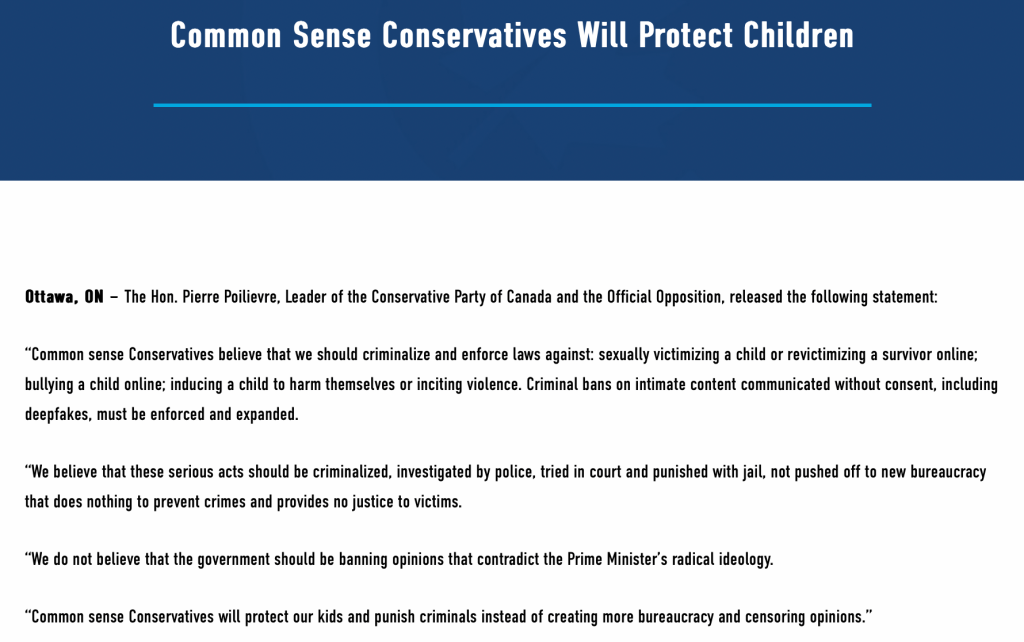
The Conservatives may have figured out that their habitual opposition to regulating the Internet won’t cut it when it comes to online harassment, bullying, and sexual exploitation of minors.
Beyond the bombast, the CPC bill is a serious piece of legislation, but of a different (and smaller) footprint than the government’s C-63.
The Conservative bill requires social media and gaming platforms to design their tools, settings and recommendations of content and contacts to protect children, and only children, from harm.
Unlike the government bill, there are no safety plans in the CPC bill for adults, not even for revenge porn or hate (although both are currently subject to criminal sanctions: the Conservative Bill would increase prisons sentences for revenge porn).
Leaving little work for a future regulator, the CPC bill gives explicit instructions to Internet platforms on what they must or must not do to protect children through safety settings that children and their parents can control or disable:
5 (1) Every operator must provide any parent of a user whom the operator knows or should reasonably know is a child, as well as that user, with clear and readily accessible safety settings on its platform, including settings to
(a) control the ability of other individuals to communicate with the child;
(b) prevent other individuals from consulting personal data of the child that is collected by, used or disclosed on the platform, in particular by restrictingpublic access to personal data;
(c) reduce features that increase, encourage or extend the use of the platform by the child, including automaticdisplaying of content, rewards for time spent onthe platform, notifications and other features that could result in addictive use of the platform by the child;
(d) control personalized recommendation systems, including the right to
(i) opt out of such systems, while still allowing content to be displayed in chronological order, with the latest published content displayed first, or
(ii) limit types or categories of recommendations from such systems; and
(e) restrict the sharing of the child’s geolocation and notify the child and their parent when their geolocation is being tracked.
Default settings
(2) The operator must ensure that the default setting for the safeguards described in subsection (1) is the option that provides the highest level of protection.
It’s shrewd retail politics and allows the Conservatives to say “limiting screen time,” “protect children,” and “parents’ rights” all in the same sound bite.
What seems to have slipped under the radar is that their bill authorizes interference with algorithmic recommendations, previously the centrepiece of the Conservatives’ opposition to the Online Streaming Act.
What’s next for these bills is subject to the whirlpool of Parliamentary politics. It’s not clear when (or if) the Conservative bill might be cleared for mandatory debate by MPs sitting in the House Justice Committee. The same committee has yet to schedule the government’s bill.
***
The battle over the Netflix Bill C-11 continues to flare. With an election in the air, the foreign streamers are engaged.
This week Netflix announced it was pulling training and development funding — vaguely described as $25 million spent over the last few years— from Canadian creator projects such as the Pacific Screenwriting Project and the imagineNATIVE film festival. Netflix gave the Globe and Mail a statement blaming its cancellations on the CRTC’s cash levy on foreign streamers to support financing subsidies to Canadian news and entertainment programming.
Netflix had previously told the CRTC it would support a 2% charge, but strenuously objected to any of its cash going to the Independent Local News Fund.
Netflix had also pitched to the CRTC that its training and development deals with various Canadian creative organizations ought to be deducted from the cash levy (training funds are also not deductible from the 5% levy paid by Canadian cable companies).
The CRTC has enveloped Netflix’s 3.5% levy like this:
0.5 % ($7.5M) to the Canada Media Fund for CanCon television series
0.5% to the Indigenous Screen Office to support television productions
0.5% shared by the Black Screen Office, the screen fund for BPOC creators and the Broadcasting Accessibility Fund
0.5% shared by funds supporting producers in official language minority communities in Québec and English Canada, as well as diverse communities; and
1.5% ($22.5M) to support newscasts at independent local stations.
[The list above has been revised and corrected from the original blog post]
Netflix’s grievance is that it ought to be given special regulatory treatment to deduct training and development funding of Canadian recipients of its choosing. (There is no public information available on whether there are strings attached to their funding).
The door is not closed on Netflix making its argument to the CRTC, however. When the Commission completes its regulatory assessment on Netflix and the other video streamers by setting expectations of direct spending on Canadian shows for their services, the streamers can make the same pitch to deduct training and development commitments.
In the same fighting spirit, the US-based music streaming lobby group Digital Media Association is launching a Canadian online petition campaign (see photo above), accompanied by messaging on its services guiding Canadians to the petition. The “Scrap the Streaming Tax” site threatens consumer price increases expressed in a vocabulary similar to the Conservative Party’s “scrap the Carbon Tax.”
Here are two new information releases that you can nerd out on.
The CRTC released its “what we heard” report that summarizes public comments on whether and how to revise Canadian content rules for video entertainment. This is a first step towards a public proceeding on possible revisions to CRTC rules that accredit video programming for regulatory compliance.
The Commission also posted for comment an application from APEM, the French-language song publishers’ organization, asking the CRTC “to collect data from the main online music streaming services and to make them public in order to provide the entire sector with a status report on the listening, showcase and recommendation of musical selections in Canada.”
If you would like regular notifications of future posts from MediaPolicy.ca you can follow this site by signing up under the Follow button in the bottom right corner of the home page;
or e-mail howard.law@bell.net to be added to the weekly update;


 MediaPolicy.ca