Television host and journalist Travis Dhanraj – CBC Photo
July 12, 2025
The fireworks ignited by television host Travis Dhanraj’s public resignation from the CBC will not be a flash in the pan. Not if the Conservative Party has anything to say about it.
The Conservatives are demanding summer Parliamentary hearings, a sequel to the political inquisition that followed the CBC’s annual payment of performance pay to some staff in late 2023.
Conservative headquarters also launched a volley of fundraising e-mails [download, below] citing Dhanraj’s “bombshell” resignation and reiterating its campaign promise to defund the CBC under the leadership of Pierre Poilievre, now standing in the August 18th by-election in Battle River-Crowfoot.
Dhanraj is a veteran television reporter and host who returned to the CBC in 2021 as a National Affairs correspondent and two years later, to much fanfare, as the host of Canada Tonight. At the time, CBC’s press release highlighted Dhanraj’s commitment to “unfiltered” and “diverse” journalism.
But last week Dhanraj announced his “involuntary resignation,” denouncing the CBC’s commitment to diversity as performative and promising detailed revelations to come. The CBC denied the allegations and cited confidentiality obligations as the reason for the brevity of its public reply. It also announced his resignation had been refused.
It’s difficult to recap the sequence of events leading up to Dhanraj’s pyrotechnic departure: much of it is connecting dots but will become easier to piece together once his lawyer Kathryn Marshall files a human rights complaint on his behalf.
The jumping off point appears to be Dhanraj posting a tweet in April 2024 that criticized the CBC for not making then-CEO Catherine Tait available as a news subject on his show, presumably to answer questions about the performance pay.
A public statement issued by his lawyer in February 2025 suggested that at one point he went on medical leave because of the psychological harm caused by CBC management’s alleged retaliatory actions towards him.
In his own public statement, Dhanraj characterized his resignation this way:
It comes after trying to navigate a workplace culture defined by retaliation, exclusion, and psychological harm. A place where asking hard questions — about tokenism masquerading as diversity, problematic political coverage protocols, and the erosion of editorial independence — became a career-ending move.
In further statements, Dhanraj’s lawyer linked “the colour of his skin” to CBC’s alleged exclusion of conservative perspectives and news guests. Specifically, she said that CBC assumed when it hired him that as a brown man his news hosting would focus on liberal perspectives, to the exclusion of conservative guests and issues. A proven connection to race might violate the federal human rights code, if discriminatory.
Marshall welcomed a Parliamentary hearing and suggested that Dhanraj’s experience was “systemic” and goes to the heart of the CBC’s workplace culture and delivering on its public mandate:
Obviously, the issues that Travis has highlighted in his resignation letter and which will be part of a future legal proceeding are very serious, and they’re not just isolated to Travis. I’ve heard from a lot of other CBC employees who have similar stories. It’s a systemic issue, and it’s a workplace culture issue that goes very deep at CBC, which is very concerning given the amount of public funds going to the corporation and its public-interest mandate.
Sooner or later the Conservatives will take this up at the Culture and Identity committee, with MP Rachael Thomas grabbing the spotlight in the prosecutorial role she relishes. But it may bring more thunder than lightning due to the stifling effects of pending litigation.
If the Conservatives go as far as attempting a filibuster of other Parliamentary business (like government bills), the balance of voting power in committee will be held by Bloc Québécois MP Martin Champoux.
If you would like regular notifications of future posts from MediaPolicy.ca you can follow this site by signing up under the Follow button in the bottom right corner of the home page;
or sign up for a free subscription to MediaPolicy.ca on Substack;
Just released, the Poilievre platform proposes to more than double the funding of the federal Local Journalism Initiative (LJI), from $20 million per year to $45 million. That potentially adds a further 400 journalist jobs in local print media markets across Canada. The locations of those markets line up nicely with Conservative Party ridings in rural areas and outside major metropolitan areas.
The reaction in some conservative circles to Poilievre’s announcement could be described as vein-bulging disbelief. They had half expected a federal news voucher policy, like the Liberals’ now expired reader tax credit. But this?
In The Hub, a conservative publication that rarely allows daylight to show between itself and the Party, Sean Speer fumed the LJI funding was “a massive concession to the Trudeau agenda and a fundamental failure of conservative politics.” The remarks were made on a podcast, so I am not sure whether the word “conservative” was supposed to be capitalized.
The Hub Publisher Rudyard Griffiths chimed in that the federal government controls news content through the LJI, a serious accusation but without a basis in fact.
The Hub’s dismay with Poilievre’s position on subsidies should be put in context.
If elected Prime Minister, Poilievre will defund the English language services of the CBC with its 2,000 journalists.
Oddly in consideration of his repeated castigations, Poilievre’s platform is silent on the federal $65 million QCJO subsidies to about 3,000 print media journalists, dispensed at 35% of salary.
He has promised immunity to Meta for liability under the Online News Act, which puts at risk Google’s compliance with their commitment to pay $100 million per year compensation to news outlets employing 9,000 journalists (at about 15% of salary).
He has also promised $20 million to fund “Indigenous journalism” without providing specifics.
The Hub’s feeling of betrayal by Poilievre runs deep. In the past few months the publication has gone out of its way to celebrate its refusal to take federal subsidies or compensation from Google, proclaiming its disdain for this financial support as part of its marketing campaign for more paid subscriptions.
What’s not well advertised is that two years ago The Hub publisher Griffiths sought and obtained official designation from the Canada Revenue Agency as a “QCJO” news publisher and, more recently, the seal of approval from the Canada Journalism Collective that is administering the Google money.
I asked him about this apparent contradiction and he confirmed that The Hub has the designations, but spurned the money. A month ago The Hub very publicly donated its $22,000 in Google cash to a charity.
As for the QCJO designation, he says The Hub wanted it for the purpose of Press credentials and never applied for the salary subsidy or reader tax credit program. As for seeking and then giving away the Google money, he said The Hub wanted to follow its application through the CJC process so it could verify the integrity of the distribution.
The Hub’s argument with subsidies is about the independence of the press from government, a non trivial concern of course, but the relevant discussion is “independence” from the many vectors of power in our liberal democracy, not only government but big corporations, sponsors, political parties, billionaires, readers demanding ideological conformity and powerful local families.
The Hub‘s success in winning official status raises the concern of how best to administer QCJO designation when it results in the certification of a news outlet so utterly committed to a northstar political party, one that may be governing Canada come Tuesday morning.
That concern is usually shrugged off by those who point to the historic practice of print media mixing its news reporting with politics through opinion journalism and explicit party endorsements. It got us where we are today, so why worry about the close ties between some media and their political champions?
One way to stop worrying about those political allegiances is found in program design for the subsidies. One of the best ways for a news outlet to prove its bona fides of good journalism is through its committment to original and accurate news gathering as the main course in the journalism meal, with opinion as the dessert.
The QCJO criteria for designation has always required that news outlets engage in original news gathering with a fairly high bar for professional standards. The weakness of those rules is that lack of a high bar for volume of news gathering, requiring only that news gathering be carried out on “ongoing basis.” The “ongoing” is left to eyeballing by a certification committee after a news organization has submitted details of its self selected “best three weeks” of news reporting.
If an outlet like The Hub with its acres of opinion writing and occasional news story can get QCJO designation, the bar for frequency of news reporting can’t be very high.
In fact Griffiths told me that as a non-profit he nevertheless decided against seeking the charitable status that would allow him to issue tax receipts to donors because the rules of the government’s less known “RJO” program for non-profits sets the news gathering bar at 51% of published content, a test he says he could not meet.
And then there is accuracy in news reporting, another thing that demonstrates good journalism and, when not done well, undermines public trust.
Recently, The Hub has repeatedly described federal subsidies to news journalism as totalling “$425 million per year.”
Included in that figure is the $100 million Google money as an “indirect” federal subsidy, a highly editorialized way of describing government-enforced news licensing payments between private parties.
More seriously, its “$425 million” figure includes $154 million from the Canada Media Fund, a media fund that spends all of its money on Canadian television dramas, documentaries and children’s programming and exactly zero dollars on news journalism. That’s a hugely misleading reporting error.
There is yet another way to demonstrate good journalism: keeping a safe distance from corporate influence. News organizations of all stripes have a chequered history on this, frequently allowing advertisers and sponsors to pay for content in one way or another. Nevertheless “advertorial” that is written and paid for by a sponsor, clearly marked as non-journalist content, is generally accepted and long tolerated.
But the arms length independence from corporate money can get squishy.
The Hub published an article in October that opposed the federal government’s Online Streaming Act, also contested in a “Scrap the Streaming Tax” public campaign launched the previous month by the American Digital Media Association (DiMA) against the CRTC’s ruling that music streamers pay five per cent of revenue to Canadian media funds.
DiMA’s member organizations Spotify, Apple, Youtube and Amazon are notorious news subjects in their opposition to the CRTC’s implementation of the bill and DiMA’s campaign art was used by The Hub to illustrate the content of the article.
DiMA even paid for the article, a fact that was acknowledged at the bottom of the article but still, in my opinion, constituting a repudiation of independent journalism.
***
While I’m on about The Hub, they posted a terrific podcast in their Full Press series hosted by Harrison Lowman and starring independent journalists Tara Henley and Peter Menzies. The topic was the notorious “shit show” of Rebel News turning the election debate press conferences on their end on consecutive nights.
It got going on the first night when a Rebel News reporter chose to ask the only non-Christian leader why he wasn’t speaking out against “ongoing attacks against Christians” and Church burnings, a provocatively staged but nonetheless legitimate question.
But the second night was when it all went to hell and the press conference became so unruly that the election commission cancelled it.
The Full Press podcast has some very intelligent commentary on the whole mess, very relevant to the Internet-induced era of wide open journalism.
***
If you would like regular notifications of future posts from MediaPolicy.ca you can follow this site by signing up under the Follow button in the bottom right corner of the home page;
or sign up for a free subscription to MediaPolicy.ca on Substack;
Of all the silver linings in Donald’s Trump’s aggression against Canada, I’ve been gratified to discover the renewed popular passion for Canadian culture.
The pinning-jelly-against-the-wall quest for a distillation of Canada’s national essence always interests me: I’ve pondered it myself in a previous post and celebrated the thoughts of others on the subject.
Unfortunately, what Marche offered us last week was a fact-free rant against the CBC.
His starting point is a much celebrated allegation: that Justin Trudeau is a proud “post-nationalist” who does not value Canada’s rich history because it is marred by the dispossession of Indigenous peoples and wrongs committed against minorities. Says Marche, our “cultural industries” eagerly signed on to Trudeau’s project of denigrating “so-called Canada” and “the self-critique quickly narrowed into a negligible, impotent stream of identity politics to the exclusion of virtually any other perspective.”
Having named all “cultural industries” in the indictment (including his own, the book publishing industry), Marche’s chief culprit is the CBC. Just to give you a flavour:
The most egregious, and most important, case is the CBC. The CBC has spent a decade turning itself into a big national scold. Literally, their ad campaign from 2023 featured the slogan: “It’s not how Canadian you are. It’s who you are in Canada.” That’s how they chose to promote themselves – a sneer at anyone who might think of themselves as a patriot. I am not sure, at this moment, whether the CBC even likes Canada. You certainly can’t tell by listening to them.
There are no facts or examples provided for this grave condemnation of the public broadcaster as “a big national scold” that “sneers” at “patriots.”
I watch, listen and read the CBC every day: I’ve never witnessed scolding, sneering or anything of the kind. What’s the CBC guilty of? Broadcasting North of North? Or Sort Of?
Once rolling, Marche doesn’t stop:
The Conservatives have, if anything, underestimated the problem. I say this as a small-l liberal: When the head of the CBC cannot name a single Conservative voice on their platform, when they are opposed, as such, to the political views of somewhere around half the country, they are failing in their mandate to represent the country. It is as simple as that.
A small point, Marche’s link is to a podcast that doesn’t verify his statement: former CEO Catherine Tait declined Paul Wells’ invitation to identify “the most interesting conservative commentators on CBC,” she didn’t say she didn’t know any.
A bigger point is whether the CBC invites conservative commentators onto its shows. On that point, I seem to recall Andrew (“defund the CBC”) Coyne making some rather good conservative arguments on CBC’s flagship At Issue panel for the last decade or so. From my own observation, the CBC regularly seeks out conservative voices on its television news panels, although I suspect it’s difficult when there appears to be a Conservative boycott on the public broadcaster.
Marche’s zippy one-liners continue: the CBC engages in a “ritualized fetish for self-purification”; “its politics seems to derive from the sociology department at York University,” and “the CBC is a force of [information] pollution, they are an active vector of polarization.”
Anyway, you get the gist. By the end of the tirade, Marche tables an unobjectionable list of principles underlying a strong Canadian cultural nationalism. Count me in.
But in the end, Mr.Marche is not a satisfied CBC customer and I am. What about everyone else?
Here’s some feedback from the Reuters-Oxford study of the Canadian news market, the first graph covering radio and television and the second chart covering online news:
These aren’t the numbers you hear about when critics are taking a run at the CBC.
When they do, one of those cherry-picked numbers is the “CBC’s two per cent market share.”
If you look it up, that’s a reference to the CBC National News channel’s share of the cable audience. It may surprise you, but two per cent for a single channel in the 500-cable channel universe isn’t bad. CBCNN’s cost is covered by cable subscriptions and advertising, basically Pierre Poilievre’s formula for a defunded CBC.
The other sore thumb is the CBC’s five per cent share of prime-time evening television ratings. It’s competitors CTV and Global no longer disclose their ratings, but they are believed to be higher. That’s not surprising: the evening prime time is when CTV and Global carry popular US programming, while CBC does not.
Here’s a chart from CRTC data (unfortunately a year behind) you might find interesting.
Since 2015 (Table 30), the CBC has slipped in the relevant television ratings (network stations) against the private broadcasters.
Since 2009 (Table 32), the CBC’s production spending on Canadian content slipped a lot, while the CanCon spending of the private networks and specialty channels climbed. The explanation is that the CBC’s Parliamentary funding is stagnant and, in response to new viewing habits, it has shifted its budget from television to online.
This is neither an apology for those television ratings nor a scolding for those that ignore the CBC’s strong ratings on radio and online.
“Not bad” or “good enough” is not the bar, not for the public broadcaster. The CBC should be appreciated and reasonably well loved across the country and if it’s perceived as projecting itself as too urban, too central Canadian, or too progressive that’s a problem it needs to address like it’s life depends upon it.
Which it probably does.
***
If you would like regular notifications of future posts from MediaPolicy.ca you can follow this site by signing up under the Follow button in the bottom right corner of the home page;
or sign up for a free subscription to MediaPolicy.ca on Substack;
The gladiator stands staggered on the sandy floor of the Colosseum, waiting for the thumbs up or down. On federal election day, April 28, the CBC will discover its fate: live or die.
The Mark Carney Liberals have promised to defend the Canadian Broadcasting Corporation and even increase its funding.
On the other hand, Conservative leader Pierre Poilievre “can’t wait” to keep his promise to defund all English-language services of the public broadcaster as no longer needed. “The CBC provides opinions and coverage that are widely available in a competitive media marketplace,” states the CPC with confidence….
The stock markets roiled by Donald Trump’s tariff yo-yo vaporized a lot of personal savings (ouch), but especially if you held Big Tech stock. Or owned the company.
Alas, shed a tear for Zuckerberg, Bezos, Musk and the bros. It must be a weird space to be in: grovelling before Trump in the hopes of an unimpeded path to worldwide AI “dominance,” losing billions in share value on any given day of the week and fending off federal anti-trust lawsuits.
The US Federal Trade Commission’s anti-trust suit against Zuckerberg’s Meta starts at the trial level on Monday and is expected to go day to day through July. The government is challenging the Facebook-WhatsApp-Instagram business as an anti-competitive monopoly in “personal social networking services.”
Matt Stoller will be covering the trial in his Big Tech on Trial Substack.
As the politics play out, the FTC’s litigation team has its work cut out for it on showing monopoly power.
To win its case, the FTC must prove that Meta has a monopoly in a relevant market, and that its acquisitions of Instagram and WhatsApp helped Meta maintain that monopoly through something other than competition on the merits.
The FTC can show monopoly power with direct evidence, like the ability to profitably raise prices or diminish quality. But because Meta does not charge consumers money for its services, it’s difficult to show the classic direct evidence of a price increase. Even so, the FTC has introduced evidence that Meta can engage in price discrimination, one sign of market power, by increasing the number of ads shown to users who have greater demand for social networking. In any event, the FTC will likely rely on indirect evidence of Meta’s market power: high market share plus the existence of barriers to entry that prevent others from whittling away at Meta’s share.
Underpinning whether Meta has a monopoly is the threshold question of how to define the “relevant market” in which it has that power. The relevant market for assessing competition is twofold: a product market and a geographic market. The FTC proposes that Meta is a monopolist in a market for “Personal Social Networking Services” (we’ll call it the “PSN market”) in the United States, which is distinguished by a social purpose: a way to connect with family and friends. Inside that market are Facebook, Instagram, Snapchat, and MeWe. Meta, for its part, disputes that definition and points to other apps that it says it competes with, like LinkedIn, Reddit, and YouTube. The bigger that Meta can make the relevant market, the smaller Meta’s market share in that market, and the more likely it is to defeat the FTC’s case.
“The principle is a fair idea,” he told reporters on the campaign trail. “It’s that these businesses earn revenue here in Canada, so the principle is that they should contribute where they earn the revenue. So I think, on this question, we should keep it in place.”
The Conservatives endorsed the DST in their 2021 election platform at the rate of 3% of Canadian operating revenues, the same amount adopted by the Liberals last year.
The Liberals in 2021 promised a “minimum global corporate tax.” It was successfully negotiated with the US Biden administration but blocked in US Congress and repudiated by the Trump administration. The fallback DST of 3% was implemented instead.
Because of federal regulations, the Canadian independent producers who made the series retain the intellectual property in the show, including the global streaming rights they licensed to Netflix which was a major pre-production investor.
That in itself is hardly unprecedented and neither is it surprising that Netflix is making a big deal of its investment and licensing deal because of the ongoing battle over its obligations to broadcast Canadian content.
What’s more noteworthy is the reporting that the production infrastructure costs of shooting in the high north were so steep that CBC, APTN and Red Marrow —the recipient of all manner of tax and broadcaster subsidies to make the series —— needed a deep pocketed foreign streaming partner to make a show with high on-screen production values and an authentic locale (as opposed to shooting in Sudbury).
It’s a reminder that our television subsidy regime feeds shows that are a million dollars per episode, not five million like American hits.
The CBC is by far the biggest spender on Canadian dramas and comedies at $195 million per year (Bell is second at $93 million) but it still has to spread that cash far enough to cover several series each season in different regions of the country, as viewers and taxpayers expect.
Speaking of the CBC, I’ve got an analysis of the defund v. defend debate coming out next week on the Institute for Research on Public Policy’s website Policy Options.
***
For those of you who wanted to know when the CRTC would reschedule its public consultation on radio and audio streaming, it’s September 18th.
The video and television hearing kicks off on May 14. The consultation on “market dynamics and sustainability” (the gatekeeping of content distribution) begins June 18.
The three-day court date for the streamers’ legal challenge to the CRTC’s five per cent levies benefiting Canadian media funds is set for June 9.
***
The possibility of a merger between Montréal’s LaPresse and the six financially vulnerable “CN2i” Québec news outlets is off.
The LaPresse offer to CN2i staff, which reports imply required an unpalatable number layoffs, was blocked at the last minute and LaPresse informed its own employees that merger discussions were at an end.
With LaPresse out of the picture, Pierre-Karl Pélédeau’s Québecor appears to be poised to make its own merger offer to CN2i. The media-telco conglomerate Québecor owns daily tabloids in Montréal and Québec City as well as the TVA television network and Vidéotron cable.
***
It’s always important to media policy to keep an eye on long-term audience trends, especially in news programming.
ThinkTV is the media marketing group that regularly pumps out polling numbers to remind advertisers where the customers are watching, listening or reading.
Its latest report affirms that television and radio continue to hold their own as the top and third most popular media respectively for national news. The way the polling chart is laid out, you can see that mainstream media is vested in video, audio and text, online or otherwise:
On the same note, American media whiz Evan Shapiro has a new post where he suggests that local news is in high demand regardless of age cohort, although he sees a watershed between GenZ/Millenials and GenX/boomers in terms of platform preferences.
The task is for local TV and radio news operators is to fish for the younger generations where they swim.
None of this is breaking news, but it’s Shapiro’s chart that caught my attention. Check out the age statistics on this one (keeping in mind it’s the American market):
***
And lastly, I recommend Ken Whyte’s latest blog post on book publishing and the trade war. This quote stayed with me:
Search ‘books and tariffs’ on Google and you’ll find a bunch of articles in which booksellers and librarians are begging to dodge the draft into Buy Canada. Frankly admitting that they depend overwhelmingly on US product, they’re asking Ottawa to exempt American books from Canada’s slate of retaliatory tariffs. Otherwise costs will rise, customers will be unhappy, business will suffer. We’ve locked arms with Danielle Smith.
***
If you would like regular notifications of future posts from MediaPolicy.ca you can follow this site by signing up under the Follow button in the bottom right corner of the home page;
or sign up for a free subscription to MediaPolicy.ca on Substack;
The future of the Canadian Broadcasting Corporation hangs in the balance, waiting for the verdict of thumbs up or down. Live. Or die.
We know where the two major political parties stand on this.
If Pierre Poilievre wins a majority in the April 28th federal election he will move quickly to “defund” English-language CBC services. An omnibus bill will remove legal impediments in the Broadcasting Act and his budget will eliminate up to $1 billion in federal spending. If he has that Parliamentary majority don’t be surprised if he also breaks his campaign promise and slashes the Radio-Canada budget, to fend off a caucus revolt over sparing Québec.
Meanwhile the Carney Liberals will be for “saving” a “new” CBC. Voters in Québec expect no less. And in English Canada there are NDP supporters to be poached.
We’ll see if it gets any more complicated than that, but I doubt it. “Defund” or “save.” That’s the choice.
Naive souls like myself would have preferred to have framed this choice within a thorough public debate, even a royal commission, to investigate what it means to defund, save or reinvent the CBC.
There’s a public appetite for this thoughtfulness. It’s worth remembering that an October 2024 poll put the hard core “defund” forces at only 11% of Canadians. An earlier poll found that 76% of Canadians want to keep the CBC but half of that support wants to see “changes.” Heavens knows what “changes” means. That’s where a more considered public policy debate might have helped.
The stale polls on public satisfaction with the CBC may no longer matter. Donald Trump moves the opinions of Canadian voters in a tweet. Fighting off his annexation plan without a CBC: what a scenario that is.
My hat is off to the grass roots campaigns to save the CBC; not just the Friends of Canadian Media‘s cheeky campaign to “FU__ the CBC,” but also the chat groups popping up on Facebook and Reddit.
But now having the benefit of the views of others, I have something to say that’s a little different.
The Senator (“don’t call me Senator,” he likes to say) ticks a lot of boxes for me. He’s a Canadian cultural sovereigntist. He asks more questions than he makes speeches. He’s unfailingly civil. Like most of the Independent Caucus senators appointed by Justin Trudeau, he carries on Senate business in a collegial and non-partisan manner despite his Liberal connections.
Having said that, I don’t agree with everything he recommends. But he got the big stuff right.
***
Cardozo’s big idea is this: cultural sovereignty is essential to Canada. And the CBC is at the heart of a news and media ecosystem that delivers this sovereignty to Canadians. The CBC employs a third of the country’s journalists and is by far the biggest spender on televised Canadian dramas and comedies set in locales across the country.
To agree with Cardozo’s view, you have to let go of the notion that a free market in news and cultural content — a free North American market– is sufficient to nourish and defend our cultural independence. It also means giving up on the argument that the existence of the CBC is only justified where there is a demonstrated “market failure” of Canadian media, like our far north. That’s a journey into the black hole of “which market?” and “how much failure?” from which I suggest no light will escape.
Cultural minorities in Canada have always understood in the pits of their stomachs what cultural sovereignty means to them. It means survival. It means to breathe. Francophones in Québec and the rest of Canada get it. Indigenous peoples get it. Anglophones in Québec, too.
Us garden variety English-Canadians, not so much. American culture is everywhere and tasty too. Until recently, the Americans kept their crazy politics on the other side of the border, so why worry? Vancouver’s sassy libertarian YouTuber J.J.McCullough liked to say we are cultural “North Americans” and “I’m fine with that.” It’s not an uncommon opinion.
Then Donald Trump announced his plans to reduce our economy to rubble and annex us. Or just turn us (and Greenland) into a vassal state.
The crazy politics have now swept across the border. As Senator Cardozo says in his report, the times demand an independent Canadian media ecosystem. It’s unlikely any Canadian disagrees. The CBC is the key institution in that ecosystem, he says, and the polls suggest Canadians agree with that too.
Cardozo recalls that the 1928 report of the Aird royal commission proposed a cross-country network of publicly owned Canadian radio stations —later christened the CBC— as essential to defending our popular culture and democratic spaces from being dominated by American voices. If anything, the situation a century later is far more urgent.
***
Here’s the Cardozo plan.
First, forget more money for the CBC, at least for now in this moment of national crisis. That means putting off the widely applauded proposal that the CBC relinquish it’s $270 million cut of the advertising market, which would be a 14% reduction of its finances when we need the CBC the most.
I admire the Senator’s pragmatism but would prefer to rephrase his idea as “let’s get the CBC house in order before we ask Canadian taxpayers for more money.”
Second, make a big bet on local news. No more thoughts and prayers about the growing pockets of news poverty and news deserts in rural and small town Canada, but action lead by the public broadcaster shifting resources away from national news coverage and “radically reducing the budget of national headquarters (Toronto, Montréal and Ottawa).”
In advocating for local programming, Cardozo has picked up on the points made in this country by the Michener Foundation and the Friends of Canadian Media and in the US by Rebuild Local News. Our democracy is fraying because of political polarization fuelled by national politics, while Canadians’ less polarized engagement with local democracy and community events is threatened by the financial precarity of local news outlets.
Public opinion polls repeatedly say that Canadians “trust” local news above all media sources. There’s a craving there to be satisfied.
Cardozo’s proposal for the CBC to double down on local news is compelling. But there are many devils in the details. One is whether this is a good time to cannibalize the CBC national news budget at a time of national emergency. Another is how to divert the CBC’s journalism resources into local markets without elbowing private media outlets in the face. That might have been what the CBC just did by expanding its local coverage into local markets with its $7 million in “Google money.”
The senator’s report does have a practical idea that could be put to good use: “sharing content.”
There have long been proposals for the CBC to share its editorial content with private news outlets, waiving copyright. That could go much deeper with a bigger CBC commitment to joint investigations with private news outlets in local markets. Or the CBC could take a page out of the BBC’s book: the 165-journalist Local Democracy Reporting Service that assigns BBC-paid journalists to work for local news outlets.
Next, the third Cardozo idea is really several issues rolled into one: how to drain the political venom about the CBC out of the public sphere. That means confronting issues of public trust, alleged bias, and accountability.
It must be said first that the griping about “CBC bias” doesn’t measure up to the facts.
Repeat after me: CBC News is the country’s most trusted news source. The slightly overweight negative trust ratings suggest the “defunder” hostility is taken into account.
from Pollara Poll, July 2024
But citing this impressive verdict on the CBC’s trustworthiness is not a get-out-of-jail-free card for its journalism. When you report in the opinion minefields of Gaza, pipelines, and (insert controversial issue here), mistakes are going to loom large. Doing better, more disciplined news reporting is an ongoing project for any news organization. Being publicly owned, the CBC has a higher bar to meet.
Cardozo has some good suggestions.
He’d like the CBC to regularly commission and publish external audits of its news coverage. It won’t convince the CBC haters, but it’s useful if it’s something that CBC managers would go to bed worrying about. I imagine they already do. But Cardozo would make this an important tool in public accountability and transparency.
He’d also like to see more debating of public issues on CBC platforms to foster a stronger Canadian culture of intellectual curiosity and tolerance of different opinions. Amen to that.
Another of his proposals is to eliminate the CBC’s in-house editorial Ombud as the arbiter of public complaints, rerouting critics to the industry-administered Canadian Broadcast Standards Council instead.
I’m not thrilled by this idea. There’s too big a volume of complaints to dump them on someone else’s desk. The Ombud reports are quite fair, if you read them. And you can always appeal to the CRTC. Cardozo acknowledges this an optics issue.
But the elephant in the room is that too many Canadians view the CBC as —how shall we say—- insufficiently representative of what makes them feel Canadian.
Too urban. Too central Canadian. Too insulated from those that pay the tax bill.
You can dismiss these dyspeptic public attitudes if you want. After all, the polling supports a far higher degree of satisfaction than dissatisfaction. For sure, some of CBC hating is a culture war cynically fomented by political foes who want to diminish mainstream media, the better to fill that void with right-wing opinion.
But we have a historic opportunity to make popular satisfaction with the CBC deeper and wider if we face the dyspepsia head on.
Cardozo’s big idea (and others including the government’s expert committee have proposed it too) is to implement a version of the British practice of a social contract between the public broadcaster and the people’s elected representatives.
That negotiated BBC charter secures multi-year funding for an eleven-year term, freed from the gyrations of annual government budgets, in return for specific performance expectations. At the expiry of the charter term, it’s judgment day for the public broadcaster.
A CBC charter would be about more than long-term planning and financial stability. It could be a new and different way to make the CBC accountable to the people and for it to feel real in doing so.
Contrast the charter idea to the accountability we have today. Currently the Broadcasting Act provides apple-pie policy objectives for the CBC, but few specifics. The Prime Minister handpicks the President of the corporation to manage the place for five years. The CRTC weighs in with five-year licensing conditions for the CBC to earmark spending for different programming genres. The last time around the CRTC botched it and was directed by cabinet to try again.
This type of governance of the CBC might hit the right balance of accountability versus keeping the ruling party’s mitts off of programming decisions and the day-to-day management of the corporation. But it does nothing to make Canadians feel that it’s “our” CBC.
A CBC charter would be better. Going in that new direction still retains a threat to the CBC’s independence from government: which political party will be in power when the charter expires and is up for renewal? The BBC just dodged that bullet when an election expelled “defunder” Conservatives and welcomed a Labour government. But Cardozo would argue it’s still better than our current approach. It is.
MediaPolicy has two other ideas to institutionalize more public confidence in the CBC.
First, move CBC headquarters from Toronto to Winnipeg. Sounds crazy, I know, but hear me out.
Much of the disaffection with the CBC is articulated as the public broadcaster being a central Canadian hyper-urban “woke” institution. Fairly or not.
So “leafy downtown Toronto”.” So “île des génies.”
The gloss on that critique is that the CBC’s programming content gets torqued towards audiences and advertising dollars in the Toronto and Montréal television markets.
And one can only add this respectfully: a staff of journalists and content creators living in big cities are naturally inclined to be culturally simpatico with the urban neighbourhoods where they reside. That’s a problem for a national institution.
Moving headquarters and staff anywhere is a big, hugely expensive deal. It’s a lot to ask in the name of moving the needle on staff culture and assuaging hinterland hostility to the Toronto and Montréal metropoli. And if it’s done, it should be gradually and without hemorrhaging experience and talent.
The second MediaPolicy idea is even more out of the box, but bear with me.
We should legislate a constituent assembly of randomly chosen CBC listeners, readers and viewers ——200 from one end of the country to the other—- to convene every two years and publish its assessment of the CBC’s performance and direction. This would be especially helpful in shining a light on what Cardozo describes as the CBC’s “blind spots.”
In the corporate world, they call these shareholder meetings. In the public world, they call them town halls. A constituent assembly would give CBC managers and elected politicians better feedback than high-level polling results. It would offer cogent (or not) thoughts about the CBC from Main Street Canada.
***
The idea of a robust CBC anchoring an independent (of the US) Canadian media is of the moment. “To let it go,” says Cardozo of defunding, “would allow for the complete domination by America of our communications system.”
It’s commonplace to observe that American-owned social media platforms are the perfect conduit for misinformation to flood into Canada in a prolonged Trump campaign to destabilize and annex us. It’s also hard to ignore that the Republican blueprint to move the US much further to the right, the Heritage Foundation’s Project 2025,advocates the elimination of government funding to public broadcasting on the explicit basis that it’s “left-wing.”
But there are still those that would argue that a strong Canadian media can and should do without the CBC except in localities where audiences are so sparse that the private news enterprises can’t succeed.
That’s tied in to yet a longer discussion of the financial viability of Canadian news reporting (as opposed to news opinionating) and whether to continue federal subsidies to news journalism.
The same policy conundrum applies to non-news programming. With Canadian private broadcasters so pinched that they are demanding relief from CRTC mandates to produce local news and Canadian entertainment content, how big a cultural hole might there be to fill if the CBC isn’t there to do it?
***
If the CBC survives and isn’t defunded by the next government, there’s an opportunity to make profound changes, as outlined in this post.
But even without big changes, the new President of the CBC Marie-Philippe Bouchard has an inbox full of strategic and programming decisions to make right away.
Forty million Canadians have forty million opinions on how to do that, some of them based on nothing more than our idiosyncratic cultural tastes and technological preferences.
Bouchard must manage unreasonable and unmeetable expectations with tough management decisions on complex questions.
Should the CBC stay on every major media platform, treating each as equally important? Or should it make bigger bets on fewer digital channels?
Would we be better off with one CBC Radio network instead of two, despite the strong ratings?
Should the CBC invest more of its television drama budget in high-budget iconic Canadian shows or keep faith with charming serials in authentic local settings?
Should the CBC find its way back into sports, avoiding the unaffordable price tags of big league programming rights?
If the CBC puts more into local news, what programming is going to get less?
These are management decisions that almost none of the forty million have an educated opinion, informed by a detailed knowledge of audience data and budget dollars.
As Richard Stursberg signed off on his advice to the new president Bouchard, “good luck.”
***
That’s the MediaPolicy view.
Let me close by recalling that one of the experts MediaPolicy interviewed in December, Peter Menzies, may have nailed it when he said the CBC’s “biggest problem is not that – at least for the English part – so many Conservatives want to kill it, it’s that a large number of people just don’t care if it lives or dies.”
I doubt that’s true any more, thanks to Donald Trump’s plan for Canada. But if the next election keeps the CBC alive, instead of killing it, a rebirth of the public broadcaster is an historic opportunity not to be squandered.
***
If you would like regular notifications of future posts from MediaPolicy.ca you can follow this site by signing up under the Follow button in the bottom right corner of the home page;
or sign up for a free subscription to MediaPolicy.ca on Substack;
The big media news of the week was Heritage Minister Pascale St.-Onge presenting a 10,000-foot “proposal” to better fund and govern the CBC. MediaPolicy offered an overview here.
The Minister’s recommendations have yet to be endorsed by the Liberal cabinet or contenders to replace Justin Trudeau as Prime Minister. As for St.-Onge, she’s quitting politics.
Her proposal stole headlines with its bold plan to double Parliamentary funding from $33 to $62 per Canadian, a number she walked back immediately to $50, phased in over five years.
Pierre Poilievre was grateful for the opportunity, messaging that the Liberals were promising “another one billion dollars of your money” for the CBC. He then squandered the point with populist blarney to the effect that the money was “an extra incentive [for the CBC] to campaign day and night to re-elect the Liberal government to a fourth term. A reminder to believe nothing you see or hear on CBC.”
On the other hand, the leading candidates for the Liberal leadership have some thinking to do on how to respond to their colleague’s big idea.
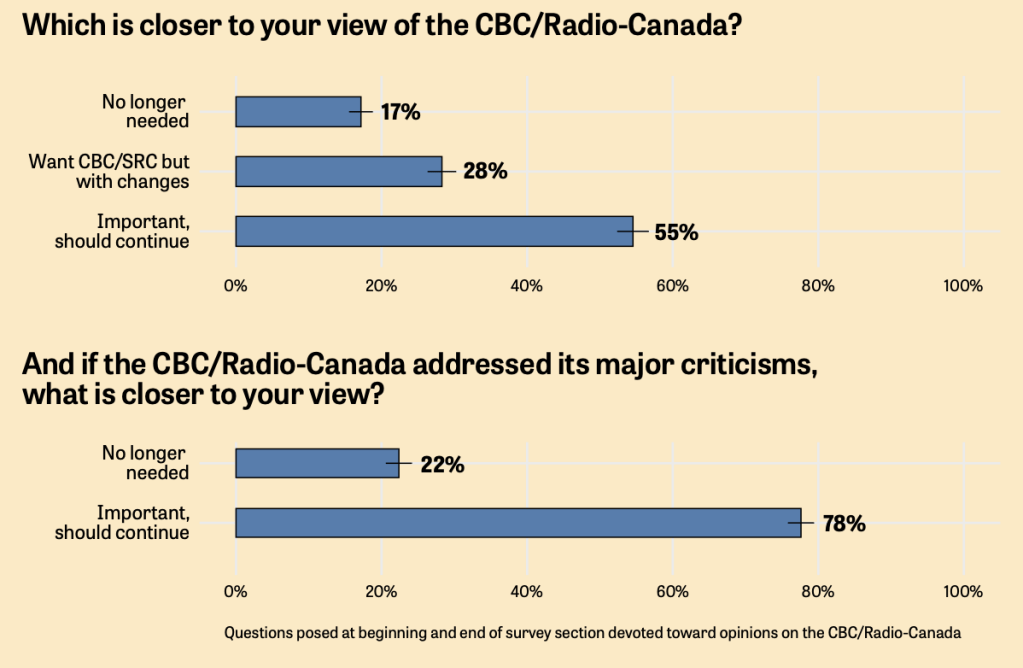
The McGill poll from October pegged 78% majority support for maintaining the CBC in the face of Poilievre’s threat to defund. Importantly, that 78% was tied to “changes” at the CBC (at some point we ought to poll what Canadians mean by changes).
But other results from the McGill poll are sometimes overlooked. Thirty-four per cent of the same pool of respondents said CBC needs more reliable funding, unchanged from previous polling in 2021. Perhaps surprisingly, the 34% is not skewed by regional differences but support for the CBC and better funding is higher among non-Conservative voters.
The political challenge for the Minister’s plan is that it’s front loaded with money, with the changes to come later. That’s why the pressure is on CBC/Radio-Canada CEO Marie-Philippe Bouchard to describe the changes.
The political challenge for defunder Poilievre is that Donald Trump has put the CBC top of mind for many Canadians. We’ll wait for some polling on that.
***
Two weeks ago I posted an update on the CRTC’s regulation of foreign music streamers and, as promised, the Commission has announced a June hearing on audio services, radio and online.
Parliament handed the Commission a laundry list of tasks in implementing the Online Streaming Act, the most pressing of which is what’s expected of Spotify and the American music streamers and whether the declining Canadian radio industry can catch a regulatory break.
The Commission’s Notice of Consultation sports the usual hints of what it’s already thinking before the hearings begin. Its code words are “our preliminary view,” “we consider,” and “we propose.”
Here’s a rundown:
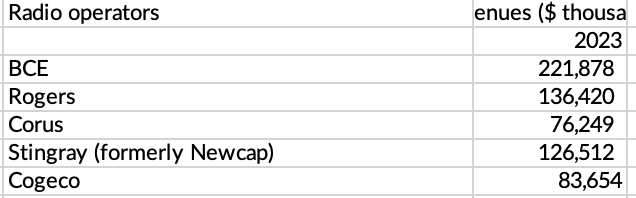
As the Commission ruled in June, the streamers are going to pay five per cent of Canadian revenues into funds for Canadian musicians and radio news. Perhaps to shore up its legal flank in the face of the streamers’ upcoming court challenge this June, the Commission plans to impose more significant cash contributions on Canadian radio networks that take in at least $25 million in annual revenue (the same earnings threshold as the Commission is applying to the foreign streamers).
CRTC Figures identify five radio broadcast groups exceeding $25 million in annual Canadian revenues
As for smaller radio broadcasters, the Commission seems ready to eliminate their half-per cent of revenue (0.05%) cash contributions to musician development funds. The current radio airplay quotas of 35% to 65%, however, are slated to remain.
The national pastime of debating the “MAPL” formula for a Canadian song that qualifies to fill airplay quotas will be revived but the Commission seems committed to the modest changes it proposed in 2022. Rules on Canadian co-writing of music and lyrics will be loosened. The Commission doesn’t seem convinced as yet that Canadian studio producers ought to join artists and songwriters in the talent club that satisfies the airplay quota.
The Commission is interested in strengthening on-air exposure for emerging Canadian artists and is open to a 5% airplay quota for artists in the first four years of their recording careers.
Similarly, the Commission is interested, in fact very determined, to introduce a 5% airplay quota for Indigenous music.
In a typically opaque discussion of news programming, the Commission declares that “news is a priority” (indeed the Online Streaming Act says so) but unlike other policy items it offers no blueprint for how to make the priority into a reality on air.
But the most difficult policy question is how to close the gap between radio broadcasters and online streamers with respect to the prominence and consumption of Canadian songs.
As noted by the Commission, CanCon consumption is a mere 10% on streaming platforms operating in Canada, a far cry from the 35% to 65% radio airplay quotas. The consumption of streamed French language music is 8.5% in Québec.
What’s unmissable in the Commission’s public notice is how little it makes of these consumption outcomes, so dismal that they are directly proportional to the Canadian share of the continental market.
It’s safe to say that if the Commission was planning anything bold to address the outcome gap, it would have said so. Instead it says “more information is required to fully understand how online services can facilitate [CanCon] discoverability.”
***
The Liberal-tormenting True North has rebranded itself as Juno News and its boss Candice Malcolm had Pierre Poilievre on her show for a 37-minute video interview last week.
The Malcolm interview is in the vein of the Conservative leader’s famous chat with Canadian expat Jordan Peterson: it falls short of being a softball news interview, it’s more of a tag team narrative (for example, Malcolm responding to Poilievre’s comments as “excellent”).
So naturally Malcolm introduced the topic of independent journalism.
What was interesting was that Poilievre passed on the opportunity to reiterate his plans for a scorched earth repeal of federal aid to journalism and said Canadians should wait to see his election platform.
Having said that, he expressed concern that some news organizations had been denied eligibility for federal aid for politically motivated reasons.
All of this is difficult to read, but there seems to be some kind of policy cogitation going on behind the scenes and we will, as the Opposition Leader suggests, have to wait to see his election platform.
***
If you would like regular notifications of future posts from MediaPolicy.ca you can follow this site by signing up under the Follow button in the bottom right corner of the home page;
or sign up for a free subscription to MediaPolicy.ca on Substack;
A few weeks ago the CBC seemed doomed. Pierre Poilievre’s defunding promises were (are) real, and as the then Prime Minister-in-waiting said, “I can’t wait to defund the CBC.”
Now that promise is an albatross draped around the Conservatives’ neck.
An October poll pegged popular support for the CBC at 78% of Canadians. The big caveat to that number was that most of the 78% were demanding an improved CBC as the price of their support.
The Liberals’ third Heritage Minister in their nine-year run, Pascale St.-Onge, is finally addressing this public desire, five years after the government’s expert committee told cabinet how to accomplish it through amendments to the Broadcasting Act.
On Thursday, St.-Onge unveiled a “proposal” to revamp the public broadcaster’s mission, funding, and governance. The quotation marks here signify that the Minister is challenging Liberal candidates for the Prime Minister’s job to say yes.
It’s a sign of the weird political moment we are in that a Minister who has already announced her decision not to run in the upcoming election was green-lit by a lame duck PM Justin Trudeau to propose, not announce, detailed legislative action on a key election issue to those contending to replace him.
And now the fate of the CBC will be an elevated election issue, of that we can be reasonably certain. While the CBC has always been emblematic of cultural sovereignty, we are no longer concerned just about cultural sovereignty. In Trump’s new world order, Canadians are thinking about sovereignty-sovereignty.
St.-Onge was not subtle in making the link, repeatedly, between the importance of the CBC to Canadian democracy and the ability of US social media platforms to flood our zone with election interference, as easily achieved as writing new algorithm code.
As for her conflicting calls for national unity on supporting the CBC and suggestions that Pierre Poilievre’s blood lust for killing the CBC is unpatriotic, that’s politics folks. You can’t say he didn’t ask for it.
Her proposal responds to the undisclosed advice of her expert committee but also the five public recommendations put forward by the Yale Committee in January 2020.
Here’s a quick run-down of her proposal:
The headline grabber is a phased-in doubling of the CBC’s $1.4 billion annual Parliamentary funding from an unofficial $33.66 per Canadian to an official funding formula of $62.20 per capita which is the benchmark funding within the G7 (see the chart below). For that kind of money, she understated, Parliament would “expect a general increase in performance indicators.”
The companion to the funding change is to abolish advertising in public affairs programming, recommended by the Yale Committee and included in the Liberals’ 2021 election platform.
There is no recommendation to mirror UK legislation that grants the BBC a multi-year charter inking a mandate and guaranteed funding, but St.-Onge suggested that legislating a funding formula that is independent of Parliamentary budgets, like Old Age Security or federal-provincial transfers, ensures funding is relatively insulated from politics. The legislative guarantee would be subject to five-year reviews by MPs.
Per capita funding of public broadcasters, c. 2022
Not pointed out by the Minister, the doubling of funding would restore historic levels of CBC finances prior to the Harper, Chrétien and Mulroney cuts that fell most heavily upon the CBC’s regional and local television and radio programming. The $62.20 is eye-popping, but the Minister had it walked back to $50 before she took her first question from reporters.
That’s the money. Now for the accountability. St.-Onge’s pitch acknowledged the range of heated passions about the CBC, the in-vogue vocabulary for those strong opinions being “public trust.”
She proposed some widely recommended legislative changes starting with the CBC Board of Directors hiring its own CEO, instead of being hand picked by the Prime Minister. As for the Board itself, she wants to entrench in legislation the practice of appointing from an independently generated list.
While this governance reform is important to any well run public broadcaster, it will elicit yawns from most Canadians. That’s why St.-Onge’s key recommendation of “citizen participation” in governing the CBC is such a missed opportunity:
“As a public broadcaster, CBC/Radio-Canada should reflect the lived experiences, languages and needs of Canadian citizens. To facilitate this responsiveness, the Minister would propose to amend the Broadcasting Act to require that the Corporation include public consultation on issues related to its priorities and strategies in the context of its corporate plans. The amended Act could require CBC/Radio-Canada to indicate in its corporate plans how it satisfies the public consultation requirement, including the results and ways in which these results influence its decision-making and operations.”
In other words, the CBC would listen to Canadians and then write its own reviews, (sometimes known as an annual report).
A bold move (says me) would have been to enshrine a triannual Assembly of Canadians of undetermined numbers who would spend a week in Ottawa debating observations and publishing recommendations for the public broadcaster’s CEO and Board of Directors.
Such a citizen’s town hall should not pull any levers — otherwise it will end up a mock Parliament and tool of disruption— but it would be hard to ignore the people’s thoughtful and well-reported judgment on whether the CBC had in fact “shown a general increase in performance factors.”
There’s not much more the Minister, or a future Parliament, can do to re-engineer the CBC. Much of the really hard work is getting the programming strategy right and setting the right cultural tone. That is the job of the independent CBC Board and its new CEO, not Parliament.
For that, the clock is already ticking.
***
If you would like regular notifications of future posts from MediaPolicy.ca you can follow this site by signing up under the Follow button in the bottom right corner of the home page;
or sign up for a free subscription to MediaPolicy.ca on Substack;
As a federal election gets closer, the fate of the CBC gets nearer.
The worst thing that can happen to the CBC (and the 78% of Canadians who support it) is that Pierre Poilievre gets elected to majority government. He will indeed defund the CBC, the only question is how quickly and completely.
The second worst thing that can happen is that the Conservatives don’t come to power and Ottawa hits the snooze button on re-engineering the public broadcaster. Recall, the McGill poll from November 2024 reaffirmed broad public support for the CBC but only if it addresses its major criticisms.
The public debate about those criticisms of the CBC, and what to do about them, finds commentators speaking from two different viewpoints. No, not for and against. But rather “news” versus “entertainment.”
Most of the high profile commentators are journalists who focus on the democratic imperative of saving CBC News in a shrinking journalism ecosystem. After all, about a third of Canada’s 10,000 professional journalists are employed by the public broadcaster. The journalist corps representing the other two-thirds, employed by privately owned media, is steadily shrinking despite the federal government financial aid that Poilievre also says he will defund.
There’s been a useful public debate on how CBC News could do the trifecta of improving programming, defending its audience share (at risk among young Canadians) and mollifying its critics in the political class.
Chris Waddell and Peter Menzies, both interviewed here on MediaPolicy, have offered useful ideas on how to do it. Their views were supplemented last week by the journalist and policy analyst Ed Greenspon and independent (and very much ex-CBC) news producer and writer Tara Henley.
If there’s at least one common theme to all these opinions, it’s to decentralize or re-regionalize CBC News. As it happens, this rhymes with the talking point that the new CBC President Marie-Philippe Bouchard is making by extolling “local” and “proximity” as the CBC’s greatest virtues.
Decentralizing CBC News would address at least two problems: first, give Canadians more of the local news they want. Second; mitigate the hinterland anger directed at a richly endowed public broadcaster that is dug deep into the Toronto streetscape where its main newsroom is steeped in a metropolitan bias, the natural outcome of where most of its employees live.
Another common theme among the news-first proponents is the lack of interest in preserving or improving CBC’s entertainment programming. Waddell and Henley want to toss it overboard entirely and cry uncle to the US streamers, while Greenspon just doesn’t mention it at all.
The CBC is the nation’s biggest platform for Canadian entertainment content, in particular television drama and documentaries (leave aside CBC sports television programming for now, that’s a different discussion).
The private Canadian broadcasters are spending less and less on “Programs of National Interest” (PNI)—-don’t be distracted by the awkward CRTC jargon—- for a variety of macroeconomic factors that can’t be bargained or reasoned with.
The ad market for television has deflated.
Canadian broadcaster revenues and profit margins have been falling steadily because of cord-cutting and the success of foreign television and music streamers.
Corus Entertainment (operator of StackTV and Global TV) is almost insolvent.
Bell Media runs its news division at a massive loss and is barely profitable only because of an entertainment portfolio anchored by its long-term deal to retail HBO programming in Canada.
Indeed, the trends are all going in the wrong direction.
Spending on Canadian TV dramas by the English language Canadian networks has shrunk 65% (in real dollars) over the last decade according to a recentstudy commissioned by the Director’s Guild.
Meanwhile the streamers have set a new, stratospheric bar in rising per hour production budgets. Canadian broadcasters can either respond with bigger budgets (they can’t or haven’t) or allow the gap in on-screen production values to widen. (The APTN/CBC/Netflix co-pro North of Northcould not have been made without the Netflix investment that made filming in Iqaluit possible).
Enter the CRTC’s white-flag-of-surrender idea of abolishing the regulatory category of “PNI” in hopes that when it orders Netflix, Amazon and Disney to make “Canadian content” the streamers will by default make dramas. Meanwhile, abolishing PNI for Canadian broadcasters would mean Bell, Global, Rogers and Québecor can opt to shift their spend from money-pit dramas to profitable unscripted television and lifestyle programming.
Quite apart from whether it’s a good idea to outsource Canadian television dramas to American studios looking to sell back into their own market, the question is whether Canadian broadcasters would ever make a drama series again if the CRTC doesn’t require it.
Those who were around to win the regulatory battle for Canadian television drama back in the 1980s will have an opinion on the matter.
If we have to take a defunded English language CBC out of the funding equation for Canadian television drama we subtract a programming budget north of $120 million annually, as the public broadcaster is the nation’s biggest buyer of Canadian dramas.
Bell spent $70 million on English-language Canadian drama in 2023-24 (its budget was $75 million ten years ago) and Corus spent $37 million (it was $96 million as Shaw and Corus combined in 2014).
Friends and foes of the Online News Act Bill C-18 will say the predictable things. What a spineless, election-motivated reversal.What a foreseeable debacle.
News Media Canada took the opportunity to hurry new survey results to press: a solid majority of Canadians want the federal government to spend more advertising in newspapers and less on social media.
According to its press release, “almost two thirds (63 per cent) of Canadians trust advertising in newspapers/news sites, while just 28 per cent trust ads they see on Facebook/Instagram.”
The publishers’ alliance applauded the Ontario government’s decision last July to boost ad spending on newspapers while pointing out that the federal advertising budget allocates only two per cent of its dollars to print.
***
I often recommend Ken Whyte‘s Substack column SHuSH and do so again.
Whyte is the owner and operator of the Canadian book publisher Sutherland House and as such automatically qualifies as an expert in the economics of Canadian media. He’s also the former editor of Maclean’s Magazine, ex-President of Rogers Publishing, and once Editor-in-Chief of the National Post. Additionally, he writes like a dream.
In his last column he contemplates what a Trump tariff on books would do to Canadian publishers who are mostly small independents that hold, collectively, a minority share of the Canadian market that is otherwise dominated by foreign giants.
Sound familiar?
***
If you would like regular notifications of future posts from MediaPolicy.ca you can follow this site by signing up under the Follow button in the bottom right corner of the home page;
or sign up for a free subscription to MediaPolicy.ca on Substack;
The new CBC President Marie-Philippe Bouchard is now two weeks into the weirdest job in Canada.
The CBC is either due for its biggest make-over in its 90 year history or, if Pierre Poilievre becomes Prime Minister, annihilation.
No pressure.
The other weird thing about becoming the CBC/Radio Canada boss in 2025 is that the Heritage Minister who hired Bouchard was expected to announce something very important, rumour had it that it was legislation to update the CBC mandate in section 3(1) of the Broadcasting Act. With Parliament prorogued and the Liberal government about to fall, it now seems that whatever the Heritage Minister was planning to say about the future of the CBC will be an election promise.
But it’s our CBC, not the Heritage Minister’s and not Mr. Poilievre’s. Let the public discussion continue.
MediaPolicy has publishedinterviews or guest columns from three public broadcasting experts and here we add a fourth, from the founder of Friends of Canadian Media, Ian Morrison.
Morrison was the chief spokesperson for the advocacy group he started up in 1985 (launched in response to the Mulroney government’s CBC budget cuts) until he retired in 2018. As the voice of a citizen’s group, not a guild or broadcaster association, Friends became and remains the nation’s muse for cultural sovereignty and prominence.
Morrison weighs in here with this open letter to the new CBC/RC president:
***
Memo to: Marie-Phillipe Bouchard, President & CEO, CBC/Radio-Canada
From: Ian Morrison, Founder, Friends of Canadian Broadcasting
As you assume your new responsibilities as Canada’s most important cultural leader, I want to offer some advice and suggestions for your consideration:
Valued Institution: Despite facing criticism from various directions, CBC/RC remains a popular and valued institution. Numerous polls in recent years have shown that a strong majority of Canadians – including Conservative voters – appreciate your services and support their continuation. For example:
Historic Legacy: The institution you lead has a long and substantial record of service that Canadians value and rely upon. This dates back to the dawn of the audio-visual era when Conservative Prime Minister R.B. Bennett created the Canadian Radio Broadcasting Act (1932) to provide Canadian radio programming amid the influx of US-based content. Liberal Prime Minister Mackenzie King furthered this legacy by establishing the CBC/RC in 1936.
Modern Mandate: Your current governing document, the Broadcasting Act (1991), continues this mission, adapting it to the anticipated digital age under Prime Minister Brian Mulroney – focusing on values, rather than technologies. The Act provides you with a broad mandate to “inform, enlighten, and entertain.” The mandate places these verbs, in both official languages, in order of importance rather than alphabetically, guiding your decisions. Additionally, the Act mandates programming in English, French, and Indigenous languages.
Challenges and Criticism: Canadians face an avalanche of digital content, making it challenging to receive enough domestic content to maintain a cohesive culture across the northern half of the North American continent. Media organizations struggle to stay relevant while meeting their obligations under the Act. CBC/RC is not immune to this challenge and faces criticism of unfair competition from other broadcasters, including allegations of excessive bureaucracy. Address these issues head-on.
Digital Transformation: Embrace ‘digital first’ as more than just a slogan. Lead demographic change within CBC/RC’s personnel to truly embody this transformation.
Partnerships and Collaboration: Transform CBC/RC’s relationships with other media and cultural organizations by creating partnerships and fostering collaboration. This will require reducing dependency on television advertising and encouraging other broadcasters to use CBC/RC-generated content without charge but with visible and audio credit. Transform your relationships into partnerships with organizations like the Canadian Press, Library and Archives Canada, NFB, Canadian Museum of Human Rights, and the National Arts Centre. The BBC’s relationship with Cultural Britain serves as a good example.
Local Roots and Relevance: CBC/RC’s local roots are a prime asset. You should enhance collaboration among them to increase CBC/RC’s relevance to Canadians. Research shows that local news is a priority for a majority of Canadians. CBC/RC has unique Canada-wide presence and networks of local news operations in both official languages across the land.
Educational Role: Position CBC/RC as a ‘learning’ organization. This includes direct action and fostering collaboration with learning institutions across the country. Provide a non-partisan link between constituents and MPs. Serve as an ‘agora’ where Canadians learn about each other, from each other, and as a pan-Canadian technology incubator.
Cultural Hub: Reach out to institutions like the Nova Scotia College of Art, Concordia University, l’Institut national de l’image et du son, OCAD University, the Emily Carr School of Art, the Banff Centre, and others to create a pan-Canadian arts and culture hub.
Successful Models: Learn from existing models of collaboration, such as the partnership between Hockey Night in Canada and Rogers Communications. Study and learn from the strategies of other national public broadcasters in OECD countries like NHK, BBC, and German public broadcasters. We are not alone. We are just nearer to the huge broadcasting organizations of a country of 335 million people to our south. Our proximity may lead us sometimes to forget that it is they, rather than we that are a broadcasting outlier in the democratic (OECD) world!
I wish you well in your new role!
***
If you would like regular notifications of future posts from MediaPolicy.ca you can follow this site by signing up under the Follow button in the bottom right corner of the home page;
or sign up for a free subscription to MediaPolicy.ca on Substack;

















 MediaPolicy.ca