In response to the October 30, 2025 post from MediaPolicy.ca, I have some ideas on how Canada could proceed with accomplishing the objectives behind S-209, “An Act to restrict young persons’ online access to pornographic material”, while respecting user privacy and dramatically reducing the chances of a data breach.
Who am I? I’m a Java software developer with over 25 years of experience not only paid to write code, but participate design software solutions, assess requirements, work with product managers, and occasionally lead times. As part of our profession, we’re expected to proactively address potential security vulnerabilities, such as upgrading software libraries before they become outdated, and thus, more likely to be vulnerable.
Prologue:
First of all, I have no fundamental objections to restricting internet porn from minors via an age verification scheme that guarantees anonymity.
My issues with S-209 are how it captures many sites and services that are not primarily for porn, and how it risks violating user security and privacy, especially for those not seeking porn, by storing their age (and possibly identity) proofs on the internet, where they could be breached.
Maximizing Privacy and Limiting Data Breaches:
Any age verification scheme ought to maintain biometric data used as an input exclusively on the client device.
By client device I mean the phone, table, or PC used to access the internet, but on no server on the internet itself. In turn, this client-side software sends proof of the user’s age, in a way that can be authenticated as legitimate, to the site in question. This means no server on the internet would have the biometric data, such as a face scan or government ID.
This doesn’t eliminate risk, but since each piece of user-identifiable data is on one client device at a time, it means a far lesser incentive for bad actors to try to steal such data. That is, it’s far more work for far less benefit than targeting a single server.
Lower Compliance Costs for Sites Hosting Porn:
Any site that’s captured by this law would still have compliance costs, but would be much lower than what is currently proposed under S-209.
The client device vendors (Google, Apple, Samsung, etc) would be responsible for implementing this scheme. They’d be tasked with providing software for the sites in question, and those sites would simply have to install and configure this software in order to complete the verification process.
Blast radius of the law:
In addition, I propose there be clear guidelines for a site to opt out of being captured by this law.
Part of the controversy of S-210 and its current iteration S-209 is the number of sites captured by the statute. This would have included search engines and social media sites, which are light years away from primarily hosting porn but on which porn is hosted to a small degree.
In my opinion, the proposal to exempt search engines is insufficient, since many people including myself largely use AI instead of Google/Bing/DuckDuckGo searches. Also, social media has a whole series of non-porn uses. I believe the vast majority of AI and social media users are not interested in porn, at least, not while using those vehicles.
So what I propose is a way for any site, such as with news under the Online News Act Bill C-18, to opt out of this law by meeting guidelines to not expose porn at all to the users of those sites.
I admit to not having fully considered the mechanisms under which this would, but likely it would involve AI scanning for pornographic images and text. Obviously, it wouldn’t be 100% bulletproof, so sites would have to merely prove a good faith effort to accomplish this. Such sites could then offer premium versions, which would be captured by age verification mandates.
Furthermore, many computing devices are “headless” and quite simply can’t comply with an age verification scheme to access the internet. Among these devices are servers like NAS’s, which must access the internet for updates. There are also minitower PCs, which don’t come with cameras.
Final thoughts:
Many users have zero interest in porn, but are very adamant about accessing the internet anonymously, and are understandably wary of data breaches given the Discord experience in the UK.
Furthermore, many minors have a long list of legitimate reasons to access the internet, AI, and social media while having no interest in porn.
Why risk blocking non-porn seeking minors from accessing the internet, or make it harder for non-porn seeking adults to access the internet?
According to many polls, Canadians are wary of digital ID schemes. On the other hand, many are also rightfully concerned about minors accessing pornography.
The solutions to the stated objectors to the framers of S-209 is a client-based age authentication scheme that maintains biometrics and other age proofs on the client device, and off servers.
It also involves allowing any general site to make porn unavailable to the vast majority of its users and thus opt out of being captured by new porn-gating mandates.
The Senate’s justice committee will soon be voting on Senator Julie Miville-Dechêne’s Bill S-209, an age verification bill for pornography that was launched in the upper house and will eventually make its way to the House of Commons.
The committee was scheduled to stop hearing witnesses and consider amendments on November 5th but hit a snag on October 29th when a representative of the German online regulator told Senators that the Canadian-owned PornHub had not complied with German law, something that appeared to contradict PornHub lawyer Solomon Friedman‘s testimony on October 8th that PornHub would obey a Canadian law as it had elsewhere, specifically mentioning Louisiana and the United Kingdom. The Senate committee is now considering its options which could mean recalling the fiery PornHub lawyer to answer questions again.
Regardless, the bill will likely get to a committee vote in November and then move on to the full Senate where an earlier version was previously endorsed in 2024 as Bill S-210.
The committee debaters, including Senators, seem to be divided into two groups, one for those that are single-minded in their concern about the privacy risks to porn consumers and another for those fed up with the lack of a policy response to the scourge of violent pornography miseducating children about sex.
UBC law professor Janine Benedet, in the bluntest possible language, described porn as a harmful cultural product sold by companies hiding behind an expansive view of the right to privacy:
So far the Senate debate has been preoccupied with adult porn subscribers being outed in a data hack. The policy challenge for the bill is how to avoid, minimize or secure the risk of personal data stolen through hacks, a risk that goes up when Photo ID is required.
That’s why the bill is designed to exploit age estimation as far as possible to dramatically drive down the number of Internet users who would ever have to verify age by submitting ID proof of majority.
Age estimation technology is driven by AI-fueled online surveillance and web scraping: the age-estimating company searches the web or commercially available data for the Internet footprint associated with the viewer’s e-mail address, suggesting either an adult or a child. To the extent that estimation misfires and wrongly concludes the viewer is ineligible as a minor to access porn, the viewer can then submit ID to the age estimator.
The fear of data leaks is an anxiety that can’t be medicated by amending the bill, but likely amendments will be tabled anyway.
Right now, S-209 says that porn sites (which could include social media platforms that allow porn) have to contract with a commercial age verification service that meets federal government standards, including a critical requirement that personal data is digitally expunged as soon as age is verified.
In this regulatory model, thousands of websites or content applications become the age-gaters for porn in partnership with age verification companies. This is how the UK is doing it.
Some US states, like Utah and Texas, have moved the responsibility for age verification further up the chain of online distribution and are hanging the age gating role on apps and content applications (like Meta, X, Google etc.) by making them contract with age verification companies. If age estimation generates false positives and denies age verification to an adult, ID would likely be required.
California has gone one step further up the tech chain. The California bill puts the onus on companies selling device operating systems to require device users to volunteer their age. Perhaps the reason that the state’s Silicon Valley giants endorsed the bill: there’s no ID required at any point.
(An interesting aside, Google’s corporate policy is to use age estimation first, requiring ID if necessary, but only for their own products available in the GooglePlay app store).
The thinking seems to be: the bigger the tech company managing the age estimation task, the better their access to data, and therefore the better their age estimation results.
The downside to moving age verification up the Internet chain is that all adult users of a major online product, like Google Search or Facebook, might be caught in the age verification net, even if they’ve never sought out porn or never will.
Google’s approach to S-209 is generally supportive: it applauds sticking the porn providers with age verification responsibility and opposes PornHub’s view that it’s simpler and less risky to make a few Big Tech companies responsible.
The S-209 amendment that Google is proposing to the Senate is to narrow the scope of porn regulation to online entities that are porn sites by nature, as opposed to most websites, apps and platforms whose overall content is not “primarily intended” for porn. That might let Elon Musk’s X off the hook even though X officially permits porn. (Google’s YouTube does not allow porn, but age-verified adults can find it on Google Search if you disable the SafeSearch default settings. On the other hand, X allows under age children to view pornography if they opt-in).
As drafted, the Bill delegates to a future government regulatory body the line drawing exercise of which online entities with porn content are going to be in or out of the age verification scheme. Age verification could be restricted to conventional porn sites or expanded to a site like X which reputedly is the source of 41% of porn consumption by children.
Critic and law professor Michael Geist told the Senate committee that such an impactful decision on requiring age verification for social media apps or search engines ought to be written right into the legislation, not deferred to a regulator.
Geist does not offer an alternative to S-209 however, other than suggesting the bill be scrapped entirely and the problem of underage consumption of violent pornography punted to a broader Online Harms bill that the government has yet to table.
If you would like regular notifications of future posts from MediaPolicy.ca you can follow this site by signing up under the Follow button in the bottom right corner of the home page;
or sign up for a free subscription to MediaPolicy.ca on Substack;
Earlier this summer, MediaPolicy interviewed bill sponsor Miville-Dechêne about the legislation aimed at protecting children from the harmful pornography that is widely available on the web, both on porn websites and social media apps.
In the video below, Lord James Bethell, a British Parliamentarian who pushed through similar legislation in the United Kingdom this summer, had this to say to Canadian senators about the impact of porn on the “plasticity” of young minds:
Courtesy of SenVu
The lightning rod for critics of the bill is the introduction of age verification into regulation of the Internet.
In the Senate hearings, fears about data breaches and leaks, increasingly remote as technology improves, have consumed most of the oxygen in the room.
But the bill seems likely to get through Parliament, eventually. So representatives of the porn sites want Canada to follow California and shift the legal responsibility for age verification from porn websites to the phones, tablets and laptops pre-installed with operating systems sold by Google, Apple and Microsoft.
The device-centred approach emphasizes parental responsibility for setting up devices to send “adult-only” or “child-access” signals to app developers who still have to obey the signal but otherwise are off the hook for age verification, as are porn sites and social media platforms.
That’s a better system of age verification, say the Canadian-based porn providers, because it only has to regulate a few tech giants instead of a constellation of porn sites, especially the offshore sites that are likely to defy the law and force the government to chase them from one website address to another with site-blocking orders.
Another key issue is whether the bill will apply to social media platforms. As written, the legislation only excludes its application to search engines.
According to Miville-Dechêne, the bill can apply to social media companies. Elon Musk’s X is reputed to be the largest conduit of pornography to children, surpassing porn sites. But the text of the bill leaves the decision to cover social media services to the federal government or its regulator.
Miville-Dechêne says she’s content to defer to a regulator on that point as her age verification bill will have to mesh with the government’s online harms bill, should it decide to revive Bill C-63.
As the hearings progress, the elephant in the room is the Liberal government’s opposition to S-209.
Miville-Dechêne’s old bill passed the Senate and second reading in the House of Commons during the 44th Parliament with majority support before dying on the order table at election time. Barring a swing in the strong popularsupport for legislation, the bill seems likely to keep the votes of Conservative, NDP and Bloc MPs once resubmitted to the House of Commons.
The only question is whether the Carney government maintains the barge-pole distance from the bill that the previous Liberal administration kept. Former PM Justin Trudeau criticized the Senator’s bill as likely to push pornography-seeking children to the dark web and Liberal MPs voted against it in the House.
Alas, the Carney cabinet observed Parliamentary convention by not appearing at the recent senate committee hearings on the bill. Instead, heritage Minister Steven Guilbeault sent mid-level civil servant Amy Awad, his subject expert on digital regulation.
Awad handled the Senators’ questions adroitly and advanced the idea that the Liberals’ much broader Online Harms Act Bill C-63 —-which also died on the Commons order table earlier this year— could have addressed the same policy goal of making porn sites responsible for age verification through third party service providers.
Those of you familiar with Online Harms bill might wonder where she finds that in the text of C-63. Answer: it isn’t there, at least not explicitly
Nevertheless, Awad argued that the concept of age verification was not inconsistent with the self-designed safety codes that C-63 would have required from the digital platforms and that the proposed Digital Safety Commission might have ordered age verification.
The decorously unasked question of Awad was “where is Bill C-63 now?” A candid answer would have been “bolted to the back burner while we deal with Trump.”
This sets up a scenario in which Miville-Dechêne’s Senate bill gets back to the House of Commons in 2026 and forces the hand of the government on Bill C-63.
***
If you would like regular notifications of future posts from MediaPolicy.ca you can follow this site by signing up under the Follow button in the bottom right corner of the home page;
or sign up for a free subscription to MediaPolicy.ca on Substack;
Senatrice Julie Miville-Dechêne does not give up easily.
The senator appointed by Justin Trudeau in 2018 is now engaged in her third try to get the pornography-regulating Bill S-209 passed through Parliament before it gets killed off by another election call. Her previous bills died that way: S-203 by the 2021 election and S-210 by the 2025 election. Both times, her Bill passed the Senate but got a frosty reception from the governing Liberals.
Described in MediaPolicy’s post earlier this week, Bill S-209 would introduce age verification technology to force pornography websites to screen out children under 18 years of age so that impressionable kids don’t view, and internalize, violent sexual behaviour. Adult access to pornography remains uncontested.
The issue of children viewing porn is definitely down her feminist alley as the former head of Québec’s Council on the Status of Women, but the Senator works hard and champions many underdog and progressive causes.
In 2022 she and fellow Senator Paula Simons fought relentlessly (but ultimately not successfully) to carve out Canadian YouTubers from the scope of the Online Streaming Act. In vindication, the CRTC later agreed with them and exempted YouTube videos from broadcasting regulation for the foreseeable future.
In 2023 Miville-Dechêne initiated legislation in the Senate that requires Canadian governments and large companies to report on their global supply chains so that the federal government can enforce prohibitions against imports of goods manufactured by forced and child labour. The Liberals played ball on that one and it was sponsored in the House by Toronto MP John McKay and it passed with broad support.
Her pornography bill has already stirred the Kraken of a regulation-free Internet, so if S-209 does make it to a House of Commons Committee in the next few months, expect some debate, especially about age verification technology that could also be used to stop children from opening social media accounts, were the federal government to consider legislating that.
Media Policy: It’s a little unusual for a bill to have the support of the Senate and the opposition parties, but not the government. What can you say about any discussions you have had with the Justice Minister?
Julie Miville-Dechêne: Not much, I had a confidential discussion very late in the game [in 2024] with [former] minister Virani. But let me say that in general, my conversations with Liberals were mind boggling.
I don’t think they knew what pornographic sites have become, hardcore and violent, so our conversation was difficult. It’s not ‘70s era erotica, a form of sexual liberation. They brought up the importance for young people searching for their identity or sexual orientation to have free access to porn sites, as if seeing violent stuff was the path to sexual identity.
There’s a whole generation at risk, we need to get something done. Studies show a correlation between viewing and harm. Kids think this is what sex is all about. The British Commissioner for children did surveys and found that 47% of youth aged 16 to 21 stated that girls expect sex to involve choking.
MP: So the former Prime Minister didn’t see it that way?
JMD: In talking to media in 2024 he called S-210 a Conservative Bill which would do shady things with personal data. It was easier I suppose than to state that the sponsor was a feminist, an independent senator. The Trudeau government never proposed any improvement to the Bill as they do with private member bills that they like. On the other hand, there was support for the Bill from all the other political parties, not just the Conservatives, but the Bloc and the NDP as well.
MP: What was it about the government’s own online harms Bill C-63 that you thought did not adequately address underage access to hardcore porn?
JMD: I was very disappointed. Nowhere in their Bill did it say that, to minimize harms to minors, age verification or age estimation is expected. Nowhere. There was only an indication that digital operators must adopt “age-appropriate design” for their services. That’s not specific enough. In the UK’s Online Safety Act, social media platforms and large search engines must also prevent children from accessing pornography and material that promotes or encourages suicide, self-harm and eating disorders. This has to be kept off children’s feeds entirely. By comparison, the Liberal Bill C-63 was vague and weak.
MP: An important practical consideration for your bill seems to be the effectiveness of age verification and estimation technology. The most recent technology doesn’t require personal information or facial recognition but claims to be able to use videos of human hand movements. Privacy lawyer David Fraser dismisses age estimation as “magic fairy dust technology.” What is the current state of the age verification/estimation technology as you understand it?
JMD: It’s obviously improving fast. I did rely on the expert on privacy matters, Privacy Commissioner Phillipe Dufresne. Because I introduced two similar bills on age verification since 2020, M. Dufresne took it upon himself to research the matter and speak with his counterparts in other countries. He testified on my Bill before the House of Commons Committee and proposed stronger safeguards
I took his advice and I rewrote section 12 of the new Bill S-209 where Parliament instructs the government on what standards it should enforce for age verification technology. The bill says that government can only approve a verification method that is “highly effective,” operated by a third party and not the pornographers themselves, collects solely personal information strictly necessary for age estimation purposes, and requires the destruction of the data once age verification is completed.
We are not re-inventing the wheel here. Germany has been verifying age for a decade on national porn sites and it’s working fine. Around twenty US states are doing age verification. Also, age verification is already happening in Canada when gambling, buying alcohol or cannabis over the Internet.
Age assurance technology is getting better. I have added age estimation to age verification in the bill because facial age estimation is now more precise, two years plus or minus, and there are also other emerging technologies like estimation of age through hand scanning which is said to be 98% accurate. No identity card is needed.
As you know, the UK started age verification and age estimation on July 25th of this year and are engaged in five million new age checks. Opponents are claiming it is a disaster because a few sites were blocked without reasons. I would argue that tech platforms are the ones who have to adjust themselves to block only what is in the law. Some might say they are acting upon an interest in the law not working.
MP: Let’s say the technology is not here yet but reasonably close to happening, does this mean the government might not implement this law until cabinet is satisfied with the technology?
JMD: I would say at this point it is more a question of transparency than technology, in the sense that the public should know what government will ask age verifiers to do in terms of privacy before authorizing them to check the age of Canadians. Right now, the bill says it must be implemented in a year after Royal Assent, but I expect that will be discussed in the House review of the Bill.
But Europe and countries like France, Spain and the UK are already in the process of implementing age assurance, why should we be the only country to think the technology is not ready? I think this debate should be put in the context of protecting children as soon as possible, because harm is being done now.
In Canada, on this issue I have support from feminists, Christian groups and worried parents. It goes beyond left-right I think.
MP: Seems so. A Leger poll conducted last year says that public support for your bill is high. But that support might change if administrative overreach ends up including something as mainstream as hot sex scenes on Netflix or HBO. Is the definition of pornography in the bill —“dominant characteristic,” “sexual purpose”— too broad?
JMD: I don’t think it’s that broad. Depiction for a sexual purpose of a person’s genital organs or anal region and breasts must be the dominant characteristic of the film or video. It’s the same elsewhere. In the UK, pornographic material is defined as ‘primarily intended for sexual arousal’. But for movies or series on Netflix, we also have the “legitimate purpose” exemption in section 7 (2) which states that no offense will occur if there is a legitimate purpose related to arts, education, science, or medicine. Movies and television series are generally considered a form of art.
MP: Okay, but I was just watching an HBO show —I would definitely not consider it pornographic in any way—that had a teen aged sex scene, body parts under clothes, and they acted out a spin-the-bottle sex game where the girl choked the boy as he masturbated. Is that “pornography” or is it exempted as “artistic” erotica?
JMD: I don’t think a single scene meets the test of ‘dominant characteristic.’An expert scholar Janine Benedet wrote a brief to the House committee hearing on S-210 that stated: The scaremongering that accompanies any attempt to define pornography in legislation is depressingly familiar. I have over the years heard predictions that any legal interventions in this area would result in the “banning” of works such as Lolita, American Psycho, Fifty Shades of Grey, and now Game of Thrones.
MP:The US Supreme Court just ruled 6-3 in favour of a Texas age verification law not unlike S-209. Even the dissent was limited to the “level of constitutional scrutiny,” meaning how much of an intrusion on free expression or privacy is too much. If that means age verification laws take hold in the US, one will think that it will here too?
JMD: It’s interesting question, because historically, the American courts have upheld the 1st Amendment of their Constitution, the freedom of expression, more strongly than in Canada.
So, the latest decision, last June was an important one: the Texas government had a legitimate interest in preventing minors’ access to porn and the law is appropriately tailored because it permits age verification of users through established methods.
Opponents of age verification will point to the fact that the US Supreme Court is now controlled by a majority of conservatives. True, but in first instance, it was a conservative trial judge who blocked the Texas Law, and in appeal court, the conservative justices were divided for and against age verification. So, it is an oversimplification to say that this is only a conservative issue.
MP: I believe US Supreme Court Justice Alito observed that 15-year-olds are far more tech savvy than their parents?
JMD: He’s right on this. So, you can imagine I was flabbergasted to hear technology expert Michael Geist in a Senate committee stating the responsibility of protecting children from porn with parental controls is solely with parents, like him, not with public authorities. Professor Geist stated: I believed then and believe now that addressing the issue is my responsibility, which includes education, frank conversations and an assessment of whether to use internal blocking tools or filters.
Obviously, not all parents are as knowledgeable as Professor Geist, and this is why the State has long imposed age verification in stores selling alcohol and cigarettes.
MP:Many US states and the UK are looking at age verification for viewing all social media content, not just pornography. What’s your view of that issue?
JMD: There are pressure and policy being brought forward in Australia and France to restrict social media for children and permit only teenagers of a certain age. So yes, it is a trend, not only pushed by the conservatives. I’m still reflecting on the issue. I find it is more complicated than age verification to limit exposure to porn because social media is also a form of socialization for kids. But addiction to social media exists, harm exists, so it is not an easy proposal. A Québec commission recently recommended restricting social media to 14 years and over.
MP: David Fraser is on YouTube describing you personally as “oblivious” to freedom of expression concerns and that supporters of your legislation are “finger waggers and pearl clutchers.” What’s your view of the freedom of expression and privacy interests raised by this kind of regulation?
JMD: I’m not a puritan if this is what he means, far from it. I’m a feminist and I was a public proponent of strong sexual education when I was head of Quebec’s Council on the Status of Women.
I’m a strong believer in freedom of expression. I was a journalist for 25 years, and then the ombud for news and current affairs at Radio Canada, so I have reflected and written on these questions. I don’t believe an age verification for porn sites which takes seconds unduly limits the freedom of expression of adults. It’s a very limited restriction. Adults can still access the sites. Asking an adult to identify themselves in a sex shop has never been seen as a limit to his freedom of expression. I also think no right is absolute. Here, we have to balance the inconvenience of proving you are an adult with protecting all children from harm.
***
If you would like regular notifications of future posts from MediaPolicy.ca you can follow this site by signing up under the Follow button in the bottom right corner of the home page;
or sign up for a free subscription to MediaPolicy.ca on Substack;
It isn’t another child porn law (that’s already illegal). Rather it’s legislation that bans children (under 18) from viewing online porn and makes it a crime for porn websites to permit it, enforced by requiring the pornographers to subscribe to a commercial age verification service for all site visitors.
What follows is a cheat sheet describing the bill and some context.
The point of the bill, according to its sponsor Senator Julie Miville-Dechêne, is to stop the serious harm to impressionable kids and teens resulting from exposure to hardcore porn, particularly the violence and aggression that has become widely available even on free sites. The dangerous stuff —hitting, slapping, choking— normalizes sexual behaviour that boys and girls should practice and accept among themselves, both as youth and later as adults.
So far —and this bill has bounced around Parliament since 2022— no one is litigating the harm.
But how to fix it?
The first thing the bill does is to identify what pornography is going to be off limits. There is a series of legal fences drawing the line between regulated and unregulated websites and content:
The porn site must be a commercial service. But only website operators are responsible: search engines and ISPs are not liable.
Websites that allow kids to view porn aren’t breaking the law if the content is for a “legitimate purpose” relating to science, education, medicine or ——this is the question-begging loophole— “the arts.”
The definition of porn is carefully drafted: “pornography means any photographic, film, video or other visual representation, whether or not it was made by electronic or mechanical means, the dominant characteristicof which is the depiction, for a sexual purpose, of a person’s genital organs or anal region or, if the person is female, her breasts.” I italicized the words inviting interpretation.
Websites will be expected to implement age verification technology.
The characteristics of acceptable age verification technology will be set by government regulation described in section 12 of the bill. Notably the pornographer must contract with a third party service (of which there is a growing industry) that protects data privacy and destroys the data as soon as viewer age is verified.
Porn sites that violate the law can be convicted of a crime but the penalty is a large fine ($250,000 for a first offence) rather than jail. As the likely offenders will be foreign sites that ignore Canadian laws, the legislation provides for a yet-to-be-named government regulator to warn the site and back it up by going to court to seek a site-blocking injunction. The site blocking powers include a de minimus rule that tolerates blocking non-pornographic content on the same site.
The bill comes into effect one year after it passes the House.
The bill has the support in principle of a majority of MPs in the House. The NDP, Bloc and Conservatives support it. The Liberals do not.
An earlier, slightly less well tuned, version of the bill got through the Senate and made its way to the House of Commons, only to be wiped off the order paper by the April 2025 federal election. Prior to the election writ dropping, the bill had languished undebated in committee for nine months, suggesting the three parties in support of the bill in principle had other priorities.
The policy support for protecting vulnerable youth, especially girls, comes from both progressive and conservative directions. Getting tough on porn is a long time conservative issue, now making common cause with feminist-inspired safety concerns. Miville-Dechêne is in the latter camp having once led Québec’s Council on the Status of Women (and a 25-year career as a prominent television journalist).
The bill also has some solid polling support, I’ve provided a link to a Leger poll below.
The Liberals under Justin Trudeau fought the bill and held it up in the House until it died. An interview with Miville-Dechêne that I will publish this weekend provides some insight into that.
Now that the bill is back in a new session of Parliament we will have to see if the Carney PMO takes a different approach to the issue.
The bill has passed second reading in the Senate without serious opposition and third reading approval ought to happen quickly. Then the bill goes to the House where the all important gatekeeping in House committee must be navigated. Even if the bill is opposed by the Liberal government, S-209 is not a “private member’s bill” that can be shunted to the back of the queue. As a Senate bill, and without a majority government controlling committee votes, S-209 might grab the Parliamentary spotlight sometime in the next year.
The bill was once denounced by Michael Geist as “the most dangerous Internet bill you never heard of.” Canadian privacy activist David Fraser has a YouTube video that parses the legalities of the legislation, salted with some unlawyerly insults of the bill’s supporters.
The kind of things you will hear in opposition to the bill include:
Age verification technology may not protect privacy and we should rely on parental, not state, regulation.
Site blocking injunctions may go beyond “de minimus” intrusions on non pornographic content and usher in fast and loose censorship of the Internet.
Regulating porn is for Puritans, “finger waggers and pearl clutchers.” (Fraser’s words)
It’s also important context that age verification for porn bleeds into broader policy issues.
But age verification is also the enforcement mechanism for legislation that goes beyond access to porn to viewing all sorts of social media content deemed harmful, so opponents see S-209 as the proverbial slippery slope. The Americans and the British are well underway with this and Canada’s federal justice minister is contemplating the revival of the Liberals’ own online harms bill.
These kinds of debates echo the big question that you’ve read about here and elsewhere for the past five years: is policy based regulation of content over the Internet acceptable, or is the wild and free Internet untouchable?
If you would like regular notifications of future posts from MediaPolicy.ca you can follow this site by signing up under the Follow button in the bottom right corner of the home page;
or sign up for a free subscription to MediaPolicy.ca on Substack;
Travis Dhanraj’s lawyer is shovelling more coal into the litigation furnace by calling upon disaffected CBC staff to e-mail her with their complaints.
In a video interview with Candace Malcolm ofJuno News, Kathryn Marshall issued a series of claims to illustrate former news host Dhanraj’s allegation that there are systemic violations of employees’ human rights at the CBC. Marshall said her inbox was full of e-mails from former staff and invited more.
It’s doubtful that any e-mails Marshall solicits from CBC staff past and present would be legally admissible in the human rights proceedings she says she is initiating on Dhanraj’s behalf.
But they can be theatre props in the public trial that Conservatives hope to schedule at the Culture and Identity (formerly Heritage) parliamentary committee in the Fall.
The feeding frenzy of conservative attacks on the CBC occasioned by the Dhanraj controversy is hardly surprising, it’s a permanent feature of our political landscape.
The blood in the water would be salacious evidence of feuding between Dhanraj and the CBC Parliamentary bureau, described by Marshall in her Juno interview. Specifically, her claim is that “a very close knit gang of Ottawa correspondents” were resentful of Dhanraj’s success in getting Conservative Party guests on his show and tried to bar those guests.
Marshall said she has “names, receipts and e-mails.” Those revelations, says Marshall, are “the CBC’s nightmare.”
Marshall also told Juno News that the CBC sought to punish Dhanraj for his X-post about then CBC President Catherine Tait by taking away his show, demoting him, and demanding he sign a gag order. She described CBC’s actions as “Stalinist” and later in the interview accused Dhanraj’s union the Canadian Media Guild of collaborating with the CBC (which would be illegal).
You get the picture.
The point of this kind of public campaign as an accessory to a legal claim is to define the public narrative. So far that story is not only how Dhanraj was treated by the CBC, but the credibility of CBC news journalism itself.
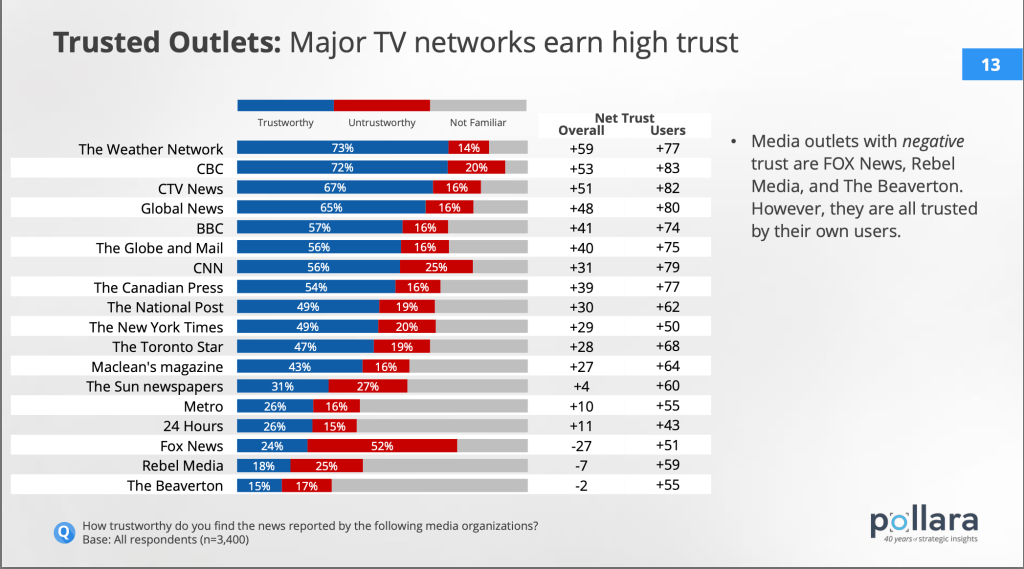
The credibility of the CBC might appear to be in jeopardy according to Dhanraj and conservative critics, but that does not seem consistent with public polling.
Last week Pollara released its annual poll on Canadian news media. CBC News continues to top the charts on both consumption and public trust. In fact, it went up over the last year, as the graphic below shows.
Still, the endless right-wing barrage against the CBC destabilizes the public broadcaster (I exempt from this tar-brushing the perceptive podcast episode posted today by The Hub’s Full Press, which is worth your time).
The CBC has done nothing to counter the Dhanraj narrative of a corrupt news culture —-it’s issuing rote denials while awaiting the filing of Dhanraj’s human rights complaint. The result is that a bunkered public broadcaster leaves a vacuum for others to fill and they are obliging.
The appointment of a new CBC President in January is now seven months old. After an early spate of interviews given by Marie-Philippe Bouchard, we’ve heard very little about any new direction or bold plans to meet criticisms or disappointments expressed about the public broadcaster.
That might be because Bouchard doesn’t know yet if the Prime Minister intends to keep his campaign promise to boost CBC funding by 11% this year, and more over time. That was complicated by this week’s disclosure that as part of its spending review the Carney government has asked CBC to submit a draft plan for deep budget cuts in 2026-2027.
Or it could be that Culture and Identity Minister Steven Guilbeault is still working on a new bill to implement election promises of better CBC governance and long-term financial independence that would require amendments to the Broadcasting Act.
MediaPolicy asked the CBC if there are any significant announcements coming and was told to expect something in the Fall. A similar inquiry to the Minister’s office did not get a reply in time for publication.
***
AI-generated image
This past week TikTok ramped up political pressure to convince the Carney government to undo the federal government’s 2024 decision to ban TikTok the company from Canada, but not the app.
The Liberals’ decision on TikTok followed US legislation to ban both the company and the app on the grounds of national security. Subsequently it was given a stay of execution by Donald Trump in his effort to force a sale of the Chinese-owned social media company to American interests.
Like the US law, the Canadian ban is based on undisclosed and/or hypothetical national security concerns about data security and the distribution of malevolent content, sponsored by China.
TikTok says it is winding up its Canadian operations to comply with the federal ban. Meanwhile it has bought media advertising pleading its case to the Canadian public, posted a posturing letter asking for a meeting with Industry Minister Melanie Joly, planned layoffs of its 350 Canadian staff and withdrawn its funding of Canadian creator development and event sponsorships.
Aside from the sponsorship largesse, TikTok is a major distributor of Canadian cultural content. According to Scott Benzie of the creator group Digital First Canada, TikTok has engineered its algorithm to be a heavy distributor of local content for users that activate the location service on the app, perhaps as high as 50% of “Nearby” and “For You” video recommendations. That’s something that foreign streamers won’t commit to.
With a lawsuit against the federal government on the go, TikTok says Ottawa has taken “measures that bear no rational connection to the national security risks it identifies.”
For its part, the government insists its investigation under the Investment Act in 2023 revealed “clear and legitimate concerns.”
When the ban was announced in November 2024, then Innovation minister François-Philippe Champagne said “I’m not at liberty to go into much detail, but I know Canadians would understand when you’re saying the government of Canada is taking measures to protect national security, that’s serious.”
The entire mess feels a lot like the Facebook ban on Canadian news even though the circumstances are quite different.
Michael Geist has published several articles on the TikTok ban, including this one, which apart from the familiar Liberal-bashing on digital policy I found persuasive (and it’s worth marking the occasion).
Another angle on the problem is something every Canadian is painfully aware of these days: when the American elephant rolls over, we can easily get crushed. And the crushers run the White House.
The troubling question is who isn’t cynical about the merits of the American ban of TikTok in the first place? Or that we are just obediently playing a vassal state by following suit?
The answer to the dilemma is for Carney to publicly defend the ban with as much disclosure of the national security threat assessment as possible, or to repeal it.
***
The Big Tech/Big Hollywood court challenge to mandatory cash contributions to Canadian media funds might get an answer from the Federal Court of Appeal before Labour Day.
Until then, the MediaPolicy boycott of streamer subscriptions (Netflix, Amazon and AppleTV) continues. I don’t miss two of them.
In their absence, I’ve made better use of my CraveTV subscription. That allows me to recommend an excellent new Canadian series, Empathie, a sad and funny drama set in a Montréal mental health facility.
***
If you would like regular notifications of future posts from MediaPolicy.ca you can follow this site by signing up under the Follow button in the bottom right corner of the home page;
or sign up for a free subscription to MediaPolicy.ca on Substack;
The federal election is over and the CBC is still standing. That’s a milestone achieved, for now.
This next Liberal term of government will probably run light on media policy compared to the last four years of legislative turmoil that swirled around the Online Streaming Act Bill C-11, the Online News Act Bill C-18, the future of the CBC, and Online Harms Act C-63, the latter bill being split into two parts and then wiped off the Parliamentary agenda by the election.
If media or cultural issues appear front and centre of public attention during the 45th Parliament, it will likely be a result of trade negotiations with the Trump administration.
The exception is the CBC: the reinvigoration, rebranding, reinvention or re-whatever of the public broadcaster is a winning file for the Liberals and long overdue. The Carney campaign promised more money, more secure long term funding, more local news and more anything to counterweight online misinformation and foreign interference.
The money —a promised 11% increase of $150 million to the Parliamentary grant — will be in the budget bill. The rest must find its way into law through amendments to the Broadcasting Act. That means getting in and out of the procedural swamp of a Parliamentary committee (the new “Culture and Identity” committee) where there is no reason to expect the Conservatives or the Bloc to hand the Liberals a “win.”
It’s going to take a strong minister to get this CBC overhaul done. In March, the Prime Minister appointed Steven Guilbeault as Culture and Identity minister, doubling up with his Quebec lieutenant duties.
Guilbeault is the wrong guy for the job at this point in history. This seems harsh and counterintuitive in many ways. He’s done the job before (2019-2021). He’s smart, decent, competent and temperate. And he is fluently bilingual. So what’s not to like?
The minister’s number one job in this Parliament is the CBC make-over and selling it to EnglishCanada.
That requires gut-instincts about culture and popular attitudes that you can’t easily learn on the island of Montreal. To be pragmatic about the political task at hand, the face of the CBC’s redemption in English-Canada, particularly the west, cannot be the much vilified environmentalist Guilbeault, no matter how unfair that tag may be.
There are other candidates that fit better: fourth-term Toronto MP Julie Dabrusin knows the cultural file as Guilbeault’s former Parliamentary Secretary, she’s bilingual, and if it matters to anyone she was born and educated in Montreal.
The other media policy file that may move forward is a retabled online harms act. You may recall that when the Liberals put forward C-63 last year it contained a raft of amendments to the hate crimes provisions of the Criminal Code and a separate regulatory scheme that would require social media platforms to establish their own binding content codes that manage the online harms to kids, revenge porn, fomentation of hate, and incitement of violence or terrorism.
The Conservatives have no interest in the content codes other than to politicize them as censorship. The Tories have their own version of an Internet crime bill that focusses on harms to children and jailing the perpetrators.
If the Liberals have any sense they will ditch the anti-hate criminal amendments which will just chew up the Parliamentary agenda with public debate over jailing free speech. But they should go full steam ahead with the content codes: it’s a winning file and the Liberals can probably get the support of the Bloc to get it through committee.
Outside of Parliament, the battle at the CRTC over implementation of the Online Streaming Act is going to peak in the next few months.
In the next few weeks the Commission begins hearings on three major policy files covering the first-time regulation of video and audio streamers, as well as online distribution chokepoints. Also, the US streamers’ legal challenges to the initial “five per cent” cash contributions to Canadian media funds will be heard in Federal Court in mid June.
Assuming the court upholds the Commission’s levies, it all points to a crescendo of policy pronouncements and trade confrontations in the fall and winter of 2025-26.
Because of this, all other media policy files will probably get ignored.
One such file is the Meta ban on news distribution over Facebook and Instagram, the very unfortunate outcome of the Bill C-18 battle that hurts journalism start-ups and news websites in smaller communities. Pierre Poilievre’s campaign proposal was to just cave to Meta, which the Liberals are unlikely to do and in any event that would just be an invitation for Google to demand the end of its $100 million in annual licensing payments.
There is no principled way to solve this policy puzzle, which means it might be solved in trade negotiations.
Another file that needs attention but won’t get it is an overdue redesign of the federal QCJO subsidies to news journalism. The opportunity here is to do some good policy work that doesn’t require legislative amendments and Parliamentary bandwidth.
Lastly, now that we have a new Prime Minister maybe we can get the Liberals to reconsider their ill-tempered and ill-considered support of password sharing on news subscription websites in the government’s litigation with Blacklock’s Reporter.
The government has convinced itself (and a trial level judge) that it’s siding with the angels by giving an expansive and elitist interpretation of the “fair dealing” or “research” exception to copyright: it simply does not match up against the common sense reality of running a paywalled news business.
The fact that Blacklock’s is editorially a thorn in the side of the government is the bad energy behind all of this. It’s a vindictive abuse of state power, made possible only because Blacklock’s is not the Globe and Mail or the Toronto Star. It’s time for fresh government eyes on this.
***
If you would like regular notifications of future posts from MediaPolicy.ca you can follow this site by signing up under the Follow button in the bottom right corner of the home page;
or sign up for a free subscription to MediaPolicy.ca on Substack;
The stock markets roiled by Donald Trump’s tariff yo-yo vaporized a lot of personal savings (ouch), but especially if you held Big Tech stock. Or owned the company.
Alas, shed a tear for Zuckerberg, Bezos, Musk and the bros. It must be a weird space to be in: grovelling before Trump in the hopes of an unimpeded path to worldwide AI “dominance,” losing billions in share value on any given day of the week and fending off federal anti-trust lawsuits.
The US Federal Trade Commission’s anti-trust suit against Zuckerberg’s Meta starts at the trial level on Monday and is expected to go day to day through July. The government is challenging the Facebook-WhatsApp-Instagram business as an anti-competitive monopoly in “personal social networking services.”
Matt Stoller will be covering the trial in his Big Tech on Trial Substack.
As the politics play out, the FTC’s litigation team has its work cut out for it on showing monopoly power.
To win its case, the FTC must prove that Meta has a monopoly in a relevant market, and that its acquisitions of Instagram and WhatsApp helped Meta maintain that monopoly through something other than competition on the merits.
The FTC can show monopoly power with direct evidence, like the ability to profitably raise prices or diminish quality. But because Meta does not charge consumers money for its services, it’s difficult to show the classic direct evidence of a price increase. Even so, the FTC has introduced evidence that Meta can engage in price discrimination, one sign of market power, by increasing the number of ads shown to users who have greater demand for social networking. In any event, the FTC will likely rely on indirect evidence of Meta’s market power: high market share plus the existence of barriers to entry that prevent others from whittling away at Meta’s share.
Underpinning whether Meta has a monopoly is the threshold question of how to define the “relevant market” in which it has that power. The relevant market for assessing competition is twofold: a product market and a geographic market. The FTC proposes that Meta is a monopolist in a market for “Personal Social Networking Services” (we’ll call it the “PSN market”) in the United States, which is distinguished by a social purpose: a way to connect with family and friends. Inside that market are Facebook, Instagram, Snapchat, and MeWe. Meta, for its part, disputes that definition and points to other apps that it says it competes with, like LinkedIn, Reddit, and YouTube. The bigger that Meta can make the relevant market, the smaller Meta’s market share in that market, and the more likely it is to defeat the FTC’s case.
“The principle is a fair idea,” he told reporters on the campaign trail. “It’s that these businesses earn revenue here in Canada, so the principle is that they should contribute where they earn the revenue. So I think, on this question, we should keep it in place.”
The Conservatives endorsed the DST in their 2021 election platform at the rate of 3% of Canadian operating revenues, the same amount adopted by the Liberals last year.
The Liberals in 2021 promised a “minimum global corporate tax.” It was successfully negotiated with the US Biden administration but blocked in US Congress and repudiated by the Trump administration. The fallback DST of 3% was implemented instead.
Because of federal regulations, the Canadian independent producers who made the series retain the intellectual property in the show, including the global streaming rights they licensed to Netflix which was a major pre-production investor.
That in itself is hardly unprecedented and neither is it surprising that Netflix is making a big deal of its investment and licensing deal because of the ongoing battle over its obligations to broadcast Canadian content.
What’s more noteworthy is the reporting that the production infrastructure costs of shooting in the high north were so steep that CBC, APTN and Red Marrow —the recipient of all manner of tax and broadcaster subsidies to make the series —— needed a deep pocketed foreign streaming partner to make a show with high on-screen production values and an authentic locale (as opposed to shooting in Sudbury).
It’s a reminder that our television subsidy regime feeds shows that are a million dollars per episode, not five million like American hits.
The CBC is by far the biggest spender on Canadian dramas and comedies at $195 million per year (Bell is second at $93 million) but it still has to spread that cash far enough to cover several series each season in different regions of the country, as viewers and taxpayers expect.
Speaking of the CBC, I’ve got an analysis of the defund v. defend debate coming out next week on the Institute for Research on Public Policy’s website Policy Options.
***
For those of you who wanted to know when the CRTC would reschedule its public consultation on radio and audio streaming, it’s September 18th.
The video and television hearing kicks off on May 14. The consultation on “market dynamics and sustainability” (the gatekeeping of content distribution) begins June 18.
The three-day court date for the streamers’ legal challenge to the CRTC’s five per cent levies benefiting Canadian media funds is set for June 9.
***
The possibility of a merger between Montréal’s LaPresse and the six financially vulnerable “CN2i” Québec news outlets is off.
The LaPresse offer to CN2i staff, which reports imply required an unpalatable number layoffs, was blocked at the last minute and LaPresse informed its own employees that merger discussions were at an end.
With LaPresse out of the picture, Pierre-Karl Pélédeau’s Québecor appears to be poised to make its own merger offer to CN2i. The media-telco conglomerate Québecor owns daily tabloids in Montréal and Québec City as well as the TVA television network and Vidéotron cable.
***
It’s always important to media policy to keep an eye on long-term audience trends, especially in news programming.
ThinkTV is the media marketing group that regularly pumps out polling numbers to remind advertisers where the customers are watching, listening or reading.
Its latest report affirms that television and radio continue to hold their own as the top and third most popular media respectively for national news. The way the polling chart is laid out, you can see that mainstream media is vested in video, audio and text, online or otherwise:
On the same note, American media whiz Evan Shapiro has a new post where he suggests that local news is in high demand regardless of age cohort, although he sees a watershed between GenZ/Millenials and GenX/boomers in terms of platform preferences.
The task is for local TV and radio news operators is to fish for the younger generations where they swim.
None of this is breaking news, but it’s Shapiro’s chart that caught my attention. Check out the age statistics on this one (keeping in mind it’s the American market):
***
And lastly, I recommend Ken Whyte’s latest blog post on book publishing and the trade war. This quote stayed with me:
Search ‘books and tariffs’ on Google and you’ll find a bunch of articles in which booksellers and librarians are begging to dodge the draft into Buy Canada. Frankly admitting that they depend overwhelmingly on US product, they’re asking Ottawa to exempt American books from Canada’s slate of retaliatory tariffs. Otherwise costs will rise, customers will be unhappy, business will suffer. We’ve locked arms with Danielle Smith.
***
If you would like regular notifications of future posts from MediaPolicy.ca you can follow this site by signing up under the Follow button in the bottom right corner of the home page;
or sign up for a free subscription to MediaPolicy.ca on Substack;
Before catching up on MediaPolicy, there are two posts I offer up to you.
The first is my speech to the Digital Media at the Crossroads conference from last weekend. It’s a well salted explainer of the CRTC’s implementation of the Online Streaming Act on music streaming, its first efforts having drawn court appeals, trade threats and the launch of the “Scrap the Streaming Tax” campaign.
The Commission is going to announce a further public consultation on audio (including radio) this week.
The US digital giants offshore revenue from their Canadian operations (and do the same in other OECD nations) in order to minimize corporate tax.
The DSTs enacted in Canada and Europe are a response to that tax avoidance.
Former US President Joe Biden recognized that when he negotiated a tax treaty to fix it but US Congress refused to ratify it.
The tech bros appear to have backed the right horse.
***
The Public Policy Forum just published a report on local news journalism, The Lost Estate. The report comes out of the Michener Foundation’s conference last October. Written by journalism A-listers Alison Uncles, Ed Greenspon and Andrew Phillips, the report covers familiar ground about the extent of Canadian news deserts and news poverty.
The Report’s public policy recommendations have evolved beyond those recommended in 2017 by Greenspon’s Shattered Mirror study and the roster of federal programs aiding news journalism enacted since then by the Trudeau Liberals.
Here they are:
Work harder at getting philanthropic foundations, community organizations and individuals to utilize current tax write-offs for donations to news journalism.
Make it easier for news organizations to go non-profit, unlocking those charitable donations.
Mirror these contributions to the operational costs of running newsrooms with a public-private-philanthropic capital investment fund for community rescues of failing news outlets.
Legislate a requirement that moribund media organizations must give a four-month public notice of closure so that local investors can save the outlet (this would require both provincial and federal action).
Redesign Ottawa’s Local Journalism Initiative that funds 400 reporting jobs by matching federal funding to charitable fundraising, something that the recipient news organizations would be responsible for undertaking.
Redesign the federal reporter subsidy by requiring staff retention and rewarding new hiring.
Introduce an advertiser tax credit for expenditures in local media.
Encourage more governments to increase their advertising expenditures in local media.
If there is a theme in these recommendations it is to juice the market-facing incentives in current programs while not abandoning government aid.
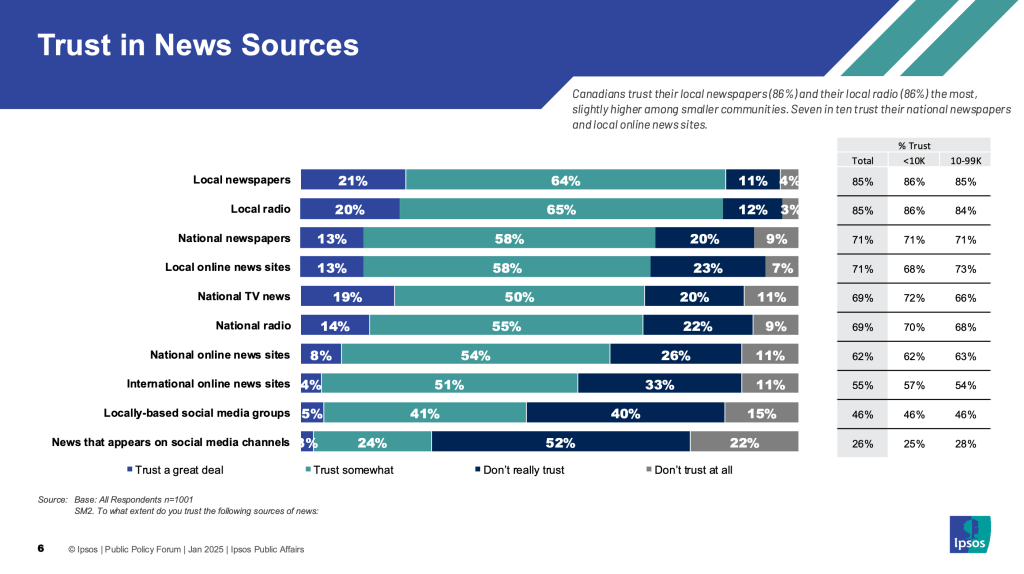
As an appendix to its Report, the Forum provided an Ipsos poll covering some familiar questions about public attitudes towards news journalism.
The results confirm a key trend in public opinion: mainstream media is highly trusted and information carried over social media is not.
On the other hand, two questions related to government subsidies to independent news journalism elicited concern that state sponsorship “might” stoke bias and a lack of independence from government.
The most trusted news sources are in fact the most subsidized by government, so give the public credit for agreeing with MediaPolicy: subsidies are a difficult to measure risk to public trust but so far not a harm.
***
I sometimes close this post by recommending content, but consider this more of a referral: the Hollywood-crafted and star-studded Super Bowl ads you didn’t get to see because the NFL sold the Canadian programming and advertising rights to Bell Media’s TSN.
Nobody quite does goofy the way that Hollywood can.
Are you not entertained? You decide.
***
Okay, changed my mind, I will recommend something serious.
I’m sure I wasn’t the only Canadian listening to Trump’s inauguration speech who noticed the President’s reference to “Manifest Destiny,” a long active but recently dormant part of America’s imperial DNA.
Here’s a good piece on that from the US National Public Radio news site.
***
From The Lost Estate Report:
FOR PHILANTHROPY
Expand issue definition: Philanthropy is growing rapidly in the United States around local news. In addition to the small handful of U.S. foundations that are interested in journalism and democracy, a second wave of foundations and donors that were funders of other issues — including domestic violence, hunger, homelessness and poverty — have come to realize they’re not going to make any progress if there’s no local news. Canadian philanthropists should follow suit.
Step up community foundation involvement: There are more than 200 community foundations across Canada, as well as thousands of private foundations. They are just now beginning to channel their impressive fundraising acumen towards local news initiatives: The Winnipeg Community Foundation, for instance, has funded reporting on religion by the Winnipeg Free Press, and the Toronto Foundation is one of several foundations that help to fund The Local. Community foundations should be encouraged to support local news coverage as part of their wider missions to encourage social vitality, community health and local democracy. More media organizations should be knocking on those doors, and more community foundations should be stepping up.
Help enable new local news models, including not-for-profits and charities: Major French-language news outlets such as La Presse and Le Devoir have become not-for-profits and then used that status to apply for Registered Journalism Organization status to take advantage of money from foundations and individual donors. Only four media organizations outside Quebec have done the same; that represents a major missed opportunity to develop a new source of revenue to support local news. RJO status would mean new startup ventures could accept philanthropic support or present an opportunity for community-based fundraising to claim back news outlets from the corporate chains that have abandoned local coverage.
Foundations can help with this step. Achieving charitable status can be complicated, but foundations can offer guidance on how to navigate the rules around registered philanthropic organizations, such as setting up “friends of” charities that can more easily raise money from supporters. If more outlets had charitable status, more foundation help could be unlocked for local journalism.
FOR GOVERNMENT
Reconceive the Local Journalism Initiative: Report for America in the United States provides a good model of a partnership with strategic intent that builds long-term capacity rather than plugging short-term holes. Its stated mission is to “strengthen our communities and our democracy through local journalism” and it funds reporters in local newsrooms for three-year terms, rather than the single year or less of the LJI. Among its other virtues: It provides training for journalists, unlike the LJI; its grants get smaller each year, shifting more onus each year on the news organization to finance its staff; and it helps news organizations learn how to fundraise within their communities. A homemade “Report for Canada” would roll in LJI funds to match those invested by philanthropy. This would provide the added governance benefit of distancing the program from the government of the day and placing authority in an independent board. Public contributions, as with academic granting agencies, would come in the form of multi-year funding.
Mandate a sales notice period: Communities should have an opportunity to rally support for news outlets that are threatened with closure by corporate owners. Specifically, there should be a notice period, perhaps 120 days, before a news operation can be shut down or sold to a non-local buyer. That would give communities time to gather support for local ownership. To help promote local buyers, governments can explore policy interventions that could include training and development, support with restructuring operations, access to expert resources, navigation support of federal and provincial programs, as well as low-cost or no-cost loans.
Tie the Labour Tax Credit to jobs: The LTC is the most important government program supporting news operations at the moment, worth an estimated $67 million in the 2024-25 fiscal year.[42] It should be continued, but with important changes. Organizations should not take money and cut content; the tax credit should carry an incentive to grow newsrooms and should be tied to the increase or preservation of editorial positions and other resources necessary to produce local content. The credit would be higher for those who increase their spending on journalism.
Drive local advertising with a tax cut: Along the same lines, local advertisers should receive a tax credit for spending their ad dollars with independent, locally owned media. As advertising dollars continue to flow to foreign-owned digital sites, depriving local media of funds they need, a tax credit would give advertisers a greater incentive to vote local while leaving the decision about which outlets get support to them, not government. Equitable tax credits for advertisers have the additional benefit of being more likely to withstand shifts in the political winds. That said, local advertising only helps if Main Street can withstand the competition from distant digital retailers, which presents a different set of challenges.
Direct government ad dollars to local news: Governments should earmark a portion of their substantial advertising budgets to local publishers and broadcasters. Ontario is showing the way by requiring that 25 percent of government ad budgets, including spending by four large provincial agencies, be directed to “Ontario-based publishers.” This program, which went into effect in September 2024, is explicitly aimed at “helping to support these publishers and their workers, who are creating local news content for people across the province.” Brought in by a Conservative government, it could be worth some $50 million a year to Ontario publishers. The federal government, other provinces and territories, and municipalities should follow suit. Governments are already spending substantial amounts on advertising and marketing. It makes no sense for them to talk about the need for vibrant local democracy and a healthy local news environment while they continue to funnel their own ad dollars to foreign-owned social media sites.
FOR PHILANTHROPY AND GOVERNMENT
Encourage capital formation: The best way to strengthen local news is to help it remain in local hands in whatever form entrepreneurs believe will work best in each community. In many cases, this will require capital. Programs to encourage capital formation for this purpose would go a long way to preserving the public good that is local news. A sustainable investment vehicle, co-funded by the federal government, provincial and territorial governments, the philanthropic sector, as well as NGOs, could draw lessons from government programs like the Social Finance Fund[43] and the Canada Rental Protection Fund,[44] where federal investment complements other public, private and philanthropic money. The government should explore any mechanism that makes crowding-in more effective, by utilizing a “first-in, last-out” methodology. For philanthropic organizations engaged in social impact investment, local journalism is a perfect match. The same is true for governments that have already put in place measures to encourage employee ownership or support.
***
If you would like regular notifications of future posts from MediaPolicy.ca you can follow this site by signing up under the Follow button in the bottom right corner of the home page;
or sign up for a free subscription to MediaPolicy.ca on Substack;
As a federal election gets closer, the fate of the CBC gets nearer.
The worst thing that can happen to the CBC (and the 78% of Canadians who support it) is that Pierre Poilievre gets elected to majority government. He will indeed defund the CBC, the only question is how quickly and completely.
The second worst thing that can happen is that the Conservatives don’t come to power and Ottawa hits the snooze button on re-engineering the public broadcaster. Recall, the McGill poll from November 2024 reaffirmed broad public support for the CBC but only if it addresses its major criticisms.
The public debate about those criticisms of the CBC, and what to do about them, finds commentators speaking from two different viewpoints. No, not for and against. But rather “news” versus “entertainment.”
Most of the high profile commentators are journalists who focus on the democratic imperative of saving CBC News in a shrinking journalism ecosystem. After all, about a third of Canada’s 10,000 professional journalists are employed by the public broadcaster. The journalist corps representing the other two-thirds, employed by privately owned media, is steadily shrinking despite the federal government financial aid that Poilievre also says he will defund.
There’s been a useful public debate on how CBC News could do the trifecta of improving programming, defending its audience share (at risk among young Canadians) and mollifying its critics in the political class.
Chris Waddell and Peter Menzies, both interviewed here on MediaPolicy, have offered useful ideas on how to do it. Their views were supplemented last week by the journalist and policy analyst Ed Greenspon and independent (and very much ex-CBC) news producer and writer Tara Henley.
If there’s at least one common theme to all these opinions, it’s to decentralize or re-regionalize CBC News. As it happens, this rhymes with the talking point that the new CBC President Marie-Philippe Bouchard is making by extolling “local” and “proximity” as the CBC’s greatest virtues.
Decentralizing CBC News would address at least two problems: first, give Canadians more of the local news they want. Second; mitigate the hinterland anger directed at a richly endowed public broadcaster that is dug deep into the Toronto streetscape where its main newsroom is steeped in a metropolitan bias, the natural outcome of where most of its employees live.
Another common theme among the news-first proponents is the lack of interest in preserving or improving CBC’s entertainment programming. Waddell and Henley want to toss it overboard entirely and cry uncle to the US streamers, while Greenspon just doesn’t mention it at all.
The CBC is the nation’s biggest platform for Canadian entertainment content, in particular television drama and documentaries (leave aside CBC sports television programming for now, that’s a different discussion).
The private Canadian broadcasters are spending less and less on “Programs of National Interest” (PNI)—-don’t be distracted by the awkward CRTC jargon—- for a variety of macroeconomic factors that can’t be bargained or reasoned with.
The ad market for television has deflated.
Canadian broadcaster revenues and profit margins have been falling steadily because of cord-cutting and the success of foreign television and music streamers.
Corus Entertainment (operator of StackTV and Global TV) is almost insolvent.
Bell Media runs its news division at a massive loss and is barely profitable only because of an entertainment portfolio anchored by its long-term deal to retail HBO programming in Canada.
Indeed, the trends are all going in the wrong direction.
Spending on Canadian TV dramas by the English language Canadian networks has shrunk 65% (in real dollars) over the last decade according to a recentstudy commissioned by the Director’s Guild.
Meanwhile the streamers have set a new, stratospheric bar in rising per hour production budgets. Canadian broadcasters can either respond with bigger budgets (they can’t or haven’t) or allow the gap in on-screen production values to widen. (The APTN/CBC/Netflix co-pro North of Northcould not have been made without the Netflix investment that made filming in Iqaluit possible).
Enter the CRTC’s white-flag-of-surrender idea of abolishing the regulatory category of “PNI” in hopes that when it orders Netflix, Amazon and Disney to make “Canadian content” the streamers will by default make dramas. Meanwhile, abolishing PNI for Canadian broadcasters would mean Bell, Global, Rogers and Québecor can opt to shift their spend from money-pit dramas to profitable unscripted television and lifestyle programming.
Quite apart from whether it’s a good idea to outsource Canadian television dramas to American studios looking to sell back into their own market, the question is whether Canadian broadcasters would ever make a drama series again if the CRTC doesn’t require it.
Those who were around to win the regulatory battle for Canadian television drama back in the 1980s will have an opinion on the matter.
If we have to take a defunded English language CBC out of the funding equation for Canadian television drama we subtract a programming budget north of $120 million annually, as the public broadcaster is the nation’s biggest buyer of Canadian dramas.
Bell spent $70 million on English-language Canadian drama in 2023-24 (its budget was $75 million ten years ago) and Corus spent $37 million (it was $96 million as Shaw and Corus combined in 2014).
Friends and foes of the Online News Act Bill C-18 will say the predictable things. What a spineless, election-motivated reversal.What a foreseeable debacle.
News Media Canada took the opportunity to hurry new survey results to press: a solid majority of Canadians want the federal government to spend more advertising in newspapers and less on social media.
According to its press release, “almost two thirds (63 per cent) of Canadians trust advertising in newspapers/news sites, while just 28 per cent trust ads they see on Facebook/Instagram.”
The publishers’ alliance applauded the Ontario government’s decision last July to boost ad spending on newspapers while pointing out that the federal advertising budget allocates only two per cent of its dollars to print.
***
I often recommend Ken Whyte‘s Substack column SHuSH and do so again.
Whyte is the owner and operator of the Canadian book publisher Sutherland House and as such automatically qualifies as an expert in the economics of Canadian media. He’s also the former editor of Maclean’s Magazine, ex-President of Rogers Publishing, and once Editor-in-Chief of the National Post. Additionally, he writes like a dream.
In his last column he contemplates what a Trump tariff on books would do to Canadian publishers who are mostly small independents that hold, collectively, a minority share of the Canadian market that is otherwise dominated by foreign giants.
Sound familiar?
***
If you would like regular notifications of future posts from MediaPolicy.ca you can follow this site by signing up under the Follow button in the bottom right corner of the home page;
or sign up for a free subscription to MediaPolicy.ca on Substack;
















 MediaPolicy.ca