MediaPolicy posted twice this week. The first one returns to our dialogue about an improved CBC with an Open Letter from Ian Morrison, the founder and former spokesperson of Friends of Canadian Media.
The other post is an interview with publisher Holly Doan of the elbows-up investigative news site, Blacklock’s Reporter. With the Reporter in mind, I coined the phrase “journalism at its fiercest” and it seems from the volume of post views and twitter response to the interview that her publication very much has a fierce fan base. If you like Old School, you’ll love this interview.
***
This is the last weekend before all hell breaks loose in our relationship with the United States.
Cast your mind back in Canadian history and recall that perhaps the most nation-defining things we have ever done were dispossessing Indigenous peoples and then managing not to be dispossessed ourselves by our covetous neighbours (1776, 1812, 1837, 1844, 1866, 1870, let me know if I’ve left anything out).
The national achievements of the USA make for a longer list. Dispossessing Indigenous people and enslaving Africans, for starters. A game effort at national fratricide through civil war. Denying African American citizens their civil rights. Building a hemispheric and then a global military empire. Tipping the balance in two world wars. Quite a list.
Now the US might be entering its age of autocracy and Big Tech oligarchs.
That’s not a reference to the US judiciary but the description of a new governing paradigm that disposes of policy and sees the Tech bros travel to the king’s court in Mar-a-Lago to supplicate and trade favours. Once in thrall to the king, Klein’s guest Erica Frantz suggests, Trump owns them in the way that Vladimir Putin owns his own oligarchs.
That has implications for everything, one of which is media. Elon Musk owns X. The grovelling Mark Zuckerberg owns Meta. Add Amazon’s Jeff Bezos to the list. Other media moguls will have to pay homage to the king to protect or advance their interests.
Then there’s the unknown future of TikTok. The US Supreme Court has upheld the Congressional ban on its Chinese-ownership. Its CEO Shou Zi Chew is playing a tough hand by saying TikTok will turn the platform dark on Sunday when the ownership edict comes into effect.
Trump is trying to engineer a sale of TikTok to a new owner, which Shou says he will not do. (Spare a kind thought for a guy caught between the world’s two superpowers.)
The Orange King supposedly has his oligarch pal Elon Musk in mind as the new owner.
And Canada’s carnival barking Kevin O’Leary, for whom grovelling to a foreign power is too mild a description, is making this comical by putting himself forward as a potential buyer of TikTok.
O’Leary’s antics are just what Trump would like to see from all Canadians: a bended knee and a favour sought.
Not since the cross-border Fenian raids of the 1870s has the threat of American dispossession been so tangible.
***
If you would like regular notifications of future posts from MediaPolicy.ca you can follow this site by signing up under the Follow button in the bottom right corner of the home page;
or sign up for a free subscription to MediaPolicy.ca on Substack;
It confirmed what other polls had already established. Overall, Canadians go to mainstream outlets for their news while younger Canadians increasingly get their news on social media platforms such as Instagram, YouTube, Snapchat and TikTok.
Across generations, the lack of trust in content distributed on social media is high.
The other half of the Dais Report (based on the Pollara survey) lasers in on the harms from online misinformation and hate. Just so I don’t bury the lede, the most salacious finding was that right-wing Canadians are far more prone to believe misinformation than left-wingers are. I’ll get to that lower down in this post.
The scope of Dais investigation overlaps but does not quite match the focus of the Liberals’ proposed online harms legislation, Bill C-63 or the Conservatives’ alternative, Bill C-412. Maybe that is because the idea of State intervention to combat harms to children, deep fakes, and revenge porn are uncontroversial. It’s the debate over hate and misinformation that heats controversy.
Majority support for fighting online harms
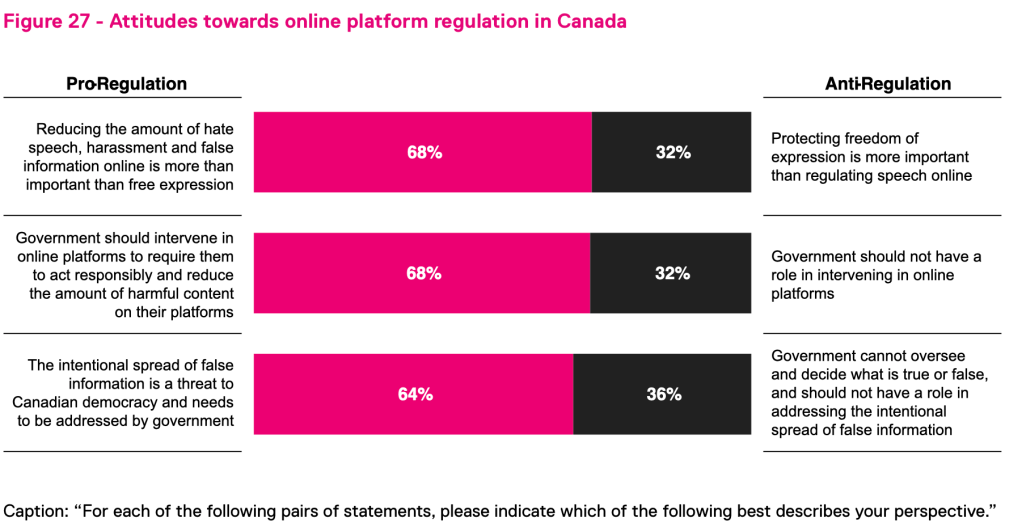
The Dais report looks at public attitudes towards the State stepping in to the ring to regulate online misinformation and hate. The bottom line: two out of three Canadians say fighting online harms trumps the freedom to misinform or hate:
An even stronger majority in favour of State action gets teased out of the poll numbers when differentiating between specific harms and consolidating “strongly” and “somewhat” support:
This polled majority support for State action against online harms is consistent with results in threepreviouspolls.
Is public sentiment an endorsement of the Liberal bill? There is only a modest level of public awareness of the specifics of Bill C-63. Only nine per cent of Canadians think they know details of the bill and another 28% are “vaguely” aware. This is typical of public attitudes towards proposed legislation so the Dais/Pollara survey has to be taken as a snapshot of uncrystallized public opinion on the bill. As well, there has been no poll testing whether combatting online harms is a vote-changer in the upcoming election, as there was with the Conservative proposal to defund the CBC.
Nevertheless a take away from all this polling suggests that the public criticism of Bill C-63 is out of step with public opinion.
the hate you see
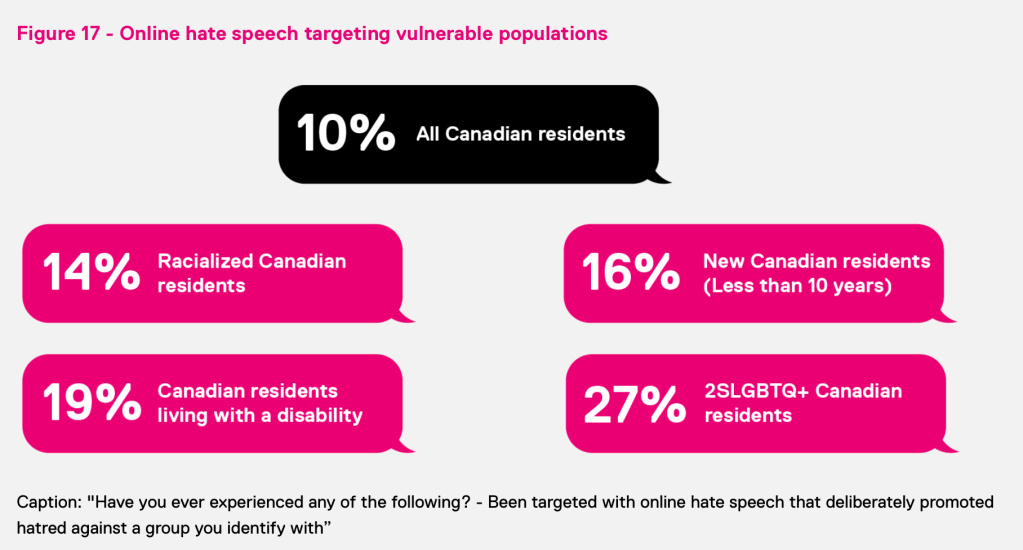
The Dais poll asked survey respondents to self-identify and then, based on the results, concluded that Canadians are seeing a troubling amount of online “hate.” Check out the third line of this graphic:
As for personal targeting, members of racialized and LGBTQ communities experience more of it:
Of course hate may be in the eye of the survey respondent and not all hate is illegal. How bad does hate have to be before we censor or punish it?
The legislative standard for illegal hate was written by our Supreme Court adjudicating the Criminal Code and human rights legislation. The legal “hallmarks of hate” are those that vilify and dehumanize members of certain communities, inciting violent and non-violent attacks upon them.
Here’s the Court describing illegally hateful messages:
The messages conveyed the idea that Black and Aboriginal people were so loathsome that white Canadians could not and should not associate with them. Some of the messages associated members of the targeted groups with waste, sub-human life forms and depravity. By denying the humanity of the targeted group members, the messages created the conditions for contempt to flourish.
Moreover, the level of vitriol, vulgarity and incendiary language contributed to the Tribunal’s finding that the messages in the case were likely to expose members of the targeted groups to hatred or contempt. The tone created by such language and messages was one of profound disdain and disregard for the worth of the members of the targeted groups. The trivialization and celebration in the postings of past tragedy that afflicted the targeted groups created a climate of derision and contempt that made it likely that members of the targeted groups would be exposed to these emotions. Some of the posted messages invited readers to communicate their negative experiences with Aboriginal people. The goal was to persuade readers to take action. Although the author did not specify what was meant by taking action, the posting suggested that it might not be peaceful. The Tribunal found that the impugned messages regarding Aboriginal Canadians and Jewish people attempted to generate feelings of outrage at the idea of being robbed and duped by a sinister group of people.
While incitement to violence is a powerful justification for censorship of hate, the common understanding of incitement as direct cause and effect may not capture hate’s long term poisoning of the mind: Jews are too rich (so take away their property); Indigenous are idle (so don’t hire them); Blacks are violent (so keep them in a ghetto).
The incitement to violence is just a further matter of accumulating a critical mass of dehumanization. The bereaved Afzaals of London Ontario probably would like to know how many haters and hate messages it took to incite the man who murdered their family with a pick-up truck.
It’s really not surprising that Canadians’ majority support for action against online hate is so high. Whether or not expanding the existing anti-hate legislation that is already on the books through C-63 is the answer, there are many informed discussions to consider. And it’s important to keep in mind that much of the bill doesn’t deal with hate speech.
taking the misinformation quiz
The Dais report also puts a lot of focus on misinformation. Neither the Liberal nor Conservative bills propose to regulate misinformation, other than where it’s present in harm to children, deep fakes, and hate speech.
It’s not well known that Canadian television and radio regulations have long prohibited “false or misleading news” in broadcasting. I can find no cases where the CRTC took action on those grounds (although a there have been censures and licence revocations for the “abusive comment” of misogyny and racism over the airwaves).
When Parliament updated the Broadcasting Act in Bill C-11 in 2022 it excluded regulation of “abusive comment” and “false or misleading news” from applying to content distributed on social media platforms such as YouTube. The federal cabinet went even further by excluding podcasts, keeping them unregulated.
Nevertheless, the Dais Report looks at the size of the online misinformation problem in Canada. This is where I promised the salacious stuff.
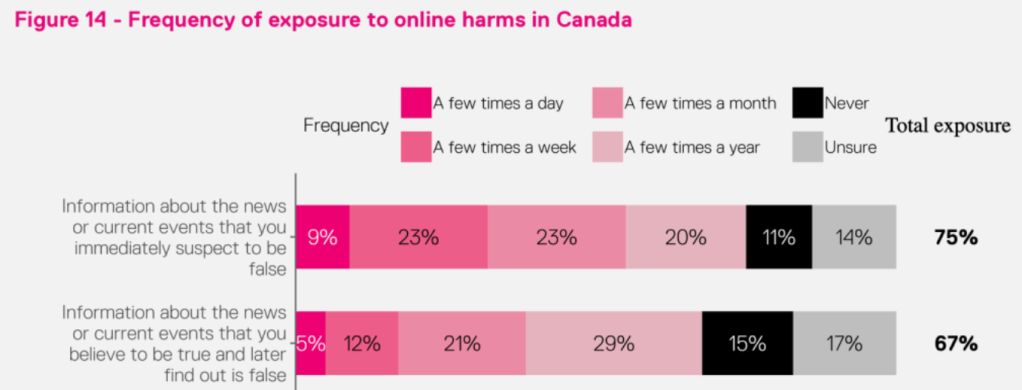
First, the polling confirms that Canadians see a lot of “fake news”:
Next, Dais looked at who is especially vulnerable to misinformation, or credulous of it, depending upon self-identified political views of the respondents; right, centre or left wing.
The pollster posed eight true/false questions about current affairs, described below with the correct answers (7 are false, one is true), in order to assign respondents to membership in “low, medium or high misinformation groups.”
Membership in the “low” misinformation group required at least six correct answers out of eight. Respondents were allowed to qualify their answers as “somewhat” true or false, or respond “don’t know.”
Seventy-eight per cent of left-wing identifying respondents scored six or better. Thirty-two per cent aced the test.
Across town in right-wing territory, only 34% scored six or better. Only six per cent nailed all eight.
Men and women performed about the same overall. Older Canadians did dramatically better than the younger generation (62% versus 45% for six or better). University-educated Canadians topped high school and college graduates. And finally, Québec respondents outperformed the rest of Canada by a considerable margin:
If you aren’t wound up enough by this point, consider that left-wing, university-educated, boomers from Québec have to be feeling pretty good about themselves.
Happy New Year.
***
If you would like regular notifications of future posts from MediaPolicy.ca you can follow this site by signing up under the Follow button in the bottom right corner of the home page;
or sign up for a free subscription to MediaPolicy.ca on Substack;
The Dais report probed how Canadians get our news, how misinformation is consumed, the prevalence of hate speech, and public attitudes about using government to fix it. (This is the fifth annual report from the Dais, a two-minute video on its 2023 report can be viewed here.)
The Dais analysis of online harms —it includes false information among the harms— is the juicy stuff. I’ll keep that warm for my next post.
Mainstream media dominates
As for news sources, The Dais report confirms what we already knew: “legacy” television news is far and away the most popular news source for Canadians:
In fact, the Dais report shows that “yesterday’s man” of Canadian media is creeping even higher over time (Figure 5). And look above in Figure 4 who’s standing next to television on the podium: news websites and radio. It’s a clean sweep for mainstream media and the news organization that make it up.
On the other hand, the 2024 Reuters Digital Report for Canada lumped together a collection of “social media” platforms to claim third place for news consumption (whereas the Dais Report above breaks out those platforms, individually).
The results are of course skewed by age cohort (Figure 6 in the Dais Report). Younger Canadians (16-29 years) are more likely to source their news from search engines and social media, also observed by Pollara earlier this year.
As for trust in the news that Canadians are consuming, again it’s mainstream media that rules. And the under-fire CBC is the king of credibility (Fig.10):
As an aside on the issue of trust in CBC News, the Dais notes that the public broadcaster’s 48% for “high” trust is elevated by a 64% score in Québec for Radio-Canada but weighted down by a 34% “high trust” in Alberta. Then again, those skeptical Albertans gave Global News and CTV the same score and even rated the Globe and Mail at 21%.
Perhaps the biggest token of skepticism is found in the Dais’ Figure 7. While noting television news’ dominant trust in comparison to other news sources, almost as many survey respondents replied that they didn’t trust any news sources, running the gamut from mainstream media to the entire Internet.
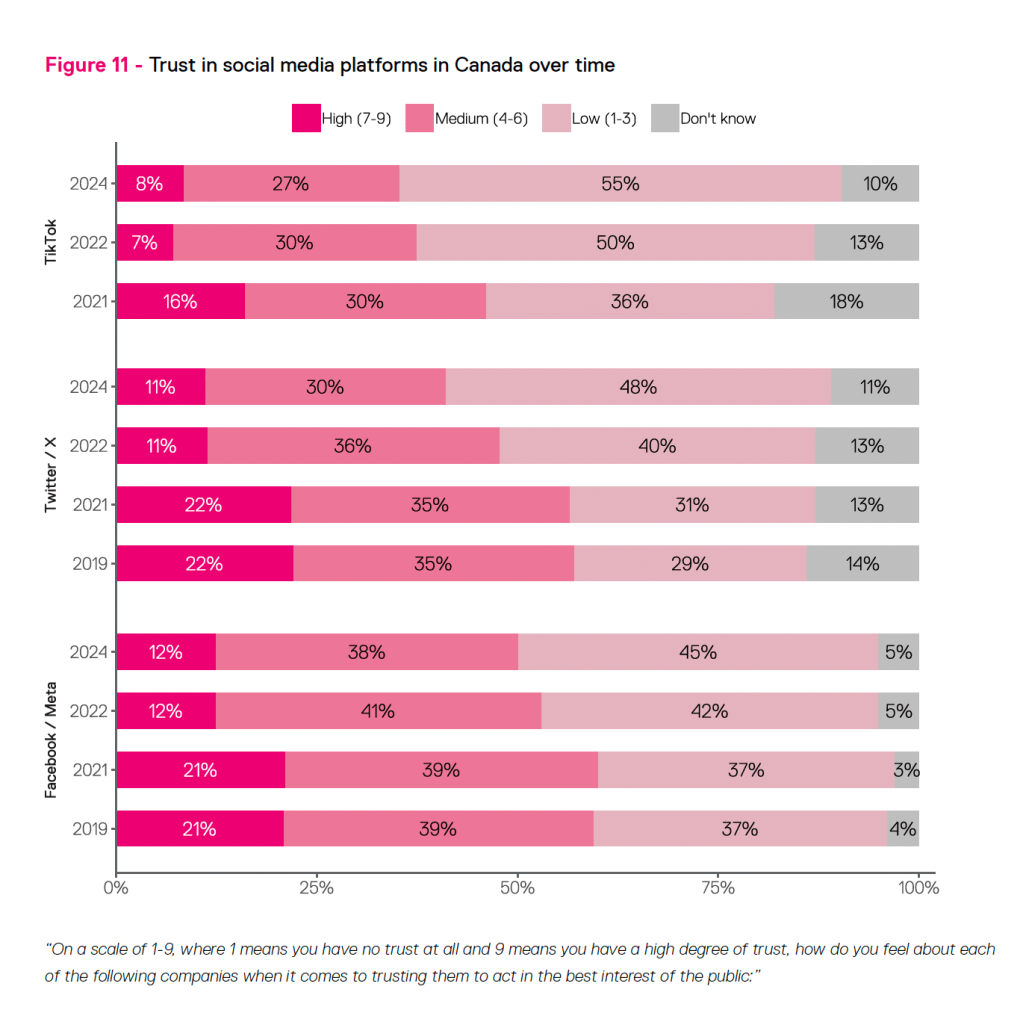
On the other side of the trust coin, popular trust of social media platforms is very low (and getting lower over time), even among the young Canadians who flock to them:
As MediaPolicy wrote this summer, the good news is that we are still a nation of news consumers. News avoidance and exhaustion is a real thing, but it’s not the main problem.
The main problem is the unravelling of news media’s business model, but the second biggest problem is Canadians’ declining trust in media and many other public institutions. That’s a world wide phenomenon, particularly acute in the United States. In Canada, the percentage of the public saying “yes” to the question “I think you can trust most of the news, most of the time” has declined from 55% in 2016 to 39% in 2024.
In the next post, we’ll look at The Dais report’s insights into misinformation, hate speech and public attitudes towards government regulation.
***
If you would like regular notifications of future posts from MediaPolicy.ca you can follow this site by signing up under the Follow button in the bottom right corner of the home page;
or e-mail howard.law@bell.net to be added to the weekly update;
It being the time of the year, retrospective lists abound.
The MediaPolicy 2024 wrapped list includes posts that are worth reading (again or for the first time) because they cover public policy that Pierre Poilievre has sworn to repeal or at least do something else that looks like he has wiped the Liberal policy slate clean.
***
Defunding or defending the CBC
The Poilievre banner campaign to defund the CBC is the right-wing answer to cancel culture. I don’t like you, I silence you.
A Sparks poll in January 2024 suggested overwhelming public support for the CBC, although a big slice of that is soft. Hence the importance of a public discussion of how to improve or re-engineer the public broadcaster.
MediaPolicy posted two interviews and a guest column from media commentators who know what they are talking about when it comes to the CBC: Chris Waddell, Richard Stursberg and Peter Menzies. I have a fourth instalment in this series on the way.
Online Harms
The Liberals’ Bill C-63 obliges social media platforms to come up with content moderation codes. It also empowers the government to order take-downs of revenge porn and content harmful to children. The Justice Minister has split off the more controversial portions of C-63 into a second bill: harsher criminal sanctions for Internet hate and access to human rights tribunals for victims.
The Conservatives are opposed to all of it (they have a more modest proposal) and none of it will pass before the next federal election.
In 2019 the Liberals passed the so-called “$600 million bailout” for Canadian news organizations (except for licensed broadcasters). The $600 million was the over-budgeted amount for five years: the actual spending was less than half of that.
MediaPolicy posted about the alleged relationship between that federal program and declining trust in news organizations. Also I looked at some policy prescriptions that might carry over into a Poilievre government despite his pledge to abolish the program.
News licensing payments
You say “link tax,” I say “compulsory news licensing payments.”
The Online News Act Bill C-18 blew up on the Liberals when Google and Meta decided to play hardball with enough gusto that US legislators would think twice about following Canada, Australia and Europe in making Big Tech platforms share their advertising revenue generated by news links.
I tried to get past the noise on this bill and pinpoint what I believe are the deeper truths about the legislation. The post is now a year old, but still helpful.
Poilievre says he will repeal this bill and, it would seem, refund Google its $100M in annual news licensing payments.
The Netflix Bill C-11
It took them forever, but the Liberals passed the bill that compels foreign streaming giants to share the responsibility with Canadian broadcasters to finance and distribute Canadian audio and video content.
Poilievre has been clear: he will “kill Bill C-11.”
Digital Services Tax
The DST is a stand-in for recouping $900 million in corporate tax avoidance by Big Tech in Canada. That doesn’t always come through clearly in news reports. Unfortunately, leading Canadian critics have displayed an obsequiousness (to Big Tech) or fear mongering (of US retaliation) that is unbecoming.
MediaPolicy posted what I will call a context piece on the DST that I hope is informative.
***
A note to readers, MediaPolicy posts will now be available on Substack. The MediaPolicy website on the WordPress platform will continue with its archive of previous postings and resource links.
If you are already an e-mail subscriber, you will continue to receive MediaPolicy posts and will not get a duplicate from Substack (unless you sign up for it).
Substack is a fascinating creature in the news ecosystem. Founded in 2017, it’s a platform for 17,000 writers, including journalists. You can find leading independent Canadian journalists: folks like Paul Wells (30,000 paid and unpaid subscribers); Jen Gerson of The Line (26k), Justin Ling (12k), Terry Glavin (12k), Ken Whyte (7k) and Patrick White (2k). On Subtstack, both writers and readers can pepper the blogosphere with rhetorical outbursts, à la Twitter/X. But for journalists and news junkies, the site’s real draw is full-length opinion and analysis.
A year ago, Substack had about 50 million unique visitors in the month of January. It boasts two million paying subscribers and over 20 million registered readers (after you have opened an account or surrendered your e-mail address to one of your favourite writers). The writer posts are usually partially paywalled, but not always (mine is not).
The most popular Substacker is Heather Cox Richardson (1.8 million), American historian and author of the non-paywalled Letters to an American. Popular Substackers, who usually charge a $5 monthly subscription fee, can make a decent living.
The question arises at to whether Substack is a candidate for stealing yet another big chunk of mainstream media’s franchise by peeling off well known staff journalists who are currently thankful for a regular paycheque.
Having lost classified ads, much of its display advertising, and a range of editorial products to the Internet leviathan, online newspapers have stayed in business by cutting news and news gatherers. To replace the lost news content, we have a great deal more opinion columns. Opinion is popular and, for the news proprietors, cheap. The key has been to concede more of the news hole to the best and well known opinionators.
What if Substack took those marquée writers and their audiences too?
If you mark off 45 minutes of your time, an engaging Canadaland podcast hosted by Jesse Brown and starring Paul Wells, Jen Gerson, and Chris Best (Substack’s Canadian co-founder) talks about the possibility of mainstream media losing its stars to Substack.
Gerson has a trenchant observation: the Canadian journalists enjoying success on Substack are generally those who made their bones and their reputations after years of service in mainstream media newsrooms. That career path, she suggests, doesn’t exist anymore.
Then there’s Substack’s Nazi problem. With that teaser, I recommend the podcast, here.
***
If you would like regular notifications of future posts from MediaPolicy.ca you can follow this site by signing up under the Follow button in the bottom right corner of the home page;
or e-mail howard.law@bell.net to be added to the weekly update;
The devil makes work for idle hands and lately MPs from the filibuster-becalmed House of Commons amuse themselves by summoning CBC Presidents before the Heritage Committee. Once in the dock, prosecutorial MPs flay the witness and then video clip for their social media posts.
Some MPs had trouble with their facts. Not without justification, MP Kevin Waugh cited the public broadcaster for raking in $400 million in advertising revenue that could otherwise be available to private media. The true dollar figure is $270 million; Google and Facebook have the rest.
MP Jamil Javani claimed that CBC English language television has a 2.1% share of viewing audience. The CBC’s percentage for prime time viewing in television, excluding its all-news and documentary channels, is more than twice that at 5.2 %. By comparison, Canadian private broadcasters collectively take 26%, a wide array of specialty channels are at 53% and US networks are at 13%.
Conservative MPs dwelled upon the bonus payout for senior CBC executives. Bouchard defused the situation by agreeing to review the payments, make her review transparent, and gently reminded MPs that the correct term is “variable pay” (the at-risk performance pay that is part of every senior manager’s compensation package in the modern world).
MP Niki Ashton from northern Manitoba assailed the CBC for its retreat from local television news. She’s not imagining that: in response to the deep Liberal budget cuts during the 1990s, the public broadcaster closed stations and reduced coverage across Canada. The coverage-killing budget cuts didn’t stop there: between 2013 and 2023, the CBC responded to Parliament’s austerity by reducing its spending on television programming in English Canada by 40% in real dollars as it shifted resources to online news.
Bouchard’s reply to MPs was noteworthy: local news will be a “big focus” as the incoming CEO. Last month the CBC announced it was spending its $7 million of “Google money” on hiring 25 journalists in underserved markets.
***
In a previous post I did the CRTC an injustice by accusing Commission staff of “twiddling around” in its investigation of whether Meta is offside by selectively waving some news items through its block of Canadian news content.
I said that because the Commission appeared to be too patient in allowing Meta lawyers to rag the puck in response to the CRTC’s demand for the details on the porous news block, details which the regulator intends to make public in the course of its inquiry.
Last Monday the Commission fired off another letter to Meta and, if you read for nuance, you will conclude that the CRTC has lost patience with Mr. Zuckerberg’s demands to keep his explanation a secret and is ready to post Meta’s unredacted explanation of its news block.
Meta has until tomorrow to play ball or else. Else what, we shall see. Once Meta’s statement of defence is public, the next step will be a decision from the CRTC on whether to investigate further.
***
There may never have been a busier week for Big Tech lawyers responding to legislation and lawsuits around the world.
Here’s a quick run down:
Australia passed a law banning kids under 16 years old from having their own social media accounts (WhatsApp and YouTube excepted). The ban takes effect a year from now —-an eternity in political time—- as the thorny issue of age verification gets sorted out. The debate over the legislation was the occasion for Elon Musk to tweet accusations of censorship, a rebuke from the CEO of the Australian public broadcaster Kim Williams and then Musk responding by unleashing a troll storm against Williams.
The Australian government dropped its version of our Bill C-63, the Online Safety Act. Its “misinformation bill” was destined to fail in the Australian upper chamber where the government does not enjoy a majority.
The Canadian Competition Bureau has filed suit against Google for allegedly abusing its market power in digital advertising. Having cleared Google of this very charge in 2013, it seems likely the Bureau has more evidence in hand as a result of the ongoing anti-trust trial against Google in the US.
Canadian news outlets have filed a copyright lawsuit against the Microsoft-backed OpenAI and its ChatGPT app —-in the wake of a similar lawsuit by the New York Times—- for ingesting millions of the outlets’ online news articles. There’s already an AI-ingestion lawsuit proceeding in Canada between two smaller players as recounted by the University of Calgary’s Hugh Stephens in a blog post.
***
The Globe and Mail’s Cathal Kelly is a born-with-the-muse columnist who just happens to write about sports.
If you would like regular notifications of future posts from MediaPolicy.ca you can follow this site by signing up under the Follow button in the bottom right corner of the home page;
or e-mail howard.law@bell.net to be added to the weekly update;
This week MediaPolicy published a report of the CRTC’s announcement on November 15th laying the groundwork for how Netflix and the other foreign video streamers will contribute to Canadian content under the Online Streaming Act.
Released on a Friday, the announcement flew quietly under the radar of the daily news cycle, possibly because there is no immediate price tag attached to Netflix’s future obligations to make or license Canadian shows.
Last June the CRTC imposed on the foreign streamers $140 million worth of annual contributions to Canadian television subsidy funds for news, drama and kid’s programming: last week’s much anticipated announcement might end up being worth five times as much in streamers’ programming budgets for Canadian content.
There are times when the impact of American public policy initiatives on Canadian media policy dwarves anything we might do north of the 49th.
As you may recall, the trial judge in an anti-trust suit begun by the Trump White House and several states against Google resulted in a legal ruling declaring Google an illegal monopoly in Search and search related advertising.
Following up, the collective of Attorneys Generals spearheaded by the federal DOJ have now tabled remedial requests to the trial judge.
Just for starters, they are requesting that Google divest its Chrome web browser and its Android mobile operating system. And there are important requests focussing directly on bootstrapping would-be competitors to Google in the Search market by giving them “catch-up” access to Google’s treasure trove of consumer data. Radical stuff for radical times.
There is a useful news summary from the New York Times. But if you can afford the time for a ten-minute read, I recommend Matt Stoller’s excellent explainer.
As I read Stoller’s piece, it easily came to mind how unlikely it is that Canadian news publishers would have successfully pursued the news licensing payments in the Online News Act if instead of Google’s monopoly on search referrals there was robust competition in the Search Engine market.
***
More than a few times MediaPolicy has raised the question of how Meta is getting away with its selective ban on Canadians news content, its response to our Online News Act.
The Heritage Minister raised the same question publicly but she is constrained by the fact that it’s the CRTC’s jurisdiction to investigate it.
It’s possible that federal cabinet considered but dismissed the idea of sending the CRTC a policy directive asking the Commission to look into why Meta permits the sharing of some news items, but not others, and why it has flat-out restored news posting privileges to outlets such as Narcity.
The Commission is twiddling around on this one. In early October it asked Meta to explain the rhyme and reason for allowing some news content on its Facebook and Instagram platforms while banning the vast majority of news organizations.
Meta filed a letter in response and, according to a Canadian Press story, it appears that Menlo Park submitted something, but it’s not clear what. And beyond whatever details of its selective ban it provided, Meta has claimed confidentiality and opposes the public release of its answers to the Commission.
This minor legal drama will play out in the fifth dimension of regulatory time.
Meanwhile the public is still in the dark as to whether the Commission thinks there is a basis for playing hardball with Meta by, for instance, officially designating its platforms under the Online News Act so that banned news organizations can file an “undue preference” complaint and get equal treatment to Meta’s favoured news outlets.
***
I’m pleased that so many followers of this blog liked Richard Stursberg’s guest column on the CBC, his advice for the incoming CBC President Marie-Philippe Bouchard. It’s now the most popular post in MediaPolicy’s short history.
Now there’s an interesting column from The Hub’s Managing Editor Harrison Lowman in which he identifies the “defund the CBC” problem as the public broadcaster’s news curation and journalism culture. His bottom line: fix it, don’t destroy an important Canadian institution and a vital provider of news journalism.
Lowman’s piece —-clearly not toeing the Conservative Party line—- was immediately disputed by The Hub’s Editor-At-Large and former Harper policy chief Sean Speer.
Speer’s says his support of defunding the CBC is not founded on an allegation of biased news reporting. Gosh no. It’s about the CBC’s declining audience share (him citing poor television viewership numbers, but ignoring strong digital and radio numbers). His colleague Lowman is just being “nostalgic” about the CBC.
***
If you would like regular notifications of future posts from MediaPolicy.ca you can follow this site by signing up under the Follow button in the bottom right corner of the home page;
or e-mail howard.law@bell.net to be added to the weekly update;
Last week I was in Charlottetown attending a conference on local news.
I posted a brief summary of the keynote speech delivered by Steve Waldmanhere.
Waldman is the American journalist who heads the Local News Project and the Report for America intern program. If you want to place him in the Canadian constellation of public journalism, consider him an American counterpart to our Ed Greenspon or Margo Goodhand. The headline graphics above and below are from Waldman’s slide deck.
Waldman’s pitch, and the idea behind the conference, was that saving local news journalism is job one.
The argument he makes is that there is a great deal of evidence in the US suggesting that towns and rural areas living in news poverty —with too few or no community news outlets — are ripe for misinformation circulating on social media and also political polarization when searching for news on more partisan sources at the national level.
There is a connection, he says, between being underinformed or misinformed about local events, issues, and politics and on the other hand the rising national tide of political polarization where citizens sort themselves into tribes and stop listening to each other.
One should be cautious about copy and pasting Waldman’s analysis from the US to Canada, but his view will strike many as true.
***
The National Post scored some of outgoing CBC President Catherine Tait’s e-mails, commenting on the Conservative “defund the CBC” campaign, through an access to information request. Alas, her comments weren’t very juicy.
Tait’s replacement is due to be announced by the Heritage Minister any day now: LaPresse and Le Devoir had stories claiming it will be Marie-Philippe Bouchard. She is currently the CEO of the Canadian broadcasting consortium TV5 Unis that partners with global francophonie broadcaster TVMonde. She was at CBC-Radio Canada for 26 years before that.
Bouchard’s reputation precedes her, at least in Québec, where reaction to her possible appointment was roundly positive.
Appointing Bouchard to replace Tait would fall in line with the important tradition of alternating between Québec and English Canada.
Peter Menzies raised the obvious question: it’s the current state of English-language CBC that needs review in response to Pierre Poilievre’s promise to defund CBC but not Radio-Canada, so why not pick someone from another province?
The answer may be that she spent 12 of her 26 years at CBC working as legal and regulatory counsel for both sides of the corporation. You can expect the question to be raised again if Bouchard is appointed.
***
A notable absence from the Charlottetown local news conference was Jeff Elgie, CEO of the expanding Village Media chain of local digital media sites.
Elgie has seemingly defied gravity for the last ten years by growing from one local site in Sault Ste. Marie to more than thirty in Ontario. Along the way he’s built a popular proprietary publishing system and even added a legislature news bureau.
I interviewed Elgie back in March and it is one of the most popular posts in MediaPolicy’s short history (he’s only got a 100 or so employees, so it’s not what you think).
Besides launching his first Toronto site in the next weeks, his next big idea is “Spaces,” a social media platform for chat groups moderated by community hosts.
I just signed up, so wait for a report.
***
My recommended read is for media nerds only. Doug Shapiro has another crystal ball blog, this time about the impact of Generative AI on video creation. It has the feel of David Bowie’s famous 1999 “tip of the iceberg” prognostication about the Internet.
Here’s a teaser from Shapiro’s “GenAI as a New Form” about what might lie below the water line:
***
If you would like regular notifications of future posts from MediaPolicy.ca you can follow this site by signing up under the Follow button in the bottom right corner of the home page;
or e-mail howard.law@bell.net to be added to the weekly update;
The House of Commons is back in full swing and media policy issues are coming thick and fast.
For at least the next few months, it might be a good idea to rename this blog MediaPolitics.ca.
I say that because the politicization of media policy issues —- the linking of minor events to allegations of catastrophic policy failure — is spinning around the turntable at 78 rpm.
***
I just attended a conference organized by Taylor Owen of the Max Bell School of Public Policy focussing on policy issues embedded into the Liberal government’s Bill C-63, the Online Harms Act.
The Bill earned publicity when it was tabled in the House last February by folding in tougher criminal sanctions against hate communications and reinstating the right of individuals to file human rights complaints as a consequence of online hate.
But the core of the bill is legislating a generic “duty to act responsibly” for social media platforms such as Instagram, Snapchat, and TikTok.
Platforms will be required to reduce online harms through safety plans that re-engineer data-driven algorithms responsible for driving harmful content and Internet predators to unsuspecting users. User tools and settings are other ways for platforms to make their services safer. Take-down orders are limited to revenge porn and sexual exploitation of children.
Justice Minister Arif Virani is the bill’s sponsor in the House but, he informed the crowd, he has no intention of giving ground to suggestions that he split off the hate crime provisions of the Bill to enable the safety plan core of the legislation to pass the House with less resistance from Pierre Poilievre’s Conservatives.
Online hate, said Virani, is what silences Canadians belonging to vulnerable, maligned communities and discourages their participation in online speech.
Online racist hate, he continued, radicalized the murderers who targeted those same Canadians. The rest of us of should find more empathy for those Canadians, he suggested, choosing his words more diplomatically than I have paraphrased.
Those who advocate for splitting the hate provisions off into another Bill (I’m one such advocate) see only another Conservative filibuster in House committee proceedings, previously the fate of the Netflix Bill C-11 (twice in the House and arguably a third time in the Senate).
On the other hand, Virani may be looking the Leger and Nanos opinion polls that demonstrated a high level of support for getting tough on hate crimes and haters. If the Conservatives try to block the government bill, they are going to wear it at election time.
The Conservatives may have figured out that their habitual opposition to regulating the Internet won’t cut it when it comes to online harassment, bullying, and sexual exploitation of minors.
Beyond the bombast, the CPC bill is a serious piece of legislation, but of a different (and smaller) footprint than the government’s C-63.
The Conservative bill requires social media and gaming platforms to design their tools, settings and recommendations of content and contacts to protect children, and only children, from harm.
Unlike the government bill, there are no safety plans in the CPC bill for adults, not even for revenge porn or hate (although both are currently subject to criminal sanctions: the Conservative Bill would increase prisons sentences for revenge porn).
Leaving little work for a future regulator, the CPC bill gives explicit instructions to Internet platforms on what they must or must not do to protect children through safety settings that children and their parents can control or disable:
5 (1) Every operator must provide any parent of a user whom the operator knows or should reasonably know is a child, as well as that user, with clear and readily accessible safety settings on its platform, including settings to
(a) control the ability of other individuals to communicate with the child;
(b) prevent other individuals from consulting personal data of the child that is collected by, used or disclosed on the platform, in particular by restrictingpublic access to personal data;
(c) reduce features that increase, encourage or extend the use of the platform by the child, including automaticdisplaying of content, rewards for time spent onthe platform, notifications and other features that could result in addictive use of the platform by the child;
(d) control personalized recommendation systems, including the right to
(i) opt out of such systems, while still allowing content to be displayed in chronological order, with the latest published content displayed first, or
(ii) limit types or categories of recommendations from such systems; and
(e) restrict the sharing of the child’s geolocation and notify the child and their parent when their geolocation is being tracked.
Default settings
(2) The operator must ensure that the default setting for the safeguards described in subsection (1) is the option that provides the highest level of protection.
It’s shrewd retail politics and allows the Conservatives to say “limiting screen time,” “protect children,” and “parents’ rights” all in the same sound bite.
What seems to have slipped under the radar is that their bill authorizes interference with algorithmic recommendations, previously the centrepiece of the Conservatives’ opposition to the Online Streaming Act.
What’s next for these bills is subject to the whirlpool of Parliamentary politics. It’s not clear when (or if) the Conservative bill might be cleared for mandatory debate by MPs sitting in the House Justice Committee. The same committee has yet to schedule the government’s bill.
***
The battle over the Netflix Bill C-11 continues to flare. With an election in the air, the foreign streamers are engaged.
This week Netflix announced it was pulling training and development funding — vaguely described as $25 million spent over the last few years— from Canadian creator projects such as the Pacific Screenwriting Project and the imagineNATIVE film festival. Netflix gave the Globe and Mail a statement blaming its cancellations on the CRTC’s cash levy on foreign streamers to support financing subsidies to Canadian news and entertainment programming.
Netflix had previously told the CRTC it would support a 2% charge, but strenuously objected to any of its cash going to the Independent Local News Fund.
Netflix had also pitched to the CRTC that its training and development deals with various Canadian creative organizations ought to be deducted from the cash levy (training funds are also not deductible from the 5% levy paid by Canadian cable companies).
The CRTC has enveloped Netflix’s 3.5% levy like this:
0.5 % ($7.5M) to the Canada Media Fund for CanCon television series
0.5% to the Indigenous Screen Office to support television productions
0.5% shared by the Black Screen Office, the screen fund for BPOC creators and the Broadcasting Accessibility Fund
0.5% shared by funds supporting producers in official language minority communities in Québec and English Canada, as well as diverse communities; and
1.5% ($22.5M) to support newscasts at independent local stations.
[The list above has been revised and corrected from the original blog post]
Netflix’s grievance is that it ought to be given special regulatory treatment to deduct training and development funding of Canadian recipients of its choosing. (There is no public information available on whether there are strings attached to their funding).
The door is not closed on Netflix making its argument to the CRTC, however. When the Commission completes its regulatory assessment on Netflix and the other video streamers by setting expectations of direct spending on Canadian shows for their services, the streamers can make the same pitch to deduct training and development commitments.
In the same fighting spirit, the US-based music streaming lobby group Digital Media Association is launching a Canadian online petition campaign (see photo above), accompanied by messaging on its services guiding Canadians to the petition. The “Scrap the Streaming Tax” site threatens consumer price increases expressed in a vocabulary similar to the Conservative Party’s “scrap the Carbon Tax.”
Here are two new information releases that you can nerd out on.
The CRTC released its “what we heard” report that summarizes public comments on whether and how to revise Canadian content rules for video entertainment. This is a first step towards a public proceeding on possible revisions to CRTC rules that accredit video programming for regulatory compliance.
The Commission also posted for comment an application from APEM, the French-language song publishers’ organization, asking the CRTC “to collect data from the main online music streaming services and to make them public in order to provide the entire sector with a status report on the listening, showcase and recommendation of musical selections in Canada.”
If you would like regular notifications of future posts from MediaPolicy.ca you can follow this site by signing up under the Follow button in the bottom right corner of the home page;
or e-mail howard.law@bell.net to be added to the weekly update;














 MediaPolicy.ca