April 21, 2026
This week the Canadian Media Producers Association released its annual Profile snapshot of how much money is being spent in Canadian video production, both for Canadian content and American shows shot on Canadian soil.
It’s best to draw conclusions from these Profile reports over an arc of multiple years. But there’s no mistaking what is going on.
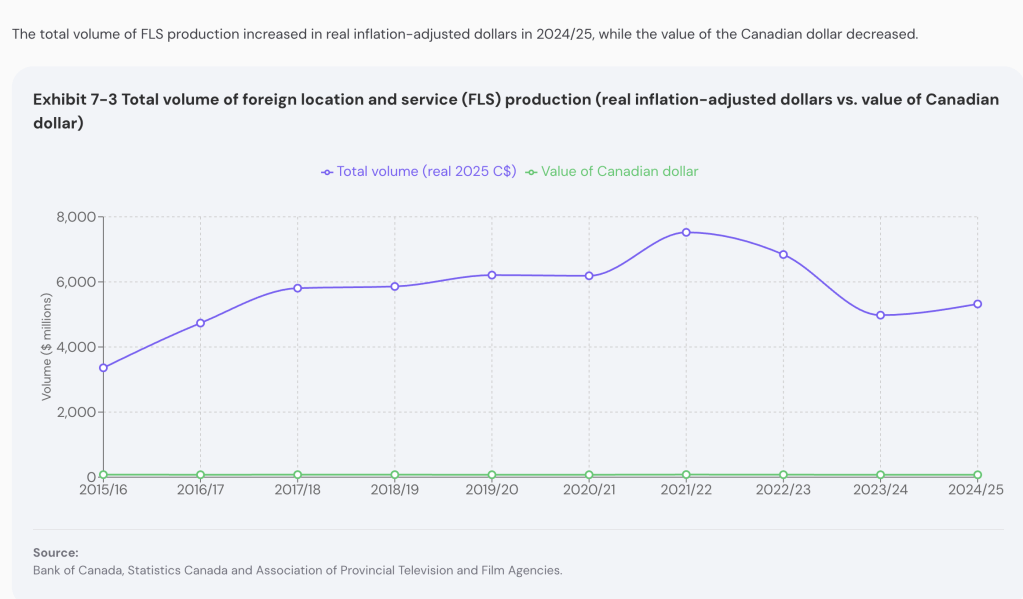
The numbers are anemic this year and suggest that the lucrative FLS (“foreign location shooting”) business in shooting US shows is a little better than last year but not going to recover to its 2022 peak.
We are past peak spending by global streamers and the viral FLS growth that Canada enjoyed from in 2015-17 has now, in real terms, appeared to have levelled off. In inflation adjusted dollars, Canada is back at 2018.
Aside from FLS, Canadian content spending is also down, even without taking inflation into account.
That’s because the CRTC’s required investment and spending requirements for Canadian broadcasters continue to tail off with the decline in earnings. But CanCon investments by US streamers also continue to drop although you wouldn’t know it from parsing the statement that Hollywood’s Motion Picture Association gave to Cartt.ca in response to the CMPA report:
Global studios and streamers, including MPA-Canada member studios, are leading investment in the Canadian film, television, and streaming industry. In addition to driving the majority of production spending and employment in Canada, global studios and streamers have proudly become one of the largest sources of private financing for Canadian productions, providing more financing than the Canada Media Fund (CMF) and Telefilm combined. The report clearly makes the case MPA-Canada’s members have been making for years: global investors are already a vibrant and indispensable capital partner of the Canadian screen sector.
The MPA is making a couple of points here, the first being that Hollywood continues to shoot a lot of US production here in Canada, thanks to our world class facilities and production crews, a low Canadian dollar, and Canadian taxpayer support through subsidies. As I mentioned, FLS has receded to 2018 levels now.
MPA’s other claim is that US studios have proudly become “one of” the largest sources of private financing for Canadian content. That’s certainly a true statement of fact (the other “one of” being Canadian private investment). More to the point, it’s policy hieroglyphics for saying the streamers’ investment largesse ought to win them a mulligan from cash contributions to Canadian media funds, something they are opposing in court.
Revealed in the report’s fine print, streamer investments have declined in the last four years, from $480 million to $408 million in English language production, a 22% drop in real dollars. In French language productions, streamer investment has declined from $13 million to $7 million although the story there is not the decline but the size of the investment.
***
The creaking of the floorboards beneath the feet of publicly funded Canadian television news is getting louder.
In a decision that split the CRTC panel hearing the case, the non-profit parliamentary news channel CPAC finally obtained the increase to its regulator-fixed cable subscriber rate that it has been asking for since July 2024. The rate of 13 cents per monthly subscriber ordered by the Commission in 2018 will go up to 16 cents this fall. All cable companies must absorb the cost within the CRTC-capped price of a basic cable subscription. In an odd twist to the story, CPAC is owned by five cable companies Rogers, Eastlink, Cogeco, Québecor’s Vidéotron, and Access Communications.
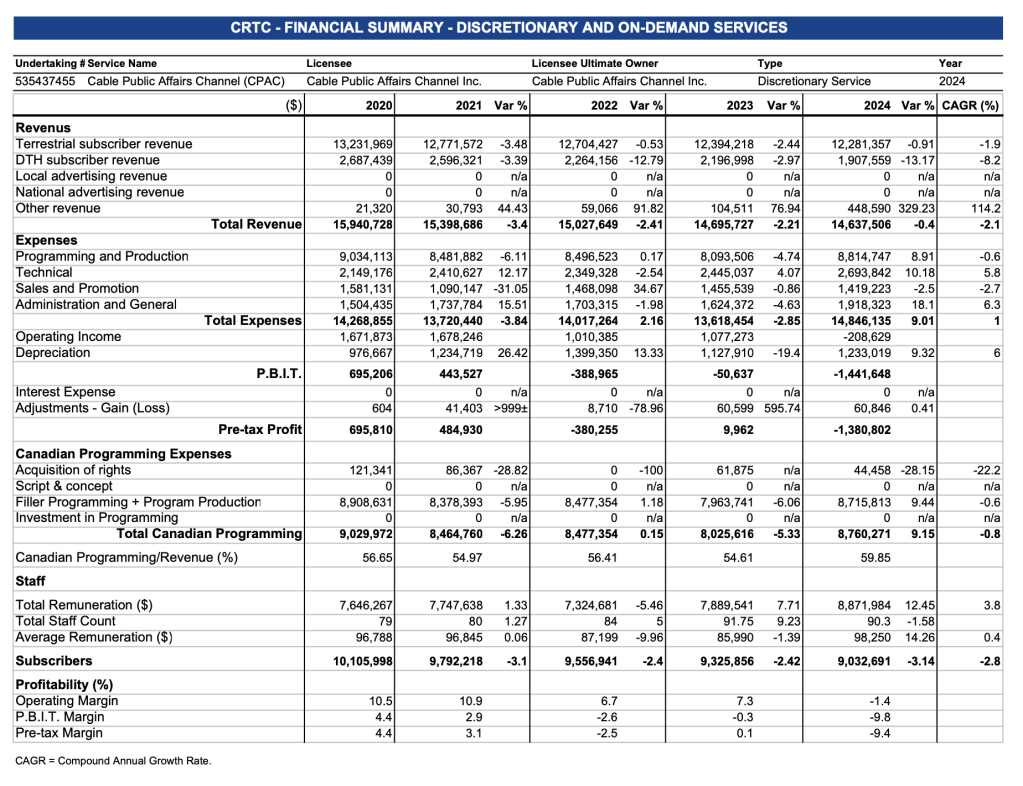
Based on its 2024 regulatory filing, CPAC is a $14 million operation and lost $1.38 million in 2024. According to CPAC CEO Christa Dickenson, it’s now a $13 million operation and the three cent bump will bring in $2.8 million.
The Commission reversed itself from a ruling in November 2025 that it was deferring making a decision on the applications from CPAC, TV5 and Vue et Voix for higher subscriber fees because other CRTC panels are seized with the two high level reviews of television and streaming services that were publicly heard in the spring and fall of 2025 and which are due to be published “in the coming months.” Many months later, there remains a graveyard silence on those files.
During that stretch of time, CPAC very publicly warned that it was about to hit a financial wall and its programming was at risk. CPAC broadcasts Parliamentary proceedings as well as occasional coverage of court proceedings, political conventions, conferences and general elections.
What also happened in the intervening time was that nothing was announced for CPAC in the Carney government’s main budget estimates in February. In 2024, the Trudeau administration cut a $5 million cheque to upgrade its equipment. But historically CPAC has only been funded by cable subscriber fees, having been cut adrift from the CBC in the 1990s. It is not licensed to sell advertising.
Update: Within minutes of publishing this MediaPolicy post, CPAC CEO Christa Dickinson posted on LinkedIn that despite the additional revenue expected from the increase in the subscriber rate, CPAC was cancelling its French and English language evening political shows and laying off 12 staff, including the host Michael Serapio.
***
Another loud floorboard creak just emanated from independently owned local television stations in Québec.
Executives from RNC Media and Télé Inter-Rives are making pleas for the CRTC or the federal government to do something quick about the shortfall in the Independent Local News Fund that supports as much as 70% of newsroom expenses to 17 independent stations across Canada.
The stations relying on the ILNF media fund have been waiting since CRTC’s 2022 approval of the Rogers-Shaw merger to sort out the consequences of admitting 15 additional Global News stations to the $17 million ILNF pool sponsored by Canadian cable companies. The doubling of stations effectively cuts the news subsidies in half.
The Commission thought it had squared this circle in 2024 by ordering Netflix and the US streamers to inject a further $42 million into the ILNF. But the extra money is in escrow while the streamers fight the levy in court.
Bloc MP Martin Champoux is advocating for the federal government to step into the breach. He is recommending the federal government extend federal QCJO labour tax credits from the current program supporting only online journalism provided by print publishers to include news websites operated by broadcast companies. The CAQ government in Québec did just that in March with its provincial news subsidies that parallel the federal QCJO program.
***
It is always entertaining for the discomfitters to be discomfitted. Rebel News editor-in-chief Shiela Gunn Reid was ripped by Bloc MP Champoux at the parliamentary Heritage committee hearings for allowing her boss, Ezra Levant, to spin nonsense about the committee proceedings being “cancelled” to prevent Gunn Reid from speaking.
Karyn Pugliese has the story here.
***
If you would like regular notifications of future posts from MediaPolicy.ca you can follow this site by signing up under the Follow button in the bottom right corner of the home page;
or sign up for a free subscription to MediaPolicy.ca on Substack;
or follow @howardalaw on X or Howard Law on LinkedIn.
COMMENTS ARE WELCOME. But be advised they are public once I hit the “approve” button, so mark them private if you don’t want them approved.
I can be reached by e-mail at howard.law@bell.net.
This blog post is copyrighted by Howard Law, all rights reserved. 2026.


One thought on “Catching Up on MediaPolicy – Streamers spending less in Canada – CPAC gets a raise – Independent TV stations want interim funding – Bloc MP rips Rebel News”