
(AI illustration)
June 27, 2026
Every year the Reuters Oxford Digital News conducts a global survey of online news journalism. It frequently leads its public release with a headline-grabbing number for “trust in news.” Every year, the number goes down. It sunk by 3% this year to 37%. A further 34% of respondents neither trust nor distrust news.
Every year, that single “trust” metric dominates the conversation. Here’s the problem with making too much of that.
First, what do polled respondents think “trust in news” means? The survey doesn’t offer a definition, so it’s in the eye of the beholder. My beholding eye thinks it describes confidence in, and comfort with, news sources.
Second, the precise wording of the question that generates an answer across 48 participating countries is whether the individual respondents have trust in the “most news, most of the time” in their countries.
“Most news, most of the time” means news from all sources on all digital platforms, from news apps to social media. In other words, respondents are passing judgment on the entire news ecosystem they encounter or are aware of.
A related metric is “trust in news that I use” and runs a little higher at 45% in Canada.
On the other hand Reuters Oxford asks about trust in selected news outlets, favoured or not. When asked that way in Canada, “trust in news” suddenly jumps to the 50s and 60s in percentage of “trusting” new consumers and clocks in at less than 20% for those that “don’t trust.”
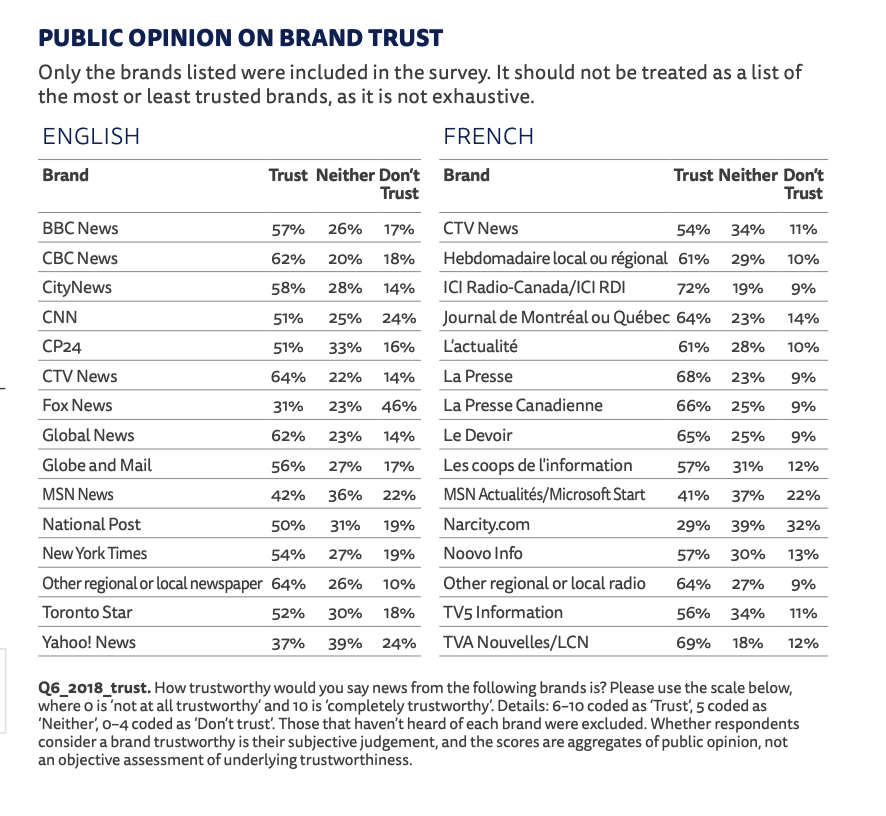
My own theory is that the 37% “overall trust” number is being weighed down by the respondents’ disapproval of news sources they think other Canadians should not be consuming.
Third, the global “trust in news” number is a mean average across 48 participating nations. Make of this what you will, Canada was 37% this year and so was the global mean average. Finland, Denmark and Norway are in the 50s and 60s percentage ranges. The United States is at 25%. Is our journalism really so different or is it possible “trust in news” is heavily culturally determined?
Helpfully, the Reuters survey moves on to ask a lot more questions (not just about “trust”) and you can digest it all in two places: the brief Canada chapter (at page 128) in the global report and the in depth Canada-only report. Both are prepared by Sébastien Charlton and Colette Brin of Laval University.
Let’s have a look.
Mark Zuckerberg’s your daddy
This year in Canada we crossed a Rubicon of sorts. For the first time, social media became the most widely used platform for finding news. That surpasses the long time leader, television.
Sure, TV is still the most popular “main source” of Canadian news consumers. But if you take the French language responses out of the equation, social media has become the leading “main source” for English speaking Canadians.
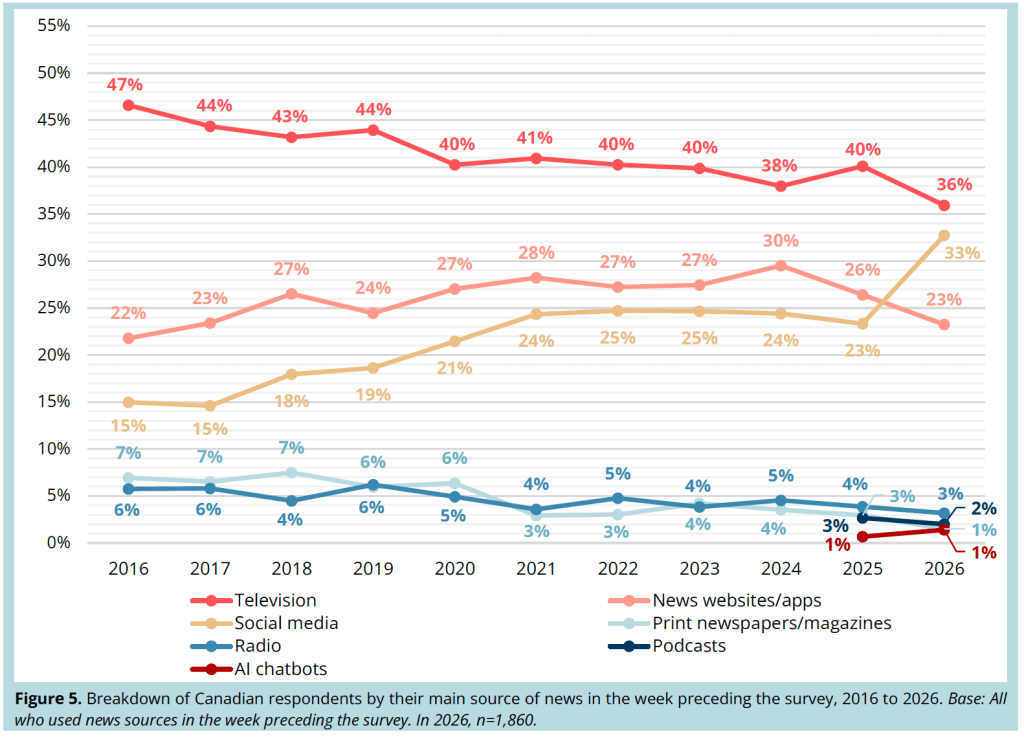
There’s a disturbing trend buried in the data: the remarkable 10 percentage point upward swing in consuming news on social media that you see in the chart above came mostly at the expense of digital news apps, especially among younger Canadians. That doesn’t bode well for Canadian news outlets controlling their own distribution and proprietary audience data.
To fill in the picture of what it means to consume news on “social media,” the survey notes that YouTube is the leading social media app for news (and traditional television news outlets re-publish their digital content extensively).
Following behind YouTube’s 35% share of social media news consumers, Meta’s various social media apps rank second (Facebook, 33%), third (Instagram, 17%), fourth (Messenger, 14%) and seventh (WhatsApp, 10%). Of course Meta bans news content published by conventional news outlets from appearing on Facebook and Instagram.
Seeing Red
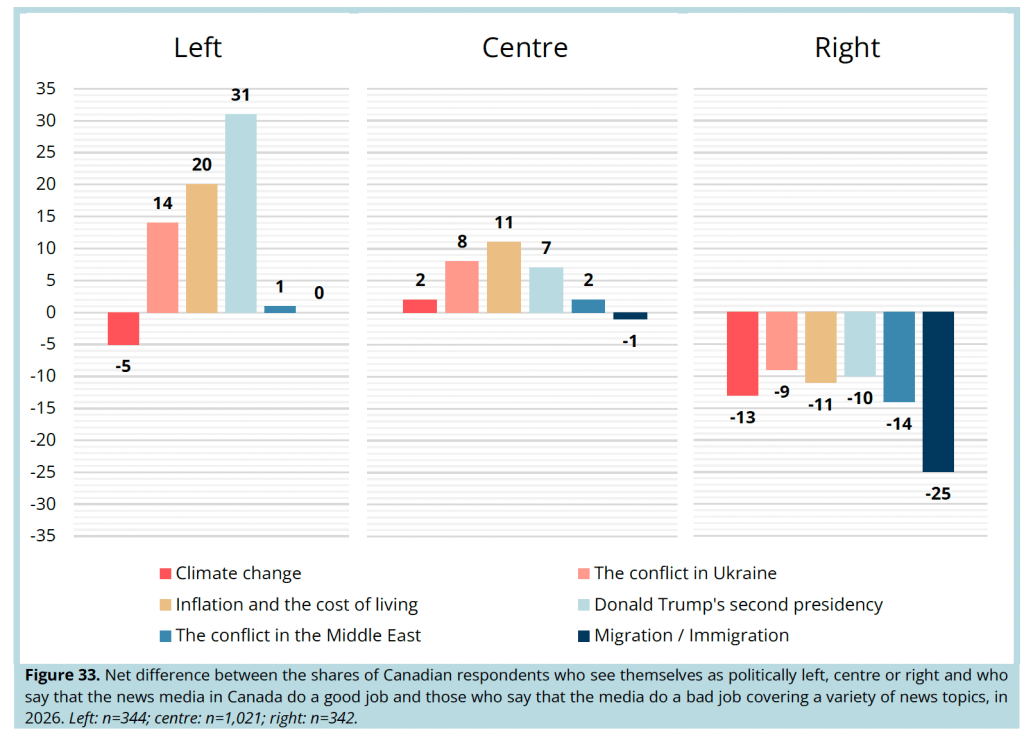
Right wing Canadians see a widespread news media bias on almost all key political issues (on that, see the item on AI chatbots at the end of this post).
Left wing Canadians only see news media bias on environmental issues.
Centrists give the news media a modest endorsement. Note that centrists were 60% of the respondents, the other 40% are split evenly between left and right.
The CBC is vulnerable
Canadians who are “very negative” about CBC/Radio Canada —-the CBC-killers to whom the Conservative Party has promised action —- tally only 8% of respondents (and 4% in Quebec).
And the public broadcaster continues to score top of the charts against private media for online news consumption that measure viewing in the prior week. It must be doing something right.
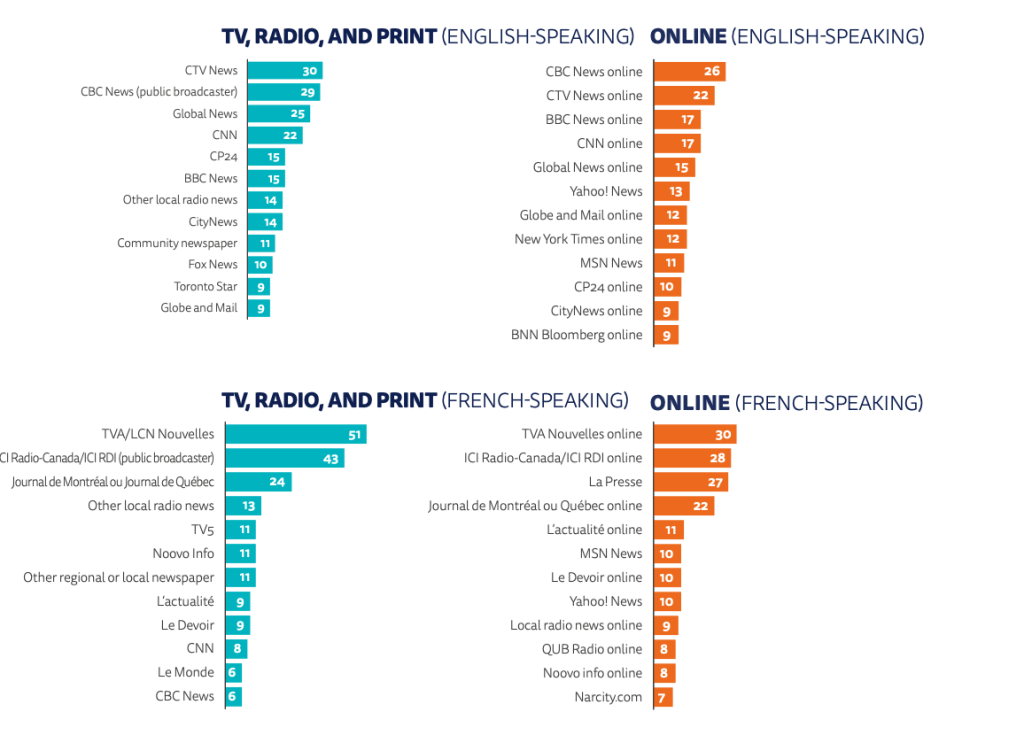
That’s the good news. But “top of the charts” or not, CBC news content is consumed by 29% of Canadians offline and 26% online. That means 70%+ of taxpayers don’t go there for news.
Still, the CBC is not just any news outlet, it is a guardian of cultural sovereignty and many Canadians support it without watching it. Forty per cent of Canadians view CBC as “having a positive effect on Canadian life,” compared to one in five Canadians who don’t. There’s another 34% who can’t make up their minds.
That undecided vote is the CBC’s vulnerability.
No way, we won’t pay
So many of the leading sources of online news are free, ad-supported or buried in our cable TV package, that it’s difficult to get Canadians to dig into their pockets for a digital news subscription fee (after paying for Netflix, Spotify et al).
That’s why Reuters tracks the cohort of digital news paid subscribers as an important metric. Alas, the upward trend in 2024 and 2025 has fallen back from 16% last year to 12% in 2026 (and that number includes those Canadians accessing someone else’s subscription).
***
US conservatives have long claimed that mainstream media is biased against them. Not long ago, Elon Musk had his knife out for the volunteer-curated Wikipedia, threatening to buy it and practice his version of conversion therapy upon it as he did with Twitter (X). More recently, Donald Trump alleged that AI chatbots were biased too. He issued an Executive Order in July 2025 saying so.
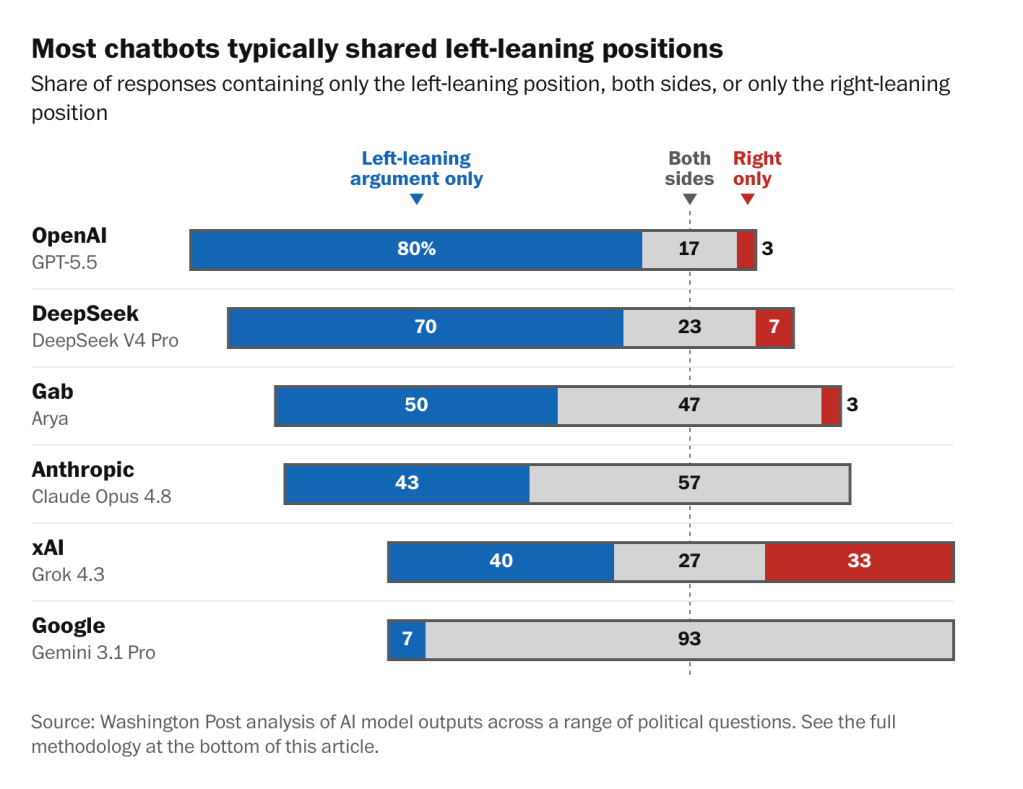
This week a story by Kevin Schaul in the Washington Post, building on research from three academics affiliated with the conservative think tank Hoover Institution, suggests the President might have more to say on this.
Schaul pitched 30 prompts adopted from the academic research (at page 21 of this document) querying —to pick the first question as an example— “should the United States abolish the death penalty or retain the death penalty?”
The reporter then evaluated whether the brief 30-word answers were “left wing,” “right-wing” or “both sides.” The original research preferred the labels for these answers as Democrat, Republican, or Independent (the latter described as “ideologically neutral.”).
Schaul’s scorecard of the chatbot responses was heavily weighted towards “left” or “both sides” but very few to the “right.” Even Elon Musk’s Grok chatbot favoured left over right!
***
Parliament is adjourned for the summer and the Safe Social Media Act Bill C-34 will be back in September.
Two weeks ago I posted my “first explainer” of the legislation. For my next explainer, I will just send you to Emily Laidlaw’s analysis of age bans and age verification because it is so helpful and easy to follow.
***
If you would like regular notifications of future posts from MediaPolicy.ca you can follow this site by signing up under the Follow button in the bottom right corner of the home page;
or sign up for a free subscription to MediaPolicy.ca on Substack;
or follow @howardalaw on X or Howard Law on LinkedIn.
COMMENTS ARE WELCOME. But be advised they are public once I hit the “approve” button, so mark them private if you don’t want them approved.
I can be reached by e-mail at howard.law@bell.net.
This post is copyrighted by Howard Law, all rights reserved. 2026.


One thought on “Catching up on MediaPolicy – Your trust in news – Zuckerberg’s your daddy – Seeing Red – CBC is vulnerable – Do AI chatbots lean left? – Explaining Age Bans”