September 12, 2026
A new Nanos poll commissioned by Bloomberg News finds increased support for public policy requiring US streamers to contribute financially to Canadian content.
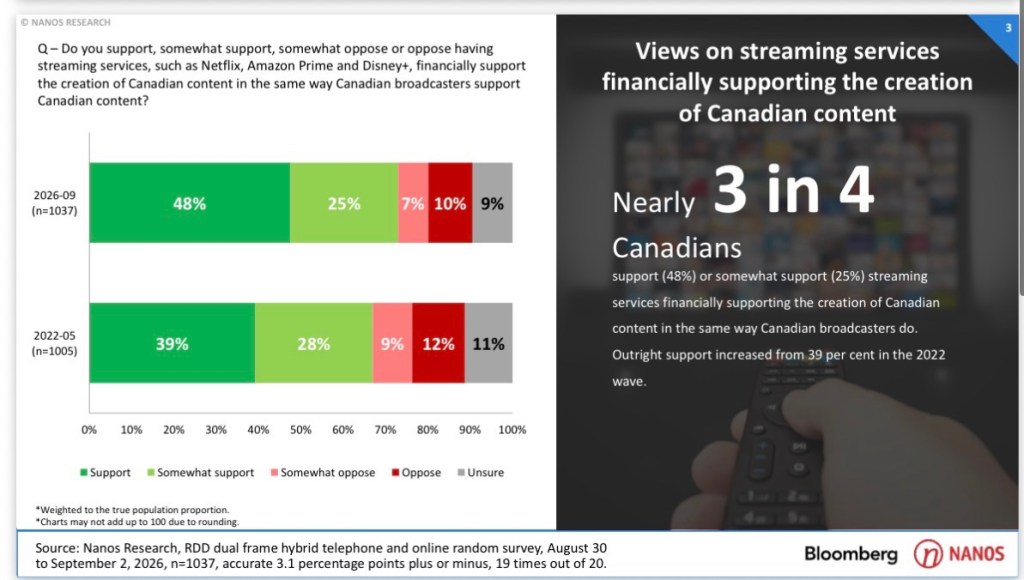
Support rose from 67% to 73% since Nanos last tested the waters four years ago while the Online Streaming Act was being debated in Parliament.
Detailed results from the new poll have not been released other than Bloomberg reporting them in a news story. Assuming it’s the same question as the May 2022 poll, respondents were asked whether they believe US streamers should contribute financially to the creation of Canadian content “in the same way” as Canadian broadcasters.
As an indicator of the intensity of that support in 2022, the 67% yes vote was divided between “support” (39%) and “somewhat support” (28%). Eleven per cent were unsure. Until we get a peek at the full Nanos report, it’s unknown how much those numbers have changed. (Update 14/8/26: the full report shows increased intensity of “support” (48%) and “somewhat support” (25%). The “unsures” are down to 9%).
In any event the new 73% number is a jab in the ribs to Prime Minister Mark Carney who allowed US trade pressure to push him in the opposite direction. In June the Prime Minister overturned the CRTC’s order that the streamers contribute 6.5% of revenues in cash to media financing funds and another 8.5% to their own investments in Canadian shows. Domestic broadcasters contribute a total of 25% of revenues to Canadian content.
The Carney government is now deliberating its guidance to the CRTC on a new framework for streamer contributions. Even prior to Carney’s intervention, the text of the Online Streaming Act and the CRTC’s implementation of it expected less of foreign streamers than Canadian broadcasters.
At the time of their intervention, Carney and cultural and identity minister Marc Miller claimed that overruling the CRTC wasn’t a response to US trade pressure but rather their sensitivity to subscription pricing.
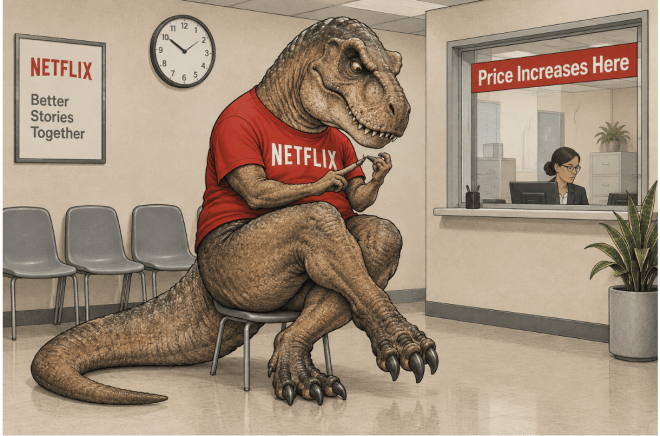
On that note, the Hollywood Reporter has published a sassy story about escalating streaming subscription prices in the US where streamers have been steadily raising prices well above the rate of inflation. The content-lean Apple TV has tripled its price since launch in 2019. Netflix Premium is up 125% since 2013 (while inflation was 38% over that period of time).
***
For those that still admit to having ever met Justin Trudeau (I did, he’s tall!), you’ll be interested to know that the drama teacher has become a drama producer.
No wisecracking, ‘kay? The former PM is going into the independent movie making business with his old sidekick and chief of staff, Katie Telford. Nom de guerre of the new enterprise is Hope and Hard Work.
I will let his press release do the explaining.
***
Steve Faguy has written a well informed and balanced account of the gradual demise, possibly fatal, of Corus Entertainment and its Global News television subsidiary.
He sizes up the various culprits: the Shaw family’s restructuring of its various business divisions and debt loads, the CRTC’s astonishing lethargy, the federal government’s inaction, and Rogers’ cutthroat raid on Corus’ profitable US programming. Like the collective assassins of Julius Caesar, it’s hard to pin the crime on one suspect alone.
Now a penny stock loaded with debt, here’s hoping that Global can survive.
One point Faguy doesn’t make, and it could make all of the difference to Global’s survival, is that the federal government’s Online News Act injects $3.9M annually into the television network. If culture and identity minister Marc Miller follows through with his promise to extend “QCJO” journalist labour tax credits to broadcasters, that’s roughly another $8M.
In 2025, Global spent $119M on television news programming. According to Unifor, Global has laid off 173 union members since early 2024.
If the QCJO money materializes, it should be announced in the Fall budget.
***
It’s intriguing to follow Californian media policy from afar.
As the home turf of Big Tech and Hollywood, you might expect corporate interests to dictate public policy.
Not necessarily.
When five Democratic federal congress representatives from California joined House Republicans in condemning Canada’s Online Streaming Act, the remaining 47 congress representatives did not. Neither did the state’s two Senators.
At the state level, the legislature is Democrat-controlled from top to bottom and elected officials insist on lobbing hot potatoes in the lap of Governor Gavin Newsom.
Over the course of twenty-four months culminating this August, Newsom endorsed, gutted and then revived the state Assembly’s modest Californian knock-off of Canada’s Online News Act, based on matching $20 million contributions from Google and the state.
Now the legislature has overwhelmingly passed AB2222, the Community News Act. The Canadian policy analogy would be the federal labour tax credit on journalist salaries. Newsom has until the end of the month to sign it, or it dies.
The Community News Act tracks our QCJO labour tax credit for hiring and retaining journalists. The dollar amounts are comparable: $20,000 (USD) per head for the first five journalists and $15,000 thereafter. Any new hires that grow the size of the newsroom are supported at $35,000 per salary.
***
If you would like regular notifications of future posts from MediaPolicy.ca you can follow this site by signing up under the Follow button in the bottom right corner of the home page;
or sign up for a free subscription to MediaPolicy.ca on Substack;
or follow @howardalaw on X or Howard Law on LinkedIn.
COMMENTS ARE WELCOME. But be advised they are public once I hit the “approve” button, so mark them private if you don’t want them approved.
I can be reached by e-mail at howard.law@bell.net.
This post is copyrighted by Howard Law, all rights reserved. 2026.


One thought on “Catching up on MediaPolicy – Support for the Online Streaming Act is up – the story of Global News – California waits for Governor to sign a QCJO bill”