
AI photo illustration
September 6, 2026
As long as I can remember, Canadian critics of the Online Streaming Act and the last sixty years of regulatory measures supporting Canadian culture have rarely articulated what they would do differently, were it left up to them.
The thinking behind the critique of Canadian cultural policy must be one of two things.
It could be a steadfast belief that Canadians deserve a free and unregulated market where Canadian art and artists compete with American content without assistance.
Maybe in this wide open North American market we would choose lots of Canadian content, maybe not. US Trade Representative Jamieson Greer recently described this as “letting capitalism do its thing and let people choose.”
If not this open borders strategy for culture, the argument that there’s an alternative to the Online Streaming Act remains an unspoken “something else.”
The Carney government is preparing to do something else. In the most Carneyesque way.
In August, Heritage Canada quietly circulated a series of seven discussion papers to a select list of industry stakeholders in Canada’s audio-visual world. No one claims authorship but the unpublished PDF document was generated by Lisa Gotlieb, Heritage Canada’s Manager of Audio Visual Policy.
The proposal is to build up Canadian film and television production companies that make visibly themed Canadian film and television content, exploit AI technology in both production and distribution, retain their copyright and intellectual property for future growth, and cultivate audiences loyal to the brand that producers nurture.
Reduced to a baseball analogy, the idea is to field a contact hitting offence like last season’s Toronto Blue Jays. A team that steadily generates baserunners and rejects the swing, miss and home run strategy.
The current model of funding Canadian content doesn’t get a warm applause in these documents. In fact it gets politely disparaged as “project by project” funding of CanCon shows that doesn’t adequately incentivize or reward IP-based branding, iconically Canadian content, growth and audience.
The policy narrative scans strongly binary —old system bad, new system good— and I suggest they be read with a critical eye. Part one of seven is available here.
In these documents, Heritage expresses dissatisfaction with an ecosystem of modestly capitalized independent Canadian producers running in place on a project-by-project treadmill without a clear path to growth.
Less fundamentally, shade is thrown on the traditional “headcount” formula that ties government and industry financing to productions hiring mostly Canadian producers, writers, directors, actors and film crews but without a formal commitment to visibly Canadian terrain and screenplays.
In the new world, Canadian film and television producers would become a feisty We-the-North of scaled up studios that would not sell off library rights or global first release to US streamers. That might induce Canadian producers to stop putting quite so much American cream in their CanCon coffee (think of the nationally androgynous Schitt’s Creek).
Relentlessly throughout the policy papers, the authors tout a growth agenda. That rhymes with Carney’s banker vocabulary of investment, building, growth, global markets, and a measurable return on public investment.
Once you get past Carney vibe, there are some engaging ideas.
The most fundamental is to restructure the current funding model that combines money and gatekeeping rules from four federal agencies, the CRTC, the Canada Media Fund ($216M in federal spending), Telefilm support for cultural exports ($150M), the National Film Board ($72M) and the federal government’s CAVCO production tax credits ($540M).
As industry insider Brad Danks explained back in June in a MediaPolicy interview (or see a refreshed version in Broadcast Dialogue), the current funding system places all bets on production financing of shows and none of it on rewarding success. Success is defined as the build out of Canadian platform distribution and audience development. Or the aggressive adoption of AI technology. It’s a strategy for cultural sovereignty that is implicit in encouraging producers to tighten their grip on cradle-to-grave distribution rights instead of cashing out these rights piecemeal to Netflix and other global platforms.
Somebody has to quarterback this reformed funding model. The authors of the Heritage documents explicitly endorse an expanded National Film Board (perhaps merging the 300 staff of the Heritage CAVCO office, the Canada Media Fund and Telefilm into the much larger NFB).
The policy papers go out of their way to laud the NFB’s unique combination of policy expertise and in-house content production. I’m guessing authors regard Telefilm and the CMF as the guardians of the old system that Heritage wants to disrupt.
The papers also moot the possibility of the federal government treating the audio-visual industry as a major investment opportunity worthy of a reliable stream of earmarked infrastructure cash from ISED or regional development funds. Although the authors don’t mention the $600 million pot of cultural cash that Carney announced in June, that is also a possible source of recalibrated program spending in the new model.
Most of these policy ideas can be traced back to ex-Deputy Minister Isabelle Mondou’s recommendations to former culture and identity minister Steven Guilbeault who approved them before leaving cabinet in late 2025. The policy momentum within Heritage is in place and the Prime Minister’s “build it” philosophy would seem hospitable to the change. Take note: Mondou now works in the PMO.
The trade war is also an accelerant to change. President Trump has his eye on Canada’s share of global streamer film and television productions. He is supporting Hollywood’s request that US Congress legislate a federal film and television production tax credit to draw more work stateside.
If Congress acts, film and television producers in Canada, the United Kingdom and European countries could all lose some production volume to Hollywood and other US states.
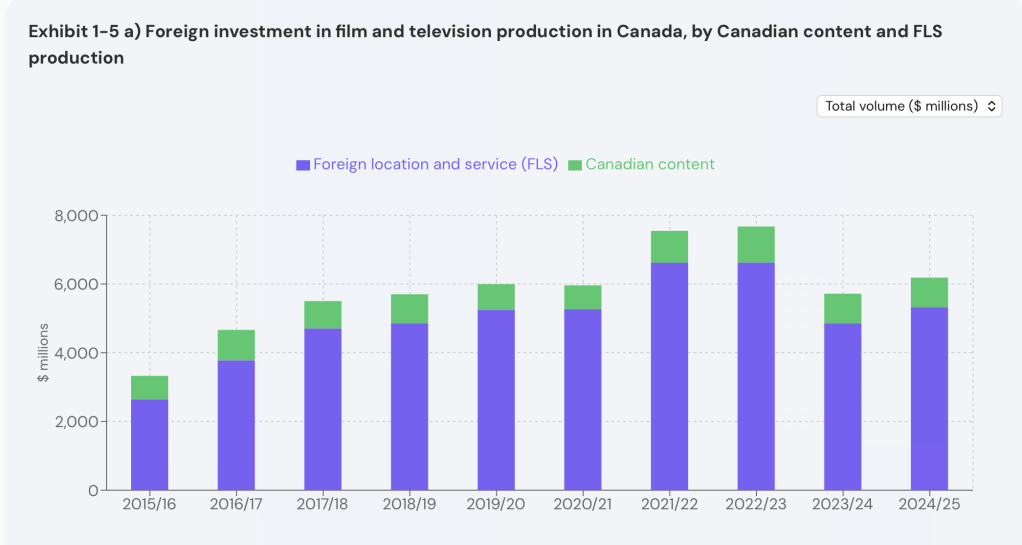
That would make Heritage’s “build it” agenda for home grown CanCon production a more pressing matter. According to Heritage, foreign film and television production in Canada is ten times the spending on Canadian content although only half of the total hours of industry employment.
It’s no coincidence that Deputy Minister Mondou warned minister Guilbeault that “the balance between Canadian content and Foreign Location and Service Production [in Canada], has shifted in favour of Foreign Location and Service Production which is vulnerable to the current tariff threat and other protectionist measures coming from the United States.”
We will see if the Heritage proposal gels in time for November’s federal budget.
***
If you would like regular notifications of future posts from MediaPolicy.ca you can follow this site by signing up under the Follow button in the bottom right corner of the home page;
or sign up for a free subscription to MediaPolicy.ca on Substack;
or follow @howardalaw on X or Howard Law on LinkedIn.
COMMENTS ARE WELCOME. But be advised they are public once I hit the “approve” button, so mark them private if you don’t want them approved.
I can be reached by e-mail at howard.law@bell.net.
This post is copyrighted by Howard Law, all rights reserved. 2026.


As I keep reading your blog, I actually have some sense of what is going on ! Loved “ Carney vibe” and the politeness of “President Trump” ( which I find more effective).
>
LikeLike