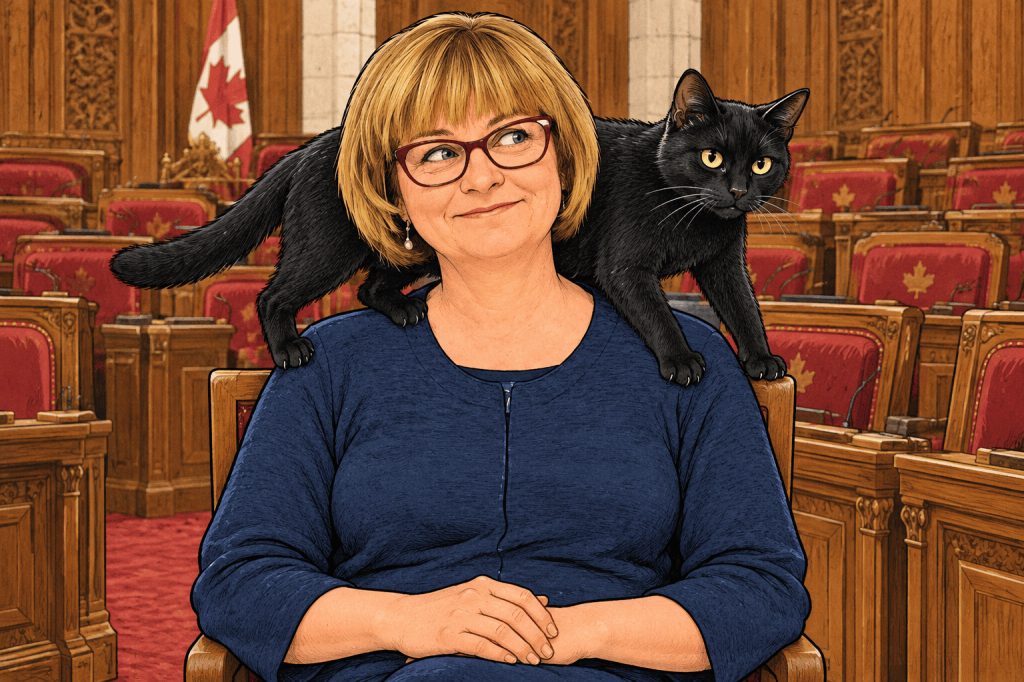
(AI illustration)
November 1, 2026
Senatrice Julie Miville-Deschênes’ Bill S-209, a proposal to age-gate online porn, must be the Parliamentary cat endowed with nine lives.
Or as Michael Geist, who opposes An Act to restrict young persons’ online access to pornographic material, describes it: “the age verification bill that won’t die.” True enough, the Senator’s bill has survived three dissolutions of Parliament over six years.
Last week Liberal backbencher Louis Villeneuve successfully moved the adoption of S-209 at second reading in the House of Commons, reversing years of the Liberal government’s steadfast refusal to support it.
After the bill passed the Senate in February, it was sponsored in the House by Conservative MP Rosemarie Falk.
The bill first tabled by Miville-Deschênes in 2021 proposes to age-gate any online platform carrying pornography with the objective of blocking minors from viewing hard-core, often violent, pornography.
The Senate bill overlaps with the Liberal government’s much broader child safety legislation, the Safe Social Media Act. That Bill C-34 empowers a newly set up Digital Safety Commission to age-gate porn on yet-to-be-designated platforms that exceed a viewership or revenue threshold set by cabinet regulation.
In a Substack post, Geist describes the overlap of the two bills as a conflict, opining that S-209 “doubles down on age verification, features inconsistent definitions of pornography, establishes a second penalty regime, and could give the future Digital Safety Commission the power to seek website-blocking orders.”
It’s accurate to say that the S-209 pornography bill raises the legal consequences for pornographers from the threshold set for general child protection purposes in C-34: S-209 features bigger fines, summary convictions for non-compliant pornographers, and website blocking as a last resort.
On the other hand, S-209’s definition of pornography is more narrow than the Liberals’ C-34: in S-209 explicit images of genitalia are not pornographic unless they are intended to cause sexual excitement, seeking to avoid concerns about artistic censorship.
The policy issue that will attract public attention, both for S-209 and C-34, is the age gating requirement. Geist noted in another post that the British government commissioned its regulator Ofcom to surveil the age gating options in advance of its social media ban for minors, due for implementation in the Spring of 2027. Ofcom’s report suggests that it will be necessary for most children and some adults to upload photo ID to third party age verification services.
Both C-34 and S-209 passed second reading in the House of Commons and are destined for study and amendments in Parliamentary committees. It appears however they are going to two different committees: S-209 to Human Resources (HUMA) and C-34 to Heritage (CHPC), which seems cumbersome.
Miville-Deschênes said she was pleasantly surprised by the Liberal government’s change of heart on her bill.
However the government’s true intentions remain cryptic. It’s possible the PMO only prefers not to be caught on the wrong side of public opinion on anything including the words “child” and “pornography.”
Despite the support of the two major Opposition parties, S-209 passed second reading “on division” without a roll call vote of MPs. That suggests there are dissenters. Several Liberal backbenchers spoke in favour and none against. But no cabinet minister took the floor. The Parliamentary Secretary to AI Minister, MP Taleeb Noormohamed, spoke of the good intentions of S-209’s “objectives” but clearly preferred the government’s own bills, C-34 (Safe Social Media Act) and C-36 (Privacy and Data Protection Act). In moving adoption, Liberal backbencher Villeneuve diplomatically described S-209 and C-34 as “closely aligned” and “complementary.”
The tea leaves might be saying that the Liberal plan is to reconcile key differences between S-209 and their own bills: for example the definition of pornography, broader coverage of platforms carrying pornography, or the higher standard for age-gating technology in S-209.
The Liberals might then push C-34 and C-36 ahead of S-209 and let the Senate bill wither in committee.
***
Here’s another MediaPolicy told-you-so: Québec’s Bill 109 is going to create trouble for the federal Liberals.
The provincial legislation passed last December by the now vanquished CAQ government purports to take cultural action in the same legislative space as the federal Online Streaming Act C-11 by setting a library quota for French language shows and songs on streaming platforms like Netflix and Spotify.
The newly sworn provincial cabinet of Parti Québécois Premier Paul St.Pierre-Plamondon is dropping the softer CAQ messaging of working harmoniously with US platforms and adopting a far more muscular tone on cultural policy.
According to the National Post, the Premier intends a 30% content quota for French language media. That figure happens to be the benchmark for the European Union’s framework law that mirrors Québec’s Bill 109 and Canada’s C-11.
The Premier also chose some strident vocabulary in asserting that Ottawa has failed to act decisively on the discoverability of Canadian or French language content. Without endorsing the Premier’s sentiment, that is not an unreasonable claim based on the CRTC’s slow-drip on implementing C-11.
Both the federal C-11 and provincial bill 109 were on the US Trade Representative’’s hit list during the abortive trade talks that broke off in August.
Although the Québec bill is of doubtful constitutional legality ——because it occupies the same legislative space as the federal power over broadcasting policy — the USTR will not care. We should expect to hear more if and when trade talks resume.
***
October was a bad month for Canadian media commentary.
The Hub’s magical Full Press podcast was cancelled after host Harrison Lowman left for a new post as Managing Editor and Host at Canadaland. You can still follow his panelists Peter Menzies and Tara Henley on their Substacks.
Let the “when-will-they-get-back-together” nostalgia begin.
Over the mountains, Vancouver’s Hugh Stephens is pausing his copyright blog . He is taking on a part-time position with the tariff-setting Copyright Board of Canada. That’s one less expert commentary on Canadian copyright and IP issues and, alas, one less voice speaking out against the noxious practice of passing off content theft as fair dealing.
***
If you would like regular notifications of future posts from MediaPolicy.ca you can follow this site by signing up under the Follow button in the bottom right corner of the home page;
or sign up for a free subscription to MediaPolicy.ca on Substack;
or follow @howardalaw on X or Howard Law on LinkedIn.
I can be reached by e-mail at howard.law@bell.net.
This post is copyrighted by Howard Law, all rights reserved. 2026.


